STENDHALBiblio.com
54 résultats
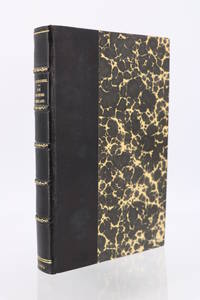
189089586Paris: G. Charpentier & Cie 1890. Fine. G. Charpentier & Cie Paris 1890 11.7 x 18.8 cm Relié First edition of which no copies were printed on deluxe paper.Half black shagreen binding spine with five raised bands decorated with gilt garlands gilt date at foot marbled paper boards combed paper endpapers and pastedowns gilt top edge original wrappers preserved.Scattered foxing some reading marks in red and blue pencil in the margins of certain paragraphs ink stamps of the Etienne Vion bookshop and stationery in Amiens on the title page a library shelfmark at the head of the title page. G. Charpentier & Cie hardcover
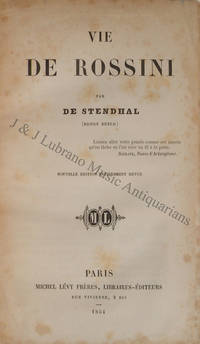
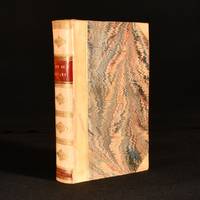
185424979Paris: Michel Lévy Frères 1854. Octavo. Full dark orange cloth spine with title label gilt original publisher's light green printed upper wrapper bound in. i series title i printer's note 1f. title 1-4 advertisement 1-4 advertisement 3 preface 4 blank 5-368 369-370 chronologic list of Rossini's compositions 371-375 table of contents i blank pp. <br /> <br /> Some leaves uncut. Part of a series of volumes of the author's complete works see series title and second advertisement.<br /> <br /> Spine very slightly faded; wrappers slightly worn and soiled. Moderate to heavy foxing to outer leaves light foxing throughout especially to edges. A later edition.<br /> <br /> "Though best known today for his novels Le rouge et le noir 1830 and La chartreuse de Parme 1839 in which opera serves as backdrop and emotional correlative Stendhal was better known during most of his lifetime for his interdisciplinary and comparative criticism and chronicling of arts and letters in relation to modern French and Italian socio-cultural politics. He cast these writings in various generic guises: biography. art history. travel literature. and Romantic manifesto. " Janet Johnson in Grove Music Online.<br /> <br /> Originally published in 1824 the present work is a colorful although somewhat inaccurate biography of the famed Italian composer. Michel Lévy Frères unknown
1829879M12Paris; Lugano: Alphonse Levavasseur; Presso G. Ruggia e Comp 1829-1831. Leather. Very Good. 8.5" by 5.5". Not Stated. A vellum-bound work concerning the lives of the important composers Haydn and Mozart and the librettist Pietro Metastasio with a history of the economy of Italy. The second edition of this work in a half vellum binding with marbled boards. Loosely inserted is a catalogue of the Mozart Museum in Salzburg published in 1937. Two volumes bound in one consisting of 'Vies de Haydn de Mozard et de Metastase' by M. de Stendhal Alphonse Levavasseur Paris 1831 and 'Storia della Economia Pubblica in Italia ossia Epilogo Critico Degli Economisti Italiani' by Giuseppe Pecchio Presso G. Ruggia e Comp Lugano 1829. The first is a history of the lives of the important composers Joseph Haydn and Wolfgang Amadeus Mozart and the poet and librettist Pietro Metastasio written in French. This work includes letters about Haydn and the life of Mozart translated from German by M. Schlichtegroll. The second work is a first edition copy of Pecchio's study of the Italian economy including a critical study of Italian economists. It was written in Italian by Giuseppe Pecchio who distinguished himself as a modern and original economist in both Italy and England. This work was influential for developments in political economy. In a half vellum binding. Externally smart though a little rubbed to the joints and extremities. Internally firmly bound. Pages are bright with the odd spot. Very Good Alphonse Levavasseur; Presso G. Ruggia e Comp hardcover
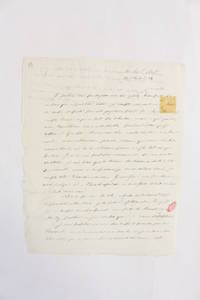
1805669741805. Fine. 10 Floréal 13 30 avril 1805 18.50 x 23.10 cm une feuille Stendhal's autograph letter addressed to his sister Pauline. 28 lines written with a fine writing in black ink. First name ""Pauline"" from the hand of the sender at the bottom of the letter. Inventory number ""36"" in ink from another hand. Two small traces of stamp and stamp a small tear restored in the bottom margin of the page. A few tiny folds inherent in the enveloping of the letter. Rare and beautiful letter of Stendhal addressed to his sister Pauline in which all the sensitivity of the young man and his love for the dramatic art shows more than twenty years before his big romantic successes. This letter comes from the correspondence between Henri Bayle here twenty-two years with his sister Pauline three years younger. This true epistolary liaison which quickly took the form of a ""diary"" - Pauline's answers were rare - is an essential milestone in the constitution of the intellectual journey of the future Stendhal. Our letter of a great lyricism testifies to the strength of the bond uniting the young writer and his sister: ""Let's shake each other my good friend. We will never find anyone who loves Pauline as Henry nor will Henry ever find a more beautiful soul than Pauline. ""The use of the third person and a lover vocabulary erects the young woman to the rank of alter ego a sister-soul and even perfect mistress. The young Henri is then precisely under the yoke of a devouring passion for the actress Melanie Guilbert whom he met during his declamation classes at Dugazon: "" I'm going to be bored perhaps by my dark sadness. I know very well that the seriousness of ardent passions is not pleasant. "" Contrasting with this passionate relationship Pauline symbolizes reason and balance a figure that Henri like a pygmalion can fashion at leisure. In good tutor he advises: ""Learn by heart roles. About declamation I will teach you a thousand things. I'm bringing you a Gil Blas and a Tracy. ""We understand here worship Stendhal devoted to the theater from his earliest years both as a player as a playwright the fund of its archives to the Grenoble Library contains nearly 700 sheets of blanks:"" I am in despair at not being able to wear you Beanies. But wait maybe someday will come . as Ulino says. ""This passion for theater Henry intends to pass it to his sister:"" We will work like hell during the time that I stay in Grenoble. ""In total opposite view with the education of women in his time he put a point of honor that Pauline is an educated person; In several letters moreover we find injunctions from the brother ordering his sister to give up needlework in favor of the reading he recommends. Truly obsessed with theater and convinced that he will become an author of successful comedies he works tirelessly: ""I am told a room where I will not be free and where I can not just declaim. Try to disturb this arrangement. ""Years before writing great novels that make her famous Stendhal already understands that loneliness is for him a source of creation and says:"" A lonely is jealous of his freedom. It is his greatest good as that of all men. "" unknown