28 résultats
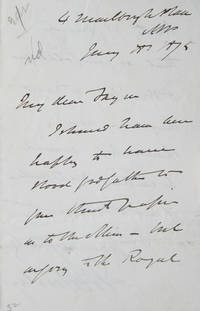
18752618261875. 2 pp. old folds small tape repair. 2 pp. Huxley and Fayrer met in 1844 at the University of London. "Fayrer became a firm friend. The two often worked through the night." Desmond. Indeed it was Fayrer who suggested Huxley take to the sea and thus he joined the Rattlesnake under the command of Owen Stanley 1846-50.<br/><br/>Having returned from the Rattlesnake voyage 1846-50 he became the professor of natural history at the Royal School of Mines and later president of the Royal Society. Though is best known as "Darwin's bulldog" for his strident advocacy of his theory of evolution. He also coined the term "agnostic".<br/><br/>Fayrer was famous for the treatment of snakebite and at the time of writing was gearing up for membership of the Royal Society. He was proposed for election in March and finally admitted in April 1877. Desmond A; Huxley From Devil's Disciple to Evolution's High Priest. Reading 1997 p.36 unknown books
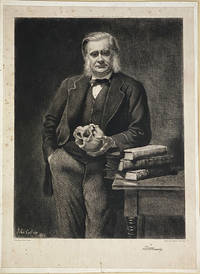
1883453251883. <p>Huxley Thomas Henry 1825-95. Etched portrait mounted by Leopold Flameng after the 1883 portrait by John Collier 1850-1934 signed in the plate by Huxley. London: The Fine Art Society 1 January 1885. 583 x 423 mm.; mount measures 604 x 440. Scattered foxing small tear in lower margin not affecting image but very good. Small embossed stamp in lower right corner.</p> <p> From the portrait of Huxley painted in 1883 by his son-in-law pre-Raphaelite painter John Collier. This version of the print is very scarce; this is the first copy we have seen or handled in over 50 years. Based on the large brow ridges shown on the skull that Huxley is holding in the portrait it is probable that Huxley is holding a Neanderthal skull the significance of which Huxley originally publicized in his Man's Place in Nature 1863. Collier was married to two of Huxley's daughters: First to Marian Mady a talented painter in her own right; and after Mady's death to her younger sister Ethel. The original of Collier's portrait now hangs in the National Portrait Gallery. </p> . unknown books
1880S9153London:: C. Kegan Paul & Co. 1880. 1880. 8vo. xiv 371 pp. Frontis. 81 figs. index. Original olive cloth beveled boards gilt-stamped spine title; neatly restored spine. Fine. This issue quite rare. LIMITED EDITION of 250 numbered copies signed by publisher: "Bradbury Agnew W" - Whitefriars. "Crayfish were the 'hidden hand' which drew Huxley from Spirula. He veered off lured by a new promise and would never finish the tentacled mollusks. . . The Crayfish might not sound like a stimulating book. But it was destined for the International Scientific Series. The ISS now stretched from physics to psychology and beyond. It outdid the evangelical presses in pumping out rationalist books for Everyman. A huge force for deterministic and social evolution it mixed modernity and notoriety to sell titles through umpteen editions. . . He started The Crayfish after the Summer holidays in 1878 giving his own text an alluring evolutionary gloss. He intended it as the beginning of his own series. He would take readers from the 'insignificant' and common-or-garden into the profound depths." Desmond. "The Crayfish his famous volume in the International Scientific Series has been called by Professor Howes the assistant and successor of Huxley at the Royal College of Science 'PROBABLY THE BEST BIOLOGICAL TREATISE EVER WRITTEN.'" Prof. G. B. Howes in Mitchell Thomas Henry Huxley; a sketch of his life and work. Desmond Huxley From devil's disciple to evolutions' high priest pp. 496-97. C. Kegan Paul & Co., 1880. hardcover books