Emile ZOLABiblio.com

228 résultats
188283518Paris: Charpentier & Cie 1882. Fine. Charpentier & Cie Paris 1882 11 x 17.50 cm broché First edition one of 250 numbered copies on Holland paper the only deluxe copies after a few rare copies on China paper. First cover skillfully restored printed library stamp with numbering on the half-title page. Copy as issued. Charpentier & Cie unknown
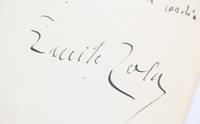
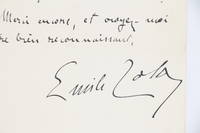
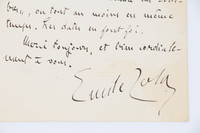
1892008454Paris 1892 Letter. Very fine. No Binding. Signed by Authors. ZOLA Emile 1840-1902. Autographed letter signed. One page. 8x5 inches. In French. 10 lines. With original addressed and postmarked envelope. Two minor creases to letter where folded. Both items beautifully and professionally matted and framed along with a color lithographed portrait of the author the whole measuring 23x25½ inches. English translation taped to verso. Very fine. Paris: January 16 1892. . unknown
188395884Paris: G. Charpentier 1883. Rare first edition of Zola's novel exploring human weakness and desire written at the height of his career. Octavo bound in three quarters morocco over marbled boards gilt titles and tooling to the spine marbled endpapers top edge gilt. Association copy inscribed by the author on the half-title page "a Edouard Noel mon de'voue confrere Emile Zola." The recipient Edouard Noel was a lawyer writer and playwright and secretary general of the Opéra-Comique between 1880 and 1891. In 1894 he was made Knight of the Legion of Honor for his action as captain during the campaign 1870-1871. In very good condition. Rare and desirable signed and inscribed by Zola. The most prominent French novelist of late 19th century French novelist and critic Emile Zola became the best-known practitioner of the literary school of naturalism and an important contributor to the development of theatrical naturalism. Also a major figure in the liberalization of France Zola was nominated for the first and second Nobel Prize in Literature in 1901 and 1902. Written at the height of Zola's career Le Capitaine Burle follows the downfall of a disciplined French military officer who becomes involved in a scandal to support his mistress. G. Charpentier hardcover
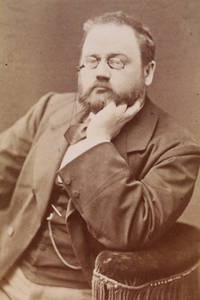
187072935Paris: Ernest Ladrey 1870. Fine. Ernest Ladrey Paris 1870 6.50 x 10.50 cm une photographie Very rare original albumen photograph in carte-de-visite format mounted on yellow cardboard with red border. Manuscript annotation on verso. The address at Passage des Princes on the back of the photograph indicates that the photograph was taken before 1875. Handsome copy of this photograph of the writer with his lorgnette and beard. Ernest Ladrey unknown
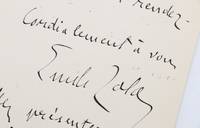
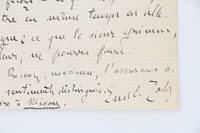
189084423Paris 1890. Fine. Paris 20 Février 1890 13.50 x 20.50 cm une page Autograph letter dated and signed by Emile Zola 12 lines in black ink addressed to librettist Louis Gallet concerning the operatic adaptation by Alfred Bruneau of the novel ""Le rêve"". Folds inherent to postal dispatch. Emile Zola was to meet jointly with Alfred Bruneau who had adapted the novel ""Le rêve"" for the opera and Louis Gallet the librettist of this adaptation. ""Je vous attends demain matin. pour causer des trois derniers tableaux. J'écris également à Bruneau pour lui donner rendez-vous"" ""I await you tomorrow morning. to discuss the last three tableaux. I am also writing to Bruneau to arrange a meeting with him"" and shows himself very satisfied with this prospect: ""Tout va bien."" ""All goes well."" unknown
189386093Paris 1893. Fine. An appointment with Gilles de La Tourette Paris 15 octobre 1893 13.50 x 20.50 cm une page 1/4 sur un bifeuillet Autograph letter dated and signed by Emile Zola addressed to his friend the physician Maurice de Fleury dated in his hand October 15 1893. 1 page 1/4 19 lines in black ink on a double sheet. Horinzontal and vertical folds due to mailing. Stain on verso not affecting the text. A most unusual invitation from the master of Naturalism who wishes to organize a luncheon with two eminent specialists in nervous diseases: ""Vous êtes bien aimable de m'inviter à déjeuner. Mais cela va vous faire perdre du temps et à moi aussi . pourquoi ne prendriez-vous pas un rendez-vous pour deux heures et demie par exemple avec M. Gille de la Tourette soit jeudi soit vendredi. Nous irions chez lui simplement ."" ""You are very kind to invite me to lunch. But this will make you lose time and me as well . why wouldn't you make an appointment for two-thirty for example with M. Gille de la Tourette either Thursday or Friday. We would go to his place simply ."" Zola relied on the expertise and scientific knowledge of Maurice de Fleury a student of Charcot to nourish his writing work on the Rougon-Macquart. De Fleury particularly shared publications from his library relating to heredity a subject at the heart of Zola's great social series of novels - most particularly the generational transmission of nervous diseases fits of violence and alcoholism. Maurice de Fleury is also famous for having made ten years after this letter a medico-psychological study of Zola himself through the prism of his working habits: ""De dix heures à midi Zola rédige encore - moins facilement et moins bien que pendant l'heure initiale - et c'est fini pour toute la journée il ne sera plus bon qu'à écrire des lettres. C'est là la puissance du plus puissant cerveau dans le domaine littéraire à la fin du siècle. Avec ce tout petit traintrain modeste trois heures par jour en deux séances cet homme dont l'attention est modique . trouve moyen de nous donner tous les dix mois un de ces livres où ne manquent ni la solidité de la charpente . ni rien de ce qui constitue la force créatrice le génie pour dire le mot"" ""From ten o'clock to noon Zola still writes - less easily and less well than during the initial hour - and it's finished for the whole day he will only be good for writing letters. This is the power of the most powerful brain in the literary domain at the end of the century. With this very modest little routine three hours a day in two sessions this man whose attention is modest . manages to give us every ten months one of those books which lack neither the solidity of the framework . nor anything that constitutes creative force genius to say the word"". ""Maurice de Fleury maintained close relations with Émile Zola and Joris-Karl Huysmans with whom he corresponded in the years 1880-1890. Fervent admirer of the author of the Rougon-Macquart Fleury advised Zola for ""Le Docteur Pascal"" 1893 and confided his admiration in an article in Le Figaro in 1896. Very 'fashionable' among the 'intellectuals' according to Victor Segalen the young physician also appears in the list of symbolist authors - alongside Paul Adam Henri de Régnier and Gustave Kahn - in an essay by André Barre in 1911"" Lola Kheyar Stibler Autograph letter dated and signed by Emile Zola addressed to his friend the physician Maurice de Fleury dated in his hand October 15 1893. 1 page 1/4 19 lines in black ink on a double sheet. Transverse folds inherent to mailing. unknown
188970523E. Plon Nourrit Et Cie. Very Good. 1889. Hardcover. FREE UPGRADE to Courier/Priority Shipping Upon Request - IN STOCK AND IMMEDIATELY AVAILABLE FOR SHIPMENT - Text pristine & unmarked - Text in French. Vii 162pp. Profusely illustrated with black & multi-color text illustrations & 10 heliogravure plates by Jean-Francois Raffaelli. Text by 22 well-known contributors including Edmund de Goncourt Alphonse Daudet Emile Zola Guy de Maupassant Octave Mirabeau J. K. Huymans Stephen Mallarme Albert Wolff Henri Greville Jean Richepin Paul Bonnetain Roger Marx and others. -- with a bonus offer-- . E. Plon, Nourrit Et Cie hardcover
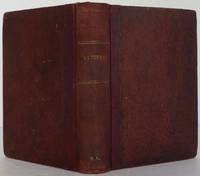
186428266Paris: J. Hetzelet A. Lacroix 1864. Fine. J. Hetzel et A. Lacroix Paris s. d. 1864 12 x 18 cm relié First edition of which there were no large paper copies. Contemporary half red shagreen spine slightly faded in five compartments with triple blindruled fillets. A few spots but otherwise a very good and rare copy of the first work by Emile Zola in a very satisfactory contemporary binding. Rare and sought-after. J. Hetzelet A. Lacroix unknown
188145284Paris: Charpentier 1881. Fine. Charpentier Paris 1881 12 x 18.50 cm relié First edition. Contemporary red cloth Bradel binding by Pierson spine with gilt floral motif date and double gilt fillet to foot black shagreen title label. A little light spotting principally affecting the first and final few leaves. Ex libris of Adolphe Racot on inside upper cover. Concerning Victor Hugo Alfred de Musset George Sand François-René de Chateaubriand Théophile Gautier Alexandre Dumas fils and so on Autograph inscription from Emile Zola to Adolphe Racot. Charpentier hardcover
189023990Paris: La Vie Populaire 1890. Fine. La Vie Populaire Paris 1er Janvier 1888 au 28 Décembre 1890 24.50 x 32.50 cm 312 fascicules reliés en 6 volumes First edition of this bi-weekly illustrated review publishing in serial form either unpublished texts or previously published texts by the most illustrious authors of this end of century. Half cherry red shagreen bindings spine with five raised bands decorated with blind fillets showing slight traces of rubbing marbled paper boards marbled endpapers and pastedowns illustrated front covers preserved contemporary bindings. Rich literary contributions including those of G. de Maupassant with notably the unpublished ""Fort comme la mort"" and also ""Pierre et Jean"" and ""Notre coeur"" E. Zola with the unpublished ""La bête humaine"" and also ""Le voeu d'une morte"" ""Le rêve"" ""La terre"" and ""Une page d'amour"" P. Loti with an unpublished novel ""Le roman d'un enfant"" J. Clarétie with an unpublished novel ""Puy Joli"" J. Richepin with an unpublished novel ""Le cadet"" and ""Césarine"" 2 unpublished works by H. Malot but also A. Daudet C. Monselet E. Renan L. Dierx E. Goudeau J. Barbey d'Aurevilly O. Mirbeau with notably ""L'abbé Jules"" M. Beaubourg C. Mendès P. Arène T. de Banville F. Mistral J. Bois G. Courteline J. Barbey d'Aurevilly Villiers de l'Isle Adam S. Masoch A. Scholl J. Gautier. Illustrated covers with portraits of the principal contributors. A marginal restoration at foot of page 213 of the first volume a small lack at foot touching text on page 383 of the second some occasional light foxing. Handsome and rare set. La Vie Populaire hardcover
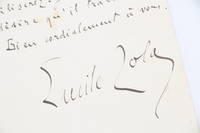
189384893Paris 1893. Fine. Paris 5 Avril 1893 13.50 x 20.50 cm une page et demie Autograph letter dated and signed by Emile Zola 23 lines in black ink on a page and a half addressed to press baron Arthur Meyer Folds inherent to postal delivery. Emile Zola intervenes with Arthur Meyer proprietor of the high-circulation newspaper ""Le Gaulois"" on behalf of his friend Louis de Robert: ""Vous sentirez comme moi que c'est un garçon d'avenir et je suis convaincu que vous l'utiliserez. Je le connais et je désire qu'il travaille."" ""You will feel as I do that he is a young man with a future and I am convinced that you will make use of him. I know him and I want him to work."" in whom he recognizes a talented writer: ""Me permettrez-vous de vous recommander un de mes jeunes confrères Louis de Robert dont j'ai lu les chroniques charmantes. Je crois que vous devriez l'encourager le mettre à l'essai car vous trouveriez en lui un excellent rédacteur pour ""Le Gaulois""."" ""May I recommend to you one of my young colleagues Louis de Robert whose charming chronicles I have read. I believe you should encourage him put him to the test for you would find in him an excellent editor for 'Le Gaulois'."" unknown
1899feb1187421899. Used. For more details please contact me unknown
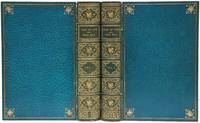
1897143835Philadelphia: George Barrie & Son 1897. Hardcover. Near fine. Edition Magnifique of Chefs-d'Oeuvre du Roman Contemporian Realists. Limited to five copies. viii 319; viii 361 pp. unpaginated plates. 2 Volumes. Octavo hardcover. Bound in full teal levant morocco leather boards designed with impressed gilt decorations double ruled in gilt. Spines with 5 raised bands each divided in six compartments decorated and lettered in gilt slightly darkened. All edges trimmed and gilt. Each volume with a vertical fore-edge painting. Inner side of the boards covered with terra cotta levant morocco doublures elaborately decorated impressed in gilt designed in green blue and white. Joints starting as usual to the fore-edge painting books. Pale blue moiré silked free endpapers; the majority of the blue silk has become detached and is laid-in in incomplete pieces. Free endpapers toned with light pencil notations. Small gallery labels to rear free endpapers recto. Illustrated with monochrome copper etchings each with a hand-coloured douplicate some guarded with tissue paper. Leaves bright and charming tight binding. Near fine condition. 2 volumes each with a fore-edge painting. vol. 1 depicting a couple standing together vol. 2 depicting a nude woman holding a child.</p><p>Limited edition of five copies of which this is number one. Printed only for subscribers. </p><p>Hammer Galleries typed letter signed on their stationary laid in dated March 1941 </p><p>From the Estate of Randall J. Moskovitz MD Memphis Tennessee. 1897 George Barrie & Son hardcover
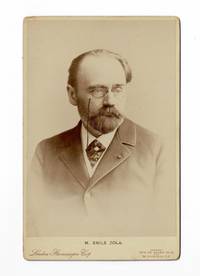
190073358Londres London: London Stereoscopic Company 1900. Fine. London Stereoscopic Company Londres London 1900 10.70 x 16.60 cm une photographie au format carte cabinet Handsome original photographic portrait of Emile Zola in cabinet card format period print on albumen paper mounted on cardboard from the London Stereoscopic Company and taken by an unidentified photographer. The writer poses there rosette of the Legion of Honor at his buttonhole. Condemned for defamation after the publication of his famous ""J'Accuse!"" on the front page of L'Aurore and to escape prison Zola secretly fled to London on July 18 1898. On July 26 1898 the Legion of Honor was withdrawn from him. A snub to this France that did not understand him this ""rosette"" photograph was most likely taken after his removal from the order of the Legion of Honor. Exceptional state of conservation. London Stereoscopic Company unknown
188379106Bénodet 1883. Fine. Bénodet 10 septembre 1883 13.20 x 20.30 cm 2 pages sur un double feuillet Signed autograph letter by Emile Zola - apparently unpublished - addressed to an unknown correspondent written in black ink on a double sheet. Folds inherent to mailing. Interesting letter relating the translation of Emile Zola's works and the legal disputes inherent to their clandestine distribution. This missive is visibly addressed to a correspondent considered for the German translation of La Joie de vivre: ""I would ask you to give me the promptest possible response regarding the translation of La Joie de vivre; for I am already receiving proposals from Germany and I would like to know where I stand."" In this autumn of 1883 Zola - though vacationing in Brittany - is very occupied with managing the translation of his works which he handles directly with publishers. We see here the determination with which he conducts negotiations: ""I repeat that I will only accept a fixed sum paid in advance. It is simpler and without possible surprises."" But things are not simple and Zola whose works already enjoy great success must fight against the clandestine publication of his novels. Completely overlooked by biographers the disputes with Hungarian publisher Gustav Grimm are nonetheless a leitmotif of Zolian correspondence: ""Monsieur Grimm of Budapest is a simple thief who has my novels translated as they are published in French newspapers without any authorization. Already the Neue Freie Presse of Vienna has sued him in my name. But it appears we have no treaty with Hungary. I await the signing of a treaty which they say is imminent."" Indeed Grimm had already published without Zola's authorization German translations of two novels: Nana 1881 and Pot-Bouille Der häusliche Herd 1882. These illegal publications discouraged German publishers Curt Busch and George Kuhr who very interested in distributing the novel to German-speaking readers declared forfeit. Gustav Grimm who finally agreed to respect commercial treaties won the battle and published the very first German translation of La Joie de vivre in 1889 under the title Die Lebensfreude. The man whom Zola here calls a ""simple thief"" would finally obtain authorization to distribute the German translation of the entirety of the twenty volumes of the Rougon-Macquart between 1892 and 1899. Interesting letter revealing the editorial mechanisms of the Rougon-Macquart and testifying to the ardor with which Zola conducted negotiations inherent to the translation of his great hereditary fresco. unknown
1871elala172Paris Brussels : Librairie Internationale A.Lacroix Verboeckhoven Et Cie. 1871. 1871. 18mo. pp. 360. A fine copy untrimmed in original printed wrs. preserved in slipcase with morocco-backed chemise. First Edition issue with publication date 1872 on front wrapper. There was no limited issue on large paper. Variously translated into English as The Rush for the Spoils The Hounds Fee and more recently The Kill La Curée is the scarce second novel from Zolas great twenty-volume Rougon-Macquart series the chief monument of the French Naturalist Movement which explores the scientific theme of the determing influence of heredity on character. The book was immediately censored upon publication. Vicaire VII 1202. 1st Edition. Soft cover. Fine. Paris, Brussels : Librairie Internationale, A.Lacroix, Verboeckhoven Et Cie., 1871. Paperback
1890RFERPAG00twCirca 1890. Very Good. Ferris Jean Leon Gerome. Page of Love. 20 framed prints of watercolors by Jean Leon Gerome Ferris for Emile Zola's novel Une Page d'Amour. Zola Emile. NP: NP Circa 1890. 10x15 cm images in 29x34 cm frames. Framed illustration prints. Book condition: Very good. 20 delicate watercolors depicting scenes from Zola's novel. Beautifully reproduced and matted in buff and moss green in gold-painted wooden frames. Jean Leon Gerome Ferris 1863-1930 was an American painter. unknown
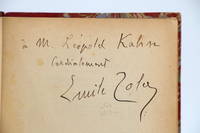
189284801Paris: Charpentier 1892. Fine. Charpentier Paris 1892 12.50 x 19 cm relié First edition. Half red morocco binding spine with five raised bands date gilt at foot restoration to head of one joint marbled paper boards endpapers and pastedowns of combed paper bookplate mounted at head of one pastedown top edge gilt contemporary binding. Occasional light foxing. A handsomely bound copy. Autograph inscription signed by Emile Zola to Léopold Kahn who was Calmann-Lévy's principal collaborator. Charpentier hardcover
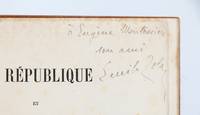
187987597Paris: Charpentier 1879. Fine. Charpentier Paris 1879 14 x 23 cm relié First edition on ordinary paper. Full tawny morocco binding spine with four raised bands set with black fillets bearing small stains at foot gilt fillet frame on burgundy morocco pastedowns brown watered silk endpapers following endpapers of marbled paper original wrappers preserved all edges gilt elegant signed binding by Georges Cretté. Scattered foxing covers marginally and lightly faded. Autograph inscription signed by Emile Zola to the painter and photographer Eugène Montrosier at the head of the title page. Charpentier hardcover
1867B-16-060011<b>Ed Manet.</b> <b>With a wood engraving by Manet.</b> Zola Emile. Dentu Paris 1867. With one etching "Portrait of Manet" by Bracquemond and a wood engraving after a drawing by Manet "Olympia" by Moller. Rebound with the original paper blue cover inside. In very good condition trace of moisture plates in very good condition without stains. More pictures on request Dentu paperback
18872507025G. Charpentier et Cie 1887. first. hardcover. very good. INSCRIBED by Zola on half-title page. First edition in French. Book very good edges of first page have been cut a little smaller minor rubbing and wear two small stains to bottom of rear paste-down. G. Charpentier et Cie unknown
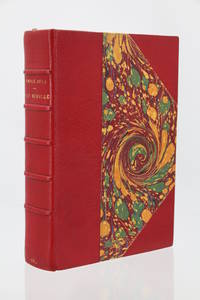
188286096Paris: Charpentier 1882. Fine. Charpentier Paris 1882 12.50 x 19 cm relié First edition one of 250 numbered copies on Holland paper the only deluxe copies after a few rare China paper copies. Half red morocco binding with corners spine with five raised bands set with blind fillets marbled paper boards combed paper endpapers and pastedowns bookplate pasted on one pastedown original wrappers preserved top edge gilt on deckled edges signed binding Pétrus Ruban. Fine bookplate engraved by Provost-Blondel and pasted on one pastedown. It depicts a helmet adorned with a feather a medallion and a phylactery bearing the motto ""Toujours en face"". It would have belonged to Victor Coué second lieutenant killed in action during World War I. Handsome copy nicely bound. Charpentier hardcover
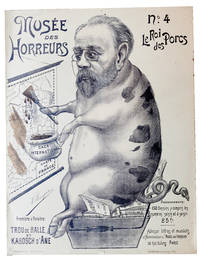
189980330Paris: Imprimerie Lenepveu 1899. Fine. Imprimerie Lenepveu Paris s. d. novembre 1899 49.80 x 65.20 cm une affiche Musée des horreurs Original colour lithographed poster n° 4 Le Roi des Porcs Imprimerie Lenepveu Paris November 1898 498 x 652 cm one poster Original colour lithographed poster depicting Émile Zola in the shape of a pig sitting on a tub containing his fictional works and smearing international poop on the map of France. Transverse folds some tiny tears two small holes above Zola's head without affecting the image. The representation of Émile Zola as a pig does not date back to Lenepveu as Guillaume Doizy highlights in his article dedicated to pig caricatures Le porc dans la caricature politique 1870-1914: une polysémie contradictoire in Sociétés & Représentations n°27 2009: For the end of the 19th century we also think of the many caricatures of which Zola was the victim and which associate excrement symbols of naturalism with pigs. Dozens of images could be mentioned. In the 1880s Sapeck imagined the naturalist naked a vine leaf hiding his genitals a veiled reference to the supposed pornography of his writings sitting astride a pig feeding on his excrement a long-lasting symbol called to stigmatise the new literary school. In a caricature dated 1898 Alfred Le Petit shows a Zola-pig defecating on the tricolore flag. Barely a month after the publication of his famous J'accuse the writer defending the Dreyfusard cause is accused of defiling France and especially its Army by defending the traitor Dreyfus and Prussia considered the eternal enemy. The pig is dirty but above all it dirties defiles by the effect of its harmful will. The same year Caran d'Ache portrayed the weapons of the Dreyfusard press as a big pig sprawled in muck and covered with mud. . In his series Le Musée des horreurs the very right-handed Lenepveu violently attacks Zola. The writer is depicted as a piglet sitting on a box of waste containing his own works the fruit of his defecations prominently including La Terre and Nana. He soils a map of France with his international poop contained in a chamber pot that he spreads with a small brush. The artist is of course aiming at the Dreyfus defender through his famous J'accuse and Jewish cosmopolitanism smearing France with his support for treason. The soiling-pig association seems obvious and primordial. As for Napoleon III the pig's dirt reinforced here by the visible excrement stigmatises the target's political choices. Lenepveu defines Zola's ideas as works of unworthiness intestinal and dripping products. Although this is not the first porcine representation of Émile Zola the one that features prominently in Lenepveu's Musée is undeniably by its realism the most violent. Circulated between October 1899 and December 1900 in a France set ablaze by the Dreyfus Affair these immense colour portraits are the work of Victor Lenepveu who announced the publication of 150 and then 200 drawings before finally producing only around fifty. Despite the 1881 law on the freedom of press allowing the dissemination of a politically subversive image the publication of this nightmarish pantheon was interrupted by order of the Ministry of the Interior. The fragility of the paper and the imposing size of these very violent posters as well as their almost immediate seizure by the police contributed to the disappearance of these caricatures which strongly left a mark on public opinion. These horreurs were widely promoted by anti-Semitic newspapers that announced a fantasised print of 300000 copies thus insinuating the success of anti-Semitic ideas in the population. On 1st October 1899 L'Intransigeant announced the publication of the Musée des horreurs in its columns: Un dessinateur de beaucoup d'esprit au coup de crayon d'un comique intense M. V. Lenepveu a eu l'heureuse idée d'inaugurer une série de portraits des vendus les plus célèbres de la tourbe Imprimerie Lenepveu unknown
188279108Médan 1882. Fine. Médan 23 juin 1882 13.40 x 21.60 cm 1 page 1/2 sur un double feuillet - enveloppe jointe Autograph letter signed by Emile Zola - apparently unpublished - addressed to Léon Carbonnaux written in black ink on a double sheet. Folds inherent to mailing. Envelope included. Important testimony to the colossal documentation work and the capital role of Emile Zola's informants in depicting his immense natural and social fresco. This letter was sent to Léon Carbonnaux department head at Bon Marché who transmitted precious information to Emile Zola for the creation of the eleventh volume of the Rougon-Macquart series: Au Bonheur des Dames. Only two letters from Léon Carbonnaux to Emile Zola are known: they can be consulted in the digitization of the preparatory file for Bonheur des Dames made available online by the Bibliothèque nationale de France. However we know thanks to this same file which contains a long section entitled ""Notes Carbonnaux"" that this department head at Bon Marché provided a significant amount of information to Zola particularly about employee customs and their remuneration. The two men undoubtedly met when Emile Zola eager for information about the functioning of department stores conducted field research in February and March 1882. This response would therefore be the very first that the writer addressed to the department head in reply to his letter of June 19 1882. Far from imagining the keen success that this new novel would achieve Zola even seems to take it lightly: ""Je désire simplement toucher au sujet dans mon livre pour le besoin du petit drame commercial qui me sert de fable. Vos notes sont excellentes. . Enfin me voilà au travail. Le sujet est à la fois bien vaste - et bien ingrat pour un roman. On devra me tolérer un peu de fiction car il faut bien que je passionne la matière. Mais je tâche de m'en tenir le plus strictement possible à mes notes."" ""I simply wish to touch on the subject in my book for the needs of the little commercial drama that serves as my fable. Your notes are excellent. . Finally here I am at work. The subject is both very vast - and very thankless for a novel. One will have to tolerate a bit of fiction from me for I must make the material passionate. But I try to stick as strictly as possible to my notes."" It must be said that Carbonnaux takes his role as informant very much to heart and having no doubt about the book's success he writes: ""Dans le bâtiment chez nous d'ailleurs partout on attend votre livre. Les lecteurs ne vous manqueront pas. Soyez-en sûr. Vous n'en êtes plus à compter les succès celui-là s'annonce comme devant dépasser les autres."" letter of June 19 1882 For another work on the same subject has just appeared: ""J'ai lu le volume de Pierre Giffard. Il me paraît comme vous injuste et même faux dans plusieurs parties. C'est bâclé. Il aurait fallu pour un pareil ouvrage de documents purs une entière exactitude. Moi qui écris une uvre d'imagination je ne me permettrai pas de tels écarts."" ""I have read Pierre Giffard's volume. It seems to me like you unjust and even false in several parts. It is hastily done. For such a work of pure documents complete accuracy would have been necessary. I who write a work of imagination would not allow myself such deviations.""It was Carbonnaux who had pointed out the work to Zola: ""Pierre Giffard du Figaro vient de faire paraître chez Havard un vol de 300 pages intitulé « Les Grands bazars de Paris ». . On sait que le Figaro est inféodé au Louvre magasin concurrent au Bon Marché & on peut assurer que ce livre a été commandé et bâclé dès que votre intention de traiter le même sujet a été connue. . Il fallait déguiser un peu la réclame pour le Louvre."" letter of June 19 1882 We can clearly see here how much department stores fascinate and we understand the immense success that this novel by Zola describing their advent and supremacy would achieve. unknown
188879098Paris 1888. Fine. Paris 11 février 1888 13.20 x 20.50 cm 2 pages sur un double feuillet Autograph letter signed by Emile Zola addressed to Henry Fouquier written in black ink on a bifolium. Usual folds from mailing. This letter was transcribed in the complete correspondence of Emile Zola published by the CNRS and the Presses de l'Université de Montréal. A fine letter evoking La Terre and Tolstoy's The Power of Darkness. Henry Fouquier 1838-1900 was a literary critic and columnist for numerous newspapers. A close friend of Guy de Maupassant he supported Emile Zolas candidacy for the Académie française. This letter was written to him the day after the performance of Tolstoy's The Power of Darkness at the Théâtre-Libre. We have not found evidence of an article in which the journalist explicitly drew a parallel between the Russian drama and Zolas La Terre but Zola here addresses his thanks: « Merci mon cher Fouquier de ce que vous voulez bien dire de « la Terre » si attaquée. J'en suis touché vivement et croyez à toute ma gratitude. » It must be said that the fifteenth volume of the Rougon-Macquart cycle was harshly received unleashing passions from the moment of its serial publication in Gil Blas. On 18 August 1887 even before the conclusion of the novel was revealed to the public Le Figaro published the Manifeste des Cinq written by Paul Bonnetain J.-H. Rosny Lucien Descaves Paul Margueritte and Gustave Guiches. These young authors issued a severe verdict: « La Terre a paru. La déception a été profonde et douloureuse. Non seulement l'observation est superficielle les trucs démodés la narration commune et dépourvue de caractéristiques mais la note ordurière est exacerbée encore descendue à des saletés si basses que par instants on se croirait devant un recueil de scatologie : le Maître est descendu au fond de l'immondice. . Nous répudions ces bonshommes de rhétorique zoliste ces silhouettes énormes surhumaines et biscornues dénuées de complication jetées brutalement en masses lourdes dans des milieux aperçus au hasard des portières d'express. De cette dernière uvre du grand cerveau qui lança L'Assommoir sur le monde de cette Terre bâtarde nous nous éloignons résolument mais non sans tristesse. Il nous poigne de repousser l'homme que nous avons trop fervemment aimé. » Zola who had been developing the idea of a peasant novel for a decade was deeply affected. Though he never responded publicly to these accusations his correspondence is strewn with clarifications about the work whose sheer brutality alone seemed to occupy readers minds: « Mais vous ajoutez que notre thèse à Tolstoï et à moi est la même et peut se résumer en ceci : le travail de la terre est corrupteur. Tolstoï il me semble protesterait bien haut et quant à moi je vous affirme que je n'ai jamais voulu prouver une telle chose radicalement fausse à mon avis. Ce que je pense c'est que la petite propriété telle qu'elle existe chez nous c'est que la suite de faits sociaux qui ont abouti à notre forme sociale nous ont donné notre paysan d'aujourd'hui avec ses qualités et ses vices. Notre paysan est le prisonnier de sa terre et non l'homme libre qu'il devrait être. Comment voulez-vous qu'il n'y étouffe pas dans son ignorance et sa passion unique Labourer est très sain mais à la condition qu'on sera le maître de son champ au lieu d'en être le forçat. Je me suis exténué à faire sortir cette vérité de mon livre si l'on ne m'a pas compris la faute en est sans doute à moi. » A remarkable letter from the master of Naturalism shedding new light on one of the most brutal volumes of the Rougon-Macquart series. unknown