18 résultats
17695207London: Vol. XXV #1906 1769. Very Good. 220 x 285 mm; 8 pages numbered 209-216. Outer leaves split along fold. Paper a bit toned. <br /><br />Contains notices of trade ships to and from North America the death of Pope Clement XIII parliamentary debates on marriage and divorce regulations entertaining advertisements farming advice auction notices and so forth. Vol. XXV, #1906, unknown
17895258London: Numb. 13076 1789. Very Good. 220 x 285 mm; 8 pages numbered 121-128. Paper a bit toned with some bleed-through. <br /><br />Prints an Act of Parliament regulating trade between His Majesty's Colonies in the West Indies Canada and elsewhere and plantations in the United States. Numb. 13076 unknown
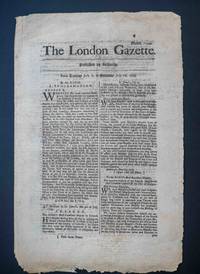
17795259London: Numb. 11994 1779. Very Good. 220 x 285 mm; 4 pages unnumbered. <br /><br />Prints a proclamation ordering all horses oxen and cattle not employed in domestic defense forces "to be driven and removed to some place of security" in the face of a threatened invasion from the French Numb. 11994 unknown
17585208London: Vol. III #200 1758. Fine. 210 x 280 mm; 8 pages numbered 339-344. Paper a bit toned. <br /><br />Reportage on events in the French and Indian War also known as the Seven Years' War. The article on "News from America" tells of a successful expedition against the French the Indians returning with a dozen scalps and three prisoners. There is also a description of how the Indian allies crept up on Fort Loudon and scalped French soldiers. Also tells of the meeting of an Indian leader with the governor of Charleston. Vol. III, #200, unknown
17585210London: Vol. III #160 1758. Very Good. 210 x 280 mm; 8 pages numbered 17-24. Paper a bit toned. Corners bumped. Outer leaves splitting along fold. <br /><br />The news starts with an article entitled "the present state of the Colonies in North-America brought by the last Mail." The report highlights the savagery of the Seven Years' War. Vol. III, #160 unknown
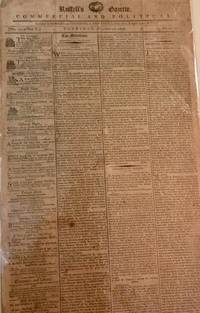
179833743Boston: John Russell 1798. Newspaper. Good. Newspaper. Approx. 20" x 12". Folded. 4 pages. Contents include a Charles C. Pinckney address from France local news sales advertisements theater advertisement etc. Light toning and edge creases to the paper. John Russell unknown
1718159896Tokyo: Asahi shinbun. Showa 17. January 181942. 4 page broadsheet newspaper folded evenly browned. Maps black and white photographic illustrations very good copy. 54 x 41cm. Main headline: "Closing in on Singapore Vanguard: Rear-guard of Defeated British Army Cut Off; Battle of Annihilation in Johor". Other headlines include: "Occupation of Strategic Territory of Batu Anam; Australian 8th Division Crushed" followed by an account of fighting between Japanese and Australian forces in Malaya; "Main Enemy Position Cut Off: Battle of Annihilation on the Bataan Peninsula Heats Up"; "Steady Advance by Road: Imperial Army's Fierce Attack on West Coast" followed by account of Japanese advances in Malaya with map; "British Cabinet Restructured"; "US Said to Be Sending Troops to Northern Ireland". Front page has photos of Japanese soldiers standing in front of the monument to Jose Rizal in Manila and of a column of Japanese soldiers advancing by bicycle along a road on the Bataan Peninsula. Articles on the inside pages include discussions of plans to increase production of shipping to meet war needs and of a meeting of Latin American countries to discuss the world situation. Several articles on the back page emphasise material and spiritual preparations being made in Japan for a "long war". The back page also includes an interesting article criticizing US and British propaganda and "misreporting" of the war situation. All text in Japanese. . Asahi shinbun. unknown
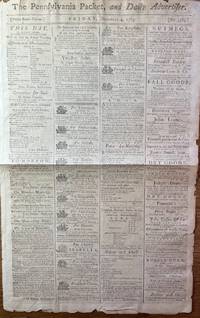
178636778Philadelphia: Printed and Sold by John Dunlap and David C. Claypoole 1786. First Edition. Newspaper. Fair. Newspaper. Approx. 18" x 11". 4 pages. Folded. Edge chips tears and splits to the paper. Contents include advertisements for shipping dry goods personal ads Foreign intelligence news on America and local Massachusetts news. Fair. Printed and Sold by John Dunlap and David C. Claypoole unknown
1733960624Printed for J. Wilford London : 1733 1733 11 leaves of 12 - No half title if one was ever present. 21 cm. Modestly soiled. Leather backed cloth boards. Goldsmiths'-Kress Library of Economic Literature: No. 7170. In Fog's Journal an early news sheet there was a call by way of historical allegory for the assassination of Robert Walpole and others. Walpole the Earl of Oxford 1676-1745 was really Britain's first Prime Minister. He governed through a time of relative peace and prosperity but not without controversies. In 1733 Walpole's influence received a profound blow. Serious frauds relating to excise duties were uncovered. He proposed to check smuggling and avoid fraud by levying the full tax on wine and tobacco not at their point of sale but upon their first removal from the various warehouses. "His opponents fastened on these proposals with irresistible force and so serious an agitation stirred the country that the ministerial measure was dropped amid general rejoicing. Several of his most active antagonists were dismissed from office or deprived of their regiments but their spirits remained unquenched." - William Prideaux Courtney in the 11th Ed. EB. Though intended as a defense of Walpole this pamphlet does not say that Fog's Weekly Journal was wrong to attack him - only that they overstepped their bounds by calling for his assassination. Juggling the power of political protest in the public press with freedom of speech was always a tricky affair. Responding in 1734 to the concerns of Queen Caroline over these and other controversies Walpole said not to worry too much about it: "Madame there are 50000 men slain in Europe and not one Englishman." VERY RARE. W140. Language: eng. 1st Edition. Hardcover. Very Good. Printed for J. Wilford, London : 1733 hardcover
179022837Paris: à l'Imprimerie des Sciences et arts 1790. First edition. 1-3 blank. 1 vols. 12mo. Disbound some light marginal browning tiny worm holes in lower marginalelse a very good copy with the 3 centimes Republique Française stamp in the lower margin. First edition. 1-3 blank. 1 vols. 12mo. The prospectus for this literary sciences and arts periodical. The periodical was to appear on the 5 and 10 of each Décade consist of 24 8vo pages beautifully produced. à l'Imprimerie des Sciences et arts unknown
1775086FR1A Bouillon Avec Approbation & Privilege Paris: 1775. 1775 72 p. 12mo. Uncut. Sewn in plain wraps as issued. A rare survival of a small French magazine for 'current events'. Included in the reports are some of the earliest European accounts of the growing American Revolution in British North America. Especially significant are: the accounts of the Battle of Lexington and Concord; the gathering of the Continental Congress in Philadelphia; and other agitations throughout the colonies. RARE. PRICE JUST REDUCED! FR1. Language: eng. 1st Edition. Soft cover. Very Good. A Bouillon, Avec Approbation & Privilege, Paris: 1775. paperback
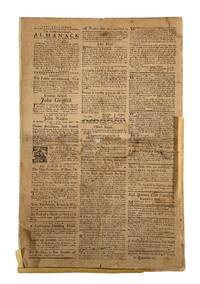
1771143781771. 1771 Newspaper with slavery ad. The Almanack Boston. 15" by 10.". The newspaper lists two advertisements relating to slavery "To be sold for want of employment a likely Negro Boy that won't drink rum he is about 14 years old." A slavery related advertisement which chronicles a dark era in American history. Overall foxing some soiling and small tears. Otherwise very good condition. unknown
1768339729Boston 1768. 4pp. Disbound. Signature of Col. Hatch. 4pp. Includes mostly European news but notes under the date Sept. 8: "Both the tenour and purport of all the late dispatches from America is That the colonists will never give up their liberties" and lists the regiments on duty in America. The final column on the last page gives local news including a reference to non-importation: "We hear the senior class at Harvard college have unanimously agreed to take their degrees next commencement dressed in black cloth of the manufacture of this country unknown
176835235Philadelphia: Printed by William Goddard 1768. Newspaper. Good. Newspaper. Disbound single issue. Approx. 11.5" X 9.25". Pages 209-216. Stitching removed. Pages are all detached with edge tears and chips on the left edge. Paper is lightly toned. A couple of small worm holes on the left margins. Fair or better condition. <br /> <br /> Front page article contains a reactionary response to the publication of the Farmer's Letter's in William Goddard's newspaper. The writer "A Barbadian" requests "without further preface.to publish after the manner of the Farmer the following extracts from the answers to his address." On page 212 is a letter signed by a "Son of Liberty" who writes "How happy are you Sir and how much to be envied to be thus by nature as well as the influences of freedom armed and supported - For this surely "is the Crisis The Very Crises" when your animating soul is called forth to action not merely to display the wordy weapons of war but to grid your armour and lead on thousands and tens of thousands to defend their invaluable rights and privileges." Page 214 is an address to the Pennsylvania State-House regarding restrictive British policy regarding trade and taxes. Advertisements for land job advertisements Irish linens and more located in back. Fair condition. From History dot Delaware dot Gov:<br /> <br /> Dickinson’s most famous contribution as the “Penman†and for the colonial cause was the publication of a series of letters signed “A FARMER.†The letters were published over a period of ten weeks in late 1767 and early 1768 with the first letter appearing in the Pennsylvania Chronicle on December 2 1767. In the letters Dickinson argued amongst other things that the Townshend Acts were illegal because they were intended to raise revenue a power held only by the colonial assemblies. His arguments were a collection of ideas that were written in a clear and concise manner which the general population could understand. Collectively the letters were called “Letters from a Farmer in Pennsylvania to the Inhabitants of the British Colonies.†The letters were shortly thereafter published in pamphlet form and reprinted in almost all of the colonial newspapers. They were read widely across the colonies and in Britain and France. This quickly made John Dickinson famous. After reading the “Letters†Voltaire the French philosopher compared Dickinson to Cicero an honored Roman statesman orator and philosopher. At the Boston town meeting in March of 1768 Samuel Adams and others spoke of the author by saying “that the thanks of the town be given to the ingenious author of a course of letters… signed ‘A FARMER’ wherein the rights of the American subjects are clearly stated and fully vindicated: …members of a committee are to prepare and publish a letter of thanks.†As a direct result of the popularity of Dickinson’s letters there were calls and petitions for the boycotting of imported goods throughout the colonies. The eventual result of the unity amongst the colonies against a common enemy was the First Continental Congress. When the Congress was called however Dickinson quickly realized that much progress needed to be made towards the solutions that he wrote about in his letters.<br /> <br /> From History dot com:<br /> The Sons of Liberty were a grassroots group of instigators and provocateurs in colonial America who used an extreme form of civil disobedience—threats and in some cases actual violence—to intimidate loyalists and outrage the British government. The goal of the radicals was to push moderate colonial leaders into a confrontation with the British Crown. The Sons marked one of their early victories in December 1765. The Stamp Act—the first tax imposed directly on American colonists by the British government—had only been in effect for a month when a group of Boston merchants and craftsmen sent a letter to Andrew Oliver the newly-appointed official collector of stamps. The group informed Oliver that he was to show up the next day at noon at the Liberty Tree in the city’s South End to publicly resign. Printed by William Goddard unknown
1791AQ33495London: Printed for the Company of Stationers And sold by Robert Horsfield 1791. 48pp. Title and calendar in red and black. Not in ESTC. Bound with: The Ladies' Diary: of Woman's Almanack For the Year of our Lord 1792. London. Printed for the Company of Stationers And sold by Robert Horsfield 1792. 48pp. Title and calendar in red and black. ESTC N3191. And: The Ladies' Diary: of Woman's Almanack For the Year of our Lord 1793. London. Printed for the Company of Stationers And sold by Robert Horsfield 1793. 48pp. Title and calendar in red and black. ESTC T58295. And: The Ladies' Diary: of Woman's Almanack For the Year of our Lord 1794. London. Printed for the Company of Stationers And sold by Robert Horsfield 1794. 48pp. Title and calendar in red and black. ESTC T58296. And: The Ladies' Diary: of Woman's Almanack For the Year of our Lord 1795. London. Printed for the Company of Stationers And sold by Robert Horsfield 1795. 48pp. Title and calendar in red and black. ESTC N3192. 8vo. Contemporary parchment-backed powder-blue paper boards. Rubbed and marked. Text-block dampstained at foot. William St Clair's copy with his distinctive pencilled ownership inscription to recto of FFEP. Five sequential late eighteenth-century editions of the immensely popular almanac The Ladies' Diary. First published by John Tipper in 1708 and including household receipts in cookery and medicine alongside the traditional astronomical and chronological almanac fare the popular success of the mathematical puzzles included at the end of the first edition influenced the future direction of the publication. The subsequent editors included several influential mathematicians such as Thomas Simpson 1710-1761 and Charles Hutton 1737-1823. William St Clair 1937-2021 British scholar and senior civil servant notable as the author of The Godwins and the Shelleys The Biography of a Family 1989 and The Reading Nation in the Romantic Period 2004. . Printed for the Company of Stationers, And sold by Robert Horsfield hardcover
1797013560Northampton 1797. The Northampton Mercury . Saturday January 7th 1797-1798. 2 full years. 104 issues.Each issue has 4 pages. Book measures 50x36.cm. January 7th 14 21st 28th February 4th 11th 18th 25th March 4th 11th 18th 25th April 1st 8th 15th 22nd 29th May 6th 13th 20th 27th June 3rd 10th 17th 24th July 1st 8th 15th 22nd 29th August 5th 12th 19th 26th September 2nd 9th 16th 23rd 30th October 7th 14th 21st 28th November 4th 11th 18th 25th December 2nd 9th 16th 23rd 30th. January 6th 13th 20th 27th February 3rd 10th 17th 24th March 3rd 10th 17th 24th 31st April 7th 14th 21st 28th May 5th 12th 19th 26th June 2nd 9th 16th 23rd 30th July 7th 14th 21st 28th August 4th 11th 18th 25th September 1st 8th 15th 22nd 29th October 6th 13th 20th 21st November 3rd 10th 17th 24th December 1st 8th 15th 22nd 29th. Bound in modern half cloth with black title lettering. Cloth dust/dirt marked. Binding in good firm condition. Internally small puncher hole throughout affecting a small section of text in each issue 1 page stained a few short tears tightly bound the inner margin has been trimmed to close to text which makes it hard to read the text along the inner margin . Generally pages in good clean condition thrioughout. . Cloth. Very Good. Folio. Hardcover
176835236Philadelphia: Printed by William Goddard 1768. Newspaper. Good. Newspaper. Disbound single issue. Approx. 11.5" X 9.25". Pages 177 to 184. Paper is lightly toned and foxed. A few small edge tears. This issue contains much pre American Revolution political discontent. <br /> <br /> Front page article contains reprinted extracts from a pamphlet published by John Dickinson titled "Farmers Letters" published in 1766. This issue also has extensive coverage of the June 10 1768 "Liberty Riot" in Boston with references to the "Sons of Liberty". Contents also include latest news from London; article on New Bern North Carolina; an illustrated advertisement for a runaway "Mulatto" slave named Harry from Delaware; continuation of correspondence between John Dickinson and Horatio Sharpe Governor of Maryland; several advertisements and more. Good condition. From History dot Delaware dot Gov:<br /> <br /> Dickinson’s most famous contribution as the “Penman†and for the colonial cause was the publication of a series of letters signed “A FARMER.†The letters were published over a period of ten weeks in late 1767 and early 1768 with the first letter appearing in the Pennsylvania Chronicle on December 2 1767. In the letters Dickinson argued amongst other things that the Townshend Acts were illegal because they were intended to raise revenue a power held only by the colonial assemblies. His arguments were a collection of ideas that were written in a clear and concise manner which the general population could understand. Collectively the letters were called “Letters from a Farmer in Pennsylvania to the Inhabitants of the British Colonies.†The letters were shortly thereafter published in pamphlet form and reprinted in almost all of the colonial newspapers. They were read widely across the colonies and in Britain and France. This quickly made John Dickinson famous. After reading the “Letters†Voltaire the French philosopher compared Dickinson to Cicero an honored Roman statesman orator and philosopher. At the Boston town meeting in March of 1768 Samuel Adams and others spoke of the author by saying “that the thanks of the town be given to the ingenious author of a course of letters… signed ‘A FARMER’ wherein the rights of the American subjects are clearly stated and fully vindicated: …members of a committee are to prepare and publish a letter of thanks.†As a direct result of the popularity of Dickinson’s letters there were calls and petitions for the boycotting of imported goods throughout the colonies. The eventual result of the unity amongst the colonies against a common enemy was the First Continental Congress. When the Congress was called however Dickinson quickly realized that much progress needed to be made towards the solutions that he wrote about in his letters.<br /> <br /> From History dot com: The Sons of Liberty were a grassroots group of instigators and provocateurs in colonial America who used an extreme form of civil disobedience—threats and in some cases actual violence—to intimidate loyalists and outrage the British government. The goal of the radicals was to push moderate colonial leaders into a confrontation with the British Crown. The Sons marked one of their early victories in December 1765. The Stamp Act—the first tax imposed directly on American colonists by the British government—had only been in effect for a month when a group of Boston merchants and craftsmen sent a letter to Andrew Oliver the newly-appointed official collector of stamps. The group informed Oliver that he was to show up the next day at noon at the Liberty Tree in the city’s South End to publicly resign. Printed by William Goddard unknown
1792012294Northamptonshire: Printed By Dicey & Sutton 1792. The Northampton Mercury. 1792-1793 Circa 73 complete issues each issue has 4pp. 1792. Saturday January 7th 14th 21st 28th February 4th 11th 18th 25th March 3rd10th 17th 24th 31st April 7th 14th 21st 28th May 5th 12th 19th 26th June 2nd 9th 16th 23rd 30th July 7th 14th 21st 28th August 4th 11th 18th 25th September 1st 8th 15th 22nd 29th October 6th 13th 20th 27th November 3rd 10th 17th 24th December 1st 8th 15th 22nd 29th. 1793. Saturday January 5th 12th 19th February 2nd 9th 16th 23rd March 2th 9th 16th 23rd 30th April 6th 13th 20th 27th May 4th 11th 18th 25th June 15th 22nd 29th July 6th 13th 20th 27th August 3rd 10th 17th 24th 31st September 7th 14th 21st 28th October 5th 12th 19th 26th November 2nd 9th 16th 23rd 30th December 7th 14th 21st 28th. Lacking 3 full issues January 26th 1793 June 1st 1793 & June 8th 1793. Also 28 issues have some articles cut-out. These issues are 1792 March 3rd April 21st July 14th & August 25th. 1793 January 12 February 2nd 9th & 16th March 3oth April 13th May 18th July 6th 20th & 27th August 17th & 31st October 5th 12th & 26th. November 2nd 9th 16th 23rd & 30th December 7th 14th 21st & 28th. Out of these issues about 12 has one or two articles cut-away the others have more substantial text cut-out. Book measures 52 x 35.5.cm. Binding heavily worn defective. Internally pages are in good clean condition. . Good Plus. Folio. Printed By Dicey & Sutton unknown