234 résultats
1839055027Kostantiniyye Constantinople - Istanbul: Takvîm-i Vekâyi. AH 1255 1839. Soft cover. Very Good. Original newspaper taken from a volume. Folio. 425 x 28 cm. In Ottoman script Old Turkish with Arabic letters. 5 p. Extremely rare early issue of this first official newspaper of the Ottoman Empire after the proclamation of Reform Tanzîmât in 1839 informed Daguerre's new and weird invention "photography" as it would be called in the 1850s to the Ottoman peoples and readers. The article reads: "It is the talk of the town steam engines have been able to run on rails in factories in recent years. Meanwhile a man carefully focused on his thoughts so much and the craft turned into a strange art and finally a coquettish mirror surface appeared. This skillful Frenchman named Daguerre drew the lines of objects by reflecting the sunlight with the methods of the different science of art he learned drew the contours of the objects and gave 20 years secretly and openly to the formation of this strange art. Finally he reached the goal and this event won the appreciation and admiration of everyone. This is to say the image of the object in the form of a large or small box free from light is pictured inside by passing through the glass in front of it. In order for the reflected picture to be captured on a surface some chemicals must be prepared. Daguerre has achieved this mix based on his experience. This substance applied on the plate is called iodine. After the plate is kept in the vapor of the iodine for a few minutes it is immediately placed in the dark box and the image passing through the window of the box is pictured for five minutes. Considering that some of the things that should be hidden are captured like this it will be understood what a valuable invention this is.". In the continuation of the article it is written that an Englishman named Talbot Henry Fox Talbot found the same thing with almost the same processes ! but Daguerre had taken pictures before. Takvim-i Vekâyi was the first fully Turkish-language newspaper. It was launched in 1831 by Sultan Mahmud II taking over from the Moniteur ottoman as the Official Gazette of the Ottoman Empire. With the beginning of the Tanzimat reform period Takvim-i Vekayi produced versions in multiple language editions. It ceased publication in 1878 resuming in 1891-2 before being closed again. It resumed in 1908 until around 1922. In the 1831-1878 period it published a total of 2119 issues - an average of slightly less than one a week. <br/> <br/> Takvîm-i Vekâyi., [AH 1255] paperback
18942111902160200920Hoeiken 1894. Soft Cover. Fine. Volume: 1 Hoeiken paperback
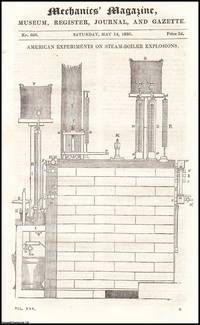
1835373895Salmon London 1835. Booklet - Unbound Pages. Very Good Condition. 32 Pages with woodcuts. Small piece missing from inner margin of first leaf with no loss of text. See pictures for detail. Genuine Original and Packed with Innovation! This weekly magazine isn't just a fragment of history it's a window into the cutting-edge advancements of the Victorian era! Since 1823 The Mechanics' Magazine has tackled revolutionary topics from printing presses to vapor baths hydrostatics and hydraulics. It dives into breakthrough safety measures preventing explosive contaminated air while exploring the mechanics of oxy-hydrogen blowpipes and self-laying rail carriages. Every page crackles with Victorian-era engineering brilliance capturing the relentless drive for invention that shaped the modern world! This is an exclusive standalone issue carefully separated from its original volume; authentic original and uniquely crafted. It is not a reprint or reproduction but a distinct piece in its own right. Preserved in a modern card cover prepared for practicality - an unassuming but serviceable presentation that favours function over finery. Size: 13 x 21 cms. Category: Mechanics' Magazine;. Salmon unknown
1887374714Graphic Illustrated Weekly Newspaper London 1887. Half Leather. Good Condition. 734 pages. Bound in contemporary half leather. Gilt lettered spine with gilt ruled bands. Contents sound with no shaken or torn pages. The binding is firm with a very scuffed and rubbed spine and the boards are rubbed and discoloured. Some minor foxing. Given the relatively complex nature of The Graphic volumes and the weekly issues we believe this book is complete but we cannot be absolutely certain in regard to any fold out sections. Size: 29 x 42 cms. Category: Antiquarian & Rare; Graphic Illustrated Weekly Newspaper. This item may require more postage than the rates shown for delivery outside the UK. If extra postage is required we will contact you before processing your order and you will be given the details and option to decline the extra cost. Graphic Illustrated Weekly Newspaper hardcover
1887374712Graphic Illustrated Weekly Newspaper London 1887. Half Leather. Good Condition. 686 pages with index. Bound in contemporary green half leather. Gilt lettered spine with gilt ruled raised bands. Contents sound and the binding is firm with a scuffed and rubbed spine and the boards are mildly scuffed. Some minor foxing. Given the relatively complex nature of The Graphic volumes and the weekly issues we believe this book is complete but we cannot be absolutely certain in regard to any fold out sections. Size: 29 x 42 cms. Category: Antiquarian & Rare; Graphic Illustrated Weekly Newspaper. This item may require more postage than the rates shown for delivery outside the UK. If extra postage is required we will contact you before processing your order and you will be given the details and option to decline the extra cost. Graphic Illustrated Weekly Newspaper hardcover
1899179371899. 2 Issues of Englishwoman's Review. John Bale Sons and Danielsson Ltd: London July 15th 1899. January 15th 1902. Measures 8.5" x 5.5" inches. 224 pages. Soft covers. Both reviews open with an advertisement for the printer that reads "Office for the employment of women as compositors. Girls trained and employed for the last twenty years. Ladies and gentleman are invited to place their orders for printing where they will be executed by women in a style equal to the best. No slipshod work! No exorbitant prices!" The rest of both reviews is composed of articles news and reviews related to women's suffrage. Some titles include "Experiences Amongst Chinese Women" "The Political Position of Women in Canada." Together the two speak to the level of organization as well as the international focus of the movement as women collaborated across countries and continents reporting on successes and obstacles bolstering support for the cause by keeping readers well informed. Soft covers missing original covers. Clean front and back free endpapers instead. Texblocks tight and clean. Overall good condition. unknown
1831F72I8N01U79Omostly on board the barque Sarah of London 1831. Contemporary sheepskin parchment sewn on 2 tapes. 4to 19.5 x 16.5 cm. The journal with an engraved view as frontispiece "Island of Saint Helena" engraved by Everingham in London 15 full-page 1 nearly full-page and 1 smaller manuscript maps and coastal profiles plus a small engraved view "Tomb of Napoleon" mounted on 1 page. The lecture notes with a matching pair of engravings of a scull one signed "A. East del" on and facing the title-page and 27 pencil and/or ink anatomical drawings including 2 full-page some also with red. Most are drawn on the album leaves a few on separate slips mounted on the leaves. Both the lecture notes and the journal are written in brown ink with occasional additions in pencil. Including: MANUSCRIPT - ANATOMICAL. MORSE Edward George.Lecture Book notes on anatomical lectures by Joseph Constantine Carpue.London November-December 1828. A manuscript ship's journal kept by Edward George Morse Bromyard 1805-Deal post 1850 who no doubt served among other functions as the ship's surgeon. Morse made his earliest dated entries in April 1831 at the island Mauritius in the Indian Ocean and others at Madagascar and its surrounding islands from May to August 1831. Morse provides extensive notes on the natural history topography and people of the Seychelles Madagascar and the neighbouring islands and provides detailed maps of many of the islands and coastal areas along with a few coastal profiles. The two manuscripts are written in a single album of laid paper. Morse used it 1828 to take notes when he attended the London lectures on anatomy and blood circulation by the innovative surgeon Joseph Constantine Carpue who had pioneered facial reconstructive surgery by introducing ancient Indian techniques. He was famous for illustrating his lectures with chalk drawings which no doubt served as the models for the anatomical illustrations in Morse's notes. A few clippings and hand-written notes have been inserted. unknown
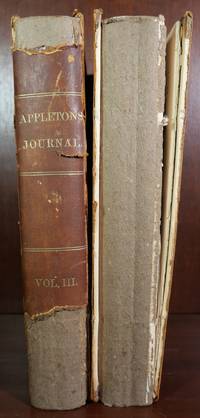
18775435New York: D. Appleton and Company 1877. Volumes II - III. Illustrated. Both volumes measuring approximately 10" x 7" with 576 numbered pages in each volume. Volume II contains The Heir Of Mondolfo by Mary Shelley on pages 12-23. First printing of this Shelley story. <br /> <br /> These volumes are in poor condition. Both boards on volume II are detached from binding. Volume II spine is missing. Volume III spine is heavily chipped with large missing pieces. Volume III boards are loose with cracked hinges but still hanging on. Moderate scuffing and chipping to all edges and boards. Moderate scuffing and foxing all edges of textblock. Previous owner's book plate on front pastedown of both volumes. Many front pages are loose from volume II. Interior pages have minor foxing to both volumes. <br /> <br /> Please view the many other rare titles available for purchase at our store. We are always interested in purchasing individual or collections of fine books.<br /> <br /> Inventory #N12-63. D. Appleton and Company unknown
18612786np: np 1861. First edition. Original leather covers. Good. A REMARKABLY EXTENSIVE ARCHIVE OF A UNION SOLIDER INCLUDING DIARIES FROM 1861-1865 SPANNING HIS ENTIRE CIVIL WAR CAREER.<br /> <br /> THE SOLDIER CHARLES E. SMITH PARTICIPATED IN SOME OF THE MOST CRITICAL CAMPAIGNS OF THE WAR INCLUDING THE SEIGE OF VICKSBURG THE FALL OF ATLANTA AND SHERMAN'S MARCH TO THE SEA. Background:<br /> <br /> Charles E. Smith 1836-1905 was born in Berlin Township Ohio. He worked as a farmer and country schoolteacher in Alum Creek Delaware County Ohio. He enlisted in the 32nd Ohio Volunteer Infantry at the age of 25 on September 3 1861 and mustered in September 7 1861. He was promoted to the rank of corporal in Company I of the regiment on January 30 1864. He was slightly wounded on July 29 1864 during the Atlanta Campaign. He mustered out of the service on July 20 1865 at Louisville Kentucky.<br /> <br /> The 32nd Ohio Infantry was organized at Mansfield Ohio on August 20-September 7 1861 and mustered in for three years' service under the command of Colonel Thomas H. Ford. The regiment was involved in several important engagements and operations during the Civil War including the Battle of Greenbrier River the Battle of McDowell the Battle of Harpers Ferry the Battle of Champion Hill the Siege of Vicksburg the Atlanta Campaign the Battle of Jonesborough Sherman's March to the Sea the Carolinas Campaign and the Battle of Bentonville. The 32nd Ohio Infantry mustered out of service at Louisville Kentucky on July 20 1865.<br /> <br /> The Collection:<br /> <br /> The collection consists of 26 dairies dating from 1859 to 1866. Except for four volumes covering a period from 1856 to April 1861 and one covering the period September 18 1865 to December 5 1866 the remaining dairies 21 volumes span his entire Civil War career in the 32nd Ohio Volunteer Infantry covering the period September 3 1861 the date of his enlistment to the date of his mustering out of the service on July 20 1865. The diaries of various sizes average approximately 100 pages with few blank pages.<br /> <br /> His daily entries in his Civil War diaries many of which are detailed consist of descriptions of the weather diet geographical locations his devotion to the Union camp activities military news and description of engagements. He also included several drawings in the diaries some in color. He described his day of enlistment of September 3:<br /> <br /> "Enlisted at Lewis Center between 8 and 9 oclock in Captain Dyre's company of 3 years volunteers. I bid good bye to all my folks and started having resolved to assist in sustaining the Government. But the feelings which came over me when I left home friends and all that seemed dear to me I cannot describe."<br /> <br /> The new enlistees moved to Camp Dennison and Smith records the daily activities in camp as his company prepared for their first movement. From Camp Dennison the 32nd Ohio was ordered to western Virginia present-day West Virginia to assist in driving Confederate forces out of the region. On October 3 1861 the 32nd Ohio participated in the inconclusive Battle of Greenbrier River. Smith records in his diary beginning on September 29 through October 3:<br /> <br /> "In the evening we received orders to march to make an attack on Greenbrier about 12 miles distant. Our company numbered 86 men. Our regiment probably numbered 900 men present and able to perform duty. The 32nd. Went in advance and cleared out the road and took one prisoner. Our regiment stopped at the cross roads within four miles of Greenbrier and stopped. We expected there that the battle commenced. but they Confederate troops did not come and we. crept into the thick laurel bushes to lay till morning. When I awoke it was daylight and other regiments were passing. The artillery was hurrying along as fast as possible each gun was drawn by six horses and about nine oclock the canons began to roar. It was kept up till two oclock on both sides when our communication failed and our men withdrew from the field without losing any guns. The canons roared very loud and the sound rolled over the Mountains and valleys and made everything ring once more. Our loss was including those that were killed on the field and those that died of wounds after the battle about 12 men. We took 13 prisoners." <br /> <br /> Smith describes an engagement with Confederate forces around Beverly Virginia on December 18 1861:<br /> <br /> "The rebels came out and met our forces and a bloody fight ensued. The 32nd fought bravely and drove the enemy back. The 25th were in the advance and were cut up dreadfully. They fell back and the 32nd stood their ground and fought them like tigers. Our men made two or three gallant charges and drove them out of their entrenchments and were forced out themselves. Our boys could not drive them out again and after a desperate and bloody struggle our troops retreated. having lost about one hundred men."<br /> <br /> After spending the winter in Beverly Virginia the 32nd Ohio participated in the Shenandoah Campaign of 1862 where they engaged Stonewall Jackson's Confederate force at the Battle of McDowell Virginia on May 8 and were defeated. On that day Smith recorded the following:<br /> <br /> "We formed into line and gave three cheers to the cavalry and were waiting to welcome the infantry when a dispatch came for us to report immediately at headquarters armed and equipped. We went forthwith and formed into line of battle on an open field. The rebels came down on the hills & tried to pick a spot to plant a gun and our boys threw shell amongst and drove them out. The rebels gathered on a mountain at the right of town about 4000 men. Our boys did not find out what they were at or where they were till late in the afternoon. Two regiments went up the mountain and the ball was opened. The battle lasted till after 8 oclock at night when our boys withdrew bringing the wounded and mostly all the dead from the field. The fight lasted about 4 hours."<br /> <br /> The 32nd Ohio retreated to Franklin Virginia where they joined General John C. Fremont's command. Fremont followed the Confederates into the valley and engaged a Confederate force at Cross Keys Virginia on June 8 1862 but Smith's company did not participate in the action. The 32nd Ohio move on to Winchester Virginia where they performed garrison duty for the remainder of the summer.<br /> <br /> In September 1862 the 32nd Ohio was dispatched to Harper's Ferry. The regiment again faced Stonewall Jackson participating in the Battle of Harper's Ferry September 12-15 1862. In this engagement Jackson captured the town and nearly twelve thousand Union soldiers including the 32nd Ohio subsequently paroling them after confiscating their supplies. In his entry for September 15 Smith describes the last day of the battle:<br /> <br /> "At sunrise the ball opened with a heavy cannonade from both sides. Our men were nearly out of ammunition for artillery and the enemy was mowing down our ranks. The shells and shot came down like hail all around and amongst us and many of our officers and soldiers were mortally wounded. Our artillerists run out of ammunition and there was no other way for us to do than surrender or be slaughtered on the field. At about 8 oclock the stripes and stars were hauled down and the white flag waved as a signal for surrender. The rebel cavalry and officers were soon riding through our camp. They hoisted the bars and stars where an hour before our glorious old star spangled banner floated proudly in the breeze. O how my heart beat and my bosom heaved to see that corrupt flag raised in defiance over us."<br /> <br /> The surrender of the 32nd Ohio resulted in a revolt in the ranks of the enlisted men against the regiment's officers which Smith later discusses in a January 15 1863 entry in his diary stating: "we were obliged to surrender 11500 men to the Rebels General A.P. Hill. It was the opinion of nearly all of our men that Colonel Miles of Baltimore betrayed us into the hands of the Rebels. It was said that he got 15 cents per head for us. Our Col Thomas H. Ford was examined by a committee and dismissed from the service for blame that was unjustly laid against him for the evacuation of the Maryland Heights. Since we were paroled a hard feeling was created between the officers of the regiment." Smith and his regiment eventually rejoined General Ulysses Grant's Army of the Tennessee in Memphis on January 25 1863. The regiment was involved in Grant's Siege of Vicksburg beginning in April 1863.<br /> <br /> A pivotal engagement in Grant's Vicksburg Campaign was the Battle of Champion Hill which occurred on May 16 resulting in a Union victory. Smith's entry for that day records the fighting:<br /> <br /> "A battle had begun on the left the firing seemed to be from large guns and the line seemed to be several miles long. We halted to await orders. Soon they came & we went forward & laid behind a ridge where we could see the fighting. The scene was grand but terrible. The heavy fighting was on the left & center at first. Our brigade charged on a rebel battery and took it & hauled it off. The 32nd did a noble part charging on the hills & ravines and out the battery driving the enemy before them killing a large number."<br /> <br /> The siege of Vicksburg ended on July 4 1863 when the Confederate forces surrendered and the Union troops under Grant including the 32nd Ohio entered the city. Smith recorded the events of July 3 and 4 in his diary. On July 3 he wrote: "This is the 46th day of the Siege. The rebels have sustained at this place and nobly and bravely have they defended it but General Grant has been too much for them." The next day's entry detailed the surrender. "At nine oclock it was announced that Vicksburg was surrendered. What a thrill of joy ran through every heart. The boys all seem lively and jubilant over the success which has crowned our arms. At half past ten oclock the rebels march out of their forts and rifle pits. and form in line outside their works and stuck arms."<br /> <br /> After Vicksburg the 32nd Ohio joined an expedition to Monroe Louisiana and then participated in General James McPherson's expedition to Brownsville Mississippi. In addition to his daily entries Smith also drew a number of pencil and ink sketches that reflected what he described in on a particular day such as sketching images that depicted the sleeping arrangements in the soldiers' tents maps of terrains and a two-page spread showing the capture of a Confederate battery in Mississippi. He also wrote down poems whether written by him or others. For example on January 31 1864 he added a six-stanza poem possibly written by him entitled "Evening Thoughts" to that day's entry. A partial transcription reads: "I'm weary and I'm lonely//As I'm sitting in my tent//And I'll take my leaden pencil//And give you my feelings sent// O would this war be over//And these bloody strivings cease//And our country now distracted//Return with lasting peace."<br /> <br /> In February 3 to March 6 1864 the 32nd Ohio was involved in General William T. Sherman's Meridian Expedition which resulted in the capture of Meridian Mississippi. On March 3 Smith recorded a diary entry that detailed the destruction rendered by the campaign:<br /> <br /> "I cannot fully give the amount of damage done to the Southern Confederacy while on this Expedition but the result foots up about as follows. About 200 miles of railroad running east & west was destroyed. About 60 miles of the Mobile and Ohio railroad was destroyed and about 40 miles of the Central Mississippi road destroyed. There were about 25 Locomotives and a considerable number of cars together with Confederate railroad houses machine shops and foundries manufacturing establishments of arms ammunition. A large amount of cotton was burned."<br /> <br /> On June 10 1864 the 32nd Ohio joined Sherman's Atlanta Campaign. In the campaign the 32nd fought in the Battles of Kennesaw Mountain Atlanta Ezra Church and Jonesborough. The campaign ended on September 2 1864 when Union forces occupied Atlanta. Smith's diary entry for June 27 mentions the engagement at Kennesaw Mountain:<br /> <br /> "We were aroused at early dawn. and then ordered to pile our knapsacks and be ready to move. A battery had been brought up and was shelling the Rebels lively for a while. Our division having formed a line of battle came to a right shoulder shift arms and then we advanced in line through the woods toward the enemy. The skirmishers engaged the enemy who replied by volleys of musketry which whizzed overhead and sounded hideous. The rebels brought several batteries down and opened upon us. Moved up a little higher and laid down again and the rebels opened with shot and shell which came whizzing overhead. Some of them sung like an old spinning wheel under the control of a northern farmer's wife. Our loss in this engagement was considerable. We fell back learning that the rebels were massing their force to right and formed a new line of battle in front of our new breastworks and behind the skirmishers. Skirmishing was kept up lively along the lines and many had hair breadth escapes. We made our demonstration to draw as much rebel force away from the right as possible."<br /> <br /> His diary entry for September 3 1864 reported the good news concerning the fall of Atlanta:<br /> <br /> "Atlanta was evacuated yesterday morning at daylight the rebels having blown up large magazines of ammunition destroyed government stores and eighty carloads of ammunition. The Twentieth Corps under General Slocum marched into and took possession of the city of Atlanta an eleven oclock. We have last caused the rebels to evacuate what they called the 'Gate City' or 'Key' to the southern Confederacy and that without a very general battle. The rebels have made many boasting speeches and declared that they would fight for Atlanta till the last man woman and child was sacrificed before they would give it up. Where is their vain boasting where are their prophesies"<br /> <br /> The capture of Atlanta had a major impact on the presidential election of 1864 and helped President Lincoln's chances for reelection enormously. On election day November 8 the 32nd Ohio voted in the field. Smith's diary entry for the day reads "This being election day the polls were opened and we voted for President. Abe Lincoln carried the day."<br /> <br /> In mid-November 1864 the 32nd Ohio participated in General Sherman's "March to the Sea." The command engaged in no noteworthy battles or skirmishes until reaching Savannah Georgia. On December 10 1864 the regiment was among the lead Northern units that drove the Confederate garrison into the confines of city. Upon the Union Army's capture of Savannah on December 21 1864 the 32nd entered and encamped in the city.<br /> <br /> Within a week of the fall of Richmond the capital city of the Confederacy the news of President Lincoln's assassination and death on April 15 spread slowly to the soldiers in the south including the 32nd Ohio. On Monday April 17 Smith recorded in his diary:<br /> <br /> "An order said to have come from Secretary Stanton to General Howard was announced to the soldiers. That President Lincoln Secretary Seward and son were assassinated and that the President was killed. Whether this be true or not it caused sadness in many hearts and was believed to be reliable."<br /> <br /> The next day's entry was in response to the confirmation that Lincoln was dead:<br /> <br /> "News of the death of our President Abraham Lincoln causes a gloom over our minds. We feel that in losing him we have lost one of the best men our nation ever produced. In losing him we lose a wise and intelligent statesman a great and good counsellor a lover of freedom and humanity and the deliverer of our nation from the curse of slavery."<br /> <br /> In addition to the dairies there are several documents and papers relating to Smith and his family including the following: 1 An autograph manuscript entitled "The Vicksburg Campaign from Millikens Bend Louisiana. From March to July 4th 1863" 81 pages one side only in a bound copy book cover missing 8.5" x 11.5" n.p.; n.d.<br /> <br /> 2 An autograph manuscript entitled "The Siege of Vicksburg Continued" 34 pages one side only in a bound copybook 6.75" x 8.25 n.p.; n.d.<br /> <br /> 3 Autograph manuscript signed entitled "Diary of Events Transpiring between the United States and Spain over Cuban affairs." 117 pages in bound copy book 5.75" x 9" n.p.; circa 1901.<br /> <br /> 4 Autograph manuscript signed entitled "Closing Scenes of the Rebellion. An Original Poem" Six pages one side only in bound copybook 8" x 10" n.p.; May 30 1895. Poem was recited on Decoration Day at Cheshire Ohio on May 30 1895.<br /> <br /> 5 An autograph manuscript entitled "The Great Three Days Battle of Gettysburg Fought July 1 2d & 3d 1863. The Greatest and Most Decisive Conflict of the Great Struggle for American Independence" 28 pages one side only in bound copy book missing front cover 8" x 10" n.p.' n.d.<br /> <br /> 6 Autograph manuscript part 2 of number 4 above 27 pages one side only in bound copy book 8" x 10" n.p.; n.d.<br /> <br /> 7 Autograph manuscript entitled "Original Poem Written for the 49th anniversary of the birth of Mrs. Louisa Rolson Smith" Five pages one side only 8" x 10" n.p.; June 22 1895.<br /> <br /> 8 Autograph manuscript signed entitled "Incidents in the war of the rebellion from 1861 to 1865. Poetical Effusions from the pen of Charles E. Smith late of Co. F. 32d Ohio veteran volunteer Infantry" 68 pages one side only in bound copybook missing front and back cover 8.5" x 11.75" n.p.; n.d.<br /> <br /> 9 Photograph of Charles E. Smith 3.5" x 4.75 oval albumin print mounted on board n.p; circa 1894. <br /> <br /> 10 CDV of George Smith brother of Charles E. Smith 2.5' x 4" T.Beach photographer Delaware Ohio; circa 1860s. <br /> <br /> 11 Medal with badge for 32nd National Encampment GAR Cincinnati 1898.<br /> <br /> 12 Photograph of residence of Charles E. Smith West Berlin Ohio an 9.25" x 7.5 albumen print on a 10.25" x 8.5" mount Acme View Company McAlisterville Pennsylvania; 1894. <br /> <br /> 13 A Confederate envelope "captured on the battle field of Raymond Miss. May 12 1863 by C. E. Smith. <br /> <br /> 14 Discharge of Charles E. Smith from the service one page 6" x 8.5" Columbus Ohio; July 28 1865.<br /> <br /> 15 Two pencil sketches by Smith of "A residence near camp of 20th Ohio sketched by C. E. Smith Dec 3d 1863" on front and "A scene in co. D. 20th O.V.I. Thursday evening Nov 26th 1863. A Thanksgiving oyster supper. Sketch by C. E. Smith Nov 27th 1863." <br /> <br /> 16 A pencil sketch of the "View of The Court House at Vicksburg. Drawn by C.E. Smith Nov 4th 1863."<br /> <br /> 17 Pencil sketch of the Rock House inside the Confederate fortifications at Vicksburg "Sketched by C.E. Smith Nov 2d 1863." On verso is sketch by Smith of the city vault in Vicksburg November 2 1863.<br /> <br /> 18 Photocopy of will of Charles E. Smith Two pages West Berlin Ohio; December 18 1901. <br /> <br /> Condition: The 26 diaries all have leather covers over boards which in most cases are worn but intact. The front cover of volume #9 has separated. Most have flaps. Overall the dairies are in good condition. The other items in the collection are overall good; numbers #1 and #7 manuscripts are brittle and fragile. Foxing and toning to letters along with creasing and light tearing at edges. Wear and staining to the exterior of diaries.<br /> <br /> Note: The text of the collection has been published as "A View From the Ranks: The Civil War Diaries of Corporal Charles Smith" in a very limited printing by the Delaware County Historical Society 1999. A copy of the book is included with the collection. <br /> <br /> A REMARKABLE UNBROKEN RUN OF DIARIES OFFERING A HIGHLY LITERATE FIRST-HAND ACCOUNT OF THE CIVIL WAR EXPERIENCE THROUGH THE EYES OF A UNION SOLDIER. np unknown
1876167211876. Wakelee Cora B. Diary 1876 records a young Connecticut student's firsthand account of the Centennial Exposition alongside later entries documenting her high school achievements and social writing practices. The manuscript provides primary evidence of how a young woman experienced and interpreted the first official World's Fair held in the United States while also preserving the social and literary conventions of adolescent friendship in the late nineteenth century. The diary supports research into youth education gendered experience at national exhibitions and the integration of public spectacle into personal narrative.<br /> Wakelee Cora B. Diary. 1876-1881. Manuscript volume containing 48 handwritten pages including early entries partially overwritten with inscription "Cora B. Wakelee Huntington Conn. May 22 1876" on the front endpaper. The opening section details Wakelee's visit to the Philadelphia exposition describing exhibits with specificity: a large-scale model of Niagara Falls "160 ft long and 80 ft high" state buildings including a New England log house furnished with objects "100 years old or over" and displays of industrial production such as carpet weaving and tinware manufacturing. She records encounters with global and historical curiosities including "Egyptian mummies" horticultural specimens such as fig orange lemon and pineapple trees and commemorative objects tied to George Washington including his carriage and textile portraits. Later entries document her academic life including transcribed newspaper recognition of her spelling achievement and scholarship prizes. Pages 14 through 48 contain a substantial collection of short poems and inscriptions intended for autograph albums combining sentimental and humorous tones such as "Though short our acquaintance has been.Permit me to call you my friend" alongside moral reflections and religious wishes. The volume also includes original mourning verse for a deceased acquaintance "Mattie Otis passed away.She has gone yes gone forever" situating personal loss within poetic expression.<br /> The diary emerges from a period in which international expositions functioned as sites of national identity formation and technological display while expanding educational opportunities exposed young women to broader cultural experiences. Wakelee's account demonstrates how large-scale public events were absorbed into individual memory and recorded alongside everyday academic and social life. The inclusion of autograph album verses reflects widespread practices among students where poetry circulated as a medium of friendship and remembrance. Original leather boards; approximately 48 pages of manuscript content; measures 8 x 5 inches. Losses to spine and loose hinges; some toning throughout; good condition. A combined record of the 1876 exposition as experienced by a young attendee and of late nineteenth-century female student literary culture. unknown
1836507966Knight and Lacey London 1836. Card Covers. Very Good Condition. 48 pages. With woodcuts. Genuine Original and Packed with Innovation! This weekly magazine isn't just a fragment of history it's a window into the cutting-edge advancements of the Victorian era! Since 1823 The Mechanics' Magazine has tackled revolutionary topics from printing presses to vapor baths hydrostatics and hydraulics. It dives into breakthrough safety measures preventing explosive contaminated air while exploring the mechanics of oxy-hydrogen blowpipes and self-laying rail carriages. Every page crackles with Victorian-era engineering brilliance capturing the relentless drive for invention that shaped the modern world! This is an exclusive standalone issue carefully separated from its original volume; authentic original and uniquely crafted. It is not a reprint or reproduction but a distinct piece in its own right. Preserved in a modern card cover prepared for practicality - an unassuming but serviceable presentation that favours function over finery. Size: 13 x 21 cms. Category: Mechanics' Magazine; New Arrivals; Special Interest. This item may require more postage than the rates shown for delivery outside the UK. If extra postage is required we will contact you before processing your order and you will be given the details and option to decline the extra cost. Knight and Lacey unknown
1875103812Paris rue Guénégaud 1875. Bonded Leather. <b>Livre en français</b>. Couverture rigide. 10 volumes 16 x 24 cm d'environ 400 pages reliures demi basane en très bon état. <i>ref. 103812</i> Paris, rue Guénégaud hardcover
1833223394Paris : Bureaux du Journal des Connaissances Utiles 1833. First Edition. Hardback. Good copy bound in contemporary gilt-blocked leather-backed boards. Spine bands and panel edges somewhat bumped and rubbed as with age. Damp stain evident to title and first few pages. Remains quite well-preserved overall. ; 8vo 8"" - 9"" tall; 160 pages; Subjects: France -- Statistics. France -- Description and travel. 160 86 p. illustrations plates maps; 15cm. Includes 86p. of maps after main text. Paris : Bureaux du Journal des Connaissances Utiles hardcover
189054948New York: E. & H.T. Anthony & Co 1890. First editions. 10 numbered issues from January to June; No. 1-4 7-12; each consisting of approx. 30 pp. of text and 30 or more pp. of adverts occasional illustrations in text. All issues include a frontispiece illustration with tissue guard either an albumen print or a photomechanical plate. Slight chipping to a few wrappers; a very good to fine run for 1887. E. & H.T. Anthony & Co unknown
188754947New York: E. & H.T. Anthony & Co 1887. First editions. 12 numbered issues from April to December; No. 8-12 14 16 18-20 22 24; each consisting of approx. 30 pp. of text and 30 or more pp. of adverts occasional illustrations in text. Issue Nos.8-10 12 16 18-20 22 and 24 4 9 10 12 14 16 17 18 19 20 22 23 24 include a frontispiece illustration with tissue guard either an albumen print or a photomechanical plate the frontis ios lacking in the other issues. Illustrated wrappers;5 have some chipping at the spine with one issue chipped on the rear wrapper. A very good to fine run for 1887. E. & H.T. Anthony & Co unknown
1879mon0003118766Appleton 1879T. paperback. Acceptable. . Has heavier wear tear and dirtiness. Overall has some soiling and discoloration due to age and usage. Pages are becoming detached from the spine / covers.rn Appleton paperback
1897BOOKS056679IAugusta ME: Daily Kennebec Journal 1897. HC. good tan cloth hardcover. B&W illustrations. Hardcover edition of the August Centennial Supplement to the Kennebec Journal issued on June 9th for the Centennial Celebration with "carefully prepared articles to bring back the past of our city and by numerous illustrations to show the city as it is at the present time." 63pp. Daily Kennebec Journal unknown
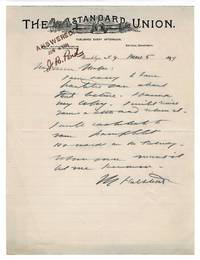
1894101010<p>Brooklyn NY June 5 1894. 1894. Very good. - Over 40 words in pencil on 10-1/2 inch high by 8 inch wide "The Standard Union" newspaper stationery. Apologizing about a lecture the American newspaper editor and war correspondent Murat Halstead offers to contribute an essay to the American impressario and lecture manager James B. Pond's pamphlet "I will contribute to your pamphlet 100 words on McKelway. When you receive it let me know." Signed "M. Halstead". Folded for mailing with minor creases and slight darkening along the bottom edge. Very good.</p><p>The American newspaper editor and magazine writer Murat Halstead 1829-1908 was a war correspondent during 3 wars. He started his career writing for "The Hamilton Intelligencer" and "The Roseville Democrat" at 18 years of age and went on to contribute to several other newspapers. He bought interest in the paper while working as a local reporter for Cincinnati's "Commercial". Halstead reported on several battles during the Civil War and was a war correspondent during the Franco-Prussian War. He took over controlling interest in the "Commercial" and became president of the company when the "Cincinnati Gazette" merged with his paper. Moving to Brooklyn in 1890 he edited the "Standard Union". He went to the Philippines as a war correspondent at the start of the Spanish-American War.</p><p>The article which Halstead mentions in his letter is about St. Clair McKelway the editor of "The Brooklyn Daily Eagle". Halstead's own paper the "Standard Union" was also in Brooklyn.</p> Brooklyn, NY, June 5, 1894.
183027905Belfast: The Paper 1830. four-page broadsheet with the usual folds and creases all text sound and readable. Issue 3959 of the paper. First Edition. Good. The Paper unknown
186319146Bells. Very Good with no dust jacket. 1863. First Edition. Non-Book. This original newspaper is in very good condition 8pp. featureson Naval Intelligence and lots of sporting stories. ; 22" x 16"; 8 pages . Bells unknown
185611772Buffalo New York: Buffalo Medical Journal 1856. First Edition. Hardcover. Good. 12 nos. bound in one volume; May 1855 July 1855 through May 1856. Black sheep spine & corners green & black boards scuffed & edge-worn good joints 8 1/2 x 6 inches. 760 generally clean pp. large dampstain top third of the first few pages fades out by page 8. This valuable medical journal was in print from 1845 to 1860. The focus of the publication is medical and surgical science. It includes recent discoveries treatments book reviews case histories lectures &c. Buffalo Medical Journal hardcover
185311771Buffalo New York: Buffalo Medical Journal 1853-4. First Edition. Hardcover. Good. 12 nos. bound in one volume. Black sheep spine & corners green & black boards scuffed & edge-worn good joints 8 1/2 x 6 inches. 760 generally clean pp. last few leaves with stain in the margin. This valuable medical journal was in print from 1845 to 1860. The focus of the publication is medical and surgical science. It includes recent discoveries treatments book reviews case histories lectures &c.This volume includes an editorial on the deficiences natural to women that make them unable to perform the work of surgery and of medicine in general. Their weaknesses limit their usefulness to the practice of obstetrics and only in established towns and cities for they are not suited for the hardships of the rural doctor. pp. 427-431. Buffalo Medical Journal hardcover
1900375731Builders' Journal London 1900. Hardcover. Good Condition. 11 volumes : 11 13-16 20 23-24 28-29 37. All in original period bindings. These are working copies and have minor wear and typical age related signs of use. They are not intended to be glamorous shelf bindings but useable working books for reference and research. Due to the complex and extensive nature of these substantial volumes it is not guaranteed that there are no missing plates or pages but they are priced appropriately to account for that uncertainty. These books have come in recent years from a private working collection and should be considered as ideal for that ongoing purpose. Given the weight it is very unlikely that overseas postage will be available on these volumes. UK delivery costs will be by arrangement our standard delivery price will not apply. Size: Folio Approx. A4 size. Category: Builder & Building News; Antiquarian & Rare; Architectural Interest Complete Volumes. Builders' Journal hardcover
187026Camden Maine: Dunton Brothers 1870. Wraps. Very good. 8pp; two horizontal folds; some spotting and chipping of edges; very good. The Camden Herald newspaper is a mid-coast Maine Knox County paper founded in 1869. This Extra reports on the Legislature includes legislation passed relating to: attorneys banks cemeteries coroners fishing highways industry lime insane hospitals insurance judgements land licenses liquor manufacturing pensions of soldiers and seamen railroads salaries schools tax collection and wildlife preservation. Dunton Brothers unknown
1883102240Hamilton: The Stock Journal Co. 1883-1888. First Edition. Quarter Leather. Fair. 4 vols.: 340; 336; 366; 354 p. 30 cm. Many b&w engravings of various animals and farm equipment. Leather with paper boards. Some loose pages. Volumes 2 and 3 have deteriorated worn spines remains of marbled paper and detached boards. O. A. C. bookplates and notations. Some cut-outs in volume 5. Occasional tears throughout. However these volumes are generally clean and tight. <br/><br/>Includes: Vol. 1 1883-84 Prospectus Number August and No. 1-11 including alternative version of No. 3 and the purple appendix; Vol. 2 1885 No. 1-12; Vol. 3 1886 No. 1-12; Vol. 5 1888 # 51-62 plus index. The Stock Journal Co. hardcover