8 résultats
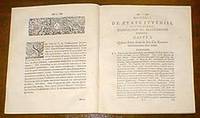
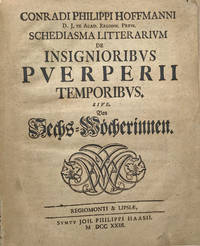
1723M13631Konigsberg & Leipzig:: Johann. Philipp Haas 1723. 1723. 199 x 163 mm. Small 4to. 96 pp. Title-page vignette headpiece; browned. Modern quarter white paper paper corners decorative boards modern end-leaves. Very good. FIRST EDITION. Hoffmann's compilation of literary scraps ancient and modern on the signs of childbirth. It is divided into three parts: pre- during and post-partum. CONTENTS: Chapter I.: De Temporibus ante Puerperium The time before childbirth. Chapter II: De Temporibus ipsius Puerperii The time during the childbirth. Chapter III: De Temporibus post Puerperium The time after childbirth. See: Blake NLM p. 216; Wellcome III p. 283. OCLC: 4 copies. Johann. Philipp Haas, 1723. hardcover books
17437882Regiomonti et Lipsiae: Impensis Francisci Bortoletti 1743. 4to. 96 pp. <br><br>Diss. Koenigsberg. First printed in 1721. Removed from a nonce volume. In very good condition. Impensis Francisci Bortoletti unknown books
1754M13008Genevae:: Apud fratres de Tournes 1754. 1754. Two parts in one. Folio. 24 x 35 cm. viii 871 1 pp. Collation: 4 A6-4D6. Half title title printed in red & black engraved title vignette Latin text printed predominantly in two columns engraved initials engraved head and tail pieces small woodcut fig. p.52; occasional minor stains some folds ownership signature Hermann . . . trimmed on title top edge. Original half calf over boards all edges red; heavily worn with chipped portions spine is mostly missing front joint reinforced with Kozo. Binding "as is" good internally. Bookplate of John G. Curtis Library of Columbia University. Rare. Second edition. "Hoffmann based his treatment on the use of sedatives tonics alternatives and evacuants according to the condition responsible for causing the disease. Apart from this system he was one of the premier practitioners of his day and one of the first to give good descriptions of appendicitis chlorosis rubella and convulsive asthma with dropsy." – Heirs of Hippocrates referring to the entire Opera. More description available on request. REFERENCES: The Dictionary of Eighteenth Century German Philosophers 3 vols. edited by Manfred Kuehn and Heiner Klemme London/New York: Continuum 2010; DSB VI pp. 458-461; Blake NLM lists editions from Geneva in 1740 1748 and 1761; Wellcome Library III p.285 2 vols. in 1. See: Garrison & Morton 72 for the complete 9 volumes published 1740-53; Justin E. H. Smith The Problem of Animal Generation in Early Modern Philosophy 2006; Willius & Dry A History of the Heart and the Circulation pp. 77-78. Apud fratres de Tournes, 1754. hardcover books
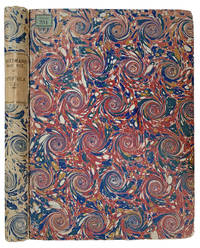
1738M13787Venice:: Apud Sebastianum Coleti 1738. 1738. Sq. 8vo. viii 311 1 pp. 2 small ink ownership stamps on title unreadable. Nineteenth century marbled boards printed title label on spine; extremities showing. Title verso with ink ownership stamp of Th. Renz. Very good. The work contains two parts of ten papers each for a total of twenty papers. Each studies aspects of medicine from the nature of art and efficacy in healing method application of drugs the power and efficiency of medicines applied the ability of the body to understand the remedies of drinking water and the virtues of milk in medicine the power of milk to heal qualities of mineral waters in promoting health. Continuing in the second part: salts as a healer the uses of China bark as applied to fevers uses of ejecting of venom the causes of death by disease the good of medicine the errors that are common in medical practice. "Friedrich Hoffmann also 'Hofmann' was born on 19 February 1660 in Halle where he also died on 12 November 1742. Called 'the second Hippocrates' and the 'Aesculapius Hallensis' he was among the most widely read medical authors of the eighteenth century and is best known for his systematic discussion of the iatromechanical model of medicine — similar to what Hermann Boerhaave 1668-1738 was developing at Leiden — that views the human body as a hydraulic machine wholly governed by mechanical laws. "Hoffmann's father Friedrich Hoffmann the Elder was the respected municipal physician of Halle. The younger Hoffmann enrolled at nearby Jena in 1678 the university at Halle would not open for another fifteen years where he studied medicine for two years under the iatrochemist Georg Wolfgang Wedel 1645-1721 also attending Caspar Cramer's lectures on chemistry in Erfurt in 1680. He received his doctorate in medicine from Jena in 1681 January 31 with a dissertation on suicide de autochiria and began lecturing on chemistry a standard course taught in the medical faculty but soon left perhaps pushed out by senior faculty jealous of his teaching success. After practicing medicine in Minden for two years Hoffmann made an academic tour of Belgium Holland and England during which he met Boerhaave Thomas Sydenham and Robert Boyle returned to Minden in 1684 and assumed various medical offices eventually being appointed the regional physician for Halberstadt. He married an apothecary's daughter Anna Dorothea Herstell on 10 December 1689. "In 1693 he was called to the newly-founded university at Halle as an ally of the Priest August Hermann Francke 1663-1727 with the charge of organizing its medical school and to serve as its first professor of medicine. He also became the godfather to Christian Wolff's first-born son Friedrich. Hoffmann recruited his old college friend from Jena Georg Ernst Stahl 1660-1734 for the second chair of medicine and the two taught side by side for twenty years transforming Halle into the preeminent medical school among German-speaking universities. Along with Boerhaave at Leiden Hoffmann and Stahl were the principal forces behind the medical reforms of the early eighteenth century. "Hoffmann was a member of the German Academy of Natural Scientists Leopoldina 1696 the Berlin Academy of Sciences he was included in Leibniz's founding lists and was inducted on 1 April 1701 the Royal Society of London 1720 and the Russian Academy of Sciences in St. Petersburg 1735. "In all Hoffmann authored about 400 publications mostly brief dissertations and essays but also the six-volume systematics discussed above a twelve-volume collection of case studies Medicina consultatoria 1721-39 and a nine-volume work on how to live a long and healthy life Basic Guide 1715-28 wherein Hoffmann emphasized the restorative effects of proper diet exercise clean air and sleep. He also criticized the diversity and overuse of drugs and was successful in reducing the pharmacopoeia of his day to a few basic remedies. -- The Dictionary of Eighteenth Century German Philosophers 3 vols. edited by Manfred Kuehn and Heiner Klemme. CONTENTS: Part I: 1 De naturae & artis efficacia in medendo. 2 De recta et simplicissima natura medendi method. 3 De medicamentorum prudenti application in tempore. 4 De prudenti medicamentorum continuation. 5 De vera medicamentor in morbis virtute et efficacia rite dignoscenda. 6 De cognoscenda corporis humani natura ex effectu remediorum. 7 De medicina simpilicissima & optima motu inedia aquae potu. 8 De mirabili lactis asinini in medendo usu. 9 De saluberrima seri lactis virtute. 10 De connubio aquarum mineralium cum lacte longe saluberrimo. Part II: 1 De salium mediorum excellente in medendo virtute. 2 De sale medicinali Carolinarum. 3 De manna ejusque praestantissimo in medicina usu. 4 De recto corticis chinae usu in febribus intermittenibus. 5 De purgantibus fortioribus ex praxi medica merito ejiciendis. 6 De medicina emetica et purgante post iram veneno. 7 De imprudenti medicatione multorum morborum et mortis causa. 8 De remediorum benignorum abusu et noxa. 9 De vesicantium et fonticulorum circumspecto in medicina usu. 10 De erroribus vulgaribus circa usum topicorum in praxi. / "Although Enlightenment physicians debated the suitability of milk as a treatment for different individuals and situations Friedrich Hoffmann's Treatise of the Extraordinary Virtues and Effects of Asses Milk 1754 exemplifies the basic understanding of its health benefits in the eighteenth century. Hoffmann who served as the physician to the Prussian King Friedrich I was a friend of Boerhaave and a proponent of the neo-Hippocratic school. He argues that since humans were nourished by a milky substance in the womb and raised on breast milk and since all food upon entering the body was transformed into a milky substance called chyle milk was 'manifestly proved to be the principal of all the kinds of aliment; so it may be deservedly reckoned the chief of all remedies.' Although Hoffmann preferred ass's milk for its resemblance to human breast milk he also recommended the milk of cows sheep and goats for the relief of fevers chronic coughs colic and nervous disorders -- the same aliments that afflicted Pompadour. Why was milk so effective" Hoffman argued that is possessed powerful cleansing properties functioning as a nonviolent purgative that penetrated the body's channels allowing fresh air to enter and perspiration to exit. It also removed obstructions in the chest lungs and bowels and returned the body to its proper system of 'flows.' Hoffmann told readers of how a certain 'gentlewoman' in his care who had been sick for years with fevers aches and pains began a course of milk treatment and 'in three days only everything appeared wonderfully amended.'" -- Meredith Martin Dairy Queens: The Politics of Pastoral Architecture from Catherine de' Medici to Marie-Antoinette Harvard Historical Studies Harvard University Pres 2011 pp. 135-6. REFERENCES: Blake NLM 217; Wellcome II 285. Apud Sebastianum Coleti, 1738. hardcover books
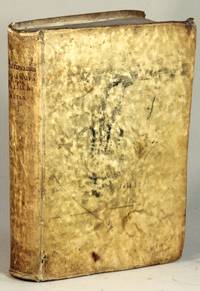
174553183Venetiis: Sebastianum Coleti 1745. 4to pp. 4 667 1; woodcut device on title page; text in double column; contemporary vellum soiled manuscript title on spine; good and sound. Hoffman 1660-1742 was a German physician and chemist. This is one of several volumes of his work published in Venice in 1745. This edition not found in OCLC. <br/><br/> Sebastianum Coleti hardcover books
170339786Halle: Renger 1703. 8vo. 16 213pp. 18th century half calf marbled boards. Very good copy. Second edition first published 1695. Renger unknown books
1732D7280Halle 1732-38. Hardcover. Very Good. Contemporary vellum over boards; 12 parts in 6 volumes 4to 166 x 206 mm. Frontispiece portrait in Volume 1. Bookplate of Herbert McLean Evans. Spines chipped and torn; boards lightly rubbed and dust-soiled; text blocks age-toned but otherwise clean. A nice set worthy of repair. <br/><br/>A collection of early editions of Friedrich Hoffmann possibly the most important of the latrochemists. Friedrich Hoffmann was one of the most distinguished physicians and chemists of his time court physician to the King of Prussia and primatus professor of medicine at the University of Halle. He was the first to perceive pathology as an aspect of physiology. hardcover books
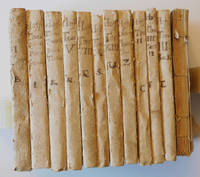
1753006549Neapoli : Benedicti Gessari 1753. The RARE First Italian edition published in Naples 1753-1763 this being a 12 volume partial set of Hoffman's major works containing the following: "Medicinae Rationalis Systematique" Tomus Secundus Tomus Tertius Section I and II all published 1753 and Tomus Quarti Pars Secunda and Pars Tertius 1754 ; "Observationum Physico-Chymicarum Selectiorum" Libri III 1755; "Operum Omnium Physico-Medicorum Supplementum" by itself a 13 volume set books 1 1754 5 1757 8 1760 10 1762 and 13 1763 ; and "Opuscula Medica Varii Argumenti Seu Dissertationes" 1756. Two of the volumes have handwritten " ex Libris Josephi de Bertolois Medici Physici Avia" an 18th century M.D. who appears to be the original owner. The "Opuscula Medici" and Book 1 of the "Operum Omnium" are Good only the "Opuscula Medici" lacking its binding but complete in its contents and Book 1 of the "Operum Omnium" the boards heavily soiled and loose in its binding. The rest of the 10 volumes Very Good soiling to boards some worm holes corner creasing. A remarkable collection of Hoffmann's works. First Thus. Handmade Paper Covered Boards . Very Good/No Jacket As Issued. 4to - over 9¾" - 12" tall. Benedicti Gessari Hardcover books