936 résultats
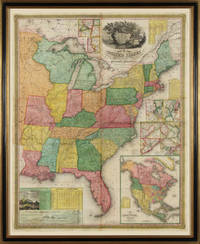
18454885Philadelphia: S. Augustus Mitchell 1845. Copper-engraved wall map with full original colour expertly repaired backed with modern linen trimmed in green cloth on contemporary rollers with bright colour overall in very good condition. An impressive wall map of the United States from a crucial year in American history.<br/> <br/> In 1834 Mitchell republished his A New Map of the United States under the title of Reference and Distance Map. New updated editions appeared almost yearly. When compared to the 1833 edition of the former this 1845 edition of the Reference and Distance Map shows many new developments in the upper Midwest. The outline of Lake Michigan has undergone extensive corrections. An oversized Wisconsin Territory 1836 now appears. Two of the small insets of American towns have been removed from the upper left-hand corner so that the new oversized Territory of Iowa 1838 could be added. The large inset General Map of the United States now shows Texas in its last year as an independent Republic. An important American map showing the country on the eve of its second great national expansion.<br/> <br/> Rumsey 4223; Phillips Maps p. 898. S. Augustus Mitchell unknown
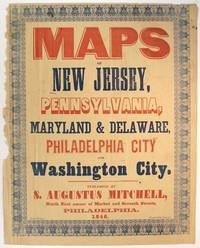
184660347Philadelphia: Evans printer Fourth below Chestnut 1846. Folio broadside approx. 17½" x 13¾" printed in red and blue with wood and metal type and within an ornate typographic border printed in blue. Left-hand margin slightly ragged but not touching the border; the whole slightly toned but on the whole very good. Purchased as a broadside in fact this is likely the upper wrapper of Mitchell's Maps of New Jersey Pennsylvania Maryland & Delaware Philadelphia City and Washington City five color maps issued together in 1846. Whether this colorful setting of type was used as a commercial advertisement beyond the obvious display on the wrapper is uncertain. Phillips List of Geographical Atlases in the Library of Congress 3692. Evans, printer, Fourth below Chestnut unknown
1888106806Philadelphia: J.B. Lippincott Company 1888. Rare first edition presentation copy of the father of American neurology's most popular work. Octavo original cloth with gilt titles to the spine and front panel. Presentation copy inscribed by the author on the front free endpaper "Mrs. Johnson with the author's regards." Weir has also noted "25 copies large paper No. 19." In near fine condition. One of Mitchell's most popular works Doctor an Patient provides a prime example of the eminent physician's direct appeal to the common sense and intelligence of the layman at large. Addressed chiefly to women the essays include: The Physician Convalescence Pain and Consequences The Moral Management of Sick or Invalid Children Nervousness and it Influence on Character and Out-Door Camp-Life for Women. The work quickly gained popularity upon publication and went through four revisions. Mitchell's more prominent patients included Charlotte Perkins Gilman and Virginia Woolf who wrote a savage satire of his treatments in her 1925 novel Mrs. Dalloway. J.B. Lippincott Company hardcover
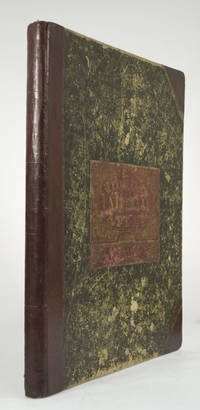
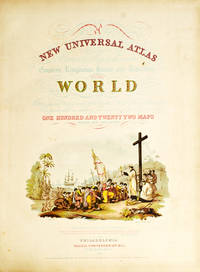
185265704Philadelphia: Cowperthwait & Co 1852. Complete with seventy-three full colored maps one of which is double-paged color frontispiece vignette title-page and table of contents heightened in gilt. Folio 17 x 14 inches; 430 x 355 mm.<br> <br> Half red morocco over marbled boards. Front board with red morocco label lettered in gilt. Binding scuffed and bumped. Hinges professionally repaired. Some toning throughout mainly to blank versos of maps and margin edges only occasionally affecting the maps. Closed tear to front free endpaper. A few instances of foxing on maps mainly to map 51 "Holland and Belgium." A small dark spot in Buenos Ayres on map 44. A small piece scraped off of map 73 "Oceana" but not making a hole all the way through. Also a marginal closed tear to this map professionally repaired. Overall a very good copy.<br> <br> This atlas was first published in 1846 by Mitchell & Sons after acquiring the rights to Tanner's New Universal Atlas in 1845. Mitchell & Sons reprinted it several times until 1850 when they sold the rights to Cowperthwait & Co. of Philadelphia who published it until 1856. During this time the atlas was further expanded and edited. Over half of this atlas deals with the Americas and features the double-page "A New Map of the United States of America." Within this map of the USA is a detailed inset of "The Gold Regions of California." The present edition is the first to show counties in California and New Mexico.<br> <br> Howes. Streeter.<br> <br> HBS 65704.<br> <br> $6500. Cowperthwait & Co unknown
181969865Atlanta Georgia August 18 1936. attractively matted and framed with the envelope to an overall size of about 20 x 16 inches. . Light horizontal creases where folded to fit the envelope; otherwise very fine. 10-1/2 x 7 inches. Mitchell thanks her correspondent for her kind remarks about "Gone With the Wind" and the verisimilitude of her characters: "I know no higher compliment that can be paid to an author." Her second paragraph discusses the novel's ending and the future of Scarlett and Rhett and concludes "I do hate to write. Just now I feel that I will never write anything again." unknown
185949436Philadelphia: S. Augustus Mitchell 1859. Large hand-colored wall map on rods approx. 64" square with 4 engraved vignettes 3 inset maps 2 of the world and 1 of the Sandwich Islands all within an elaborate floral border; some infill along the margins slight loss in the population tables at the bottom and several cracks in the paper the whole neatly and professionally backed with linen; overall appearance is certainly very good or better with the usual small defects. America as it was on the eve of the Civil War. Unusual features of this map include the Shoshone Territory what is now mostly Idaho Colona now part of Colorado the unusually large Nebraska the horizontal Utah and New Mexico and the unusually small Dakotas. Phillips Maps of America lists only the 1856 edition. OCLC records examples from 1856 1857 both on conjoined sheets 1858 1860 and 1861 but not this. S. Augustus Mitchell unknown
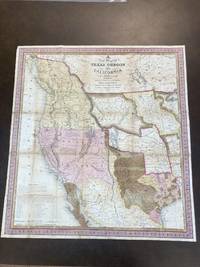
184687887Philadelphia PA: S. Augustus Mitchell 1846. Map. Good Plus. Folding lithographic map 22.75 in. x 21 in. with original color. Map is laid flat in archival plastic and will be securely protected and shipped in a mailing tube. Tanning to seams. Tape repairs and reinforcement on verso to all seams. Tiny losses of paper at six seam junctions. Storm 2841. Wagner-Camp 122b. <br /> <br /> This is Mitchell's third map of Oregon the first being "Oregon and California" published in Mitchell's ;School and Family Geography; and the second being "Mexico and Guatemala" which includes Upper or New California New Mexico and Texas." Wheat Mapping The Transmississippi West 520. Carl Wheat described it as: ".a work of real importance highly popular and.on it the influence of the War wioth Mexico is strikingly revealed.It was among the first by a commercial cartographer to utilize the recent explorations that had bounded and determined the nature of the Great Basin. The Texas claim to a western boundary up the Rio Grande is here shown with the northern panhandle extending all the way to the 42nd parallel.Because of its popularity this map of the West exerted great influence not only on the public but on other commercial cartographers." "The region covered by the map was of particular interest in 1846 because of two recent and related events. In 1845 Texas was admitted into the Union which prompted Mexico to invade Texas in 1846 thus precipitating the U.S.-Mexican war. General curiosity about the new State of Texas and interest in the war with Mexico led to Mitchell's timely map becoming quite popular. Mitchell used the latest and best sources for the map including Arrowsmith's 1841 map of Texas Fremont's and Emory's maps of their explorations in the region data from the Lewis & Clark expedition Nicollet's map of the region between the Mississippi River and the Missouri River Wilkes map of Oregon. <br /> <br /> Among other significant uses of the map Brigham Young ordered 6 copies of the map and an example in the BYU collection includes an annotation placing the Mormons in Utah pre-dating Fremont's map of 1848 which is the first printed map noting the presence of the Mormons in the Great Basin. <br /> <br /> The map shows Texas's claims to the Upper Rio Grande in present-day New Mexico -- eventually given up as part of the Great Compromise of 1850 in exchange for the U.S. Federal Government's assumption of Texas's public debt. One of the most influential maps in Western American History." from Stanford University Library. S. Augustus Mitchell unknown
1852236680Philadelphia: Thomas Cowperthwait & Co 1852. Chromolithograph title hand-colored frontispiece 73 hand-colored lithographic maps. 1 vols. Folio. Half red morocco in period style original marbled boards with printed label on upper cover very clean. Chromolithograph title hand-colored frontispiece 73 hand-colored lithographic maps. 1 vols. Folio. Mitchell & Sons first published their NEW UNIVERSAL ATLAS in 1846 having acquired Tanner's NEW UNIVERSAL ATLAS in 1845 and printed it several times subsequently until 1850 when the firm sold the rights to Cowperthwait & Co. of Philadelphia who published it until 1856 continually adding to and editing the hand-colored maps. Despite the attribute "Universal" in the title the Atlas clearly concentrates on America with 43 maps of the continent and features a large double-page transcontinental map of the U.S; and this 1852 Cowperthwait edition is the first to show counties in California and New Mexico. Phillips 809; Ristow pp.311-13; Rumsey p.240 Thomas, Cowperthwait & Co unknown
183122138Philadelphia 1831. No binding. Fine. Map of the United States. Entered according to Act of Congress in the Clerks Office of the Eastern District of Pennsylvania October 10th 1831. Philadelphia 1831. Folding map on four sheets joined. Folding into original covers 8vo binding size: 9 5/8 x 6 1/2 in. red half morocco over marbled paper boards upper cover with gilt-lettered title label corner and edges worn. The map and covers now apart and separately mounted for display. Historical BackgroundFirst edition and the first wall map issued by Mitchell. This edition does not have the counties delineated and numbered. Ristow mistakenly says all editions have the townships he means counties numbered but this one the first does not thereby eliminating the index of counties and thus showing more of the western territory. This map predates the Traveler's Guide by 1 year and thus is Mitchell's first ""original"" production as opposed to the Finley material he reissued as the American Atlas and Pocket Maps. Copyright date is October 10 1831. There is no other date on the map. Ristow thinks the map was issued in early 1832 but it is not in Phillips until 1834 edition which probably has the counties indicated by number and the 1831 copyright so Ristow may not have seen this edition but rather the 1834.ReferenceKarrow 1-1473; Ristow p309.ConditionOriginal full color the palette rich and bright. One 5-inch repaired tear at left into Arkansas some cracking and more minor tears at folds. Some overall browning of the sheet. In good condition.
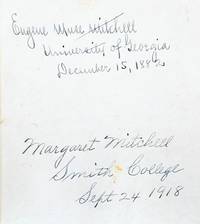
1882176004Boston: Ginn Heath & Co. 1882. A glimpse into Mitchell's family life and thwarted education A resonant literary artefact from a formative period of Mitchell's life: her family's copy of a dictionary used in her early days at Smith College and inscribed by her upon enrolment. A gift from her father a prominent Atlanta lawyer and historian it is inscribed by both generations on the front pastedown: "Margaret Mitchell Smith College Sept. 24 1918" and above her father's inscription from his own university days: "Eugene Muse Mitchell University of Georgia December 15 1882". Both father and daughter have practised their signatures elsewhere in the volume. It was Mitchell's suffragist mother May Belle Stephens Mitchell who encouraged her to attend Smith the prestigious female liberal arts school; she wanted her daughter to be educated as preparation for life's vagaries. May Belle loomed large as a figure of admiration and influence in Mitchell's early years but she did not live to witness the fruits of her daughter's schooling and the literary success of Gone with the Wind. In 1919 she died of influenza. This and the death of Mitchell's fiancé in action during the First World War prompted Mitchell to abandon her studies after her freshman year. She left Massachusetts and returned to the South to assume a role in her family's household supporting her father and stepping into her mother's role of a society hostess. 2 works in 1 octavo 188 x 140 mm presumably issued thus. Early 20th-century black textured coated cloth cloth labels lettered in manuscript. Housed in a custom green half morocco slipcase. Annotations to rear blank and throughout in an unidentified hand. Spines ends worn repair to covers inner hinges strengthened with linen spine labels toned and lifting slightly couple of small damp stains to edges loss to lower outer corner of first title page small tear to pp. 246-7 in second work contents toned. hardcover
186064001London UK: William Tweedie 337 Strand 1860. Small 4to. 5.25 x 7.5 in. xv 1 3-172 xi 1 pp. Woodcut-engraved frontisp. of the author still preserving tissue guard. Publisher’s ribbed plum-coloured cloth dark maroon coloured title label & price of 1 shilling 6 pence mounted front cover very minor chipping head & foot of spine slight fraying title label stamping dimmed and minor bumping to a couple corners still a VG copy w/ London UK bookseller’s label partially removed at gutter margin front pastedown. First edition first printing of the first book wholly devoted to the Underground Railroad published only in England and by an African-American/Native-American author. Mitchell was a pivotal figure in the Underground Railroad who also aided the escaped slave “Eliza†whose escape over the Ohio River ice inspired the key dramatic moment in Harriet Beecher Stowe’s pivotal Uncle Tom’s Cabin. “Eliza†was sheltered originally in the network by noted abolitionist John Rankin passed on to Mitchell who then subsequently ensured her safe passage along the network overseen by Levi Coffin 1798-1877. Ironically the passage of the 1850 Fugitive Slave Act which criminalized those aiding in the Underground Railroad to free slaves with fines of $ 1000 and six months imprisonment fueled resistance and forced Mitchell to publish this seminal work in Great Britain rather than the U.S. As a freeborn orphan Black in North Carolina Mitchell was forced into apprenticeship with a North Carolina plantation owner where he witnessed the deprivations of slavery and became inspired to aid African-American slaves to escape to Canada. From 1842-1855 he helped over 1300 slaves reach Canada from his Washington Court House Fayette County Ohio way station. This memoir recounts many anecdotes of the formerly enslaved including: one enslaved woman who died from frostbite while protecting her three children and a former slave John Mason brought Mitchell in just 19 months of that 13 year span “265 human beings whom he had been instrumental in redeeming from slavery.†Mitchell further recounts Mason’s recapture in Kentucky and later escape from New Orleans to Canada. Mitchell estimates in his book that 60000 enslaved peoples escaped into Canada on the Underground Railroad modern estimates range from 40000 to 100000. At the end of the 1850’s he moved to Toronto and began serving as a minister to African-American Baptist Free Mission congregations largely composed of freed slaves and the final section details the lives of these Canadian Black immigrants. In the final appendix he urgently pleads for a boycott of Southern cotton by Great Britain attempting to overcome resistance to the economic impact and hardship it would have on British cotton mills and related industries. Mitchell c. 1826-c.1879 was encouraged to write this historic work by W.H. Bonner A British abolitionist and had toured Britain in 1860 with William Howard Day and British abolitionist George Thompson to oppose the condition of slavery before the outbreak of the Civil War. This work is quite scarce with only 2 copies at auction in the last 50 years and both those appear to have been the 2nd edition which removed the hyphen in “Under-Ground†extended the title and a couple other revisions. William Tweedie, 337, Strand, hardcover