2 résultats
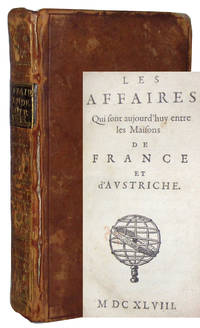
1648FRLIT001Belgium: Louis Elzebier 1648 First edition. Finely bound in mid-18th century brown calf ruled in blind to boards and in gilt to spine with decorative floral tooling and a black leather spine label lettered in gilt board edges tooled in blind red text block edges red marbled endpapers two blue silk markers present. A very good copy with wear to extremities and front hinge cracked but holding otherwise a beautiful copy with a clean interior. A non-fiction discourse on the state of relations between France and Austria this text seeks to highlight the historical events beginning in 1477 that led to the various wars conflicts and periods of peace between what were the two most powerful Christian states in Europe. First Edition. Hard Cover. Very Good. Belgium: Louis Elzebier hardcover books
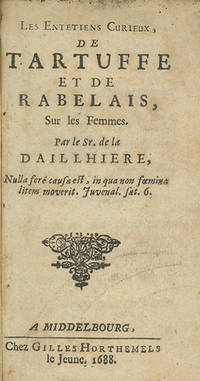
168828487Middelburg: Gilles Horthemels le Jeune 1688 1688. First edition. Brunet II 470; Cioranescu Bibliographie de la Littérature Française 38017; OCLC records 12 copies five in the US and seven in Europe and Britain. Edges of the binding a little rubbed; scattered stains and foxing; paper repairs to the final two leaves mostly marginal but affecting a few letters at the extremities of three lines in the penultimate leaf; very good copy. Small 12mo 19th century brown half morocco signed P. Pralon of Dijon dark brown paper boards blind rules and gilt lettering. Woodcut device on the title-page and two woodcut initials. 12 95 pages. ¶ Three ingenious bold and entertaining imaginary conversations between the fictional character of Moliere's famous play Tartuffe and the deceased François Rabelais written pseudonymously and modeled most closely on the dialogues of Lucian Pietro Aretino and Bernard le Bovier Fontenelle. The subject of the conversations is women men's relationship to women procreation coquetry seduction and caring for them including the roles of eunuchs in classical antiquity. Moliere's character Tartuffe made his first appearance on stage in 1663. Outwardly he was pious but in reality he was mercenary lecherous and deceitful. Both character and play were popular but frowned upon by the church and banned which made pairing him in dialogue with the master of satire free-thinker and great writer Rabelais circa 1485-1553 intriguing. In one part of the second conversation the character of Rabelais teasingly critiques the work of Moliere. And in the preface the pseudonymous Le Sieur de la Daillhiere falsely claims as Tartuffe might have that there is no sin in the text of the dialogues. ¶ This is an early example of a dialogue that uses literary figures as its interlocutors. The dialogue form was popular in France in the 17th century and was used most successfully by Fontenelle 1657-1757 and François Fénelon 1651-1715. In the preface the author states that his reason for anonymity was "that the work doesn't deserve it being a mere trifle in comparison to other works he is about to give to the public of which the present is merely an outline." ¶ From the library of French bibliographer Gabriel Peignot 1767-1849 with the manuscript notation on front blank "Vente Peignot." Catalogue de la Bibliothèque de feu Gabriel Peignot page 227 #1883 this copy. On the front paste-down is the armorial bookplate of Jean-Baptiste Philippe Constant Moens 1833-1908 the Belgian philatelist considered the first dealer in stamps for collectors. <br/><br/> Middelburg: Gilles Horthemels le Jeune, 1688 unknown books