44 résultats
194827263Paris: Éditions surréalistes 1948. First edition. 13 p. 17 cm. Wrappers fine. One of 30 numbered copies on Marais paper. Fine. An anti-clerical tract signed in type by Adolphe Acker Sarane Alexandrian Maurice Baskine Jean-Louis Bédouin Hans Bellmer Jean Bergstrasser Roger Bergstrasser Maurice Blanchard Joë Bousquet Francis Bouvet Victor Brauner André Breton Jean Brun Pierre Cuvillier Pierre Demarne Charles Duits Jean Ferry André Frédérique Guy Gillequin Arthur Harfaux Jindrich Heisler Georges Henein Maurice Henry Jacques Hérold Véra Hérold Marcel Jean Alain Jouffroy Nadine Kraïnik Jerzy Kujawski Pierre Lé Stan Lélio Pierre Mabille Jehan Mayoux Francis Meunier Nora Mitrani Henri Parisot Henri Pastoureau Benjamin Péret Gaston Puel Louis Quesnel Jean-Dominique Rey Claude Richard Jean Schuster Iaroslav Serpan Seigle Hansrudy Stauffacher Claude Tarnaud Toyen Clovis Trouille Robert Valançay Jean Vidal Patrick Waldberg. Éditions surréalistes unknown
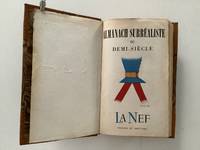
195020415AB1950. Paris Editioons du Sagittaire 1950 23 : 15 cm. 1 leaf 226 pages with many dual-tone and b/w illustrations 6 leaves advertisment. Half calf original coloure wrappers bound in. SURREALIST ALMANAC OF THE HALF CENTURY - Calendar of the World Tour of Tolerable Inventions by André Breton and Benjamin Péret. First edition text in French. unknown
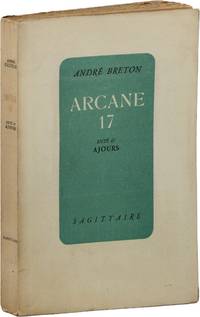
194788266Paris: Sagittaire 1947. First French Edition. First Impression regular issue. Octavo 18.5cm; original printed card wrappes; 67-2226pp. From the library of noted poet translator and anthropologist Nathaniel Tarn 1928-2024 with 7 lines of penciled notes on rear wrapper and some light pencil markings in text. Light wear to extremities gentle sunning to spine mild dust-soil to wrappers with some of the usual tanning to text edges; Very Good. A significant surrealist text about the discovery of love through loss written while Breton and his third wife Elisa were self-exiled in Canada. Portions of the work were originally published in New York. 88266. Sagittaire unknown
19392092902137302598Atorie-sha 1939. Soft Cover. Fine. The book is in fine condition. Atorie-sha paperback
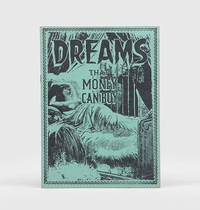
1956227075Paris: Jean-Jacques Pauvert 1956. First. paperback. very good. With b/w illustrations throughout. 168pp. Tall 8vo green printed wrappers spine ends a bit worn. Paris: Librairie Jean-Jacques Pauvert 1956. A very good copy of this uncommon surrealist periodical.<br/> <br/> Jean-Jacques Pauvert unknown
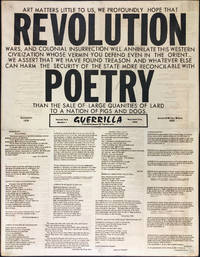
196846364New York 1968. First edition. A very good cop a few corner tape marks and pin pricks folds. 17x 22 inches. Published by Allen Van Newkirk later arrested for holding up a Toys-R-Us store in 2005 and who in the 1960s charged the stage during a Kenneth Koch reading firing a pistol loaded with blanks declaring "death to bourgeois poets" the free newspaper of the streets was an important if short lived publication helping to shape the counterculture’s understanding of surrealism’s relationship to contemporary social movements and is perhaps best summed up by the subtitle of this issue taken from the surrealists' open letter in 1925: “Art matters little to us we profoundly hope that revolutions wars and the colonial insurrections will annihilate this Western civilization whose vermin you defend even in the Orient and we call upon this destruction as the least unacceptable state of things for the mind…We assert that we have found treason and whatever else can harm the security of the State more reconcilable with poetry than the sale of ‘large quantities of lard’ to a nation of pigs and dogs."<br /> <br /> Includes poetry and quotes from Ed Dorn LeRoi Jones Surrealists Rimbaud Smohalla Nez Perce tribe Diane Di Prima Sam Abrams Robert Kelly Margaret Randall Victor Hernandez Cruz and others. And an illustration attributed to “CHE†of a modified weapon designed to launch Molotov cocktails.<br /> <br /> Scarce. OCLC locates only six copies of this issue: NYU Yale Univ. Kansas Univ. Indiana Northern Illinois Univ. While we could locate a few auction and sales records for other issues we could find none for this issue. unknown
196623242Paris: Lettres Modernes 1966. soft covers as issued. four volume set. vol. 1 has an owner name/date to first page. minor bits of exterior wear a little crease a little smudge. no text markings. no tears. strong sewn bindings.; french text as issued.; no. 1 1966 232pp./no. 2 1968 264pp./no. 3 1969 147pp./no. 4 1970 176pp. some have b/w figures. each contains numerous articles documents essays by various contributors. First Edition. Soft Cover. Very Good Plus. 8vo - over 7¾" - 9¾" tall. Multi-Volume Set. Lettres Modernes Paperback
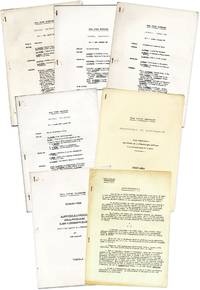
195386611France: Cercle D'Etude Metaphysiques 1953-1955. Archival Materials. A collection of privately printed/reproduced booklets and newsletters issued by the Cercle D'Etudes Metaphysiques between 1954-1955. 27 pieces in total. All components typewritten and mimeo'd on multicolored paper. Some light wear and toning in places to the staple bound pieces all very good or better.<br /> <br /> Comprising:<br /> <br /> 1. Dialectique De L'Initiation: Premiere Partie Fasicules I-VI; Deuxieme Partie Fasicules I-IV; Troisième Partie Fasicules I-III.<br /> 2. Circulaire Janvier 1955 single orange mimeo'd paper sheet printed recto only<br /> 3. Lettre Circulaire No. I-IV staple-bound reproduced on irregularly sized and colored paper sheets. 9pp. <br /> 4. Travaux des Membres; La Constitution de L'Objective Selon La Critique de Kant et Selon La Phenomenologie de Husserl.par Jean Largeault. 16pp. staple-bound. Dated 15 Mars 1955.<br /> 5. Cercle D'Etudes Metaphysiques "Journal Interieur" Nos. 1-8 with the final issue dated Juin-Septembre 1955 being a double issue. <br /> <br /> The very privately printed and distributed output of the short-lived and incendiary "Cercle D'Etudes Metaphysiques" formed in 1953 by the self-styled visionary Raymond Abiello actually a pseudonym of the eclectic and confounding Georges Soulès.<br /> <br /> Soulès was born in Toulouse in 1907 studied at the local Polytechnique and in his early 20's discovered and joined the post-1929 crash youth movement known as "X-Crise" a technocratically inclined group who believed that classical liberalism had failed as a means of socio-economic control and should be replaced with strict economic planning. Members included Soulès Louis Vallon Jules Moch and Alfred Sauvy.<br /> <br /> Their theories and reconstructivist drive have been directly linked to the creation of the collaborationist Vichy government in France during WW2. Sauvy in particular rose to post-war prominence as the Head of the Institute for Demographic Studies the INED and is remembered as the man who coined and popularized the term "Third World" in application to developing non-white nations. Abellio/Soules was among the numerous Vichy/Nazi sympathizers who went into exile in Switzerland to avoid imprisonment.<br /> <br /> Inspired by Gurdjieff the I-Ching Gnostic Mysticism Qabbalism Jungian theory Biblical Gematria early Surrealists and all points in between Abiello formed the Cercle D'Etudes Metaphysiques in 1953 with fellow travellers Jean Largeault and Bernard Noel both of whom feature heavily in the "Journal Interieur" contributing articles and manifestos on diverse subjects such as "Kafka and the Terrible Father" and "The Problem of Homosexuality" in tandem with the openly gay Raymond De Becker's "L'Homosexuel et la Magna Mater". <br /> <br /> Other contributors or collaborators included Jean Cocteau; Irene Tateossian; Raymond De Becker the Belgian journalist and writer who espoused the idea of "Intellectual Collaboration" during the war and edited the Nazi sanctioned newspaper "Le Soir"; Henry Lhong a rather incendiary figure in the Toulouse art scene of the 1950's who founded the aggressively disruptive L'Atelier Gallery and created the "Art Presente" shows in direct conflict with Toulouse's more traditionalist "Art Occitans" and "Artistes Méridionaux" events; Olivier de Carfort who made contributions to the avant-garde journal "Bizarre" alongside Jean Paulhan Eugene Ionesco Rene Magritte and others<br /> <br /> Abellio's C.E.M. seems to have been the industrious loom for a number of interconnecting threads; avant-garde artistic sensibilities crypto-fascist societal reform homosexuality and esoteric and occult researches for the furtherance not necessarily of mankind in general but certainly for those who were found strong and intellectual enough to handle the rigours of enlightenment. Jungian Psychoanalysis is woven in alongside Huserlian philosophy the symbolic incomprehensibility of surrealism knotted in with the arcane complexities of Eastern transcendentalism all laid across a ground preoccupied with one shared belief among all the other whirling beliefs; that art and intellectual thought if not western society in general was in the midst of what Cercle member Henri Lhong described as "La crise metaphysique du siecle" the idea that 20th century humanity had lost its way and must seek deep in the metaphysical and esoteric realm to find it again.<br /> <br /> A dense and as far as can be ascertained substantially complete collection of the main elements of the Cercle's internal publications; necessarily only printed for a small number of members and comprising a combination of newsletter manifesto and conceptual primer of their inner workings. No trace can be found in commerce a couple of references in the art world where the C.E.M. intersected with the mainstream avant-garde and no holdings in institutional libraries except for one 1954 issue of the Journal in the National Library of France. Cercle D'Etude Metaphysiques unknown
1966205540Paris: Lettres Modernes 1966. Brossura con copertine stampate in litografia camicia custodia original publisher's printed lithograph wrappers chemise slipcase. Molto buono Very Good. Etudes: Dada étude linguistique de la fonction d'un terme qui ne signifie rien Jean-Claude Chevalier; Dada a Paris Michel Sanouillet; dada en Russie Benjamin Goriely; Perspective sur Dada Michel Seuphor; Yhe Nadja File Roger Shattuck; Le mythe de L'Amour sublime dan Feu central de Benjamin Peret marie-Odile Blanquaer; Edgar Varese Pierre de Massot; Format écolier André Tinel; Aventure et Dés Henri Béhar. Inédits: Le dossier de Dadaglobe Michel Sanouillet; Georges Ribemont-Dessaignes: Larmes de couteau Presentation par Michel Corvin; Georges Ribemont-Dessaignes et le laboratoire Art et Action; Georges Ribemont-Dessaignes et Autant-lara: l'affaire des prix; The Mechanics of The Large Glass Arturo Schwarz. 16mo. pp. 32. Molto buono Very Good. . Lettres Modernes, unknown
194987656Paris: Gallimard 1949. Second edition in same year as first. 12mo 16.5cm. Original printed wrappers; 1082pp. A very fresh copy with just a bit of toning to spine; text entirely unopened pages uncut; Near Fine and unusual thus. Text entirely in French. Gallimard unknown
199325103New York:: Paragon House 1993. First Printing of the First Edition. A Fine tight copy in a Fine bright unclipped dust jacket. The closest Andre Breton has ever came to writing an autobiography Conversations--based on a series of radio interviews conducted with the founder of Surrealism in 1952--chronicles the entire Surrealist movement as lived from within tracing the origins and development of Surrealism from the discovery of automatic writing in 1919 to the Surrealists' ideological debate with communism and their opposition to Stalin. Paragon House, unknown
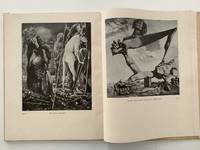
195016861AB1950. Heidelberg Lambert Schneider 1950. 30 : 235 cm. 90 pages with 36 illustrations 16 1 coloured plates. Original boards First edition. - Introduction into surreal literature and painting on psychoanalytiv basis.based on the method of the complex psychology of C.G. Jung as well as the psychoanalysis of Freud. Very well documented. Treats the most important movements of modern art 'the presurrealist poems' Jarry Rimbaud Lautremont Apollinaire 'the surrealist m ovement' 'the surrealist authors' all important authors 'the painting of surrealkism' most detailled about Max Ernst specially the collage's of Max Ernst. The first issue of 'Un Semaine de Bonté' 'Le Lion de Belfort' and the paintings which are especially typical for surrealism are analyst in-depth. hardcover
1947179710New York: 1947. An original brochure for this classic surrealist film. It features items from each of the film's collaborators: Max Ernst Fernand Leger Man Ray Marcel Duchamp Alexander Calder and the director Hans Richter. Richter began the project in 1944 after receiving a $6000 grant from Peggy Guggenheim. In an interview with the New York Times Richter stated "I started the picture as an adventure. But I knew one thing that was important. That is in cinematography we have scratched only the surface of the art and that there are thousands of other possibilities in film. I felt that both modern art and the movies are an expression of our time and that it would be interesting to combine the two." Octavo. Photographic portraits and reproductions from the film in the text throughout. Original green wrappers printed in black after a design by Max Ernst. A fine copy. Ezra Goodman "Musical Fantasy Filmed in Manhattan Loft" New York Times 11 April 1948. unknown
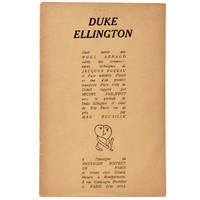
1950333501Paris: Messager Boiteux de Paris 1950. First edition limited to 500 copies. Text in French. 8vo. Front cover has tiny closed tear at top edge small soil spot and faint crease at lower fore-corner else a very good copy. First edition limited to 500 copies. Text in French. 8vo. Surrealist and Dada writings inspired in part by Jazz and the music of Duke Ellington. OCLC locates seven holdings Library of Congress Emory Northwestern Illinois Missouri Hofstra and South Carolina State. T.C. #1. T.C. #1 <br/><br/> Messager Boiteux de Paris unknown
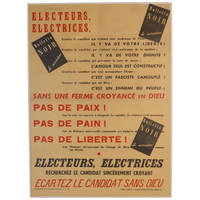
1952362568Paris: Pour l'Unite 1952. A French election poster from ca. 1951 with a connection to the Surrealists from three printed emblems reading "Bulletin NOIR Les Surealistes." Your cataloger's knowledge of French and French politics after the Second World War is not sufficient to offer an analysis of the poster. One suspects it mostly means the opposite of what it says or that it is a sort of word salad of election-style statements without meaning but draw your own conclusions:<br /> <br /> Pas de paix! Car la voie est ouverte à l'orgueil la cupidité la violence et le mensonge No peace! Because the way is open to pride greed violence and lies.<br /> <br /> Écartez le candidat qui préconise la lutte de classe. L'amour seul est constructif! Reject the candidate who advocates class struggle. Love alone is constructive!<br /> <br /> Published as a supplement to l'homme nouveau no. 97.<br /> <br /> 17-3/16 by 23-3/4 inches. Good only apparently removed from a wall with some loss to the margins repaired with infill paper. Linenbacked. Pour l'Unite unknown
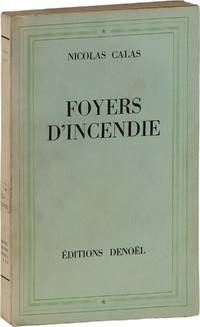
193887425Paris: Éditions Denoël 1938. First Edition. First printing. Octavo 23cm. Printed paper wrappers; 261pp. Text mostly unopened. Fading to spine with scuffing to publisher's price-sticker; expected toning to text; still a tight lightly worn copy Very Good. Text entirely in French. There was no numbered issue. <br /> <br /> Quite presentable copy of Calas' first surrealist work written shortly after his relocation to Paris from his native Athens. Foyers d'Incendie "Hearths of Arson" based in large part on Calas' reading of Trotsky's theoretical works on the role of literature in revolution won high praise from André Breton and would become one of the great forgotten texts of Marxist Surrealism never being reprinted in French and translated into only a few languages. Calas would later move to the U.S. where he collaborated with Charles Henri Ford on the American surrealist journal View. GERSHMAN p.12. Éditions Denoël unknown
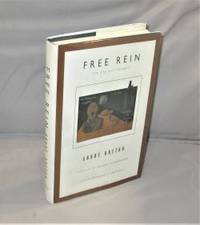
199527755<p>Surrealism Breton Andre. Free Rein: Essays. Lincoln: University of Nebraska Press 1995. First Printing of the First US Edition. ISBN: 0803212410. A Near Fine copy faint remainder stamp in a Fine dust jacket. Free Rein is a gathering of seminal essays by André Breton the foremost figure among the French surrealists. Written between 1936 and 1952 they include addresses manifestoes prefaces exhibition pamphlets and theoretical polemical and lyrical essays. Together they display the full span of Breton's preoccupations his abiding faith in the early principles of surrealism and the changing orientations in light of crucial events of those years of the surrealist movement within which he remained the leading force.Having broken decisively with Marxism in the mid-1930s Breton repeatedly addresses the horrors of the Stalinist regime which denounced him during the Moscow trials of 1936. He argues for the autonomy of art and poetry and condemns the subservience to "revolutionary" aims exemplified by socialist realism. Other articles reflect on aesthetic issues cinema music and education and provide detailed meditations on the literary artistic and philosophical topics for which he is best known. Free Rein will prove indispensable for students of Breton surrealism and modern French and European culture. </p> University of Nebraska Press, hardcover
19722092902137306827Shinchosha 1972. Soft Cover. Fine. The book is in fine condition. Shinchosha paperback
19509830Munich West Germany 1950. Four original ink drawings on paper various sizes roughly 14x10" up to 20x14". Two are dated "24 X 50" and perhaps from a series with roman numerals IV and V. Another is dated "20 XII 50" and the last simply dated 52. Some light foxing and a few faint stains and smudges corners occasionally bumped. Residue from old adhesive on back of one of the larger images the two smaller pieces matted. Generally very good. <br /> <br /> A cohesive group of four surrealist ink drawings by Rolf Engler active in West Germany in the early 1950s as both painter and experimental filmmaker associated with the Munich film industry. The drawings dated across the years 1950-1952 fall squarely within the period of Engler's work on the animated short Der Traum in Tusche A Dream in Ink 1952 an abstract animated film employing fluid ink imagery and experimental animation to explore the psychological devastation of war lingering guilt and unresolved trauma through dreamlike and nightmarish forms. The Harvard Film Archive described the work as "an animated fantasy film with nightmarish aspects including not overly allegorical references to the more recent past made by a genius of the FRG animation art." Der Traum in Tusche received a prestigious Bundesfilmpreis in 1953 and was later screened at the Locarno International Film Festival and other such events.<br /> <br /> Though we have not been able to view the film the present drawings exhibit the same visual language described: surreal figures distorted anatomy and shifting dreamlike forms rendered in bold ink line and fluid drawing techniques that formed the basis of Engler's experimental animated work. Two pieces bear Roman numeral notation suggesting a conceptual or sequential framework consistent with animation-adjacent production methods. We find it very likely these drawings were either used or heavily influential in Traum in Tusche or other projects of Engler's from this time period. <br /> <br /> <br /> We find documents and scripts by Engler held in the Landesrchive in Nordrhein-Westfalen though we have not been able to find examples of his artwork. A rare surviving group of works on paper from the formative years of postwar German experimental animation preserving the hand of an elusive but historically important mid-century artist and filmmaker. <br /> <br /> <br /> . unknown
193687495London: The Surrealist Group in England 1936. September. Small 4to. 18 pp. Near fine in glossy illustrated wrappers. Texts in English and French. Issued shortly after the International Surrealist Exhibition held in London from 11 June to 14 July 1936. Ten b&w reproductions. London: The Surrealist Group in England, unknown
1936SURREALI002339The Surrealist Group in England London. September 1936. First edition. Quarto. 20 pages. Illustrations. Wrappers. The publication of this issue marked the International Surrealist Exhibition at the New Burlington Galleries 11th June to 4th July 1936. The artists and writers included Paul Nash Andr� Breton Edward Burra Hugh Sykes Davies Julian Trevelyan Ruthven Todd Roland Penrose Henry Moore Man Ray Len Lye David Gascoyne and Paul Eluard. Contains a speech by Herbert Read as well as extracts from a lecture by Hugh Sykes Davies "Biology and Surrealism". Parallel texts in English and French. Staples rusted. A bit of creasing to spine. Very good indeed. The Surrealist Group in England, London. September, unknown
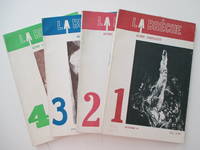
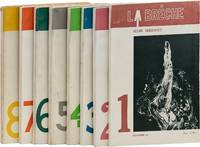
196117854AB1961. Volume 1 - 4 off 8. Paris La Terrain Vague 1961 - 1963. 23 : 15 cm. With many illustrations. Illustrated original wrappers. First edition of the first 4 issues of this rare journal a total of 8 issues was published. With literary contributions by Andre Breton Gérard Legrand Paul Nougé Jean-Claude Silbermann etc. and illustration by Dali Kubon Schroeder-Sonnenstern René Magritte Konrad Klapheck and others. llustrées.Revue littéraire et artistique parue sous la direction de André Breton. 8 numéros en 8 livraisons du n° 1 octobre 1961 au n° 8 novembre 1965.Dernière revue dirigée par André Breton elle prend fin à sa mort. Comité de rédaction Robert Benayoun Gérard Legrand José Pierre Jean Schuster. Textes et illustrations de Pierre Alechinsky Arrabal Vincent Bounoure Annie Le Brun Ghérasim Luca René Magritte. - unknown
196189467Paris: Le Terrain Vague 1961-65. Eight octavo digest-size issues. Pictorial wrappers printed in colors; each issue ca. 124-132pp; illus; ads. Gentle rubbing and soil to most issues but in all a complete attractive and perfectly sound run easily Very Good. Text entirely in French. <br /> <br /> Breton's final periodical venture a continuation of sorts of his long succession of Surrealist journals that included La Révolution Surréaliste 1924-1929 Surréalisme au Service de la Revolution 1930-1933 and Minotaure 1933-1939. La Brêche is the definitive journal of late-period Surrealism very much pointing the way towards the movements - Pop Art Situationism Abstract Expressionism etc - that would soon supplant it. The journal ceased publication in November 1965 presumably due to Breton's declining health; he would die in September 1966. Beyond Breton himself who contributes at least one article to every issue the list of contributors to La Brêche is impressive including Radovan Asvic Jean-Claude Barbé Robert Benayoun Alain Joubert J.-F. Revel Pierre Alechinsky Joyce Mansour Annie Lebrun and many others. GERSHMAN p.48. Le Terrain Vague unknown
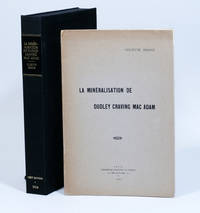
19242729Paris: Imprimerie Croutzet et Depost 1924. First edition. Original wrappers. Very Good. FIRST EDITION of Roche's surreal dadaist roman à clef exposing the misogynistic world of the French avant-garde. With annotations likely in Roche's hand. Like too many women artists of the early twentieth century French writer and artist Juliette Roche 1884 - 1980 has been long overshadowed by her male contemporaries. Roche came of age amidst leading artistic and literary salons of early 20th century Paris. She studied at Académie Ranson then considered the absolute best art school in Paris and was an early adopter of Cubism. However she is most closely associated with Dadaism. Despite Dada being a movement of absolute rebellion it harbored the normalized misogyny of the early twentieth century. Roche's most explicit critique of this discrepancy of rebellion vs repression can be found in La Minéralisation de Dudley Craving Mac Adam her groundbreaking novella.<br /> <br /> Part satire and part Dada nonsense the thinly veiled roman à clef is a prime example of the daring poetic style that Roche developed while living in New York during World War I. Having watched artistic vanguards come and go in Paris' salons and exhibitions Roche observed the New York City hijinks of Francis Picabia French 1879 - 1953 and Marcel Duchamp 1887 - 1968 with a level of detachment that alluded their American peers. She had close access to Picabia perhaps too close: in 1917 he and his wife Gabrielle Buffet-Picabia moved into an apartment directly beneath one Roche shared with her husband Albert Gleizes a French artist and philosopher who helped popularize Cubism on the Upper West Side. While Roche admired Picabia's iconoclasm she was disturbed by the misogyny she saw in works like his manometres where woman as 'la machine' was at best a manipulable object at worst the butt of a private joke. If taking Roche's ambivalence towards and her neighborly proximity to Picabia into consideration the novella could be inspired in part by an age-old story: pure contempt of one's neighbor.<br /> <br /> The novella is an indirect indictment of certain illicit behaviors Roche found annoying and dangerous. She synthesizes her fellow expatriates' personalities and physical traits to create the decadent Mac'Adam and the men he encounters on the day of his demise. Picabia becomes Mac'Adam. Swiss writer and boxer Arthur Craven 1887 - 1918 lends his name to the protagonist while becoming Lloyd Willow. Juliette Roche herself appears as Juliette Granite a play on words since roche means rock in French. Roche spins the narrative in poetic and surreal fragments at turns absurd and others told in a stream-of-consciousness style. La Minéralisation moves beyond conventional storytelling to allow readers into the minds of her characters through rich interior monologues revealing in each case her estimation of the particular model's idiosyncrasies. Roche seemed to find the antics of the all-male world of the Dadaists to be too limited and they're wickedly satirized among these pages.<br /> <br /> Written in ink on the first page is "Publié dans 'La Vie des Lettres' en 1921 / New York 1918" and there are a few words written on page 20 in the same hand. It appears to be Roche's handwriting from the few samples we've seen but we can't guarantee it.<br /> <br /> Paris: Imprimerie Croutzet et Depost 1924. Thin octavo 33pp terminal blank original printed wrappers stapled as issued; custom box. Small tear and split at top of spine; a near-fine extremely well-preserved copy.<br /> <br /> EXCEEDINGLY RARE: We can find records of no other copies that have been on the market.<br /> <br /> References:<br /> <br /> Burke Carolyn "Recollecting Dada: Juliette Roche." Women in Dada: Essays on Sex Gender and Identity edited by Naomi Sawelson-Gorse MIT Press 1998 557. Imprimerie Croutzet et Depost unknown
19362345Paris: Jeanne Bucher 1936. First edition. Original wrappers. Very Good. FIRST EDITION THE PRINTER JACQUES GROU-RADENEZ'S COPY WITH TWO LONG PERSONAL INSCRIPTIONS BY HUGNET. WITH COVER MY MARCEL DUCHAMP. ONE OF ONLY 294 COPIES IN THE EDITION; AN OUT-OF-SERIES COPY LABELED "EXEMPLAIRE NO. G.H.". "This is Georges Hugnet's first volume of 'poemes-decoupages.' The title echoes Andre Mallarme's Un Coup de Des N'Abolira Jamais le hazard 1895 and Hugnet's poems printed on the left-hand pages of the book mirror the unusual spacing and various typefaces and sizes of Un Coup de Des. Hugnet had joined the Surrealists by 1932 and the collages on the right-hand pages centered around nude images cut out of Paris Magazine rehearse typical Surrealist themes. The cover by Marcel Duchamp spells out the title in letters containing the names of a whole Surrealist pantheon including Sade Freud Rimbaud Paracelsus Swift Heraclitus Roussel Chaplin Jarry Uccello and Saint-Juste and also a Man Ray photograph of DuChamp's assisted readymade 'Why Not Sneeze Rrose Sélavy' consisting of 152 marble cubes the size of sugar cubes a thermometer and a cuttlebone inside a small cage" Roth 101 p.92.<br /> <br /> An extraordinary association copy signed and inscribed twice by Hugnet:<br /> <br /> On the half-title Hugnet has written a warm inscription dated 1936 the year of publication thanking Grou-Radenez for his work on the book. Beneath that in 1963 he added an additional inscription to the new owner of the book the surrealist photographer Leo Dohmen praising Grou-Radenez who had been arrested and murdered by the Nazi's for hiding Jewish children and aiding the French Resistance. <br /> <br /> Paris: Editions Jeanne Bucher 1936. Original photographically embossed wrappers hand-sewn as issued; housed in beautiful custom box. Illustrated throughout with black-and-white photo collages several hand-colored. Only mild wear to wrappers; remnants of paper at spine ends we have not been able to confirm that there was originally a paper spine under the external sewing; all other copies we've seen have not had a paper spine. A beautiful copy. Jeanne Bucher unknown