10 résultats
185444783Paris Victor Masson 1854. No wrappers. Extracted from "Annales de Chimie et de Physique" 3me Series - Tome 41. With titlepage to Tome 41. Pp. 120-164 and 1 large folded engraved plate showing the experimental apparatus. Some foxing throughout. <br/><br/><em>The periodical issue of Foucault's doctorial thesis in which he for the first time showed that light slows down in water thus giving experimental evidence for the undulatory theory of light."He.made use of his mirror method to measure the velocity of light through water and other transparent media. As long before as the time of Huygens and Newton it had been suggested that one way of settling the dispute as to whether light was a wave form or a stream of particles was by measuring its velocity in water. According to the wave theory light should slow down in water; according to the particle theory it should speed up. In 1853 showed that the velocity of light was less in water than in air a strong piece of evidence in favor of the wave theory. He presented this work as his doctoral thesis."Asimov. </em> unknown
184943827Paris Victor Masson Imprimerie de Bachelier 1849-50. No wrappers. In "Annales de Chimie et de Physique" 3me Series - Tome XXVI a. XXX. Juin 1849 a. Octobre 1850. The entire issues offered. Titlepages to vol. 26 a. 30. Pp. 129-256 a. pp. 129-256. Fizeau & Foucault's paper: pp. 138-148 a. pp. 146-159 2 folded engraved plates. Some scattred brownspots. <br/><br/><em>First appearance of thispaper in which the authors demonstrated importent similarities between sound - and lightwaves and that interference takes place between rays of light of different wavelenghts thus giving considerably evidence for the wave theory of light."By analyzing the white light source into simpler constituents by means of a spectroscope Fizeau and Foucault were able to observe fringes produced by interfering light rays with a difference of travel equal to more than 7000 wavelenghts thus showing hat light waves like sound waves remain geometrically constant over a large number of periods. But light waves because of their transverse vibrations are more complex than sound waves. Light can assume different forms of planes of vibration as well as different intensities. Using the same spectroscopic apparatus as in the preceeding experiment Fizeau and Foucault observed the interaction of two rays produced by passing a single polarized ray through a birefringent crystal. In this case instead of obtaining alternating bands of light and dark they obtained bands of light periodcally polarized in different planes of vibration."DSB V p. 19. </em> unknown
1869133625Paris France: L'Académie des Sciences 1869. unbound edges uncut in later portfolio. Science. 4to. unbound edges uncut in later portfolio. 6 pages. Text in French. Extracted from Comptes rendus des séances de L'Académie des Sciences LXIX December 13 1869. The siderostat is a revolving flat mirror designed to enhance telescopic viewing. Foxing. Unopened. L'Académie des Sciences unknown
185145070Leipzig Johann Ambrosius Barth 1851 Without wrappers as issued in "Annalen der Physik und Chemie. Hrsg. von J.C. Poggendorff" 82. Bd. 3. issue "Heft" No 3 1851. Entire issue offered. Pp. 337-464. Foucault's paper: pp. 458-462. With titlepage to volume 82. <br/><br/><em>First German edition of the famous paper in which Foucault presented his discovery of the proof of the rotation of the earth by the large pendulum called FOUCAULT'S PENDULUM. It was presented by Arago at the meeting of the Acadey of Scieces on February 3 1851.Since Léon Foucault’s public demonstration of his pendulum experiment it has played a prominent role in physics physics education and the history of science. The Foucault pendulum is a long pendulum suspended high above the ground and carefully set into planar motion. The phenomenon described by Foucault1 concerns the orientation of the plane of oscillation of the pendulum. "The experiment with the pendulum caused great exitement at the time. Heracleides had first suggested twenty-two centuries before that the earth was rotating and Copernicus had renewed the suggestion three centuries before. Since the time of Galileo two and a half centuries before the world of scholarship had not doubted the matter. Nevertheless all evidence as to that rotation had been indirect and not until Foucault's experiment could the earth's rotation actually be said to have been demonstrated rather that deduced." DSB.Parkinson "Breakthroughs" 1851 E. </em> unknown
185408799Paris: Victor Masson 1854. Quarter Leather. Very Good. Octavo. Offered is a very good entire Vol. 41 of Annales de Chimie et de Physique in nice quarter brown leather binding and marbled paper covered boards with raised bands spine gilt lettering on black leather spine label. Light rubbing cover edges scattered foxing. Complete with the foldout plate demonstrating Foucault's apparatus diagramatically reproduced in DSB VOl. 5 p. 85. A Comparison of this velocity in air and in water would be clear experimental test between the wave and particle theories of light since the former required light to travel faster in air; the later; in water.Fizeau returned to the rotating mirror to compare light's velocity in rare and dense media but here he was beaten by Foucault who announced on 30 April 1850 that "light travels faster in air than in water" Foucault's first experiment carried out in 1850 and written up in full in his doctorial thesis of 1853; was purely comparative; he announced no numerical values until 1862. DSB Vol. 5 pp. 85-85. <br/><br/> Victor Masson hardcover
186249458Paris Mallet-Bachelier 1862. 4to. No wrappers. In: "Comptes rendus hebdomadaires des séances de l’Académie des sciences" Vol. 55 No 12 a. 21. Pp. 481--519 a. pp. 781-803. Entire issues offered. With title-page to vol. 55. Foucault's papers: pp. 501-503 a. pp. 792-796. Clean and fine. <br/><br/><em>First printing of Foucault's famous experiments on the velocity of light with the description of his improved equipment the rotating mirror. Foucault's method was later developed by Michelson and Morley in their famous experiment in 1887."Foucault’s first experiment carried out in 1850 and written up in full in his doctoral thesis of 1853 was purely comparative; he announced no numerical values until 1862. Then with an improved apparatus he was able to measure precisely the velocity of light in air. This result significantly smaller than Fizeau’s of 1849 changed the accepted value of solar parallax and vindicated the higher value which Le Verrier had calculated from astronomical data. Foucault’s turning-mirror apparatus was the basis for the later determinations of the velocity of light by A. A. Michelson and Simon Newcomb."DSB.Leon Foucault used a similar method to Fizeau. He shone a light to a rotating mirror then it bounced back to a remote fixed mirror and then back to the first rotating mirror. But because the first mirror was rotating the light from the rotating mirror finally bounced back at an angle slightly different from the angle it initially hit the mirror with. By measuring this angle it was possible to measure the speed of the light. Foucault continually increased the accuracy of this method over the years. His final measurement in 1862 determined that light traveled at 299796 Km/s. Magee "A Source Book in Physics" p. 342 ff. and "Source Book in Astronomy" p. 282 ff. </em> unknown
1855287442Paris 1855. unbound. very good. Uncommon A.L.S. "L. Foucault" 8vo. 1 page Paris February 24th 1855 to Monsieur Ami Gilbert Govi in French translated: "Here is my take on the size one has to give the drawing; you could make it even smaller but certainly not any larger. As you know the engraver is more than willing to engrave on your marks so I rely on your extreme kindness. All yours and leaving things in your camp I remain." Two very minor striations at the top left-hand margin otherwise in fine condition.<br/> <br/> French physicist who invented the Foucault Pendulum made an early measurement of the speed of light discovered eddy currents and is credited with naming the gyroscope.<br/> <br/> unknown
190052530Paris France: Mes. Boudin & Foucault Et Al. As New. 1900. Hardcover. FREE UPGRADE to Courier/Priority Shipping Upon Request IN STOCK AND IMMEDIATELY AVAILABLE FOR SHIPMENT - Text pristine clean & unmarked tight to the spine - Text in French. 265 lots catalogued; 13 plates in black and white or sepia. Among the artists whose works are included in the collection: Antoine Watteau Nicolas Lavreince Fragonard Poussin Lancret and many others. -- with a bonus offer-- . Mes. Boudin & Foucault, Et Al hardcover
185144780Paris Bachelier 1851-52. 4to. Later blank wrapper. Extracted from "Comptes rendus hebdomadaires des séances de l’Académie des sciences" Vol. 32 and vol. 35. Foucault's papers: pp. 135-138 1851 vol. 32 pp. 421-424 1852 vol. 35 pp. 424-427 1852 vol. 35 pp. 469-470 1852 vol. 35 and p. 602 1852 vol. 35. <br/><br/><em>First appearance of the papers in which Foucault presented his discovery of the proof of the rotation of the earth by the large pendulum called FOUCAULT'S PENDULUM. It was presented by Arago at the meeting of the Acadey of Scieces on February 3 1851 the first paper offered. In the third paper offered "Sur les phénoménes d'orientation des corps tournant entraînés par un axe fixe." Foucault presents his invention of the GYROSCOPE a freely spinning flywheel which constitutes a different method of demonstrating the rotation of the Earth; he furthermore correctly predicts the use of the gyroscope as a compass. The word "gyroscope" was coined by Foucault on p. 427 of the third paper taken from the Greek meaning "to look at the rotation".Since Léon Foucault's public demonstration of his pendulum experiment it has played a prominent role in physics physics education and the history of science. The Foucault pendulum is a long pendulum suspended high above the ground and carefully set into planar motion. The phenomenon described by Foucault1 concerns the orientation of the plane of oscillation of the pendulum. "The experiment with the pendulum caused great excitement at the time. Heracleides had first suggested twenty-two centuries before that the earth was rotating and Copernicus had renewed the suggestion three centuries before. Since the time of Galileo two and a half centuries before the world of scholarship had not doubted the matter. Nevertheless all evidence as to that rotation had been indirect and not until Foucault's experiment could the earth's rotation actually be said to have been demonstrated rather that deduced." "Continuing to experiment on the mechanics of the earth's rotation Foucault in 1852 invented the gyroscope which he showed gave a clearer demonstration than the pendulum of the earth's rotation and had the property similar to that of the magnetic needle of maintaining a fixed direction. Foucault's pendulum and gyroscope had more than a popular significance which continues to this day. First they stimulated the development of theoretical mechanics making relative motion and the theories of the pendulum and the gyroscope standard topics for study and investigation. Second prior to Foucault's demonstrations the study of those motions on the earth's surface in which the deflecting force of rotation plays a prominent part especially winds and ocean currents was dominated by unphysical notions of how this force acted. Foucault's demonstrations and the theoretical treatments they inspired showed conclusively that this deflecting force acts in all horizontal directions thus providing the sound physical insight on which Buys Ballot Ferrel Ulrich Vettin and others could build. DSB.PMM: 330 lists the offprint with the title "Sur Divers Signes Sensibles du Mouvement Diurne de la Terre" - Barchas Collection 738 the periodical version but only the first paper - Dibner No. 17 offprint version. </em> unknown
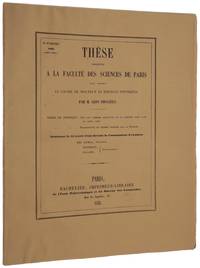
18534843Paris: Bachelier 1853. First edition. <p>First edition rare and an exceptionally fine copy of Foucault's doctoral thesis on the speed of light in which he provides a convincing proof for the wave theory of light. Foucault undertook a series of optical experiments using an apparatus of rotating mirrors to determine the velocity of light. In this thesis Foucault gives a detailed account of his experiment illustrating his apparatus and proves that light travels faster in air than in water a decisive argument in favour of the wave theory of light; it was not until 1862 that he was able to determine a numerical value for the speed of light of about 298000 kilometers per second a figure significantly smaller and more accurate than Fizeau's.</p>. Proving the wave theory of light. <p>First edition rare and an exceptionally fine copy of Foucault's doctoral thesis on the speed of light in which he provides a convincing proof for the wave theory of light. In the 1840s Foucault undertook a series of optical experiments using an apparatus of rotating mirrors to determine the velocity of light. Originally developed by Charles Wheatstone to measure the velocity of electricity the rotating mirror apparatus had been proposed as an instrument for the measurement of light in 1838 by Dominique-François Arago who failed in his own attempts to carry out the experiment. Foucault's initial work was carried out in conjunction with the physicist Armand Hippolyte Louis Fizeau 1819-1896; but a personal dispute broke up their partnership in 1847 and the two collaborators became rivals working separately on the same problem using the same technique. Both reached the same conclusion but while Fizeau was the first to obtain in 1849 a precision measurement of the velocity of light Foucault pre-empted him in announcing on 30 April 1850 that light travels faster in air than in water a decisive argument in favour of the wave theory of light which by the mid-nineteenth century had become generally accepted. In his thesis Foucault gives a detailed account of his experiment illustrating his apparatus; it was not until 1862 that he was able to determine a numerical value for the speed of light of about 298000 kilometers per second a figure significantly smaller and more accurate than Fizeau's. Foucault is today best known for the pendulum experiments demonstrating the rotation of the earth which he performed in 1851. Perhaps he considered these experiments to be unsuitable as a thesis topic as the result the rotation of the earth was well known to everyone whereas the results of his air-and-water experiments though expected by most scientists were new. ABPC/RBH list five copies in the last 40 years: Christie's 2008 $17395; Christie's Paris 2004 €9000; Christie's 2004 $8812; Christie's 1999 $10350; Christie's 1998 $7475.</p> <br /> <p>"The early-to-mid 1800s were a period of intense debate on the particle-versus-wave nature of light. Although the observation of the Arago spot in 1819 may seem to have settled the matter definitively in favor of Fresnel's wave theory of light various concerns continued to appear to be addressed more satisfactorily by Newton's corpuscular theory .</p> <br /> <p>"In 1834 Charles Wheatstone developed a method of using a rapidly rotating mirror to study transient phenomena and applied this method to measure the velocity of electricity in a wire and the duration of an electric spark 'An Account of Some Experiments to Measure the Velocity of Electricity and the Duration of Electric Light' Philosophical Transactions of the Royal Society of London vol. 124 pp. 583-591. He communicated to François Arago the idea that his method could be adapted to a study of the speed of light. Arago expanded upon Wheatstone's concept in an 1838 publication 'Sur un système d'expériences à l'aide duquel la théorie de l'émission et celle des ondes seront soumises à des épreuves décisives' Comptes rendus hebdomadaires des séances de l'Académie des sciences vol. 7 pp. 954-960 emphasizing the possibility that a test of the relative speed of light in air versus water could be used to distinguish between the particle and wave theories of light" Wikipedia.</p> <br /> <p>"A comparison of this velocity in air and in water would be a clear experimental test between the wave and particle theories of light since the former required light to travel faster in air; the latter in water" DSB.</p> <br /> <p>"In 1845 Arago suggested to Fizeau and Foucault that they attempt to measure the speed of light. Sometime in 1849 however it appears that the two had a falling out and they parted ways pursuing separate means of performing this experiment. In 1848-49 Fizeau used not a rotating mirror but a toothed wheel apparatus to perform an absolute measurement of the speed of light in air .</p> <br /> <p>"In 1850 and in 1862 Léon Foucault made improved determinations of the speed of light substituting a rotating mirror for Fizeau's toothed wheel. The apparatus involves light from a slit S reflecting off a rotating mirror R forming an image of the slit on the distant stationary mirror M which is then reflected back to reform an image of the original slit. If mirror R is stationary then the slit image will reform at S regardless of the mirror's tilt. The situation is different however if R is in rapid rotation. As the rotating mirror R will have moved slightly in the time it takes for the light to bounce from R to M and back the light will be deflected away from the original source by a small angle.</p> <br /> <p>"Guided by similar motivations as his former partner Foucault in 1850 was more interested in settling the particle-versus-wave debate than in determining an accurate absolute value for the speed of light. Foucault measured the differential speed of light through air versus water by inserting a tube filled with water between the rotating mirror and the distant mirror. His experimental results announced shortly before Fizeau announced his results on the same topic were viewed as 'driving the last nail in the coffin' of Newton's corpuscle theory of light when it showed that light travels more slowly through water than through air. Newton had explained refraction as a pull of the medium upon the light implying an increased speed of light in the medium. The corpuscular theory of light went into abeyance completely overshadowed by wave theory. This state of affairs lasted until 1905 when Einstein presented heuristic arguments that under various circumstances such as when considering the photoelectric effect light exhibits behaviors indicative of a particle nature.</p> <br /> <p>"In contrast to his 1850 measurement Foucault's 1862 measurement was aimed at obtaining an accurate absolute value for the speed of light since his concern was to deduce an improved value for the astronomical unit. At the time Foucault was working at the Paris Observatory under Urbain le Verrier. It was le Verrier's belief based on extensive celestial mechanics calculations that the consensus value for the speed of light was perhaps 4% too high. Technical limitations prevented Foucault from separating mirrors R and M by more than about 20 meters. Despite this limited path length Foucault was able to measure the displacement of the slit image less than 1 mm with considerable accuracy. In addition unlike the case with Fizeau's experiment which required gauging the rotation rate of an adjustable-speed toothed wheel he could spin the mirror at a constant chronometrically determined speed. Foucault's measurement confirmed le Verrier's estimate. His 1862 figure for the speed of light 298000 km/s was within 0.6% of the modern value" Wikipedia.</p> <br /> <p>Jean Bernard Léon Foucault 1819-68 "worked in a laboratory set up in his home until following the award of the Cross of the Legion of Honor in 1851 for his pendulum experiment and the docteur ès sciences physiques in 1853 for his thesis comparing the velocity of light in air and water he was given a place as physicist at the Paris observatory by Napoleon III. Further honors followed: the Copley Medal of the Royal Society in 1855 officer of the Legion of Honor and member of the Bureau des Longitudes in 1862 and foreign member of the Royal Society 1864 and the academies of Berlin and St. Petersburg. Finally after having failed to be elected in 1857 Foucault was chosen in 1865 following the death of Clapeyron a member of the Académie des Sciences" DSB.</p> <br /> <p>En français dans le texte 270; Norman 820.</p> <br/> <br/> 4to 282 x 230 mm pp. iv 35 1 with one large folding engraved plate. Original printed wrappers unopened. Marginal corrections to text on pages 3 and 5 in the author's hand. Very rare in such fine condition. Bachelier unknown