211 résultats
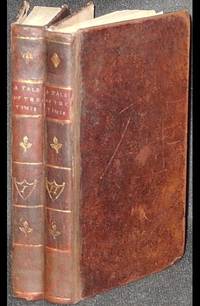
18220007721Paris: Chez Bechet 1822. First French Language edition. Original Boards. Good. 8vo xiv 351; vi 359 pages untrimmed in contemporary boards. Very scarce. <br/><br/>Attracted by the ideals of the "Declaration of Independence" Fanny Wright traveled extensively through the U.S.A. tracking how those ideals were being realized. In France who became almost like a daughter to Gen. Lafayette. She and her sister returned to America and with Lafayette were guests of Jefferson at Monticello. Later as a U.S. citizen she founded the Nashoba commune in Tennessee in anticipation of emancipation. She visited New York and Philadelphia West Point Niagara Falls Lake Errie and on to Lower Canada Montreal Lake Champlain Burlington Vermont Washington D.C. to Virginia with many observations along the way. This edition has a dedication to Lafayette by the translator who also supplied a new translation. Vol. 1 ends with remarks upon Morris Birkbeck's letters about the Illinois country. All in all Fanny Wright became one of the most remarkable women of the first half of the 19th century: among other accomplishments being the first woman to write this work the first travelogue by a woman. Howes D74; Sabin 18642; Clark Old South 16; Buck 137. Chez Bechet hardcover
1874JC17692Northampton : Bridgman & Childs 1874. Paperback. Very Good. Stitched wraps. 31 pp. <br/><br/> Bridgman & Childs paperback
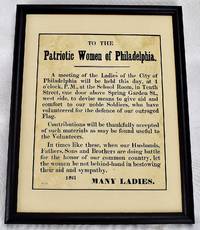
18611911280009Pennsylvania: King & Baird Printers 1861. First Edition. Framed Broadside. Very Good. Women during the Civil War Civil War Broadside from 1861 organizing Union women in Philadelphia. 30 x 23 cm. Held in modern frame. The Broadside reads: "A meeting of the Ladies of the City of Philadelphia will be held this day at 4 o'clock P.M. at the School Room in Tenth Street one door above Spring Garden St. to devise means to give aid and comfort to our noble Soldiers who have volunteered for the defense of our outraged Flag. Contributions will be thankfully accepted of such materials as may be found useful to the Volunteers. In times like these when our Husbands Fathers Sons and Brothers are doing battle for the honor of our common country let the women be not behind-hand in bestowing their aid and sympathy." Ref: LOC Printed Ephemera Collection; Portfolio 157 Folder 25. Pennsylvania: King & Baird Printers unknown
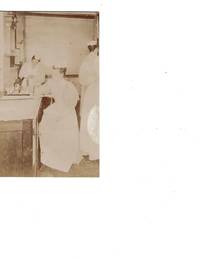
1900168731900. Women in Medicine Three Female Nurses at Work in the Hospital. c. 1900. Original silver gelatin print. 4 x 7 in. One nurse is filling a bottle with medicine while another is seated and logging a patient's progress or recording other information. The third nurse's back is turned to the camera which demonstrates the truly candid nature of this image. The nurses wear white caps and aprons over floor length striped dresses with leg-of-mutton sleeves. At the turn of the 20th century women faced harsh discrimination in applying to medical schools considered by many men to be unsuitable for women's "delicate" nature; thus women leveraged their perceived caregiver role to dominate the new field of nursing. These professionals had high levels training and their jobs required them to master a number of facts of patient care as shown in this photograph. Surface abrasion to lower left edge. Good condition. unknown
1900231291900. Women's History Women's labor photo archive documenting women at work across millinery laundry commercial kitchen precision bench and wartime relief settings preserving a concentrated visual record of how female labor was publicly pictured in the years immediately preceding and overlapping World War I. Several photographs bear Brown Bros. New York stamps placing part of the group within the sphere of press photography while the verso inscription "Russian Women Filling Bandages for the front" situates one image within the culture of wartime female service and aid production. The photographs show women's work as a visible and varied part of early twentieth-century public life where skill repetition discipline and service shaped how female labor was pictured.<br /> <br /> Photo archive of 8 photographs 7 silver gelatin and one mounted sepia photograph ranging from 6 x 4 to 9.5 x 7 inches including New York and other unidentified locations circa 1900-1915. One Brown Bros. photograph shows a seated woman trimming or assembling hats at a worktable crowded with millinery forms and materials framing decorative labor as skilled commercial production rather than private handiwork. Another image shows four women and one man gathered around tables stacked with folded cloth corresponding to the handwritten verso note "Russian Women Filling Bandages for the front." A larger photograph inscribed on the verso "women workers / compass making" shows a woman seated at a bench adjusting a circular instrument with tools and components arranged before her. Another workplace view pictures a woman handling a metal object beside machinery and a crate with partial printed text ending in ".products. Cleveland." The photograph inscribed "women in Laundry" shows several women bent over long tables in a bright workroom lined with tall windows while the mounted sepia image depicts six apron-clad women at long counters beneath a large hooded vent in a commercial kitchen. Across the group aprons work dresses caps tables tools and stacked materials recur giving the photographs a shared emphasis on feminine labor as organized visible and socially legible.<br /> <br /> The archive belongs to a period when women's wage labor was expanding in both scale and visibility and when photography increasingly circulated images of female work as part of modern urban and wartime culture. Its strength lies in the range of roles pictured: decorative trade work industrial handling laundry labor food preparation and aid work directed toward the front all of which show how women's labor was understood through service dexterity endurance and collective effort. The bandage-making image is especially important because it connects ordinary workplace culture to the wartime recasting of women's labor as patriotic and humanitarian duty. Light surface wear scattered creasing minor silvering and fading and general handling wear; mounted sepia photograph with heavier toning. Overall good condition. A compact and pointed visual record of the cultural meaning of women's work at the point where everyday labor and wartime service converged. unknown
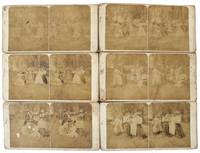
1900188011900. Women SPORTS Six action shots of a women's fencing dual in the early 1900s. 4" x 6" each. Stereoview on cardboard mount. N.p. Captioned "Le Duel" with each photograph numbered. Historically fencing has been primarily a men's sport and though women have been fencing for hundreds of years there was still heavy stigma against women taking up any sport. After WWI many French fencing schools opened up classes for women to grow their economy. This act opened up the doors for women to eventually be allowed to fence in the Olympics in 1924. This set of six stereoviews showcase two women fencers with a female referee and a group of female viewers. Each stereoview is numbered in the order of the duel; the first shows the two women facing each other with their swords down the second and third show the women mid duel and the last three show the victor heralding over the defeated opponent with two women side by side helping her recover. Minor wear to edges some sunning and wear to photos. Overall only good condition. unknown
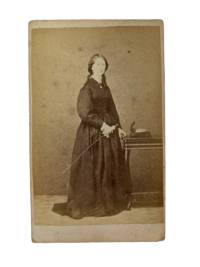
1850205961850. Albumen carte-de-visite depicting a woman dressed in a dark riding habit holding a slender riding crop in her right hand and resting her left on a desk. C.a. 1850s-70s. 2.5" x 4" on cardstock mount. There are no markings on the photograph indicating the woman's identity though her long-sleeved fitted bodice and full skirt are characteristic of American equestrian fashion in the mid-19th century. Riding habits of this period often adapted the tailored silhouette of men's coats paired with practical yet elegant skirts suitable for sidesaddle riding. The riding crop in her hand was both a functional tool for controlling a mount and a fashionable accessory in formal equestrian portraiture. Women's participation in equestrian activities in the 19th century was often associated with skill refinement and social standing with formal portraits like this serving as lasting representations of their horsemanship and style. Overall very good condition. A fine example of mid-19th century equestrian portrait photography. unknown
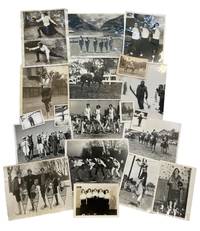
1900158521900. WOMEN IN SPORTS Photographic collection of 18 rare vintage photos celebrating girls and women in sports. Some are identified with names and locations. Locations include New Jersey Canada New York California Massachusetts. Dated approximately 1900-1940. Various sizes; mostly between 8.5" x 11" and 6.5x 8.5" with four smaller photos at 2.25" x 3.5". Black and white silver gelatin photographs. Many pieces show uniformed team photos and action shots documenting girls' increasingly rigorous participation in active sports in the first half of the 20th century. Sports include winter skiing ice skating fencing equestrian and polo bowling swimming track and field rugby. Many of the photos have extended captions on the verso. For example one photo features several Canadian swimmers in uniform in 1930 with the caption: "Swimming champions add to picturesque country at Lake Louise Canada. They are left to right: Agnes Geraghty Olympic swimmer; Catherine Ames Like Lindstrom Metropolitan Distance Champion; Constance Hanf Junior Metropolitan Champion; Eleanor Holm National Champion back stroke 100 and 200 yards; Georgia Colemen National Champion Diver. Miss Coleman is From Los Angeles while the other are members of the Women's Swimming Association New York. Another caption on a photo of several polo players states: "Southern California co-eds to form polo team sorority women at the University of Southern California are preparing to invade one of the few remaining sport sanctuaries of men- polo." Also included is a short of the American Women's Olympic Fencing Team which include: MMarion Lloyd Muriel Guggolz and Dorothy Locke. <br /> <br /> Curated photographic archive celebrating female athletes who overcame stereotypes of women as the "weaker" sex. Because early social constructs regulated physical activity for women few were able to rise up as professional sports competitors until the 20th century. This archive is a testament to these women's historic strides revealing their early physical training their membership in early sport clubs as well as their most daring record-breaking feats. The collection depicts women participating in during the early 20th century. unknown
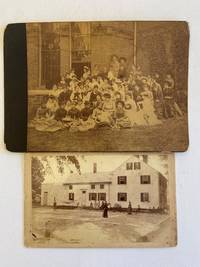
1880178721880. 2 Albumen photos of early recreational tennis game. Circa 1880's. Larger photo measures 6.75" x 8.5" inches on original photographer's board measuring 9.75" x 6.75". Smaller photo measures 7.25" x 4.5" inches on white photographer's board measuring 8" x 5" inches. Photo was taken by Marston photo studio of Bangor Maine. Larger photo shows a large group of young women posed in tiers on a lawn in front of a large brick building. The front row is spread across the grass with others in chairs behind them and the back row sitting on the open windowsill and ledge along the side of the building. The group is entirely female suggesting maybe an early women's college all of them dressed in high-collared dresses long skirts with bustles many in hats and some with parasols. In the front row four women hold tennis rackets as if posing before or after a game. This restless group of young women are pictured in the 1870s or 1880's. The other photo shows a tennis game at play with a man on one side of the net and two women on the other holding rackets on a tennis lawn. The court has been constructed on a lawn with painted boundaries and a net which was customary in 19th century. In the background is a large white wooden house. Lawn tennis came into fashion in the 1870's as an upper-class hobby marking leisure time for players and spectators. Some spotting and Light staining on photos does not effect clarity of images. Overall in very good condition. unknown
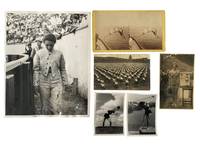
1900224351900. Sports and HobbiesWomen's History Archive of six original photographs depicting women in sports and physical culture ca. 1900s-1950s. A striking group of five silver gelatin photographs and one stereoview documenting early and mid-20th century women's athletics across a range of sports including bullfighting competitive swimming mass calisthenics and weight training. The archive is anchored by a powerful press photograph of Bertha Trujillo a Colombian woman bullfighter shown bloodstained and exhausted yet defiant after leaving the ring as documented by a Hamilton Wright press caption on verso dated May 7 1956. The image captures the rare spectacle of a woman operating within a hypermasculine and violently gendered tradition underlining her transgressive presence in the public arena of the corrida. Trujillo's visibility as a "girl bullfighter" not only subverts gendered codes of spectacle and aggression but also underscores the fraught place of women in national rituals of machismo.<br /> <br /> Also included is an early gelatin silver stereoview of a woman mid-dive from a boat into open water ca. 1900s her long dress captured in graceful suspension. A vintage sepia-toned postcard shows a massive synchronized physical training display by women in uniform skirts likely in a European stadium setting. A third photograph features a smiling young woman swimmer in a tight one-piece suit standing beside a trophy likely ca. 1920s-30s exuding post-competition confidence and the growing visibility of women in elite amateur sport. Two additional gelatin silver prints ca. 1930s-40s show women engaged in solitary strength and flexibility exercises: one throwing a medicine ball under clouded sky the other stretching a resistance band at the edge of a pond. Each of these images gestures toward evolving conceptions of female strength embodiment and public physicality across the 20th century. The photographs collectively trace a visual history of women's contested access to spaces of physical prowess and public acclaim. Minor edge wear and surface rubbing to a few prints. Overall very good condition. A varied archive showcasing women's athleticism in the early 20th century. unknown
1861174981861. Women's in Sciences Sepia photograph circa 1860-1880 identified in manuscript at the upper left "State Eclectic Medical Society at Worthington" depicting approximately twenty five women alongside male practitioners in Worthington Ohio an early center of Eclectic medical organization just north of Columbus Ohio. The image documents a rare mixed gender professional gathering at a moment when women's participation in formal medical education remained severely restricted under prevailing institutional norms. Within the dominant nineteenth century medical establishment women were largely excluded from training and professional societies; however the State Eclectic Medical Society of Ohio and the broader Eclectic movement created alternative pathways into medical study. These networks were closely tied to reformist traditions that challenged orthodox practice and opened limited but meaningful access to women prior to the broader professionalization of female physicians following mid century breakthroughs such as the graduation of Elizabeth Blackwell in 1849.<br /> <br /> Original Photograph. C. 1860-1880. Sepia. Approximately 6" x 9" Inches. Written in black ink in the upper left corner "State Eclectic Medical Society at Worthington". Photo shows about 25 women along with their male peers. The the first woman graduated medical school in the 1850s. The Eclectic Medical Society was notable for accepting female students before most women were allowed to study medicine.<br /> <br /> The photograph reflects the intellectual and institutional culture of Eclectic medicine a distinctly American medical movement that drew on botanical therapies Native American knowledge systems and the herbal tradition associated with Samuel Thomson. In contrast to orthodox allopathic medicine Eclectic practitioners emphasized plant based remedies and a more flexible therapeutic philosophy which correlated with a greater willingness to admit women into study and practice. The presence of a substantial number of women within this group suggests not only participation but active integration within the society's professional sphere offering visual evidence of gender inclusion within an otherwise exclusionary nineteenth century medical landscape. As a primary source the photograph provides direct documentation of women's early entry into organized medical communities in the United States capturing both the social composition and institutional networks that facilitated their participation. It is particularly valuable for research in women's medical history alternative medical movements and the development of professional education outside orthodox channels illustrating how reformist medical systems functioned as critical entry points for women prior to broader legal and institutional change. Some creasing present; otherwise in good condition overall. unknown
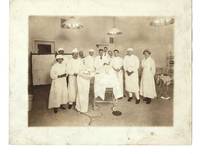
1900162081900. Women in Sciences. Original vintage photograph of operating room and surgery team. Photograph shows eleven figures dressed all in white standing around a patient in an early operating room. While most of the medical workers are men two women stand at the edges of the group and the woman standing on the left is shown wearing an operating apron and rubber gloves. 8 x 10 in. sepia photo. Photo is in good condition with light scuffing to photo surface two water marks in bottom left quadrant and some dirt and stains to the image border. Light crease in top left corner and small tear on lower right edge. Image remains crisp and clear. An important photograph that shows women's involvement in the medical field and the development of surgical technology throughout the 20th century. unknown
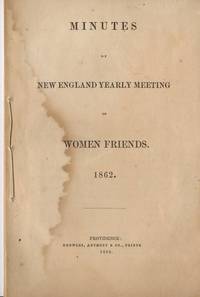
1862052340Providence RI: Women Friends of New England. Very Good-. 1862. First Edition. Paperback. 8vo - over 7¾" - 9¾" tall Used 8vo 15pp VG- wraps missing Soiling to endpapers & interior due to water damage. Keywords: Religion Religion Christianity Women Friends New England Americana women s studies quakers women in religion. Women Friends of New England paperback
1871165651871. Women Employment Labor To the Right Honorable Richard Assheton Cross M.P. Secretary of Sate for the Home Department. 1871. 4 pages. 8 x 5 in. In this document women workers express fears regarding proposed labor regulations that would limit their ability to earn and would "restrict the paid labour of all women.or even make all married women half-timers." They claim it is unjust treatment that would harm women workers and pit their marriages at odds with their ability to work: "Your Memorialists assert that it is unjust to place restriction son the labour of unmarried women for the presumed protection of married women or mothers and further that any special restrictions upon the labour of married women is practically a penalty imposed on marriage as regards to the woman." Document that reveals the competing priorities for women factory workers between workplace safety and their earning power. Chipping with small losses along top and right edge. Repairs to two tears on page 2. Top left corner missing. Good only. unknown
1887174331887. Women's Employment MABEL Robert F. Our Working Women and Their Earnings. United States 1887. First Edition. 13 pages measuring approximately 6" x 10" inches. At the time that this description is being written no copies are recorded in American institutions. OCLC search results are at best an estimate and can vary over time. The article begins "We as a nation have made no effort to teach our redundant female population to support itself although our position as a mother of colonies leaves us with a steadily increasing proportion of women who through the emigration of their male relatives are forces to provide for themselves." and concludes that "a woman's technical training will have still done her a good service in quickening her intelligence and in thus making her a wiser mother to her children and a more sympathetic companion to her husband above all in banishing much care by ensuring to her a means of livelihood in case of need." A compassionate thoughtful appraisal of the state of women's labor and financial prospects in the United States backed up by employment and pay statistics from the end of the 19th century. Cleanly disbound. Chipped along top edge. Toning. Pages clean and uncreased. Overall in good condition. unknown
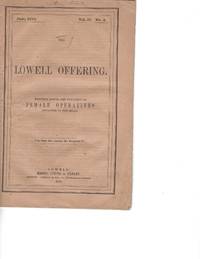
1844167391844. Lowell mill women periodical issue from June 1844 documenting female textile operatives using print culture to claim literary editorial and publishing authority inside the early New England factory system. Published during the penultimate year of The Lowell Offering the issue belongs to the monthly periodical written by women employed in the Lowell mills from 1840 to 1845 and preserves the publication's own public claim on its wrapper: "Written Edited and Published by Female Operatives Employed in the Mills."<br /> <br /> The Lowell Offering. June 1844. Vol. IV No. 8. Lowell: Misses Curtis & Farley; Boston: Jordan & Co. 121 Washington Street 1844. Pamphlet. The wrapper prints the title in large type with the date "June 1844" at upper left and "Vol. IV. No. 8." at upper right. Beneath the title the issue identifies its producers as "Female Operatives Employed in the Mills" followed by the biblical motto "Is Saul also among the Prophets" The imprint names Misses Curtis & Farley in Lowell and Jordan & Co. in Boston placing the issue within the final phase of the magazine's publication history.<br /> <br /> The Lowell mills recruited young women often between the ages of 15 and 35 into wage labor at a time when American manufacturers faced a smaller labor supply than European factories and could not draw on the same large landless urban population. Cash payment every week or two weeks helped persuade these women to enter mill work while the Boston Associates promoted a managed culture of self improvement through free lectures circulating libraries and improvement circles for creative writing and public discussion. Lowell operatives attended lectures by Ralph Waldo Emerson and John Quincy Adams borrowed books from circulating libraries and joined circles that encouraged writing and debate making The Lowell Offering part of a broader institutional effort to frame factory labor as compatible with female education and intellectual discipline. Wrapper toned with light soiling creasing and edge wear visible. Overall good condition. A printed record of Lowell women mill operatives presenting themselves not only as industrial workers but as authors editors and publishers within the educational culture built around the mill system. unknown
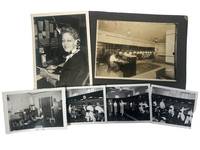
1900200911900. Telephone operator photo archive circa 1900 to 1958 documents women's labor within telephone exchange systems showing how urban communications depended on trained female operators seated at switchboards connecting calls handling information and maintaining the human infrastructure behind early and mid twentieth century telephone service. The material documents telephone communication labor through photographs of switchboard rooms operators wearing headsets plug boards supervisory presence and grouped clerical activity revealing how connection work operated in practice before automated dialing fully displaced manual exchange work. The archive supports research into women's wage labor communications history gendered office work New York telephone service and the disciplined workplace culture that positioned young women as the public voice and operational center of the telephone network.<br /> The archive consists of six black-and-white photographs including five silver gelatin photographs and one early albumen photograph with images measuring from approximately 3.5 x 4.25 inches to 7 x 9 inches. The date range appears to extend from the early twentieth century to 1958 based on the later dated images. Several photographs show women seated in tight rows facing large switchboards wearing heavy headsets with horn mouthpieces and working among dense arrangements of cords and plugs. The early albumen photograph shows a row of women facing the switchboards while a female supervisor watches over the room indicating both the gendered hierarchy and procedural discipline of the exchange floor. One image shows an operator turning toward the camera with a plug in hand smiling while gesturing toward the board. Four smaller photographs dated 1958 show teams of women moving between boards and a small group with paperwork behind the operating area; pencil inscriptions on the versos identify the location as New York.<br /> The photographs are valuable because they make visible the labor system behind telephone service: rows of operators standardized equipment supervisors paperwork and the coordinated manual routing of calls. They also record the gendered character of communications work in which women's voices posture speed and manner were made part of the service itself. Light handling wear minor edge wear and expected age toning; images remain crisp with equipment and personnel details clearly visible; overall very good. Strong women's labor and communications history archive documenting the human operation of telephone exchange systems across the first half of the twentieth century and into the postwar period. unknown
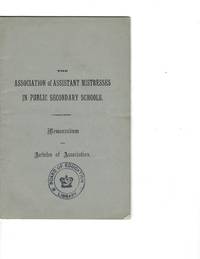
1897164571897. Women's Education Women Employment The Association of Assistant Mistresses in Public Secondary Schools. Memorandum and Articles of Association. London: Printed by Charles North The Blackheath Press S.E. 1897. This was a document published for the Association of Assistant Mistresses a trade union representing female teachers in British secondary schools. Ex-library copy with stamp and pencil writing on the first page. Very good. unknown
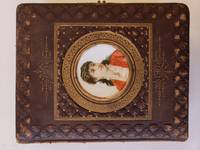
1899171841899. Monson Academy student photo album circa 1899-1901 documenting coeducational secondary education and student identity at a Massachusetts preparatory institution during a period of expanding academic opportunities for both men and women. The album records individual students through formal portraiture providing evidence of enrollment class affiliation and institutional culture at one of the earliest coeducational academies in the United States. The material supports research on preparatory education gender integration in schooling and the development of academically oriented boarding institutions at the turn of the twentieth century.<br /> <br /> Photo album containing 43 original silver gelatin photographs including 25 cabinet sized portraits and 18 smaller prints primarily consisting of individual bust length student portraits with several group images. Many photographs include handwritten pencil annotations on the verso identifying sitters and class years such as "W. H. Ballard Class '01 M.A." The album is bound in an ornate leather cover with gilt and brown decorative elements and a central cameo portrait with pages arranged to display both larger and smaller format photographs. The images present male and female students in formal studio style compositions reflecting conventions of academic portraiture and documentation of student cohorts.<br /> <br /> Created at the turn of the twentieth century the album situates Monson Academy within broader developments in American education including the growth of coeducational institutions and preparatory training aligned with emerging scientific and technical fields. Founded in 1804 the academy later developed a reputation for preparing students for institutions such as the Massachusetts Institute of Technology and earlier admitted international students including Yung Wing who became the first Chinese graduate of an American university. The album provides a visual record of student populations within this institutional context documenting the presence of both men and women in a shared academic environment. Light wear to album with minor foxing to pages; photographs clear and well preserved; overall very good. A cohesive photographic record of coeducational preparatory schooling in the United States. unknown
1805368829Argyle NY 1805. 6pp. Small 4to. Pinned together at an early date. Usual folds minor foxing. 6pp. Small 4to. Much of the minutes of two meetings of the elders of the Argyle were taken up with the case of Joseph Wright who was accused of beating his wife. The minutes include the testimony of two female witnesses that Wright had beaten his wife with a broomstick as well as the testimony of another female witness that she had heard rumor that Wright had beaten his wife "because he was jealous with her being great with a Negro & expected that the last child she had would be black. unknown
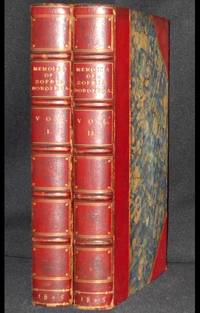
1845005557London: Henry Colburn 1845. Hardcover. Very Good. 2 volumes: 1 xxiii 1 452 p. frontispiece portrait; 1 vii 452 p. frontispiece portrait; 23 cm. Contemporary half red morocco with marbled paper over boards. Six spine compartments between raised bands; gilt-tooled title in second compartment and volume in third with "1845" at tail. Top page edges gilt. Marbled endpapers in gilt and blue matching boards. Published anonymously but attributed to Robert Folkestone Williams approx. 1805-1872. The life of Sophia Dorothea 1666-1726 Consort of George I before he became King of Great Britain. Forced to marry her cousin George Louis she bore him three children before he divorced her and imprisoned her in the Castle of Ahlden where she spent the rest of her life. In Very Good Condition: edges rubbed; spines lightly sunned; frontispiece portraits are foxed; text has minimal marginal foxing and soiling; a solid and attractive set. Henry Colburn hardcover
1850001653London: H. Bailliere 1850. 2nd Edition . Hardcover. Very Good/No Jacket. 8vo - over 7¾ - 9¾" tall. The second edition of this detailed study in early Gynaecology. Very good in original cloth recased with original spine laid down. Ex libris stamp of the Library of the Royal College of Surgeons Ireland impressed mainly on blank spaces throughout the book and to rear of plate leaves. Collated complete with 10 plates two of which are hand coloured. Mispagination to gathering G1 where page number starts at 53 instead of 51. Tipped in adjacent to title page is a page of instructions for the use of the "Syphon Douche" invented by the author. The rear pastedown has tipped in an advertisement for the sole supplier of the douche. A very good copy of an uncommon book. <br/> <br/>The second edition of this detailed study in early Gynaecology. H. Bailliere hardcover
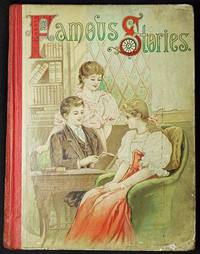
1893004191Boston: D. Lothrop Co 1893. Hardcover. Very Good -. approx. 200 p.: many full-page and in-text illustrations; 25 cm. Red cloth spine with chromolithographed illustrated paper over boards. Cover title: Famous Stories. "Copyright 1893 the Gast Lith. Co. N.Y." -- at lower edge of front board. In addition to fiction and poetry contains history and biography including the early life of American sculptor Theo Alice Ruggle Kitson 1871-1932 and the life of English author Felicia Hemans 1793-1835 illustrated with facsimiles of her writing. Illustrators include Charlotte Weeks Hiram Barnes Childe Hassam and W.P. Bodfish among others. In Very Good- Condition: edges are rubbed in particular lower corner of front board; cloth spine is unevenly faded; cover is lightly soiled; hinges are weak; upper corner of 1 leaf heavily creased; pages are clean and tight. D. Lothrop Co hardcover
1801003514Alexandria Va: Cottom and Stewart 1801. Hardcover. Very Good. Full imprint: "Alexandria: Printed by Cottom and Stewart for Robert and John Gray Alexandria; and for Conrad and Co. Philadelphia Baltimore and Washington City." 2 volumes: 256 248 p.; 18 cm. 12mo. Contemporary full calf with six spine compartments between gilt rules. Gilt-tooled title on red morocco spine label in second compartment of each volume. Gilt-tooled volume number in fourth compartment of each volume with gilt-tooled decoration in the first third and fifth compartments. All page edges yellow. This is the First American edition after the British 1799 edition. Each volume has a label on the front fixed endpaper indicating that the volumes were given in 1855 to the Union Philosophical Society of Dickinson College by Samuel M. Dickson 1837-1866 and John W. Cornelius 1835-1894 graduates of the college who became Methodist ministers. Dickinson College Library oval stamp also on front fixed endpapers and embossed stamp at lower edge of title pages. Former owner's name at head of vol. 1 title page and first page of text in vol. 2: N. Amory. Very scarce. The anonymous author of this anti-Jacobin novel was Jane West 1758-1852 an English novelist poet and playwright. In Very Good Conditon: sensitive spine and joint repair; ends of spines and corners rubbed; ink stains on vol. 1 title page; lacking both endpapers from vol. 2; shadow on edges of title pages from binding; otherwise clean and tight. Cottom and Stewart hardcover
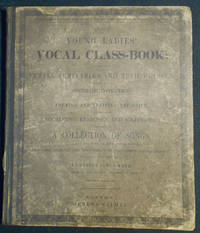
1843007450Boston: Jenks & Palmer 1843. Hardcover. Very Good. Second Edition. 152 p.: music; 29 cm. Black cloth spine; brown paper over boards printed in black. Back cover has advertisements for works by Webb published by Jenks & Palmer. "Consisting of Systematic Instructions for Forming and training the Voice and Suitable Vocalizing Exercises and solfeggios; Together with a Collection of Songs for One Two Three and Four Voices." Scarce. In Very Good Condition: cover is rubbed; cloth is frayed at spine ends and split over front joint; minor soiling of a few page margins; otherwise clean and tight. Jenks & Palmer hardcover