56 résultats
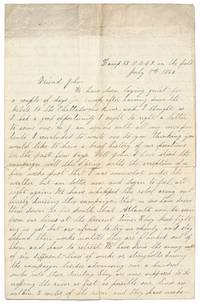
1864438776Atlanta Georgia 1864. Very Good. Autograph Letter Signed. Folio. 4pp. Partial splitting at the edges of one vertical and two horizontal folds about very good. A detailed and historically important long letter written in the field by Union soldier Harvey Rodgers just two weeks before he was killed at the Battle of Atlanta on July 22 1864.<br /> <br /> Rodgers was mustered into service in 1861 as a Corporal in the 54th Regiment Ohio Volunteer Infantry Zouaves Company A commanded by 1st Lt. Judson McCoy referred to as “Jud†in the letter. In the letter written to his “Friend John†on four easily legible folio pages Rodgers describes Confederate and Union Army maneuvers and skirmishes immediately after the Battle of Kennesaw Mountain fought from June 19 – July 2 1864 during the lead-up to the Battle of Atlanta which began on July 21st:<br /> <br /> “… Well John I have stood the campaign well this Spring … We have whipped the rebel army out finely … that is we have drove them so far South that Atlanta can be seen from our lines … I suppose you have heard about our making a charge on the 27th June … I do not wish to be in anymore such places … we lay in camp until the 2nd of July when our Division moved … very near due south of the Kennesaw mountain. That night Jud with our Company was on picket. We heard the cars very plain but did not think they the rebel army were evacuating the mountain and falling back … Next morning … We did not move forward until two o’clock when we advanced our lines two miles finding a small force of Cavalry in our front which we routed by charging them. The Regt. lost 1 killed 14 wounded …â€<br /> <br /> He describes a second skirmish on July 4th at which his Company fought in support of the Union army’s 16th Corps to advance Union lines and continues:<br /> <br /> “… On the 5th we were moved back again and brought further around on the right where we now lay. Our front lines are two miles further on. The rebels have a line of works between them and the Chattahoochee river … I expect we will have a pretty hard time before we get there and a hard time to cross the river …â€<br /> <br /> The Battle of Atlanta commenced on July 21 1864. Both Harvey Rodgers and Union Maj. Gen. James B. McPherson were killed during the battle on July 22nd. Rodgers' letter thus ends poignantly:<br /> <br /> “Well John my time is fast rolling around now and I begin to think I will soon get home again. Only two months and 8 days more … Still in that short time there are many dangers to undergo. I may be called on to go into several more charges. Perhaps of some one not to come out alive … There has not more than half a dozen days passed since the 10th of May but what we have been under the sound of artillery. The troops appear to be pretty well worn out and wish for the campaign to close yet they all want to get into Atlanta first …â€<br /> <br /> A compelling and ultimately heartbreaking eye witness account of General Sherman’s Atlanta campaign during the summer of 1864. Longer quoted extracts from the letter are available. unknown
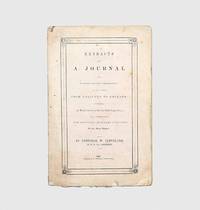
1847189591Deal: Printed by J. Deveson 1847. The battlefields of the Punjab seen from the ranks First and only contemporary edition of this brief but spirited and entirely unembroidered account in the authentic voice of an enlisted man. The 31st were one of the most heavily engaged units of the conflict seeing action at Mudki Ferozeshah Aliwal and Sobraon. Scarce with just two locations traced BL and Boston Public Library unrecorded at auction. Vivid vignettes from the battle front are set within the context of a diary account of an uneventful voyage back from Calcutta to Gravesend. Cleveland opens on 23 October 1846 "weather continues fine and the wind steady" reminiscing of Moodkee "the first battle in which I had even been engaged I have often since endeavoured to imagine what my feelings were on that occasion but the hurry and confusion of that Action prevented the exercise of thought". One thing remains clear in his memory "So confident were our Officers and men that the Sikh Army was composed of nothing but a rebel mob that they did not believe they would hazard an engagement. this entire ignorance of the Sikh Army it is wonderful that all were alike involved even the Governor and Commander in Chief each of whom it should fairly be supposed ought to have been possessed of correct information on so important a subject". Of Ferozeshah he recalls the "lurid flames" of the burning Sikh camp "gleaming through the darkness diffusing sufficient light to make the horrors of our situation more apparent" the shot from the Sikh guns falling "among us by far to thick and fast to be agreeable". The situation only saved by what Cleveland - along with Sikh commander Tej Singh - read as the Commander in Chief's order for the cavalry to make a "false charge" which was in fact the withdrawal of the Horse Artillery desperately short of ammunition to Ferozepur to resupply while under cavalry escort. At Aliwal the 31st were on the extreme right of the British line "When we had arrived within a short distance of the village under heavy fire from the enemy who were waving their swords and cutting a great variety of menacing capers in front of us General Smith galloped up and said 'take that village boys and carry it along with you' when the whole regiment broke into a rapid double which they did not abate until they had cleared the village captured the guns upon its left and caused the whole of the enemy's left flank to run for dear life. We now quietly took possession of the whole of their camp equipage ammunition and stores; and having amply supplied ourselves. we turned in for the night near the banks of the Sutlej". And so to Sobraon "At 9 A. M. the battle had reached its warmest point - shot and shell were then whizzing through the air in rapid succession. on their fearful missions of mischief. from the muzzles of 150 pieces of ordnance - about half past 9 a low rumbling sound was heard resembling distant thunder which was caused by the report of musquetry - as the infantry ad passed the Enemy's breastworks. thus concluded the most severe contest in the annals of Indian warfare and not a second to any fought in Europe with the exception of Waterloo". Following the ratification of the Treaty of Lahore the 31st marched to Calcutta and embarked for home Cleveland composing this very personal and telling NCO's witness to world-changing events while under weigh. Octavo. pp. 24. Original thin paper printed wrappers. Wraps rubbed and soiled with some minor chips and splits at the edges no loss of text creases to the corners; pale toning and some finger-soiling to the text; but a well preserved copy very good. paperback
186458358Various places including Methuen Lawrence Andover Boston and Lowell Massachusetts 1864-1865. modern calf antique with original gilt-lettered label "Company Clothing" laid down on front panel. Folio. Two pages list "Price of Clothing Camp & Garrison Equipage Year 1864." Following are 204 pages one to a soldier listing name company place and date of enlistment articles of clothing issued value itemized date of clothing issue and signature of soldier and witness. In some cases date of discharge desertion or demise is also noted. A "colored" under cook is also listed along with the soldiers. hardcover
1809000867cSCOTLAND IRELAND ENGLAND DUBLIN EDINBURGH UK. Good. 1809. On offer is a remarkable original 1809 - 1833 handwritten manuscript book once used by the British Army's 94th Regiment of Foot. This book contains all manner of writings relevant to the running and goings-on of the Regiment by the Officers. The book is rather eclectic containing standing orders regimental orders different charts and forms for payroll and other reportage for example on the conditions of the Dublin Garrison orders of the day direct communications between officers public requests for leave advancement of funds settling of accounts etc. public apologies for poor behavior copies of letters sent to superiors up to and including the Duke of York Commander of all His Majesty's Forces and many other of Britain's peerage and there are even personal reminiscences notes of reference for departing soldiers plus much much more. Most of the entries of personal notes and those for Day Book purposes are signed by all manner of officers and peerage; Colonels Captains Lords and many reference specific orders by the Supreme Commander of the Army or even the King. Most fascinating are the 'Memorialist' messages of certain officers writing in the 3rd person touting themselves while seeking favor. 164 pp of history and methodology of this noted British Army regiment contained in this entirely handwritten book. Most of the entries are circa 1809 - 1827 but the oldest entry in the book is dated Edinburgh Castle 1833 and is addressed to what appears to be 'My Dear Beaver' while the correspondent signs in initials F.M. late of St. Lucia. He makes reference to Mr. Beaver as the clergyman that baptized his 3 children. Also of note: on the very last page written upside down are a quote a note and an invitation dated Fort Charlotte 1825 to His Excellency Major General Blackwell by Mr. and Mrs. Murray. Many clues for the astute researcher will assuredly unveil many of the writers in this fascinating piece of British militaria. Save for the front cover being nearly detached and some loosened endpapers this book would be G. Truly one of the most exceptional pieces of manuscript militaria we have ever encountered.; English; 4to - over 9¾" - 12" tall; KEYWORDS: HISTORY OF MILITARY MILITARIA BRITISH ARMY 94TH REGIMENT SCOTLAND IRELAND DUBLIN GARRISON MAP MANUSCRIPT DOCUMENT LETTER AUTOGRAPH DIARY JOURNAL LOG KEEPSAKE WRITER HAND WRITTEN DOCUMENTS SIGNED LETTERS MANUSCRIPTS HISTORICAL HOLOGRAPH WRITERS DIARIES JOURNALS LOGS AUTOGRAPHS PERSONAL MEMOIR MEMORIAL PERSONAL HISTORY antiquité contrat vélin document manuscrit papier Antike Brief Pergament Dokument Manuskript Papier oggetto d'antiquariato atto velina documento manoscritto carta antigüedad hecho vitela documento manuscrito Papel . unknown
181154628E-172: Longman Hurst Rees Orme and Brown. Very Good. 1811. First Edition; First Printing. Hardcover. Leather. 4to. Printed in London for Longman Hurst Rees Orme and Brown Paternoster-Row. 1811. 436 pgs. Fine folding engraved map "of the Interior of Louisiana with a part of New Mexico" and full-page map of ". The Mississippi River from its source to the Mouth of the Missouri." Bound by in full calf leather. Spine has been rebacked with contemporary leather spine and gilt titled spine label. Boards are scuffed and worn with wear present to the edges of the boards. Small name present to the reverse of the front board. Both maps present however the first map has a small piece missing and has been rebacked with linen. Foxing present. Text is free of marks. Binding tight and solid. The first U. S. Government exploration of the American southwest. In 1805 Wilkinson ordered Pike to find the source of the Mississippi River so Pike traveled into the northern Louisiana Territory newly purchased from France. In 1806 Pike led an expedition to the southwestern borders of the land acquired by the United States through the Louisiana Purchase. One of the most important inland travel narratives giving an account of the South-west including the author's description of his earlier journey to explore the headwaters of the Mississippi. The two maps are among the first of the area executed by a government expedition. After Pike returned from this first expedition General Wilkinson almost immediately ordered him to mount a second expedition this time to explore map and find the headwaters of the Arkansas and Red rivers. Additional objectives of this exploratory expedition into the southwestern part of the Louisiana Territory were to evaluate natural resources and establish friendly relations with Native Americans. Beginning July 15 1806 Pike led what became known as the "Pike Expedition". General Wilkinson's son James served as one of his lieutenants although it now seems that Wilkinson planned that the Spanish who controlled Mexico would capture him and his men. Over 100 years later France released official records showing General Wilkinson received personal trade concessions and thus could be labeled a spy for Spain at the time. Sabin 62837; Howes P373 e-172; 8vo 8" - 9" tall . Longman, Hurst, Rees, Orme, and Brown hardcover
186166<p>Original rubbing for the Stele of Second Opium War Arrow War in China during 1856-1860. Stele erected in 1861 in Canton Guangzhou City in GuangTong Province in China.</p><p>Very big size on a whole thick rice paper 152cm X 98cm The original stone had been demolished long long ago. This rubbing is the only one found in the world. Folded a few wears at edges. Both text and pictures were fine copied and undamaged but had some folds.</p><p>Rubbing is an ancient Chinese method to copy text and pictures on stone or on bronze wares by hand.</p>