25 résultats
169016114New York: Crown 1690. First edition. Hardcover. Near Fine/Very good. The amazing career of the most successful Confederate spy". 307 pages index map photos. Light grey cloth boards. Price-clipped dust jacket has a half-inch chip at bottom and two half-inch tears and creases at top but bright and clean. <br/><br/> Crown hardcover
167244860No Place No Printer Gedruckt in 't Wonder-Jaer 1672. 4to. No wrappers. 12 pp. <br/><br/><em>The pamphlet contains a discussion between three persons an Englishman a French and a Dutch relating to the Third Anglo-Dutch War 1672-74. </em> unknown
16196516516th MAY 1917 - 21st NOVEMBER 1917. 4to. Twenty-eight parts each c.40pp. bound in one volume. Each with original pictorial wrappers preserved. Profusely illustrated. A contemporary record of the First World War during 1917. unknown
1616373417Michel Colin Amsterdam Undated c.1616. Unframed Print. Very Good Condition. The page measures 17 x 22 cms printed to both sides. There is loss of blank margin and an old lower margin repair. A rather rare survivor of a very uncommon publication. Category: PRINTS : Antiquarian Interest; Antiquarian & Rare; PRINTS : Historic Interest; Special Features. This item may require more postage than the rates shown for delivery outside the UK. If extra postage is required we will contact you before processing your order and you will be given the details and option to decline the extra cost. Michel Colin unknown
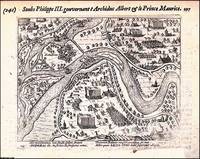
166746176Graven-Hage: Tongerloo 1667. good. 4 leaves 94pp. rubricated title 4to stitched. Graven-Hage 1667. Good.<br/> <br/> A treatise on the dispute between France and Spain over the inheritance rights of Marie Therese daughter of Philip IV of Spain and wife of Louis XIV of France.<br/> <br/> Tongerloo unknown
165624287London: Printed by E. Tyler 1656. Lacking all plates. 1 vols. Folio. Old learther boards perished sewing sound. Ex-library with stamps some soiling and browning marginal tears and holes in title not affecting text else text is complete and in good condition. Lacking all plates. 1 vols. Folio. A history of war. Printed by E. Tyler unknown
168910254Cologne 1689. Wrappers. Very Good binding. Small quarto. 24 pp. In later plain wrappers. Title in manuscript on the front wrapper; light to moderate foxing/age-toning throughout but generally a nice copy. <br /> <br /> Political pamphlet on French policies translated from German for Spanish-speakers. Excellent reportage of what was happening where and who was involved in these early days of Louis XVI's expansionist policies leading to the Nine Years' War. Institutionally rare. Between the two editions that were issued in 1689 there are only 7 institutions reporting ownership according to OCLC--Harvard is the only institution in the U.S. Palau VII p. 152 for another edition printed in Barcelona 1688 sic by Hernando Ferrer. The first edition of Palau appears to be in error as to the date; OCLC identifies that edition as having been printed in 1689. unknown
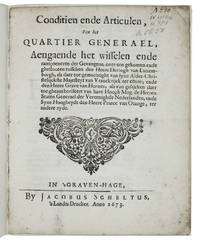
1673ABC_46181The Hague 1673. 4to. Jacobus Scheltus Modern wrappers. With a woodcut vignette on the title-page. 8 pp. First edition of a highly interesting agreement regarding the treatment and exchange of prisoners of war taken captive whether by the French or by the Dutch army during the French-Dutch war of 1672-1673 the rampjaar or year of disaster. The agreement was concluded on 26 May 1673 and signed on the French side by the notorious François of Montmorency 1628-1695 Duke of Luxembourg the French Governor of Utrecht and instigator of the massacres of Bodegraven and Woerden who later that year made his famous retreat from Utrecht to Maastricht. In 1675 he was made Marechal of France. On the the side of the States General and Stadtholder William III the agreement was signed by Willem Adriaan II of Horne 1633-1694 a high-ranking officer in the army of the States General.The prisoners could be exchanged according to their military ranks or could be ransomed. Pp. 3-5 lists the monetary value for each rank. A new version was promulgated in 1675 and was reprinted several times probably into the early 18th century.Slightly dust-soiled with a horizontal fold in the middle but overall in good condition.l Knuttel 10717; STCN 851322913; Tiele 6638. unknown
1619D20732Prague: Lorentz Ermmerich 1619. Hardcover. Near Fine. Small 4to. Modern brown calf. 4 leaves - followed by a number of blank leaves bound in at the end. Exceptionally scarce tract. <br /> <br/><br/> Lorentz Ermmerich hardcover
16511006702 volumes 4to however one volume is slightly larger than the other modern calf and boards printed in black leter and Roman types 2 1369-1417 & 2 1677-1689 pp. Last leaf in both volumes moderately worn and some repairs to one of those leafs pages in both volumes creased in the middle library plate on both front pastedowns early owners inscrpition on back of last leaf in one volume normal aging and browning; otherwise very good. This is a scarce item that was probably removed from a larger work however the sjubect is the same. Basically these acts focus on the seizure of lands during the English Civil War following the execution of Charles I in 1649 and just before the installation of Oliver Cromwell as Lord Protector in 1653. The text is primarily lists of nobility who remained loyal to the crown and whose lands were forfeited to the commonwealth for "treasons against the parliament and the people of England." John Field, hardcover
1618106380<p>Entire issue small folio 8 1/2" x 11 1/2" removed disbound 473-480 pp. slight offsetting A few small holes affecting a some letters holes look like a slight tear in right column some aging and browning; otherwise about very good. At the Battle of Camden in South Carolina the Americans suffered a major defeat at the hands of the British. The British General Cornwallis defeated the American General Gates on August 16 1780 causing the American to lose 2000 men in the process. Despite its publication in a London newspaper this is an American account of the Battle of Camden which includes a letter from General Gates. history american-revolution/battle-of-camden website.</p>
165832480Brussels: Chez Francois Vivien. Very Good with no dust jacket. 1658. Third Edition. Hardcover. History French; 17th Century; 12mo 7" - 7½" tall; 542 pages; Wing P361. Nicely bound in full sheep leather with ornate gilded spine. Short history of this century of iron. Containing the miseries and calamities of recent times with their causes and pretexts till the coronation of Ferdinand IV King of the Romans made in late summer one thousand six hundred fifty three. The author wrote his book to expose the horror of war. . Chez Francois Vivien hardcover
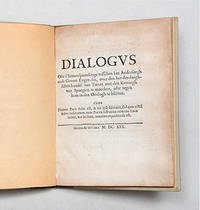
1630139110Amsterdam: publisher not named 1630. First edition of this West Frisian rhymed dialogue against the ongoing peace negotiations between the United Provinces and Spain to conclude the Dutch War of Independence 1568-1648. The United Provinces had gained significant ground in the preceding few years with the Dutch West India Company occupying Bahia the capital of Brazil in 1624 and that year taking Pernambuco the centre of Brazilian sugar production. The author of the rhymed dialogue deemed the tide to be in the favour of the United Provinces and opposed any truce while in a strong position. They moreover support the continuation of the war to enhance the Dutch economic interest especially with regard to trade with the West Indies. Despite the weakening of Spain negotiations proceeded slowly and peace was not declared until 1648. Worldcat locates six copies in the Netherlands one in Germany one in the UK British Library and two in the US Michigan Minnesota. Small quarto 189 x 143 mm. Twentieth-century green quarter cloth printed labels to spine and front cover grey card sides. A little rubbed contents a little browned. A very good copy. Brown European Americana 630/54; Knuttel 4020. Not in Landwehr or Sabin. hardcover
16609736London: Printed by J. Cottrell for William Roybould at the Unicorn and Henry Fletcher at the Three Gilt Cups in St. Paul's Church-Yard 1660. First edition. 8vo 7 459 I.e. 359pp. Engraved portrait frontis title page in two colors. Bound in half morocco spine lettered in gilt with gilt ruling marbled endpapers t.e.g. Lacks half title. Paper flaw to h4 affecting several words from the ends of about 4 lines on both upper and lower corners but not the sense. Otherwise text clean and complete binding tight and attractive. <br /> <br /> First edition of this important early biography of Cromwell offering a relatively sympathetic account of his military and civil career issued in the year of the Stuart Restoration. This work has been attributed to Henry Fletcher and William Raybould the publishers. There was a second edition in 1680 but the first remains quite scarce in the trade. <br /> <br /> ESTC R18473. Printed by J. Cottrell for William Roybould at the Unicorn, and Henry Fletcher at the Three Gilt Cups in St. Paul's Church-Yard unknown
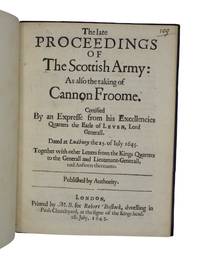
1645AQ22725London: Printed by M. B. for Robert Bostock 1645. 2 6pp. Modern navy morocco lettered in gilt to spine T.E.G. Marbled endpapers early alternate manuscript pagination to upper corners. With a loosely inserted letterpress receipt from bookseller Frank Hammond addressed to Lord Cottesloe acknowledging payment of £12 for the book in 1961. The sole edition of a decidedly uncommon news-book account of the actions of the Army of the Solemn League and Covenant - led by veteran Scottish Army officer Alexander Leslie 1st Earl of Leven c.1580-1661 - in the summer of 1645 reporting most particularly on their taking of a royalist garrison within the moated house at Cannon Froome Herefordshire. Following the defeat of a Royalist rebellion against the Covenanting-led Scottish Government in the Spring of 1645 the Scottish army of the Solemn League and Covenant - named after the 1643 treaty between the reforming parliaments in England and Scotland- led by the Earl of Leven marched south to assist their allies. As this news-book reports a 'party of 4500 Horse Foot and Dragoons' en route to Hereford became aware of a Royalist garrison led by 'Governor Colonell Barnold' in the small Herefordshire village of Castle Froome. After the Royalist commander refused to surrender the moated house which had been reinforced with Irish volunteers after the battle of Newark Leven the 'Lieut. Generall.gave order for storming the place'. The heat of the battle is described thus from a purely Roundhead perspective: 'The Grasses were about nine foot deep and as broad and in most places full of water; The Works above the Grasses were so high that all the Ladders we could get were too short; the Enemy behaved themselves valourously but it pleased the Lord to give our Souldiers to much courage that after a hot dispute they were beate from their works after which they fled to the house where they fought desparately till a great part of them were killed. We lost about 16. and 24. are wounded; of the Enemy were killed about 70. Colonell Barnold deadly wounded Captain Briskoe Capt. Houke & thirty others taken Prisoners.' ESTC records copies at just seven locations in the British Isles Advocates Library BL Hereford Cathedral Newcastle NLS Oxford Trinity College Dublin and just three further elsewhere California State Harvard Texas and Yale. Provenance: Recently dispersed from the Cottlesloe Military Library 'probably the most extensive private collection of early printed books focused on military matters'. ESTC R200176 Thomason E.294 Wing L557. First edition. Quarto. Printed by M. B. for Robert Bostock unknown
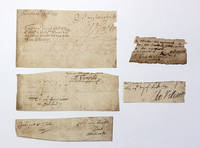
1650031291UK 1650. First Edition . Paper. Very Good. 48mo - over 3" - 4" tall. A group of 5 Ink Signatures of Royalist soldiers who fought in the 1st Civil War. They include 2nd Viscount Molyneux of Maryborough George Monck 1st Duke of Albemarle Sir William Compton General William Legg; Edward Villiers and Guilford Slingsby. Dated between 1640/1680. All removed from various paper documents and comprising signatures of: Richard 2nd Viscount Molyneux of Maryborough c. 1617-1654 'R. Molyneux' signed at the foot of a small piece with text in another hand being a list of supplies and countersigned by Corporal Griffith Standen; George Monck 1st Duke of Albemarle 1608-1670 'Albemarle' on an irregularly trimmed piece dated 4 February 1660; Sir William Compton 1625-1663 'W. Compton' written at the foot of a possible autograph sentiment sent to General William Legg; Edward Villiers 1620-1689 'Edw. Villiers' on a small piece dated 29 April 1680; Guilford Slingsby 1610-1643 'Gylf. Slyngsby' on an irregularly cut piece with autograph sentiment 'your loving friend' Richard Molyneux 2nd Viscount Molyneux of Maryborough about 1617-1654 was a Royalist officer in the English Civil War. Molyneux was present at the siege of Manchester in September 1642 and on 20 April 1643 was defeated by Captain Ashton at Whalley. After the surprise capture of Wakefield on 21 May 1643 the Earl of Derby being then with Queen Henrietta Maria at York Molyneux was ordered to conduct the Lancashire forces thither. He was defeated on 20 August 1644 by Major-general Sir John Meldrum at the battle of Ormskirk and narrowly escaped capture by hiding in a field of corn. He was at Oxford on 24 June 1646 when the city surrendered to the Parliament. George Monck 1st Duke of Albemarle 1608 -1670 was an English military officer and politician who fought on both sides during the Wars of the Three Kingdoms. A prominent military figure under the Commonwealth his support was crucial to the 1660 Stuart Restoration of Charles II. Sir William Compton 1625 - 1663 was an English royalist army officer. He earned the name of the "godly cavalier" in 1648 from Oliver Cromwell for his conduct at the siege of Colchester. William Legge 1608 - 1670 was an English army officer and politician who was a close associate of Prince Rupert of the Rhine. On the outbreak of the First English Civil War Legge joined the king's army and was taken prisoner in a skirmish at Southam Warwickshire on 23 August 1642. Committed by the House of Commons to the Gatehouse Prison he escaped about 4 October 1642 and rejoined King Charles at Oxford. Henceforth he closely attached himself to Prince Rupert and was wounded and again taken prisoner while under his command at the siege of Lichfield in April 1643. At the Battle of Chalgrove Field on 18 June 1643 he was temporarily taken prisoner on the field. After the first Battle of Newbury 20 September 1643 the king presented him with an ornate hanger and wanted to knight him. On 19 May 1644 Prince Rupert appointed him temporary Governor of Chester. Guilford Slingsby 1610-1643 was a member of the Yorkshire gentry who was confidential secretary to Thomas Wentworth 1st Earl of Strafford and present during the trial which ended in his execution in April 1641. Slingsby sat in the Parliament of Ireland as Member of Parliament for Carysfort from 1634 to 1635 and during Strafford's period as Lord Deputy of Ireland was appointed to several administrative posts. When the First English Civil War began in August 1642 he raised a regiment for the Royalist army in Northern England; he was badly wounded in a skirmish near Guisborough on 16 January 1643 and died three days later. Some occasional spotting age toning and paper sizes 11 x 18.5 cm and smaller. Ref19239 <br/> <br/> unknown
16946281London: Josiah Bromley 1694. First Edition. Loose Broadside Framed Under Glass. Good. Original one-sheet broadside roughly trimmed 8-1/8 by 12-4/8 inches. Printed on rag paper with old creases now mellowed and two archival tissue repairs on left margin. Mounted on mat board with mat board overlay. Overlay with edge-wear. Framed under glass. First Lord of the Admiralty Edward Russell 1653 -1727 was a key figure in the Nine Years War notably establishing his reputation at the Battles of Barfleur and La Hougue. <p>Following a decisive 1693 victory over the French navy near Cape Barfleur the House of Commons determined that Russell had not done enough in dispatching French ships; he was removed from duty. After disasters that befell the British Navy in summer 1693 Russell was reinstated. In early May 1694 he was appointed First Lord of the Admiralty and sailed for the Mediterranean to thwart French depredations against the Spanish coast near Barcelona and Palamos. The engagement documented here likely occurred enroute to the Mediterranean.</p> <p>With the idiosyncratic spelling and usage common to the era. e.g. "we were buzzed about the ears .". A charming patriotic broadside from reign of William and Mary. Rare. No institutional copies located.</p> . Josiah Bromley unknown
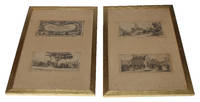
163651722A Paris Avec Priuilege de Roy 1636. Four original etchings by Callot published by Henriet who added a frontispiece title etched by Abrahem Bosse. Comprising frontispiece and 3 etchings ca. 59 x 120 mm. numbered 12 a. 3 in the plate. All 4 mounted and framed in two 29 x 20 cm. Mildly brownspotted. <br/><br/><em>The "Small miseries of the War" was unfinished - there was only published 7 etchings the 4 first offered here.Callot was one of the first great artists to practise the graphic art exclusively. His innovative series of prints documenting the horrors of War of which his series "Les Miseres et les Mal-Heurs De la Guerre" Great Miseries of War is the most famous greatly influenced the socially conscious artists of the 19th and 20th centuries. For instance its themes and imagery were used as a source by Goya and he is acknowledged as equal to the three great: Dürer Rembrandt Goya. It is said that no one ever to such an extent possessed the talent of grouping a large number of figures in a small space and of representing with two or three bold strokes the expression action and peculiar features of each individual. Brunet I 1488 17. </em> unknown
1648304145np 1648. Sole edition. 4 ll. Collation: A4. 4to. Green half morocco by Riviere spine gilt some spotting. Sole edition. 4 ll. Collation: A4. 4to. "And would you know what here is meant / By Monster 'Tis our Parliament."<br /> ESTC lists seven other copies of this scathing anti-Cromwellian work though no other parts are traced. Wing S 2321; ESTC R204781. Provenance: Samuel Christie-Miller 1873 purchase note on flyleaf with cost of binding; Britwell Court Sotheby's 4 April 1924 lot 814; Fairfax of Cameron bookplate; Robert S. Pirie bookplate unknown
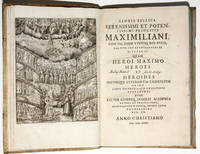
16235340Ingolstadii: Ex officina typographica G. Haenlini 1623. Hardcover. Near Fine. 4to 27 x 17.5 cm. 17 ff. 388 pp. recte 386 7 ff. with misnumbered pages at pp. 203-06 243-46 and 260-71 1 full-page engraving 20 x 15.5 the platemark. Bound in contemporary blind-stamped pigskin raised bands boards beveled somewhat scuffed clasps missing. Blue edges small hole repaired on half title and engraving ownership inscription of Andechs Abbey on title page minor browning in some quires. An excellent and unsophisticated copy. First edition of a rare volume of prose and verse glorifying the military exploits of the Prince-Elector Kurfürst of Bavaria Maximilian I 1572-1651 by members of the University of Ingolstadt as compiled by the Jesuit philosopher-theologian Georg Stengel 1584-1651. The Gloria Bellica is an important witness to the intertwining of princely power university politics and religious sectarianism at the onset of the Thirty Years War 1618-48. Published in the year of Maximilian's elevation to Prince-Elector 1623 the book seems to have been an attempt by faculty at Ingolstadt to secure his favor. The increasingly Jesuitical university would be frequently imperiled during the flux of the war and quickly identified Maximilian himself educated by Jesuits as an important military protector. Maximilian's central role in the German Catholic League had been essential in checking the power of the Protestant Union. The volume is especially notable for its full-page prefatory engraving executed by the Augsburg artist Daniel Manasser a highly detailed and elaborate allegory charting Maximilian's martial rise and the praise conferred on him from various secular and sacred sources. Merchants clerics Liberal Arts herself and a throng of lesser citizens crowd together to salute Maximilian as he rides upward on the back of Pegasus toward the Olympian gods reclining in the empyrean; the demigod Hercules mediates between heaven and earth while battling Nessus and the Lernaean Hydra. Flanking Maximilian's ascent are 8 groups from whom he receives "Gloria": his enemies his commanders and soldiers muses and scientists hometown Bavaria the Catholic League the Holy Roman Emperor Ferdinand I the pope and church and indeed Mary Christ and the saints. The text of the Gloria Bellica is arranged as a fuller version of this scheme with 20 chapters each detailing a source Maximilian's glory. OCLC identifies U.S. copies at Harvard Trinity CT Georgetown and Chicago. VD 17 23:231047E; De Backer/S. and VII 1550 32; Lentner 3774; Pfister I 4297; Mario Praz Studies in Seventeenth-Century Imagery Rome: Edizioni di Storia e Letteratura 1975 pp. 503-04. <br/> <br/> Ex officina typographica G. Haenlini hardcover
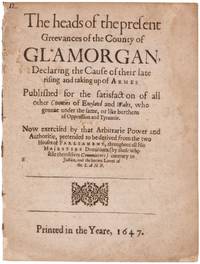
164721028431647. London: n.p. 1647. Small 4to. Disbound pp. 2 6; a little toned a few stains to title light dampstaining to outer margin of A1-2 but overall a very good and crisp copy.First and only edition very rare of this denunciation of the abuses of the Parliamentarian County Committees in Wales issued at the height of the Civil War.By the summer of 1647 one surviving copy is dated in manuscript ""1 July"" the war had dragged on for nearly five years. Parliament was steadily gaining the advantage largely through the network of County Committees manned with loyal supporters. These officials collected the taxes that sustained the war effort requisitioned horses and supplies for the army and carried out Parliament's decrees. Their growing power - together with the ever-heavier burden of taxation to maintain the army - provoked widespread resentment and in turn revived support for the Royalist cause.This pamphlet sets out the grievances against the Parliamentarian committees in Glamorgan South Wales and denounces their exactions and abuses. The rising it encourages was less an expression of loyalty to Charles I than a reaction to Parliament's oppressive rule. Indeed it contains no Royalist propaganda and no expressions of loyalty to Charles. Instead it reads as a near-anarchic denunciation of arbitrary power itself of its arrogance remoteness and disregard for the people.ESTC R201640 recording only five copies BL National Library of Wales Cardiff Central Library Oxford Folger. unknown
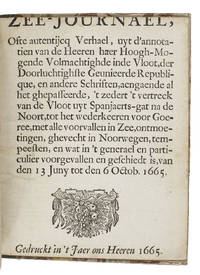
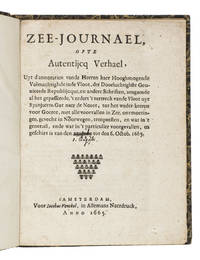
1665ABC_46560Amsterdam 1665. 4to. Jacobus Venckel Contemporary half vellum marbled sides. With an ornamental woodcut title-vignette. 35 1 blank pp. Rare pamphlet written by an anonymous author discussing the fascinating Battle of Vågen the main port area of neutral Bergen in Norway in August 1665 during the Second Anglo-Dutch War 1665-1667 including its background and aftermath. The Second Anglo-Dutch war was a war at sea caused by conflicts in colonial territories of the Dutch Republic and England. This naval war consisted mainly of protecting their own merchant ships capturing enemy ships and trying to sink mutual warships. The Battle of Vågen was an important naval battle between a rich treasure fleet of the Dutch East India Company VOC and an English flotilla of warships. The present pamphlet gives an account of the events before and after the Battle of Vågen and also in broad lines of the battle itself including all kinds of correspondence and notes from high-ranking figures.Since Tiele attributes this anonymous edition to Venckel it seems likely to be the first edition which Venckel first published anonymously. In any case the present edition is rare. We find only two records of it at auction in 2005 and 2015 the other copies are all held institutionally. A highly interesting pamphlet on one of the most important and fascinating 17th-century sea battles in Dutch naval history and in the history of the Dutch VOC.A few spots the margins trimmed with no loss of text except that the words "Zee-Journael" on the title-page are slightly shaved. Otherwise in good condition.l Knuttel 9103; STCN 863290108 6 copies; Tiele 5266; WorldCat 5 copies in 4 entries; for Venckel: H.F. Wijnman De Amsterdamsche boekverkooper Jacob Vinckel 1627-1680 in: Vondel-kroniek 5 1934 p. 192. hardcover
1665ABC_49489Amsterdam 1665. 4to. Jacob Venckel Modern marbled boards. 2 69 pp. Rare pamphlet written by an anonymous author discussing the fascinating Battle of Vågen the main port area of neutral Bergen in Norway in August 1665 during the Second Anglo-Dutch War 1665-1667 including its background and aftermath. The Second Anglo-Dutch war was a war at sea caused by conflicts in colonial territories of the Dutch Republic and England. This naval war consisted mainly of protecting their own merchant ships capturing enemy ships and trying to sink mutual warships. The Battle of Vågen was an important naval battle between a rich treasure fleet of the Dutch East India Company VOC and an English flotilla of warships. Twice a year the Dutch VOC sent a treasure fleet from the East Indies to the Dutch Republic with money and goods. On 24 December 1664 one of the richest-laden fleets in Dutch history departed from Batavia for the homeland with a cargo estimated to be worth millions. This fleet was intended to support the Dutch Republic financially and therefore should not fall into enemy hands. Since the tensions with England were already high in 1664 an experienced officer the rear admiral Pieter de Bitter ca. 1620-1666 was appointed to command this fleet.The present pamphlet gives an account of the events before and after the Battle of Vågen and also in broad lines of the battle itself including all kinds of correspondence and notes from high-ranking figures. The dating in the title is incorrect as the story took place from August 1 to August 20 which is why the title has been corrected by hand in the present copy. The present edition is one of two both printed in 1665 but with a different imprint the present one with the publisher and place of publication and the other with only the year and the alignment of the text. However they were both likely printed by the same printer. The present edition is very rare. We've not been able to find other copies in sales records and only a few in institutions. A highly interesting pamphlet on one of the most important and fascinating 17th-century sea battles in Dutch naval history and in the history of the Dutch VOC.The date "13. Juny" has been crossed out on the title page and replaced by "1. Augusti" in manuscript. The work is slightly browned throughout a small hole in the lower margin of the title-page and an ink drop in the lower margin of page 65. Otherwise in very good condition.l Knuttel 9102; STCN 842169458 8 copies incl. 1 incomplete; Tiele 5265; USTC 1802668 9 copies incl. 1 incomplete; WorldCat 85201870 747664026 4 copies; cf. for Venckel: H.F. Wijnman De Amsterdamsche boekverkooper Jacob Vinckel 1627-1680 in: Vondel-kroniek 5 1934 p. 192. hardcover
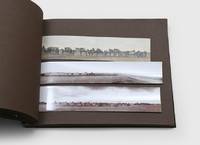
1619161520Aden: 1916-19. The First World War in south Arabia A fine personal album of unique images of the AFF in the field taken and compiled by Captain A. G. Dyce 1886-1959 deputy assistant director Supply and Transport Corps. It includes photographs of infantry cavalry and artillery units the use of balloons and the signal contribution of ship-launched aircraft under the command of Charles Rumney Samson. On the outbreak of war Ottoman forces advanced into the Western Aden Protectorate from Yemen forcing the British to withdraw from Lahej and part of the Aden settlement. While Turkish encouragement of jihad fell on deaf ears in central Arabia "it found resonance in Yemen. Ali Said Pasha the skilful Turkish commander was so successful in radicalising the tribes for the Ottoman cause that he was able to push British forces into the enclave of Aden. The tactic that defeated Ali Said Pasha was the use of Imam Yahya who argued that Yemen was not for the British or Ottomans but the Arabs. Arab nationalism eroded Said Pasha's influence and saw England supporting a treaty with Imam Yahya as monarch of Yemen which concluded in 1920" Infantry p. 43. Born in India and educated at Wellington College Alan George Dyce 1886-1959 son of Brigadier-General G.H.C. Dyce Indian Staff Corps joined the Indian Army in 1906 serving initially with 22nd Sam Browne's Cavalry. He was a keen photographer appearing in an issue of Amateur Photographer for 1917 and mountaineer being on the committee of the Himalayan Club. Despite being taken in the field while on active service Dyce exhibits a good eye and composes his pictures with care. There are many shots of the combined arms operating with the AFF: No. 13 Kite Balloon Section of the Royal Navy Air Service five images the Mountain Battery of the Malay States Guides lancers of what are presumed to be the 26th King George's Own Light Cavalry and medical facilities including a cavalry field ambulance at Sheikh Othman an advance dressing station a camel ambulance tonga a two-wheel vehicle common in India and camels with cacolets cradle-like structures mounted either side of the camel's hump. One image signed by Dyce in pencil on the verso is captioned: "The GOC Aden F.F. leaving the dais with the Sultan after the installation ceremony" and shows 'Abd al-Karim II ibn al-Fadl al-'Abdali Sultan of Lahej reigned 1915-1947 being handed down from the dais by Brigadier-General William Crawford Walton. There is a sequence of six images covering the "Fight at Jabir" 7 December 1916 described in General Sir Charles Monro's despatch as having had "a demoralising effect on the Turkish Arab auxiliaries and to have produced the intended result viz. preventing the withdrawal towards the Yemen of Turkish troops from Lahej". One panoramic shot shows British officers observing the shelling of Turkish positions and three others the sighting positioning and firing of what appears to be a six-inch naval gun. Three wide-angle shots show the mountain battery and its camel team hauling 15-pounder mountain guns. A trio of crisp sepia-toned prints depict Indian Army troops of the "water column" perhaps the 66th Punjabis who are named elsewhere: "filling water carts with condensed water sent from Aden" "filling canvas tanks" and "water column moving out". Commander Samson 1883-1931 features in one image "Seaplane: Cmdr. Sampson sic" which shows a huddle of figures around the cockpit of what appears to be a Short 184 its wings detached and apparently undergoing repairs. This accompanies "Signalling to plane with lamp and canvas strips" another excellent wide-angle shot taken from a high position that encompasses a rail track steamroller and men laying out a triangular canvas-strip indicator. Most intriguing is a small snapshot of a manned seaplane suspended from a derrick over the side of a ship probably HMS Ben-my-Chree. The pilot may be Samson and the plane a Short 184 that he modified by adjustments to the wings and tail fin and christened the "Short Cut". Captured Turkish prisoners feature in eight images including their commander Said Pasha; two are captioned "Turks marching in to surrender" and "Turks going in by train" while a series of five is titled "Turkish prisoners and guns" including a touching image of two Turkish soldiers under escort their eyes bandaged one holding the other's coat tails. Landscape folio album 240 x 280 mm. 49 ff. some blank. With 92 photographs from 40 x 65 to 170 x 270 mm portrait and landscape format mounted on rectos only on brown leaves including a panorama in two parts joined with tape some images loose one hand-coloured many captioned in pencil on verso or in white on mounts. Commercial Kodak album of black morocco-grain faux leather. Spine ends a little worn many images loose but clean and unfaded: very good. Infantry Volume 97 Number 1 2008. hardcover
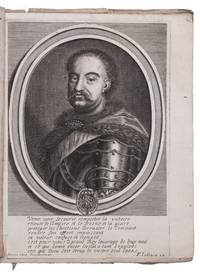
168722346Bordeaux: Pierre Abegou 1687. Marbled wrappers. 4to. With an inserted latter engraved frontispiece portrait of the Polish King Jan III Sobieski engraved by F. Jollain. Very rare pamphlet published during the European wars against Turkey with a frontispiece portrait of the Holy Roman Emperor Léopold I 1640-1705 Archduke of Austria and King of Bohemia and Hungary. He succeeded his father Ferdinand III in 1657 and immediately had to fight against the Turks in the Great Turkish War also known as the War of the Holy League 1683-1699. This war finally led to the Peace of Karlowitz in 1699.This work gives directions and arrangements for ritual processions that the Turkish Sultan Suleiman III ordered after his victories during the so-called Holy Wars against the Christians. It is of great importance for our understanding of the problematic Turkish-European relations during the 17th century especially as an interesting example of counter-propaganda. One of Suleiman IIIs directions presented in the book for example ordered that one Christian slave or one Jew was to be killed every fifteen minutes as part of the procession. One can imagine the reaction of a Christian reading this text: although the crusades were over this could provoke war and violence between the parties.Wrappers worn and somewhat frayed a few worm holes but still in good condition.l Bibliotheca bibliographica Aureliana CX XVIIe siècle XIV Bordeaux 2176 not mentioning the portrait; cf. Desgraves Bordeaux 1580. Pierre Abegou, unknown