645 résultats
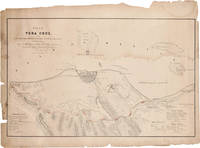
1847WRCAM48455Washington D.C. 1847. Engraved map 16 x 25 1/4 inches with hand- coloring on a 19 1/2 x 27 inch sheet. Worn around the edges with chips and loss not affecting the map imagery itself. Two closed tears in the left edge do intrude into the map. Paper tanned upper portion stained. About good. A scarce and detailed map of the Siege of Vera Cruz a turning point in the Mexican- American War. Winfield Scott with ten thousand American troops and a siege train landed on the beach near Vera Cruz on March 9 1847. The American forces outnumbered the Mexican defenders of the city by a two-to-one margin and the American guns were especially devastating. The city's castle was undamaged but the terrified citizenry implored Gen. Juan Morales to capitulate which was done at the end of March. The map notes American casualties as twelve killed and sixty-one wounded the actual numbers were slightly higher; the casualty rate among Mexican soldiers and civilians outnumbered that of the Americans. Vera Cruz would become an important port base for the American forces. This map shows the coastline from the road to Jalapa to the landing point of the American troops. The city and its main defenses are shown in detail and the headquarters of American commanders Scott Worth Patterson and Twigg are also shown. The Line of Investment is colored in red as is the location of the American hospital. Text on the map describes the make-up of the divisions led by Patterson Worth and Twigg. This map was drawn by George B. McClellan then a captain under Winfield Scott and a participant in the battle some fifteen years before he achieved notoriety as a commander in the Civil War and as the Democratic nominee for president in 1864. OCLC records some sixteen institutional copies but in our experience this map is scarce in the market. unknown books
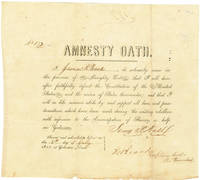
1865WRCAM55643Galveston 1865. Partially-printed document 8 1/4 x 9 1/2 inches completed in manuscript. Three vertical folds. Minor toning foxing soiling and edge wear. Very good. A rare Civil War amnesty oath attested to and signed by James P. Nash in Galveston on July 8 1865. The partially-printed document is signed by him twice and also dated and signed by the Captain and Provost Marshal Harry Beard. The oath reads in full: <br> <br> "Amnesty Oath. I JAMES P. NASH do solemnly swear in the presence of Almighty God that I will hereafter faithfully defend the Constitution of the United States and the union of States there=under; and that I will in like manner abide by and support all laws and proclamations which have been made during the existing rebellion with reference to the Emancipation of Slavery; so help me God. JAMES P. NASH. Sworn and subscribed to before me this 8th day of JULY 1865 at Galveston Texas. H. BEARD Captain and Provost Marshal." The signer of the Amnesty Oath James P. Nash was likely the same James P. Nash who was an early educator and professor in Galveston. <br> <br> This 1865 amnesty oath appears to exist in two states: one blank below the line "1865 at Galveston Texas" and one with a dotted line added above the printed words "Captain and Provost Marshal." The present example is the former and likely first state of the document before the dotted line and "Captain and Provost Marshal" were added later. <br> <br> Amnesty oaths are scarce in the market; this one is especially interesting for its association with an early Galveston educator. unknown books
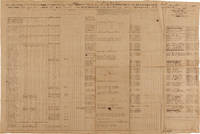
1863WRCAM54505Richmond 1863. Printed form approximately 24 x 36 inches completed in manuscript. Folded. Light wear and a few small separations along folds. Slightly wrinkled at right edge. Moderate tanning scattered foxing. Still very good. A rare example of a Civil War muster roll for a Confederate unit. This roll is for for Company E of the 2nd Battalion Georgia Sharpshooters commanded by Maj. J.J. Cox as they mustered on Feb. 28 1863 near Chattanooga shortly after the battle of Fort Donelson. Although it was a Georgia Battalion the vast majority of men in Company E were from Montgomery Alabama. As a part of Gen. J.K. Jackson's Brigade in the Army of Tennessee the unit fought at Murfreesboro Chickamauga and Missionary Ridge and later as a part of Gen. Gist's Brigade participated in the battle for Atlanta and Hood's Tennessee operations. The roll lists all officers and enlisted men records two deaths in the company a number of absentees through sickness and desertion and even notes two instances of substitution. Civil War soldier substitutions were a controversial tactic in which men of means bought their way out of service. A fine copy of a scarce Confederate military document. unknown books
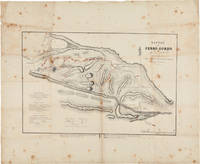
1847WRCAM43715Washington D.C. 1847. Engraved map 12 1/2 x 18 1/2 inches with hand- coloring on a 19 1/2 x 23 3/4 inch sheet. Old folds. Small splits at four cross-folds. Foxing. Good. A scarce and detailed map of the Battle of Cerro Gordo one of the important battles of the Mexican-American War. General Winfield Scott's victory at Cerro Gordo over a much larger force commanded by Santa Anna allowed the Americans to move closer to Mexico City. The map shows the location of the Mexican battery at the pass as well as an additional Mexican battery of seventeen guns. Most dynamically it shows the location of several American forces including those commanded by Shields Riley Twiggs Worth and Pillow as well as the location of the American dragoons and light artillery. A printed note below the map records that Scott commanded some 8325 men while Santa Anna had twice that under his command. A further note records a total of sixty-three Americans killed and 367 wounded. The Mexican forces took some 1000 in killed and wounded. The map was drawn by George B. McClellan then a captain under Winfield Scott and a participant in the battle some fifteen years before he achieved notoriety as a commander in the Civil War and as the Democratic nominee for president in 1864. unknown books
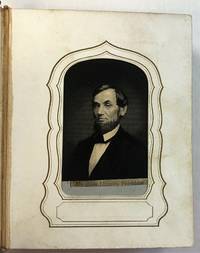
186337056New York: Elias Dexter; one by L. Prang 1863. Forty-eight handsome portrait engravings of important Civil War figures including Lincoln and Cabinet members Union Army and Navy leaders Jefferson Davis and others. Each mounted within a decorative stiff card frame with gilt border. Portraits are clear and clean most with an identifying slip the slips are loose and not pasted to the engravings only one or two with some light wear to picture. They are preceded by a decorative title page. Bound in original cloth "Album" stamped in gilt on the spine. Spine cloth chipped at head and foot slightly shaken but covers firm. The portraits are not glued in but rather placed into the frame from the bottom and the bottom then sealed. The cards have the name of the subject below the portrait and the imprint at the bottom and are in Near Fine to Fine condition.<br/><br/> The portrait of Lincoln is based on a popular photograph taken by Mathew Brady on or around May 16 1861. The remaining portraits include: Seward Stanton Chase Welles Winfield Scott Wool Commodore Davis Foote Wilkes Porter Farragut Stringham Com. Dupont Lieut. Worden McClellan Halleck Dix Gen. Grant Gen. Curtis Franklin Mitchel Burnside Pope Fitz Porter Sigel Banks Lander Heintzelman Rosecrans McDowell Buell Ben Butler Anderson Baker Shields McCook Col. Wilcox Benham Sherman Lyon Mansfield Hunter Parson Brownlow Gov. Sprague Jefferson Davis Gen. Beauregard Magruder. The imprints are from Elias Dexter with the exception of the Magruder which has the imprint of L. Prang & Co. Boston & Washington; and possibly one other.<br/> Elias Dexter 1816-1897 was an engraver publisher photographer and frame maker. He is best known for his 1862 publication The St.-Memin Collection of Portraits. Louis Prang 1824-1909 was a printer lithographer and publisher. He is sometimes called the father of the American Christmas card. Elias Dexter; one by L. Prang unknown books
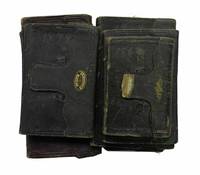
1861100126<p>Group of three daily diaries for 1861 1863 1865 and two others for 1866 and 1867. Together five diaries. Various places: 1861-1867. Each 12mo morocco wallet style bindings four black one red. Diaries for 1861 and 1863 in pencil others combination of pencil and ink. All bindings are worn 1863 is more so and a couple have some tears along edges and hinges. The 1866 diary has more significant wearm and some cracks along the edges. Group of 10 pages are loose in 1863. Condition of writing varies but generally fairly legible. Overall the group is in very good condition.Herrick was from Syracuse New York and served in Company D of the 110th Regiment of the New York Volunteers. However information from the National Park Service archive suggest he served with the 12 Regiment out of New York. He appears to have served during the siege at Port Hudson and did garrison duty at the infamous Union prison Fort Jefferson in Florida. The first diary covers his enlistment in April 1861 to the end of that year. The diary describes training and the trip to Washington where the regiment was reviewed by President Lincoln. It appears that in July 1861 he was discharged for medical reasons but for some reason he re-inlisted in August 1862. The diary for 1863 covers the entire year and includes descriptions of the siege and assault on Port Hudson. Herrick seems to have been ill during this period and stayed in camp a lot. In February 1864 Herrick and the 110th began garrison duty at Fort Jefferson the much reviled Union prison located on Garden Key Island in the Gulf of Mexico. While Herrick’s descriptions often seem somewhat monotonous the weather his health which ships came in his impressions of various drills this diary is one of very few first hand accounts inside the prison. There are some interesting entries including a prison detail discovering coffins while digging a foundation for a new building an officer arrested for selling whiskey to prisoners and a prisoner being "strung up" for stealing. Perhaps the most significant content of this diary is related to Lincoln’s assassination. In an entry on April 22nd a ship brings news to the prison "they had three prisoners slung up for rejoicing over it" Then in an entry dated July 24th the naval transport Florida brought three of the Lincoln assassination conspirators Samuel Arnold Michael O’Laughlin and Dr. Samuel Mudd to the prison. This prison wasn’t known for kindly treatment of prisoners the weather usually very hot and humid and the place was infested with bugs and misquotes. The food was what you would expect and Samuel Arnold was reported to have said the meat was so rotten "dogs ran from it." nps.gov/civilwar/soldiers</p> books
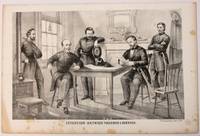
186537368Philadelphia: P.S. Duval & Son LIth. 1865. Broadside lithograph oblong 10-1/8" x 6-3/4." Some foxing at the margins else Very Good.<br/><br/> This is an extremely rare lithograph by Duval depicting General Joe Johnston's surrender of his army to General Sherman on April 18. "Peter Stephen Duval the most prominent Philadelphia lithographer of the 19th-century was born ca. 1804/5 in France. He emigrated from France to Philadelphia in the fall of 1831 to accept a job as a lithographer with the printing firm of Childs & Inman. By 1837 he had established his own lithographic printing shop and remained in business until his retirement in 1869" online Library Company article on Duval. <br/> "Sherman studies the surrender terms as his vanquished opponent Confederate General Joseph E. Johnston waits with evident unease in this rare depiction of the meeting at the Bennett House in Durham North Carolina. The print erred in showing the principals with their staffs; Sherman remembered that 'we were alone together.' Unlike Appomattox the Bennett House surrender quickly had a shadow cast over it when the War Department disallowed Sherman's terms and this scene never rivalled the meeting of Lee and Grant in iconographic memory." Neely and Holzer THE UNION IMAGE: POPULAR PRINTS OF THE CIVIL WAR NORTH. UNC Press: 2000. Page 194 Figure 98. In our copy the face of the man standing behind Sherman differs slightly from the Neely-Holzer illustration.<br/>Neely & Holzer 194. Not located in Reilly Weitenkampf Bartlett Sabin Eberstadt LCP or on OCLC or the AAS online site as of January 2021. P.S. Duval & Son, LIth. unknown books
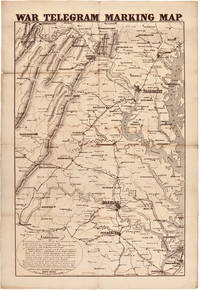
1862WRCAM52854Boston: L. Prang & Co. 1862. Large lithographic poster 38 x 26 inches. Backed with later paper. Old fold lines some minor soiling and wear. Minor loss at a few folds. Nearly very good. A handsome and large-scale map of Virginia from Norfolk to Lynchburg and north to Baltimore and Harper's Ferry. The explanatory cartouche indicates "The extraordinary large scale on which this map is drawn has been adapted to make it just what we designed it to be namely 1st. The most distinct map ever published of the whole Virginia Territory; 2nd. A Marking Map that is a map to mark the change of positions of the Union Forces in red pencil and the Rebel Forces in blue on the receipt of every telegram from the seat of war; for this latter purpose we want plenty of space and a distinctness combined with enough detail not to crowd but to enable us to follow the march of the army as advised by the telegrams. The pencils which we also furnish should be used with a light hand to enable obliterating the marks with the aid of a little soft bread if found necessary. These peculiarities combined with extreme cheapness will make this Map a welcome companion to every person interested in the pending struggle of our nation." L. Prang & Co. unknown books
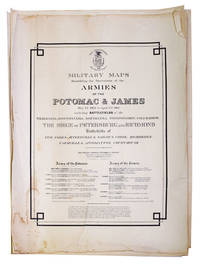
1869267611Washington D.C.: War Department Office of the Chief of Engineers Lithographed by Julius Bien New York 1869. First Edition. Prepared under the direction of Bvt. Brig. Gen. N. Michler Major of Engineers and Bvt. Lieut. Col. P.S. Michie Capt. of Engineers. 16 maps on 17 sheets. All but one double-page. Folio 23-5/8 x 18-1/2 inches. Unbound sheets. Light stains at top edges of several maps title with tape repair. First Edition. Prepared under the direction of Bvt. Brig. Gen. N. Michler Major of Engineers and Bvt. Lieut. Col. P.S. Michie Capt. of Engineers. 16 maps on 17 sheets. All but one double-page. Folio 23-5/8 x 18-1/2 inches. The topographic maps comprise:<br/>1A. Gettsburg to Appomattox Court House northern<br/>1B Gettysburg to Appomattox Court House southern <br/>2. Fredericksburg<br/>3. Chancellorville <br/>4. The Wilderness<br/>5. Spottsylvania<br/>6. North Anna single page<br/>7. Totopotomoy <br/>8. Cold Harbor<br/>9. Richmond<br/>10. Bermuda Hundred <br/>11. Petersburg and Five Forks <br/>12. Jetersville and Sailor's Creek<br/>13. High Bridge<br/>14. Appomattox Court House<br/>15. Antietam<br/>16. Harper's Ferry. Phillips Atlases 3688 listing only 15 maps; Civil War Maps 518; Stephenson and McKee "Virginia in Maps" p. 194: "Topographers had already surveyed more than 1300 miles and issued more than 1200 maps prior to the army's passage over the Rapidan River on the night of 3-4 May 1864 the beginning of U.S. Grant's major offensive in Virginia that led from the Battle of the Wilderness on 5 and 6 May to the ten-month siege of Petersburg beginning in mid-June and finally to R.E. Lee's surrender at Appomattox on 9 April 1865. Bvt. Brig.-Gen. Nathaniel Michler's men made more than 1600 photographic sketches between the time of the river crossing and 30 July 1864. The vast number of surveys that Michler directed led to the publication of this atlas. War Department, Office of the Chief of Engineers [Lithographed by Julius Bien, New York] unknown books
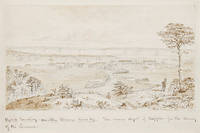
1863WRCAM56150Aquia Landing Va 1863. One pen and ink drawing 7 x 10 1/2 inches sight and one pencil sketch 6 3/4 x 9 3/4 inches sight each in recent matching frames 11 1/2 x 15 inches; plus 2pp. letter on folded folio sheet. Slight soiling and smudging to sketches. Short tape repairs to two closed tears at top margin of letter minor separation at fold text not affected. Very good overall. Two drawings by an unnamed artist submitted as potential accompaniments for articles in HARPER'S WEEKLY which was well-known for the copious Civil War illustrations that supplemented its text. Such illustrations were usually either drawn by reporters or artists sent into the theater by HARPER'S or less often by soldiers in the field. These two works were done by a Union Army Division Post Master and are accompanied by a letter from his commanding officer submitting them for publication. <br> <br> The first work done in pen and ink on paper is entitled "Aquia Landing on the Potomac River Va. The main depot of Supplies for the Army of the Potomac" and depicts a river scene with steamers and sailing vessels along with a pier in the middle distance with a supply train approaching in the foreground which is observed by two soldiers. In the foreground are delicately drawn trees and shrubs; in the background one can see more ships and the other side of the river possibly Simms Point. In early March 1862 the Confederates abandoned Aquia Landing a strategically important post on the Potomac River and Union forces quickly seized the point. The Union Army used the wharves and storage building at Aquia Landing until June 7 1863 when the army headed north for the Battle of Gettysburg and again used the facilities in 1864 during the Overland Campaign. <br> <br> The second work is a pencil sketch titled "Army Bakery in charge of Capt. James Gillette Commissary of Subsistence to Genl. Geary's Division." One medium-sized and two small cabins are at the left side of the image with barrels and a large cauldron nearby; presumably this is where the bakers prepared bread and other items for baking. On the right side of the image is a large wooden lean-to sheltering at least nine ovens. Two bakers are carrying trays of bread and one stands near an open oven with a large peel. To the right of the lean-to is a tent partially open and filled with loaves of bread with three more bakers loading in loaves. In the background are bare trees suggesting this scene is set in winter. <br> <br> The accompanying letter on "Office of the Commissary of Subsistence" letterhead is from Capt. James Gillette to John Bonner then editor of HARPER'S WEEKLY. Gillette writes that he encloses three sketches of which two are included here: "These sketches were made under my own supervision by our division post master are as accurate in detail as any I have seen." Gillette then describes additional material he has enclosed and notes "Some time since a few sketches of scenes in Richmond furnished by my experience found place in your weekly eliciting from you the request that I should occasionally forward to your address such representations of military scenes as might be of interest. Hence these enclosures which in truthfulness cannot be excelled." <br> <br> James Gillette 1838-81 enlisted as a private and rose quickly through the ranks. By this time he was Captain and Assistant Commissary of Subsistence for the 2nd Division XII Corps under Gen. John W. Geary. For his meritorious service he was breveted lieutenant colonel U.S. Volunteers and for gallantry at the battle of Chancellorsville he was breveted major in the regular Army. John Bonner 1829-99 was one of the best known newspaper writers in America at this time. He started as a writer at the NEW YORK HERALD and then moved on to be an editor at HARPER'S. After the Civil War he made a small fortune on Wall Street and then lost it in a most dramatic fashion. He drifted west working for the LEADVILLE CHRONICLE and LEADVILLE NEWS in Colorado and the SAN FRANCISCO CHRONICLE and SAN FRANCISCO CALL among other Bay Area newspapers. <br> <br> An attractive pair of original Civil War drawings from a Union soldier in Virginia in the middle year of the war accompanied by the letter from the Army Commissary officer submitting them for publication to HARPER'S WEEKLY. unknown books
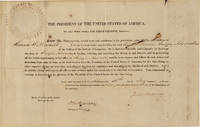
1813WRCAM54812Washington D.C. 1813. 1p. partially-printed document completed in manuscript. Paper seal of the United States affixed to upper left corner. Old folds. Light tanning mild surface wear a few ink blotches one small area of ink burn not affecting text. Overall very good. Matted framed and glazed. A War of 1812-era presidential appointment signed in ink by President James Madison and by Secretary of War John Armstrong. Here Madison appoints Maryland attorney James Sewall Morsell to the position of Judge Advocate of the Militia of the District of Columbia. In addition Morsell has fully endorsed and docketed the document on the verso pledging to "carefully & diligently perform the duties of a Judge Advocate.to the best of my Skill & Judgement and that I will support the Constitution of the United States." Morsell would serve as a Judge Advocate for almost two years. From January 15 1815 until March 3 1863 he would serve as a circuit court judge in the District of Columbia. Earlier in his career and during his years in private practice Morsell represented numerous African-American families who petitioned for freedom in the nation's capital. Judge Morsell passed away in Maryland in 1870. unknown books
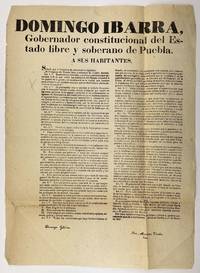
18471731Puebla 1847. Good plus. Broadside approximately 17 x 12.25 inches. Previously folded near lower and right edges to fit in a folio volume with several small stab holes at left edge where previously bound. Some separation from left edge along lower fold line and small area of loss at fold point not affecting text. Light tanning and faint foxing. A rare broadside that promulgates a March 16 1847 decree of the Puebla state government that sought to raise emergency funds for the army facing the American invasion at Veracruz during the Mexican-American War. This decree printed and published in Puebla the following day under the authority of its governor Domingo Ibarra orders the formation of a group to be called the "Patriotic Board of Aid" in order to assure the participation of its citizens. The first article of the decree announcing the establishment of the junta reads as follows:<br /><br />"Entretanto se decretan y realizan contribuciones generales á fin de que todos los habitantes del Estado cooperen á los goastos de la guerra se establecerá en la capital una reunion para proporcionar prontos recursos que se denominará 'Junta patriotica de auxilios.'"<br /><br />The subsequent sixteen articles define the constitution authority and goals of the group. The second article for example stipulates the specific legislative judicial religious and municipal bodies that will nominate two members each to the junta. The fourth article outlines the responsibilities of the board -- to acquire a loan of up to 100000 pesos using the state income as collateral; to seek cash and military supplies via donation loan or purchase; to administer the delivery of goods and money to the army at Veracruz; and to issue state treasury bonds to lenders. The group according to the last article has eight days to amass a much as possible before reporting their results to the state.<br /><br />At this point in the war not only was the entire country under enormous pressure from the landing of Winfield Scott's army but Puebla was also suffering from the significant unrest of the Polkos Revolt which had led to an unsuccessful insurrection aided by a portion of the military garrison in the city just a week prior to the publication of this decree. Indeed the need to ensure the participation of all citizens in the costs of the war is mentioned and emphasized at several points in the decree. The larger size of this broadside underscores the importance of the message and its distribution as well. <br /><br />A fascinating and rare document of emergency efforts at the state level to support the war effort against the United States. We locate only one copy of this rare broadside at Yale. books
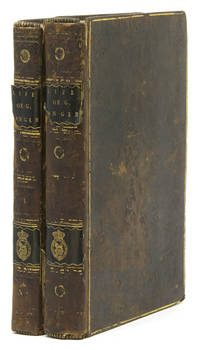
1801302703London: J. Debrett 1801. Complete with half-titles and one illustration to text. 339; 475 4 ads pp. 2 vols. 8vo. Contemporary calf black morocco labels to spine gilt slightly shelf-worn extremities a little rubbed presentation inscription to title-page. Complete with half-titles and one illustration to text. 339; 475 4 ads pp. 2 vols. 8vo. AUTHOR'S PRESENTATION COPY. Presentation copy signed "From the Author" on the title-page. This copy formerly belonged to Sir George Chetwynd; it has both his bookplate and discreet embossed library stamps from Grendon Hall where his collection was housed. A manuscript note to the front free endpaper states that this copy also belonged to the Duke of York.<br/><br/>Having served as aide-de-camp to Clinton during the Charleston campaign he was wounded at Charlotte in 1782 Hanger was appointed Major of Tarleton's Dragoons. With further connections to Carleton Gen. Dickenson and Major Andre among others he was well placed to produce one of the best accounts of the Revolutionary War in the South. <br/><br/>Sabin notes the "curious prophecy" to be found in the second volume: "one of these days the Northern and Southern powers will fight as vigorously against each other as they both have united to do against the British" Howes H-158; Sabin 30227 J. Debrett unknown books
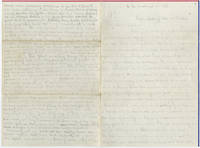
186222500<p>Mainer Edgar Alphonso Burpee describes the Battle of Fredericksburg providing previously-unknown details regarding order of battle Union movement through city streets <i>"unbecoming"</i> ransacking of civilian property and Confederates shelling Union-occupied parts of their city. He also includes drawings of the city's streets.</p> <b>CIVIL WAR. EDGAR A. BURPEE.</b>Autograph Letter Signed to Alexander Burpee. Fredericksburg Va. December 15 1862 12 pp. 5 1/8 x 7¾ in.<p><b>Partial Transcript</b></p><p><i>"Being our orderly I summoned the company at 4 o'clock and gave them my orders.a report of a gun was heard that sounded like thunder. It was a signal gun and to us indicated that something was in process of being done. Then another was heard and immediately after that musketry and some other guns.we stacked arms and lay down waiting the order to move forward.waiting for the pontoon bridges to be laid so we could pass.guns of both forces were constantly being fired and such a roar I never heard before. It seems as if the very heavens were filled with thunder and it was very stirring that our forces were engaged in shelling the city.Then later at double quick we crossed the pontoon bridge and set foot in the doomed city for our first time. We filed into the street that runs along the river bank having the honor of being the first regiment of our brigade in. As we entered marched up the street some 5 or 6 rods in front of us skirmishing and the bullets of the rebels came whistling thickly over our heads and around our ankles.</i></p><p><i>The streets are laid out in regular squares I shall draw you a plan. Because skirmishing was going on in the next street above us we were protected from the rebel shots. the rebel sharpshooters were about six rods away in the houses.their sharpshooters rapidly picked off our men.Our batteries too poured into the rebels showers of shells so that they completely riddled the homes nearby killing a large number of the enemy.By this time 7 o'clock the firing had ceased.our men commenced.ransacking the houses and stores tearing down fences & out buildings.It was alarming to see the scenes of unbecoming behaviors around us.All this time the dead and wounded were being brought down the street. The surgeons were busy attending to those badly wounded.On going up the street we would stumble over the dead of both sides some shot in the heads with shells still there were others killed by bullets. Some wounded would crawl off to some place of shelter.It was indeed a sad scene.</i></p><p><i>Morning came.we formed into line of battle.We were ordered to lie low or march in a stooping position.The ambulance corps were also engaged in carrying off the dead & wounded.In the street where we were two or three rebels lay. One had his whole side and his arms shot off. Another had the top of his head and brains carried away.Towards morning December 13 when it became light enough for the rebels to see our men they began to shell us and the pieces would fly.About 12 o'clock skirmishing commenced on our left.The streets were now filled with moving lines of soldiers.We could see and hear nearly the whole field and our brave men as they advanced under heavy fire from the enemy's batteries and musketry fire.Gen Howard marched often along our line & encouraged us by his words and presence. A balloon was in the rear of the city to observe all movements.About 4 o'clock our brigade was ordered in and down the street with a rush we went.bang went the rebel guns and whiz came their shells at us.Our regiment remained firm.Gen. came along after dark and said 'men of the 19th reg. you have done nobly. Your consistency deserves great praise.' To be continued - Ed."</i></p><p><b>Edgar A. Burpee</b> 1839 – 1919 of Rockland Maine mustered into the 19th Maine Infantry on August 25 1862. He rose to captain's rank was wounded at Gettysburg and was captured at the Battle of Jerusalem Plank Road Virginia in June 1864. He returned to Rockland married Annie Farwell and eventually joined his family's funeral business.</p><p><b>Condition</b></p><p>Fine. Written in light pencil. With some separation at edge of folds.</p> books
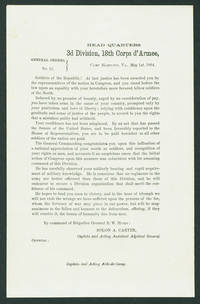
1864WRCAM55912Camp Hamilton Va 1864. 1p. on an octavo sheet. Faint tideline to upper left corner. Near fine. An important order announcing equal pay for "colored troops" in the Union Army issued by Capt. Solon Carter on behalf of Gen. E.W. Hinks. This is a field press printing of one of Hinks' earliest and most consequential orders upon taking command of 3rd Division of the 18th Corps of the Union Department North Carolina composed entirely of United States Colored Troops U.S.C.T. This order was issued over a month before Congress finally authorized equal pay for U.S.C.T. troops on June 15 1864. Until then black soldiers were paid $7 per month plus $3 for clothing while white soldiers earned $13. The order begins: "Soldiers of the Republic! At last justice has been awarded you by the representatives of the nation in Congress and you stand before the law upon an equality with your heretofore move favored fellow soldiers of the North." <br> <br> One of Hinks' other early orders was to appoint Carter then captain of Company G 14th New Hampshire Volunteers as Assistant Adjutant General of Volunteers and Aide-de- Camp to Hinks. Carter later served on the staff of Gen. Charles J. Paine 3rd Division 25th Corps. For his service and bravery he was breveted Major and then Lieutenant Colonel at the end of the war. In 1900 at a meeting of the Military Order of the Loyal Legion of the United States Commandery of Massachusetts Carter presented a paper titled "Fourteen Months' Service with Colored Troops" in which he praised the service of the U.S.C.T.: <br> <br> "The object of the present paper is to tell in simple language without exaggeration or embellishment the story of what the Colored Division of the Eighteenth Corps did and how they did it throwing here and there a side light upon previous descriptions of their deeds of valor and heroism. That the lights are of such exceedingly limited power must be attributed to the fault of the instrument rather than lack of loyalty to the memory of the gallant officers and brave men living and dead whose acts are commemorated." <br> <br> Carter went on to describe their role in the Bermuda Hundred Campaign leading up to the Siege of Petersburg and how they earned the respect and admiration of their fellow white soldiers. <br> <br> The United States Colored Troops were regiments in the Army composed primarily of African-American soldiers although members of other minority groups also served including Native Americans Pacific Islanders and Asian Americans. By the end of the Civil War U.S.C.T. regiments constituted about one-tenth of the Union Army although they had a casualty rate about thirty-five percent higher than white Union troops. The U.S.C.T. fought with distinction: fifteen U.S.C.T. soldiers received the Medal of Honor among numerous other awards. <br> <br> In July 1862 Congress passed the Confiscation Act freeing slaves whose owners were in rebellion against the United States and then the Militia Act of 1862 empowered the president to use former enslaved men in any capacity in the army. Lincoln opposed early efforts to recruit black soldiers although he approved of the army using them as paid workers. However once he issued the Emancipation Proclamation recruitment of African Americans became widespread. On May 22 1863 the War Department issued General Order 143 establishing the Bureau of Colored Troops to better facilitate the recruitment and mustering of African-American soldiers. Regiments of infantry cavalry engineers light artillery and heavy artillery units were recruited from all states of the Union. 175 regiments totaling more than 178000 "colored" soldiers served during the last two years of the war. <br> <br> U.S.C.T. regiments were led by white officers and rank advancement was limited for black soldiers with very few receiving commissions. The courage displayed by black troops during the war played an important role in African Americans gaining new rights after the war. In his speech "Should the Negro Enlist in the Union Army" delivered at National Hall Philadelphia on July 6 1863 Frederick Douglass stated: "Once let the black man get upon his person the brass letter U.S. let him get an eagle on his button and a musket on his shoulder and bullets in his pocket there is no power on earth that can deny that he has earned the right to citizenship." Douglass was a prominent supporter of recruitment for the U.S.C.T. and Douglass' two sons Lewis and Charles were two of the first to enlist in Massachusetts. <br> <br> We could find only two copies of this general order held in institutions: Hampton History Museum and the University of Rochester. An important early step on the road to racial equality in the United States armed forces. OCLC 1101179313. Solon A. Carter "Fourteen Months' Service with Colored Troops" in CIVIL WAR PAPERS READ BEFORE THE COMMANDERY OF THE STATE OF MASSACHUSETTS MILITARY ORDER OF THE LOYAL LEGION OF THE UNITED STATES Boston: F.H. Gilson 1900 vol. 1 pp.155-179. hardcover books
186110065752 folded and docketed uniform manuscript resolutions mostly 4to typically written on one side and docketed on the back includes a contemporary cover sheet that originally held resolutions together two small pictures of Lincoln and Grant included housed in modern photo album. A few with folds at the top and minor chips normal aging and browning; overall in very good condition. These resolutions were passed by the Public Aid Committee which was created by the Newark City Council at the beginning of the Civil War to advance money to soldiers' families. These resolutions would then be given to a clerk for filing. This clerk seems to have had strong anti war or Copperhead sympathies and gradually began editorializing as he wrote out the docketing on the back of each folded document. He titled the 31 March 1862 resolution "For aid to families. in the war to abolish slavery." On 2 September it was "the war for the ruin of the country." On 26 November it became "the Negro War" and 2 December it says "the Army of Abm. Lincoln to subjugate the Southern States." This obscure city clerk took things a step further after the Emancipation Proclamation. On 4 February 1863 he titled a resolution "In aid of families of volunteers. in the Nigger War!" He must have been spoken to after this remark because he drifts into sarcasm rather than outright racism. In a later resolution he states "for the benefit of our coloured fellow citizens of African decent." However by 14 September 1863 he was back to his old tricks again referring to "Lincoln's nigger war." He continued his editorializing through June 1864. These docketed resolutons were found in the included wrapper on which a a Union soldier later wrote: "The name if it can be found out of the miserable traitor who booked the within resolutions should go down in posterity as one who should receive the contempt of loyal men." The name of that Union soldier appears to be Major W. W. Morris. books
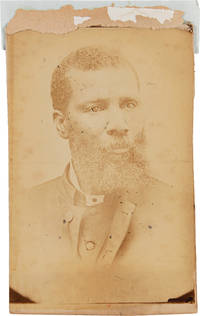
1865WRCAM55438N.p. likely Boston 1865. Albumen photograph 8 3/4 x 5 3/4 inches mounted on card. Moderate fading a bit of spotting in the image. Verso darkened from exposure to wooden backing now removed from backing and period frame backing tape still attached to verso along top edge. Remnants from previous mat at top edge. Good and a worthy candidate for professional conservation. An apparently unrecorded image of Rev. Samuel Harrison a former slave and fierce abolitionist who served as Chaplain of the 54th Regiment Massachusetts Volunteer Infantry the famous Civil War regiment of U.S. Colored Troops. Colonel Robert Gould Shaw led the 54th Mass. Regiment the second unit of colored troops formed by the Union Army but ultimately the most famous all-black infantry unit to fight in the Civil War as seen in the film GLORY. After Shaw was killed at the Battle of Fort Wagner Massachusetts Governor John A. Andrew recommended that Rev. Samuel Harrison serve as Chaplain to help the unit's morale. Harrison accepted and was also instrumental in getting equal pay for black soldiers. Harrison's demand that he receive the same pay as white chaplains led Gov. Andrew and United States Attorney General Edward Bates to write letters to President Lincoln to end the discriminatory practice of unequal pay among white and black soldiers in the Union army. In June 1864 legislation requiring equal pay for black units retroactive to January 1864 was passed in the Army appropriations bill. <br> <br> Images of Rev. Samuel Harrison are rare and online exemplars seem to vary widely. The present example appears to be a much younger version of Rev. Harrison compared to the image of him at age eighty-one held by the Samuel Harrison House. Here he also appears to be wearing a chaplain's uniform indicating this is a wartime or near-wartime image of him. The verso of the photograph has a penciled note reading: "Rev Samuel Harrison 54th Mass." unknown books
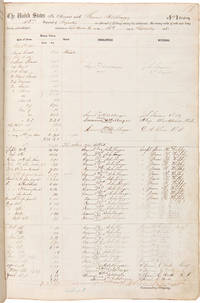
1865WRCAM55621Various locations in Pennsylvania Virginia and South Carolina 1865. 21987pp. Large folio. Contemporary three-quarter maroon calf and black cloth boards gilt spine titles reading: "PENN. CLOTHING BOOK COS. C & D 52nd INFANTRY P. & P. OFFICE." Spine partially split chipped and rather worn; boards soiled edges and corners worn. Binding a bit tender and bowed. Scattered occasional soiling and foxing to text. Good. A voluminous manuscript account book used to track the clothing and equipment transmitted to the soldiers of two companies of the 52nd Pennsylvania Infantry Regiment between 1861 and 1865. The meticulous records herein provide significant research material on the outfitting of Civil War troops and show that an army marches not just on its stomach but on its shoes and clothing as well. <br> <br> The majority of the entries relate to clothing including shorts pants coats caps blouses shoes socks and other materials needed by the Civil War foot soldier on the move during the conflict. Equipment listed here includes haversacks and blankets among other items. Each page is dedicated to a single soldier whose name company enlistment location and enlistment date are all recorded in the pre-printed form at top with various line items their costs the rank of the soldier and his signature recorded in the body of the ledger-like account book. Often accounts are noted as settled either before discharge or by death or desertion. Over two-thirds of the entries pertain to Company C of the 52nd Infantry. <br> <br> Importantly in addition to equipment and clothing the account book also records transfers death discharges and desertions. The first five entries for example provide a snapshot of the fates of various soldiers. The first soldier is noted as discharged with the last date of equipment listed as February 28 1862. The second and third soldiers were both "Killed in action at Fair Oaks Va." aka the Battle of Seven Pines May 31 - June 1 1862. The fourth soldier was discharged sometime after June 1862. And the fifth soldier "Died from wounds" after May 18 1862. Others here are noted as "Died from Disease" "Died of wound received by accident" and "Supposed to be killed by the explosion of the Gun Boat Mound City." <br> <br> The 52nd Pennsylvania Infantry Regiment was an important unit during the Civil War. The regiment formed in the late summer and early fall of 1861. They were assigned to the Peninsula Campaign in March 1862 and swiftly saw action at the Battle of Williamsburg and the Battle of Seven Pines also known as the Battle of Fair Oaks which is the name used for the soldiers recorded as dying there in the present account book. The regiment then moved to South Carolina at least one soldier in the present account book enlisted there and by mid-summer they were in Charleston to witness the ill-fated Battle of Fort Wagner. For the remainder of 1863 and most of 1864 the regiment moved around South Carolina until participating in the occupation of Charleston in February 1865. Afterwards the regiment joined Sherman's march through the South and some of the regiment ended the war in North Carolina where they witnessed the final surrender of Gen. Joseph E. Johnston. <br> <br> A valuable and research-worthy record of Civil War service covering the span of the conflict filled with unique information on the ground level needs of the Union foot soldier. hardcover books
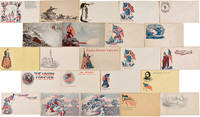
1865WRCAM56082Various locations including Philadelphia New York Salem Cincinnati Baltimore and others 1865. 119 unused postal covers all but one of them illustrated almost all printed in color or hand-colored. Generally minimal wear. Ranging from very good to near fine condition. An interesting and substantial grouping of Civil War-era patriotic covers encompassing a wide variety of themes devoted to the Union cause. A great number of Union officers are celebrated here among them are eight examples depicting General McClellan three of Gen. Fremont and a pair featuring Gen. Rosecrans the "Hero of the West." There are also numerous regimental leaders including Edward Dickinson Baker Commodore Silas H. Stringham Lt. John T Greble Gen. Wool printed with a map of the seat of war in Missouri Col. E.D. Baker Col. H.E. Paine of the Wisconsin Volunteers Col. Max Friedman of the Cameron Dragoons and many others. There are also pictorial covers of Gen. Sherman's Headquarters at Hilton Head; a pair depicting Fort Sumter; four depicting Camp Dennison near Cincinnati; one of the Battle Monument in Baltimore; and one featuring Benton Barracks in St. Louis. Three examples are practically bird's-eye views of Baltimore one a general view another from the perspective of Federal Hill and the third from Fort McHenry. <br> <br> A common visual theme is the use of symbolic iconography of the United States. Numerous examples depict women standing proudly with the American flag and are evocative of Columbia the personification of the United States. One depicts a woman serving with the "Home Guard" and decked out in a dress resembling the flag. Another example shows a "Daughter of the Regiment." Yet another is titled "The Ladies' Envelope" and features Columbia with an American flag-style shield. There are also a plethora of examples featuring the flag itself. One example prints a "History of Our Flag" beginning with its endorsement by Congress on June 14 1777. One prints the flag next to a warning reading "If Any One Attempts to Haul Down the American Flag Shoot Him on the Spot." <br> <br> The American Eagle features prominently here as well. In one example the great bird is tearing apart a Rebel flag with his beak. In another the eagle holds a banner in his mouth reading "Beware" while confronted with a disjointed hand labeled "Jeff. Davis" holding eight snakes labeled with the names of the Confederate states an interesting twist on the famous severed snake image featured in the Revolutionary-era "join or die" illustration. <br> <br> Also a handful of the covers display the type of twisted gallows humor sometimes literally to be expected from patriotic covers. One of these shows Jefferson Davis hanging from a tree; the text around his lifeless body reads "Southern Eagle Jeff. Davis in Suspense Long May He Wave." A similar example shows Davis hanging from a gallows; the caption reads "Jeff. Davis 'President' of Traitors Robbers and Pirates; the Nero of the 19th century. On the Last 'Platform' of the Southern Confeder- ass-y." Yet another cover not gallows humor but featuring Jefferson Davis depicts him as a fox holding two geese one labeled Tennessee and the other Virginia above a caption reading "Jeff. Davis on a Scouting Expedition." <br> <br> A particularly-colorful example depicts a proud Union soldier defending Washington D.C. The soldier holds fast to an American flag as a cannon fires beneath his feet with the Capitol building in the background. Other examples celebrate the New York State Volunteer Militia the Pennsylvania Volunteers the Quartermaster Department of the Anderson Zouaves the Monitor the naval battle between the Monitor and the Merrimack Sherman's Flying Artillery the text of the Army Hymn "Jeff. Davis' Doom" various political cartoon-style illustrations and many more. <br> <br> A significant collection of one of the more ephemeral and visually significant artifacts of life in the North during the Civil War. unknown books
1863WRCAM55392N.p. but likely St. Louis 1863. Broadside 13 3/4 x 4 1/4 inches. Remnants of tape at top edge and ink mark in top margin. Slight tanning and spotting old folds. Very good. A rare Civil War broadside recounting Confederate General John S. Marmaduke's second raid into Missouri. It gives detailed news of battles between Union and Confederate troops in southeast Missouri an area that saw bloody battles between Unionists and Bushwhackers throughout the Civil War. <br> <br> Marmaduke aided by other Confederate units led by Joseph O. Shelby and Sterling Price and others attempted to lay claim to Missouri in 1861; they were unsuccessful but did not acknowledge defeat. Marmaduke planned his return for spring of 1863 confident that secessionist-minded Missourians would rally to his banner and he could make a decisive move on Jefferson City and even St. Louis. He needed the help: at the beginning of the raid Marmaduke had about 5000 troops of which 1200 were unarmed and 900 were unmounted and he hoped to resupply at Patterson and Bloomfield. He divided his forces and sent 2000 against Patterson the furthest south in a string of fortified outposts in southeastern Missouri. Marmaduke's troops had the element of surprise initially approaching Patterson and its small garrison of about 400 troops commanded by Col. Edwin Smart. Marmaduke's men captured Smart's pickets but revealed themselves soon after as over-eager artillery troops started firing before the infantry could get into place. Smart sent out a battalion under Major Wood to hold off the Confederates while he prepared his troops and supply trains for retreat. <br> <br> In the text of this broadside Smart reports that Wood "held them in check and skirmished them into town.Before I left the town I destroyed what stores I could not bring away. Nothing fell into the hands of the enemy." Marmaduke pursued them to Big Creek about eight miles west of Patterson and Smart writes that: "The engagement was severe in the extreme often fighting hand to hand. At Big Creek they got in my front and attempted to cut off my retreat but I forced my way and formed on this side of the Creek. The enemy did not renew the engagement." Smart lost about fifty troops including Major McConnell. Marmaduke failed to obtain any military stores at Patterson or during his subsequent raid at Bloomfield and no sympathetic Missourians joined his cause; the raid was a failure and confirmed that while Missouri was no Union stronghold neither was it interested in furthering the Confederate cause. <br> <br> This broadside bears no imprint and the place of printing is unknown but the tone of the text and the fact that the news arrived so quickly indicates that it might have been printed in St. Louis. No copies of this broadside are listed in OCLC. Such broadsides bearing news of the Civil War in the Trans-Mississippi West are rare and shine an important spotlight on an often- neglected aspect of Civil War history. unknown books
1833List508Mexico 1833. First Edition. Mexico: May 23 1833. Letter and chart on watermarked single folio sheets approx. 13 x 16-½ inches letter: 3 pp.; chart: 2 pp.;. Near Fine. Rare first-hand documentation of the growing trade tensions that eventually led to the French-Mexican "Pastry War" of 1838. Consul Hersant's gossipy report surveys the "commercial movement of the port of Tampico since it's opening in 1824 until the end of 1832." Hersant complains to his superiors that Mexican trade with the US and England far outpaces France; even the Hanseatic League has become a problem. The Consul includes a hand-drawn table tallying foreign ships and the weight of goods by country a visual aid supporting his claim that French trade lags considerably behind other partners. <br /> <br /> Ultimately it is civil disorder that most disturbs the Consul; that is smuggling assisted by the Mexican customs officers themselves: "se fait impunément et avec l'aide des douaniers eux-mêmes et peut porter au double la quantité de marchandises qui entrent du dehors." Indeed the early years of the Mexican Republic were marked by a notable lack of governmental accountability toward foreign governments or private property owners as various internal parties struggled for power. This disregard eventually led King Louis-Philippe's government to sue for damages against Mexico on behalf of French citizens doing business there. The most famous claimant was a pastry chef who claimed his shop had been looted. In 1838 when the amount went unpaid the French invaded Veracruz and blockaded Mexico's Atlantic ports beginning the so-called Pastry War.<br /> <br /> References to Hersant can be found in other histories of the French attempt to gain ground in Mexico e.g. establishing alternative shipping passages inland to compete with North American traders. Overall a scarce pair of documents in excellent condition with minimal normal wear. unknown books
1813WRCAM41998Sackets Harbor N.Y. 1813. 1p. manuscript letter signed docketed on verso. Folio. Old fold lines. Some separation at folds; one tear closed with archival tape. Lightly soiled. Good. An eyewitness account of the second battle of Sackets Harbor on the shores of Lake Ontario from the commander of the American forces there Gen. Jacob Brown to his friend Joshua Hatheway quartermaster general and formerly the commander of the defenses at Sackets Harbor. The town situated near the entrance to the St. Lawrence River at the far eastern end of Lake Ontario and opposite the Canadian town of Kingston was a vital defensive point for the Americans challenging British control of the St. Lawrence and the lake and preventing a British thrust into New York State. If either side could control both sides of the entrance to the St. Lawrence they could control the Upper Great Lakes. Taking advantage of the American action against York which drew troops away to the western end of the Lake the British decided to strike. On May 28 1813 the British Great Lakes squadron under the command of James Yeo appeared off Sackets Harbor carrying troops under the command of the governor-general Lieut. Gen. George Prevost. Having been forewarned by several men who escaped the Battle of Henderson Bay the previous day the Americans had some time to reinforce their defenses before the British could attack. The British landed on the 28th but launched their main attack the next morning. They easily routed the American militia but the regulars under Brown were able to fight off repeated attacks on their fortifications. Prevost fearing the arrival of more American troops ordered a retreat which nearly became a rout. Brown was the hero of the day and was later rewarded with a commission as brigadier general. He must have immediately written this letter describing the action. This appears to be written in a secretarial hand and signed by Brown himself. The letter states: "Dr. Sir I received an order some days since from Genl Dearborn to take comm. at this Post. Comd. Chauncey is up the lake. We were this morning attacked as day dawned by Sir George Prevost in person who made good his landing with at least a thousand picked men. Sir James Yeo commanded the fleet after loosing some distinguished officers and of course some gallant men. Our loss is very severe as to the quality of those who have fallen. The enemy left many of their wounded on the Field - but I have no doubt carried off many more. We shall probably be again attacked as Sir George must feel very sore. All I can say is whatever may be the result we will not be disgraced." A superb battlefield letter reporting on one of the most significant military actions of the War of 1812. unknown books
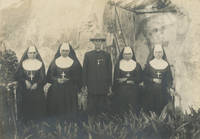
1900List518Most Cuba or Jacksonville 1900. Silver gelatin or albumen photographs various sizes ranging from 3 x 3 to 6 x 8 most captioned to verso. With handwritten manuscript four leaves discussing various diseases. The Spanish-American War was the first war in which nurses formed their own dedicated units as well as the first war in which they were accepted within military hospitals. While no nurses died in battle 153 died during the war from disease. Nurses were responsible for both treating soldiers as well as maintaining sanitary conditions within the camps. Conditions were often poor leading some to work until they were too sick to continue. <br /><br /> The current collection of photographs documents the experiences of a Mrs. Waters who was originally from Groton Massachusetts. The collection begins with a couple early photographs including a portrait as a young woman and a cyanotype of one of Waters' leprosy patients at Johns Hopkins Hospital in Baltimore. The next section shows Waters' training in Jacksonville Florida with either the Fourth or Seventh Army Corps at what was called Camp Cuba Libre both Corps trained there in 1898. The photographs of Jacksonville show life around the military camp and environs with some notable photographs of African-American inhabitants of the region. Three photographs quite notably show the Congregation of American Sisters a small group of American Indian nuns led by Reverend Francis Craft. The photographs taken in Cuba are notable for their portrayal of local life. Several photographs of military installations are taken around the "trocha" or line established by General Valeriana Weyler from Mariel to Majana. Another notable photograph is a cabinet card of a large group of nurses taken by the Havana photographer R. Testar. <br /><br /> The group overall shows very early photographic records of military nurses in training as well as a scarce photographic record from a woman in a combat situation. The photographs are generally well preserved in very good to excellent condition with some light fading. Accompanying the photographs is a four page manuscript essay presumably by Waters discussing leprosy as well as the booklet Spanish Phrase Book for American Soldiers and Sailors published by the National Relief Commission of Philadelphia. <br /><br /> Offered in partnership with Daniel / Oliver Gallery. books
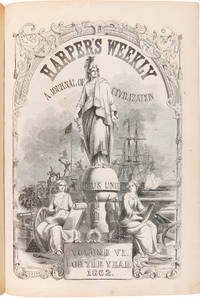
1865WRCAM56383New York 1865. Ten volumes. Volume V No. 210 through Volume IX No. 470. 416; 417-502507-534539- 706711-832; iv230235-416; 417-422427- 438443-832; iv416; 417-502507-832; iv390395-416; 417-848; iv400; iv401- 832pp. Profusely illustrated. Lacks eighteen leaves. Folio. Contemporary three-quarter black morocco and cloth spines gilt. Noticeable wear to spines. Long horizontal closed tear and minor chipping to a few leaves occasional foxing and minor soiling a handful of misbound gatherings and detached leaves. Lacking eighteen leaves and priced accordingly. Overall a fair to good set. The famous Civil War volumes of HARPER'S WEEKLY covering the period from January 5 1861 to December 30 1865 profusely illustrated with engravings after many famous artists of the day most notably Winslow Homer who worked for the magazine in the first years of the war and with a number after photographs by Matthew Brady depicting Civil War scenes important political figures and satirical cartoons. These volumes of HARPER'S WEEKLY. constitute a remarkable illustrated record of the Civil War for the duration of the conflict full of first-hand accounts of battles political news and wonderful engravings and maps some folding nearly all relating to the war. Included is ample reporting of Sherman's march Lincoln's assassination and funeral and all the major battles. "The most popular periodical of its day and valuable for a study of any aspect of the war; the illustrations are unsurpassed" - Nevins. With much on the campaigns in Florida early in the war and so very much more. Though this set is a bit wounded it still holds a wealth of pictorial and textual history on one of the defining events in American history. Also includes a single issue of FRANK LESLIE'S ILLUSTRATED NEWSPAPER November 28 1863 bound into the second volume of HARPER'S WEEKLY for 1863. NEVINS p.15. SERVIES 4601-4615 4696. hardcover books
187842992Champion NY 1878. Leather wallet bindings black purple navy and green with gilt or marbled edges year or "Excelsior Diary" in gilt to some wallet flaps. Rubbing and wear to leather of all volumes; cracked hinge or hinges to some volumes; endpaper and one leaf removed from two volumes respectively; occasional light soiling or staining in rare cases minimally affecting readability. Good condition overall. 10 diaries one per year here offered. Smallest volume: ~ 375 unnumbered pages dates printed one entry per page plus front and rear matter. Remaining volumes: ~120 unnumbered pages dates printed 3 entries per page plus a varying number of printed pages at rear for memoranda accounting etc.; ~20 printed pages of yearly calendar tables statistics etc. to beginning of some volumes. Most entries contain writing though occasional blanks; some unused pages of back matter particularly in later diaries. Total manuscript word count conservatively estimated at 55000. Sizes vary. Smallest 4" x 2-3/4"; largest 6-13/16" x 3-1/2". Most ~5" x 3-1/4" <br/><br/>An archive of ten Civil War and Reconstruction era manuscript diaries kept by Myron E. Rose a Democrat from Champion New York whose political views during the war coincided most strongly with those of the Peace Democrats or “Copperheads.” Although Rose never self-identifies as such only as a staunch Democrat he voted for Horatio Seymour in the 1862 election for NY governor makes no secret of his loathing for abolitionists lauds the possibility of Lincoln’s capture by Confederate troops and resents a war fought to “free the n----- — it takes more men than there were negroes what works” July 19 1864. His diaries offer a near-daily if often terse portrayal of the experience of a Northern Democrat during and after the Civil War including not only notes on the progress of the war drafts and draft riots local and national politics and the deaths of friends and fellow townsfolk but also his move to Iowa following the war and efforts to homestead there his life back in Champion after the death of his wife his attendance at Spiritualist meetings and disdain for Adventists readings and his many jobs social life successes and lack thereof with women book purchases accounting and more. The diaries begin in 1859 when Rose was a 25-year-old new schoolteacher still working toward getting his teaching certificate doing a variety of additional odd jobs and seemingly more interested in dating the local women than in national events: “Went home with Cor. Hormer and went in she gave me an introduction to ‘for the cool’ confound her” Oct. 21 1859. He notes the 1860 election the next year — “Election day . . . S. A. Douglas Dem A. Lincoln Rep Bell Union Breakenridge Administration seceders. Morgan Gov Rep Kelly Dem. Quite an exciting day. . . . Lincoln Elected” Nov. 6 - 7 1860 — and mentions that one Mr. Winslow a Democrat was elected School Commissioner suggesting that there was perhaps a small concentration of Democrats in the Champion area. By 1862 the war has started to impact him: “Have been roof-boarding. Some towns will have to draft it is expected. A good many have gone to Canada. The war begins to affect sic us here now” Aug 26 1862. That November Rose notes that there has not been “a great turn out at the polls. Will be a close rub voted for Seymour” Nov 4 1862. The next year he comments: “The war progresses about the same turning out the Generals and putting in new ones &c &c. The rebels will gain their independence I guess and that by d___d Republican mismanagement” Feb 9 1863. Shortly thereafter he learns that his brother Arthur “is proclaimed a deserter”: “Harnessed up my colt single and put him on my cutter drove him down to Tylersville. John went down with me saw quite a number there Arthur also. Willard is dead died in hospital of consumption so his Captain wrote . . . Snows P. M. Arthur feels very bad” March 11 1863. In July 1863 Rose reports on the New York City draft riots : “A great riot in N.Y. City on acct. of drafting no call for men but they are giving orders for drafting by number of men a mean miserable proceeding a good many killed and a good deal of property destroyed” July 18 1863 and the next day that “the draft is postponed for the present. I am most afraid that there will be hard times all over” July 19 1863. Nevertheless he places the cause entirely on the Republican party: “A good deal of excitement in Wtn Washington so Warren says. If there are riots & murder & robbing it is the teachings of the Abolition Republican party for they have trampled the Constitution underfoot in more ways than one” July 21 1863. Rose’s views about the Republicans and “shrieking Abolitionists” never waver though he seems to relish debating politics and feels he’s a good ideological counterbalance. Nevertheless as the following passages indicate he remained strictly antiwar/ anti-Republican: - “News to night Greely & old Lincoln’s sec. have been to see Geo. Sanders & others in Canada all rebels and should go over the falls together.” July 21 1864 - “News that Atlanta is taken. I don’t care how soon they wind up the rebels and then return to something else.” Sept 3 1864 - “Staid to Mr. Knowls’s talked politics. He says that we have a king now and that it is all right — is for it until peace is obtained. He is not fit for a republic.” November 17 1864 In a curious precursor to modern politics Rose even notes that “Ohio Penn & Indiana hold their election today. As they go so goes the election next month” Oct. 11 1864. Rose makes little mention of politics after the war and in 1866 moved with his wife and his brother Arthur and his wife to Iowa where they bought 160 acres of land possibly utilizing provisions of the Homestead Act of 1862 cleared it built a house and farmed for approximately 6 years. Research indicates that Rose’s wife and newborn child died in 1872 and that he moved back to Champion shortly thereafter; aside from 1866 the diaries from these years are absent. Rose seems to have continued teaching school both in Iowa and upon his return to New York and also remarried started a cheesemaking business and attended Spiritualist meetings back in Champion as well. All in all a fascinating glimpse into the life and times of a Northern Democrat during the Civil War. hardcover books