645 résultats
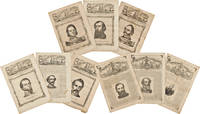
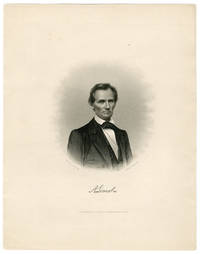
1863WRCAM49849New York 1863. Fifty engraved portraits each 9 1/4 x 11 3/4 inches. Each stored inside its own paper sleeve and housed together in two contemporary brown leather portfolios stamped in gilt. Portfolios worn and rubbed. Images in excellent condition. A wonderful contemporary collection of Civil War-related engravings. Featured personalities are mostly Union generals colonels commodores and other officers and figures of note plus presidents Abraham Lincoln and George Washington. Also includes an engraving of William Gannaway Brownlow the anti-secessionist Tennessee newspaper editor and later governor of Tennessee immediately after the end of the Civil War. At the time of the publication of this set Brownlow was a celebrity in the North for his ardent anti-secessionist stance. <br> <br> Due to the portrait poses on which the engravings are based as well as the stated ranks of the military leaders and the general selection of personalities chosen for the set it must have been published in late 1862 or 1863. Of particular note is the image of Ulysses S. Grant who was still so relatively unknown in comparison to some of the other military leaders that the publisher either erred and used the likeness of another man or could not find a suitable portrait and used a different subject. Also the portrait of Lincoln is early as it shows the president without his trademark beard. While we have seen some of these engravings before we have never seen the full set in the original leather portfolios. All engravings include the facsimile signature of the subject and credits the engraver as J.C. Buttre of New York with many also crediting the original artist or photographer whose image the engraving is based on most by Brady with others by Fredricks Appleton German Silsbee et al; the Washington image is based on a Stuart painting. This is a very rare wartime-published collection of Union officers. <br> <br> The following is a full list in alphabetical order: <br> <br> 1 Anderson Brig. Gen. Robert <br> <br> 2 Baker Col. Edward <br> <br> 3 Banks Nathaniel P. <br> <br> 4 Blenker Maj. Gen. Louis <br> <br> 5 Brownlow William G. <br> <br> 6 Buell Maj. Gen. Don Carlos <br> <br> 7 Burnside Brig. Gen. Ambrose E. <br> <br> 8 Butler Maj. Gen. Benjamin F. <br> <br> 9 Carr Col. Joseph B. <br> <br> 10 Clay Maj. Gen. Cassius M. <br> <br> 11 Corcoran Col. Michael <br> <br> 12 Cox Brig Gen. J. Dolson <br> <br> 13 Curtis Maj. Gen. Samuel R. <br> <br> 14 Dix Maj. Gen. John A. <br> <br> 15 Doubleday Brig. Gen. Abner <br> <br> 16 Du Pont Com. Samuel F. <br> <br> 17 Ellsworth Col. Elmer E. <br> <br> 18 Foot Capt. John <br> <br> 19 Foote Com. Andrew H. <br> <br> 20 Fremont Maj. Gen. John C. <br> <br> 21 Grant Maj. Gen. Ulysses <br> <br> 22 Halleck Maj. Gen. Henry W. <br> <br> 23 Hawkins Col. Rush C. <br> <br> 24 Heintzelman Brig. Gen. Samuel P. <br> <br> 25 Hunter Maj. Gen. David <br> <br> 26 Lander Brig. Gen. Frederick W. <br> <br> 27 Lincoln President Abraham <br> <br> 28 Lyon Brig. Gen. Nathaniel <br> <br> 29 Mansfield Brig. Gen. J.K.F. <br> <br> 30 McCall Brig. Gen. George A. <br> <br> 31 McClellan Maj. Gen. George B. <br> <br> 32 McDowell Brig. Gen. Irvin <br> <br> 33 Meagher Col. Thomas Francis <br> <br> 34 Mitchel Maj. Gen. O.M. <br> <br> 35 Mulligan Col. James A. <br> <br> 36 Pope Maj. Gen. John <br> <br> 37 Rosecrans Brig. Gen. W.S. <br> <br> 38 Scott Lieut. Gen. Winfield <br> <br> 39 Shields Brig. Gen. James <br> <br> 40 Sigel Maj. Gen. Franz <br> <br> 41 Slemmer Maj. Adam J. <br> <br> 42 Sprague Maj. Gen. & Gov. of Rhode Island William <br> <br> 43 Stringham Com. S.H. <br> <br> 44 Wallace Maj. Gen. Lewis <br> <br> 45 Wallace Maj. Gen. W.H.L. <br> <br> 46 Washington President George <br> <br> 47 Weber Col. Max <br> <br> 48 Wilkes Capt. Charles <br> <br> 49 Wilson Col. Henry <br> <br> 50 Wool Maj. Gen. John E. <br> <br> There is only one similar item in OCLC a collection called PORTRAITS OF CIVIL WAR OFFICERS calling for 110 plates including Lincoln's cabinet and an engraving of his childhood home also by Buttre located at the Public Library of Cincinnati & Hamilton County. That collection is bound and was likely issued as a slightly different item by the publisher than the collection presented here. OCLC 20140615. hardcover books
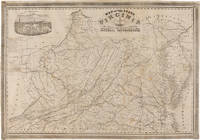
1862WRCAM46982ARichmond: West & Johnston 1862. Lithographed map 25 1/2 x 36 3/4 inches with ornamental border and inset view of Richmond. Sheet trimmed to just outside the ornamental border and mounted on modern linen. Old folds now flattened. Small chip in upper right corner just touching the ornamental border. Separations at a cross-folds with a few instances of small paper loss stabilized by the linen backing. Good plus. This impressive Confederate map of Virginia was originally based on work done by Ludwig von Bucholtz in connection with his updating the famed Herman Boye map of Virginia in 1858. Bucholtz was hired to re-engrave the copperplates for maps of Virginia originally made by Herman Boye in 1826. The ultimate products of his work were the very large maps of Virginia called the Boye-Bucholtz maps. Using knowledge from his work on this project Bucholtz issued his own map in 1858 lithographed and published by Ritchie & Dunnavant in Richmond. This map was vastly superior in detail and accuracy to Bucholtz's revision of the Boye map. <br> <br> In 1862 with Confederate officers in need of good maps of the region Richmond publishers West & Johnson re-issued the Bucholtz-Ludwig 1858 map of Virginia reprinted from the original stone with minor alterations including the removal of the cartographer's name. "There are minor geographic changes from Map 1 the original 1858 Bucholtz map on Map 2 the West & Johnson issue. For example on Map 2 Jerusalem in Southampton Co. has been moved a little to the northwest of its Map 1 location near the Seaboard and Roanoke Railroad and the road between the two points imperfectly erased the remaining shadow is additional evidence that the Map 1 stone was involved. Still for the most part Map 1 and Map 2 are the same map" - Wooldridge "The Bucholtz- Ludwig Map of Virginia and its Successors" in THE PORTOLAN 68 Spring 2007 pp.26-39. A second edition of the West & Johnson issue would be published in 1864. <br> <br> The map shows all of Virginia West Virginia Maryland Delaware and parts of Pennsylvania and New Jersey and includes an inset view of Capitol Square in Richmond. A chart below the view lists all the railroads and the length of each line. <br> <br> "In stark contrast to the large often colored maps pouring out of Northern presses the Confederate imprints are few in number modest in scale and more often than not black and white printed on poor paper. Long before the war was over they weren't being printed at all" - Wooldridge. PARRISH & WILLINGHAM 6204. SWEM 971. Wooldridge "The Bucholtz-Ludwig Map of Virginia and its Successors" in THE PORTOLAN 68 Spring 2007 pp.26-39. STEPHENSON 475.5. WOOLDRIDGE 254. West & Johnston unknown books
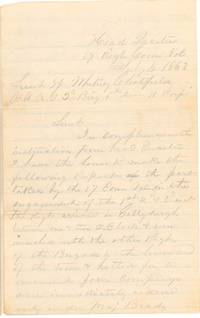
186321808<p>A field report from the Battle of Gettysburg by Major Allen G. Brady commander of the 17th Connecticut Regiment written on the 4th of July 1863 the day after the battle ended in a great victory for the Union.</p><p><i>"We had not more than time to form before the enemy were discovered advancing rapidly upon us on our right & a full Brigade obliquely towards our left….our fire was so destructive it checked their advance the troops on our left giving way the enemy came in behind us but we still remained firmly at the stone wall until the rebels were driven back."</i></p> <b>CIVIL WAR – GETTYSBURG.</b>Allen G. Brady Autograph Manuscript Gettysburg Pennsylvania July 4 1863. 6 pp. in pencil an unsigned draft or retained copy.<p>With: <b>ANDREW JOHNSON.</b> Officer's commission of brevet Lieutenant Colonel to Allen G. Brady <i>"for gallant conduct at the Battle of Chancellorsville Va to date from March 13 1865"</i> March 20 1866 signed with stamp not in ink; and</p><p>With: <b>ALLEN G. BRADY.</b>Autograph Letter Signed to the Adjutant General U.S. Army May 19 1877 seeking a copy of the military record of General Hugh Brady who had fought in the War of 1812; and</p><p>With: <b>WHARTON J. GREEN.</b> Autograph Letter Signed to Allen G. Brady December 13 1885.</p><p><b>Complete Transcript</b></p><p><i>Head Quarters 17 Regt Conn Vol. </i></p><p><i>July 4 1863</i></p><p><i>Lieut. H. Whitney Chatfield </i></p><p><i>A.A.A.G. 2d Brig. 1st Div. 11 Corps</i>.</p><p><i>Lieut.</i></p><p><i> In compliance with instructions from head quarters I have the honor to make the following report the part taken by the 17 Conn Vol in the engagement of the 1st 2d & 3d inst. The Regt. arrived in Gettysburgh between one & two O'Clock & were marched with the other Regt. of the Brigade to the lower end of the town & halted for a moment. Four companies were immediately ordered out under Maj Brady </i>2 <i>two of the four Companys under Maj. Brady were deployed from the bridge to the right as skirmishers the other two held in reserve. The remainder of the Regt under the Command of Lieut Col. Fowler advance with the rest of the Brigade to the front & left of the village. Directly in rear of the 107 Ohio Vol. - who were closed in mass by Division & were ordered to the front Deployed & advanced at Double quick our men held their ground notwithstanding they rushed to the rear of troops directly in advance until ordered by the Brigade Commander to fall back. </i></p><p><i>This order was obeyed the men loading & firing as they were retreating it was <b>about this time Lieut Col. Fowler was killed. Upon reaching the village the four companys</b> </i>3 <b><i>still skirmishing briskley with the enemy </i></b><i>& retiring in good order & ordered by the Comdg Genl to rejoin the Regt. <b>Maj. Brady immediately taking command after deploying & firing in several streets running to the left of the main street of the town on account of the rapid advance of the enemy we were ordered to fall back out of the town & while retreating through the main street the Regt was halted & faced to the rear & poured several destructive vollys into the enemy.</b> We then fell back out of the town & formed in front of the battery <b>pursuant to order from Maj. Genl. </b></i>Oliver Otis <b><i>Howard we then advanced to the stone wall in rear of the village </i></b><i>& remained a few moments there again advanced to a rail fence still further to the front & then remained until </i>4 <i>late in the evening when the whole Regt was sent out on picket & performed that duty <b>until late in the afternoon of 2d when we were relieved & took our old position behind the rail fence w</b></i>h<b><i>ere we remained exposed to fire of the enemy's battery & sharp shooters until about 7 o'clock P.M. were ordered to the extreme right of the Brigade behind a stone wall on each side of the lane below the battery opposite the cemetery entrance one company was advanced to the grain field near the woods we covered the wall on each side of the land by compelling 200 straggling soldiers to fall into our line. We had not more than time to form before the enemy were discovered advancing rapidly upon us on our right & a full Brigade obliquely towards our left. The Regt were ordered to fire obliquely to the left upon the Brigade our fire was so destructive it checked their advance the troops on our left giving way the enemy came in behind us but we still remained firmly at the stone wall until the rebels were driven back.</i></b></p><p><i>It was during this engagement that Maj. Brady was wounded </i>5 <i>by a fragment of shell hitting his right shoulder blade. </i></p><p><i>After the enemy had been driven back & the firing ceased except occasional shots from their sharpshooters. We were relieved by the 4 Ohio Vol. and were ordered to change front to the left behind a wall running at right angles with the fence we had occupied and fronting the town where the rebels entered on our left. During that night & the 3d inst. exposed to a cross fire of the rebel batterys & to the fire of the sharp shooters who were watching our movements. </i></p><p><b><i>When the Regt entered the engagement on the 1st inst it numbered 17 officers & 369 enlisted men. We report at the present time 9 officers & 120 enlisted men. </i></b><i>Capt. Wilson French is the </i>6 <i>only officer known to have been taken prisoner he was wounded in the engagement of the first inst & we are not aware of his being paroled</i>"</p><p><b>Historical Background </b></p><p>The Battle of Gettysburg fought July 1-3 1863 was a major turning point in the Civil War. Over the course of three grueling days Union Major General George G. Meade's Army of the Potomac beat back desperate attacks by Confederate General Robert E. Lee's Army of Northern Virginia including the ill-fated "Pickett's Charge" on July 3. The Union victory ended Lee's short-lived invasion of the North.</p><p>Many soldiers of the 17th Connecticut had been stung by criticisms leveled at their unit after the Battle of Chancellorsville where the corps was surprised and driven from the field with a flank attack by Stonewall Jackson. As Brady reports here events on the first day of the Battle of Gettysburg were eerily similar to Chancellorsville. On July 1 their regiment was again divided outnumbered and outflanked by the same Confederate unit as it had been at Chancellorsville although this time under command of Richard Ewell. As he drove the Connecticut soldiers from the field and through the streets of Gettysburg on the first day of fighting Union Lieutenant Colonel Douglas Fowler was killed. In a disciplined retreat that evening the 17th Connecticut fell back and was posted near the center of the Union line on Cemetery Hill near a stone wall. Their position where the Union lines' "fishhook" curved southeastward toward Culp's Hill exposed them to murderous crossfire from Confederate artillery on three sides. The unit sustained high casualties for the next two days; of the unit's 386 men at Gettysburg 20 were killed 81 wounded and 96 reported missing. Brady himself was wounded by a shell fragment on July 2.</p><p>The regiment performed heroic service on the second day of the battle protecting Cemetery Hill from the attacks of Jubal Early's division specifically Harry Hays's brigade of "Louisiana Tigers." The 17th Connecticut then withstood the Confederate bombardment of July 3 spending much of the day trading shots with sharpshooters in town. Brady's report in slightly revised and expanded form is reprinted in <i>Official Records</i> Series 1 Vol. 27 Chap. 39 Part 1 pp. 716-719. In closing there Brady said "The regiment behaved gallantly. No troops in the world behaved better. Both officers and men are deserving of great credit for their coolness and bravery throughout the entire three days' battle."</p><p><b>Allen G. Brady </b>1822-1905 was from Torrington Connecticut. He enlisted in May 1861 as part of the 3rd Connecticut Infantry Regiment. In August 1862 he was commissioned into the 17thConnecticut Volunteers. Brady was brevetted Lieutenant Colonel for his valor at the Battle of Chancellorsville just two months before Gettysburg. There Brady assumed command after the colonel and lieutenant colonel of his regiment each fell. Brigadier General Charles Devens commended Brady in his official report stating "The Seventeenth Connecticut under command of Major Brady – its colonel having been wounded and lieutenant-colonel killed – was in fact rallied and reformed in their positions." In October 1863 Brady was discharged for disability presumably from his wound suffered at Gettysburg three months previous. He was mustered into the Veteran Reserve Corps and served as Provost-General at the Point Lookout Union Prison Camp in 1864. He was brevetted Colonel in August 1865.</p> books
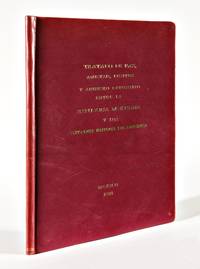
1848319879Mexico: Imprenta de I. Cumplido 1848. 55pp. printed on facing pages in parallel Spanish and English. Original printed green wrappers bound into modern red limp polished Mexican calf gilt. Light toning occasional minimal foxing small tear in upper outer corner of page 19/20 affecting just six words. Overall very good. 55pp. printed on facing pages in parallel Spanish and English. Official Mexican Printing of the Treaty of Guadalupe Hidalgo. The official Mexican printing of the final text of the landmark Treaty of Guadalupe Hidalgo ending the Mexican War and delivering to the United States its current territory in the Southwest. This printing closely follows the Queretaro edition produced just a few months earlier but contains added protocols excluded from that earlier printing. The full text appears here in both English and Spanish on facing pages. Pages 46-49 contain the text of amendments made to the treaty by the United States Senate followed by a statement of Pena y Pena dated May 30 1848 accepting the modifications and concluded by a Protocol dated May 26 attempting to put the best light on the treaty from the Mexican point of view. The Treaty of Guadalupe Hidalgo which ended the war between the United States and Mexico resulted in the formal cession of the entire Southwest and California to the United States. Agreements were reached for the withdrawal of American troops from Mexico the payment of Mexican claims and the formal cession of territory the U.S. had already occupied all of the land. The theoretical boundaries were set out and arrangements for boundary commissioners were made. By this treaty the United States obtained an addition of land equalled in size only by the Louisiana and Alaska purchases. <br/><br/>A fundamental piece of Western Americana here in the official Mexican edition of the complete treaty and scarce on the market. Streeter Sale 282; Palau 339389; Garrett p.91l; Cowan p.252; Howes M565"aa"; Eberstadt 162:847; Malloy p.1107; Reese Best of the West 104 Imprenta de I. Cumplido unknown books
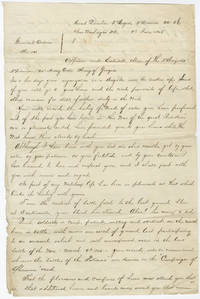
186523320<p>Brigadier General William Cogswell offers a dramatic farewell message to the troops under his command in the Army of Georgia. A Salem Massachusetts lawyer Cogswell turned his law office into a recruiting station after learning the 6th Massachusetts had been attacked in Baltimore. He was first in last out in his Civil War service: In 24 hours he raised the first full company of the war Company C 2nd Massachusetts Volunteers and his brigade fought in the final battle of the war in Bentonville North Carolina. Despite his relative obscurity Cogswell's eloquence rivals the great farewell messages in military history.</p> <b>WILLIAM COGSWELL. CIVIL WAR.</b>Manuscript Document Signed. General Orders No. 14. Farewell to the Army of Georgia Near Washington D.C. June 9 1865. 1 p. 7¾ x 12 in.<p><b>Complete Transcript</b></p><p><i> Head Quarters 3rd Brigade 3d Div. 20th Army Corps </i></p><p><i> Near Washington D.C. 9th June 1865</i></p><p><i>General Orders</i></p><p><i>No. 14</i></p><p><i>Officers and Enlisted Men of the 3rd Brigade 3rd Division 20th Army Corps Army of Georgia.</i></p><p><i>In a few days your organization will be broken up. Some of you will go to your homes and the civil pursuit of life while others remain for still further duty in the West. </i></p><p><i>Your noble record the history of the deeds of valor you have performed and of the part you have taken in this "War of the great Rebellion" now so gloriously ended have preceded you to your homes while the West knows them already by heart. </i></p><p><i>Although I have been with you but six short months yet by your valor by your patience by your fortitude and by your courtesies I have learned to love and respect you and I shall part with you with sorrow and regret. </i></p><p><i>No part of my military life has been so pleasant as that which links its history with yours. </i></p><p><i>From the earliest of battle fields to the last grand blow at Bentonville N.C. your blood has stained Alas! too many a sod. </i></p><p><i>Quick soldierly in camp patient willing and obedient on the march brave in battle with never an inch of ground lost participating to an unusual extent and with unsurpassed valor in the last battle of the War – March 19 1865 – your record will be remembered wherever the "battles of the Potomac" are known or the "Campaign of Sherman" read. </i></p><p><i>That the pleasures and comforts of home may attend you that go that additional honor and laurels may await you that remain that an Almighty and good God may forever lead you in ways of pleasantness and paths of peace that industry and virtue may crown you with their rewards that all that good brave men deserve may be yours that those who remain may shortly be sent to home and friends and that the blessings of a kind heaven may always be with you wherever you go is the last best wish of your Brigade Commander.</i></p><p><i> Wm Cogswell</i></p><p><i> Bvt. Brig Gen Commanding</i></p><p><b>Historical Background</b></p><p><b>William Cogswell</b> 1838-1895 was the son of the founder of the Massachusetts Republican party. He left Dartmouth College and spent two years on a square-rigger sailing around the world. When he returned he attended Harvard Law School and became a lawyer in Salem Massachusetts. When word reached Salem that the 6th Massachusetts had been attacked in Baltimore on April 19 1861 Cogswell turned his law office into a recruiting station and raised Company C of the 2nd Massachusetts Volunteer Infantry in 24 hours. He went on to become its commander.</p><p>Though the regiment suffered heavy losses Cogswell's company distinguished themselves well at the Battle of Antietam. Cogswell was promoted from company to regimental commander. During the Battle of Chancellorsville Cogswell was seriously wounded which resulted in his missing the Battle of Gettysburg where the 2nd Massachusetts lost another commander resulting in Cogswell's promotion to colonel. Cogswell was brevetted brigadier general on December 15 1864 and took command of the 3rd brigade 3rd division of the 20th Corps a part of the Army of Georgia that participated in Sherman's Savannah Campaign better known as the March to the Sea.</p><p><b>Condition</b></p><p>Very good. Lower half of left margin somewhat tattered affecting only one word go edge wear at upper right half some toning. Superb for display.</p> books
18803009121880. Newspaper clippings maps and illustrations laid down on card stock and bordered in black ink others extracted complete plus some contemporary photographs engravings and other pictorial material. 31 vols. 4to & large 8vo. Half contemporary morocco and marbled boards spines & boards gilt t.e.g bookplate of C.B. Farwell to front pastedowns. Newspaper clippings maps and illustrations laid down on card stock and bordered in black ink others extracted complete plus some contemporary photographs engravings and other pictorial material. 31 vols. 4to & large 8vo. A remarkable collection of newspaper dispatches maps plans portraits and illustrated scenes of battles and views. The maps portraits and illustrations are drawn from a variety of published sources including The New York World but many are coloured or engraved and on heavier stock. This set provides an incredible overview of how the Civil War was not only reported but depicted in a multitude of media. <br/><br/>The bulk of the set consists of fourteen volumes of "Dispatches to the World Newspaper" spanning the period between January 1861 and June 1865. The New York World newspaper commenced publication in 1860 and was ongoing until 1931. It was a major organ for the Democratic Party and Joseph Pulitzer was its head from 1883-1911. In its first years however it was run by Manton Marble. In 1864 the paper was shut down for a short period having printed a document purportedly by Lincoln but obviously forged. <br/><br/>A third of the set is devoted to the Southern Rebellion. The ten volumes illustrating it are as follows: Plans maps and battlefields; Forts and batteries Military uniforms; Battle scenes and incidents; Emblems Arms and Endurance; portraits; war pictures many coloured patriotic covers by Charles Magnus a full page watercolour of greiving soldier2 vols; scenes and views 3 vols. The remainder of the set comprises: Portraits of Army Officers 3 vols; Portraits of US Representatives 2 vols; Portraits of US Senators; and Portraits of Distinguished Men.<br/><br/>The set was formerly owned and likely compiled for C.B. Farwell whose bookplate adorns the front pastedown of each volume. This would be Charles B. Farwell 1823-1903 the former US Senator and Member of the House of Representatives. Farwell was a Democrat and this is certainly the type of set that might be owned by a politician whose philanthropy extended into education. Furthermore the bookplate itself was printed in Chicago and Farwell was a representative for Illinois. He was a major benefactor of Lake Forest College. unknown books
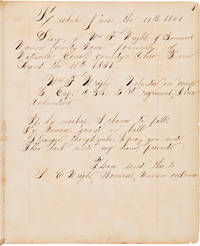
1861WRCAM56124Various places in Iowa and Missouri as described below 1861. 1022pp. approximately 16000 words. Contemporary half sheep and marbled boards. Boards detached but present worn and rubbed. Bookseller stamp on front free endpaper. Pages loosening but all present pages 33-34 with old repairs to a vertical tear running the length of the page. Occasional spots of soiling throughout but overall the text is quite clean and very easily read. Overall very good. An engaging account of the early days of the Civil War in Missouri by William F. Wright a Union volunteer from Somerset Iowa. Missouri was a highly-contested border state with both Union and Confederate supporters. It sent soldiers and arms to both sides was represented with a star on both flags maintained dual governments and featured a vicious intrastate war within the larger national war. William Wright's journal of his service in the first year of the war ably communicates the dangerous and unprecedented nature of guerilla warfare in the western theatre of the Civil War. <br> <br> Wright 1837-1905 enlisted in the 3rd Iowa Infantry Regiment in May 1861 responding to President Lincoln's first call for troops. Much of the diary centers on the months from July to September 1861 as his unit traveled back and forth across Missouri facing a guerrilla enemy with no clear battle lines. Unlike the large armies and massive battles further east Wright's regiment was frequently on the move by rail and foot often splitting off into companies squads and scouting parties prone to ambush by raiding parties with small detachments occasionally getting picked off by snipers. In addition to Confederate soldiers Wright's regiment also faced bands of pro-Confederate irregulars known as "bushwhackers." The war in Missouri was continuous from 1861 to 1865 with conflicts throughout the state. There were over 1200 distinct engagements in the state during the war; only Virginia and Tennessee exceeded this total. <br> <br> Wright is generally stoic throughout though he does admit to occasional homesickness and is justifiably distressed over a case of ague that comes on in August. When not drilling or recounting recent attacks Wright frequently mentions attending church prayer meetings and Bible study though he does not seem overly picky as to where. He attends a Catholic mass and a Presbyterian service on the same day and on another attends Episcopal Methodist and Presbyterian services on the same day. <br> <br> The diary begins on May 27 1861 as Wright puts his affairs in order and travels to Indianola where he "was sworn into the state service for three years" after which he proceeds with other recruits to Keokuk Iowa a major staging area for Union forces. His unit is officially sworn into "United States service" on June 8 receive their rifles on the 23rd and then assemble in camp on the 26th. The next day they receive word that they are heading to Missouri in the morning: "we received orders to cook enough provisions for three meals the drum would beat at 3 in the morning at which time we were to pull up stakes." They march to the docks board several steamships and head south on the Mississippi to Hannibal Missouri. Upon disembarking Wright comes across two men taken prisoner by the home guard "and I had for the first time the privilege of seeing a secession prisoner." <br> <br> The next day July 1 they board trains and head west: "I was surprised to see so many fine residences also quite a number of slaves were to be seen at work in the fields who cheered lustily as we passed.We passed several encampments of soldiers on the way who were all in good spirits. We hauled up at Utica in Livingston Co. slept in the cars." After a couple of weeks of false alarms of pending attack mysterious shots at night low rations and rumors of murdered soldiers the company was on edge. On July 18 Wright and nine other men were detailed to guard the railroad station in Utica after reports "that the enemy was going to burn it." During their watch "a spy came in with the information that from 500 to 800 men on Spring Hill were making preparations for an attack at the bridge and station simultaneously." No attack materialized however: "Daylight came and no enemy we were disappointed as we were well prepared for them and would have been pleased to have seen from 50 to 100 make their appearance." <br> <br> Tensions continued in a similar vein for the next few weeks as they shifted back east to Kirksville. Wright reports of all-night guard duty multiple nights in a row and frequently going without meals due to inadequate rations. On August 19 they received warning of a pending enemy attack which ends up as a small skirmish: "Six of our scouts were surrounded by 25 of the enemy. They killed Corporal Dix. The others made their escape after killing 3 or 4 of the enemy." Not long after they start heading south and while passing through Shelbina Missouri three of their men were shot one died by an enemy squad hidden in the brush. Circling back to Shelbina to rest they find the town partially destroyed by Rebel forces. Wright's unit then finished the task which he describes neutrally: ".the boys were allowed to go where they pleased and they took and destroyed ev'y thing in town. When ever a chicken was heard to crow a dozen men were ready to start for the place. Chickens and pigs were killed women's dresses taken children's playthings &c &c." Passing through Macon Missouri Wright and his comrades "dropped into a Brewery. There were quite a number of the boys there. Some of them were trading their shoes some shirts and others drawers for beer. I do not know whether they were their own clothes or whether they had stolen them. Saw three fights today." <br> <br> Heading west just outside of Kansas City they notice enemy scout activity. After more than two months of skirmishing and sniping the regiment saw its first pitched battle. On September 17 "3 p.m. we started from Liberty about 600 strong in the direction of the river. The enemies scouts were retreating as we went forward. The enemy killed 4 and wounded one of our men. About 4 o'clock we were fired into by the enemy which was the first that we knew of their position. We were within about 100 yds of their lines when we were fired on.We fought about an hour and 20 minutes when we were ordered to fall back as they had three men to our one and were flanking us. Four of the artillery men were kiled & four wounded which did not leave enough to man the gun and she was only fired three times when we had to haul her back by hand.we had 17 killed about 60 wounded and a number missing.it is reported that there were over 100 enemy killed and wounded." This was the Action at Blue Mills Landing also known as the Battle of Liberty. The next day Wright wrote "I have been helping to make coffins for our killed 12 bodies which will be buried in the evening.The most shocking scene that I have ever witnessed is one of the dead men whose face has been skined said to have been done by his brother-in-law." <br> <br> Wright had reported on his unit's tendency to loot earlier in the diary and now makes an interesting clarification: "When in the free State of Kansas the boys behaved very well. But since we have again come into Mo. they have began their old tricks. Last night there were quite a number of chickens stolen and a calf taken out of a man's dooryard." Perhaps in fairness to the Iowa troops they regularly went without rations or were given only flour and because they were often in hostile territory they rarely had permission to hunt or fish for their meals. <br> <br> Until this point Wright does not mention any direct encounters with African Americans but on October 18 as they depart Kansas City he notes they ".took three slaves with us who had run away from Lexington." Upon reaching Quincy Illinois "Will Newton and I went down town and got lodging for the three darkys who came from Kansas City. We left them with the supt. of the Colored Peoples Church." <br> <br> For the remainder of this diary Wright was stationed at the Benton Barracks in St. Louis; some of these entries are slightly out of order chronologically as though Wright inadvertently skipped pages. On December 1 he writes "In the evening one of Co. K was killed by accident. One of his comrades cocked his gun not knowing that it was loaded and shot the top of his head off. It was the most horrible sight that I have yet seen." Not much else happens until the end of the month when they get word that they'll be heading back out soon and start prepping their equipment. Leading up to Christmas he notes many of the men planning a big Christmas dinner: "For my part do not feel like celebrating the day. Think it will not pay here will pass it by as other days for this time." <br> <br> Wright's final entry on Christmas Day is also introspective. Having reflected on his past seven months in the army the things he has seen and how frequently he has been spared he concludes: "I do not like a sol. life. Would be far from following it from choice but believe that it is my duty as we are engaged in a just and noble cause trying to sustain one of the best governments ever formed. Co. G is not drunk to night but slightly inebriated." <br> <br> At the end of the diary Wright has transcribed a letter from a rebel which gives a sense of some the psychological warfare practiced during the conflict. Dated at Fillmore Missouri July 18 1861 it reads in part: "I hope when this letter comes to hand you may have time to read it. And I think that I shal be nearby. And then as soon as it is red I shal be near enough to nock your life out of you. I hope the time may come when the flag of the fifteen glorious states may fly over the free and independent.Instead of one thousand of us there is about 8000 of us and we are coming there as soon as we can get there." <br> <br> Wright reached the rank of sergeant in 1863 and survived to muster out in 1864. After the war he married raised a family and farmed in Kansas and Nebraska. <br> <br> A detailed and informative diary of the brutal and chaotic early months of the Civil War in Missouri. hardcover books
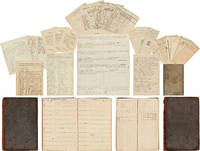
1864WRCAM54525Various places including Ohio Kentucky and Georgia but mostly Tennessee 1864. Five cloth-bound manuscript ledgers two printed books and over 100 documents letters and related forms either wholly manuscript printed or partially printed. Some soiling and staining to bound volumes some bindings partially perished. Typical folds some edge wear and soiling to documents. Overall fair to very good condition. A valuable collection of ledger books and documents recording the Civil War service of Company H of the 40th Ohio Volunteer Infantry. This archive contains five manuscript ledger books two printed volumes and more than 100 documents and letters relating to the unit. The 40th Ohio Volunteer Infantry was organized at Camp Chase Ohio in December 1861. They saw action at Chickamauga the Siege of Chattanooga Lookout Mountain the Siege of Atlanta and the Battle of Franklin. While some of the regiment was mustered out in October 1864 the remainder was mustered out in Nashville in December 1864 with the exception of veterans who were consolidated with the 51st Ohio Infantry. <br> <br> These materials were preserved by 1st Lieut. George Day Stone whose reports and letters can be found in this archive. Lieutenant Stone served in Company H of the 40th Volunteer Infantry from Oct. 9 1861 until Dec. 6 1864. He enlisted as a 2nd lieutenant and was promoted to 1st lieutenant on April 25 1862. He served under two company captains - William Cunningham through 1862 and whose account book is present here and John C. Meagher who is referenced throughout the archive. <br> <br> The 40th Ohio regiment lost over 200 men during service with six officers and ninety- six enlisted men killed or mortally wounded and one officer and 134 enlisted men who died of disease. A healthy number of these casualties are recorded here in the Company H ledger books. <br> <br> The bound volumes chronicle important service details and include: <br> <br> 1 Folio account book of Capt. William Cunningham of the 40th Regiment Ohio Infantry 109pp. September 1861 to August 1862. The ledger records pertinent details regarding moneys issued to various members of Company H throughout the first years of the war. <br> <br> 2 Folio ledger book 57pp. listing commissioned and non-commissioned officers along with a one-page detailed listing of thirty soldiers killed and a descriptive roll of the company with detailed remarks on desertions mustering in and out soldiers taken prisoner and more. <br> <br> 3 Folio ledger book with 16pp. of furlough lists descriptive roll notes and manuscript general orders. <br> <br> 4 Folio volume of Morning Reports 50pp. dated November 1861 to October 1864 listing number of troops with about twenty full reports and a dozen pages of remarks. <br> <br> 5 Oblong folio ledger book 190pp. dated 1862-1864 recording soldier pay and supplies for Company H with notes. <br> <br> 6 INSTRUCTIONS FOR MAKING QUARTERLY RETURNS OF ORDNANCE AND ORDNANCE STORES. Washington: Government Printing Office 1863. 140pp. Publisher's pebbled cloth gilt. Captain Meagher's copy with his ownership signature on the front endpapers. <br> <br> 7 A volume of printed General Orders dated 1863-1864 variously paginated but approximately 150 pp. reporting rolls of officers and men assigned to various units including those judged unfit for duty or removed to invalid units. <br> <br> A sampling of the loose letters and documents is as follows: <br> <br> 1 Lieutenant Stone's report Nov. 15 1863 detailing the capture of John Meagher at Chickamauga and stating that he "was placed in command of said company." Stone then relates the inventory of supplies he found among the remaining men in the company. <br> <br> 2 Two letters addressed to Brig. Gen. Montgomery C. Meigs one dated June 4 1864 and one Sept. 13 1865 being letters of transmittal of men and materials. <br> <br> 3 Letter dated Dec. 5 1864 reporting on David Holmes a private who was "captured and taken prisoner by the enemy while in the line of Duty on or about the 22nd day of September 1864." <br> <br> 4 Several partially-printed "Quarterly Returns of Deceased Soldiers" from 1864 completed in manuscript. <br> <br> 5 Manuscript report from Sept. 25 1863 2pp. reporting on soldiers taken prisoner and supplies lost to the enemy at Chickamauga and Missionary Ridge Tennessee. The report reads in part: "I certify.at Chickamauga.The Regt. to which my company belongs was directed to advance under the fire of the enemy to take a certain position; in so doing one private was killed two severely wounded & two taken prisoner." The report then lists the material lost to the Confederates and a similar report follows detailing prisoners taken and material lost at Missionary Ridge. <br> <br> 6 Two manuscript field orders from the Army of Kentucky dated in the Spring of 1863. The first dated March 20 gives directions on uniform regulations and then instructs officers and soldiers "now quartered at dwelling houses will at once remove to their tents or such hospital as the Regimental Surgeon or Medical Director shall direct." The second field order instructs all soldiers to carry "forty rounds of cartridge in their cartridge boxes." <br> <br> 7 Commissioned officer list for Company H from October 1863 listing thirty-two officers including Stone a sergeant a corporal the wagoner and twenty-eight privates along with detailed remarks on recent movements of everyone but Stone. Most of the privates are listed as either absent or sick. <br> <br> 8 Commissioned officer list for Company H from December 1863 listing thirty-eight officers taken prisoner by the Confederates at the Battle of Chickamauga on Sept. 21 1863 including the aforementioned Captain Meagher and David Holmes. <br> <br> 9 Various blank report forms including morning reports inspection reports receipts for ordnance volunteer descriptive lists and more. <br> <br> An important collection from the 40th Regiment Ohio Infantry providing insight into the various day-to-day activities experiences and duties of the unit during its Civil War service. hardcover books
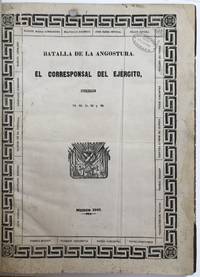
18471307Mexico City 1847. Good plus. 202pp. Large folio. Original printed wrappers bound in contemporary marbled boards rebacked and recornered in recent morocco gilt leather spine label all edges marbled. Numerous additional blank leaves bound in. Rubbing and scuffing to boards moderate edge wear; wraps with repaired chips and tears. Early 20th-century bookplate on front pastedown small ink stamps scattered throughout. A couple of short repaired edge tears internally; light tanning and foxing. A rare Mexican view of the defeat suffered by forces under the command of Santa Anna in the Battle of Buena Vista at the hands of Zachary Taylor during the Mexican-American War. The battle occurred in late February 1847 when Santa Anna freshly recalled from exile in Cuba rushed his new army north to halt the southern advance of Taylor's forces from Texas. Taylor had already been victorious at the battles of Palo Alto and Resaca de la Palma and had captured Monterrey and Saltillo before much of his army was sent to assist in the invasion of Veracruz being prepared by Winfield Scott. When Santa Anna attacked the American forces dug in at Buena Vista south of Saltillo on February 22nd he did so with an army far superior numerically but also one far less trained and experienced and was driven back with heavy losses. Taylor's enhanced reputation and legend that grew out of the battle took him to the White House in 1848.<br /><br />Both sides claimed victory in the battle. Santa Anna did so on the perhaps dubious grounds that although his own army suffered numerous casualties and withdrew from the field Taylor with his now limited forces halted his advance after the conclusion of the engagement. The present work provides a detailed account of the battle from the Mexican point of view printed as five consecutive issues of their official military periodical but published separately with its own wrappers and a sheet with two large woodcut maps. The report as the introduction from the editor makes clear was intended as a defense against criticism from parties within Mexico concerning the conduct of the brief campaign: <br /><br />"Despues de terminar los partes oficiales nos encargaremos de refutar un cuaderno que se ha impreso recientemente con el solo objecto de eclipsar el brillo que las armas mexicanas adquierieron el mes de Febrero ultimo en el estado de Coahuila y que parece escrito si no por Taylor mismo si bajo su influencia y por el poder del oro americano. El ilustre general Santa-Anna nunca ha sido mas digno del amor y reconocimiento de sus conciudadanos y nunca tampocoha debido considerarsele come general y como mexicano mas digno de elogio que en la epoca actual."<br /><br />The work first contains a lengthy report by Santa Anna and several shorter ones from his lieutenants that present the performance of the Mexican army and the results of the battle in the most positive possible light. The majority of the work comprises a unit-by-unit account of Mexican action during the battle with detailed descriptions of the participation of each regiment including lists of soldiers killed wounded and missing in action. The two woodcut maps delineate the geography and trails of the area surrounding Saltillo and the initial order of battle on the field. As a result the work serves not only as a brisk defense of Mexican military conduct but also as an important and comprehensive record of the Mexican side of the engagement.<br /><br />Very rare -- we locate only three copies at Yale Harvard and the University of Texas and none in auction records. books
18559027465Washington D. C.: A.O.P. Nicholson 1855 - 1860. 1st . Hardcover. Fine. Rebound in quarter black cloth and marbled paper boards brown paper label on spine printed in black and white. Volumes 1 2 11 map volume and 12 part I are Senate issues; the rest are House of Representative issues.Observations on condition: VOLUME FOUR; 21 of the black and white lithographic plates foxed more heavily than the rest. VOLUME FIVE; 7 of the colored lithographic views foxed more than the rest one plate loose. VOLUME SEVEN; waterstain to the first eighty-three pages affecting the upper perimeter of the text and eight color lithographic views. VOLUME TEN; slight foxing to four color bird lithographs and overall foxing to one black and white reptile lithographs and minor overall spot foxing to several black and white reptile and fish lithographs. VOLUME ELEVEN the upper and lower folds of the maps have some wear weathering and separation. The fore edge folds are clean and strong. VOLUME TWELVE BOOK TWO; two black and white rodent lithographs heavily foxed one black and white fish lithographs heavily foxed with minor scattered foxing to several others. <br/><br/> A.O.P. Nicholson hardcover books
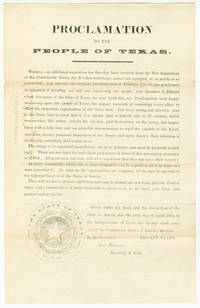
1861WRCAM56192Austin 1861. Letterpress broadside 12 1/2 x 8 inches. Docketed in manuscript on verso. Old folds tiny fold separations at edges minor wrinkling. Near fine. A phenomenal Texas Confederate broadside calling for the recruitment of infantry volunteers just two weeks after the attack on Fort Sumter ushered in the Civil War. It is only the second copy of this broadside that we have been able to locate. The proclamation was issued by Texas Governor Edward Clark who arouses the southern patriotism of potential Texas Confederate recruits asking them to join the battle since "the arrogant administration of Abraham Lincoln has proclaimed its intention of invading our soil and conquering our people." Governor Clark "most deeply impressing upon the people of Texas the urgent necessity of combining every effort to effect the immediate organization of our brave men" calls for volunteers for the Confederate Infantry. <br> <br> Clark appeals not only to patriotism and a sense of religious destiny but also evokes an obvious and widely-shared disdain for the northern states of the Union: <br> <br> "Let every young and chivalric man in the State bear in mind that it is a solemn duty to himself and his country which now invokes his action and let the old men gird their armor on the young and inspire them with a holy zeal and an inflexible determination to repel the vandals of the North who have already possessed themselves of our homes and made known their intention of destroying everything that is dear to us." <br> <br> Governor Clark calls for the immediate formation of one or more companies in as many communities as possible in the state of Texas and orders those companies to report to the Adjutant General in Austin. Clark hopes that these companies will soon number "eight thousand men to defend our new-born glorious Confederacy and a reserve force of many thousands to preserve us as we have ever been independent and invincible." <br> <br> The attack on Fort Sumter raged from April 12 to 14 1861 and resulted in a resounding Confederate victory. In the aftermath of the battle both Union and Confederate officials kicked off aggressive recruitment campaigns. The news of Fort Sumter was received by Governor Clark in Austin on April 17; that day Clark issued a directive to establish and instruct volunteer companies dividing the state into six districts Parrish & Willingham 4233 Winkler 1662. The present broadside issued a week later was a response to the Confederate government's request for five thousand more troops for a total of eight thousand new Texas infantry recruits in the two weeks following the outbreak of the war which were promptly furnished by the state. <br> <br> This is an extraordinarily rare Texas Confederate broadside. Parrish & Willingham and Winkler record only a single copy at the University of Texas. PARRISH & WILLINGHAM 4230. WINKLER 1663. unknown books
186335748Richmond Columbia Augusta and elsewhere 1863. Quarto. Collation as below. Expertly bound to style in half dark purple morocco and purple cloth covered boards flat spine ruled and lettered in gilt yellow endpapers<br/> <br/>An impressive collection of Confederate lithographed sheet music.<br/> <br/>This bound volume includes the majority of the imprints by Richmond publishers and lithographers George Dunn and Company active in Richmond from 1862-64. The collection includes: 1 The Dying Soldier or the Moon rose o'er the battle plain. 4pp. Richmond: J. W. Davies & Sons lithographed by E. Crehen 1864. P&W 6983. 2 Dear Mother I've come home to die. Words by E. Bowers Music by Henry Tucker. 4pp. Richmond: Geo. Dunn & Co.; Columbia SC Julian Selby nd. P&W 6953. 3 God Save the South. Words by Earnest Halphin music by Chas. W. A. Ellerbrock. 6pp. Lithographed by B. Duncan & Co. Columbia SC. Baltimore: Miller & Beacham; Augusta: Blackmar & Co. nd. P&W 7064. 4 The March of the Southern Men. 4pp. Richmond: Geo. Dunn & Co.; Columbia: Julian A. Selby 1863. P&W 7228. 5 On Guard. Words by Wallace Rowe. 4pp. Richmond: Geo. Dunn & Co.; Columbia: Julian A. Selby 1864. P&W 7327. 6 The Southern Soldier Boy. Song sung by Miss Sallie Partington in the Virginia Cavalier at the New Richmond Theatre. 4pp. Richmond: Geo. Dunn & Co.; Columbia: Julian A. Selby 1863. P&W 7494. 7 The South. Poetry by Charlie Wildwood. Music by John H. Hewitt. 4pp. Columbia SC: Julian A. Selby B. Duncan & Co. lith. 1863. P&W 7474. 8 Palmetto Schottisch. Composed and Arranged by A. F. Turner. 4pp. Richmond: Geo. Dunn & Co. 1864. P&W 7348. 9 I Remember the hour when sadly we parted. 4pp. Mobile: H.C. Clarke and others 1864. P&W 7116. 10 Annie of the Vale. Words by G.P. Morris. Music by J.R. Thomas. 6pp. Richmond: Geo. Dunn & Co.; Columbia: Julian A. Selby nd. P&W 6806. 11 Good Bye Sweetheart Good Bye. 4pp. Richmond: Geo. Dunn & Co.; Columbia: Julian A. Selby 1863. P&W 7084. 12 Spring Time Polka. Composed by A.J. Turner. 4pp. Richmond: Geo. Dunn & Co. 1864. P&W 7505. 13 My Wife and Child Song. Poetry by the Late Lamented Hero General Stonewall Jackson. Music by F. W. Rosier. 4pp. Richmond: Geo. Dunn & Co.; Columbia: Julian A. Selby 1863. P&W 7288. 14 Mother Oh! Sing me to rest. Composed by M. Keller. Richmond: Geo. Dunn & Co.; Columbia: Julian A. Selby nd. P&W 7279. 15 The Musical Olio: or Favorite Gems of the Popular Southern Composer John H. Hewitt. 4pp. Macon & Savannah: John C. Schreiner & Son nd. P&W 6966. 16 Up With the Flag. Composed nd Respectfully Dedicated to the Fourth N.C. Troops by Dr. Wm. B. Harrell. 4pp. Richmond: Geo. Dunn & Co.; Columbia: Julian A. Selby 1863. P&W 7572. 17 Pray Maiden Pray! Poetry by A. W. Kercheval. Music by A.J. Turner. 4pp. Richmond: Geo. Dunn & Co. 1864. P&W 7380. 18 The Standard Bearer. Words by Major T.N. P. C.S.A. Music by N.S. Cleman. 4pp. Richmond: Geo. Dunn & Co. 1864. P&W 7506. 19 No Surrender Song. Music by C.C. Mera. 4pp. Richmond: Geo. Dunn & Co.; Columbia: Julian A. Selby 1864. P&W 7301. 20 Keep me awake Mother. Words by Mrs. M.W. Stratton. Music by Jos. Hart Denck. 4pp. Columbia: Julian A. Selby nd. P&W 7175. 21 Gen'l Morgan's Grand March. Composed by C.L. Peticolas. 4pp. Richmond: Geo. Dunn & Co.; Columbia: Julian A. Selby 1864. P&W 7049. 22 Nautical Song.The Alabama. By E. King. 4pp. Richmond: Geo. Dunn & Co.1864. P&W 6793. 23 All quiet along the Potomac To-Night. Words by Lamar Fontaine. Music by J. H. Hewitt. 4pp. Richmond: Geo. Dunn & Co. 1864. P&W 6796. 24 The Exotics. Flowers of Song Transplanted to Southern Soil. 4pp. Augusta: Blackmar & Broth.; Columbia: B. Duncan & Co. lith nd. P&W 7361. 25 Mary of Argyle. Music by S. Nelson. 4pp. Richmond: Geo. Dunn & Co.1864. P&W 7234. 26 Her Bright Smile Haunts Me Still. Words by J.E. Carpenter. Music by W.T. Wrighton. 4pp. Richmond: Geo. Dunn & Co. 1864. P&W 7097. 27 Harp of the South. Awake! A Southern War Song. Words by J.M. Kilgour. Music by C.L. Peticolas. 4pp. Richmond: Geo. Dunn & Co.; Columbia: Julian A. Selby 1863. P&W 7090. 28 Mother is the Battle Over. Arranged by Jos. Hart Denck. 4pp. Richmond: Geo. Dunn & Co.; Columbia: Julian A. Selby nd. P&W 7277 29 The Southern Cross. Words by St. George Tucker. Music by C. L. Peticolas. 4pp. Richmond: Geo. Dunn & Co.; Columbia: Julian A. Selby 1863. P&W 7482. 30 The Star Spangled Cross and the Field of Pure White. Written and Composed by Subaltern. 4pp. Richmond: Geo. Dunn & Co.; Columbia: Julian A. Selby 1864. P&W 7510. 31 Virginian Marseillasise. By F. W. Rosier. 4pp. Richmond: Geo. Dunn & Co.; Columbia: Julian A. Selby nd. P&W 7584. 32 Wait till the War Love Is Over. Words by A.J. Andrews. Music by C.W. Burton. 4pp. Richmond: West & Johnston litho. by Geo. Dunn. & Co. 1864. P&W 7599. 33 When this Cruel War is Over. Words by Charles C Sawyer. Music by Henry Tucker. 4pp. Richmond: Geo. Dunn & Co.; Columbia: Julian A. Selby nd. P&W 7630. 34 You Can Never Win Us Back . Written by a Lady of Kentucky. Arranged by J.E. Smith. 4pp. Richmond: J.W. Davies & Sons. litho. by E. Crehen 1864. P&W 7653. 35 Gems of Southern Song. 4pp. Macon: John W. Burke; Columbia: B. Duncan & Co. lith. nd. P&W 7576. 36 Call me not back from Echoless Shore. Words by Chas. C. Sawyer. Music by Henry Tucker. 4pp. Richmond: Geo. Dunn & Co.; Columbia: Julian A. Selby nd. P&W 6878. 37 The Dearest Spot of Earth to Me Is Home. By W.T. Wrighton. 6pp. Augusta: Blackmar & Bro. nd. P&W 6954. 38 There's Life in the Old Land Yet. Poetry by Jas. R. Randall. Music by Edward Eaton. Augusta: Blackmar & Bro. lith. B. Duncan Columbia. nd. P&W 7548. 39 Who Will Care for Mother Now. Poetry by C.C. Sawyer. Music by C.F. Thompson. 4pp. Richmond: Geo. Dunn & Co. 1864. P&W 7638. 40 Christmas and New Year Musical Souvenir. Music by F.W.R. Richmond: Geo. Dunn & Co.; Columbia: Julian A. Selby 1863. P&W 6903. 41 Our First President's Quickstep. By P. Rivinac. 4pp. Augusta: Blackmar & Bro. B. Duncan lith. Columbia. P&W 7337. 42 Something to Love Me.Words by J.E. Carpenter. Music by E.L. Hime. 4pp. Richmond: Geo. Dunn & Co.; Columbia: Julian A. Selby nd. P&W 7467. 43 Silver Bells Mazurka. Composed by Charles O. Pape. 6pp. Columbia: P.L. Valdry nd. P&W 7446. 44 We Have Parted. Poetry and Music by Miss Ella Wren. 4pp. Richmond: Geo. Dunn & Co.; Columbia: Julian A. Selby 1863. P&W 7613. unknown books
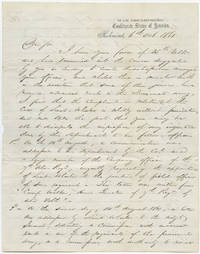
186123285<p>Writing as acting Confederate Secretary of War Judah P. Benjamin denies Major General Braxton Bragg the possibility of a transfer to a more active post. Instead Benjamin gives Bragg additional responsibilities including defending Alabama. Bragg must have become tired of inaction as three days after Benjamin wrote this letter Bragg ordered the Confederate assault on Fort Pickens at the Battle of Santa Rosa Island.</p> <b>JUDAH P. BENJAMIN. CIVIL WAR.</b>Autograph Letter Signed as acting Secretary of War to Braxton Bragg. Richmond Va. October 6 1861. 4 pp. 7¾ x 10 in. On War Department letterhead.<p><b>Transcript</b></p><p><i>"I have your favor of 25th Ulto and have examined into the causes suggested by you as tending to create dissatisfaction amongst your officers and whilst there is much truth in the assertion that some of your juniors have received advanced rank in the Provincial army I find that this complaint in relation to the case of Lieut. Wheeler is wholly without foundation and will state the facts that you may be able to dissipate the impression of any injustice done by the department to his fellow-officers.</i></p><p><i>1st on the 14th August a communication was addressed to this department by the Col. and a large number of the Company officers of the 7th Ala. Regt. urgently requesting the appointment of Lieut. Wheeler to the position of filed officer of the same regiment. This letter was written from "Camp Walker Head Quarters of the 7th Regt. of Ala. Vols."</i></p><p><i>2d on the same day 14th August 1861 a letter was addressed by Lieut. Wheeler to the Adjt. General soliciting a commission with increased rank as are of the regiments of the provisional army or a commission with authority to raise a battalion or regiment for the War. This letter was endorsed with a very earnest recommendation that the appointment should be made signed by Col Wood of the 7th Ala Regt. commanding 2d Brigade and was forwarded by <u>yourself</u> with a <u>'full and cordial endorsement of Lt Wheeler's application'</u>and it was in consequence of these endorsements and recommendations that my predecessor yielded to the solicitation of the officers of the 19th Ala Regt. and appointed Lieut. Wheeler their Colonel. I enclose you copies of the papers as a duty to my predecessor whose action on the subject is somewhat impugned by your letter of 25 Ulto.</i></p><p><i>And now my dear sir having disposed of this matter let me say that the noble and self-sacrificing spirit displayed by yourself and the gallant spirits that are now chafing in the hateful inaction on the sands of Pensacola harbor are fully appreciated and elicit the most heart-felt approval and admiration not only of the President Jefferson Davis but of every member of the administration. We are as anxious as you can possibly be to relieve you from a position to which the fortune of war has condemned you and we look forward as impatiently as you can to some opportunity of testifying our sense of what is due to you all. But all our deliberation results in this that to remove you as we know is your earnest desire to some field of more active operation would have the most disastrous effect on the morale of the army under your command whilst for your officers we can do nothing for the moment under the legislation as it now exists; but we shall none the less hold them in remembrance for the marks of approval as soon as it shall be possible to transfer them to other fields of duty; and I will further say that whenever you feel you can spare any of your officers and desire him rewards I will find the means to place him in some desirable post and with increased rank in the provisional army.</i></p><p><i>In the mean time the President in conversing with me on the subject of own position has suggested that it might be a partial relief to the tedium of your constant vigil to extend your command and make it embrace the coast of Alabama thus giving you an additional chance for an actual fight in the event of a descent by the enemy and you will accordingly find that a general order has been issued making of your command a department and placing the coast defences of Alabama under your control. I think you will thus have an increased chance for actual combat."</i></p><p><b>Historical Background</b></p><p>Santa Rosa Island blocked the mouth of Pensacola harbor and the Union Fort Pickens effectively eliminated any strategic value of the Confederate capture of Pensacola's naval shipyard and nearby railroad. Three weeks prior to this letter Union forces raided the captured shipyard and burned the schooner <i>Judah</i> to prevent its putting to sea as a privateer. As evidenced in this letter Confederate Major General Braxton Bragg was <i>"chafing in the hateful inaction on the sands of Pensacola harbor"</i>cut off from using his newfound assets to their fullest benefit. As Benjamin was writing this letter denying Bragg's transfer request Bragg himself must have been planning the retaliatory raid against Fort Pickens. The battle which took place on October 9 1861 was inconclusive with both sides claiming victory in the Florida's first land action of the war.</p><p>Known as "the brains of the Confederacy" <b>Judah Benjamin</b>1811-1834 served in the Louisiana state legislature and U.S. Senate before joining Jefferson Davis's cabinet first as Attorney General then Secretary of War and finally as Secretary of State. A New Orleans lawyer Davis had given Benjamin the post of attorney general until deciding he needed him in a more important role. In September 1861 he was moved to the War Department. His closeness to Davis—and his Jewish faith—attracted resentment from jealous rivals. With the loss of Roanoke Island in 1862 along with Grant's capture of Forts Henry and Donelson critics demanded Benjamin's blood. Davis responded by promoting him to Secretary of State a post he held until the collapse of the Confederacy. Initially part of Davis's contingent when the Confederate president fled Richmond in women's clothing Benjamin escaped to England where he thrived as a lawyer and was named to the Queen's council. He retired in 1883.</p><p><b>Braxton Bragg</b> 1817-1876 was a career military officer first in the U.S. Army and later in the Confederate Army. He attained the rank of full General in the Confederate Army one of only seven in the Confederacy. He fought at the Battles of Shiloh Chickamauga and Chattanooga among others and in 1864 became Jefferson Davis's military adviser.</p><p><b>Condition</b></p><p>Very good. Some separation at folds. One and one-quarter inch tear at the upper edge of page three. Minor paper loss along the main vertical fold. Areas light toning.</p> books
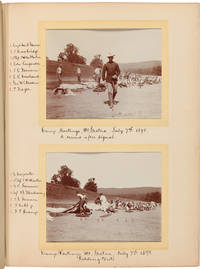
1898WRCAM54683Various places including Pennsylvania Virginia at sea New Jersey and Puerto Rico 1898. 171pp. with 342 photographs. Four large quarto photograph albums. Matching contemporary three-quarter crimson morocco and cloth front covers gilt. Minor shelf wear and some rubbing. Images in overall very good condition. An amazing assemblage of photographs documenting the Spanish-American War experiences of the First Troop Philadelphia City Cavalry which was at that time the oldest volunteer military unit in continuous service to the United States. The photographs are arranged chronologically in four contemporary photo albums with the images occasionally annotated in a contemporary hand and including the identification of numerous members of the Troop. <br> <br> The first volume opens with images of Mt. Gretna Pennsylvania "where troops were sworn into U.S. service May 7th 1898 by Maj. Thompson U.S.A." The photographs record field exercises camp building and tent organization at Camp Hastings cavalry drills an image of "Capt. Groome reading the Articles of War to Troop June 1898" a "first arrival of government horses" several shots of men training and "throwing" their horses shooting practice "Capt. Groome assigning Government horses to Troopers" and various shots of the men at work and even some play. Over the course of the album the names of numerous soldiers are recorded below several of the photographs. <br> <br> The second album opens with several photographs of the Troop striking their tents in preparation for leaving Camp Hastings at Mt. Gretna headed for Camp Alger at Dunn Loring Virginia. Here the Troop was ordered to increase their enlistment numbers. At Camp Alger the Troop was also fitted out with federal supplies and assigned to the Second Army Corps commanded by Maj. Gen. William Graham who is pictured here. Other photographs capture the camp scene at Alger "the First Troop picket line" the Troop receiving their federal-issue khaki uniforms the Troop at roll call and some shots featuring African-American helpers. <br> <br> In late July the Troop was sent to Newport News and several photographs record their brief time there with about a dozen shots of their temporary camp. On July 28 1898 the Troop left Virginia on the transport ship MASSACHUSETTS bound for Puerto Rico. Several images here capture the frenetic loading of the troops and their horses onto the ship with the remaining half dozen or so shots recording the Troop's time on board. <br> <br> The third album picks up where the second left off with the First City Troop embarked on the transport ship MASSACHUSETTS headed for Guanica Puerto Rico. Shipboard activities captured here include a few shots of groups of men being showered with water hoses. Several shots record the arrival of the men in the port of Guanica where they encounter the hospital ship NUECES which reports of the news of the "surrender of Ponce." After the men disembark they pitch their camp around Cathedral Virgin del Carmen on August 5. The next day several photographs record the unloading of horses and stores in the harbor at Ponce. The remaining thirty-eight photographs in this volume record scenes in the interior of Puerto Rico and are the most heavily annotated of the four albums. The images record scenes from the "road from Port of Ponce to Ponce" several scenes capturing a market day in Ponce and recording numerous native islanders the Troop's "temporary camp about 2 miles beyond Ponce" the "Troop wagon leaving camp beyond Ponce to join wagon train for Guayama" on August 8 a shot of the Troop's wagon "on road to Guayama in a Porto Rico mudhole" images of the wagon train to Guayama with the H Troop 6th U.S. Cavalry the "Point of Advance Guard entering Guayama within the lines" the Troop itself "entering Guayama passing General Brooke's Headquarters" a "View of First Troop Phila. City Cavalry U.S.V. Camp at Arroyo August 10th to 6A.M. Aug. 13th 1898" with the last ten images recording the camp or the streets at Arroyo. <br> <br> The fourth album documents the Troop's voyage home to Philadelphia. This time they take passage on the transport ship MISSISSIPPI and about half of the images record their voyage on board. On Sept. 10 1898 they reach Jersey City in New York harbor where they camp for a short time before returning to camp in Pennsylvania where the album ends. A couple of months later all three officers and the ninety- eight enlisted men of the First City Troop were mustered out of federal service for the Spanish-American War. <br> <br> Originally founded in 1774 by twenty-eight Philadelphia patriots as the "Light Horse of the City of Philadelphia" the First Troop of Philadelphia Cavalry is the oldest mounted military unit operating in continuous service to the American republic being the first volunteer cavalry troop organized in defense of the colonies. Among the Troop's original founders was John Dunlap printer to Congress from 1778 to 1789 publisher of the first American daily newspaper and the first printer of the Declaration of Independence. Most of the earliest members were similarly notable professional men of Philadelphia. The Troop served with valor in the American Revolution the War of 1812 the Mexican- American War the Civil War the Spanish- American War and every major American war through the Korean War. <br> <br> The present albums present a unique and important visual record of the First City Troop's activities before during and on the way home from the Spanish-American War. hardcover books
186426136Chattanooga 1864. Lithographed folding map sectioned and linen-backed as issued. Original card covers printed paper label. In a modern folding morocco-backed box. A remarkable Union Army field map printed for Sherman's operations in Georgia.<br/> <br/>A highly detailed map of the northern part of Georgia made under the direction of Capt. W. E. Merrill Chief Topographical Engineer of the Army of the Cumberland. The map shows all the major roads and rail lines in addition to natural topographical features in northern Georgia. The map extends as far north as Chattanooga near the Georgia/Tennessee state line and far enough south and east to include the northwest sixth of the state. The capture of Chattanooga in November 1863 gave the Union the foothold they needed to cut off supply lines and advance into the deep South. In the spring of 1864 the forces under Gen. William T. Sherman were poised to strike. As soon as Chattanooga was taken Sherman's chief topographical engineer Capt. William E. Merrill "the most innovative and conscientious exponent of mapping during the Civil War" began to compile a map of northwest Georgia. Merrill had his own complete establishment for map production -- a printing press lithographic presses and draughtsmen. Equally importantly Merrill's assistant Sgt. N. Finnegan developed an extraordinary body of intelligence drawing on spies prisoners refugees peddlars itinerant preachers and scouts what Merrill called "his motley crew". All of this information was digested by Merrill day by day until he was notified that the campaign would begin within the week. At this point the topographers finished their work and two hundred copies were produced mounted on linen for field use and distributed to field commanders down to the brigade level. In five months Merrill and his men had produced a remarkably accurate map of country that lay mostly behind enemy lines. The Merrill map was a critical aid to Sherman's campaigns in Georgia. Five days after the map was completed on May 7 Sherman's army left Chattanooga and began its hard-fought push to the southeast slowly driving the Confederates back to the railroad hub of Atlanta which is in the lower right quadrant of this map. In a campaign of continual attempts by both armies to outflank each other the understanding of the ground it would have brought the Union commanders was invaluable. Sherman took possession of Atlanta in September and used it as a base of operations for the next two and a half months while he raided in every direction all within the boundaries of this map. On November 15 the Federal forces burned the city cut loose from their rail communications with Chattanooga and began the famous March to the Sea heading east toward Savannah burning and pillaging everything in their path. About a week later they moved off the east edge of this map. An examination shows why this map would have been an invaluable aid to the Union commanders in the Georgia campaign. It details topography rivers existing roads and railroads towns and other features on a very small scale of four miles to the inch. Conveying the latest in Union military intelligence and combining new and existing information it would have guided Sherman and his officers through eight months of the hardest-fought campaigning of the entire Civil War. A triumph of coordinated intelligence and map-making it is one of the most remarkable cartographic productions of the Civil War. Indeed it might be called the "Holster Atlas" of the Georgia campaign.<br/> <br/>Stephenson Civil War Maps in the Library of Congress S28-29; Miller Great Maps of the Civil War p.39. unknown books
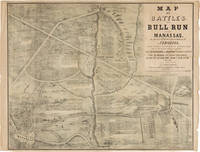
1861WRCAM48993Richmond: West & Johnston 1861. Sheet map 19 3/4 x 26 inches. Old fold lines. Some separation at two folds on the right edge. Light wear minor toning. Very good. A handsome and historic map depicting the First Battle of Manassas or Bull Run depicting troop positions and movements roads railroads houses and other significant geographical features. First Manassas was the first significant engagement of the Civil War and the place where Thomas J. Jackson became "Stonewall" Jackson when his brigade stood their ground against disorganized Union forces. The Confederate troops won the battle raising hopes in the South and signaling to the North that the war would not be won so easily. The map indicates that it was "made from observation" by Solomon Bamberger and lithographed by the firm of Hoyer & Ludwig in Richmond. <br> <br> It appears that at least two issues of this map exist this being the most vividly pictorial that we have found and thus perhaps the later of the two. Rather than a simple plan of the battle the present map lays out the same information augmenting the background with shading and pictorial scenery. The title is likewise enclosed in a simple border setting it off from the rest of the map and though the title is the same the typeface of some of the title lettering has been changed slightly. Parrish & Willingham do not indicate any differentiation of issues but the details and graphics make this by far the most desirable. <br> <br> A rare and interesting map of this important battle and one of the most dramatic graphics produced in the Confederacy. Without the means to produce suitable paper few pieces on a comparable scale were created. PARRISH & WILLINGHAM 6148. West & Johnston unknown books
186126345Washington: Bureau of Topographical Engineers 1861. Sun printed i.e. photozincographed map after the original manuscript routes of railroads and canals hand-coloured 44 x 51 1/2 inches dissected into 24 sections and linen-backed as issued. Manuscript annotations in pencil by J. J. Young. Modern blue morocco-backed box. Provenance: Descendants of Amiel Weeks Whipple. Incredible Civil War map of Virginia produced by the Corps of Topographical Engineers for use by Union officers in the field.<br/> <br/>A highly important military map of Northern Virginia made for the use of the Union Army in the early days of the Civil War by an important military cartographer. The present map depicts Virginia as far north as Fredericksburg as far south as the North Carolina border and as far west as Charlottesville with detail including towns roads waterways and railroads. A statement on the map cites the U.S. Coast surveys and the Boye map of Virginia as sources in addition to surveys conducted by the Corps of Topographical Engineers. The map was completed within a month of the first major battle of the war the Battle of Bull Run fought on July 21 1861. The failure of the Union forces there made it clear that the war was not going to be resolved easily and quickly. Although not named as the cartographer the present map can be attributed to Amiel Weeks Whipple. During the 1850s Whipple became one of the most accomplished surveyors in the Corps of Topographical Engineers leading explorations for the transcontinental railroad. Captain Whipple was immediately ordered to report to the Chief of Topographical Engineers in Washington. There was then a dearth of maps giving any but the most meagre of information concerning the State of Virginia and to him as Chief of Topographical Engineers of the defenses of Washington South of the Potomac was entrusted the very challenging duty of making armed reconnaissances to collect the topographical details required. It was hazardous work in a country thickly wooded in places where small bodies of men could be concealed with absolute impunity; and the first skirmishes of the war such as that at Fairfax Court House were fought during its continuance. The work however was successfully and very quickly done and reliable maps were soon in possession of the Union commanders" Stoddard. Attribution of this map to Whipple can also be determined by a very similar map though focussed on Fairfax Loudoun and Prince William Counties which identifies Whipple as the source for the manuscript drawn by Civil Engineer J. J. Young see Stephenson 536.6. That map is in essence the companion to the present map i.e. showing the northern regions of Virginia not shown on this map. The handwriting of the manuscript used for that map and the present map are identical suggesting both to have been drawn by Young. Interestingly the present map includes pencil annotations again in the same hand see for example the naming of the branches of the Elizabeth River near Norfolk. That this map was done specifically for use in the field is suggested by the hurried process of its production. Rather than taking the time to have the map lithographed or engraved a sun print process was used to duplicate the original manuscript. Sun prints also called photozincography were developed in Great Britain in the mid-19th century to reproduce maps created during the Ordnance Survey. In this photographic process a negative is made of the original using a wet plate collodion method which is then exposed onto a thin sheet coated with a saturated potassium bichromate solution and transferred to a zinc plate coated in ink and put through a press. The present copy descended in the family of Whipple and includes a manuscript presentation below the cartouche "To accompany letter to / dated Bureau of Topogl. Eng.s Augt 1861." The name of the recipient is not filled in suggesting that Whipple kept this copy for himself. The map is very rare with OCLC citing but three known examples.<br/> <br/>Stephenson Civil War Maps 451.6; Francis R. Stoddard "Amiel Weeks Whipple" in Chronicles of Oklahoma vol. 28 Autumn 1950. Bureau of Topographical Engineers unknown books
1864WRCAM54026Richmond: Ayres & Wade 1864. Forty-four issues of 110 most 8pp. each. Folio. Old fold lines and light wear. Separations along gutter vertical folds. Some light tanning and soiling scattered foxing and wear. Some issues lightly dampstained. Many issues trimmed at gutter margin creating loose sheets. Still very good overall. THE SOUTHERN ILLUSTRATED NEWS was the Civil War South's answer to northern publications such as HARPER'S WEEKLY. A pictorial paper it printed portraits and biographies of important military leaders political cartoons mocking President Lincoln and other northern figures as well as literary tidbits. The paper ran from Sept. 13 1862 to Feb. 4 1865 and was published weekly. Through 1863 issues were eight pages in length but into 1864 issues were more often four pages or sometimes skipped entirely and only published every other week. <br> <br> The quality of the publication and its illustration were rather crude by comparison with the North's offerings. The publishers advertised several times for expert engravers but never seem to have found any to take up the job. Nevertheless each issue contains cartoons and portraits of famous generals and officers along with literary works a few advertisements theatre and literature critiques and the news of the day though often several days behind. The back page of each issue advertises literary works now available or recently off the press maps of the war and different plays and shows coming up. One cartoon shows a downcast President Lincoln as Julius Caesar with a black Brutus; another shows the pleasant conditions for Union soldiers at Belle Isle Confederate Prison as opposed to the isolation and unhappiness of Confederate soldiers imprisoned in Ohio. Still a further illustration shows a dead man sprawled across a coffin captioned: "The Fate of a Deserter." The NEWS not surprisingly published with a pro-southern bias even to the point of declaring the Battle of Gettysburg to be a great Confederate victory. <br> <br> Publication only became more difficult as the months passed. Legend has it that in 1864 several issues were printed with shoe polish rather than proper printing ink due to shortages not borne out by an examination of existing copies. Paper was also in short supply resulting in shortened or skipped issues. By 1865 with the Union Army occupying major southern cities and marching further into the heart of the Confederacy the paper's circulation plummeted and distribution outside of Richmond became next to impossible. Richmond fell to the Union on April 2 1865 which is when the periodical effectively ceased. <br> <br> This excellent run consists of issues spanning from Sept. 20 1862 No. 1:6 through March 5 1864 No. 3:9. The NEWS published forty-two issues in its first volume Sept. 13 1862 to June 27 1863 twenty-five in its second volume June 27 1863 to Dec. 26 1863 and thirty-eight issues in its third Jan. 2 1864 to Dec. 24 1864. There is some confusion about how many issues appeared in 1865. Some sources record the paper running until September 1865 though that is almost certainly wrong; others say the end of March. The Library of Congress website devoted to historical newspapers "Chronicling America" indicates an end date of Sept. 3 1865 but gives the final issue as Volume 4 issue 5 which was published on Feb. 4 1865. Emory University holds a 4:5 dated Feb. 4 1865 the latest we can find listed anywhere and thus probably the actual end of the publication. Assuming this is correct the present run contains forty-four of one hundred ten issues. <br> <br> Issues are rare and representative runs even more so. A wonderful resource for Civil War history. Ayres & Wade unknown books
186136810Charleston: Evans & Cogswell 1861. Lithographic broadside 34 x 26 inches. Expert restoration archivally paper-backed. South Carolina calls for secession.<br/> <br/>The very rare lithographic facsimile of the South Carolina Act of Secession which precipitated the beginning of the Civil War and is thus one of the earliest Confederate imprints. One of only 200 copies printed. This large-format contemporary print of the original engrossed and signed manuscript document presents the Act of Secession as it was passed and signed in the South Carolina State House. It so faithfully executed that it also reproduces the ink blots present on the original document. The document features the text of the secession ordinance and the signatures of D.F. Jamison President of the Convention and 169 delegates to the Secession Convention called by Gov. Francis W. Pickens. The historic resolution which revoked South Carolina's ratification of the United States Constitution was largely the work of Robert Barnwell Rhett editor of the Charleston Mercury which printed a well-known secession broadside of its own proclaiming: "The Union Is Dissolved!" The secession resolution was passed unanimously at 1:15 p.m. on Dec. 20 after which Jamison said "The Ordinance of Secession has been signed and ratified and I proclaim the State of South Carolina an Independent Commonwealth." Shortly after passage of the ordinance Evans & Cogswell printers to the convention were asked to prepare a copy for use by the members. The convention reconvened in March 1861 to address issues related to the coming war. According to the report of Paul Quattlebaum Chairman of the Committee on Printing published as an appendix to the March 28 1861 entry in the Journal of the Convention of the People of South Carolina the printing was "in a style creditable to the art; and by a careful comparison with the original the Committee find it to bear a very notable similarity to it." The convention delegates immediately authorized Evans & Cogswell to print 200 lithographic copies of the Ordinance to be distributed at the direction of D.F. Jamison. Evans & Cogswell likely printed the 200 copies including the present copy in the days that followed and probably before the Battle of Fort Sumter on April 12. The copies were then most likely distributed to the convention delegates and other prominent state officials. An exceedingly rare and important Civil War document with only eleven copies known in institutions according to Parrish & Willingham and even fewer in auction records.<br/> <br/>Crandall 1887; Journal of the Convention of the People of South Carolina pp. 204 543. Parrish & Willingham 3794; Sabin 87444. Evans & Cogswell unknown books
1861WRCAM52380Charleston: Evans & Cogswell 1861. Lithographic broadside 33 3/4 x 26 1/2 inches. Mild creasing toning and spotting. Very minor repaired marginal tears small chip in lower left corner. Near fine. Matted and framed. The very rare lithographic facsimile of the South Carolina Act of Secession which precipitated the beginning of the Civil War and is thus one of the earliest Confederate imprints. One of only 200 copies printed this copy was found among the papers of William Dunlap Simpson a prominent South Carolina legislator and governor. Simpson was a lawyer who served two terms in the South Carolina House of Representatives and one in the state Senate. He acted as a lieutenant colonel during the Civil War and was a delegate to the Confederate State House in 1863. After the Civil War Simpson was elected lieutenant governor then governor for a brief time before serving ten years as chief justice of the South Carolina Supreme Court. <br> <br> This large format contemporary engraving of the original engrossed and signed manuscript document presents the Act of Secession as it was passed and signed in the South Carolina State House. It was so faithfully executed that it also reproduces the ink blots present on the original document. The document features the text of the secession ordinance and the signatures of D.F. Jamison president of the Convention and 169 delegates to the Secession Convention called by Gov. Francis W. Pickens. <br> <br> The historic resolution which revoked South Carolina's ratification of the United States Constitution was largely the work of Robert Barnwell Rhett editor of the CHARLESTON MERCURY which printed a well-known secession broadside of its own proclaiming: "The Union Is Dissolved!" The secession resolution was passed unanimously at 1:15 p.m. on December 20 after which Jamison said "The Ordinance of Secession has been signed and ratified and I proclaim the State of South Carolina an Independent Commonwealth." <br> <br> Shortly after passage of the ordinance Evans & Cogswell printers to the convention were asked to prepare a copy for use by the members. The convention reconvened in March 1861 to address issues related to the coming war. According to the report of Paul Quattlebaum Chairman of the Committee on Printing published as an appendix to the March 28 1861 entry in the JOURNAL OF THE CONVENTION OF THE PEOPLE OF SOUTH CAROLINA the printing was "in a style creditable to the art; and by a careful comparison with the original the Committee find it to bear a very notable similarity to it." The convention delegates immediately authorized Evans & Cogswell to print 200 lithographic copies of the Ordinance to be distributed at the direction of D.F. Jamison. Evans & Cogswell likely printed the 200 copies including the present copy in the days that followed and probably before the Battle of Fort Sumter on April 12. The copies were then most likely distributed to the convention delegates and other prominent state officials such as William Dunlap Simpson. <br> <br> An exceedingly rare and important Civil War document once belonging to a South Carolina governor and Civil War officer with only eleven copies known in institutions according to Parrish & Willingham and even fewer in auction records. PARRISH & WILLINGHAM 3794. CRANDALL 1887. SABIN 87444. JOURNAL OF THE CONVENTION OF THE PEOPLE OF SOUTH CAROLINA pp.204 543. Evans & Cogswell unknown books