57 résultats
178113905JN.p: 1 page oblong 8vo January 19 1781. Autograph Document Signed of Abraham Hite Assistant Paymaster of the 8th Virginia Regiment. "I do certify that Lieut. Joseph Swearingen of the 8th Virga. Regt. was not included in the Pay Rolls of said Regt. for the Six Months Pay allowed by the Assembly of Virginia he being absent from the Regt. at the time said pay was drawn.". The amount owed Lt. Swearingen was "160 Dolls. 1 page, oblong 8vo unknown books
1739606731739. Relates to Events in the Americas Anglo-Spanish War. Cotejo de la Conducta de S.M. Con la de el Rey Britanico Assi en la Acaecido Antes de la Convencion de 14. de Enero de Este Anno de 1739 Como en lo Obrado Despues Hasta la Publicacion de Represalias y Declaracion de Guerra: Con Licencia en Madrid. His Catholick Majesty's Conduct Compared With That of His Britannick Majesty As Well With Regard To What Happened Before the Convention of the 14th of January of This Year 1739 As to What Has Been Done Since Untill the Publication of Reprisals and Declaration of War: Printed by Authority at Madrid by Antonio Marin. London: Printed for T. Cooper 1739. 63 pp. Spanish text with English translation on facing leaves. Octavo 8" x 5". Later quarter morocco over textured paper boards gilt title to spine. Some rubbing to joints corners lightly bumped hinges just starting at ends. Discoloration to free endpapers light toning to text somewhat heavier in a few places. Early owner signature Eyre to head of title page interior otherwise clean. $1250. Only edition. A legalistic analysis of Spanish claims advanced during the Anglo-Spanish War 1739-1748. Also known as the War of Jenkins' Ear after the conflict's flashpoint it related to Great Britain's exclusive right granted by the Treaty of Utrecht at the end of the War of the Spanish Succession 1713 to ply the slave trade and sell other goods in Spain's American colonies. This war was eventually subsumed into the War of the Austrian Succession 1742-1748. The signature in this copy may be that of Sir James Eyre 1734-1799 the notable judge later chief justice of the Court of Common Pleas. Sabin A Dictionary of Books Relating to America 17026. unknown books
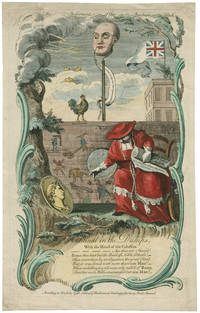
1740WRCAM43159London 1740. Engraving with hand-coloring 14 x 8 3/4 inches. Minor soiling. Color quite bright and fresh. Very good. A satire against French Cardinal Fleury Chief Minister to Louis XV published during the frenzy of celebrations over Admiral Vernon's victory over the Spanish at the Battle of Porto Bello - an enthusiasm which the Cardinal apparently did not share. Fleury was an ally of Robert Walpole whose power was in decline and had reluctantly agreed to hostilities with Spain. Fleury is seen here seated reaching out toward a medallion of Admiral Vernon and holding a scroll which reads "His iron will get ye better of my gold" and "G-d he'll take all our acquisitions in America." On the wall behind him are several small crude illustrations one of which appears to be a portly Walpole hanging from a gallows above the slogan "No matter if he is longer than ye gallows." A head sits atop a pole perhaps alluding to the fact that many people would be pleased to see Walpole's head positioned thus. Engraved by George Bickham. Only one copy located in OCLC at Northwestern University. BRITISH LIBRARY CATALOG 2454. OCLC 43946235. unknown books
1718106614<p>Folio newspaper extracted illustrated 369=384 pp. Disbound some pages separated double page illustration torn and separated a bit at the center with some loss normal aging; otherwise about good. This issue features Secretary of State William H. Seward on the cover. This issue contains a short article on the capture of Jefferson Davis. Also double page panoramic view of Richmond based on a photograph of Alexander Gardner. Included is an almost full-page picture of Major General William T. Sherman.</p> Harper's books
1718101905Letter sheet 8x10 4 pages 3 1/2 pages of text. Some very minor bends at edges a couple of very minor nicks creased a little slight aging and browning; otherwise in really nice condition. This highly legible letter to a father from his son talks about more than the "usual" life in an army camp. There are certainly routine matters covered like receiving letters from family members and requests for money but he also talks about his legal misfortunes. While it is unclear what issues are involved it is clear he has some military legal problems which he hopes to resolve by the time his regiment is 'mustered." The letter makes it sound like it is something important and probably related to his military standing. His father appears to suggest that he should take his case to Washington but the son decides to wait it out. The son Jon indicates that while he feels badly over his misfortunes he really feels badly for his friends and relatives. This suggests along with a comment about handling the impact on public opinion that this case was a visible one. He also complains about the cost of living in the South which he says is twice what it is in the North and indicates he pays $10 per week for boarding. That would seem to be very high when measured at a soldier's pay during this period. He does throw in a couple of comments about the war including that "Sherman too is still in successful pursuit." he also states that nothing is heard from General Smith "but his safety and success is a thing assured." books
17181019044 page lettersheet 9 3/4x 8 1 1/2 pages of text with docketing and commentary by several officials on the 4th page. Some soiling and aging to the last page a little toning; otherwise very good or better. The letter from Woods attempts to resolve what must have been a common problem in the Union Army during the Civil War which was the red tape involved in battle field promotions. Woods 'was mustered into the Service of the United Sates as an enlisted man. on the 29th day of July 1861 at Washington City D.C. by Lieut. Jno. Elwood. On the 14 day of Decbr. I was promoted to the 2nd Lieutenancy in said Co. vice Lieutenant Donaldson died May 15th 1862 but did not receive my Commission as such until 5th day pf March 1863 since which time I have actually performing the duty of 2nd Lieut. in said company and as such I have been on the muster and pay rolls for March and April. I would respectfully ask the Order mustering me out as an enlisted man being 2nd Serge. of said Company when I received my commission and ordering my muster in as 2nd Lieut. to date from March 5 1863. I have made efforts to be mustered but without success. " Perhaps even more interesting are the comments by several officials on the forth page trying to cut through the 'red tape'. books
176337559London: Robert Sayer 1763. Engraved map on four joined sheets hand coloured sectioned and linen backed at a contemporary date. Overall sheet size: 42 1/8 x 47 3/8 inches. Housed in a tan cloth box. An early issue of Bowen and Gibson's impressive wall map of North America: the first issue following the end of the French and Indian War.<br/> <br/>Bowen and Gibson's map was first issued in about 1755 under the title An Accurate Map of North America. It was reprinted and served as a template for the enormous political changes of the next forty years attesting to its importance. Aside from its stunning visual impact Bowen and Gibson's map teems with information including numerous Native American placenames in the western areas native tribal regions notes and routes of early roads and the forts along the Mississippi and to the west of the Appalachians. The two insets are of Baffin and Hudson's Bays and the mouth of the Colorado River the latter map based on the explorations of Eusebio Kino. The roccoco cartouche is particularly attractive and features a Native American couple with their small child and a group of indigenous animals: beaver alligator parrot and the skin of a mountain lion. The present issue was the first to the published following the French and Indian War and includes the boundaries as reflected by the Treaty of Paris of 1763.<br/> <br/>Stevens & Tree "Comparative Cartography" 49b in Tooley The Mapping of America; Degrees of Latitude 36; Phillips A List of Maps of America p. 589. Robert Sayer unknown books
175623894London: Printed for M. Cooper at the Globe 1756. Small octavo. 7 1/4 x 4 1/2 inches. 100pp. Blindstamp to title and G4 library ink stamp to the verso of the title and p. 48. 20th-century half calf over marbled paper-covered boards rubbed marks from old library label on upper cover.<br/> <br/>The first edition of a scarce but important critical commentary on the British government's handling of the French and Indian war.<br/> <br/>This work relates "to the inefficient conduct of the ministry in the disputes with France especially in America on the Ohio and elsewhere under Washington Braddock etc. For this and later publications Shebbeare was fined and put in the pillory. A change of government brought him a change of sentiment and a pension" Sabin.<br/> <br/>Howes S366; Sabin 80038; ESTC T75830. Printed for M. Cooper, at the Globe unknown books
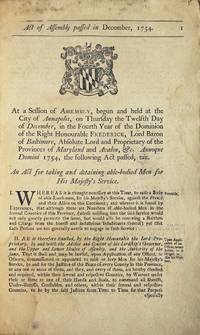
1755319725Annapolis: Jonas Green 1755. 2pp. Bound with: Acts of the province of Maryland made and passed at a session of Assembly begun and held at the city of Annapolis on Saturday the twenty-second day of February in the fourth year of the dominion of the Right Honourable Frederick Lord Baron of Baltimore absolute lord and proprietary of the provinces of Maryland and Avalon &c. Annoque Domini 1755. Published by authority. 8pp. Folio. Period wrappers restitched some losses to the blue sugar paper old repairs at head of each leaf with minor losses old dampstaining. 2pp. Bound with: Acts of the province of Maryland made and passed at a session of Assembly begun and held at the city of Annapolis on Saturday the twenty-second day of February in the fourth year of the dominion of the Right Honourable Frederick Lord Baron of Baltimore absolute lord and proprietary of the provinces of Maryland and Avalon &c. Annoque Domini 1755. Published by authority. 8pp. Folio. Recruiting for Braddock's Campaign. Passed in December 1754 "to raise a Body of able Land-men for his Majesty's Service against the French and their Allies on this Continent" this separately-printed session law essentially authorizes a draft system for forcing "all and every able-bodied Freeman who live idle and do not follow or exercise some lawful Calling" to be enlisted as soldiers. Given the timing it is believed that the troops being raised were intended for service on the Braddock expedition against Fort Duquesne.<br/><br/>Bound together with the above is a second session printing of Maryland laws including acts relating to the French and Indian War: "An Act to Prevent the People of this Province from Supplying the French or their Indian Allies with Ammunition Warlike Stores or Provisions of any Kind" and "An Act for Regulating the Rates of Carriage and Quartering Soldiers in Public Houses within this Province for His Majesty's Service." Also included are acts on currency courts and tobacco.<br/><br/>Both session printings are rare with ESTC recording only five copies in four institutions and eight copies in six institutions respectively. Bristol B1727 and Evans 7458; Wroth 179 and 180; ESTC W33246 and W7078 Jonas Green unknown books
175723896London: Printed for J. Morgan 1757. Octavo. 7 3/4 x 4 5/8 inches. 4 99 1pp. Half-title errata on verso 1p. publisher's advertisements at back. Blindstamp to title H1 and H2 library number stamp at the foot of the verso of the title and at foot of p. 48. 20th-century half calf over marbled paper-covered boards joints rubbed.<br/> <br/>First edition of the fifth in a series by Tory political satirist and pamphleteer John Shebbeare.<br/> <br/>Here Shebbeare attacks the ministry of the Duke of Newcastle and the unfair influence exercised by George III's Hanoverian interests on policy. There are also references to Admiral Byng and problems in North America with the French. The first five letters were published between 1755 and 1757 and together they constituted a bold attack on the government and its handling of home and international affairs. Near the end of 1757 after Pitt's dismissal Shebbeare published his Sixth Letter and finally went too far: in the following year he was tried for libel fined pilloried and imprisoned and his final Seventh letter London: 1758 was seized and suppressed.<br/> <br/>Kress 5647; Sabin 80044; ESTC 35524. Printed for J. Morgan unknown books
1760WRCAM35262London: A. Millar 1760. 456pp. Dbd. Very good. Lacks half title. Second printing of the first edition. The ascription of authorship to John Douglas is suggested by Halkett & Laing; William Pulteney has also been a candidate. An appeal to William Pitt and the Duke of Newcastle that the process of making peace with France must include France's relinquishing all of Canada Guadeloupe and Senegal. This work is important for having elicited Franklin's noteworthy THE INTEREST OF GREAT BRITAIN CONSIDERED WITH REGARD TO HER COLONIES. This second printing includes an erratum on the final page below "FINIS." HOWES L276. SABIN 20684 second ed. TPL 314 first issue. A. Millar unknown books
1760WRCAM221London: A. Millar 1760. 56pp. Half title. Later paper wrappers. Very good. The ascription of authorship to John Douglas is suggested by Halkett & Laing; William Pulteney has also been a candidate. An appeal to William Pitt and the Duke of Newcastle that the process of making peace with France must include France's relinquishing all of Canada Guadeloupe and Senegal. The issue is important for having elicited Franklin's noteworthy THE INTEREST OF GREAT BRITAIN CONSIDERED WITH REGARD TO HER COLONIES. TPL 315. JCB 1III:1264. A. Millar unknown books
175738668Newtown NJ 1757. 1p. Signed by Henry Simson Joseph Byram John Anderson Thomas Woolverton and Joseph Parry. The French and Indian War on the New Jersey "Front Tears."<br/> <br/>In the wake of Braddock's defeat with tensions with the Delaware Valley Indian tribes rising and with a perceived threat that the tribes of the Delaware Valley would invade into New Jersey at the end of November 1755 Governor Belcher detached hundreds of West New Jersey troops to the New Jersey/Pennsylvania border and into Pennsylvania many under the command of Colonel Abraham van Campen. The present document concerns the death of a resident of Sussex County who evidently travelled with Van Campen and Colonel Jacob Ford to the "front tears" to "parley or hold a treaty with the Indians there" but "hath never returned & by report was near about that time killed." The document advocates for his bereaved wife and suggests that his eldest son be appointed heir and estate administrator. Another copy of this document addressed to "Your Honour" appears in the Documents Relating to the Colonial History of the State of New Jersey first series vol. xxxii p. 326. unknown books
175736652Paris: Imprimerie Royale 1757. 4 volumes quarto. 10 x 7 1/2 inches. Woodcut head- and tailpieces. viii lxxv 1 1811 61 1cvii120; xiii 1 646; xvi319 1; 6 xxv 1 654pp. 2 engraved folding maps. Contemporary mottled calf gilt with arms of the duke of Sutherland on upper covers spine gilt in compartments with fleurs-de-lys and crowned L monogram red morocco lettering-pieces red speckled edges<br/> <br/>Provenance: George Granville Leveson-Gower Duke of Sutherland and Marquis of Stafford gilt arms on binding armorial bookplate<br/> <br/>Critical work on the French and Indian War particularly respecting Canada: with the very rare fourth volume seldom found with the set.<br/> <br/>A valuable collection of historical documents and official papers setting forth the opposing claims of France and England to North American territories. This is the most important contemporary source for the origins of the Seven Years' War. The commissioners William Shirley governor of Massachusetts Sir William Mildmay representing Great Britain and the Marquis de la Galissonière and E. de Silhouette acting on behalf of France were appointed after the Treaty of Aix-La-Chapelle in 1748 to reach an agreement regarding the definition of the exact geographical boundaries of Acadia ceded by France to Great Britain by the Treaty of Utrecht in 1713 under the vague definition of "its ancient limits." The documents and papers contained herein provide a significant historical record of Acadia with a discussion of the first permanent settlement in Canada early trading companies and subsequent occupation of the country. Of particular and great importance is the continual discussion of the early maps explorers and geographers of America. Besides the Acadian question the third and fourth volumes contain considerable material on disputes over St. Lucia and Tobago in the West Indies. The fourth volume issued two years after the other three volumes is quite rare and seldom found with the set although is present here.<br/> <br/>Howes M508; TPL 235; Lande 148; Vlach 350; COX II p.120; Sabin 47547 incorrectly calling for 3 maps; JCB I:1074. Imprimerie Royale unknown books
1760WRCAM35264London: R. and J. Dodsley 1760. 64pp. Half title. Dbd. Very good. Second edition issued the same year as the first but with different pagination. "It relates chiefly to affairs in America and the aggressions of the French. The 'Two Great Men' were William Pitt and the Duke of Newcastle." - Sabin. Authorship of this work has been attributed to both Charles Townshend and William Burke. GOLDSMITHS 9634. HOWES T321. SABIN 69470. R. and J. Dodsley unknown books
1760WRCAM35266London: R. Griffiths 1760. 456pp. Half title. Dbd. Early ink inscription on half title. Outer leaves a bit tanned otherwise very good. This work was written in response to Mauduit's CONSIDERATIONS. which argued that Britain should further her war against France in North America and the East Indies while abandoning the war in Continental Europe. The present pamphlet argues that it is impossible for a large commercial nation such as Britain to ignore events in Europe. The author maintains that further attempts at colonial expansion would antagonize other nations especially France. SABIN 15208. R. Griffiths unknown books
1756WRCAM35228London: Printed for S. Bladon 1756. 68pp. Dbd. Very good. "Remonstrance addressed to London merchants against imprisoning of British traders on the Ohio" - Howes. We believe this to be the first edition first issue differentiated by having the price "one-shilling" printed on the bottom of the titlepage. The second issue is from the same setting of type but with "Second edition" on the titlepage. Bladon also published a forty-two-page edition priced six-pence. Such compact cheaper editions are almost invariably later ones. HOWES C668 "aa." SABIN 15207. KRESS 5501. THOMSON 265. Printed for S. Bladon unknown books
176136901London: Chez D. Wilson T. Beckett & P. A. DeHondt 1761. First English edition. Pp. 2 60. Wanting half-title. 1 vols. 4to. Calf-backed marbled boards spine lettered in gilt. Some rubbing stitchmarks some light discoloration. Ink notation concerning first edition on title else very good. Provenance: John Carter Brown armorial bookplate with deaccessioned stamp on the bookplate and ink stamp on verso of title. First English edition. Pp. 2 60. Wanting half-title. 1 vols. 4to. Choiseul's narrative and commentary with the state diplomatic correspondence and papers relating to the treaty of 1762 dealing primarily with the areas of the cession of Canada the fisheries of Newfoundland Cape Breton and the West Indies and the limitation of Louisiana. Sometimes attributed to Jean François de Bastide. The London edition is considerably more scarce than the French first edition published the same year. Goldsmith's Kress 9718; Sabin 47516; Howes M-507 Chez D. Wilson, T. Beckett & P. A. DeHondt unknown books
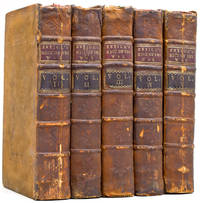
1766237662London: Edward and Charles Dilly 1766. Third edition revised and corrected of vols.I-III; second edition of vols. IV & V. With 41 portraits and 8 folding maps. iv 495; 464; 480; 470 26 Index pp. 5 vols. 8vo. Bound in contemporary panelled reversed calf boards tooled in blind leather title labels. Extremities worn joints rubbed front hinge of volume I detached and front endpaper laid in. Very good. Text clean. Bookplate. Third edition revised and corrected of vols.I-III; second edition of vols. IV & V. With 41 portraits and 8 folding maps. iv 495; 464; 480; 470 26 Index pp. 5 vols. 8vo. History of the French and Indian War drawn largely from primary source material and with much pertaining to the war in North America and the West Indies. Entick 1703-1773 was a prominent lexicographer and historian. Howes E165a; Sabin 22667 Edward and Charles Dilly unknown books
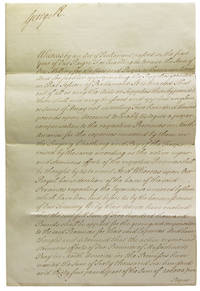
1761319882Great Britain 1761. 2pp. plus integral blank. Docketed on verso "King's Warrant / Province of Massachusetts / Bay £60634 in part / of £200000 Granted for / the North American / Provinces." Signed by George III at the head of the first page countersigned on the second page by William Wildman Barrington James Oswald and Gilbert Elliot. Folio 14 1/4 x 9 1/2 inches. Usual folds. 2pp. plus integral blank. Docketed on verso "King's Warrant / Province of Massachusetts / Bay £60634 in part / of £200000 Granted for / the North American / Provinces." Signed by George III at the head of the first page countersigned on the second page by William Wildman Barrington James Oswald and Gilbert Elliot. Folio 14 1/4 x 9 1/2 inches. Towards the end of the French and Indian War William Pitt started a specie grant program to reward colonies for raising troops thus putting the colonies in competition with each other for a share of an annual 200000 pounds. With specie scarce in the colonies the colonial assemblies were thus incentivized to raise troops to fight against the French. The present document authorizes Henry Fox to make payment to Massachusetts via their colonial agent William Bollan for their share of the annual grant. Although successful the policy was abandoned in favor of direct taxation after 1762 leading to the Sugar Act and most notably the Stamp Act. <br/><br/>This undated document -- the space for the date being left blank suggesting it to possibly be a draft -- is countersigned by William Wildman Barrington Chancellor of the Exchequer 21 March 1761 to 8 May 1762; Sir Gilbert Elliot third Baron Minto Lord of the Treasury 1761-62 and James Oswald Commissioner of the Treasury 1759-63. The date would therefore appear to be 1761 or early in 1762.<br/><br/>George III documents relating to North America from the early years of his reign are particularly scarce. unknown books
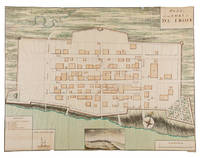
1761WRCAM56427Albany 1761. Manuscript plan in pen and ink with watercolor on four conjoined sheets of paper 21 1/2 x 28 1/2 inches signed at lower right "W.B. Albany Augt. 18th 1761." Old folds minor edge wear light soiling a few unobtrusive minor repairs to verso. Very good. A beautifully-rendered pen ink and watercolor plan of Fort Detroit executed by noted cartographer William Brasier for his commander General Jeffrey Amherst in Albany in 1761. It depicts Fort Detroit just months after it was ceded from New France to Great Britain and very much as it would look for the next four years. This version of Detroit would hold strong against Pontiac and his warriors throughout their barrage in the summer of 1763. <br> <br> William Brasier produced this plan after an original drawn the year before by Lieutenant Diedrich Brehm which was also presented to Amherst some months earlier in February 1761. Brehm had accompanied Robert Rogers from Detroit to New York in late 1760 and early 1761 and arrived at Amherst's command in New York with his plan of Detroit in tow. It is here in Albany where Brasier used Brehm's plan to create the present depiction. <br> <br> Like Brehm's plan Brasier's version presents Fort Detroit as a long roughly rectangular-shaped settlement populated with about seventy mostly-unidentified buildings colored in light red-brown. The names of north and south streets are labeled according to their orientation; this was just the second time the first being on Brehm's map that these streets were identified in print. The fort is shown just off the banks of what is now the Detroit River; a handwritten notation in the water reads "The Streight is about 900 Yards wide here." <br> <br> Brasier includes a "Reference" key at bottom left which identifies six of the buildings and other locations on the plan namely the "King's Powder Magazine" the powder magazine belonging to the inhabitants of the fort the block-houses "The Cavalier" the church and the "Commandant's Garden." This is down from nine locations in a similar key on Brehm's plan. Brasier's plan of Detroit was featured in Brian Leigh Dunnigan's FRONTIER METROPOLIS: PICTURING EARLY DETROIT 1701- 1838 and Dunnigan illuminates the reasoning behind Brasier's elimination of some of these locations: <br> <br> "Brasier's title 'Plan of the Fort at De Troit' does not reveal why it was drawn but the work is not an exact copy of Brehm's original. The differences lie in the west end of the town where all of the buildings shown by Brehm along both sides of the 'Rue neueve St. Germain' have been deleted. These stood within the space gained when Captain Belestre enlarged the stockade during 1758- 59 and it is likely that Brasier's copy relates to the controversy over ownership of those properties. At least twelve grants were made within the town by Captain Belestre during 1758-59 and most were in the area of expansion at the western end of the stockade. Before it had been incorporated into the town however that land was part of the Domain surrounding the fort and was thus the property of the French king. British officers questioned whether Captain Belestre had the authority to grant lots there to individuals. If not the land was rightly the property of King George III." <br> <br> Brasier also followed Brehm by including a "Profil sic of the Stockade" and an elevated depiction of the fort titled "View from the West." The stockade profile is a detailed depiction of the construction of Detroit's main defensive apparatus. The view of the city is considered the "first look at the town of Detroit in other than a ground plan or a map" according to Dunnigan. The perspective of this view was intended to be that of Rogers' troops as they faced the main gate upon arrival at the fort. The tops of many of the buildings including Belestre's own house peek over the tops of the surrounding stockade. The view also makes clear the reality of the uneven ground upon which Fort Detroit was built; the ground swells from left to right to about the middle of the fort then pitches downward again towards the river at right before plunging down to the river banks just outside the stockade walls. <br> <br> William Furness Brasier 1689-1775 was a draftsman in the engineer's office of General Amherst's command post at the time he executed the present plan of Fort Detroit. He was also a prolific and exacting cartographer who produced well-regarded maps of Lake Champlain the upper Hudson River valley and the Mississippi River as well as impressive plans of Fort Ticonderoga Fort Ontario Fort George Mobile and Pensacola and St. Augustine Florida. <br> <br> The whereabouts of this plan were unknown to Dunnigan at the time he published FRONTIER METROPOLIS. The plan remained in the collection of General Jeffrey Amherst and descended through his family until it was bought by Charles Sessler for H. Richard Dietrich at Sotheby's sale of the Earl of Amherst's collection July 4 1967 lot 494. It has been in the Dietrich American Foundation ever since. Brian Leigh Dunnigan FRONTIER METROPOLIS: PICTURING EARLY DETROIT 1701-1838 Detroit: Wayne State University 2001 p.55 figure 4.5. Sotheby's & Co. CATALOGUE OF AMERICANA VOYAGES AND TRAVEL ATLASES AND MAPS London: Sotheby's July 4 1967 pp.102-03. unknown books
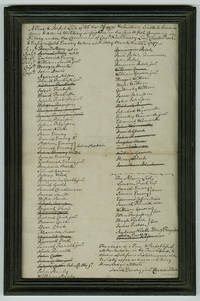
1757WRCAM51214Kittery Me 1757. Broadside 12 x 7 1/2 inches. Old folds mild toning. Very good. In frame. Appears to be docketed on verso but not examined outside frame. A manuscript roll-call for a company of Maine military personnel organized to participate in the French and Indian War. The document lists over seventy names of regulars in two columns plus an additional dozen names under "The Alarm List" essentially a reserve list of soldiers appointed to defend the homefront. Below the Alarm List is the following text: "The above is a True & Perfect list of all the soldiers in the Train'd band & Alarm List from sixteen years old to sixty as far as has come to my knowledge. Attest Daniel Emery jun. Clerk und. Oath." The Emery family supplied seven members of this list of officers and soldiers with others such as the Furbush Ferguson and Wamouth families also providing more than one man for the army. Several names are crossed out about half of which belong to a family supplying more than one member to the list. Most of the men on the Alarm List are also identified by profession such as deacon miller or sailor among others. Such lists of colonial American military personnel for the French and Indian War are exceedingly rare in the market. An important colonial Maine and military document. unknown books
1755WRCAM40157London 1755. 2pp. extracted from an unknown source. Folio. Slight tanning at spine edge old fold lines. Very good. Speech of King George II to Parliament on the eve of the French and Indian War. The speech outlines the steps that have already been taken and the steps that will need to be taken in order to go to war with France in North America. unknown books
1755WRCAM40158London 1755. 2pp. extracted from an unkown source. Folio. Spine edge chipped old fold lines. Good. Parliament's response to King George's speech in November of 1755 on the eve of the French and Indian War. Parliament affirms their unwavering support of the Crown in going to war with France in North America. Followed by George II's brief response of thanks. unknown books
1772269008Venice: Heredis Nicolai Pezzana 1772. First. hardcover. very good. Volumes I & II out of four. Title page vignettes Volume I title in red & black; minor worming & foxing; llibrary mark eradicated from the bottom of each title page. Folio contemporary limp vellum; stained. Venetiis: Heredis Nicolai Pezzana 1772.<br/><br/> First edition of Guerra's edition of the Luxemburg Bullarium one of the most famous editions of papal bulls.<br/><br/> Heredis Nicolai, Pezzana unknown books