57 résultats
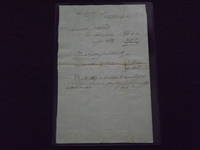
178063128Head Quarters Bergen County NJ 1780. Folio one page approximately 125 words in part: "I perceive . that you had collected about two hundred Cattle more and that a further number might be obtained . I cannot of right command the services of the militia . let the commanding officers know how distressed the Army has been and is likely to be for provisions and that it will be rendering splendid service to us and distressing the enemy to remove the Cattle from those parts of the Coast which furnish the New York Markets." Very good. Browned one small piece detached one word of text easily repaired. After Washington's victory at Monmouth June 1778 during which battle Forman had served as an advisor to Charles Lee the war settled into stalemate with Washington's army in New Jersey and the British forces content to remain in New York both sides keeping an eye on each other while trying to provide for their soldiers the American forces suffering deprivation similar to that of Valley Forge. Meanwhile on the day this letter was written word reached Washington of the complete rout of Horatio Gates and his troops at Camden South Carolina opening Virginia to British invasion from the South. Bolstered by American victories at Kings Mountain Oct. 1780 and Cowpens Jan. 1781 and the depletion of Cornwallis's army at its victory over Nathaniel Green at Guilford Court House Washington in conjunction with his French allies moved south to envelop Yorktown earning the British surrender in October 1781 effectively ending the war. General David Forman 1745-1797 born and raised in Monmouth County New Jersey was appointed colonel of a New Jersey regiment that reinforced Washington at New York in June 1776. After suppressing a loyalist uprising later that year during which time he earned the nickname "Devil David" he was chosen to lead a regiment in the Continental army and in 1777 was commissioned brigadier general to lead the New Jersey militia commanding that force in the battle of Germantown Oct. 1777. Disagreements with the New Jersey legislature led to his resignation from that command and he spent the rest of the war running listening posts especially along the coast of New Jersey providing Washington with intelligence on the movements of the British fleet and army a service he was providing at the time of this letter. see DAB Tench Tilghman 1744-1786 born and raised in Talbot County Maryland graduated from the precursor to the University of Pennsylvania in 1761 taking up a mercantile business until the outbreak of the revolution. After serving briefly as a captain in the army he joined Washington as a volunteer and served continuously as an aide-de-camp to the general for the balance of the war. "The amount of secretarial work in addition to military duties that he performed for Washington was prodigious" DAB and he was granted a regular commission of lieutenant-colonel in 1781. After the victory at Yorktown Tilghman was chosen by Washington to carry the announcement of the surrender of Cornwallis to the Continental Congress. Provenance: When recently purchased the letter was in an old frame and removal revealed an autograph note inside the backing included here as follows: "This letter was bought by me about 1860 of Miss Brown residing at 92 Columbus Street Albany New York. She was a sister of an old minister of St. Peters Church. This Miss Brown was a client of Orlando Meads and myself and found this letter in a barrel in the garret of the home occupied by her sister at Manalapan New Jersey formerly owned by General David Forman. signed Dexter Reynolds / Albany Sept. 7 1902. Presented to my son Marcus T. Reynolds." A newly discovered Washington letter shedding light on the general's relationship to state militias and his concerns for providing for his troops while disrupting the supply lines of the British. Not in Fitzgerald or the Founders Online from the National Archives which lists 57 other Washington letters to Forman 1777-1782 showing a gap from 24 July 1780 to 17 May 1781 and two others post-war. 9836. <br/><br/> unknown books
1740WRCAM35453London: T. Cooper 1740. 460pp. Half title. Dbd. Light stain on half title leaf affecting but not obscuring a handful of letters. Else very good. "Relates largely to affairs with Spain in the West Indies the writer defending the Ministry and the Convention. Probably written by a Ministerial partizan" - Stevens. First of three editions. BELL L321. EUROPEAN AMERICANA 740/185. GOLDSMITHS 7808. SABIN 40399. STEVENS RARE AMERICANA 1926 1521. T. Cooper unknown books
1739WRCAM35446London: T. Cooper 1739. 31pp. Dbd. Very good untrimmed. Second edition. A point-by-point refutation of a recent pamphlet which favored diplomacy to war with regard to recent colonial trade conflicts with Spain. A REPLY. was one of many 1739 pamphlets that reflected and reinforced the British public's outrage at perceived injustices to British seamen by the Spanish in the Caribbean. Prime Minister Walpole bowed to popular sentiment in October and commenced the War of Jenkins' Ear. EUROPEAN AMERICANA 739/248. DE RENNE I p.79. GOLDSMITHS 7685 first ed. SABIN 69687. T. Cooper unknown books
1739WRCAM35449London: T. Cooper 1739. 63pp. Dbd. Very good. A defense of Robert Walpole's international policy leading up to and including the Convention of El Pardo January 1739. Walpole's long diplomatic efforts praised by the anonymous author of this pamphlet would soon prove to have been in vain as the Prime Minister reluctantly declared war on Spain later in the year. The result was the desultory affair known as the War of Jenkins' Ear. Of this pamphlet's two 1739 editions the present one is given priority by EUROPEAN AMERICANA and CATALOGUE OF THE GOLDSMITHS' LIBRARY OF ECONOMIC LITERATURE. EUROPEAN AMERICANA 739/280 GOLDSMITHS 7693. SABIN 79228 another ed. STEVENS RARE AMERICANA 1926 1539. T. Cooper unknown books
1739WRCAM47525London: T. Cooper 1739. 228pp. Lacks half title. Modern tan half morocco and cloth spine gilt. Minor soiling and wear. Very good plus. Letter concerning the secession on March 9 1739 of the "Patriots" from the House of Commons over the negotiations preceding the War of Jenkins' Ear. The Patriots were Tories and disaffected Whigs who opposed Sir Robert Walpole the first Prime Minister. Walpole argued for peace and moderation in dealing with Spain and he was supported by a scant majority. This letter presents the informed view of a member of Parliament displaying the furor in England for the protection of their American trade and decrying the factitious nature of English politics. The secession proved advantageous for Walpole because it allowed him to push through several bills relating to the free exportation of sugar and molasses from the West Indian Colonies. ESTC T138894. GOLDSMITHS 7730. EUROPEAN AMERICANA 739/154. SABIN 34807. T. Cooper hardcover books
1740WRCAM41547London: W. Webb 1740. 428pp. Modern marbled boards gilt leather label on cover. Bookplate of Alberto Parreño on front pastedown. Minor soiling. Very good. A later issue of this edition published shortly after the beginning of the War of Jenkins' Ear. Sir Robert Walpole's lengthy diplomatic efforts eventually came to naught and he bowed to popular sentiment in October of 1839 and commenced the War of Jenkins' Ear. "Includes several references to naval actions & commerce in the West Indies" - EUROPEAN AMERICANA. ESTC calls for an added postscript with this issue though SABIN and EUROPEAN AMERICANA make no such differentiation. Only four copies of this issue located in ESTC. EUROPEAN AMERICANA 740/76. SABIN 15994. ESTC T2956. W. Webb hardcover books
1739WRCAM35447London: T. Cooper 1739. 230pp. Dbd. Very good. Responding specifically to the recently published POPULAR PREJUDICES. Sabin 64143 this pamphlet criticizes the Convention of El Pardo and Prime Minister Walpole's other diplomatic efforts to avoid war with Spain. The House of Commons sided overwhelmingly with the belligerent faction claiming abuses of British seamen and unfair interruption of trade by the Spanish authorities in the Caribbean and pressured Walpole into commencing the War of Jenkins' Ear in October 1739. BELL M373. EUROPEAN AMERICANA 739/199. GOLDSMITHS 7679 another ed. SABIN 49228. T. Cooper unknown books
1739WRCAM41544London: T. Gardner 1739. 256pp. Dbd. very good. A pamphlet published shortly after the beginning of the War of Jenkins' Ear apparently addressed to Sir Robert Walpole. Walpole's lengthy diplomatic efforts eventually came to naught and he bowed to popular sentiment in October and commenced the War of Jenkins' Ear. This work includes numerous references to American commerce. One of two issues noted by ESTC; this issue not in EUROPEAN AMERICANA. ESTC N10777. EUROPEAN AMERICANA 739/210 ref. KRESS 4452. SABIN 56464. T. Gardner unknown books
1739WRCAM35443London: T. Cooper 1739. 30pp. Dbd. Very good. From the heated pamphlet controversy in Great Britain between supporters and opponents of war with Spain in the late 1730's. The author of the present volume supports the 1739 Pardo Convention and further diplomatic efforts between the two colonial powers taking aim at the arguments of a recent pro- war pamphlet. The War of Jenkins' Ear was nevertheless declared a few months later. First of three editions. EUROPEAN AMERICANA 739/231. GOLDSMITHS 7680. KRESS 4457. SABIN 64143. STEVENS RARE AMERICANA 1926 1534. T. Cooper unknown books
1739WRCAM35444London: T. Cooper 1739. 30pp. Dbd. Very good untrimmed. Second edition. Part of the heated pamphlet controversy in Great Britain between supporters and opponents of war with Spain in the late 1730s. The author of the present volume supports the 1739 Pardo Convention and further diplomatic efforts between the two colonial powers taking aim at the arguments of a recent pro-war pamphlet. The War of Jenkins' Ear was nevertheless declared a few months later. EUROPEAN AMERICANA 739/232. GOLDSMITHS 7680 first ed. SABIN 64143. STEVENS RARE AMERICANA 1926 1534 first ed. T. Cooper unknown books
1798WRCAM16809Washington 1798. 360pp. Gathered signatures stitched. Minute foxing in end leaves. Internally bright and clean. Near fine untrimmed and unopened. A report on the salaries and duties of the clerks under the secretary of war including the names of clerks salary distribution and explanation of their various tasks. EVANS 34764. unknown books
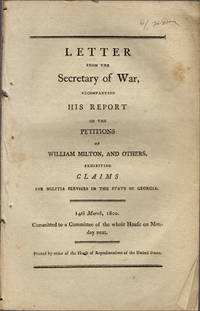
180012055Philadelphia: no publisher/printer 1800. Small 8vo. 41 3 blank pp. <br><br>Concerns service in Georgia during the period 1790-94 in the wars with the Creek and Cherokee Indians. Gives an excellent review of the events and personalities. <br>Â Â Â Â <br>Â Â Â Â Evans 38774; Eberstadt Cat. 114 item 326. Removed from a nonce volume. Very good condition. no publisher/printer unknown books
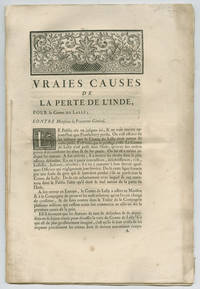
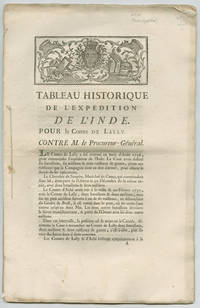
1766WRCAM47802Paris 1766. 2220pp. plus large folding map. Large folio. Stitched. Minor soiling and foxing. Very good. Defense of the Comte de Lally for his actions in India during the Seven Years' War. This is one of two versions authored by him. Lally head of the French expedition to India reached Pondichery in 1758. Though capable he was incredibly unpopular and fell into a series of events which proved fatal to his career and his person. He was unsuccessful in the Siege of Madras beaten at the Battle of Wandiwash and eventually capitulated from the siege of Pondichery. Taken prisoner by the British he returned to France on parole and was imprisoned for two years before being put on trial and executed. This is his last defence published shortly thereafter or perhaps immediately preceding. A publisher's note is dated April 14 and Lally was executed May 6. The map shows the Indian subcontinent and Madagascar. unknown books
1766WRCAM47801Paris 1766. 51pp. Large folio. Stitched. Minor soiling and foxing. Very good. Defense of the Comte de Lally for his actions in India during the Seven Years' War. This is one of two versions authored by him. Lally head of the French expedition to India reached Pondichery in 1758. Though capable he was extremely unpopular and fell into a series of events which proved fatal to his career and his person. He was unsuccessful in the Siege of Madras and beaten at the Battle of Wandiwash and eventually capitulated from the siege of Pondichery. Taken prisoner by the British he returned to France on parole and was imprisoned for two years before being put on trial and executed. This is his last defence published shortly thereafter or perhaps immediately preceding a publisher's note is dated April 14 and Lally was executed May 6. unknown books
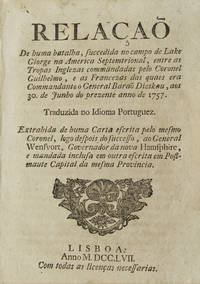
1757303318Lisboa: Domingos Rodrigues 1757. First edition. Woodcut vignette to title-page. 7 blank pp. Small 4to. A very good copy some very faint dampstaining. First edition. Woodcut vignette to title-page. 7 blank pp. Small 4to. THE BATTLE OF LAKE GEORGE. A Portuguese translation of General William Johnson's "Letter to the Governours of the Several Colonies who raised Troops on the Present Expedition" signed in the text "Wilhelmo Gonson." <br/><br/>Not long after the commencement of the Seven Years' War Johnson was appointed British agent to the Iroquois. On 28 August 1755 he renamed Lac Saint Sacrement Lake George in honor of the British monarch and proceeded north as part of a four-pronged attack on the French specifically to capture the French-held Fort St. Frédéric at Crown Point. <br/><br/>"It was not the greatest battle of the French and Indian War but it came when a victory was needed and the results were momentous. It retrieved both the glory and morale so badly depleted when Braddock fell at the forks of the Ohio the previous July. It blunted a French drive which menaced Albany and the northern frontier set up a new English outpost in that area and the capture of a distinguished French general Dieskau was triumph for the victors and humiliation for the enemy" Hamilton.<br/><br/>The publication of this letter was of course a remarkable source of propaganda for the English and boosted Johnson's career signficantly. The letter was reprinted in London an engraved plan of the battle was produced as well as portrait. This Lisbon printing is however very rare and little known. It's not in COPAC there wasn't a copy in the Streeter Sale. In fact the last copy on the market we can find was in 1928. Not in Church; Sabin 38661; Maggs "Biblioteca Americana" IV 2998; Milton W. Hamilton "Battle Report: Genreal William Johnson's Letter to the Governors Lake George September 9-10 1755" in Proceedings of the American Antiquarian Society April 1964 pp 19-36 [Domingos Rodrigues] unknown books
17629044Lisboa i.e. Lisbon 1762. 4to 20 cm 8". 1 f. 55 1 blank 8 6 6 4 3 1 blank 3 1 blank 3 1 blank pp. <br><br>During the Seven Years War Portugal gave support to her traditional ally Great Britain especially the use of her ports and with the entry of Spain into the war the Spanish tried to put a stop to it. First they tried diplomacy and when that failed they invaded their neighbor as is here documented. They were beaten off by the Portuguese with British assistance thus reinforcing Portuguese distrust of their Castilian neighbors and their close ties with Great Britain. <br>Â Â Â Â <br>Â Â Â Â Palau 307020. Wrappers stencilled in green with manuscript title on paper label affixed to front wrapper; all edges speckled red. Wrappers with a few tears and a little tattering. Small wormhole in front fly-leaf. A few pencil marks. Inked number on verso of front fly-leaf. unknown books
179720431Philadelphia: Printed by William Ross 1797. 8vo. 8pp. Loose gathering uncut. Leaves splitting on folds loosening. Some edge chipping and dusting. Good. <br/>Evans 33095. NAIP w025330. Printed by William Ross? unknown books
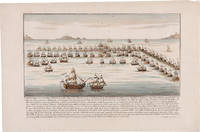
1782WRCAM56168Augsburg 1782. Handcolored engraving 11 1/2 x 17 3/4 inches. Some light soiling and tanning. Near fine. Matted. An attractive and well-preserved contemporary print by German engraver Johann Martin Will with delicate hand-coloring depicting the British and French fleets in combat formation during the Battle of the Saintes also known as the Battle of Dominica/Bataille de la Dominique. Britain's victory over the French navy in April 1782 effectively ended French control of the Caribbean. The engraving depicts over eighty ships which are keyed for identification in captions in German below the image. The upper middle ground depicts Rodney's flag ship "Formidable" and two supporting vessels attacking and breaking the French line. Among the many other ships identified are the flagship of the French admiral Comte de Grasse's "Ville de Paris" here identified as "Stadt Paris" as well as Sir Francis Samuel Drake's division Admiral Samuel Hood's division and the Prince George which according to this account broke its main mast while breaking the line. Also depicted is the French fleet's attempt to reestablish the line in which they have little luck as ships were already starting to flee. <br> <br> The battle was named after the Saintes a group of islands between Guadeloupe and Dominica in the West Indies. The year before the French fleet under de Grasse had decisively defeated the British fleet in the Battle of the Chesapeake and then blockaded the coast until Cornwallis surrendered at Yorktown helping to secure American victory in the Revolution. This time the British fleet soundly defeated the French capturing the flagship and de Grasse the first French admiral in history to be captured by an enemy and inflicting significant causalities. This emboldened the British in the ongoing negotiations with the Americans and French as well as in ongoing conflicts with Spain. The French-American alliance effectively dissolved and Britain reaffirmed its claims on the Newfoundland fisheries and Canada. Further the French and Spanish abandoned their planned invasion of Jamaica focusing instead on protecting their existing holdings. <br> <br> Johann Martin Will 1727-1806 was a prominent engraver and publisher in Augsburg who specialized in producing images for the British and American markets. A most uncommon image of an important naval battle in the West Indies. unknown books
1791104028<p>A one page partially printed and manuscript folio sheet 13" x 8 1/4" considerable manuscript text on the reverse. Some browning and aging a few tiny chips or holes at folds top edge with a couple of nicks; otherwise very good. This document basically transfers pay owed to William Champlin of Rensselaer County New York who served under Colonel Robert Elliot to a Samuel Dorrance of Providence Rhode Island. Champlin appears to appoint Dorrance as his substitute to collect the balance of fourteen pounds fifteen shillings and five pence. The document is signed by various others. There is a fair amount of manuscript text on the reverse which appears to transfer the debt to at least one additional person. Â Provenance: The Calvin Otto Collection. </p> books
1781104027<p>One page folio sheet 15" x 9" docketed about ten short lines of text. Some aging and browning folds; otherwise very good or better. This is a manuscript document for payment to the Wethersfield Connecticut Selectmen for payment for clothing and the transportation of clothing and some other items to the Continental Army dated "March 5th 1781." The amount of the request is two hundred ninety-two pounds eighteen shillings and five pence. The document is signed by George Stanley and is docketed on the reverse as paid signed by a S. Hubbard. Provenance: The Calvin Otto Collection. </p> books
17861008004 page letter sheet I pp of text 13 lines of test signed and mailed remnant of wax seal labeled duplicate docketed on last page. Legible probably a second copy made for legal purposes signed by author some wear at folds and some staining second sheet split and cracked a bit but text page in very good condition. Interesting letter that appears to have the wrong date on the front page. What appears to be January 20 1706 should read January 20 1786 according to the docketted date on the last page. The letter is written by Stephen Lush 1753-1825 to Jellis Jacob Fonda 1751-1839. It relates to taxes on land in New York owned jointly by Lush and Fonda. John Lansing an attorney and former delegate to the Constitutional Convention seems to have resquested the payment of one shilling per acre on the 40000 of acres they own jointly. Provides some interesting content on land taxation for the period. Lush practiced law in Albany until the War for Independence; he was commissioned a captain and saw action in New York City but was captured by the British. Major Fonda was considered one of the first patriots of Schenectady and after Lexington he formed a company of Minutemen. He fought in the Campaign against Burgoyne and at the Battle of Bemis Heights. Fonda organization website. ny education government website. books
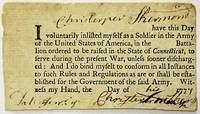
177734560Hartford 1777. Small printed broadside oblong 4" x 2-3/4". "Christopher Sherman" is inserted in manuscript as the name of the volunteer. An "X" for "his mark" is in ink at the end over an attempt to sign his name. For the year "177" is in type and the final "7" in manuscript. "Date" at the bottom is in manuscript along with the month probably "janry". Outer margin closely trimmed but text unaffected. Very Good. <br/><br/> An unrecorded form of Revolutionary War enlistment engagement exceedingly interesting for its reference to "the United States of America." Recorded enlistment engagements from this era-- all of them rare-- refer to the "United Colonies of America" "America" the "Colony of Massachusetts" the "Colony of Massachusetts-Bay". We have handled an unrecorded Massachusetts enlistment engagement from this period which refers to the "United States of America." Enlistment engagements from Connecticut referring to the "United States of America" from this era are unrecorded.<br/> The Continental Congress renamed the Nation "United States of America" on September 9 1776 ordering that "In all continental commissions and other instruments where heretofore the words 'United Colonies' have been used the stile be altered for the future to the 'United States'."<br/> Christopher Sherman was a Private under Captain William Richard's Company in the First Regiment of the State of Connecticut commanded by Lieut. Col. Samuel Prentice Esq. in 1777. A manuscript notation on the payroll sheet for the period January to June 1777 states that he deserted on January 10th or 18th. Revolutionary War Rolls 1775-1783; National Archives Microfilm Publication M246 138 rolls; War Department Collection of Revolutionary War Records Record Group 93; National Archives Washington. D.C. accessed at Ancestry website. <br/>Not located on NAIP ESTC OCLC as of November 2020. unknown books
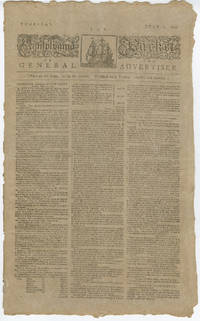
177921556.07Philadelphia PA 1779. No binding. Fine. Pennsylvania Packet or General Advertiser. Newspaper. Pennsylvania Packet or General Advertiser. John Dunlap Philadelphia Pa. July 1 1779. 4 pp. 10 1/2 x 17 untrimmed. Page 1-2 leads with extracts from the Journals of Congress regarding Indian Affairs and New Hampshire land disputes. Extensive content on the Revolutionary War medical department including a lengthy serialized ""Doctor Morgan's Vindication"" regarding the Continental Congress's dismissal of Dr. John Morgan who had great success managing military hospitals for Washington's Army without cause or explanation. Here he obtains testimony from General Nathanael Greene and even Washington himself to defend his reputation.Page 3 reports war news from Pennsylvania as well as a June 29 1779 act of the Continental Congress borrowing $20 million to maintain fiscal solvency.Page 4 includes advertisements for runaway slaves book auctions and stolen horses.Excerpt ""IN CONGRESS June 29 1779.AS Congress are bound by every motive of policy and of public & private justice to maintain the credit of the paper money emitted by their authority on the faith of the United States; so it is their intention not only to avoid further emissions but to diminish the quantity in circulation provided that the respective States by correspondent and vigorous exertions shall put it in their power to raise the necessary supplies.Resolved therefore That twenty millions of Dollars or such a part thereof as shall be brought into the Continental Loan-Offices on or before the first day of October next be borrowed on the faith of the United States at an interest of six per cent. per annum.For facilitating the said Loan Resolved1. That the Loan-Officers in every state do immediately open subscriptions for the said Loan. 2. That the executive authorities of the several states be requested immediately to appoint persons of character and influence in every county town or district to receive subscriptions and transmit the same to the Loan-Officer or Officers in the states respectively. 3. That no subscription be received for less then five hundred dollars. 4. That all subscriptions under ten thousand dollars shall be paid into the Loan-Office where the same shall be subscribed or into the Hands of the person obtaining the subscription within fourteen days after the subscription shall be made. 5. That any person subscribing ten thousand dollars or upwards shall be allowed to pay the same at two periods to wit one half within fourteen days after the subscription the residue on or before the first day of October next; the whole to bear interest from the time of the first payment provided the other payment shall be punctually made. 6. That each lender shall have his election either to receive the principal at the expiration of three years from the date of the Loan or to continue it in the funds on interest until the whole amount of Continental bills in circulation shall not exceed the sum in circulation at the time of the Loan. 7. That interest on all sums which shall be paid into the Loan-Office before the said first day of October or which shall be subscribed and paid agreeably to the terms of the 5th resolution aforesaid shall be payable annually at the Continental Loan-Office of the State in which the money was originally subscribed. 8. That when the interest on Monies which have been or may be placed in the several Loan-Offices on or after the first day of March 1778 shall become due and be paid the same until some more accurate standard of value can be devised shall be increased in proportion to the increase of the sum of Continental paper money which may be in circulation after the date of such Loans respectively.Extract from the MinutesCHARLES THOMSON Sec'ry."" unknown books
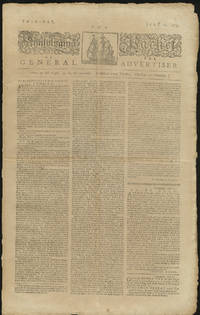
177921556.04Philadelphia PA 1779. No binding. Fine. The Pennsylvania Packet or the General Advertiser. Newspaper. The Pennsylvania Packet or the General Advertiser John Dunlap: Philadelphia Pa. July 15 1779. 4 pp. 10 1/2 x 16 1/2 in. untrimmed. The front page prints a lengthy letter from ""A Farmer of Virginia"" on inflation taxation and monetary policy. Excerpts""There are three principal causes of the depreciation of our paper-currency. First the great quantity in circulation. Second the want of confidence in the will and ability of the States to redeem it by taxes and specie. Third the deranged State of the public business and the want of effectual laws for regulating the conduct of an bringing to account all such as are employed in the service of the public.I shall endeavor to shew by what methods the quantity in circulation may be lessened and the value restored without violating the public faith or oppressing the citizens of these United States. The paper-money of these States differs from that of any country in Europe because the principle on which it is emitted is different. The principle is taxation; and if it be not duly applied the quantity must encrease according to the exigencies of the States and the credit or value will be diminished in proportion as the quantity emitted exceeds the sum necessary for a circulating medium. This will generally be ascertained by comparing the price of commodities purchased with paper-money to that which shall be purchased with specie. Taxation then being the principle on which the paper money was emitted if it had been applied when the depreciation commenced it would most certainly have produced a remedy for the evil. This would have prevented the enormity of the public debt. p. 1 col. 1-3Also on the front page: an advertisement for ""Good Bohea Tea"" sold by Jewish merchant Benjamin Seixas who had relocated to Philadelphia from New York during the British occupation. p.1 col.3This issue also contains a letter from George Washington responding to Doctor John Morgan who was in the process of a very public vindication. ""No fault I believe ever was or could be found with the economy of the Hospitals during your Directorship. Things in the first stage of the war were plentiful and cheap and I am inclined to think that you contributed as much as lay in your power to provide at the lowest rates."" p.2 col.1As well as the protests of the ""tanners curriers and cordswainers of the city"" in response to inflation: ""The depreciation of our currency is a fact so notorious that the cause of America can receive no injury from mentioning it in the course of the observations we are about to make. For many years preceding the issuing of the present currency the prices of skins leather and shoes were so proportioned to each other as to leave the tradesmen a bare living profit.The prices of leather and shoes continued the same as formerly until the depreciation of the currency had made considerable progress nor did we advance our price until the increased expence of almost every other article of consumption rendered it absolutely necessary and then we kept a great distance behind many other tradesmen and infinitely almost behind the advance on foreign articles. Thus in the beginning of 1777 when money had depreciated or which is the same thing goods had risen for the most part to three and four prices our commodities had advanced scarcely two prices.Having thus stated our ideas of this matter for your consideration we think ourselves justified before the world in declaring that we do not consider ourselves bound by the regulated prices of our commodities and we shall not observe them until a general regulation of all other articles shall take place by common consent."" p. 2 col. 2-3 p. 3 col. 1Along with other reports of the war. ""We have been twice out after the enemy's fleet but can't bring them to action. On our passage to this port in company with the Carrisfort we fell in with a fleet fr. See website for full description unknown books
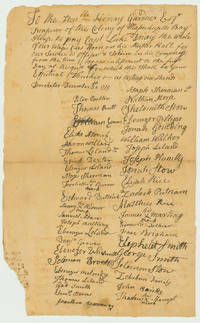
177520781.03<p>A scarce petition for pay listing 44 members of Captain Luke Drury's Company 27 of whom were Grafton Massachusetts-area Minutemen who had marched 36 miles to respond to the Lexington-Concord Alarm on April 19-21 1775. The list includes Fortune Burnee a Minuteman of African American and Native American heritage and his half-brother Joseph Anthony who enlisted on April 29th and died in service. Another of the Minutemen listed is the famous clockmaker Aaron Willard.</p> <b>REVOLUTIONARY WAR.</b>Manuscript Document Dorchester Massachusetts December 30th 1775 addressed to Massachusetts Treasurer Henry Gardner. 1p. 8 x 13 in. Likely Drury's retained copy from the time with the signatures all in one hand though some may be signed with marks & Jonathan Hemenway has signed himself.<p>Petition<i> "to pay Capt Luke Drury the Whole of our Wages as born on his Muster roll for our Services as Officers & Soldiers in his Company from the time of our inlistment to the first Day of August for which this shall be your effectual voucher." </i></p><p>Today the terms <i>minuteman </i>and <i>militiaman</i>are often used interchangeably but there was a distinction in the eighteenth century. Militia were men in arms formed to protect their towns from foreign invasion. They could designate up to one quarter of their force as minutemen a specially trained force required to be highly mobile and able to assemble instantly to a call to arms. It is difficult to categorize specific men into either of the two groups based on the surviving historical record. We apply the term here to all of those militia who responded April 19-21 1775 to the Lexington-Concord Alarm. </p><p>The 27 soldiers and officers listed here who were part of Luke Drury's Grafton Aaron Kimball's Grafton & John Putnam's Sutton April 19-21 Minutemen companies are: 1st Lt. Asaph Sherman Sgt. Nathan Morse Sgt. Shelomith Stow Sgt. Ebenezer Phillips Sgt. Jonah Goulding Cpl. William Walker Cpl. Joseph Leland Drummer Elijah Rice Fifer Zadock Putnam Matthias Rice Isaac Brigham Eliphalet Smith George Smith Peter Butler Thomas Pratt William Evans Elisha Aldrich Aaron Willard Eseck Dexter Moses Sherman Fortinatus Fortune Burnee signed with mark Edward Buttrick Ebenezer Leland Solomon Brooks Ebenezer Melendy Thomas Leland Sr. & Samuel Stearns.</p><p><b>Luke Drury</b>1734-1811 of Grafton Massachusetts joined the militia in 1757 during the French and Indian Wars. As captain of a company of Minutemen and Militamen he responded to the Lexington Alarm and later joined Colonel Jonathan Ward's regiment to fight at Bunker Hill. Drury and his men served in different areas during the war from West Point to Grafton where his company guarded military stores. He also supported the Continentals financially at one point giving £50 fifty pounds to enlist soldiers in Grafton.</p><p>In 1786-1787 Drury became deeply involved in Shays' Rebellion a tax revolt led by farmers in western Massachusetts. The uprising was quashed and Drury imprisoned as "a person dangerous to the state." He was eventually released on good behavior. Drury remained active in state and local politics serving terms as constable deputy sheriff tax collector assessor selectman and state legislator.</p><p><b>Condition</b></p><p>Usual folds small loss at bottom left corner affecting some marginal ciphering else fine condition.</p><p><b>Joseph Anthony</b> and <b>Fortune Burnee Jr.</b> half brothers were both part African-American and Hassanamisco Nipmuc Native American. Compared to records of white New Englanders we know relatively little about them but even so more information exists on these freedmen than is the norm. Several of the Anthonys and Burnees were recorded in the Grafton vital land and probates records the U.S. census neglected to record Native Americans from 1790-1890 and the Burnees have been discussed in recent historical and sociological literature: exploring the relationships both amongst marginalized peoples as well as with their white Yankee neighbors in eighteenth century New England; the definitions of race and identity; social mobility; Indian and black cultures; gender roles; Anglo-Nipmuc land dealings; and the remarkable preservation and history of an 190-acre tract of land in Grafton known as Hassanamesit Woods which is the site of a seventeenth-century "praying Indian" village with Nipmuc habitations that clung on into the mid-nineteenth century.</p><p><b>Joseph Anthony</b>was born in Grafton on December 24 1753 son of Joseph/William Anthony "Negro" and Abigail Printer Abraham "Indian." According to a Nipmuc leader and genealogist Anthony's ancestors include Hassanamisco Nipmuc Chief Anaweakin second in command in King Philip's War in 1675-6; along with Philip/Metacom Anaweakin was killed and his children sold into slavery; his father Noas Sachem of Hassanamesit forced into exile at the same time and died at Deer Island in Boston Harbor; and Nanapashemet Great Sagamore of the Massachuset Federation who was killed in battle in 1619 at Rock Hill Medford the year before Massachusetts was colonized by the English.</p><p>In 1728 seven Indian "Planters" or householders and 33 English re-divided the land at Hassanamesit to incorporate the town of Grafton. In 1739 Abigail Printer married Andrew Abraham Jr. "Indian Planter." Based on Abigail Printer's surname and the very small population left at Hassanamesit in the 1700s it is believed that she is a descendant of Rev. John Eliot's notable contemporary James Printer a Harvard student in 1645-46 who worked for Samuel Green printing Eliot's famous "Indian Bible" in 1663. Abigail and Andrew had three sons before he died in August 1746 after returning from service in the Port Royal Campaign.</p><p>Abigail married second November 14 1752 Joseph/William Anthony. Little is known of him other than his listing in town records as a "Negro." It appears he died circa 1756. Their son the signer of this document <b>Joseph Anthony</b> married Lydia Mercy Johnson. He enlisted in the army April 29 1775 and was reported missing July 6 1777 probably at the Battle of Ticonderoga and dead December 26 1777 possibly a prisoner of war on board an infamous New York City British prison ship. At the time he was a private in Capt. Blanchard's Company of Col. James Wesson's 9th Massachusetts Regiment.</p><p><b>Fortune Burnee Jr.</b> Grafton records spell his name a number of different ways. Dr. David R. Mandell believes there was one man of that name but we find that Electa Kane Tritsch's postulation that there was a father and a son of the same name makes more sense. Abigail again a widow married a third time January 27 1757 to Fortune Burnee Sr. described as "Negro" a veteran of one or more expeditions to Canada during the French and Indian War and widower of another Hassanamisco Sarah Muckamaug Whipple. Mandell writes that Burnee had changed his first name from William to Fortune based on his good luck but does not cite the source or anecdote: Fortune seems more likely a given slave name. He also claims that Burnee abandoned his first wife Sarah before her death but Tritsch has found no evidence for this: that statement may have been compounded with Sarah's first husband Aaron Whipple of Providence Rhode Island. It is thought that Burnee Sr. died about 1771. If so his son <b>Fortune Burnee Jr</b>. is the man who served under Capt. Luke Drury. It is as yet unknown if he is the son of Fortune Burnee Sr.'s second wife Abigail Printer Abraham Anthony Burnee who died in 1776 or his first wife Sarah Muckamaug Whipple Burnee who died in 1751 thus he is either Anthony's younger half-brother or older step-brother. It is interesting to observe that Burnee signs another Drury document with a mark while Anthony was capable of signing in full – whether that hints that Anthony was the younger brother with less responsibilities on the homestead and more opportunity for education is mere speculation. However Tritsch probably by process of elimination finding that Fortune Burnee Jr. does not appear in Sarah's estate papers assigns him as the younger a son of Abigail and half-brother of Joseph Anthony. Fortune Burnee Jr. marched on April 21 1775 in response to the Lexington-Concord Alarm. Marriage records then show that Fortune Burnee Jr. married July 31 1778 "Phylis…negro servant of Rev. Mr. Frost…of Mendon both are listed as "Negroes" and then November 8 1781 Sarah Hector of Sutton again both are listed as "Negroes". He died in 1795.</p><p>Without going into the complex history of Hassanamesit and the Hassanimisco praying Indians Reverend Ezra Stiles's 1761 impressions of the settlement are notable: "At Grafton…I saw the Burying place & Graves of 60 or more Indians. Now not a Male Ind. in Town & perh. 5 Squaws who marry Negroes." By 1770 the town selectmen reported "that there is but one male Indian left" – this man was in fact one of Sarah Muckamaug Whipple's bi-racial children Joseph Aaron. 87 years earlier in 1674 Daniel Gookin had noted that the Indian village had contained twelve families perhaps sixty souls – King Philip's War of 1675-76 and its lingering years of conflict played a major part in this population displacement and decrease.</p><p><b>African Americans & Native Americans in the American Revolution</b></p><p>Of the estimated 100000 men who served in the Continental Army at least 5000 were black. Most black soldiers fought in integrated units as in Massachusetts; some states like Rhode Island had segregated regiments while Connecticut seems to have had both segregated and integrated. Both enslaved and free African-Americans served in the army as soldiers laborers and servants. In some cases slaves were offered freedom for their services as soldiers though others remained enslaved fighting in place of their masters. Many states had been reluctant to arm the black population but had no other countermove to the British Lord Dunmore's offer of freedom to Southern black enlistees. A significant number of colonial blacks at this time were also partly of Native American ancestry – to take once state Massachusetts's eighteenth-century Indian population had two females to one male while the majority of the imported African slave laborers were male. Those figures coupled with their removal to neighboring outskirts of colonial society as well as the enslavement of many Indians in New England after King Philip's War did much to comingle the two ethnic groups.</p> books