580 résultats
1917WRCLIT78591New York: Funk & Wagnalls 1917. xviiii210pp. Decorated cloth. Frontis and plates. Introduction by Herbert C. Hoover. First edition. Foxing to edges and to pages facing plates' a good sound copy. Funk & Wagnalls hardcover books
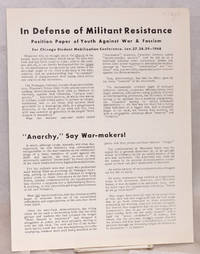
1968253156New York: Youth Against War and Fascism 1968. 4p. 8.5x11 inches edgeworn. Argues that "acceptable" methods of protest and passive resistance are chains on the antiwar movement and defends against charges of adventurism or fears of alienating the working class through more direct action against draft centers companies with ties to the military etc. Youth Against War and Fascism unknown books
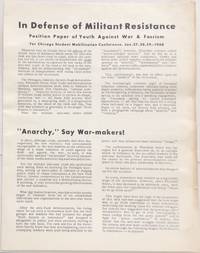
1968135912New York: Youth Against War and Fascism 1968. 4p. 8.5x11 inches very good. Argues that "acceptable" methods of protest and passive resistance are chains on the antiwar movement and defends against charges of adventurism or fears of alienating the working class through more direct action against draft centers companies with ties to the military etc. Youth Against War and Fascism unknown books
1966249220New York: YAWF 1966. Two issues of the single-sheet newsletter 8.5x14 and 8.5x11 inches respectively horizontal fold to number 2. Contents mostly focus on opposition to the Vietnam War. YAWF unknown books
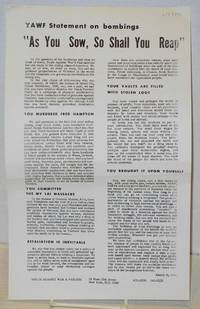
1970135920New York: Youth Against War and Fascism 1970. Legal size sheet printed on one side single horizontal fold else very good condition. Argues that the ruling class has brought upon itself the bombings by radical domestic groups. "You murdered Fred Hampton. You committed the My Lai massacre. Retaliation is inevitable. Your vaults are filled with stolen loot. You brought it upon yourself. Youth Against War and Fascism unknown books
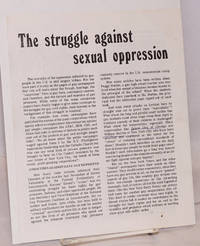
1974110569New York: Gay Caucus Youth Against War & Fascism 1974. Four panel brochure 7x8.5 inches political cartoon and essay YAWF stamp on rear panel else very good condition. Gay Caucus, Youth Against War & Fascism unknown books
19892816Annapolis: Naval Institute Press. Very Good in Near Fine dust jacket. 1989. Hardcover. 087021991X . A reprint of the 1958 original with new material. The rear board has a patch of abrasion from a large partially removed piece of adhesive tape that runs vertically and inexplicably down its center else very good in an about fine dust jacket. . Naval Institute Press hardcover books
195242190Chicago: Faculty-Graduate Committee for Peace 1952. Second printing. 12mo; printed card wrappers; 24pp. Quarter-sized splash-stain to front wrapper else Very Good. Argues that the Cold War rearmament of Germany would threaten post-war peace calls instead for "effective measures for decartelization and elimination of Nazi influence from points of vantage in public life. Faculty-Graduate Committee for Peace unknown books
197890123Franklin Center: Franklin Library 1978. Franklin Limited edition. Illustrated by Edward Vebell. Issued unsigned this copy is specially signed by Wouk on the title page. The Franklin Library issued a signed edition of this title in 1977; the 1978 publication was issued unsigned. Marine-blue leather-covered boards all edges gilt satin pagemarker. Unread copy in Fine condition. Rare as such. Signed by Author. First Thus. Hardcovers. Illus. by Edward Vebell. 8vo - over 7¾" - 9¾" tall. Limited Edition.<br />The images are of the book described and not stock photos. Franklin Library hardcover books
196840964Berkeley: World Without War Council 1968. 48p. slightly soiled wraps. World Without War Council unknown books
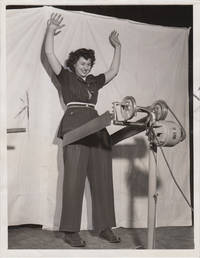
1942CAT0191Cleveland 1942. Silver prints most 6 ½ by 9 with various editorial marks and identifiers to versos. A collection of women's fitness press photographs taken around Cleveland in 1942 from the archives of the Cleveland News. Excellent. A collection of twenty-two photographs documenting women's fitness programs in Cleveland in 1942. The programs and corresponding articles in the Cleveland News appear to be the work of Eleanor Dearnley physical education teacher at Flora Stone Mather College. Other photographs show women's fitness activities at the Lakewood Community Center also in Cleveland. There are several examples of similar local efforts in support of the national "Keep Fit for Victory" Campaign. <br /> <br /> The photographs show women in a range of activities - basketball stretching calisthenics volleyball etc. Some of the photographs are graphically hand-painted by the editorial staff. Most pictures have corresponding articles pasted onto versos. The images are generally quite playful in nature - perhaps because it was early in the war or because the pictures were intended as morale boosters. A generally quite well-preserved group in excellent condition except for the above-mentioned editorial marks. unknown books
1942313964New York 1942. 1p. on Sergievsky's personal letterhead. 8vo. Old folds lower right hand corner chipped not affecting text or signature otherwise a fine letter with a bold clear signature. 1p. on Sergievsky's personal letterhead. 8vo. A letter written by the renowned Russian ace and world record setting Sikorsky test pilot on behalf of Danish-born ballet and Broadway dancer Paul Haakon considered by many to be one of greatest ballet dancers of the 20th century. <br/><br/>Reading in part: "I have known Paul Haakon Longreen for over sixteen years. In the theatrical profession he is known under the name of Paul Haakon. It is very well known that he is one of the best dancers in the world. He gave up his dancing recently to become a flying instructor purely to serve his country. I sincerely believe that anything which could be done to facilitate his joining the United States Army Air Force reserve would benefit our war effort."<br/><br/>Despite Sergievsky's recommendation in our letter it seems Haakon never became a combat pilot during WWII and instead toured as an entertainer with the United Service Organizations. He died in New York in 1992. unknown books
191815610Columbus OH: np 1918. First Edition. Hardcover. Good. 4to. Cloth hardcover three ring binder. Holding 151 leaves; 110 holograph 41 typed. Many sheets loose from ring binding. Cloth torn at spine. Overall contents well preserved. <br/><br/>The classroom lecture notebook of an unnamed cadet at The United States Army School of Aeronautics at Ohio State University Columbus OH covering January through March 1918. During WWI a pilot shortage in the United States became apparent. In response the War Department and U.S. Army formed the Aviation Cadet Training Program installing aviation training schools at six universities across the country. This program at Ohio State appears to have consisted of 8 weeks of classes with training in military drill discipline and technical instruction with an emphasis on aviation. Curriculum from the program formed the basis for the aeronautical engineering courses later taught at OSU. A scarce set of materials from an early instructional program of military aviation training and education one that would eventually become the US Air Force. np hardcover books
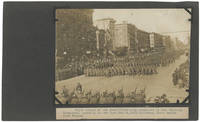
1919CAT0119New York: Underwood and Underwood 1919. First Edition. Gelatin silver prints 7 ¾ x 5 ½ inches each on 11 ½ x 7 inch black paper mounts captioned with affixed text. Very Good. Two WWI-era press photographs related to the Negro 15th Infantry Division of the New York National Guard a.k.a. the 369th US Infantry Regiment and their white commander Colonel William Hayward. One photograph shows the division on parade in New York following their return from combat duty in France in 1919 the other is a well-known image of Hayward who organized the all-black unit and served as its leader. Fighting for a record-breaking 191 consecutive days alongside French troops in the trenches the regiment became known as the "Harlem Hellfighters." <br /> <br /> The opportunity for African-Americans to serve in WWI arose from the Selective Service Act of 1917 which drafted all men between the ages of twenty-one and thirty. Special segregated training camps were established and units were formed. The US National Archives states that 200000 African-Americans served in Europe during WWI but only 42000 saw combat. When the 15th Infantry arrived in France in 1918 Hayward was committed to the idea that his unit would fight on the front lines. After General Pershing refused to integrate them with the full US army Hayward pushed for another assignment under French command. Unlike many other segregated divisions in WWI the 15th aka 369th was eventually sent to the trenches. Its members' distinguished service brought honor and fame. Before leaving the US in 1917 the regiment had not been allowed to participate in the New York National Guard's farewell parade. When they returned victorious Hayward ensured they were publicly honored. <br /> <br /> Both with various press stamps to versos. Small closed tear of about a half inch to upper edge of parade picture good overall. Hayward portrait with some rippling at edges very good overall. Underwood and Underwood unknown books
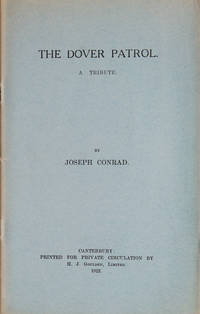
1922303662Canterbury: Printed for Private Circulation by H.J. Goulden Ltd 1922. First edition one of 75 copies this copy is in the earlier state without the half title and title. 14 pp. 1 vols. 8vo. Original pale blue wrappers stapled. Edges slightly faded otherwise about fine. In red calf-backed case. First edition one of 75 copies this copy is in the earlier state without the half title and title. 14 pp. 1 vols. 8vo. ONE OF 75 COPIES. The Dover Patrol provided safe passage to the Continent for British troops in World War One and protected and regulated Channel traffic during the war. Though "no figure of rhetoric can render justice to the quiet resolution of men making up for the inadequacy of their means" Conrad pays them a handsome tribute. This essay written at the request of Lord Northcliffe originally appeared in the The Times July 27 1921 and was later included in Later Essays.<br/>This is one of the most difficult items in the Conrad canon nearly sixty copies eighty percent of the edition are held in universities. A title-page was added to the second printing to please Conrad. Cagle A56a; Keating 221 Printed for Private Circulation by H.J. Goulden, Ltd unknown books
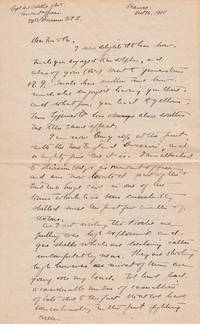
1918308587France 1918. 2-1/2 pages pen and ink on paper with original envelope. Old folds else fine. 2-1/2 pages pen and ink on paper with original envelope. AN OFFICER IN THE REMOUNT SERVICE. An animated letter home from an officer serving in a little-known but vital branch of the service during the First World War. Reading in part:<br/><br/>"I am now living up at the front with the New England division and a mighty fine one it is. I am attached to Division headquarters as remount officer and am now located part of the time in a huge cave in one of the towns which has been considerably shelled since the first few troubles of the war. As I sit writing the Boche are hurling over high explosives and gas shells which are rather uncomfortably near. They are shooting high however most of the time and going over our heads. We have had a considerable number of casualties of late due to the fact that we have been continually in the front fighting area. The animal situation has become so desperate due to the tremendous losses and lack of supply that a number of divisions have become immobile and this one along with still others threatens to become so. That's why I have been sent here and I am doing everything in my power to save up what animals we have by being continually out among them instructing officers and men in proper care and feeding most of the losses have been due to neglect preventing over loading; and making such suggestions to the General as I see fit. It is interesting but difficult work."<br/><br/>Born in Brookline Massachusetts into a prominent and notable American family Brigadier General Nicholas Biddle 1893-1977 was a career officer in the United States Army National Guard who saw action in the Mexican Border 1916 World Wars I and II and was a recipient of the Legion of Merit. Biddle was the son of Edward Biddle 1851-1933 and Lillian Howard Lee Biddle 1862-1946 and great grandson of banker Nicholas Biddle. Biddle married Sarah Lippincott 1894-1962 granddaughter on her father's side of the founder of the J. B. Lippincott Company and granddaughter on her mother's side of Joseph Wharton founder of the Wharton School of the University of Pennsylvania. They had one son John Scott Biddle 1925-2008 who was best know as a foremost yachting cinematographer. <br/><br/>Known as the "Yankee Division" the 26th Infantry was formed from the Massachusetts National Guard in July 1917. The division was sent to Europe in WWI as part of the American Expeditionary Forces and saw extensive fighting in France. The Remount Service was part of the Quarter Master Corps and worked with the Veterinary Corps to handle the thousands of animals that still played a major role in WWI. As the division's "Remount Officer" Nicholas Biddle would have been in charge of supervising the care and handling of the unit's horses and mules. unknown books
19182117881918. 9 issues single sheet except Number 6 & 7 which are 4pp. Small 4to. Fine. 9 issues single sheet except Number 6 & 7 which are 4pp. Small 4to. 'We Cannot Tell a Lie'. Printed on board the USS George Washington a German ocean liner seized by the US and converted to a troop transport during WWI The Hatchet a reference to the legend about George Washington and the cherry tree was started in February 1918 to as a diversion for the troops and sailors on board who were making the dangerous Trans-Atlantic crossing. A bend of shipboard gossip and news received via the ship's radio the single-sheet paper was written by officers with literary experience and printed by on a small hand-press by men who had worked in the printing and publishing business. With a print run of 7000 the paper whose motto was "We Cannot Tell a Lie" boasted that it had "The Largest Circulation on the Atlantic Ocean." <br/><br/>Our collection was presented by the ship's chaplain who also doubled as the newspaper's managing editor to banjo player Joe Lorraine. Lorraine was one of the professional semi-professional and amateur players of the American Stage and Lyceum in WWI that followed the American Army through the war and entertained the troops often in areas close to the frontline. Lorraine entertained more than 2000000 soldiers in 650 appearances over 5 months before being invalided for mustard gas exposure and sent home to recuperate. He returned in 1919 with his famous autographed bull neck banjo which had been signed by more than 700 soldiers from most of the major battles of the war. A pen and ink inscription at the head and tail of Vol. 6 No. 1 reads: "Presented to me by the Chaplain of the George Washington Property of Joe Lorraine. These papers were presented on the transport steamer George Washington during the war with Germany. President Woodrow Wilson sailed to and returned from France on this boat.". unknown books
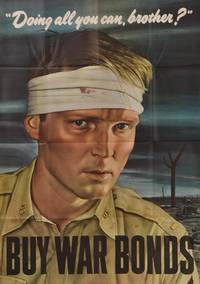
1943WRCLIT70153Washington DC: GPO 1943. Folio color photolithographed broadside 40 x 28"; 102 x 72 cm. Folded as issued. A very near fine unused example. The larger of two formats in which this poster was issued. It features a fair-haired US 2nd Lt. with his head bandaged and with some stains to his uniform cast against a backdrop of a desolate battlefield with armaments a shattered tree and barbed wire receding into the distance. Sloan b. 1915 began his career in commercial art in 1940 including commissions for covers and illustrations for such publications as Time Coronet and Collier's. After he was drafted the same year this poster was issued he did illustrative work for military manuals as well as larger commissions such as the 1944 watercolor "Station Hospital." One of his most widely exhibited works is the 1944 "Negro Soldier" now at the Fogg Museum at Harvard. GPO unknown books
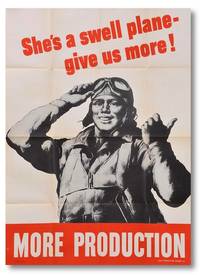
1942WRCLIT70141Washington DC: GPO / War Production Board 1942. Folio photolithographed broadside 40 x 28"; 102 x 72 cm. Folded as issued. Short closed tear at lower edge a few minor wrinkles at edges of folds minor breaks at apexes of a couple of folds with a slight trace of tanning along folds otherwise a near fine fresh unused example. A bold image by Riggs promoting increased homefront production dominated by a large waist-up figure of an American airman raising his goggles with his right hand and gesturing "thumbs up" with his left. Robert Riggs 1896-1970 was in his heyday one of the best- known artists and illustrators in the United States. After studies at the Art Students League and service during World War I Riggs settled in Philadelphia his home base for the rest of his life. In the 1930s and '40s he rose to national prominence as an illustrator lithographer and commercial artist producing well-known images of boxers and circuses two life-long obsessions and of soldiers during World War II. In 1940 around the peak of his career as an illustrator his drawings commanded $750- $1500 each and his name was as well-known in the trade as that of Norman Rockwell. Curiously at a recent auction of African American printed manuscript and visual material an example of this poster was offered quite tenuously making the assertion that the image is of a Tuskegee airman. On the basis of that assertion the example offered there realized $2400. GPO / War Production Board unknown books
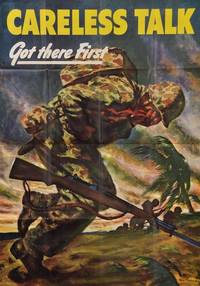
1943WRCLIT70154Washington DC: GPO 1943. Folio color photolithographed broadside 40 x 28"; 102 x 72 cm. Folded as issued. Minuscule breaks at junctions of four folds otherwise a very near fine brilliant unused example. The larger of two formats in which this poster was issued as a forceful reminder about the need for security. The poster is dominated by the image of a serviceman shot in the face during a beach assault dropping his M1 clutching his face with streaming blood trailing to his chest as he falls to his knees. Another design by another artist with the same caption featured a dying paratrooper aloft over land. Prohaska moved in 1908 from his native Yugoslavia to the San Francisco Bay area where he received his formal art education. In 1930 he moved to NYC where he worked as an illustrator for a number of major periodicals and commercial accounts and eventually settled in the east end of Long Island. GPO unknown books
194520240The Hague ca. 1945. Hardcover. Near fine. Two oblong 8vo. albums. First album: 11.5" by 9" approx. String-tied faux-alligator boards. 43 gelatin-silver prints majority 3.75" by 2.5" but many 5.5" by 3.25" mounted to stiff gray leaves with cobweb-patterned tissue guards on each and handwritten captions in Dutch. Apparently complete. Near fine with several photos mildly yellowed but majority bright and sharp. <br /> <br />Second album: 13'' by 9'' approx. String-tied grey textured paper boards. 91 gelatin-silver prints of various sizes from 3.75'' by 2.5'' to 5.5'' by 3.25'' most of the latter size on stiff blue paper with tissue guards and handwritten captions in Dutch. Also contains an anti-Hitler card affixed to the front paste-down several cards with art and verse and two sepia-toned photographs on the final page. Two 5'' scuff marks to front board album corners and edges worn and bumped otherwise near fine with bright and sharp photographs. <br/><br/>A pair of carefully assembled albums possibly compiled for official use. The majority of the photos in both albums record the aftermath of a botched Allied bombardment in the Hague on March 3 1945; the attack claimed the lives of 511 civilians and left over 20000 people homeless. Targeted at a German missile base in the occupied Netherlands bombs deployed by the Royal Air Force landed instead in the adjacent Bezuidenhout neighborhood in the Hague destroying thousands of homes business and public buildings. The photos show several bombed-out churches and many apartment buildings with street names captioned underneath. Near the end of the first album three images show the burning of the Schevenigen Pier near the Hague which the compiler blames on the Germans but whose exact cause has never been established. The album forms a direct account of wartime destruction in the Netherlands. <br /> <br />The second album much more extensive includes some of the same material along with many other photographs. Affixed to the front paste-down is a black-bordered satirical memorial card for Hitler reading in Dutch "He came.but not to England / He saw.Moscow / He lost.the war." Beginning with two views of The Hague one in 1930 and one apparently mid-bombardment labeled March 3 1945 it also includes numerous scenes of destroyed buildings and monuments identified by street name. Some of these overlap with images from the first album; many do not. In addition to those showing the aftermath of the bombing several photos show intact monuments and buildings from neighboring cities like Middelburg possibly as a point of comparison with the ones destroyed. A few pages show photographs of various Bailey bridges at unspecified locations and other wartime construction. The final page of uncaptioned photos includes a shot of a pro-Hitler slogan painted in Dutch on a bridge underpass and a photo of several posters including a Dutch advertisement for "De Eeuwige Jood" The Eternal Jew a German propaganda film. A final leaf follows with two pro-R.A.F. cards with verses and drawings and three souvenir cards of Queen Wilhelmina Princess Juliana and her children Beatrix and Irene. The final page has two sepia-toned photos of a parade presumably celebrating the war's end. An important act of witnessing from an unfortunate event. hardcover books
194019884Various ca. 1940s. Thirteen brown paper leaves loose from a presumably perished scrapbook holding 57 black and white silver print photographs and dozens of ephemeral articles clippings postcards documents etc. tape-mounted to rectos and versos. Prints ranging in size from approximately 1.5” square to approximately 8” x 10” 42 of the 57 photos approximately 1.5” square contact prints. WITH Two ALS totaling approximately 650 words. Letters good to very good. WITH About 35 pieces of loose ephemera: military correspondence personal clippings and photographs etc. Scrapbook pages worn flaking at edges loose contents often with tape remnants or residue from previous mounting. Contents overall about good. Pearl Harbor letter very good with folds from mailing light toning and a small chip from right margin. <br/><br/>A small archive of World War II service and personal materials belonging to a Gerald Maynard Watkins of Memphis Tennessee highlighted by a monumental Pearl Harbor eyewitness letter written by Watkins to his mother less than 2 weeks after the Japanese attack. <br /> <br />Watkins was stationed at the Kanehoe Naval Air Station on the East side of the island of O’ahu site of the first Japanese attack carried out just minutes prior to Pearl Harbor approximately 30 miles to the West. His approximately 575 word letter of December 20 1941 describes the surprise onslaught in vivid and revealing detail exceprt: <br /> <br />"Then it happened. Never til my dying day will I forget. Bombers. They came from nowhere – Seemed to just be there. I looked up just in time to see them drop their eggs. For one startling second the world stood still as I followed the bombs line of drop with my eyes. I couldn’t help it. Fascinated by it all I watched until thy hit. That broke the spell. Courage – Every man there was a hero. <br /> <br />I rushed over to the hangar after the debris had settled. The first person I saw was Lawrence. He was just lying there kind of white looking and awful still. My throat tightened until it was hard to swallow. I knew he was dead." <br /> <br />This remarkable eyewitness account one of the best pieces of World War II correspondence we’ve seen is certainly the highlight of the group and its remaining contents are largely typical of World War II-era scrapbooks and archival material with several dozen photographs of his later service in the War many from Canton Island airfield in the Pacific with the decorated Patrol Bombing Squadron VPB-52. The balance of contents consist of personal clippings marriage photographs 3 pages seeming to be the fitful beginnings of an attempt at an early draft of a memoir of his Pearl Harbor Day experience and a second wartime ALS written on Christmas Eve 1941 in which he follows up his December 7 experience with a report on a mild injury he suffered during the attack: “Now that I am well and health once more I can tell you this. I had a very small piece of shrapnel from one of the bombs that were dropped here hit me in the shoulder. I didn’t even have to go to bed. I feel like a veteran now.” <br /> <br />Watkins left the Navy in 1946 after six years of service and went on to a career as a commercial airline pilot. His 2006 obituary notes he entered the University of Miami Law School at 67 years old passing the Florida Bar at 70 to become a practicing lawyer in retirement. <br /> <br />A handful of primary written accounts of the Pearl Harbor attack are known notably the diary of George Macartney Hunter whose family privately holds the manuscript but have made it available in multiple venues including for use in the 2003 PBS documentary THE PERILOUS FIGHT. The offering of similar materials in commerce appears to be rare with a significantly less impressive letter by a civilian witness to Pearl Harbor several miles from the battle itself making approximately $1200 nearly tripling its high estimate at a small regional auction in 2011. <br /> <br />A rare thoughtful and exceptionally revealing participant account with important supporting documentation lending additional context of arguably the defining event of the 20th century. unknown books
195732753London: Robert Hale Limited 1957. First edition. Illustrated. 1 vols. 8vo. Scarlet morocco-backed scarlet cloth. A very good copy. First edition. Illustrated. 1 vols. 8vo. The story of the June 1942 brutal massacre of the Czech village of Lidice by the Nazis following the murder of Reinhard Heydrich the German Deputy Reich protector in Bohemia and Moravia. Robert Hale Limited unknown books
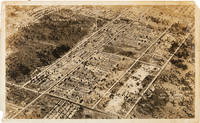
1941WRCAM56386Detroit: Spencer & Wyckoff 1941. Large format photograph 12 x 19 3/4 inches. A few small chips and short tears. Mild scuffing moderate staining and soiling. Good condition. A rare aerial view of the short-lived American military installation at Camp Livingston Louisiana. The camp opened in 1940 and closed in 1945 and was created to train field artillery regiments during World War II hence the "F.A." in the title of the photograph. The most notable use of Camp Livingston began the year after this photograph was taken when the American government used the camp to house thousands of Japanese German and Italian prisoners of war. In addition as many as a thousand Japanese-American citizens were held at Camp Livingston as part of the War Relocation Authority's wartime internment program. The present photograph would be useful in studying the accommodations for wartime prisoners and internees or perhaps the changes over time to the camp to accommodate them. No copies located in OCLC. Spencer & Wyckoff unknown books
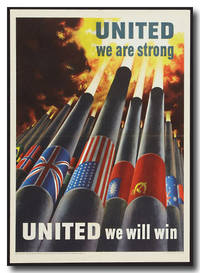
1943WRCLIT71230Washington D.C.: U.S. Government Printing Office / Office of War Information Poster 64 1943. Vintage color offset lithographed poster 28 x 20". Previously folded neat pinpricks in each of the top corners one panel on verso dust smudged short split at lower edge of midpoint margin else very good or better. One of the canonical WWII posters presenting a visual metaphor for the Allied nations executed by the Austrian-American artist 1915 - 1991 after his 1938 emigration to the US in the wake of Hitler's annexation of his home country. The image depicts a battery of artillery gun barrels decorated with the flags of the Allies all firing in unison into a tumultuous sky. Koerner later gained wide recognition for his portrait commissions for the covers of TIME magazine. This particular poster was produced in several sizes for different uses. U.S. Government Printing Office / Office of War Information Poster 64 unknown books