57 résultats
175723896London: Printed for J. Morgan 1757. Octavo. 7 3/4 x 4 5/8 inches. 4 99 1pp. Half-title errata on verso 1p. publisher's advertisements at back. Blindstamp to title H1 and H2 library number stamp at the foot of the verso of the title and at foot of p. 48. 20th-century half calf over marbled paper-covered boards joints rubbed.<br/> <br/>First edition of the fifth in a series by Tory political satirist and pamphleteer John Shebbeare.<br/> <br/>Here Shebbeare attacks the ministry of the Duke of Newcastle and the unfair influence exercised by George III's Hanoverian interests on policy. There are also references to Admiral Byng and problems in North America with the French. The first five letters were published between 1755 and 1757 and together they constituted a bold attack on the government and its handling of home and international affairs. Near the end of 1757 after Pitt's dismissal Shebbeare published his Sixth Letter and finally went too far: in the following year he was tried for libel fined pilloried and imprisoned and his final Seventh letter London: 1758 was seized and suppressed.<br/> <br/>Kress 5647; Sabin 80044; ESTC 35524. Printed for J. Morgan unknown books
1760WRCAM35262London: A. Millar 1760. 456pp. Dbd. Very good. Lacks half title. Second printing of the first edition. The ascription of authorship to John Douglas is suggested by Halkett & Laing; William Pulteney has also been a candidate. An appeal to William Pitt and the Duke of Newcastle that the process of making peace with France must include France's relinquishing all of Canada Guadeloupe and Senegal. This work is important for having elicited Franklin's noteworthy THE INTEREST OF GREAT BRITAIN CONSIDERED WITH REGARD TO HER COLONIES. This second printing includes an erratum on the final page below "FINIS." HOWES L276. SABIN 20684 second ed. TPL 314 first issue. A. Millar unknown books
1760WRCAM221London: A. Millar 1760. 56pp. Half title. Later paper wrappers. Very good. The ascription of authorship to John Douglas is suggested by Halkett & Laing; William Pulteney has also been a candidate. An appeal to William Pitt and the Duke of Newcastle that the process of making peace with France must include France's relinquishing all of Canada Guadeloupe and Senegal. The issue is important for having elicited Franklin's noteworthy THE INTEREST OF GREAT BRITAIN CONSIDERED WITH REGARD TO HER COLONIES. TPL 315. JCB 1III:1264. A. Millar unknown books
1740WRCAM35453London: T. Cooper 1740. 460pp. Half title. Dbd. Light stain on half title leaf affecting but not obscuring a handful of letters. Else very good. "Relates largely to affairs with Spain in the West Indies the writer defending the Ministry and the Convention. Probably written by a Ministerial partizan" - Stevens. First of three editions. BELL L321. EUROPEAN AMERICANA 740/185. GOLDSMITHS 7808. SABIN 40399. STEVENS RARE AMERICANA 1926 1521. T. Cooper unknown books
1739WRCAM35446London: T. Cooper 1739. 31pp. Dbd. Very good untrimmed. Second edition. A point-by-point refutation of a recent pamphlet which favored diplomacy to war with regard to recent colonial trade conflicts with Spain. A REPLY. was one of many 1739 pamphlets that reflected and reinforced the British public's outrage at perceived injustices to British seamen by the Spanish in the Caribbean. Prime Minister Walpole bowed to popular sentiment in October and commenced the War of Jenkins' Ear. EUROPEAN AMERICANA 739/248. DE RENNE I p.79. GOLDSMITHS 7685 first ed. SABIN 69687. T. Cooper unknown books
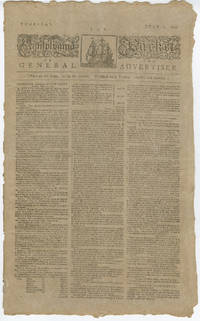
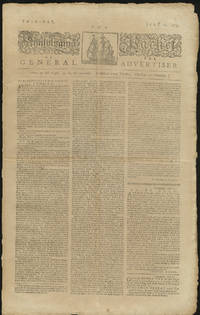
177921556.07Philadelphia PA 1779. No binding. Fine. Pennsylvania Packet or General Advertiser. Newspaper. Pennsylvania Packet or General Advertiser. John Dunlap Philadelphia Pa. July 1 1779. 4 pp. 10 1/2 x 17 untrimmed. Page 1-2 leads with extracts from the Journals of Congress regarding Indian Affairs and New Hampshire land disputes. Extensive content on the Revolutionary War medical department including a lengthy serialized ""Doctor Morgan's Vindication"" regarding the Continental Congress's dismissal of Dr. John Morgan who had great success managing military hospitals for Washington's Army without cause or explanation. Here he obtains testimony from General Nathanael Greene and even Washington himself to defend his reputation.Page 3 reports war news from Pennsylvania as well as a June 29 1779 act of the Continental Congress borrowing $20 million to maintain fiscal solvency.Page 4 includes advertisements for runaway slaves book auctions and stolen horses.Excerpt ""IN CONGRESS June 29 1779.AS Congress are bound by every motive of policy and of public & private justice to maintain the credit of the paper money emitted by their authority on the faith of the United States; so it is their intention not only to avoid further emissions but to diminish the quantity in circulation provided that the respective States by correspondent and vigorous exertions shall put it in their power to raise the necessary supplies.Resolved therefore That twenty millions of Dollars or such a part thereof as shall be brought into the Continental Loan-Offices on or before the first day of October next be borrowed on the faith of the United States at an interest of six per cent. per annum.For facilitating the said Loan Resolved1. That the Loan-Officers in every state do immediately open subscriptions for the said Loan. 2. That the executive authorities of the several states be requested immediately to appoint persons of character and influence in every county town or district to receive subscriptions and transmit the same to the Loan-Officer or Officers in the states respectively. 3. That no subscription be received for less then five hundred dollars. 4. That all subscriptions under ten thousand dollars shall be paid into the Loan-Office where the same shall be subscribed or into the Hands of the person obtaining the subscription within fourteen days after the subscription shall be made. 5. That any person subscribing ten thousand dollars or upwards shall be allowed to pay the same at two periods to wit one half within fourteen days after the subscription the residue on or before the first day of October next; the whole to bear interest from the time of the first payment provided the other payment shall be punctually made. 6. That each lender shall have his election either to receive the principal at the expiration of three years from the date of the Loan or to continue it in the funds on interest until the whole amount of Continental bills in circulation shall not exceed the sum in circulation at the time of the Loan. 7. That interest on all sums which shall be paid into the Loan-Office before the said first day of October or which shall be subscribed and paid agreeably to the terms of the 5th resolution aforesaid shall be payable annually at the Continental Loan-Office of the State in which the money was originally subscribed. 8. That when the interest on Monies which have been or may be placed in the several Loan-Offices on or after the first day of March 1778 shall become due and be paid the same until some more accurate standard of value can be devised shall be increased in proportion to the increase of the sum of Continental paper money which may be in circulation after the date of such Loans respectively.Extract from the MinutesCHARLES THOMSON Sec'ry."" unknown books
1739WRCAM35449London: T. Cooper 1739. 63pp. Dbd. Very good. A defense of Robert Walpole's international policy leading up to and including the Convention of El Pardo January 1739. Walpole's long diplomatic efforts praised by the anonymous author of this pamphlet would soon prove to have been in vain as the Prime Minister reluctantly declared war on Spain later in the year. The result was the desultory affair known as the War of Jenkins' Ear. Of this pamphlet's two 1739 editions the present one is given priority by EUROPEAN AMERICANA and CATALOGUE OF THE GOLDSMITHS' LIBRARY OF ECONOMIC LITERATURE. EUROPEAN AMERICANA 739/280 GOLDSMITHS 7693. SABIN 79228 another ed. STEVENS RARE AMERICANA 1926 1539. T. Cooper unknown books
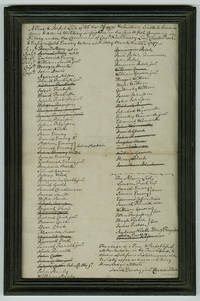
1757WRCAM51214Kittery Me 1757. Broadside 12 x 7 1/2 inches. Old folds mild toning. Very good. In frame. Appears to be docketed on verso but not examined outside frame. A manuscript roll-call for a company of Maine military personnel organized to participate in the French and Indian War. The document lists over seventy names of regulars in two columns plus an additional dozen names under "The Alarm List" essentially a reserve list of soldiers appointed to defend the homefront. Below the Alarm List is the following text: "The above is a True & Perfect list of all the soldiers in the Train'd band & Alarm List from sixteen years old to sixty as far as has come to my knowledge. Attest Daniel Emery jun. Clerk und. Oath." The Emery family supplied seven members of this list of officers and soldiers with others such as the Furbush Ferguson and Wamouth families also providing more than one man for the army. Several names are crossed out about half of which belong to a family supplying more than one member to the list. Most of the men on the Alarm List are also identified by profession such as deacon miller or sailor among others. Such lists of colonial American military personnel for the French and Indian War are exceedingly rare in the market. An important colonial Maine and military document. unknown books
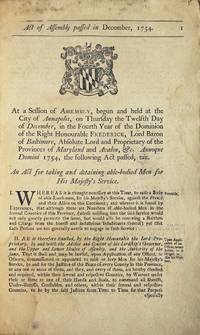
1755319725Annapolis: Jonas Green 1755. 2pp. Bound with: Acts of the province of Maryland made and passed at a session of Assembly begun and held at the city of Annapolis on Saturday the twenty-second day of February in the fourth year of the dominion of the Right Honourable Frederick Lord Baron of Baltimore absolute lord and proprietary of the provinces of Maryland and Avalon &c. Annoque Domini 1755. Published by authority. 8pp. Folio. Period wrappers restitched some losses to the blue sugar paper old repairs at head of each leaf with minor losses old dampstaining. 2pp. Bound with: Acts of the province of Maryland made and passed at a session of Assembly begun and held at the city of Annapolis on Saturday the twenty-second day of February in the fourth year of the dominion of the Right Honourable Frederick Lord Baron of Baltimore absolute lord and proprietary of the provinces of Maryland and Avalon &c. Annoque Domini 1755. Published by authority. 8pp. Folio. Recruiting for Braddock's Campaign. Passed in December 1754 "to raise a Body of able Land-men for his Majesty's Service against the French and their Allies on this Continent" this separately-printed session law essentially authorizes a draft system for forcing "all and every able-bodied Freeman who live idle and do not follow or exercise some lawful Calling" to be enlisted as soldiers. Given the timing it is believed that the troops being raised were intended for service on the Braddock expedition against Fort Duquesne.<br/><br/>Bound together with the above is a second session printing of Maryland laws including acts relating to the French and Indian War: "An Act to Prevent the People of this Province from Supplying the French or their Indian Allies with Ammunition Warlike Stores or Provisions of any Kind" and "An Act for Regulating the Rates of Carriage and Quartering Soldiers in Public Houses within this Province for His Majesty's Service." Also included are acts on currency courts and tobacco.<br/><br/>Both session printings are rare with ESTC recording only five copies in four institutions and eight copies in six institutions respectively. Bristol B1727 and Evans 7458; Wroth 179 and 180; ESTC W33246 and W7078 Jonas Green unknown books
1757WRCAM9300AAnnapolis: Jonas Green 1757. 213pp. Contemporary plain front wrapper rear wrapper renewed. Small ink library stamp on verso of titlepage tape repairs to edges of each leaf mostly small and inconsequential minor foxing. Very good. In a black cloth slipcase. A rare Annapolis imprint comprising the session laws for Maryland in early 1757. In the midst of the French and Indian War naturally there is significant content related to the war. Namely there are three acts: "An Act for his Majesty's Service and the more immediate Defence and Protection of the Frontier Inhabitants of this Province" encompassing the first four-and-a-half pages "An Act for the Relief of sundry Inhabitants of this Province who have had their Servants Enlisted into his Majesty's Servants" and "An Act to prevent the Exportation or Carrying out of this Province Ammunition Warlike Stores or Provisions of any Kind towards supplying the French or their Allies." The first of these acts calls for the raising of 500 men to be organized into companies to protect the frontier and for the manner of their deployment and use. Most of the others laws are continuing acts relating to slaves "languishing Prisoners" debtors and other issues. Rare with ESTC recording only three copies in two institutions AAS has two. EVANS 7935. WROTH 197. ESTC W7081. Jonas Green hardcover books
176337559London: Robert Sayer 1763. Engraved map on four joined sheets hand coloured sectioned and linen backed at a contemporary date. Overall sheet size: 42 1/8 x 47 3/8 inches. Housed in a tan cloth box. An early issue of Bowen and Gibson's impressive wall map of North America: the first issue following the end of the French and Indian War.<br/> <br/>Bowen and Gibson's map was first issued in about 1755 under the title An Accurate Map of North America. It was reprinted and served as a template for the enormous political changes of the next forty years attesting to its importance. Aside from its stunning visual impact Bowen and Gibson's map teems with information including numerous Native American placenames in the western areas native tribal regions notes and routes of early roads and the forts along the Mississippi and to the west of the Appalachians. The two insets are of Baffin and Hudson's Bays and the mouth of the Colorado River the latter map based on the explorations of Eusebio Kino. The roccoco cartouche is particularly attractive and features a Native American couple with their small child and a group of indigenous animals: beaver alligator parrot and the skin of a mountain lion. The present issue was the first to the published following the French and Indian War and includes the boundaries as reflected by the Treaty of Paris of 1763.<br/> <br/>Stevens & Tree "Comparative Cartography" 49b in Tooley The Mapping of America; Degrees of Latitude 36; Phillips A List of Maps of America p. 589. Robert Sayer unknown books
175623894London: Printed for M. Cooper at the Globe 1756. Small octavo. 7 1/4 x 4 1/2 inches. 100pp. Blindstamp to title and G4 library ink stamp to the verso of the title and p. 48. 20th-century half calf over marbled paper-covered boards rubbed marks from old library label on upper cover.<br/> <br/>The first edition of a scarce but important critical commentary on the British government's handling of the French and Indian war.<br/> <br/>This work relates "to the inefficient conduct of the ministry in the disputes with France especially in America on the Ohio and elsewhere under Washington Braddock etc. For this and later publications Shebbeare was fined and put in the pillory. A change of government brought him a change of sentiment and a pension" Sabin.<br/> <br/>Howes S366; Sabin 80038; ESTC T75830. Printed for M. Cooper, at the Globe unknown books
1739WRCAM47525London: T. Cooper 1739. 228pp. Lacks half title. Modern tan half morocco and cloth spine gilt. Minor soiling and wear. Very good plus. Letter concerning the secession on March 9 1739 of the "Patriots" from the House of Commons over the negotiations preceding the War of Jenkins' Ear. The Patriots were Tories and disaffected Whigs who opposed Sir Robert Walpole the first Prime Minister. Walpole argued for peace and moderation in dealing with Spain and he was supported by a scant majority. This letter presents the informed view of a member of Parliament displaying the furor in England for the protection of their American trade and decrying the factitious nature of English politics. The secession proved advantageous for Walpole because it allowed him to push through several bills relating to the free exportation of sugar and molasses from the West Indian Colonies. ESTC T138894. GOLDSMITHS 7730. EUROPEAN AMERICANA 739/154. SABIN 34807. T. Cooper hardcover books
17861008004 page letter sheet I pp of text 13 lines of test signed and mailed remnant of wax seal labeled duplicate docketed on last page. Legible probably a second copy made for legal purposes signed by author some wear at folds and some staining second sheet split and cracked a bit but text page in very good condition. Interesting letter that appears to have the wrong date on the front page. What appears to be January 20 1706 should read January 20 1786 according to the docketted date on the last page. The letter is written by Stephen Lush 1753-1825 to Jellis Jacob Fonda 1751-1839. It relates to taxes on land in New York owned jointly by Lush and Fonda. John Lansing an attorney and former delegate to the Constitutional Convention seems to have resquested the payment of one shilling per acre on the 40000 of acres they own jointly. Provides some interesting content on land taxation for the period. Lush practiced law in Albany until the War for Independence; he was commissioned a captain and saw action in New York City but was captured by the British. Major Fonda was considered one of the first patriots of Schenectady and after Lexington he formed a company of Minutemen. He fought in the Campaign against Burgoyne and at the Battle of Bemis Heights. Fonda organization website. ny education government website. books
1740WRCAM41547London: W. Webb 1740. 428pp. Modern marbled boards gilt leather label on cover. Bookplate of Alberto Parreño on front pastedown. Minor soiling. Very good. A later issue of this edition published shortly after the beginning of the War of Jenkins' Ear. Sir Robert Walpole's lengthy diplomatic efforts eventually came to naught and he bowed to popular sentiment in October of 1839 and commenced the War of Jenkins' Ear. "Includes several references to naval actions & commerce in the West Indies" - EUROPEAN AMERICANA. ESTC calls for an added postscript with this issue though SABIN and EUROPEAN AMERICANA make no such differentiation. Only four copies of this issue located in ESTC. EUROPEAN AMERICANA 740/76. SABIN 15994. ESTC T2956. W. Webb hardcover books
1739606731739. Relates to Events in the Americas Anglo-Spanish War. Cotejo de la Conducta de S.M. Con la de el Rey Britanico Assi en la Acaecido Antes de la Convencion de 14. de Enero de Este Anno de 1739 Como en lo Obrado Despues Hasta la Publicacion de Represalias y Declaracion de Guerra: Con Licencia en Madrid. His Catholick Majesty's Conduct Compared With That of His Britannick Majesty As Well With Regard To What Happened Before the Convention of the 14th of January of This Year 1739 As to What Has Been Done Since Untill the Publication of Reprisals and Declaration of War: Printed by Authority at Madrid by Antonio Marin. London: Printed for T. Cooper 1739. 63 pp. Spanish text with English translation on facing leaves. Octavo 8" x 5". Later quarter morocco over textured paper boards gilt title to spine. Some rubbing to joints corners lightly bumped hinges just starting at ends. Discoloration to free endpapers light toning to text somewhat heavier in a few places. Early owner signature Eyre to head of title page interior otherwise clean. $1250. Only edition. A legalistic analysis of Spanish claims advanced during the Anglo-Spanish War 1739-1748. Also known as the War of Jenkins' Ear after the conflict's flashpoint it related to Great Britain's exclusive right granted by the Treaty of Utrecht at the end of the War of the Spanish Succession 1713 to ply the slave trade and sell other goods in Spain's American colonies. This war was eventually subsumed into the War of the Austrian Succession 1742-1748. The signature in this copy may be that of Sir James Eyre 1734-1799 the notable judge later chief justice of the Court of Common Pleas. Sabin A Dictionary of Books Relating to America 17026. unknown books
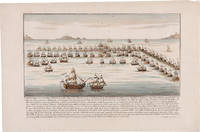
1782WRCAM56168Augsburg 1782. Handcolored engraving 11 1/2 x 17 3/4 inches. Some light soiling and tanning. Near fine. Matted. An attractive and well-preserved contemporary print by German engraver Johann Martin Will with delicate hand-coloring depicting the British and French fleets in combat formation during the Battle of the Saintes also known as the Battle of Dominica/Bataille de la Dominique. Britain's victory over the French navy in April 1782 effectively ended French control of the Caribbean. The engraving depicts over eighty ships which are keyed for identification in captions in German below the image. The upper middle ground depicts Rodney's flag ship "Formidable" and two supporting vessels attacking and breaking the French line. Among the many other ships identified are the flagship of the French admiral Comte de Grasse's "Ville de Paris" here identified as "Stadt Paris" as well as Sir Francis Samuel Drake's division Admiral Samuel Hood's division and the Prince George which according to this account broke its main mast while breaking the line. Also depicted is the French fleet's attempt to reestablish the line in which they have little luck as ships were already starting to flee. <br> <br> The battle was named after the Saintes a group of islands between Guadeloupe and Dominica in the West Indies. The year before the French fleet under de Grasse had decisively defeated the British fleet in the Battle of the Chesapeake and then blockaded the coast until Cornwallis surrendered at Yorktown helping to secure American victory in the Revolution. This time the British fleet soundly defeated the French capturing the flagship and de Grasse the first French admiral in history to be captured by an enemy and inflicting significant causalities. This emboldened the British in the ongoing negotiations with the Americans and French as well as in ongoing conflicts with Spain. The French-American alliance effectively dissolved and Britain reaffirmed its claims on the Newfoundland fisheries and Canada. Further the French and Spanish abandoned their planned invasion of Jamaica focusing instead on protecting their existing holdings. <br> <br> Johann Martin Will 1727-1806 was a prominent engraver and publisher in Augsburg who specialized in producing images for the British and American markets. A most uncommon image of an important naval battle in the West Indies. unknown books
177921556.04Philadelphia PA 1779. No binding. Fine. The Pennsylvania Packet or the General Advertiser. Newspaper. The Pennsylvania Packet or the General Advertiser John Dunlap: Philadelphia Pa. July 15 1779. 4 pp. 10 1/2 x 16 1/2 in. untrimmed. The front page prints a lengthy letter from ""A Farmer of Virginia"" on inflation taxation and monetary policy. Excerpts""There are three principal causes of the depreciation of our paper-currency. First the great quantity in circulation. Second the want of confidence in the will and ability of the States to redeem it by taxes and specie. Third the deranged State of the public business and the want of effectual laws for regulating the conduct of an bringing to account all such as are employed in the service of the public.I shall endeavor to shew by what methods the quantity in circulation may be lessened and the value restored without violating the public faith or oppressing the citizens of these United States. The paper-money of these States differs from that of any country in Europe because the principle on which it is emitted is different. The principle is taxation; and if it be not duly applied the quantity must encrease according to the exigencies of the States and the credit or value will be diminished in proportion as the quantity emitted exceeds the sum necessary for a circulating medium. This will generally be ascertained by comparing the price of commodities purchased with paper-money to that which shall be purchased with specie. Taxation then being the principle on which the paper money was emitted if it had been applied when the depreciation commenced it would most certainly have produced a remedy for the evil. This would have prevented the enormity of the public debt. p. 1 col. 1-3Also on the front page: an advertisement for ""Good Bohea Tea"" sold by Jewish merchant Benjamin Seixas who had relocated to Philadelphia from New York during the British occupation. p.1 col.3This issue also contains a letter from George Washington responding to Doctor John Morgan who was in the process of a very public vindication. ""No fault I believe ever was or could be found with the economy of the Hospitals during your Directorship. Things in the first stage of the war were plentiful and cheap and I am inclined to think that you contributed as much as lay in your power to provide at the lowest rates."" p.2 col.1As well as the protests of the ""tanners curriers and cordswainers of the city"" in response to inflation: ""The depreciation of our currency is a fact so notorious that the cause of America can receive no injury from mentioning it in the course of the observations we are about to make. For many years preceding the issuing of the present currency the prices of skins leather and shoes were so proportioned to each other as to leave the tradesmen a bare living profit.The prices of leather and shoes continued the same as formerly until the depreciation of the currency had made considerable progress nor did we advance our price until the increased expence of almost every other article of consumption rendered it absolutely necessary and then we kept a great distance behind many other tradesmen and infinitely almost behind the advance on foreign articles. Thus in the beginning of 1777 when money had depreciated or which is the same thing goods had risen for the most part to three and four prices our commodities had advanced scarcely two prices.Having thus stated our ideas of this matter for your consideration we think ourselves justified before the world in declaring that we do not consider ourselves bound by the regulated prices of our commodities and we shall not observe them until a general regulation of all other articles shall take place by common consent."" p. 2 col. 2-3 p. 3 col. 1Along with other reports of the war. ""We have been twice out after the enemy's fleet but can't bring them to action. On our passage to this port in company with the Carrisfort we fell in with a fleet fr. See website for full description unknown books
179464027Columbia SC 1794. Partly printed document completed in manuscript 11 1/8 x 15 1/2 inches describing the parcel of land; attached to that document with a cloth tie is another partly printed document completed in manuscript and signed by the Surveyor General of South Carolina Francis Bremar September 10 1794 and countersigned by the Deputy Surveyor William Sims and with a manuscript map of the parcel of land on the top half of the document. Accompanying the two documents each of which has docketing on the verso is the original clay state seal though worn cracked and in three pieces. The verso of the land survey document bears the signature "Col. Wade Hampton Jr." Offset from the seal but complete with the manuscript map and clay seal. Both documents folded some breaks along a central fold taking a bit of several letters but not affecting the sense. 10515. Moultrie began his military career in the Anglo-Cherokee War of 1761; as colonel and commander of the 2nd S.C. Regiment in 1776 he successfully defended the fort named for him which was located at the entrance of Charleston Harbor from attack by a British fleet delaying British occupation of that city by four years. Bremar served as Deputy Surveyor General of S.C. in the 1760s and was named Surveyor General in 1788. <br/><br/> hardcover books
1718106614<p>Folio newspaper extracted illustrated 369=384 pp. Disbound some pages separated double page illustration torn and separated a bit at the center with some loss normal aging; otherwise about good. This issue features Secretary of State William H. Seward on the cover. This issue contains a short article on the capture of Jefferson Davis. Also double page panoramic view of Richmond based on a photograph of Alexander Gardner. Included is an almost full-page picture of Major General William T. Sherman.</p> Harper's books
1755WRCAM40157London 1755. 2pp. extracted from an unknown source. Folio. Slight tanning at spine edge old fold lines. Very good. Speech of King George II to Parliament on the eve of the French and Indian War. The speech outlines the steps that have already been taken and the steps that will need to be taken in order to go to war with France in North America. unknown books
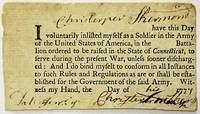
177734560Hartford 1777. Small printed broadside oblong 4" x 2-3/4". "Christopher Sherman" is inserted in manuscript as the name of the volunteer. An "X" for "his mark" is in ink at the end over an attempt to sign his name. For the year "177" is in type and the final "7" in manuscript. "Date" at the bottom is in manuscript along with the month probably "janry". Outer margin closely trimmed but text unaffected. Very Good. <br/><br/> An unrecorded form of Revolutionary War enlistment engagement exceedingly interesting for its reference to "the United States of America." Recorded enlistment engagements from this era-- all of them rare-- refer to the "United Colonies of America" "America" the "Colony of Massachusetts" the "Colony of Massachusetts-Bay". We have handled an unrecorded Massachusetts enlistment engagement from this period which refers to the "United States of America." Enlistment engagements from Connecticut referring to the "United States of America" from this era are unrecorded.<br/> The Continental Congress renamed the Nation "United States of America" on September 9 1776 ordering that "In all continental commissions and other instruments where heretofore the words 'United Colonies' have been used the stile be altered for the future to the 'United States'."<br/> Christopher Sherman was a Private under Captain William Richard's Company in the First Regiment of the State of Connecticut commanded by Lieut. Col. Samuel Prentice Esq. in 1777. A manuscript notation on the payroll sheet for the period January to June 1777 states that he deserted on January 10th or 18th. Revolutionary War Rolls 1775-1783; National Archives Microfilm Publication M246 138 rolls; War Department Collection of Revolutionary War Records Record Group 93; National Archives Washington. D.C. accessed at Ancestry website. <br/>Not located on NAIP ESTC OCLC as of November 2020. unknown books
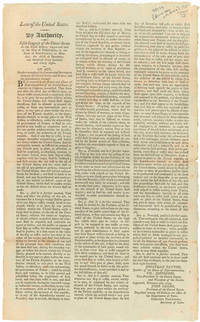
1799WRCAM48177Philadelphia 1799. Broadside 13 1/2 x 8 1/4 inches printed in three columns. Docketed in ink on verso. Three horizontal folds. Some light edge wear small separations at edges of folds not affecting text. Very good. Rare congressional act extending the suspension of trade with France during the so- called "Quasi-War" of the late 1790s and adding a provision allowing the U.S. Navy to inspect and seize American ships that are violating the embargo. This act was approved February 9 1799 and extends the provisions of the law first approved on June 13 1798. It is signed in type at the end by President Adams Vice President Jefferson and Speaker of the House Jonathan Dayton. The Quasi-War was an undeclared conflict between the United States and France during the Adams administration in the late 1790s manifested mostly in naval engagements between the two nations. The war was the outgrowth of deteriorating Franco-American relations which had been weakened earlier in the decade by the Genêt Affair and the XYZ Affair and it wreaked havoc on commerce between the two nations. One of the main weapons wielded by Adams was to ban American commerce from France and French dependencies accomplished by the congressional act of 1798 and extended by the present law. The law forbids American ships from trading with France or with French dependencies including in the West Indies and goes on to bar French commerce and French ships from American ports. Significantly this act goes beyond the provisions of the 1798 law by permitting United States Navy vessels to inspect and potentially seize American vessels that have traded with France or with French dependencies. <br> <br> This broadside format is unusual for the printing of a law and indicates that it was meant to be displayed in ports and customs officers for the attention of ships' masters who may have been unaware of the embargo law or willfully violating it. ESTC locates only three copies at Oxford the British National Archives and the American Antiquarian Society. Rare. EVANS 36522. ESTC W42364. OCLC 80514531. unknown books
179720431Philadelphia: Printed by William Ross 1797. 8vo. 8pp. Loose gathering uncut. Leaves splitting on folds loosening. Some edge chipping and dusting. Good. <br/>Evans 33095. NAIP w025330. Printed by William Ross? unknown books
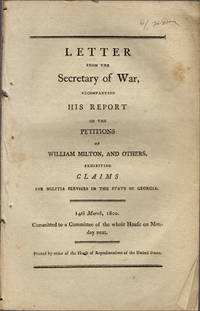
180012055Philadelphia: no publisher/printer 1800. Small 8vo. 41 3 blank pp. <br><br>Concerns service in Georgia during the period 1790-94 in the wars with the Creek and Cherokee Indians. Gives an excellent review of the events and personalities. <br>Â Â Â Â <br>Â Â Â Â Evans 38774; Eberstadt Cat. 114 item 326. Removed from a nonce volume. Very good condition. no publisher/printer unknown books