6 résultats
190033725Washington: Government Printing Office 1900. 1st edition Wickersham 7772. Original publisher's brown cloth binding. Cloth dull with wear. Slight cock. Pencil pos to ffep. An About VG copy. 169. 1 pp. Suite of 168 photographic images on 127 plates follows text. Folding-map at rear. 8vo. <br/><br/> Government Printing Office hardcover books
190033725.1Washington: Government Printing Office 1900. 1st edition Wickersham 7772. Original publisher's brown cloth binding. Slight lean. Spine panel lightly sunned. POS to ffep. A VG copy. 169. 1 pp. Suite of 168 photographic images on 127 plates follows text. Folding-map at rear. 8vo. <br/><br/> Government Printing Office hardcover books
18922563Chicago: Women's Temperance Publishing 1892. First Edition. Cloth. Very good. First edition of the history of the Illinois Thirteenth Volunteer Infantry. Octavo viii 672pp. Brown cloth title in gilt on spine embossed decorative illustrations on cover. Wear to rear cover light dampstain at top edge. Frontispiece portrait of Colonel John B. Wyman with tissue cover. Floral endpapers some cracking at hinges text block stable and secure. Nevins 1 110. The 13th Illinois Volunteer Infantry Regiment was organized under the Ten Regiment Bill and nicknamed "Fremont's Grey Hounds." They were part of General Sherman's attack on Chickasaw Bayou where their commander Colonel Wyman was killed. Women's Temperance Publishing unknown books
185532141Boston: Davis & Farmer Printers 1855. 48pp top margins of first few leaves spotted. Stitched in original printed wrappers lightly foxed. Except as noted Very Good.<br/><br/> The Infantry is named in honor of Revolutionary War Major General Benjamin Lincoln. This rare pamphlet prints its founding documents marching and arms instruction for the soldier and a manual of arms for sergeants.<br/>FIRST EDITION. OCLC 590599680 2- AAS NYHS as of June 2015. Davis & Farmer, Printers unknown books
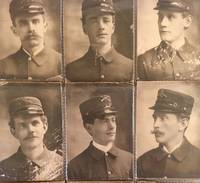
1898List319Massachusetts 1898. The 2nd Massachusetts Volunteers mustered into service in May 1898 and within a month saw significant action in Cuba at the Battle of El Caney. They were one of three volunteer units from Massachusetts to see action on the Santiago Campaign. The regiment was inexperienced - 55% were untrained recruits. The lack of experience combined with their rifles giving off a very visible black smoke led to a heavy casualties in the Battle of El Caney. After an encampment near Santiago de Cuba in which a large number of the soldiers became ill with disease - estimates are as high as 65% - the regiment returned home in August. Historians have noted that soldier demographics changed considerably from the Civil War to the Spanish American war as the smaller number of troops and the lack of a draft led to a more enthusiastic army with higher morale. <br /> <br /> The photographs in this group are interesting as a typological grouping of images of untrained soldiers and also for their historical value as most contain identifications to versos. The highlight of the group is forty-four uniformly mounted portraits of soldiers nearly all identified measuring 3 ¾ x 2 ½ inches each. Other photographs include a large portrait of Captain Frederick E. Pierce with the blindstamp of Goldsmith Studio Springfield Massachusetts and a 3 ¼ x 3 ¼ inch square card of Capt. Pierce in Camp Turner. Also included are two slightly larger photographs on similar mounts. <br /> <br /> Overall an interesting group. Good condition overall with assorted chips and wear. unknown books
1890WRCAM52682Chicago: Kurz & Allison 1890. Color lithograph. Image size: 18 1/2 x 25 inches; sheet size: 22 x 28 1/4 inches. Matted to an overall size of 25 x 31 inches. Some moderate chipping and edge tears not affecting image. Reinforced with older tape along top edge. Lightly toned though colors are still strong and fresh. Good plus with wide margins. Suitable for framing. A dramatic rendering of the first major battle in the Civil War to involve African- American troops the attempted storming of a Confederate fort near Charleston South Carolina on July 18 1863. Colonel Robert Gould Shaw was killed along with fifteen other officers and nearly 300 of his men. The print shows the Union troops charging the ramparts of Fort Wagner charging into the oncoming Confederate rifle and cannon fire. A Union officer likely intended to be Shaw stands atop the first rampart sword held high the flag waving boldly next to him. Union ships float off the coast in the background shells bursting above them. <br> <br> Shaw 1837-63 came from a wealthy Massachusetts family noted for upholding reform and abolitionist causes. When the Civil War broke out in 1861 Shaw distinguished himself in combat surviving the bloody battles of Antietam and Cedar Mountain. After the Emancipation Proclamation was passed in 1863 Massachusetts governor John Andrew organized the army's first black volunteer unit the 54th Massachusetts. Despite his initial refusal Shaw was ultimately persuaded by his family to accept the command. Sent to fight in the Union effort to seize the border islands of the Carolina coast in the late spring of 1863 the regiment proved its valor that summer by holding off Confederate troops at James Island South Carolina. "Two days later July 18 1863 on Morris Island Shaw proudly volunteered his regiment to lead the assault on the impregnable Fort Wagner the first step in an offensive on the Confederate stronghold of Charleston South Carolina. When the Fifty-fourth charged the fort 272 were killed wounded or captured. One of those who fell was Shaw leading his African- American troops in battle. Although the assault failed the bravery of the Fifty- fourth proved the ability of black troops and in death the young Shaw was ennobled as a martyr to freedom and as a symbol of enlightened sacrifice" - ANB. The soldiers of the 54th impressed Shaw with their dedication and valor which they demonstrated during the Fort Wagner assault. Shaw was buried with his troops by the Confederates in a mass grave on the site of the assault. <br> <br> Shaw and his troops are the subject of one of the most celebrated works of public sculpture in the United States Augustus St.- Gaudens' Shaw Memorial on the corner of the Boston Common nearest the State House. Shaw's leadership of the regiment is best known to many people today through the film GLORY 1989 which culminates in the attack on Fort Wagner and Shaw's death. A dramatic portrayal of this important historical moment. BLOCKSON 111. Kurz & Allison unknown books