5 536 résultats
1978Alibris.0034971民美術出版社 China Fine Arts. 1978. Trade paperback. Good. wear & some discoloration to cover pages dog-eared. 59 p. Includes illustrations. 民美術出版社 [China Fine Arts... paperback
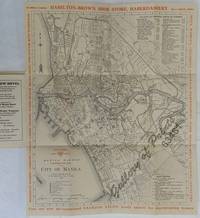
193563461/62<p>lithograph in black with red letterings. verso: <strong>Philippine Islands with index with map showing main roads and principal points of interest</strong> pocket map with 16 pp text. VERY RARE. "Tourist" booklet with general info on Philippines and Manila including map prepared under the direction of the Engineer. Phil. Dept U.S. Army. Second edition with advertisements by American Express Magnolia Sanitary Steam Manila Yellow Taxi Brias Roxas Botica Boie Bay View Hotel and others. Condition: Very good to excellent condition.</p> Young Men's Christian Association (YMCA), Manila branch Army & Navy.
19962092902144201399Sekchanomizu Shobo 1996. Soft Cover. Fine. The book is in fine condition. Sekchanomizu Shobo paperback
1970KFZZQ100589National Museum of Modern Art 1970. Soft Cover. Fine. KFZZQ100589 National Museum of Modern Art paperback
1925302891London : R. Bentley & Son 1925. First Edition. Hardcover. Map volume with 13 folding maps held in a cloth case decorated in gilt. Maps remain well preserved overall tight bright clean and sharp-cornered. Physical description; map volume: 14 maps. v. 7: Map Volume: 1905-1923 / compiled by H.C. Wylly 1925. Subjects; Great Britain. Army. Queen's Royal Regiment West Surrey History. Great Britain. Army Officers ; Registers. Regimental histories. Great Britain History Military. Genre; Illustrated. London : R. Bentley & Son hardcover
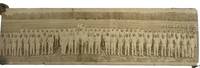
1942185261942. Panoramic photograph 1940s depicting an African American Quartermaster Corps unit during World War II with direct relevance to the study of segregated military organization logistical operations and the role of Black service troops in the war effort. The image shows three rows of Black soldiers in uniform assembled on a field with five white officers positioned in front reflecting the racial hierarchy characteristic of the U.S. Army during the period. A soldier at center holds a unit flag bearing an eagle insignia and the number "663" identifying the formation as part of a Quartermaster unit responsible for supply provisioning and support functions. During World War II the majority of African American soldiers were assigned to service branches rather than combat divisions and Quartermaster units played a central role in sustaining operations across multiple theaters. The photograph documents both the scale of military organization and the structural limitations placed on Black troops within the wartime army.<br /> <br /> Panoramic sepia photograph measuring approximately 8 x 16 inches showing the assembled unit in formation on a grassy field with additional soldiers visible in the background engaged in training or awaiting assembly. The composition emphasizes uniformed ranks command structure and the presence of the unit flag providing visual identification and context for the group.<br /> <br /> Photograph with creasing pinholes and tears consistent with handling; image remains clear; overall fair condition. A large-format visual record of African American service personnel in a logistical unit central to the operation of the U.S. Army during World War II. unknown
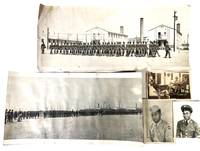
1941193561941. Partially identified Black Airmen photographs and Tuskegee Airmen signatures. African American airmen associated with the United States Army Air Forces during the World War II era document the struggle the struggle of entry into military aviation during a period when the armed forces remained racially segregated. This archive contains sixteen items including photographs of Black airmen in uniform and autographs of Tuskegee Airmen the pioneering African American pilots and support personnel trained beginning in 1941 after federal pressure forced the Army Air Corps to open limited aviation training opportunities to Black candidates.<br /> <br /> Five original photographs of African American airmen in Army Air Forces or early U.S. Air Force uniforms and nine signed note cards bearing the signatures of Tuskegee Airmen veterans. The archive also includes a contemporary pamphlet and photograph of a monument commemorating the Tuskegee Airmen. Signatures appear on white unlined cards measuring approximately 5 x 3 inches and include Claude Platt of the 301st Fighter Squadron and an Army primary flight instructor Charles A. Lane Jr. of the 99th Fighter Squadron Charles McGee of the 302nd Fighter Squadron Luther E. McIlwain Eldridge Williams of the 332nd Fighter Wing Leroy Bowman of the 301st Fighter Squadron Edward E. Tillman of the 477th Bombardment Group Utota Knox of the 302nd Fighter Squadron and Curtis C. Robinson of the 99th Fighter Squadron. The five photographs include two panoramic images measuring approximately 8 x 15 inches and 8 x 17.5 inches and three smaller photographs measuring roughly 3 x 5 inches. <br /> <br /> One panorama shows a large formation of troops assembled in ranks with a band and flag bearers present with African American personnel grouped separately from white soldiers and women within the formation. A second panorama shows approximately four dozen Black airmen marching in formation near a military installation. The smaller photographs depict African American airmen wearing service uniforms with airman caps and winged shoulder insignia; one image bears the inscription "To Mother - From Son in the service" while another real photo postcard shows a Black airman posing with a Black woman seated in a prop carriage behind a decorative mule annotated with "me" above the woman and the initials "T.B." above the man. <br /> <br /> The Tuskegee Airmen program began in 1941 when the U.S. Army Air Corps initiated training for African American pilots at Tuskegee Army Air Field in Alabama following federal directives requiring the military to allow limited Black participation in aviation roles. Units such as the 99th Fighter Squadron and the 332nd Fighter Group became the most visible African American flying units during World War II flying escort and combat missions in the European theater while operating within a segregated military structure. Their service challenged long standing claims that African Americans were unsuited for combat aviation and became a major milestone in the broader campaign for racial equality in the armed forces. The experience of these aviators and the public recognition of their accomplishments contributed to growing pressure for the desegregation of the military culminating in President Harry S. Truman's 1948 order ending official racial segregation in the armed forces. Five photographs ranging from approximately 3 x 5 inches to panoramic formats up to about 8 x 17.5 inches accompany nine signed note cards. One panoramic photograph shows slight water staining and a fold at the left corner; the remaining photographs and signatures remain well preserved. Overall condition very good. The material preserves visual documentation of African American participation in military aviation alongside signatures of several Tuskegee Airmen who served in fighter and bomber units during the war. unknown
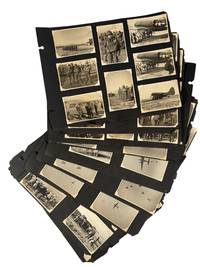
1943214541943. United States Army airborne training operations documented in photographs created during World War II at Laurinburg Maxton Army Air Base in North Carolina. The images record the preparation and execution of paratrooper training jumps carried out as part of the rapid expansion of American airborne forces during the war. Photographs show soldiers receiving equipment checks boarding transport aircraft deploying from the air and regrouping on the ground after landing illustrating the coordinated logistical and training processes required to prepare airborne infantry units for combat operations. Airborne training facilities such as Laurinburg Maxton served as major preparation sites where paratroopers and troop carrier crews rehearsed the procedures that would later be used in large scale combat operations across multiple theaters of the war.<br /> <br /> Photograph album consisting of 45 black and white photographs mounted on eight unbound album pages. The images depict paratroopers wearing standard issue M1 steel helmets jump boots and M42 paratrooper jump uniforms equipped with web gear. Several photographs show soldiers conducting pre flight checks and assembling near transport aircraft before boarding. Aircraft visible in the photographs include a Douglas C-47 Skytrain bearing markings associated with the 317th Troop Carrier a transport unit that trained at Laurinburg Maxton before deployment overseas during the war. Multiple photographs capture the moment of airborne deployment with paratroopers descending beneath round canopy parachutes consistent with the T-5 parachute used by U.S. airborne forces during most of the war. Ground level images document soldiers gathering after landing and coordinating recovery operations providing visual evidence of the training routines that prepared airborne units for operational deployment.<br /> <br /> During World War II the United States military rapidly expanded its airborne capabilities developing specialized training programs that combined parachute infantry units with troop carrier aviation groups responsible for delivering soldiers and equipment by air. Troop carrier units such as the 317th Troop Carrier Group later played an important role in Allied airlift and airborne operations in the Pacific theater transporting troops and supplies and participating in airborne missions during campaigns in New Guinea and the Philippines. Photographs documenting airborne training exercises therefore provide important evidence of the preparatory phase that preceded combat deployment of these units. Album pages remain unbound with photographs mounted to paper leaves. Minor edge wear and light handling marks visible on several prints; overall very good condition. The album preserves detailed visual documentation of American airborne training procedures during the Second World War. unknown
1951191891951. African American U.S. Army soldiers photographed during the early Korean War era document Black military service during the first years following the formal desegregation of the United States armed forces. Twenty photographs dating from approximately 1950 to 1952 depict African American soldiers in uniform at military bases and in field conditions associated with Korean War deployment. Several images also show Black and white soldiers posing together providing visual documentation of the Army during the first phase of racial integration ordered by President Harry S. Truman through Executive Order 9981 in 1948. Inscriptions on several photographs including one signed portrait reading "Joe Moddin 1951" identify individual servicemen and record personal messages written during active service.<br /> <br /> Twenty black and white photographs depicting African American soldiers in U.S. Army uniforms during the early 1950s. Photographs include scenes of soldiers standing with military trucks traveling along roads in Korea and posing with fellow servicemen at military installations where barracks structures are visible in the background. Several images show troops operating or stationed in rough winter terrain consistent with Korean War conditions. Three photographs contain extended inscriptions on the verso dated December 1951 and January 1952. Another photograph is a portrait image signed and dated "Joe Moddin 1951." The images collectively portray daily military life including group portraits transportation scenes and base environments during wartime deployment.<br /> <br /> The Korean War fought between 1950 and 1953 became the first major conflict in which the United States attempted to implement racially integrated military units following Truman's desegregation order. African American soldiers had served in segregated formations throughout World War II and their wartime service contributed to growing national pressure to dismantle racial segregation within the armed forces. By the early years of the Korean War the Army began integrating many units in training and field operations bringing together soldiers of different racial backgrounds in combat and support roles. Historians estimate that roughly 600000 African Americans served in the armed forces during the Korean War and Black servicemen accounted for a significant portion of U.S. casualties during the conflict. These photographs provide ground-level visual documentation of soldiers serving during the transitional period when formal military segregation was being dismantled but integration remained uneven in practice. Twenty photographs. Minor handling wear typical of mid twentieth century vernacular photographs. Overall condition very good. unknown
19972082702114603182Seishiosha fixed price 11000 yen 1997. Soft Cover. Fine. Number of books: 1 Seishiosha fixed price 11000 yen paperback
19972091502135302240Aoshio-sha 1997. Soft Cover. Fine. Volume: 1 Aoshio-sha paperback
19812081002109001894Beppu and the Occupation Army Editorial Committee 1981. Soft Cover. Fine. Number of pages: 311p 15 plates Size: 21cm Beppu and the Occupation Army Editorial Committee paperback
19182083002117700143Imperial Military Association Headquarters 1918. Soft Cover. Fine. The book is in fine condition. Imperial Military Association Headquarters paperback
19192092902143901451Kinzashi Houryu-do Kanda district Tokyo 1919. Soft Cover. Fine. Number of books: 1 book Kinzashi Houryu-do (Kanda district, Tokyo) paperback
19192092902143801436Kinzashi Houryu-do Kanda district Tokyo 1919. Soft Cover. Fine. Number of books: 1 book Kinzashi Houryu-do (Kanda district, Tokyo) paperback
19212080202105600515Not Available 1921. Soft Cover. Fine. The book is in fine condition. Not Available paperback
19432091502135700009Dainihon Educational Book 1943. Soft Cover. Fine. The book is in fine condition. Dainihon Educational Book paperback
19352091502135704160Army War Mountain College General School Assembly Hall 1935. Soft Cover. Fine. The book is in fine condition. Army War Mountain College General School Assembly Hall paperback
19422080302106808994National Association for the Advancement of Education 1942. Soft Cover. Fine. Number of books: one National Association for the Advancement of Education paperback
1943190146Washington: United States Government Printing Office 1943-45-46. Presentation copies from General George Marshall to his "miracle worker" General Brehon B. Somervell A complete set of the original official US Army wartime reports handsomely produced the personal copies of General Brehon Burke Somervell 1892-1955 George Marshall's commander of Services of Supply the first two being presentation copies from Marshall the cover of each volume gilt lettered with Somervell's name and rank. Services of Supply was one of the three "superagencies" organized by the US Army after the United States's entry into the war in December 1941 - the other two being Army Ground Forces and Army Air Forces - and gathered under its overarching aegis Quartermaster Corps Chemical Warfare Service Signal Corps Corps of Engineers Ordnance Department Medical Corps and Transportation Corps. "General George C. Marshall the army's chief of staff during World War II held Somervell in high regard for his ability to perform monumental tasks and was willing to overlook his penchant for antagonizing others. "What he did was a miracle" said Marshall in a postwar interview. The U.S. Army in World War II was probably the best-supplied army that had ever gone to war. Much of the credit for that accomplishment goes to Somervell who provided the "sinews of war" for a military effort that literally spanned the globe" American National Biography. Somervell is mentioned directly by Marshall in his concluding remarks to the first volume where he notes "The requirements of logistics are seldom understood. The burdens they impose on the responsible military authorities are rarely appreciated. The conflicting demands of our theater commanders of Allied sovereign powers and of the home front pose difficulties never before approximated in war. The necessity for a high degree of efficiency in management is evident and it has been found in the coordination of all the various supplies and administrative departments of the Army under the command and leadership of Lt. Gen. Brehon B. Somervell. "Published at two-year intervals these reports provide a comprehensive picture of global war as seen from the perspective of the Chief of Staff. The first report describes the race to mobilize an unprepared country and Marshall's appeal on the eve of war for the renewal of Selective Service a reminder of how far the U.S. Army had to come to meet the Axis challenge. The second recounts the initial defeats after Pearl Harbor and the ultimately successful efforts of the United States and its Allies to turn the tide. The final report describes the drive to victory and outlines Marshall's analysis of the reasons for the Allied triumph. Summaries give an overall view of the progress of the war but the scholar and military professional will find most interesting Marshall's comments on such topics as technology the "90-division gamble" the replacement system troop morale and the citizen-soldier and demobilization. These comments and the other material presented in the reports provide not only a fresh perspective on the myriad problems of conducting a global war at the highest levels but also renewed appreciation for the man whom Churchill appropriately called 'the organiser of victory'" Brigadier-General John W. Mountcastle foreword to the 1996 Center of Military History edition. This is a set of the scarce original edition produced by the United States Government Printing Office in Washington; trade editions were also produced by the Infantry Journal Press in the US and HMSO in Britain. The set comprises: Biennial Report of the Chief of Staff of the United States Army July 1 1941 to June 30 1943 to the Secretary of War. Octavo pp. v 56. 6 folding maps and 19 folding charts. Presentation copy from General George Marshall inscribed on a preliminary blank: 'To General Somervell with appreciation and warm regard G. Marshall". Biennial Report of the Chief of Staff of the United States Army to the Secretary of War July 1 1943 to June 30 1945 to the Secretary of War' Quarto pp. iii 123. bound with the supplementary Atlas of World Battle Fronts in Semimonthly Phases to August 15 1945 pp. 101. Presentation copy from General George Marshall inscribed on a preliminary blank: "Dear Somervell - Please accept this copy of my final report as Chief of Staff with appreciation of your tremendous service to the army and support of me with my affectionate regards - G. Marshall October 5 1945". Report by the Supreme Commander to the Combined Chiefs of Staff on the Operations in Europe of the Allied Expeditionary Force 6 June 1944 to 8 May 1945. Quarto pp. x 123. Several colour maps. 3 vols one octavo 232 x 135 mm 2 quarto 305 x 210 mm. Contemporary black pebble-grained skiver gilt lettered on front covers first 2 vols with dark blue vertical-rib cloth endpapers third with white moiré silk-effect endpapers. Bindings a little worn at extremities some mottling to covers scattered foxing otherwise very good. hardcover
1939192368Edinburgh: 1939-45. Digging for victory A small but evocative collection tracing the war work of the artist Mary Paton who served with the Women's Land Army in Scotland throughout the Second World War. The highlight of the collection is a pair of standard-issue corduroy breeches made by Redman Bros in January 1943. Other than a couple of small oil stains to the right inner thigh they are well-preserved and have been supplemented with non-standard leather reinforcing patches to the inner knees. Two certificates in the collection are addressed to "Frances M. R. Paton" the full name of Mary Paton 1920-1990 who studied at the Edinburgh College of Art before and after the war and later lived in Aberdeenshire. A letter of thanks records her service as having lasted from 11 October 1939 to 10 October 1945 while the two WLA armbands show her service at 3 1/2 and 5 1/2 years respectively. The collection also includes two enamelled WLA lapel badges and a silver gelatine photograph 86 x 57 mm showing a young woman with "Mave. Freiburg '37" inscribed on the verso. Together eight items. One certificate with storage folds overall in very good condition. hardcover
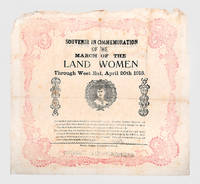
1918170820London: Sarah Burgess 1918. An ephemeral piece of wartime memorabilia A souvenir tissue napkin advertising a parade through London of the Women's Land Army intended to promote the organization and encourage agricultural volunteers. Napkins were commonly printed for large public ceremonies: "the most spectacular napkins were the souvenir issues of Mrs S. Burgess of London who created items for various historical and period events" Florey p. 108. The march was an enormous undertaking consisting of over 200 women and farmers: "the war has afforded many stirring spectacles in the streets but these processions could hardly be excelled for picturesqueness or the appeal they made to national gratitude" The Times p. 4. The focus of the procession was promoting agricultural pursuits; the women were flanked by a myriad farmyard animals hay-balers and tractors. Recruitment speeches were delivered imploring women to support troops abroad by ensuring that industry and agriculture were appropriately maintained at home. "The soldiers are giving their lives for England. All that we ask of you girls is to give one year of your lives in the Land Army in the same noble cause" ibid. Known as "Auntie" in the trade Sarah Burgess operated from premises in Bishopsgate and later off the Strand as here advertising as a "manufacturer of paper switches cut tissues lace paper and shelf trimmings & confetti and stationer wholesale and export" Crawford. The napkin squares were imported into London from Japan already printed with a decorative border in up to five colours and a blank central area. After being printed with the appropriate commemorative design they were sold for about one penny by street traders lining the route of the event. Burgess was particularly involved with producing commemorative napkins for the suffrage movement including for the march to the House of Commons on 29 June 1909 the Suffrage Coronation Demonstration on 17 June 1911 and Emily Wilding Davison's internment in Morpeth on 14 June 1913. However "the WSPU had mixed feelings about Burgess's efforts. Disturbed by her producing an 'unauthorized official programme' for the June 29 event they nevertheless pointed it out as an example of 'how the movement interests the public'. Mrs Burgess's products demonstrated quite clearly how important the concept of a suffrage 'souvenir' or collectible had become to suffrage sympathizers who wanted to retain a tangible memory of a major event that they might have participated in" ibid. Square of plain crepe paper 325 x 360 mm. Central printed illustration depicting a portrait of Queen Mary of Teck set within oak and laurel leaves and flanked by two scrollwork motifs surrounded by decorative floral border printed in red. Some nicks and creases at extremities mostly to top edge gently creased from folding and a couple of small damp stain patches offset from ink lettering; overall a very good and intact example of a fragile product. Elizabeth Crawford "Ephemera: Mrs Sarah Burgess Printer" Woman and Her Sphere blog 12 Sep. 2019 accessible online; Kenneth Florey Women's Suffrage Memorabilia: An Illustrated Historical Study 2013; "Women War Workers. Munition Makers at St. Paul's. Land Army Procession" The Times 22 Apr. 1918. unknown
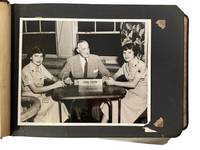
1950231531950. WACKorean War Women's Army Corps photo album compiled by Sgt. Elizabeth Adamek of Cairnbrook PA ca. early to mid 1950s extensively recording enlisted women in post-1948 U.S. Army administrative operations at Camp Zama Japan during the Korean War period. Elizabeth Adamek later Elizabeth Adamek Pierce 1932-2016 served approximately twenty years in the United States Army as an administrative assistant and instructor including service in Japan and the Korean Theater during the Korean War. Adamek is shown several times in uniform with her twin sister Cpl. Cristania Adamek indicating the sisters served in the WAC around the same time period. This album documents postwar U.S. Army overseas base administration showing how clerical labor recordkeeping and office management were carried out by WAC personnel during the Korean War. Images of Hill and fellow servicewomen engaged in office work reveal women's roles in the Army's daily bureaucratic and logistical functions while stationed abroad. A comprehensive primary-source documentation of the operational role of women within permanent peacetime Army structures following the formal establishment of the Women's Army Corps in 1948.<br /> <br /> Photo archive of approximately 240 silver gelatin photographs from Camp Zama Japan and the United States circa early to mid 1950s. The album is housed in a Japanese lacquer-style postbound binding with black paper leaves containing a mixture of small snapshot prints deckle-edge photographs and larger mounted images. The visual content centers on Hill frequently shown in WAC uniform posed in front of barracks administrative buildings and landscaped areas as well as inside office environments seated at desks surrounded by stacked files paperwork and card index systems. Several images explicitly depict clerical workspaces including a servicewoman operating a typewriter beside filing drawers reinforcing the administrative function of WAC personnel. A clearly legible building sign reads "Camp Zama 8030th Army Unit APO 50" situating the album within a specific military unit structure. Additional photographs include formal military reviews with officers and dignitaries group portraits of uniformed women before display walls and social scenes in dining facilities and clubs. Off-duty life is extensively documented through images of Japanese urban streets market stalls rail platforms commercial signage shrine gateways temple architecture zoo enclosures and landscaped gardens alongside recreational scenes such as swimming roadside travel and barracks exteriors collectively illustrating both the operational and social dimensions of overseas Army life. Adamek is posed throughout the album with a romantic partner one Sgt. Kidder whose service at Camp Zama is also documented extensively.<br /> <br /> The album captures the workings of U.S. Army overseas base administration demonstrating the process by which women in the Women's Army Corps sustained military infrastructure through administrative labor. Camp Zama functioned as a major logistical and support installation during the Korean War era and the photographs provide insight into the women that maintained its operations while also recording the social networks and cultural encounters experienced by American service personnel in postwar Japan.<br /> <br /> Elizabeth Adamek Pierce's obituary in The Oklahoman indicates she was honorably discharged from the US Army in 1971 after which she relocated to Oklahoma City and worked in an administrative role with the OKC Police Department. Adamek was a member of the Civil Air Patrol the VFW Post 1335 and a volunteer at Tinker Air Force Base in Oklahoma City. Light edge wear and chipping to album leaves occasional corner wear scattered fading and softness to prints and general handling wear to the binding; overall good condition. A cohesive and well-identified visual record of women's military service in the U.S. Army in East Asia. unknown
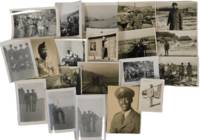
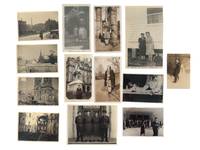
1945214301945. WWII era Women's Army Corps photo archive documenting servicewomen including two African Americansand four partially identified individuals. Creation of the WAC in 1942 marked the first permanent institutional incorporation of women into the U.S. Army placing female personnel into administrative communications intelligence and logistical roles across both domestic bases and overseas commands. One photograph identified on the verso as "Gynnie Polly Corsica '45" provides additional documentation of Black women serving overseas in segregated Army units during the final year of the war.<br /> <br /> Archive of 18 silver gelatin photographs from W.W.II. Photographs measure approximately 3 x 2 inches to 6 x 3.5 inches. The images depict American servicewomen in a range of wartime contexts including official uniform portraits informal snapshots and scenes taken in European cities damaged by combat. Several photographs show women wearing standard WAC dress uniforms with garrison caps and enlisted insignia while others depict personnel wearing British style battledress associated with American administrative units stationed in Europe. One photograph shows three uniformed personnel two women and one man standing at attention before a formal government building likely in Britain. Another image places a uniformed American servicewoman before the gilded equestrian statue of Joan of Arc in Paris a landmark associated with Allied presence in liberated France. Additional photographs depict ruined urban landscapes with bombed churches and collapsed structures suggesting scenes from Germany or France shortly after liberation. A photograph inscribed "Chattanooga Tenn." shows a woman standing in civilian clothing at the entrance of a home indicating a stateside context connected to the servicewoman's life before or after deployment. Another photograph labeled "Ann & Lillie Mother" shows two women standing outside a residence likely relatives of one of the servicewomen. <br /> <br /> Women's military service expanded rapidly during World War II as the War Department created organizations such as the Women's Army Corps and the Navy's WAVES to address labor shortages across the armed forces. Overseas deployments placed WAC personnel in newly liberated European cities and military headquarters throughout the Allied command structure. Light toning minor edge wear and occasional handling marks. Overall very good condition. Although African American women served within segregated units their participation in overseas assignments including Mediterranean theater postings marked a significant shift from earlier military policy which had typically limited Black women's service to domestic assignments within segregated support units. unknown
19378079H81220NY: Paisley. Inked name on endpaper. . Acceptable. Hardcover. First Edition. 1937. Paisley hardcover