3 résultats
1889S6274Bologna:: Camberini et Parmeggiani 1889. 1889. At head of title: R. Academie des Sciences de L'Institut de Bologne. 4to. 20 pp. Paper brittle. Original printed wrappers; extremities chipped. Ex library rubber stamp and ms. notations on top cover. Very good. Camberini et Parmeggiani, 1889. unknown
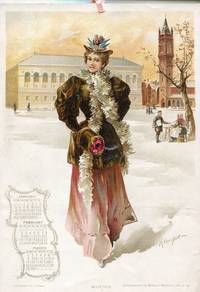
189600009241Chicago: The Winters Co 1896. Sheets. Very Good. Chromolithograph calendar 4 chromolithograph sheets. 8" x 11.25" or 20 cm by 29 cm. Each drawing has a lady dressing for winter spring summer and fall in the latest fashion of the day. The winter sheet was a supplement to the Boston Herald issued on Dec. 8th 1895 the spring sheet was the supplement to the Boston Herald issued on Dec. 15 1895 the summer sheet a supplement to the Herald issued on Dec. 22 1895 and the fall sheet was a supplement to the Boston Herald issued on Dec. 29 1895. All sheets are tied together by a thin pink ribbon. Each sheet has a small calendar in the left corner with three months represented on each sheet. The winter sheet depicts a lady standing in a public square with a church and municipal building in the background spring shows a lady picking flowers in a pastoral lane summer shows a lady sitting on a bench next to a hayfield and the fall sheet depicts a lady mailing letters on a city street with yellow flowers in her hand. Wikipedia "Richard Veenfliet". The four chromolithographs were drawn by Richard Veenfliet. Veenfliet was a German-born American artist Civil War Veteran having fought for the Union an architect and an early advocate for immigration. Veenfliet moved from New York state to Michigan and would become a member of the Cincinnati Art Club. He was active in the art community until his death in 1922. A charming and richly detailed calendar. Very Good with the occasional tiny surface rub and a discreet tear to the right margin of both the spring and summer sheets .5" and 1" respectively. The Winters Co unknown
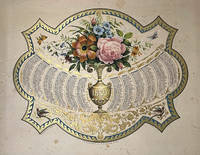
1839101827<p>Different papers different sizes but all from the Engelmann family archives.</p><p>Includes:</p><p>1839. One plate for the year sheet size 31 x 24 cm.</p><p>1840. One plate for the year sheet size 555 x 36 cm.</p><p>1841. Two plates each depicting 6 months on a sheet sheet size 32 x 49 cm.</p><p>1842. One plate for the year sheet size 49 x 325 cm.</p><p>1842. a different calendar Two plates each depicting 6 months on a sheet sheet size 32 x 49 cm.</p><p>1843. Two plates each depicting 6 months on a sheet sheet size 575 x 215 cm.</p><p>1844. Two plates each depicting 6 months on a sheet sheet size 275 x 41 cm.</p><p>1844. a different calendar Two plates each depicting 6 months on a sheet sheet size 32 x 485 cm.</p><p>1848. Two plates each depicting 6 months on a sheet sheet size 47 x 17 cm.</p><p>Fine examples of early chromolithography a technique invented in France by Godefroy Engelmann who received his patent in 1837 only three years before the present calendar was printed. The patent was given to him for printing colour lithographs from four stones using just black blue yellow and red in a version of the technique perfected by French intaglio colour printers in the eighteenth century. Engelmann who had been a leading pioneer of monochrome lithography in France was now poised for showing the way forward for commercial colour printing. The success of chromolithography depends on the immensely skilful process of separating each image into its four constituent colours. These calendars clearly show the style of this new technique.</p>