12 résultats
157118254Gulielmum Rouillum. Good. 1571. Hardcover. Bound in full leather. The top of the spine has been repaired with another piece of leather glued on. The binding is splitting at the bottom of the spine. Contents have been trimmed at the top but are otherwise "fine". ; 32mo 4" - 5" tall; 1116 pages . Gulielmum Rouillum hardcover
1600D12223Londoni: in aedibus Thomae Wight 1600. Hardcover. Very Good. Half dark brown morocco and black cloth gilt-stamped lettering in spine compartments 5 raised bands; folio 286x193mm; title-page with ornamental woodcut border and numbered leaves 2-49 2-31 1-26 1-36 2-46 2-28 2-34 2-26 1-34 1-27 1-27 26 Table with woodcut decorative initials printed in blackletter. Complete even where pagination begins at 2. With 2 smaller later manuscript leaves tipped-in. Boards rubbed; light scuffing at spine tips along joints and edges of boards. Title page toned and dust-soiled large closed tear with tape repair on the verso and lightly chipped along the edges with faint stamp; text block a bit brittle along the edges. Bookplate of the New York City Bar Association. <br/><br/>Covers regnal years 1366-1377 Edward III. With an index of cases side-notes and cross-references. Edward's long reign of fifty years saw vital developments in legislation and government in particular the evolution of the English parliament. An extremely important source for our knowledge of medieval common law. in aedibus Thomae Wight hardcover
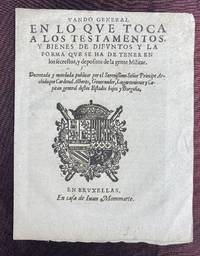
15963764Brussels: Juan Mommarte 1596. First Edition. Very good. Small 4to. 6 ff. with the arms of Spain on the title. Small wormhole in first three leaves affecting text but a very good crisp copy unbound. INHERITANCE LAW IN SPANISH-RULED FLANDERS IN 1596: WHAT DID SHAKESPEARE KNOW <br /> <br /> "Recent research on inheritance law in 'Hamlet' reveals that the author of that play had a precise and extensive knowledge of inheritance law and that this knowledge informs many aspects of the plot and the interrelationships of characters." SOURCE: "Could Shakespeare Think Like a Lawyer Inheritance Law in Hamlet: How Inheritance Law Issues in Hamlet May Shed Light on the Authorship Question" by Thomas G. Regnie in: Shakespeare Oxford Fellowship Online. <br /> <br /> Ours is certainly the copy described in the 1967 Quaritch Catalogue 883 Foreign Books Printed Before 1600 item 74 $14 and it is the only copy that has ever appeared on the market according to Rare Book Hub which currently lists more than 12 million transactions in its database. <br /> <br /> To our knowledge there are no copies outside The Netherlands. Juan Mommarte unknown
1572D4701Venice: F. Rampazeto 1572. Hardcover. Very Good. 8vo 175 x 120mm. 48 366pp. Signatures: a-f 8; A-YY 8; ZZ 8 -ZZ7-8 blank. Woodcut printers device on title of basilisk fighting a bird with motto Terrena coelestibus obsunt; in an architectural frame and woodcut historiated headpiece woodcut vignette beginning book of the Institutiones; on leaf 212r a full-page representation of the arbor civilis. Text is all-around gloss; printed in black and red. Dedicatory letter of H. Messaggius to Senator Federicus Baduarius prelim. leafs 2 is dated 1558. Period vellum three raised bands; leaves slightly offset slightly browned; hinge cracked at rear some quires loose rear pastedown glue-stained. The Corpus Iuris Civilis or the Justinian Code was the result of Emperor Justinians desire that existing Roman law be collected into a simple and clear system of laws or code. Tribonian a legal minister under Justinian lead a group of scholars in an effort to codify existing Roman law. The result was the first Justinian Code completed in 529. This code was later expanded to include Justinians own laws as well as two additional books on areas of the law. In 534 the Justinian Code made up of the Code the Digest and the Institutes was completed. Justinians collections were in ancient times always copied separately and afterwards they were printed in the same way. This part of the Institutiones falls under the whole Corpus Iuris Civilis is an early example before the unification under this heading. The present name of Justinians codification was only adopted in the 16th century when it was printed in 1583 by Dionysius Gothofredus. The legal thought behind the Corpus Juris Civilis served as the backbone of the single largest law reform of the modern age the Napoleonic Code which marked the abolition of feudalism. <br/><br/> [F. Rampazeto] hardcover
15779419Basel: Ex Officina Hervagiana Eusebius Episcopius 1577. Enlarged and revised edition. Folio in 6 275ff 375 cols. 7ff. Illustrated title page and colophon text in two columns woodcut initials. Modern gray paper over boards few splits to paper at head of spine black spine label with gilt lettering page edges stained red. Very fresh copy with nice cream paper some smudging and marginal soiling to rear signatures with one instance of marginal worming. Title with a few smudges else a near fine copy. <br /> <br /> Nice copy of this influential Renaissance dictionary of Roman civil law with very handsome title page that served as a foundational reference for early modern legal scholarship. The text was first printed in Basel in 1538 and later revised and expanded to reflect the continuity of Justinian law. Jakob Spiegel Ca. 1483-1547 was a lawyer scholar and legal counselor in the administration of Holy Roman Emperor Charles V. Ex Officina Hervagiana (Eusebius Episcopius) unknown
1596D12221Londoni: In Aedibus Ianae Yetsweirt relictae Caroli Yetsweirt armigeri 1596. Hardcover. Very Good. Half dark brown morocco and black cloth gilt-stamped lettering in spine compartments 5 raised bands black topstain; folio 294x198mm; 404 leaves title-page with ornamental woodcut border woodcut decorative initials printed in blackletter. Boards rubbed; light scuffing at spine tips along joints and edges of boards. Title page toned and lightly chipped along the edges with early ownership signature along top margin; third leaf first page of text detached laid-in; later manuscript leaf tipped-in at fol. 22. Bookplate of the New York City Bar Association. <br/><br/>Covers regnal years 1326-1335 Edward III. With an index of cases side-notes and cross-references. Edward's long reign of fifty years saw vital developments in legislation and government in particular the evolution of the English parliament. An extremely important source for our knowledge of medieval common law. In Aedibus Ianae Yetsweirt relictae Caroli Yetsweirt armigeri hardcover
1599013165London: Thomas Wight & Bonham Norton 1599. Book measures 29.5x20.5.cm. Pages numbered in sections circa 1500pp.Text in black letter. Bound in moderrn quarter calf cloth boards raised bands gilt lettering. Binding in very good clean firm condition. Internally decorative title page chipped with loss on edges not affecting text laid-down small hole in a couple of pages with loss of a few letters some period or early annotations. Pages in very good clean condition. A very nice copy. . Quarter Calf. Very Good. Small Folio. Thomas Wight & Bonham Norton Hardcover
1599007232London: Richard Field 1594 1599. Second English Edition . Quarter Calf. Good. 943 X. Quarter Calf. Second English Language Edition. Folio. Quarter Calf Over Marbled Boards. Pages 10 3/4" Tall All Three Edges Watered. Leather Is Quite Worn Joints Cracked Frayed At Corners With Small Losses Paper Covering The Boards Is Partly Worn Away At Edges. Lacks Initial Blank. Contemporary Gilt And Embossed Compartmented Spine. Signs Of Removed Bookplate On Front Pastedown. Hinges Cracked But Firm. Title Page With Complex "Anchora Spei" Ornamental Engraving Missing Lower Right Corner About One Square Inch Total With No Loss Of Text Or Ornament. Text Divided Into Twenty Books With Woodcut Ornaments And Initials For Each; Unpaginated Ten Page Table Index At End. Dedication To Queen Elizabeth I By Fenton. Small Waterstains Showing Irregularly At Bottom Of Some Pages Well Below Text Block. First Page Missing Lower Corner Adjacent To Spine With No Loss Of Text. Light 1/2" Ink Smear P. 8 With No Loss Of Text. Page 49 Mis-Numbered 53 Otherwise Correct. Page 57/58 With Two Inch Tear At Bottom Extending 1/2" Into Text Block With No Loss Of Text. Small Chip To Side Of Text Block On P. 135/136 Not Affecting Text. Page 161 Mis-Numbered 155 Otherwise Correct. One-Eighth-Inch Hole Through P. 209/210 Affecting One Letter. A Few Letters Near Bottom Of P. 212 Apparently Once Obliterated Or Misprinted Carefully Restored In Ink. About One And A Half Square Inches Of Lower Left Corner Of P. 235 Missing With No Loss Of Text Block But Loss Of Most Of Gloss Note At Bottom Of P. 235 X3. One-Eighth-Inch Hole At Top Margin Of P. 271/272 With Loss Of One Letter Of Gloss Note. One Eighth Inch Hole P. 327/328 With Loss Of A Letter On Each Page. There Are No Pages 460 Through 500; The Tenth Book Ends On Page 459 Rr As It So States In The Text And The Eleventh Book Begins On P. 500 P. 501 Is Rr2. One Quarter Inch Foxing Spot Pp 535-544 At Upper Left Margin At Edge Of Page Not Affecting Text. Page 584 Mis-Numbered 588 Otherwise Correct. Page 593 Mis-Numbered 597 Otherwise Correct. Pp599-603 Bbb3--Bbb4 Somewhat Browned. One Sixteenth Inch Spot Pages 641-643 Obscuring A Letter On Each Page. A One-Eighth-Inch Hole And Singed Margin Through Page 673/674 Causing Loss Of One Or Two Letters On Each Page 673-674. A Small Stain Spot Extending Through Pp713-721 Another Few Pp723-725 Without Obscuring Text. Small Stain P 736 Not Obscuring Text. There Is No Page 787-788; A Reading Of The Text On Pages 786 And 789 Indicates That The Text Is Complete Regardless. Page 798 Is Mis-Numbered 799 Otherwise Correct. Apparently A Former Water Stain Now Invisible Obscured A Few Letters On P. 802; These Have Been Re-Inked. De Sanctis Has Written " From The Point Of View Of Intellectual Power It Is The Most Important Work Ever To Come From An Italian Mind." A Printing And The Mind Of Man Title. First Published In 1561 Twenty One Years After Guicciardini's Death. Fenton's English Translation Was First Printed In London In 1579 And Went Through Three Editions In Fifty Years. The First Edition Of 1594 Is Rarely Seen. This Copy Is Still Quite Readable. <br/> <br/> London: Richard Field (1594) unknown
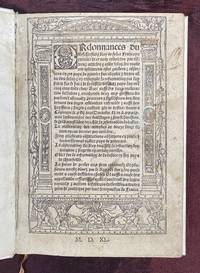
15403843Avignon and Lyon: Jehan de Channey and reissued in Lyon by Thibaud Payen 1540. Good. Small 4to. Collation: A-T6 lacking two leaves at end including colophon on T6v. Foliation: cv 7 of 9 ff. Woodcut title-border and initials throughout see below. Bound in modern Italian full vellum title in calligraphic manuscript on spine in red and black marbled endpapers edges at one time stained red. Title-page with two small worm tracks in lower blank margin diminishing through first two gatherings; verso of title with contemporary MS title and early ownership inscription abrasions suggest the removal of something that had been pasted down at one time; upper and outer margins closely cropped with frequent loss of headlines and shoulder notes; foxing and blemishes throughout; fol. K6 with large tear. A washed copy and strongly and inexplicably pungent. Preserved in a marbled slipcase tipped with citron morocco. With stated faults and priced accordingly. VERY EARLY FRENCH PROVENCAL LAWS AND STATUTES A RARE AND IMPORTANT EDITION BEAUTIFULLY PRINTED IN AN ELEGANT BATARDE TYPE WITH THE TEXT IN HIGH RENAISSANCE FRENCH AND A WOODCUT TITLE BORDER ATTRIBUTED TO GUILLAUME LEROY. <br /> <br /> This is a significant collection of royal ordinances and edicts promulgated by Francois I for Provence more specifically for the town of Forcalquier and adjacent lands. The original sheets were printed in 1536 in the Papal city of Avignon by Jehan de Channey with a privilege; the work was then reissued with a new title-page in 1540 either in Lyon by Thibaud Payen ut Bechtel or by Channey's son Bernard ut Betz. "Perhaps the priviledge might have been usurped or contested because the true first edition of the Ordonnances was printed in Lyon by Denys de Harsy in 1536 with a privilege of three years . Thus the edition of Channey could well be only a counterfeit favored by the political position of Avignon a dependence of the Papal States" M. Rouard in the 1860 Bulletin du bibliophile p. 1404 "Note sur les editions de la 'Meygra Entrepriza' d'Antoine Arena". <br /> <br /> Francois I ordered to be printed this collection of Provencal laws which sought to consolidate his authority as king of Provence which was subject to the incursions of Emperor Charles V and to bring regional justice closer to "common" i.e. Parisian forms. The collection shows that the king wished to appease Provencal legal custom by not modifying the existing Privileges or administrative frameworks; nonetheless the entire Provencal legal system was effectively brought under his control. <br /> <br /> Every aspect of the Provence law is addressed; of particular interest:<br /> <br /> -- The ordinance of Is-sur-Tille an edict intended to curb the abuses of Provencal magistrates by forbidding them among other things to use Latin during trials i.e. Villers-Cotterets ordinance.<br /> -- The edict of Joinville - 5 September 1535 which carries out a reform of justice and administration by strengthening the powers of parliament.<br /> -- Ordinance on the of the Navy -- January 17 1517 -- one of the first of its kind.<br /> -- Ordinance of Dijon 23 November 1535.<br /> -- Ordinance on wheat.<br /> -- Ordinance of King Rene of September 4 1438 against imperial and apostolic notaries<br /> -- Ordinance of King Rene prohibiting imperial and apostolic notaries if they were not invested with the royal investiture.<br /> -- Ordinances of Louis XII 1501 and 1502 an edict establishing the Parliament of Aix.<br /> -- Ordinance on the Gendarmerie - Bordeaux July 15 1530.<br /> -- Ordinance of Saint Germain -- July 24 1534.<br /> -- Edict establishing the 7 legions of "Gendarmerie" or footsoldiers an ordinance on tolls and repair of highways - Fontaine September 1535.<br /> -- Edict on "reforming the justice system" of Marsailles dated in manuscript "1535".<br /> -- Table of Ordonnances of Provence our copy lacks the final two leaves of the Table. <br /> <br /> Provence was not annexed to France until 1486 but even then was preserved as a separate administrated organization. Francois I strengthened royal authority through a series of reforms to control and optimize the management of the state and its territory. It was for these purposes that he had the Villers-Cotterets ordinance drawn up in 1539 certainly the best known and most enduring of his reign. He instituted French as the exclusive official language of the administration and initiated its civil status. The Montpellier Ordinance issued in 1537 gave rise to the legal deposit of printed publications from the Kingdom. <br /> <br /> The colophon on T6v which is not present in our copy reads: "Ces presentes ordonnances ont este imprimees en Avignon par Jehan de Channey l'an de grace 1536 au moys Daoust." Other copies of the 1540 reissue have additional works bound with it e.g. the Berkeley Law Library copy which collates A-T6 V4 2A-D4 E2. These added works are considered discrete bibliographical units. <br /> <br /> BIBLIOGRAPHIC NOTES: Judging from the title-page transcription in HOLLIS our Jehan de Channey edition must have a different title-page than that of Harvard Law Library; their transcription begins: "Ordonnances du treschrestien roy de frãce Francoys premier" etc. The cataloguer informs us that the 1540 edition is "the same as the 1536 Avignon edition except for a new t.p. and leaves 69142750. The son of the original printer reissued this; cf. Panzier." <br /> <br /> Whereas our copy lacks two leaves and has faults as stated we note with interest that the Friedlaender copy of the Denis de Harsy 1536 edition bound with two other works sold in 2001 at Christie's for $11162; a similar Sammelband was offered and sold by Messrs Sokol for EUR 11315. <br /> <br /> Baudrier vol. IX p. 303. Bechtel O-220. Collection des ordonnances des rois de France: Catalogue des Actes de Francois Ier" Vol. 9 p. 374. Repertoire bibliographique des livres imprimes en France au seizieme siecle I Avignon pp. 244-246 no. 50. Fairfax Murray / Davies French 411. USTC 22905. <br /> <br /> CENSUS: Bibl. Mejanes Aix-en-Provence; Bibl. municipale Livree Ceccano Avignon; Bibl. municipales Grenoble; Bibl. municipale Lyon; Univ. de Paris Bibl. Cujas; Arsenal; BnF; Berkeley Law; Harvard Law; Iowa University; UPenn; GWU. <br /> <br /> Further literature cited by Odysee Bibliotheque patrimoniale Aix / Marsaille Universite: Isambert Decrussy and Armet Recueil general des anciennes lois francaises depuis l'an 420 jusqu'a la revolution de 1789 1827 tome 9 p. 422-432 et p. 437 and tome 12 p. 137-148; p. 346-349; p. 355-356; p. 390-400; p. 414-491. Roger Aubenas Etude sur le notariat provencal au Moyen-age et sous l'Ancien Regime Aix 1931. Sylvain Soleil "L'ordonnance de Villers-Cotterets cadre juridique de la politique linguistique des rois de France" in: Langues et Constitutions Economica PUAM 2004 p. 19-34. Jehan de Channey (and reissued in Lyon by Thibaud Payen) unknown
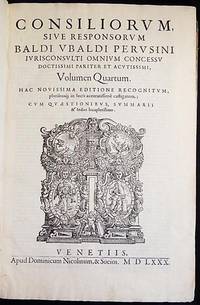
1580003503Venice: apud Dominicum Nicolinum & Socios Domenico Nicolino 1580. Hardcover. Very Good . Vols. 4 & 5 of 5 only. 2 volumes in 1. "Hac novissima editione recognitum pluribusq; in locis accuratissime castigatum; cum quaestionibus summarii & indice locupletissimo." 117 leaves 234 p. 139 leaves 278 p.; 37 cm. Signatures: A-P8 -P7 -P8 A-R8 S4 last leaf blank folio. Original parchment over boards. Five spine compartments between raised bands; hand-written title in first compartment. Handwritten identification also on lower page edges. Large and elaborate printer's device on title pages which combines the earlier printer's device of Domenico Nicolino a woman holding a wreath with three others presumably of the partners Socios referred to in the imprint. In Very Good Condition: original parchment over boards rubbed and soiled with loss of parchment at ends of spine and over raised bands; loss at lower corner of front board; small stain along lower edge of 5:2-22 not impacting text; minor soiling along lower edge of 5:42 verso and 5:43 recto; marginal worming in vol. 5; otherwise clean and bright. apud Dominicum Nicolinum, & Socios [Domenico Nicolino] hardcover
1567171<p>Folio 30.5 x 19.5 cm 10 ff. 307 i.e. 308 13 ff. including woodcut title showing Ferrara and Este arms and full-page woodcut portrait of the printer Rossi on EEEviii v. Bound in 18th-century stiff vellum title stenciled on spine. Some minor staining in scattered leaves and some trivial worming in margin but generally a broad-margined and fresh copy excellent. Rare and most likely the earliest acquirable edition of the municipals laws of Ferrara one of the richest and most cultivated of Northern Italian courts published shortly after the concluding session of the Council of Trent 1563. The work contains one of the earliest portrait of a printer in a book he himself produced see below. The work significantly revises the previous publication of local statutory law and is signed by a committee of local jurists 3v-4r. The statutes govern all aspects of civil and criminal law from the buying and selling of goods and property marriage testaments to criminal procedure. The work is of interest for containing a portrait of the printer. Note: Rossi had no editorial or authorial part in the work; he is expressly designated "Typographus" printer in the identifying legend. This is of interest to historians of the book for it showing the developing confidence and prestige enjoyed by 16th-century printers and is analogous though considerably more assertive to putting an element of the printer's process or trade in a publisher's device. "Rossi was near the end of a career as a printer at Ferrara that covered more than 50 years and certainly justified the use of his portrait in this volume" Mortimer I.261. Although it should be regarded as a form of self-indulgence and did not catch on-as say the author portraits on which it is based obviously did-it nonetheless remains an interesting bit of evidence for the elevated status of Italian printers. There is no repertory of examples and we know of no study of the subject but in querying colleagues we have located only two earlier analogous portraits: Rossi pictured himself in smaller format in the colophon to another book he published: Giovanni Maria Verrato's 1561 response to critics of the Council of Trent: Contra responsiones et protestationes. And Francesco Priscianese pictured himself in a Latin grammar published in 1540. Also Prof. Anthony Grafton draws our attention to the portraits of the illustrators in the Historia Stirpium of Leonhart Fuchs 1542. Further searching would doubtless turn up a few other examples but it is clearly an isolated phenomenon The statutes received an incunable edition in 1476 published by Severino da Ferrara BMC VI.609 the only copy we have been able to locate: this edition is not in Goff and we locate no American copy. The next edition was published by Rossi in 1534 with a less elaborate version of the title cut and without the portrait. The present edition is next making it third. According to Mortimer the hypothetical issue points raised by F. Berlan in his Bibliografia degli statuti municipali ed inediti di Ferrara Rome 1878 pp. 21-7 are in need of substantial copy-checking. There are no copies of the editio princeps or the 1534 edition in America; for the present edition OCLC lists Kansas Minnesota and the Waseda Library to which should be added the Harvard copy described by Mortimer. Mortimer Italian 182; Adams F266; Fumagalli Lexicon p. 128 fig 45 portrait; L. Manzoni Bibliografia degli statuti ordini e leggi dei municipali italiani I.2 Bologna 1876 pp. 177-78.</p> Francesco Rossi hardcover
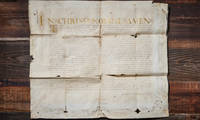
15852363525/09/1585. <blockquote><p>The Renaissance was a period of crucial cultural artistic social and financial development in late Medieval and Renaissance Italy and particularly the affluent cities of Florence Venice Genoa and Padua.</p></blockquote><p>The Holy Roman Empire spanned central Europe in one form or another for the span of a millennia. For much of that time it contained vast swaths of Italy mainly in the north and included the Italian city of Padua which would become a hub in the Renaissance in that country and a major university center. As the Middle Ages bled into the period of the Renaissance the Empire slowly lost direct control over Italy. It managed to maintain its power into the 16th century in part via old established orders that maintained local control.</p><p>Among these Holy Roman imperial titles was the ""comes palatinus caesareus"" or the imperial count palatine. The office of imperial count palatine was hereditary and the emperors seem to have used it to create an Italian aristocratic class loyal to the empire. In 1357 the Emperor Charles IV added the power of conferring licenses and doctorates of civil law to those of the counts palatine. Later on they acquired the power to confer doctorates in general. In 1363 Charles himself bestowed this honor to Giacomo Santacroce. His heir to this title and power given by it which was significant was Giovanni Santcroce who in addition to being the benefactor for religious and cultural efforts in the region was a businessman.</p><p>The Facino or Facini family was a prominent one from the town of Feltre. The Ioannes Baptista Facinus namd in the document was prominent in the cultural community. There remains today a church bearing the crest of this family constructed shortly before his birth.</p><p>Francisco Fabriano and Andreas Tinto were important functionaries and notaries of the period in Padua.</p><p><strong>Document signed</strong> September 25 1585 in Latin using the Latin names of the people involved including The Holy Roman Emperor Charles signed by important figures of the late Italian renaissance. In it <em>""Ioannes Sancta Cruce""</em> bestows the position of <em>""comes palatinus caesareus""</em> on <em>""Ioannes Baptista Facinus""</em> and all his male heirs. The document is witnessed and signed not only by Santa Cruce himself described as <em>""the most excellent lawyer lord count soldier knight horseman of the Court of Caesar""</em> but also by Fabriano and Tinto. The document is likely in the hand of Tinto himself.</p><p>Such Italian Renaissance documents are very uncommon. The most direct comparable was acquired by J.P. Morgan and is now in the Morgan Library.</p><p>There is an extended portion in the middle about Holy Roman Emperor Charles IV who it describes in 1357 added the power of conferring licenses and doctorates of civil law to the position.</p><p><img class=""alignnone wp-image-23609 size-post-window"" src=""https://cdn.raabcollection.com/wp-content/uploads/20231204153244/Folder-site-6-1600x1327.jpg"" alt="""" width=""1600"" height=""1327"" /></p> unknown