John LawBiblio.com
187 résultats
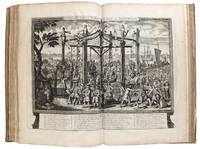
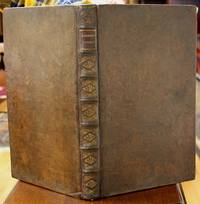
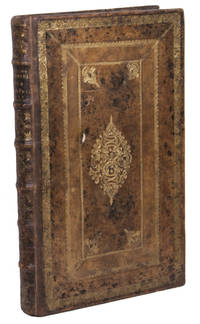
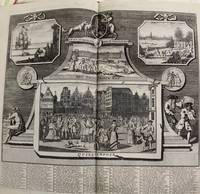
1720B4227Netherlands c. 1720. A few tears in the plates expertly repaired; mispagination in 3rd part pp. 26 jumps to 29 but foliation remains constant no loss; see below for information on plates; otherwise a fine copy of this infamous work bound in decorative gilt 18th-century Dutch full calf.<br>Plates and text are clean and crisp.<br>. Edition: First edition later issue Binding: Contemporary 18th-century gilt-panelled mottled calf with arabesque centerpiece on covers spine in seven compartments of raised gilt bands and gilt floral motifs morocco label on two board edges gilt-tooled. Rebacked skillfully. Notes: Text in Dutch. “This great Theatre of Folly representing the origin progress and downfall of the South Sea Bubble in France England and Holland is an exceedingly curious collection of emblematical plates and caricatures on the scheme of J. Law and the Mississippi Company and the imitations of it in Holland with their fatal results. Not a few of the scenes here depicted have been reproduced in the New York Exchange. The engravings which illustrate the rise and fall of the great speculation are full of humor; many of them are exceedingly ludicrous and some very obscene. They are finely engraved on copper and are accompanied with full descriptions in prose and poetry. So much offence was given to the English and French by this book that medals were struck by them in ridicule of the Dutch which was perhaps the beginning of the hostility which long existed in the minds of the English against the latter. The number of the plates in copies varies from sixty to seventy-four.†<br><br>The first edition of the most elaborate publication was inspired by the economic events of 1720 primarily satirizing Dutch manifestations of the speculative mania that led to the Mississippi Bubble in France a financial scheme that shook the French economy to its core and instigated the use of paper money in the country; engineered by Scottish economic theorist John Law and the South Sea Bubble in England.†Sabin<br> Size: Folio 390x240mm Illustration: With 61 copper engraved plates including caricatures portraits and 2 maps – one finely hand-coloured- of which some are single- page many double-page and larger some folding. Title in red and black.<br>At publication copies of this book were composed with whichever caricature plates were at hand at the time resulting in a great variation in the number of plates contained in each some as few as 46 others as many as 84. Generally the typical complement of illustrations of the first edition was 74 plates --this copy has 61 in total. It contains plates# 3-8 10-26 28-33 35-37 39-43 45 47-56 58 60-64 66x2-68 70 73 according to Koninck's rarely preserved list of plates seen in early editions plus a portrait entitled ‘’een schooner Lotkrans…’’. Volume: 5 parts in 1 volume. References: Ref: Alden European Americana 720/114; Cole The Great Mirror of Folly pages 23-35; Sabin Bibliotheca Americana 28932; Goldsmith 5879; Howes G 442; Muller America 1503 Pages: P. Plate 64 Map illustrated title bl. 1-25 list of towns in report 1-31 bl. 1-26 29-52 1-8 1-9 bl. including 60 engravings. Category: Book Caricatures; Book Plate Books General; Book Europe Benelux; unknown
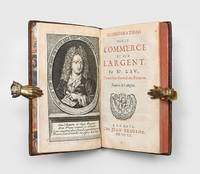
1720182235The Hague: Chez Jean Neaulme 1720. Stimulating the French economy after the wars of Louis XIV First edition in French of Law's seminal disequilibrium theory of money published as the Mississippi Bubble was coming close to bursting. By 1720 Law had finally been appointed minister of finance in France and was in near-total command of the French economy. At the same time his scheme to monopolize the commercial development of French North America was running into difficulties: shares in the Mississippi Company stagnated amid increasing reports of underdevelopment in the French colonies. By December these shares had crashed completely sparking a general stock market crash in France and prompting Law to flee to Venice. Considerations had originally been published in English as Money and Trade Considered in 1705 when Law was attempting to persuade the Scottish government of his ideas. He was bitterly opposed to this French edition not least because it revealed details of the man he had killed in a duel 25 years earlier. Although ruinous to many individual investors Law's system is generally credited with stimulating the French economy exhausted after Louis XIV's wars. Octavo 158 x 95 mm pp. viii 168 167-187 19. Engraved portrait frontispiece title page printed in red and black and with woodcut device woodcut headpiece. Contemporary mottled calf spine ruled and decorated in gilt and with red morocco label marbled endpapers edges red green silk book marker. With 20th-century library ticket. Restoration to joints and extremities. Minor browning and foxing to contents: a very good copy. Einaudi 3274; Goldsmith's 5820; Kress 3235; STCN 202328686. unknown
1720ABC_50107Amsterdam 1720. Contemporary gold-tooled mottled calf with the title and year lettered in gold on the spine sewn on 7 supports with the corresponding raised bands on the spine bound by the Double Drawer Handle Bindery in Amsterdam Storm van Leeuwen. Folio. With the title page printed in red and black and 79 engraved plates most double-page and several larger folding sheets including several maps and the plate with the complete set of 52 playing cards. The copy contains the register listing 74 items and 4 plates not in Mullers principal list Muller 3611note 3612 3613 and 3615. Second edition according to Muller of one of the most remarkable works in the history of finance. Few books equal the visual power satirical brilliance or bibliographical complexity of Het groote tafereel der dwaasheid. First published in Amsterdam in 1720 in the very year of the financial collapses it depicts this extraordinary work stands as the most ambitious and visually arresting contemporary response to the speculative mania that engulfed France England and the Dutch Republic.The work chronicles the rise frenzy and catastrophic collapse of the Mississippi Scheme in France under John Law 1671-1729 and the South Sea Bubble in England speculative ventures designed in part to consolidate and manage national debt in Englands case tied to the funding of the navy but which spiralled into one of the first great international stock market crashes. Laws Compagnie dOccident with its monopoly over Louisiana and trade along the Mississippi ignited feverish dealing in Paris Rue Quincampoix London answered with its own speculative excesses and the contagion swiftly spread to Amsterdam.The Dutch seasoned participants in organised finance responded not merely with alarm but with satire of unparalleled inventiveness. The Tafereel der dwaasheid gathers together emblematic engravings caricatures poems plays pamphlets and moralising texts all exposing the greed credulity and collective madness of the wind trade transactions in nothing more substantial than air.The engravings are by turns humorous grotesque theatrical and occasionally deliberately obscene. They chart the entire arc of speculation: the seduction of investors the carnival atmosphere of trading houses and coffee rooms the frenzied crowds and finally ruin and flight. Law himself appears in portrait placed squarely at the centre of events.The publication history of the Tafereel der dwaasheid is famously intricate. Four editions of the letterpress are known the present work corresponds to the second edition as classified by Muller. Within each edition the number and arrangement of plates varies considerably from copy to copy. Muller recorded 74 plates in the most extensive contemporary published list and several plates frequently encountered are listed seperately. The present work is complete according to the engraved register listing 74 items also present at the start of the work although several plates appear here in their variant often later states. It also includes 4 plates showing portraits and a map of Louisiana not in Mullers principal list Muller 3611-3613 and 3615 including different portraits and the map of Louisiana on the Mississippi.Together they form one of the most striking and bizarre monuments in all economic literature a merciless visual anatomy of financial hysteria.The present work appears here in a striking contemporary gold-tooled binding. This binding is the work of the so-called Double Drawer Handle Bindery according to Jan Storm van Leeuwen. The decorations are made up from numerous impressions of 12 different stamps and 4 different rolls. The bindery was active in Amsterdam between circa 1697 and 1742 and is regarded as the most important Amsterdam workshop of the eighteenth century.The binding is very slightly rubbed the hinges and edges and corners of the boards show signs of wear. Occasional browning and staining some plates show small tears mainly along the folding lines and often repaired/reinforced with paper on the verso without any loss. Plates 33 no. 32 in Muller 77 and 78 nos. 73 and 74 in Muller loose in binding. Otherwise in very good condition.l Cole The Great Mirror of Folly nrs. 1-4 6-8 10-71 73; De Bruyn Het Groote Tafereel in: Eighteenth-Century Life XXIV 2000 pp. 62-87; Goetzmann The Great Mirror of Folly 2013 esp. pp. 35-51 bibliogr. analysis by K. Forrer; Kress 3217; Landwehr 230; Lipperheide Xf 5; Muller Historieplaten esp. nos. 3536-3609; pp. 103-131; Sabin 28932; STCN various issues and made-up copies: the present work resembles 254984185; cf. for the binding: Storm van Leeuwen Dutch Decorated Bookbinding in the Eighteenth Century pp. 228-284. hardcover
172520771Amsterdam 1725. Folio. 15 3/8 x 9 3/4 inches. Title printed in red and black. Folding engraved frontispiece engraved list of plates within a decorative surround 72 engraved plates maps and broadsides on 73 leaves 5 of the single-page plates cut to the edge of the image and mounted as issued 45 double-page 19 folding and including 10 which combine both engraving and letterpress text one plate loosely inserted 2 with sections of blank margins torn away some other clean tears occasionally affecting the image area. Contemporary Dutch speckled calf spine in eight compartments with raised bands red morocco lettering-piece in the second compartment repeat decoration in gilt in the others.<br/> <br/> A rare work exhibiting a collection of contemporary satirical prints relating to the financial exploits of John Law and his infamous Mississippi Bubble.<br/> <br/> John Law 21 April 1671 - 21 March 1729 was a Scottish economist who believed that money was only a means of exchange that did not constitute wealth in itself and that national wealth depended on trade. He is said to be the father of finance responsible for the adoption or use of paper money or bills in the world today. Law was a gambler and a brilliant mental calculator and was known to win card games by mentally calculating the odds. An expert in statistics he was the originator of economic theories including two major ideas: The Scarcity Theory of Value and the Real bills doctrine. The present work records the economic crisis precipitated by Law. The crisis had its origins in the decision of the French regent Philippe d'Orléans to appoint John Law the Controller General of Finances for France. In May 1716 the Banque Générale Privée which developed the use of paper money was set up by Law. It was a private bank but three quarters of the capital consisted of government bills and government accepted notes. In August 1717 he bought the Mississippi Company to help the French colony in Louisiana. In 1717 he also brokered the sale of Thomas Pitt's diamond to the regent Philippe d'Orléans. In the same year Law floated the Mississippi Company as a joint stock trading company called the Compagnie d'Occident which was granted a trade monopoly of the West Indies and North America. The bank became the Banque Royale in 1718 meaning the notes were guaranteed by the king. The Company absorbed the Compagnie des Indes Orientales Compagnie de Chine and other rival trading companies and became the Compagnie Perpetuelle des Indes on 23 May 1719 with a monopoly of commerce on all the seas. The system however encouraged speculation in shares in The Company of the Indies the shares becoming a sort of paper currency. In 1720 the bank and company were united and Law was appointed Controller General of Finances to attract capital. Law's pioneering note-issuing bank was extremely successful until it collapsed and caused an economic crisis in France and across Europe. Law exaggerated the wealth of Louisiana with an effective marketing scheme which led to wild speculation on the shares of the company in 1719. In February 1720 it was valued for a very high future cash flow at 10000 livres. Shares rose from 500 livres in 1719 to as much as 15000 livres in the first half of 1720 but by the summer of 1720 there was a sudden decline in confidence leading to a 97 percent decline in market capitalization by 1721. Predictably the bubble burst at the end of 1720 when opponents of the financier attempted en masse to convert their notes into specie. By the end of 1720 Philippe II dismissed Law who then fled from France. Originally published by a group of Amsterdam booksellers the work has a convoluted bibliographic history owing to the ongoing enlargement of the number of prints published between late 1720 and the ensuing years coupled with the issuance of the plates as separate unbound sheets as well as later editions with yet more plates which maintained the title page dated 1720. In short nearly every extant example is unique in composition. "This remarkable complexity helps to explain why the book continues to fascinate scholars and readers to the present day: Het groote tafereel der dwaasheid in its many diverse copies represents an important witness to the events of 1720 and their aftermath which makes it valuable to cultural and economic historians . The book presents the rise progress and downfall of the deceptive trade of 1720 what that a group of booksellers who published it in 1720 when in Amsterdam where in order to restore social and ethical norms in Dutch society why by making fools of the greedy in a theatrical setting how. In short the Tafereel is an Amsterdam-born satirical comedy in disguise" Kuniko Forrer "Het groot tafereel der dwaasheid: A Bibliographical Interpretation" in The Great Mirror of Folly: Finance Culture and the Crash of 1720 Edited by William N. Goetzmann et. al. pp. 35-36. The present example corresponds to Forrer's third edition issued shortly after 1723 with the "Register" listing 73 plates and bound in a contemporary binding attributed to the Double Drawer Handle Bindery. This edition noted as the final edition published in the 1720s and the most complete including portraits of Madame Law and the King of the Mississippi "Der Koning van Missisipi" not found in earlier issues among other additions. This copy is accompanied by: GOETZMANN William N. et al. The Great Mirror of Folly: Finance Culture and the Crash of 1720. New Haven: Yale University Press 2013. The definitive modern study of the present work edited by William N. Goetzmann Catherine Labio K. Geert Rouwenhorst and Timothy Young. The volume reproduces and interprets the full range of plates satires and texts situating it within the broader visual and cultural history of the early modern financial revolution. Richly illustrated and deeply researched it brings together essays by leading scholars on economic thought print culture theatre and art illuminating how Law's System and the speculative mania of 1720 transformed Europe's understanding of credit risk and value.<br/> <br/> Goldsmiths 5829; Kress 3217; Muller 3535; Sabin 28932; A.H. Cole The Great Mirror of Folly . an economic-bibliographical study Harvard: 1949; The Great Mirror of Folly: Finance Culture and the Crash of 1720 Edited by William N. Goetzmann et. al. Yale University Press: 2013. unknown
172542567Amsterdam 1725. Folio. 15 3/8 x 10 inches. Title printed in red and black. Folding engraved frontispiece engraved list of plates within a decorative surround 1 title page and 87 engraved plates maps and broadsides 40 double-page 22 folding single-page 6 folding double-page and 17 single-page. Includes some plates with multiple variants. Vellum tooled gilt with 8 raised bands forming 9 compartments spine gilt morocco lettering piece in second compartment<br/> <br/> A rare work exhibiting a collection of contemporary satirical prints relating to the financial exploits of John Law and his infamous Mississippi Bubble.<br/> <br/> John Law 21 April 1671 - 21 March 1729 was a Scottish economist who believed that money was only a means of exchange that did not constitute wealth in itself and that national wealth depended on trade. He is said to be the father of finance responsible for the adoption or use of paper money or bills in the world today. Law was a gambler and a brilliant mental calculator and was known to win card games by mentally calculating the odds. An expert in statistics he was the originator of economic theories including two major ideas: The Scarcity Theory of Value and the Real bills doctrine. The present work records the economic crisis precipitated by Law. The crisis had its origins in the decision of the French regent Philippe d'Orléans to appoint John Law the Controller General of Finances for France. In May 1716 the Banque Générale Privée which developed the use of paper money was set up by Law. It was a private bank but three quarters of the capital consisted of government bills and government accepted notes. In August 1717 he bought the Mississippi Company to help the French colony in Louisiana. In 1717 he also brokered the sale of Thomas Pitt's diamond to the regent Philippe d'Orléans. In the same year Law floated the Mississippi Company as a joint stock trading company called the Compagnie d'Occident which was granted a trade monopoly of the West Indies and North America. The bank became the Banque Royale in 1718 meaning the notes were guaranteed by the king. The Company absorbed the Compagnie des Indes Orientales Compagnie de Chine and other rival trading companies and became the Compagnie Perpetuelle des Indes on 23 May 1719 with a monopoly of commerce on all the seas. The system however encouraged speculation in shares in The Company of the Indies the shares becoming a sort of paper currency. In 1720 the bank and company were united and Law was appointed Controller General of Finances to attract capital. Law's pioneering note-issuing bank was extremely successful until it collapsed and caused an economic crisis in France and across Europe. Law exaggerated the wealth of Louisiana with an effective marketing scheme which led to wild speculation on the shares of the company in 1719. In February 1720 it was valued for a very high future cash flow at 10000 livres. Shares rose from 500 livres in 1719 to as much as 15000 livres in the first half of 1720 but by the summer of 1720 there was a sudden decline in confidence leading to a 97 percent decline in market capitalization by 1721. Predictably the bubble burst at the end of 1720 when opponents of the financier attempted en masse to convert their notes into specie. By the end of 1720 Philippe II dismissed Law who then fled from France. Originally published by a group of Amsterdam booksellers the work has a convoluted bibliographic history owing to the ongoing enlargement of the number of prints published between late 1720 and the ensuing years coupled with the issuance of the plates as separate unbound sheets as well as later editions with yet more plates which maintained the title page dated 1720. In short nearly every extant example is unique in composition. "This remarkable complexity helps to explain why the book continues to fascinate scholars and readers to the present day: Het groote tafereel der dwaasheid in its many diverse copies represents an important witness to the events of 1720 and their aftermath which makes it valuable to cultural and economic historians . The book presents the rise progress and downfall of the deceptive trade of 1720 what that a group of booksellers who published it in 1720 when in Amsterdam where in order to restore social and ethical norms in Dutch society why by making fools of the greedy in a theatrical setting how. In short the Tafereel is an Amsterdam-born satirical comedy in disguise" Kuniko Forrer "Het groot tafereel der dwaasheid: A Bibliographical Interpretation" in The Great Mirror of Folly: Finance Culture and the Crash of 1720 Edited by William N. Goetzmann et. al. pp. 35-36. The present example corresponds to Forrer's third edition issued shortly after 1723 with the "Register" listing 73 plates and bound in a contemporary binding attributed to the Double Drawer Handle Bindery. This edition noted as the final edition published in the 1720s and the most complete including portraits of Madame Law and the King of the Mississippi "Der Koning van Missisipi" not found in earlier issues among other additions.<br/> <br/> Goldsmiths 5829; Kress 3217; Muller 3535; Sabin 28932; A.H. Cole The Great Mirror of Folly . an economic-bibliographical study Harvard: 1949; The Great Mirror of Folly: Finance Culture and the Crash of 1720 Edited by William N. Goetzmann et. al. Yale University Press: 2013. unknown
1720B5707c. 1720 . Altogether a very good and attractive copy of this important caricature platebook.<br>. Edition: First Edition Binding: Contemporary full calf with raised bands in 7 compartments. Text on 2 gilt centerpieces and decorative borders in compartments. Notes: Text is in Dutch. “This great Theatre of Folly representing the origin progress and downfall of the South Sea Bubble in France England and Holland is an exceedingly curious collection of emblematical plates and caricatures on the scheme of J. Law and the Mississippi Company and the imitations of it in Holland with their fatal results. Not a few of the scenes here depicted have been reproduced in the New York Exchange. The engravings which illustrate the rise and fall of the great speculation are full of humor; many of them are exceedingly ludicrous and some very obscene. They are finely engraved on copper and are accompanied with full descriptions in prose and poetry. So much offence was given to the English and French by this book that medals were struck by them in ridicule of the Dutch which was perhaps the beginning of the hostility which long existed in the minds of the English against the latter. The number of the plates in copies varies from sixty to seventy-four.†<br><br>This first edition of the most elaborate publication was inspired by the economic events of 1720 primarily satirizing Dutch manifestations of the speculative mania that led to the Mississippi Bubble in France a financial scheme that shook the French economy to its core and instigated the use of paper money in the country; engineered by Scottish economic theorist John Law and the South Sea Bubble in England.†Sabin<br> Size: Folio 394x235mm. Illustration: Illustrated with red and black title 74 engraved plates including many double-page or folding; 70 of 74 plates as listed in Koninck's rarely preserved index of plates of early editions; plates 26 29 39 and 71 of this list are not included but instead four other plates one of these a map entitled “Louisiana by the River Mississippiâ€. References: Alden European Americana 720/114; Cole The Great Mirror of Folly pages 23-35; Sabin Bibliotheca Americana 28932; Goldsmith 5879; Howes G 442; Muller America 1503 Pages: Title bl. 25 list of towns; 1-52; 1-14; detached insert of four letters 195x156mm: 1st: title bl. 1-10; 2nd: title bl. 1-10; 3rd: title bl. 1-10; 4th: title bl. 1-9; 15-26 29-31 bl. 1-8. Category: Book Caricatures; Book Europe Benelux; Book Europe France; Book Plate Books General; hardcover
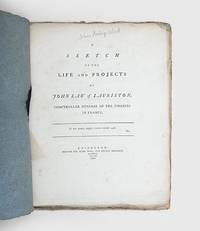
1791173742Edinburgh: for Peter Haill and George Kearsley London 1791. The first biography of the economic pioneer First edition of the first biography of Law whose financial schemes of an expanded paper money supply brought economic ruin to France yet paved the way for the modern credit economy. The biographer John Philip Wood was a local historian of Cramond where Law was born. He had "access to certain materials which are not now available" and "included a number of interesting genealogical and personal details in his book" though he "made no attempt to examine the 'system' objectively or even to analyse his subject's character in the light of his career" Hyde pp. 36 216. Both Antoin Murphy and James Buchan cite Wood's work in their scholarly biographies of Law although part of Wood's account of Law's genealogy is challenged by Murphy. The work was republished in an expanded edition in 1824. Quarto pp. 4 ii 48. Original stab-sewn blue wrappers edges uncut. Housed in 20th-century clamshell portfolio backed with earlier marbled paper. Rear wrapper detached a little chipped and torn at extremities light spotting and patch of toning to title page else contents fresh: a very good copy. ESTC T8458; Goldsmiths' 14941; Kress B2240. H. Montgomery Hyde John Law 1969. unknown
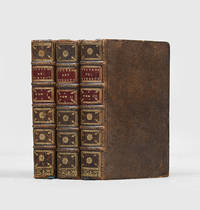
1739164842The Hague: Pierre de Hondt 1739. The best contemporary account of John Law's system First edition of Marmont's history of French finance during the minority of Louis XV an important record of the activities and operations of John Law. A tax collector from Flanders Marmont was a great admirer of Law's system despite its dramatic collapse in 1720. He covers Law's foundation of the Banque Générale through to the formation of the Compagnie des Indes which by absorbing various other chartered companies acquired the monopoly on trade to Africa America and the Far East. This finally transformed into the Mississippi Company giving Law control of France's finances most notably tax collection and debt management. 6 vols bound in 3 duodecimo 160 x 93 mm. Engraved plate in vol. 4 2 folding letterpress tables printed on both sides in vol. 6 woodcut devices and vignettes title pages printed in red and black. Contemporary sprinkled calf spines decorated in gilt in compartments red morocco labels marbled endpapers red edges silk bookmarkers. Head of spines of vols 2 and 3 slightly chipped corners worn front cover of vols 1 and 2 slightly darkened in places; marginal stain to fore edge of preliminary leaves of vol. 1 contents otherwise clean and fresh: a very good copy. Einaudi 3728; Goldsmiths' 7712; INED 1553; Kress 4447; Mattioli 2247; Sraffa 3776. unknown
1720B6829Amsterdam. 1720. Plates are clean and crisp.<br><br>. Edition: First Edition. Binding: Full contemporary mottled Dutch calf expertly rebacked in matching calf. Matching upper and lower boards with triple frame of decorative gilt fillet and a panel of darker calf between inner two gilt frames. Gilt stamp in centers of boards. Spine with 5 raised bands decorative gilt fillet on bands and in compartments. Title in gilt lettering on brown label in 2 remaining compartments with gilt stamps. Decorative gilt rolls on board edges. Notes: “The engravings which illustrate the rise and fall of the great speculation are full of humor; many of them are exceedingly ludicrous and some very obscene†Sabin. “Published in Amsterdam the giant tome includes pamphlets legal documents economic analyses maps satirical plays poems playing cards and more than seventy prints. The volume attracted wide audiences feeling the sting of the financial crises taking place in England France and the Dutch Republic that together resulted in the first international stock market crash.â€<br>“Het Groote Tafereel der Dwaasheid references Tulipmania in the Dutch Republic where the prices of tulip bulbs spiked and abruptly plummeted in 1637; the South Sea Bubble in England and Mississippi Bubble in France that burst in 1720; and other British French and Dutch enterprises that failed in 1720. Investing frenzy is characterized as a form of contagion moving from one country to the next: a consequence of the craze for international emulation as was evident in the English for example adopting the measures of John Law’s Mississippi Company that ultimately resulted in the South Sea Bubble. Prints in the volume commonly depict the dreams disordered states of mind and moral failures of investors caught up in the speculative zeal—alluding to herd behavior gambling corruption insanity immorality and demonic possession.â€<br>The text first appeared in 1720/21 and continued to be reprinted throughout the 18th century. Very few copies of this book survive as most were broken apart so that engravings could be sold individually. Professor Arthur Cole writes: “Rarely does a single volume combine in itself so much economic interest and so many bibliographical puzzles as Het Groote Tafereel Der Dwaasheid. There is scarcely another item just like it. Not merely are the identity of the compiler and the place of publication unknown and not merely is the date of original issuance uncertain but the volume went through an evolutionary process over time quite unnoticeable by ordinary superficial inspection. Moreover so strange was the mode of issuance that no two specimens even of approximately the same actual issue date are exactly the same. Neither the textual material nor the engraved prints are always identical nor do they appear in the same sequence within the volume.â€<br><br> Size: Folio 390x248 mm Illustration: Text in Dutch.<br>With the exceedingly rare index leaf. Extra illustrated with 80 plates.<br>A near fine example of this “extraordinary visual record of the first banking crash showing the shocking effects of the South Sea Bubble in France England and Holland and placing John Law 1671-1729 with his Mississippi company scheme squarely at the centre of the disastrous chain of events. ‘A unique historical document … of real significance’†Cole p.1. This copy is complete with the 74 plates listed in the very scarce index leaf included in this text in addition to 6 extra plates; 80 plates in total. With many folding and double-page plates. Includes frontispiece original engraving of John Law and a deck of “bubble cards.†Title in red and black. Pg. 43 mislabeled as 23. In full contemporary decorative Dutch calf. References: Cole Great Mirror of Folly 1949; Goldsmiths' 5879; Kress 3217; Sabin 28932. Pages: Blank 2. Frontispiece. Blank. Title. Blank. Index. P. 1 – 25. Aanwyzinge Der Projecten. 1 – 52. Versameling van Gedigten… 1 – 31. Blank. Papegaay of Actie-Kaart… 1 – 8. Copye Van Een Brief… 1 – 10. 80 plates. Blank 2. Category: Book Caricatures; Book Europe Benelux; Book Plate Books General; hardcover
1720297394Amsterdam 1720. First. hardcover. very good. Rubricated title 25 1 52 31 10 pages 74 copper engraved plates 58 folding including 3 maps 2 folding and 1 plate laid in. Bookplate of Dutch writer Jan Te Winkel pasted on upper corner of title page. Light dampstain on the top margin of some plates. Folio full contemporary mottled calf elaborately gilt spine and covers black leather spine label rubbed at corners and bottom of spine. Amsterdam: 1720. Very good.<br/> <br/> Contemporary Dutch account of the Mississippi Land bubble. A renowned monument for the speculative mania of 1720: The great mirror of folly showing the rise progress and downfall of the bubble in stocks and windy speculation in France England and the Netherlands. It constitutes a collection of mostly satirical plates on the operations of John Law in France and the South Sea Bubble in England together with the text of the charters of speculative companies in Holland and a number of satyrical plays and comedies published during the bubble. The first text-part reprints the charters of some 30 speculative companies of commerce navigation and assurance' established or at least projected in Holland between June and October 1720. The following parts contain comedies and poetry published during the mania an explanation of the large print with playing cards known as April-kaart'. The book is divided into six sections with no general table of contents. The first part contains the articles of various Dutch companies. The second section consists of comedies and farces; the third part poems often containing street language; the fourth part descriptions of playing cards satirizing speculators; the fifth part four letters to "N.N."; and the sixth section chiefly pictures. A.H. Cole The Great Mirror of Folly Boston 1949; Kress 3217; Sabin 28932.<br/> <br/> unknown
1720J68DA7J71DZAAmsterdam 1720. Folio ca. 39 x 25.5 cm. Contemporary elaboratly gold-tooled mottled calf sewn on 6 supports with corresponding raised bands on the spine and with the title lettered in gold on the spine gold-tooled board edges marbled edges bound by the so-called Double Drawer Handle Bindery in Amsterdam between 1720 and 1742 - Storm van Leeuwen With the title-page printed in red and black and 76 engraved plates mostly double-page and several are larger folding sheets including several maps the plate with the complete set of 52 playing cards and an extra copy of plate 18 Muller loosely inserted at the front of the work. 1 1 blank 25 1 52 "31" = 29 1 blank 8 10 pp. and engraved ll. A famous collection of texts and plates satirizing the Englishman John Law his Mississippi Company and the international land and trading speculation in worthless shares of the South Sea Bubble of 1719-1720 which resulted in an international scandal. The speculation began in Paris London and Hamburg spreading to the Netherlands in the summer of 1720. While plays satirizing the speculation already opened in September 1720 the bubble really burst in October. Pieter Langendijk and Gysbert Tysens have been identified as authors of some of the plays. The book also provides the texts of official documents relating to the Dutch trading companies involved.Text and plates were originally issued in parts and were continuously supplemented over a longer period. Work on the book as a whole must have begun after the Amsterdam disturbances of 5 October 1720 though some of the plays and other items had been separately published before that. There are four editions known of the letterpress of which this one is listed as the first by Muller. Within each edition the number and makeup of the plates varies greatly from copy to copy. Muller gives a list of 74 plates in the most extensive contemporary published list but no copy of any edition includes them all some are alternatives and several plates frequently included are not in those lists. The present copy includes 72 in Muller's list of 74 omitting nos. 57 and 74 and includes 4 not in that list Muller 3611-3613 and 3615. The book is an important source for multidisciplinary research e.g. iconology economic history colloquial proverbs and idioms.The binding is very slightly rubbed the joints have been professionally reinforced slightly browned throughout some plates show small tears along the folding lines without any loss. Otherwise in very good condition.l De Bruyn "Het Groote Tafereel . " in: Eighteenth-Century Life XXIV 2000 pp. 62-87; Kress 3217 eds. not distinguished; Muller Historieplaten II pp. 103-124; Van Rijn het groote tafereel der dwaasheid 1905; Sabin 28932 eds. not distinguished; STCN 254984576; cf. slightly differing collation or fingerprint STCN 254984185 293084076 228136539; for the binding: Storm van Leeuwen vol. I pp. 228-284. hardcover
1720135019Leipzig: in der Missisippischen Staats-Druckerey 1720. John Law and the Mississippi Company Rare first edition of this anonymous account of the State of France under Louis XIV and under the Regent who "under the clever guidance of Mr. Law has to the amazement of all fortunately improved it" our translation. Dedicated to "Mons. Law" who "der Welt bey anderthalb Jahren so viel zu reden gemacht hat" the stubbornly anonymous author he signs himself so gives an account of the rise and decline of France under Louis XIV the state of France following his death its subsequent recovery under the Prince Regent and an account of Law's activities and Mississippi Company. Bound after this work is a copy of the life of Cardinal Giulio Alberoni prime minister of Anjou a German translation apparently from the Italian published in 1718. The work is attributed in WorldCat to Jean Rousset de Missy. Octavo 163 x 100 mm. With engraved portrait frontispiece of John Law. Bound with another work in contemporary speckled paste paper boards paper spine label lettered in manuscript. Housed in a dark brown flat-back cloth box by the Chelsea Bindery. Spine ends joints and corners rubbed with some flaking of sprinkled paper coverning paper stock lightly browned with occasional spotting; a very good copy. Alden 720/58; Goldsmiths' 5608; Kress 3185; Sabin 39308. hardcover