798 résultats
1811216717J.G. Cotta`sche Buchhandlung Tübingen 1811. Hardcover kartoniert Zustand: Exemplar einer Privatbibliothek mit Kennungen Rücken Ecken Kanten bestoßen. Innen gut. J.G. Cotta`sche Buchhandlung, Tübingen, hardcover
1803216708Im Verlage der Stettinischen Buchhandlung Ulm 1803. Hardcover kartoniert Farbrundumschnitt rot Zustand: Exemplar einer Privatbibliothek mit Kennungen Rücken Ecken Kanten bestoßen. Innen sauber nur leicht braunfleckig. Im Verlage der Stettinischen Buchhandlung, Ulm, hardcover
18560006868New York: D. Appleton 1856. First edition. Hardcover. fine. 12mo xii 412 pages original light brown embossed cloth. <br/><br/>These observations are related in a series of 61 letters. These were originally composed in Spanish then translated into English by Joseito. "I have thereby been enabled to impart entirely new data and reliable information instead of merely copying from books already known. . I applied myself to natives who besides an intimate knowledge of affairs in general possessed a sound judgment and an investigating disposition. It has beeen indeed a very happy incident to have found them. . That part of my work which treats on judicial matters and the secrets of the management of the tribunals will especially attract the attention of my readers. - Introductory Letter." Sabin 17816; Treiles BIBLIO. CUBANA vo. 4 p.17. D. Appleton hardcover
1886175031886. Women Suffrage Law Minor. Francis. Women's Legal Right to the Ballot An Argument in Support Of. Reprinted from The Forum. December 1886. 8.5" x 6" inches. 10 pages. This pamphlet was written by lawyer and woman's rights advocate Francis Minor. Minor was married to suffragist Virginia Minor famed for her unsuccessful but precedent-setting Supreme Court case Minor v. Happersett where she argued that citizenship necessitated the right to vote. The Court held that while women are no less citizens than men are citizenship does not confer a right to vote and therefore state laws barring women from voting are constitutionally valid. The 19th Amendment which prohibited the state from denying the right to vote to citizens of the United States on the basis of sex effectively overruled Minor v. Happersett in 1920. Minor never backed down from this belief that citizenship conferred equal rights and opens up this pamphlet with the statement: "in the United States and under the Federal Constitution suffrage whether for men or for women is an attribute of their federal citizenship; that it is one of the essential privileges of a citizen of the United States inhering in the status or condition of such citizenship." Upon Minor's death in 1892 Susan B. Anthony wrote of him: "No man has contributed to the woman suffrage movement so much valuable constitutional argument and proof as Mr. Minor." This pamphlet is in its original yellow paper wrappers and is in very good condition overall. unknown
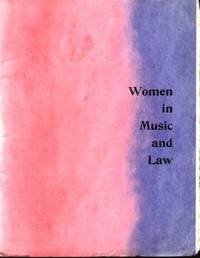
189512074New York: Author's Publishing Co. Very Good. 1895. Softcover. Clean soft pink & blue covers. Text tight clean & intact. Illustrated with B/W portrait photos. An unconventional piece written at a time when most women knew their place & their limits. Two sections: Musical Compositions by women Women in law. Rear cover slightly color faded. Women; B&W Photos ; 12mo 7" - 7½" tall; 48 pages . Author's Publishing Co. paperback
1847005104Philadelphia: s.n. 1847. Pamphlet. Very Good. 16 p.; 22 cm. Disbound from a volume of unrelated 19th-century pamphlets. "22" in ink at upper right-hand corner of first page. Caption title. At head of title: "Supreme Court Eastern District of Pennsylvania. July 1847 No. 40." William M. Kennedy claimed that his property running from Maiden St. to the adjacent wharf in the Kensington District of the Northern Liberties at the time not part of the city of Philadelphia included half of the street and the wharf itself. Elihu Duplessis Tarr d. 1851 and John Meredith Read 1797-1874 represented Samuel Tucker Bodine 1810-1879 and the commissioners and residents of Kensington offering the history of the property back to the orignal 1689 grant to Michael Neilson and through its ownership by William Masters and his descendants to show that both the street and the wharf had been public property. Very scarce. In Very Good Condition: disbound; light foxing primarily on first page; otherwise clean. s.n. unknown
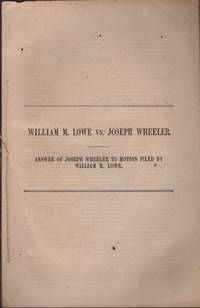
188233573n.p.: n.p. 1882. First Edition. Wraps. Good. Stitched wraps. Approx. 9" x 6". 30 pages. Original wraps with title on page 1. Scattered light brown spots on the covers. Interior contents clean. No place of printing or date provided for this contested Alabama legal/political election. 3 copies located in OCLC. From wikipedia:<br /> <br /> Joseph "Fighting Joe" Wheeler September 10 1836 – January 25 1906 was an American military commander and politician. He is known for having served both as a cavalry general in the Confederate States Army in the 1860s during the American Civil War and then as a general in the United States Army during both the Spanish–American War and Philippine–American War near the turn of the twentieth century. For much of the Civil War he served as the senior cavalry general in the Army of Tennessee and fought in most of its battles in the Western Theater. Between the Civil War and the Spanish–American War Wheeler served multiple terms as a United States Representative from the state of Alabama as a Democrat.<br /> <br /> William Manning Lowe June 12 1842 – October 12 1882 was an American politician who served the state of Alabama in the U.S. House of Representatives between 1879 and 1881 and in 1882. He was born on June 12 1842 in Huntsville Alabama. He attended the Wesleyan University at Florence Alabama and the University of Virginia. During the Civil War he served in the Confederate Army as a private lieutenant captain and lieutenant colonel. He studied law was admitted to the bar and practiced in Huntsville. He was solicitor of the fifth judicial circuit between 1865 and 1867. In 1870 he was elected to the Alabama House of Representatives and was a delegate to the Alabama constitutional convention of 1875.<br /> <br /> Lowe was elected in 1878 as a Greenback to the U.S. House of Representatives but in initial results was defeated for reelection by Joseph Wheeler in 1880 601 votes for Lowe having been declared illegal by election judges. In a highly contentious recount that lasted over a year Lowe successfully contested Wheeler's election and assumed the office on June 3 1882. Lowe however only served four months and died of tuberculosis at his home in Huntsville on October 12 1882. He was buried in Maple Hill Cemetery in Huntsville. Wheeler won a special election and served the remaining weeks of the term.1. n.p. unknown
1825015048London: John Knight & Henry Lacey: 1825. Volume I- 288 pages with 4 illustrations and a with the folding frontis: A Chart Of Eminent Lawyers. Preface notes: "It is hoped that the following volumes will not only interest the Lawyer but like-wise the general reader. With the mere technicalities of professional learning they have no connexion and they will therefore it is anticipated be found both intelligible and acceptable even to those who are without the pale of the profession. January 1825. Volume II- 288 pages with 3 illustrations and a folded frontis print: The Nomodenron; Or Law Tree. Volume III- 304 pages with 6 illustrations and a folded frontis Autographs Of Distinguished Lawyers. This scarce first edition set is bound in a reddish cloth that has faded with paper labels on spines 7" L x 4 ¼" W. Some foxing is present. Edges of spines are worn and a lower section of the spine cloth on Volume III is missing. Text is clean and bright and bindings are tight. All prints are present. Print Index at the back of Volume III has Sir Walter Raleigh listed on page 128 in Volume I however Lord Eskine's print is present. Hard Covers. Very Good. 12mo - over 6¾" - 7¾" tall. John Knight & Henry Lacey: hardcover
1867MASTER232919INEW YORK: BENJ. W. HITCHCOCK. G IN ORANGE BOARDS W/BLACK CLOTH SPINE & CORNERS. GERMAN TEXT. Pages: 449. . 1867. HARDCOVER. BOARDS EDGEWORN & SCUFFED TINY TEARS ALONG SPINE. LIGHT SOILING. STICKER RESIDUE FFEP. TEXT CLEAN BINDING TIGHT. . BENJ. W. HITCHCOCK hardcover
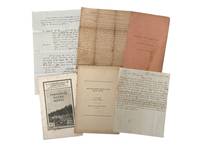
1825230481825. EnvironmentalismAgriculture Archive of six manuscripts and printed works concerning water rights water supply and environmental regulation in the United States and Britain during the nineteenth and early twentieth centuries. The materials chronicle the evolving legal protections governing access to water resources including industrial use agricultural supply municipal control of waterways and emerging concerns regarding river pollution. Together the documents trace a historical arc from early industrial petitions for water-powered manufacturing and property-based water rights disputes to later government and professional studies addressing irrigation law water infrastructure and environmental contamination. The archive contains six items three manuscripts and three printed works:<br /> <br /> 1 Manuscript Petition. Lancaster Pennsylvania. 1825 petition submitted to the Honorable Mayor and Common Council of the City of Lancaster requesting authorization to use water from the town run for manufacturing purposes. The petitioner proposes constructing a machine for manufacturing cards used in carding cotton and requests permission to convey water through wooden pipes from the municipal run to power the operation. The petition references specific lots and locations within Lancaster and includes statements assuring that the diversion would not interfere with existing water flow or neighboring property. Approximately 8 x 9.75 inches.<br /> <br /> 2 Autograph Letter Signed. Philadelphia February 25 1861. Letter addressed to J. E. Thompson concerning a dispute involving water use along the Wissahickon Creek. The writer discusses complaints relating to the removal of sand and alteration of water flow affecting neighboring property references a dam causing land inundation and ultimately states a willingness to relinquish certain rights so the dam may be removed noting that steam power is sufficient for his manufacturing purposes.<br /> <br /> 3 Charles C. Brown. River Pollution in the United States. Reprinted from the Journal of the American Society of Engineers October 1890. Early engineering study discussing sources of river contamination and methods of measuring and preventing industrial pollution of American waterways.<br /> <br /> 4 Certified Court Record Suffolk England 1833. Court of Common Pleas water rights dispute concerning property and access to a well in the parishes of Stowmarket and Needham Market Suffolk. The case lists William Ransom as plaintiff and Thomas Wells and Susan Wells as defendants relating to the liberty of drawing water and access rights. The record references the reign of King George IV and was officially certified July 16 1833 by Charles Roberts Assistant Keeper of Records of the Public Record Office.<br /> <br /> 5 R. H. Hess. Arid-Land Water Rights in the United States. Reprinted from the Columbia Law Review June 1916. Scholarly legal analysis examining riparian rights and the doctrine of prior appropriation in the American West and the legal development of irrigation water allocation.<br /> <br /> 6 United States Department of Agriculture. Farmstead Water Supply. Farmers' Bulletin No. 1448. Washington D.C. issued August 1925 and slightly revised June 1933. Government agricultural engineering bulletin describing sanitary well construction water storage and safe water supply systems for American farms.<br /> <br /> Manuscript documents show typical folds from original filing and storage with moderate toning and minor edge wear; handwriting remains clear and legible throughout. Printed pamphlets show light toning occasional edge wear and scattered minor staining consistent with use and inexpensive publication formats. Overall condition good to very good. This archive offers a compact documentary survey of water governance and environmental awareness across more than a century linking early industrial petitions and property disputes with the later emergence of legal scholarship and engineering studies addressing irrigation policy rural infrastructure and river pollution in the modern United States. unknown
1852816481852. OLMSTED Frederick Law. Walks and Talks of an American Farmer in England 2 Vols. in 1. New York: G. P. Putnam & Company 1852. 1st ed. 12mo. 4 247 1 192 pp. frontis. illus. In modern quarter leather and cloth over boards. Lacking the title page to the second part. Date and number rubber-stamped on the title page otherwise clean but for some general foxing throughout. Bookseller's ticket on the front pastedown. Binding is near fine. Smith American Travellers Abroad O20. Olmsted "travelled through England at mid-century and examined English agriculture in detail. He writes well and would be called today a rural sociologist and an agricultural economist." A very nice copy of both parts of Olmsted's first book. unknown
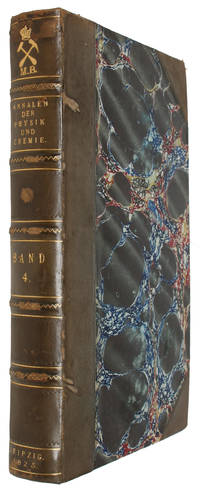
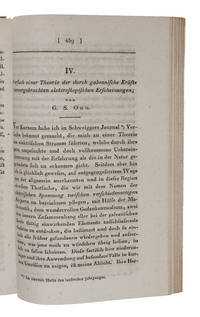
182543090Leipzig Johann Ambrosius Barth 1825. Contemp. hcalf. 5 raised bands gilt spine and gilt lettering to spine. A few scratches to spine. Small stamp on verso and on titlepage. A tear to right margin of titlepage repaired. In: "Annalen der Physik und Chemie. Hrsg. von J.C. Poggendorff" Poggendorff Bd. 4. 10476 pp. 4 large folded tables 6 engraved plates some folding. Small stamp on verso of plates. Ohm's paper: pp.79-88. Internally fine and clean. <br/><br/><em>First appearance of a paper of outmost importence in the history of electricity - it is Ohm's first scientific paper and it contains the report on the different original experiments sending a current through a variety of test wires that was the foundation for his famous law Ohm's Law. The paper contains the original research material that was to immortalize his name for the mathematical formulation of the law two years later in the well-known work "Die galvanische Kette mathematisch bearbeitet" 1827. - This paper was at the same time published in Schweiggers Journal."Ohm's first scientific paper was "Vorläufige Anzeige des Gesetzes." the paper offered. In it he sought a functional relationship between the decrease in the electromagnetic force excerted by a current-carrying wire and the lenght of the wire.Fromthe zinc and copper poles of a voltaic pile he ran two wires A and B the free ends of which terminated in small mercury-filled cups M and N; between M and another cup O he ran a third wire C. Together AB and C formed what he called the "invariable conductor" to distinguish it from one of the seven wires of different lenghts that when placed in a circuit between O and N constituted the "variable conductor". Among the latter was one "veru thick" wire four inches long and six thinner ones 0.3 line .025" in diameter ranging in lenght from one foot to seventy-five feet. Finally over wire C hung the magnetic needle of a Coulomb torsion balance which served to measure the electromagnetic force exerted when one of the variable conductors completed the circuit.He then found that the loss in force was equal to the difference between the normal force and the lesser force occasioned by one of the other wires divided by the normal force. Tabulating these value against the lenghts of the wires he found that his data were well represented by the formula v=0.41 log 1x where v is the loss in force and x is the lenght of the wire in feet."DSB X p.187. - This expression is the preliminary formula for his famous relations between voltage amperage and resistance R=V/I.Parkinson "Breakthrough" 1825 P. - Ronald's Library p. 376.The volume contains other importent papers in the history of chemistry and physics Berzelius F. Wöhler F.E. Neumann Heinrich Rose Chr. Hansteen Fresnel etc. </em> hardcover
1840131611Ruprecht Göttingen 1840. Ohne Schutzumschlag Hardcover Befriedigend Ruprecht Göttingen, hardcover
183445160Leipzig Johann Ambrosius Barth 1834. Without wrappers. Extracted from "Annalen der Physik und Chemie. Hrsg.von Poggendorff" Bd. 31 No 15-17. Faraday's paper:pp. 225-245. Clean and fine. <br/><br/><em>First appearance in German of this importent paper in which Faraday announces his discoveries of the conductability of liquids "a new law of electric conduction"."The author while prosecuting his rechearches on electr-chemical decomposition oberved some phenomena which appeared to be referable to a general law of electric conduction not hitherto recognized. He found that an electric current from a voltaic battery which is readily conducted by water did not pass through ice: even the thinnest film of iice interposed in the circuit was sufficient to intercept all electrical influence of such low intensities as that produced by the voltaic apparatus although it allows of the transmission of electricity of such high intensity that ecited by the common electrical machine. The author ascertained that a great number of other substances which are solid at ordinary temperatures do not conduct the electric current from the volataic battery until they are liquified." Abstract.From 1831 to 1852 Michael Faraday published his "Experimental Researches in Electricity" in The Philosophical Transactions of the Royal Society. These papers contain not only an impressive series of experimental discoveries but also a collection of heterodox theoretical concepts on the nature of these phenomena expressed in terms of lines of forces and fields. He published 30 papers in all under this general title.They represents Faraday's most importent work are classics in both chemistry and physics and are the experimental foundations for Maxwell's electro-magnetic theory of light using Faraday's concepts of lines of force or tubes of magnetic and electrical forces. His many experiments on the effects of electricity and magnetism presented in these papers lead to the fundamental discoveries of 'induced electricity' the Farday current the electronic state of matter the identity of electricity from different sources equivalents in electro-chemical decomposition electrostatic induction hydro-electricity diamagnetism relation of gravity to electricity atmospheric magnetism and many other."Among experimental philosophers Faraday holds by universal consent the foremost place. The memoirs in which his discoveries are enshrined will never ceaseto be read with admiration and delight; and future generations will preserve with an affection not less enduring the personal records and familiar letters which recall the memory of his humble and unselfish spirit."Edmund Whittaker in 'A History of the Theories of Aether and Electricity' p. 197. </em> unknown
182643632Leipzig Johann Ambrosius Barth 1826. Without wrappers as issued in "Annalen der Physik und Chemie. Hrsg.von Poggendorff" Bd. 6 7 Viertes u. Fünftes Stück. Entire issues 4 and 5 present. Titlepage to vol. 6. Pp. 369-514 a. 1 engraved plate Titlepage to vol. 7. Pp. 1-136 a. 1 engreved plate. Ohms paper: pp. 459-469 pp. 45-54 a. pp. 117-118. Clean and fine. <br/><br/><em>First appearence of a major paper in 19th century electrical theory breaking new ground in associating an electric tension with both open and closed galvanic circuits unifying the theory of Galvanic electricity and containing Ohm's Law in the simpler and last form."Ohm's second major paper of 1826 announced the beginnings of a comprehensive theory of galvanic electricity based he said on the fact that the contact of heterogenous bodies produced and maintained a constant electric tension Spannung. He deferred the systematic exposition of thsi theory to a later work however and limited himself to stating without derivation the two eqautions that constituted its heart: X=kwa/l and u-c = /- x/lawhereX is the strenght of the electric current in a conductor of lenght l cross section w and conductibility Leitungsvermögen k produced by a difference in electric tension a at its end points. By means of the first equation one can .reduce the actual lenght of a wire of whatever cross section and conductibility to the equivalent lenght of one of the wire chosen arbitrarily as a standard. Letting l now be this equivalent lenght - called the reduced lenght reducirte Länge of the conductor - Ohm WROTE HIS FIRST LAW IN THE SIMPLER FORM X=a/l THE EXPRESSION WHICH HAS BECOME KNOWN AS OHM'S LAW."DSB X pp. 188-89. </em> unknown
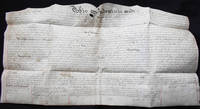
18110082971811. Near Fine -. 1 handwritten vellum deed 45 x 83 cm. dated 2 April 1811. Rudolph Stauffer and his wife Beata Reiner Stauffer sell to John Price storekeeper 103 acres in Coventry Township Chester Co. Pa. for 1800 pounds "lawful money of Pennsylvania." Recorded 3 Feb. 1812 by recorder Charles Kenny. Signed by witnesses George Prise and David Kinehart justice of the peace for Chester County John Hiester Jr. recorder Charles Kenny and Rudolph Stauffer and Beata Stauffer Rudolph's name is in German script while Beata's is not. In Near Fine- Condition: light soiling and discoloration; otherwise clean and bright. An attractive early 19th-century vellum deed. unknown
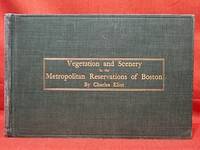
1898COLLECTI010460IBOSTON MA: LAMSON WOLFFE AND COMPANY. VERY GOOD WITHOUT D.J. PUB 1898. FIRST EDITION. HARDCOVER. GREEN OBLONG CLOTH COVERED BOARDS WITH GILT TILES IN GILT LINED BOX ONTHE FRONT COVER WITH 23 PAGES OF TEXT 57 FULL PAGE PLATES AND 3FOLD-OUT MAPS ATTACHED AT THE REAR FREE ENDPAPER. BOOK'S SPINE IS RUBBEDWITH ENPAPER SPLITS NEATLY REPAIRED A PURPLE INK NAME STAMP ON PAGE 10AND SOME FAINT EVIDENCE OF REMOVED MARKS/ERASURES FROM THE FRONTENDPAPER TITLE PAGE AND PREFACE. AN EXCELLENT CLEAN AND TIGHT COPY. Keywords: LANDSCAPE ARCHITECT. LAMSON, WOLFFE AND COMPANY hardcover
1899191978London: Franz Hanfstaengl 1899. 8/15 American issue. Softcover. Good soiling and shelfwear to wraps pages are very crisp and clean with light age toning mainly to page edges all plates are present and clean. Oversized light blue wraps with red lettering blue cloth spine; 106 pp XXX plates with protective guard sheets. "Sixty copies of this edition on Japanese vellum paper extra large Imperial Folio have been printed for issue in Great Britain and fifteen for America. This is No. 8 of the American issue"- signed by author on title page verso. 23x16x1" Franz Hanfstaengl paperback
180743644Halle Rengerschen Buchhandlung 1807. Without wrappers as published in "Annalen der Physik. Herausgegeben von Ludwig Wilhelm Gilbert" Bd. 27 Zwölftes Stück. The entire issue offered = Stück 12. Pp. 369-488 a. 1 folded engraved plate. Dalton's papers: pp. 369-387 and pp. 388-399. <br/><br/><em>First appearance in German of two importent papers on the multiple proportions of gases announcing the first example of the Law of multiple proportions. The first paper was read to the Manchester Society in 1802 but first published in 1805. It is Dalton's first chemical memoir and it "disclosed the insight obtained through study of the combinations of oxygen with nitrous gas into the LAW OF MULTIPLE PROPORTIONS."D.N.B."One thing Dalton did in order to provide support for his heavely attacked theory of mixed gases was to begin an experimental inquiry into the proportions of the various gases in the atmosphere. This inquiry accidentally raised the whole question of the solubility of gases in water. By 12. Novwember 1802 he had discovered enough to read to the Manchester Society his paper "On the Proportion of Several Gases or Elastic Fluids." the paper offered. When read although not when published it contained the staement that carbon dioxide "is held in water not by chemical affinity but merely by the pressure of the gas.on the surface forcing it into the pores of water.". The researches on solubility thus led to an extension of his mechanical ideas."DSB III p. 541.Smyth No. 36 a. 37. German version. </em> unknown
180344130Halle Rengerschen Buchhandlung 1803. Without wrappers as extracted from "Annalen der Physik. Herausgegeben von Ludwig Wilhelm Gilbert" Bd. 12. Pp. 257-291 a. 1 folded engraved plate showing the experimental apparatus used. <br/><br/><em>First appearance in German of this extremely important paper in which Gay-Lussac first formulated the law the Gay-Lussac's Law stating that if the mass and pressure of a gas are held constant then gas volume increases linearly as the temperature rises. This is sometimes written as V = k T where k is a constant dependent on the type mass and pressure of the gas and T is temperature on an absolute scale. In terms of the ideal gas law k = n R / P."In 1802 he Gay-Lussac showed that different gases all expanded by equal amounts with rise in temperature. Charles had made the same discovery some years earlier but had not published it; the credit therefore belongs to Gay-Lussac at least as much and probably more. This was an extremely importent discovery which Avogadro was to use within the decade to formulate hid long-neglected hypothesis that equal volumes of different gases at equal temperatures contained equal numbers of particles."Asimov.Magie "A Source Book in Physics" p.165-172 - Leicester & Klickstein "A Source Book of Chemistry" p. 374-379. - Parkinson "Breakthroughs" 1802 C. </em> unknown
1803216601n.g. 1803. Hardcover kartoniert 1803 1804. Zustand: keine Beschädigungen mit Kennungen einer Privatbibliothek. Rücken Ecken Kanten berieben/bestoßen. n.g., hardcover
1852675821852. New York 1852. Four parts only. New York 1852. Four parts only. An Interesting View of the American Legal Community in 1852 Law Journal. Livingston John Editor. United States Monthly Law Magazine. New York: United States Monthly Magazine Office 1852. Volume 6 No. 1 July 1852 Volume 5 No. 1 January 1852 Volume 5 No. 2 February 1852 Volume 4 No. 4 1852. Title page and final two pages author notice and prospectus lacking from Volume 6 No. 1. Final two leaves prospectus and advertisements lacking from Volume 5 No. 2. Octavo 8-3/4" x 5-1/2". Together four issues from 1852. Periodicals bound into nineteenth-century three-quarter morocco over marbled boards. Light rubbing to boards moderate rubbing to extremities with wear to spine ends joints cracked a few cracks to text block. Light toning to text slightly heavier in places. $150. The United States Monthly Law Magazine was published from January 1850 to July 1852. It specialized in scholarly essays and jurist biographies but also offered book reviews review essays court reports of American and English cases and notices. Some of the more notable articles in our volume are an anonymous critique of the Field Codes of civil and criminal procedure Volume 5 No. 2 pp. 152-172 and a biographical sketch of Sam Houston Volume 4 No. 4 pp. 567-592. Hoeflich Legal Publishing in Antebellum America 153-157. Catalogue of the Library of the Harvard Law School 1909 I:824. unknown
185443057Leipzig Johann Ambrosius Barth 1854. No wrappers as extracted from: "Annalen der Physik und Chemie. Hrsg. von J.C. Poggendorff" Vierte Reihe Bd. 3 = Poggendorff Bd. 93 No. 12. Pp. 481-506. Clean and fine. <br/><br/><em>First printing of this milestone paper in thermodynamics which together with his paper from 1850 established the second law of thermodynamics. In the offered paper Clausius introduces the symbol T for the universal function of temperature a 1 and he introduces the concept of "entropy" the greek word for 'transformation' but without using the word Clausius introduced the word later in 1865 he calls this new theorem "the principle of the equivalence of transformations". This principle paints a dramatic picture of the end of the world the so-called "heath-death of the universe"."Entropy on the other hand of the complementary experience of water seeking its own level of hot bodies cooling of springs untensing of magnetism wearing off and electrical charges leaking away of a destiny suchThat no life lives forever; - That dead men rise up never; that even the weariest river Winds somewhere safe to sea: a world getting old and running down."Gillespie in "The edge of Objectivity" p. 400-01."Clausius discovered that if he took the ratio of the heat content of a system and its absolute temperature this ration would always increase in any process taken place in a closed system. A closed system is one that loses no energy to the outside world and gains no energy from it. With perfect efficiency which is never realized in the real world of course the ratio would remain constant but i would never under any circumstances decrease."Asimov. - Parkinson: Breakthroughs 1854 C. </em> unknown
185444808Leipzig Johann Ambrosius Barth 1854. No wrappers in "Annalen der Physik und Chemie. Hrsg. von J.C. Poggendorff" Bd. 93 No 12 entire issue offered. Titlepage to vol. 93. Pp. 481-632. Clausius's paper pp. 481-506. <br/><br/><em>First printing of this MILESTONE PAPER IN THERMODYNAMICS which together with his paper from 1850 established the second law of thermodynamics. In the offered paper Clausius introduces the symbol T for the universal function of temperature a 1 and he introduces the concept of "entropy" the greek word for 'transformation' but without using the word Clausius introduced the word later in 1865 he calls this new theorem "the principle of the equivalence of transformations". This principle paints a dramatic picture of the end of the world the so-called "heath-death of the universe"."Entropy on the other hand of the complementary experience of water seeking its own level of hot bodies cooling of springs untensing of magnetism wearing off and electrical charges leaking away of a destiny suchThat no life lives forever; - That dead men rise up never; that even the weariest river Winds somewhere safe to sea: a world getting old and running down."Gillespie in "The edge of Objectivity" p. 400-01."Clausius discovered that if he took the ratio of the heat content of a system and its absolute temperature this ration would always increase in any process taken place in a closed system. A closed system is one that loses no energy to the outside world and gains no energy from it. With perfect efficiency which is never realized in the real world of course the ratio would remain constant but i would never under any circumstances decrease."Asimov. - Parkinson: Breakthroughs 1854 C. </em> unknown
186345072Leipzig Johann Ambrosius Barth 1863. Without wrappers. In "Annalen der Physik und Chemie. Hrsg. von J.C. Poggendorff" Bd. 120 No.11. Pp. 337-512 a. 2 plates. Entire issue offered. Clausius' paper: pp. 426-452. With titlepage to volume 120. <br/><br/><em>First appearance of one of Clausius' importent papers in which he gives further proofs of the Second Law of thermodynamics."Clausius discovered that if he took the ratio of the heat content of a system and its absolute temperature this ration would always increase in any process taken place in a closed system. A closed system is one that loses no energy to the outside world and gains no energy from it. With perfect efficiency which is never realized in the real world of course the ratio would remain constant but i would never under any circumstances decrease."Asimov. </em> unknown