Biblio.com
74 résultats
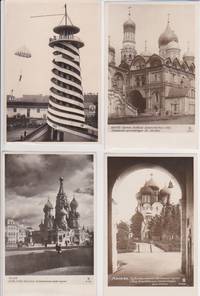
19302279Moscow: Various Publishers 1930s. <br /><br />Thirty black-and-white postcards each measuring 5 3/4 x 3 7/8 inches 147 x 98 mm all unused and unmounted. <br /><br />A collection of postcards depicting scenes in Moscow during the tumultuous 1930s when Stalin was expanding his power and killing off his opponents. The scenes include workers' houses hotels department stores and cathedrals that the Bolsheviks closed and turned into museums. Other scenes show Arbat Square Pushkin's monument the race course Dynamo stadium the Izvestia building Moscow University and more. <br /><br />Seventeen of the cards have brief captions in English and sometimes in French and German in addition to Russian. <br /><br />A wonderful series of vibrant images of Moscow in one of the most significant decades in Soviet history. <br /><br />CONDITION: One card lightly trimmed at the edges a few minor stains to the versos of some cards. Overall Very Good or better. Various Publishers
19482875New York: Council of Negro Trade Unionists 1948. Near fine. 4pp. on a single folded sheet. Minimal wear. A rare leaflet issued by the Provisional Harlem Committee to Free Ferdinand C. Smith and the Council of Negro Trade Unionists. Ferdinand C. Smith secretary of the National Maritime Union was instrumental in promoting Black membership in the Negro Trade Unionists. Attorney General Tom C. Clark originally from Texas sought to deport Smith back to Jamaica because of his Communist affiliations and work for civil rights. OCLC reports just a single copy of this work at the University of Kansas. Council of Negro Trade Unionists unknown
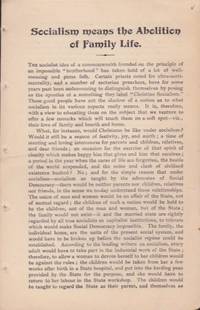
19011202<p>London: Liberty and Property Defence League ca. 1901-05. First Edition. <br /><br />A wonderfully lurid warning against socialism by an organization devoted to laissez-faire economics.</p><p>The anonymous author suggests that socialism would lead to the breakup of families: "There would be no such place as home under socialism. Everyone would live in the State barracks. There would be no breakfasts dinners or teas with one's family at one's own table as in the first place meals in private would not be permitted as it would be against the socialist idea of equality.In other words everybody when hungry would be reduced to the necessity of repairing to the common swine-trough and eating the hogwash the State had placed therein. No roast beef turkey and plum pudding no smiling faces of children and friends around the table on Christmas Day. Indeed there would not be any Christmas Day under socialism."</p><p>This pamphlet carries no publication date but it appears to have been issued sometime between 1901 and 1905. It refers to "the late Mr. Oscar Wilde" who died in late 1900. In 1906 the Liberty and Property Defence League issued a book Socialism: Its Fallacies and Dangers which included the text of this pamphlet.</p><p>OCLC lists 8 institutional holdings under two different accession numbers: Syracuse Stanford Amherst Harvard Texas Wisconsin Historical Society Michigan and the London School of Economics. No other copies in commerce.</p><p>PHYSICAL DETAILS: Single sheet measuring 8 x 5 1/4 inches 205 x 132 mm when folded creating a 4-page unbound pamphlet.</p><p>CONDITION: Paper lightly toned old stab holes along the gutter tiny check mark to front wrapper a couple small closed tears small ink stamp at the end of the text general handling wear. A Very Good copy of an uncommon publication.</p> Liberty and Property Defence League paperback
192658580Chicago: Charles H. Kerr & Co. 1926. 8vo. 152 2 pp. Blue cloth red lettering & ruling on covers red lettering on spine minor shelfwear w/ d.j. black lettering and hammer & sickle on red field minor chipping head & foot of spine VG/VG- copy. First edition of this travel memoir recounting this labor writer’s visit to the Soviet Union as she investigated music instruction in the new Russian schools. She describes labor conditions status of women child organization militarism a Volga journey along with theaters and the new sports movement. Charles H. Kerr & Co., hardcover
190688451Chicago Ill: Charles H. Kerr & Co. London: Swan Sonnenschein & Co. 1906 1907 1909. First Editions First Printings. Three Volumes. Octavo. 22.5cm. Publisher's deep maroon ribbed cloth titled in gilt to spines and ruled in blind to boards. 869pp.; 618pp.; 1048pp. Generally strong and tight; mild scuffing and to spine ends and corners and a few minor exterior stains. Spine gilt is significantly oxidized to Vol II as is usually seen on the first printing; internally clean and fresh some very light spotting in places mainly confined to the page edges. A very good handsome set of first printings. <br /> <br /> A full set of first printings of this bibliographically complex edition issued over the course of three years. Marx published the first volume of his epic analysis of capitalism in German in 1867. The first translation into English was of Volume 1 only and was accomplished by Edward Aveling and Samuel Moore in 1887 based on the revised 4th German edition as edited by Engels. The 1906 first American printing under the Charles Kerr impint as here largely follows this translation with the subsequent translation work for Volumes II and III being performed by Ernest Untermann. Thus the earliest printings of the Kerr edition comprise the first complete edition of Capital in the English language. The printing was done in Chicago by James Higgins Kerr's printer of choice making this also the first complete edition of Capital to be printed entirely by a union-run print shop. Untermann did most of his translation work from remote Florida beginning the effort in 1905 discovering in the process a number of indices footnotes and at least ten pages of text that Aveling and Moore had not included in their London edition - making the Kerr edition the most complete up to its time. <br /> <br /> Kerr burned through the first two-thousand copy print run of Volume I almost immediately and rushed to get Volume II out by July 1907. It's very possible that financial constraints were already making themselves known by Volume II as Kerr was selling the books at a loss to encourage sales; the almost ubiquitous oxidation of the gilt on Vol II is likely a result of experimental economy that swiftly failed. Vol III returns to the higher standards of the first volume. The bindings on the first printings also feature a triple blind rule to the ribbed cloth boards with subsequent printings having double rules. Kerr's reprint system seems to have incorporated dates on the title pages for some length of time with the dates on the copyright pages remaining unchanged; after a certain point around the early 1920's reprints were issued without dates to the title pages and any volume without a date can safely be deemed a post-1920s reprint. Issues of Kerr's International Socialist Review from the period of printing recount in detail some of his problems and concerns publishing and selling the work with detailed data on dates numbers of copies and the firm's hopes for the completed book. <br /> <br /> Genuine first printing sets of this important edition are tremendously scarce in commerce. The lack of any real bibliographical authority for the American edition combined with Kerr's generally lax approach to differentiating printings has over the years led to frequent errors and misjudgments on the part of cataloguers including in full disclosure ourselves. After a good deal of research most in the advertising pages of the International Socialist Review we're confident we've finally got it right. Charles H. Kerr & Co. [London: Swan Sonnenschein & Co.] unknown
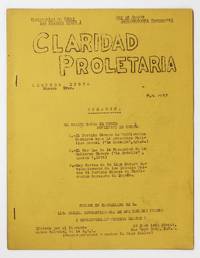
19376146New York: Revolutionary Workers League 1937. About very good. Two issues each 13pp. Folio. Mimeographed front wrapper stapled. One cover loosening. Moderate toning and dust soiling. Two issues of the scarce New York Spanish-language periodical Claridad Proletaria "El Organo en Castellano de la Liga Obrera Revolucionaria de los Estados Unidos." The Revolutionary Workers League was formed by American Trotskyist and Communist Party leader Hugo Oehler in 1935. The first issue present here dated September 1936 contains articles describing the revolutions in Spain and Latin America as well as pieces on the various internecine fights between the Trotskyist Stalinsist and other Communist factions during the 1930s. The second dated February 1937 is dedicated entirely to events in Spain and the role of Partido Obrero de Marxista Unificacion Workers' Party of Marxist Unification. OCLC locates a small smattering of individual issues. Revolutionary Workers League unknown
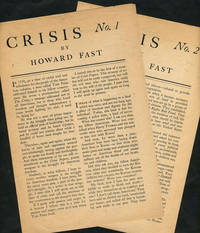
195123521New York: Civil Rights Congress 1951. Very good condition. Two pamphlets part of a series of articles by the American author and noted Communist. Fast modeled his pamphlets on Thomas Paine's "Crisis Papers" noting "I intend this to be the first of a number of Crisis Papers. This tyranny of today will not be easily conquered nor will the evil men who rule America easily bow to the will of the people. I state that I will speak up again and again so long as the need be present". <br /> <br /> Crisis No. 1 protests the American war in Korea the activities of the House Committee on Un-American Activities and attacks and threats on American Communists. Fast decries the threats against the leader of the Civil Rights Congress William L. Patterson to turn over all of his organization's records or be jailed. The Congress's goal was to fight racism & racial injustice in the US.<br /> <br /> Crisis No. 2 concerns the government's attacks on the Civil Rights Congress Bail Fund. 8vo 4pp each. Paper evenly toned. These are the first and second of three pamphlets titled Crisis. Fast wrote extensively on the Paul Robeson riots in Peekskill NY. OCLC: 30448136 Crisis No. 1 and OCLC: 71682230. Civil Rights Congress unknown
193243659Santiago de Chile: Union Social de Chile 1932. First Edition. 12mo 17.5cm.; publisher's blue-grey printed staplebound wrappers; 8pp. Textblock slightly toned else a Fine copy. Issued as "Folleto No. 21. [Union Social de Chile] unknown
196282699Stanford: Stanford University Press 1962. First Edition. Octavo. 22.5cm. Publisher's pale slate grey cloth covered boards titled in black to spine. Dustjacket. viii; 279pp. Light scuffing and edgewear minor bumping to spine ends in a bright strong example of the dustjacket with some minor rubbing and chipping to extremities. some sunning and fraying to the spine panel and ends a very good handsome copy with some light wear. Internally clean. Bookplate of Phillip G. Fox to front pastedown clearly a home made design and almost certainly that of Professor Phillip G. Fox of the University of Wisconsin who was a professor of business administration with an almost obsessive interest in slot machines and the mathematics of gambling payouts. The bookplate has been composed as a piece of typewriter art centered on a complex mathematical equation; bookdealers aren't necessarily terribly mathematically adept so the solution will have to be found by the next owner of the book.<br /> <br /> Packer's preoccupation here is centred around which of the regularly used official methods for interrogating communists and building information on their activities is the most efficient and successful; court trials admisnitrative hearins or Congressional investigations. There is an interesting corollary in that he is compelled to analyze whether or not Communism is in fact subversive but the answer to that shouldn't probably shouldn't get in the way of a good system for governments to control their citizens. Stanford University Press unknown
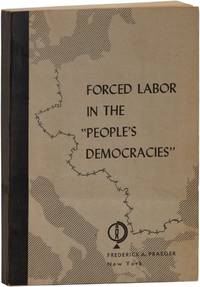
195584362New York: Frederick A. Praeger; For the Mid-European Studies Center of the Free Europe Committee 1955. Revised Edition. Octavo. 20cm. Original black cloth spine over illustrated card wraps. 247pp. Some light wear to the extremities and minor toning to the card wraps; internally clean. A very good strong copy.<br /> <br /> An analysis of the nature extent and appalling realities of Soviet forced labor camps in Hungary Czechoslovakia Romania Bulgaria and Poland. This revised edition was expanded in order to include data regarding forced labor camps in Communist China. Frederick A. Praeger; For the Mid-European Studies Center of the Free Europe Committee unknown
193416160Hamtramck MI 1934. Hand-painted banner 8.5cm x 65cm ca 3-1/4" x 26". In red and black on a white background. Old stains and tape adhesions; complete and Good. Scarce relic from the 1934 Hamtramck Michigan mayoral campaign in which George Kristalsky and a slate of seven communist candidates for City Council were defeated. Hamtramck a working-class suburb of Detroit was a center of radical labor activity during the Great Depression. unknown
193740520San Francisco: Educational Committee San Francisco Communist Party N.d. ca 1937. First Edition. Corner-stapled mimeographed typescript 36cm x 22cm; 6pp printed recto-only. Toning corner creases and general wear; still a complete Good or better example. Dated from text. Rather remarkable Popular Front document prepared by Manuilsky as Deputy General Secretary of the Comintern and clearly oriented toward American Party members as the majority of the text deals with the resurgent economic crisis in the U.S. Though the title of the paper might suggest a style sheet or compositional outline the document in fact is a list of rather explicit instructions to American Party members on how to interpret contemporary world events in the light of current Soviet doctrine the general upshot being that the American economic crisis the rise of European fascism revolution in China and the increasing militancy of the Japanese are all symptoms of the collapse of capitalism and the ". growing resistance of the working class and the toiling masses against the onslaught of the fascist powers!" Evidence of Moscow's direct influence on the CPUSA during this period is hardly necessary to prove a point but this document provides a neat example of precisely how that influence was directed and executed. Unrecorded in this format though a similar document was published in Los Angeles in 1946 per OCLC; this printing clearly much earlier based on text. Educational Committee, San Francisco Communist Party unknown
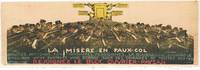
192982982Impression illegible: Bloc Ouvrier-Paysan 1929. Original lithographed poster 40cm x 120cm ca 16" x 47". Minuscule losses at margins not approaching image; closed tears; impression slightly weak; Very Good professionally backed on linen B/B.<br /> <br /> An ephemeral work produced for the short-lived Bloc Ouvrier-Paysan Workers & Peasants Party a Communist splinter group which existed in France only from 1929-30. The poster invites white-collar workers including artisans civil servants and pensioners to join the Bloc to save themselves from being crushed under the weight of bourgeois capitalism. The image depicts the bourgeoisie personified in the form of high rents food goods taxes and transportation costs being pulled forward by a horde of civil servants under harness. Copies located at Hoover Institution and the archives of the Department of Correze France; none others in institutional collections or commerce. Bloc Ouvrier-Paysan unknown
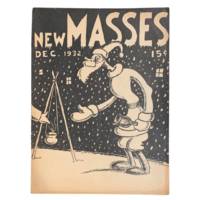
19326517New York: New Masses Inc 1932. First edition. Magazine 2 30 2pp. Advertisements illustrations. Staple bound in illustrated paper wrappers of O. Soglow. Some toning light edge wear. Very good. New Masses, Inc unknown
196284966New york: Doubleday 1962. First Edition. Octavo. 21.5cm. Publisher's russet cloth titled in black to spine. Dustjacket. 359pp. Light wear to board edges and spine ends; internally clean fore-edge untrimmed; in a clean bright example of the dustjacket with some light marginal wear and fraying to the head of spine. A very good copy. <br /> <br /> One of two works written about life in the Soviet Union by Kosinski under his Novak pseudonym. Kosinski something of a master of obscuring his own footprints never really accounted for his need to write anti-communist material in the US under an assumed name and it was widely understood that these works were sponsored and commissioned by the CIA although the claim was never substantiated. This copy has one small piece of underlining to the text of the jacket flap where the author's status as "a social scientist" has been emphasised. This title and "The Future is Ours Comrade" both stem from the period when Kosinski was studying at Columbia on a Ford grant. Doubleday unknown
193426222New York: Workers Library Publishers n.d. but ca.1934. Original poster offset printed in black on white stock measuring 67.5cm x 80.5cm. Light wear to extremities old horizontal and vertical folds with attendant creasing; Very Good.<br /> <br /> Propaganda poster advertising eight penny pamphlets published by the Workers Library; pricing ensured that even the lowliest worker would be able to afford something to read. The poster pictures titles by Israel Amter Elizabeth Lawson Herbert Benjamin and Sadie Van Veen. Issued by the National Committee Unemployed Councils proceeds presumably went to aid the unemployed and anti-hunger organizations. Not found in OCLC. Workers Library Publishers unknown
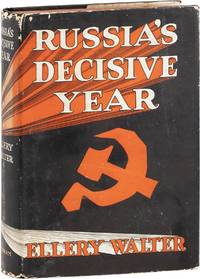
193284963New York: G.P. Putnam's Sons 1932. First American Edition. Octavo. 21cm. Publisher's black cloth titled and decorated in red to spine and front board. Dustjacket. 282pp. A little light wear to extremities minor bumping to spine ends bright and strong; internally clean topstain red fore-edge untrimmed; in a strong example of the dustjacket priceclipped with some soiling to the white portions and some shallow marginal chipping. A very good copy. Signed by the author to the title page. <br /> <br /> Walter's assessment of the Russian experiment as it stood in the early 1930's after he had just been granted unprecedented access to administration and infrastructure during a six month tour of the country. G.P. Putnam's Sons unknown
191943051New York: Libreria Rossa N.d. ca 1919. First Edition. 12mo 18cm. Staple-bound pamphlet; printed thick paper wrappers; 24pp. Slight aging; mild creasing to spine; Very Good. Text entirely in Italian. Communist tract issued shortly after the Russian revolution calling for an immediate proletarian revolution in Italy with socialization of industry and agriculture; closure of borders to prevent the flight of the bourgeoisie; and the "management of the new society through a free arrangement of persons and competent groups" ".persone e di gruppi competenti interessati all soluzione di ogni singolo problema tecnico e sociale". The pseudonym "Emme" is unknown to us; nor is it certain from which "Libreria Rossa" this pamphlet originated - "libreria rossa" "red bookshop" being a common enough appelation among Italian-American radical booksellers of all political stripes during this period. One copy only in OCLC; not seen in commerce; not in Periconi. Libreria Rossa unknown
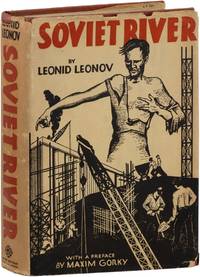
193284363New York: Dial Press; Lincoln Mac Veagh 1932. First American Edition. Octavo. 19.5cm. Original deep red cloth titled in black to spine with embossed publisher's imprint to front board. Dustjacket. 383pp. Bumped to spine ends with some minor wear to corners some minor darkening to the cloth in places; internally clean fore-edge untrimmed top edge a trifle dusty; in the John Gram dustjacket with some toning to the spine panel shallow chipping and loss to the spine ends intruding upon the author's first name and a short closed tear to the front upper front spine hinge. A good strong copy with some wear.<br /> <br /> Leonov's novel of Soviet labor centred around the building of an enormous factory; Sotstroy. Gorky provides the preface; the novel was notable at the time as an antidote to the image of the USSR as an enormous generator of plans progress noble artistic and industrial endeavor and a shining beacon of energy. Leonov tends towards a more on the ground depiction of enthusiastic ineptitude paranoia and fanaticism. Bookplate of Alvin Kapusta to front pastedown a Special Assistant for Soviet Nationalities at the US State Department and a notable scholar of the Soviet Bloc whose collections are housed at the Hoover Institution. Dial Press; Lincoln Mac Veagh unknown
198084959London Boston Henley: Routledge & Kegan Paul 1980. First U.K. Edition. Octavo. 22cm. Publisher's deep red cloth titled in gilt to spine. Dustjacket. 464pp. Clean and bright cloth strong and tight; internally clean and fresh. A near fine copy in dustjacket. <br /> <br /> An examination of the process by which the Soviets laid the groundwork for post war occupation of Poland providing a step by step analysis. The research is assisted by the data found in a number of contemporary Soviet documents which were smuggled into the West in the early-1970's. Routledge & Kegan Paul unknown
192984083New York: Alfred A. Knopf 1929. Large Paper Edition. Large Octavo. 26.5cm. Publisher's pale orange cloth titled in black and gilt to front board with red paper title label to spine. xvi; 308pp. Scuffing and bumping to extremities the cloth uniformly faded to a pale diluted pinkish orange with some scuffing and soiling darkening to the spine label and some very light marginal chipping; internally clean black topstain fore-edge untrimmed lavishly illustrated throughout in color and black and white. A strong and handsome copy about very good due to solidity and completeness but with cosmetic external wear. <br /> <br /> Significantly taller and more bulky than the trade edition likely a deluxe or large paper edition produced from British sheets the pagination differs considerably from the earlier trade edition with several additional color illustrations for example the "Red Angel of Revolution" color plate is here the recto of the photographic frontis and a rather unusual contemporary small format photograph of Leningrad tipped onto one of the plate pages. The paper title label suggests a slipcase although none is present. Unusual rather than scarce with a pretty solid showing in institutions if none in trade. Alfred A. Knopf unknown
199984402New Haven CT: Yale University Press 1999. First American Edition. Octavo. 24cm. Publisher's red cloth spine over black paper covered boards titled and ruled in gilt to spine. Dustjacket. xxvii; 635pp. Very light wear to spine ends; internally clean illustrated throughout; in a clean bright dustjacket. A near fine copy. <br /> <br /> An academic analysis of the depradations of Stalin's ruling party during the pogroms and cleansings in the few years immediately prior to WW2 compiled from previously secret of inaccessible documents and testimonies. Yale University Press unknown
191917439Chicago: Deutschen Sprachgruppe der Socialist Party of the United States 1919. First American Edition. 12mo 18cm. Printed card wrappers; 127pp. Very mild external wear; faint spotting to a few pages of text; Near Fine in the original wrappers. Probable first printing in America of Trotsky's account of the October revolution. English editions appeared the same year in London and Brooklyn but it is likely that this German-language version translated from the Russian by German-American scholar Jacob Wittmer Hartmann precedes any English edition. Interestingly a German translation had already appeared in Berlin in 1918 but the German-language group of the Socialist Party commissioned this new translation from Hartmann for the American edition. Deutschen Sprachgruppe der Socialist Party of the United States unknown
198081760Moscow: Tushino Machine Building Plant 1980's. Pasteboard box 44cm x 23cm. Name printed in stark black and white onto a stereotypically minimalist Soviet box all the more susrprising considering this is a toy for children. Light inoffensive wear to the extremities a little rubbing and scuffing to the corners clean and complete. The verso of the box lid contains a plan of the contents with item numbers and small illustrations. Inside the box liner is moulded polystyrene with spaces for the individual components ranging from pressed steel baseboards and wall/hull sections to a set of rubber tyres woven string to simulate hawsers and cables pulleys connecting rods all the necessary tools a bag of nuts bolts and other connector pieces; all mass produced in a fashion that would have even a cursory modern day child safety inspection shutting down the whole plant and issuing a warning that if your children get this for Christmas you might need to count their fingers on Boxing Day. Miraculously complete as far as can be ascertained and with very little sign of use including the plans and construction book which is complex enough to count as aggressively educational and has the original warranty sheet with inspection stamps hand stamped and dated 1992 although the slip dates the set to the 1980's laid in. The introduction to the set in the 62 page instruction book states: "The 'Yunost' contruction set is a game designed in 1944 to introduce children aged 10-15 years to the principles of technical design and construction engineering. Each set of the 'Yunost' construction set contains the most intricate parts intnded for assembling models of various mechanisms machines and industrial structures."<br /> <br /> Clearly designed as a controlled Soviet alternative to Western toys like Erector Sets Meccano and the like the principles are identical whilst the delivery is rather more tailored to a deliberately educational USSR approach to entertaining children. "Nothing without purpose" seems to have been the guiding tenet of USSR toy production approaches which became notorious for taking an existing Western temptation like Meccano or Lego or GI-Joe and adapting them to the requirements of collective adherence to the improvement of the USSR. To Western eyes a lot of this material looks like the physical representation of the "We have McDonalds at home." meme but whilst Western toy design was aimed as much at keeping kids quiet and out of the way with a side of education the Soviet philosophy seems to have been 'if a child is building a toy crane then he should be learning the principles of load bearing members understanding pulleys and getting an idea of where crane operators fit into the process of industrial engineering' whilst this approach seems to take some of the joy out of play time it also contributed to the Western paranoia that the USSR was basically a cradle to grave enemy factory. Tushino Machine Building Plant unknown
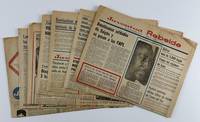
196912628Havana: Union de Jovenas Comunistas 1969. Seven newspapers each between 6 and 8pp. on newsprint. Illustrated. Modest toning some edge wear and closed tears some bumped or dog-eared corners. Overall very good. A small but instant collection of an informative newspaper from Communist Cuba published daily by the youth wing of the Party. The issues are all dated in January 1969 specifically from January 11 15 22 28 29 30 and 31. The issues contain domestic and international reporting along with topics relevant to revolutionary young people. Interestingly one issue contains a translated interview with Hollywood legend Marlon Brando. The paper also prints a legion of photographs cultural event listings classifieds baseball statistics and updates cartoons and more. Union de Jovenas Comunistas unknown