[COMMUNISM] MARX, Karl; J Roy, transBiblio.com

130 résultats
187247305Paris: Maurice Lachatre et Cie 1872-1875. First French Edition. Large octavo 28.5cm.; original parts bound in early 20th century blue cloth gilt-lettered spine; 351pp.; pictorial half title and title pages full-paged steel-engraved portrait and facsimile additional vignettes throughout; text printed in double column. Boards a bit rubbed and corners bumped foxing and toning to preliminaries as well as minor dampstaining to last few leaves of text light foxing to rear cover; overall Very Good and sound. First appearance in French of Marx's "Das Kapital" the translation the only such to have been executed with the collaboration of the author whose letter to Lachatre appears in facsimile on p. 7: "J'applaudis à votre idée de publier la traduction de 'Das Kapital' en livraisons périodiques. Sous cette forme l'ouvrage sera plus accessible à la classe ouvrière et pour moi cette considération l'emporte sur toute autre" "I congratulate you on your idea to publish the translation of 'Das Kapital' as a periodical. In this format the work should be more accessible to the working class and to me this is more important than all else" our translation. Maurice Lachatre 1814-1900 was a Parisian radical bookseller publisher and collaborator of Félix Pyat's with whom Marx butted heads over the growth of the International Working Men's Association in France. Lachatre's projected publication of the anarchist newspaper "La Commune" nearly cost him his life after the fall of the Paris Commune when his bookshop was attacked with murderous intent by the Versaillaise army see "The Publisher's Weekly" Vol. 19 1881 pp. 50-1. It was while exiled first in Belgium and then Switzerland that Lachatre began work on publishing the present edition though he was not free to return to Paris until 1879. Maurice Lachatre et Cie unknown
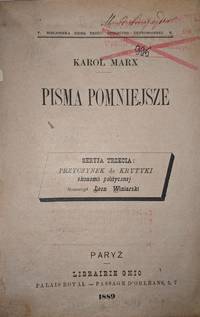
18891872Paryż Paris: Librairie Ghio 1889. First Polish edition. In contemporary half leather. Binding rubbed at extremities. Spine damaged at tail and head. With old private and institutional collection inscriptions and stamps. Paper yellowed due to aging. Rear panel restored by tape. First Polish edition. In contemporary half leather. 111 1 p. <p><br /> Pisma Pomniejsze the first Polish translation of the essay The Contribution to the Critique of Political Economy appeared in the series of “Biblioteka dzieł treści społeczno-ekonomicznej†an early series of social economical works initiated and organized by Maria Jankowska-Mendelson 1850–1909 a Polish emigré publicist and socialist activist in Paris correspondent and friend of Friedrich Engels.<br /> <p><p><br /> The book includes explanations by Léon Winiarski 1865–1915 a pioneer Marxist social economist.<br /> <p>. Librairie Ghio unknown
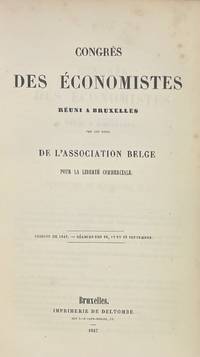
18473297Bruxelles: Imprimerie de Deltombe 1847. First edition. In later wrappers. Paper tanned occasional foxing. Otherwise in fine condition. First edition. In later wrappers. 5 2-211 1 p. <p><br /> Rare printed proceedings of the first international congress of economists in Brussels featuring Karl Marx's attendance and his early engagement in public economic debates.<br /> <p><p><br /> This volume documents the proceedings of the first-ever international conference of economists held in Brussels from September 16 to 18 1847 under the auspices of the Association belge pour la Liberté commerciale. Directed by Charles Joseph Marie Ghislain de Brouckere the conference was a landmark event gathering leading economists lawyers and businessmen to debate issues of free trade and economic policy.<br /> <p><p><br /> A significant aspect of this congress is the participation of Karl Marx whose presence is recorded on the official list of participants "Marx homme de lettres et économiste à Bruxelles" p. 7. At the time Marx was living in Brussels and his involvement in the congress marked a crucial moment in his engagement with economic theory and the broader socialist movement. Although Marx was prevented from speaking his attendance along with other members of the Communist League such as Friedrich Engels was notable for their intent to challenge bourgeois economics and advocate for working-class interests.<br /> <p><p><br /> The congress became a site of contention between the bourgeois majority and the Communist group particularly after Georg Weerth's speech which sharply criticized the benefits of free trade as espoused by the free traders. Engels later provided a detailed report of these events in the Deutsche-Brüsseler-Zeitung highlighting the tensions and the exclusion of Marx's voice from the official proceedings.<br /> <p><p><br /> This book is a rare primary source for the study of 19th-century economic thought and a crucial document for understanding the early public activities of Karl Marx just months before the publication of the Communist Manifesto. It offers invaluable insights into the ideological battles that shaped modern economic and political thought.<br /> <p>. Imprimerie de Deltombe unknown
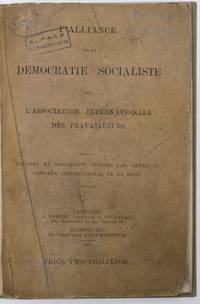
18731526Londres London; Hambourg Hamburg: A. Darson; Otto Meissner 1873. First edition. The original printed wrappers bound into later half cloth. Old faint collection stamps on wrappers and title page. The front wrapper and first leaf with traces of creasing. Wrappers and first and last two leaves dusted. A stain at the upper corner of the first four leaves one leaf with a whole due to the stain which only affects the margin. Overall in very good condition. First edition. The original printed wrappers bound into later half cloth. 4 137 1 p. <p><br /> A scarce copy of the renowned Alliance Pamphlet whose conclusion was written by Karl Marx.<br /> <p><br /> <p><br /> This report the so-called Alliance Pamphlet is a collection of documents and writings related to the International Alliance of Socialist Democracy written compiled and edited by Friedrich Engels Paul Lafargue and Karl Marx. <br /> <p><br /> <p><br /> The Alliance was a semi-secret subgroup of the International Workingmen's Association IWA; First International founded and led by Mikhail Bakunin the Russian revolutionary anarchist. The International sought to extrude the sectarian Alliance from the organization since its establishment in late 1868. Eventually at the Hague Congress 1872 the leaders of the International exposed the public and clandestine activities of the group and expelled its chief leaders Bakunin and James Guillaume from the IWA. The Congress appointed a committee which included Marx Engles and Lafargue to edit and publish the documents related to the Alliance. “The bulk of the work involved in the collection of additional material its comparison and analysis was carried out by Engels and Paul Lafargue. The concluding part of the pamphlet was written by Marx†see Collected Works 44. p. 665 note 623. In his letter dated on 26 July 1873 to Adolph Sorge Engels wrote: “Lafargue and I wrote it i.e. the Pamphlet together; only the conclusion is by Marx and myselfâ€. Collected Works 44. p. 521. The book appeared in French in the fall of 1873 and soon it was translated into German under a somewhat more tendentious title “Ein Complot gegen die Internationale Arbeiter-Associationâ€. <br /> <p><br /> <p><br /> Bibl.: The Collected Works of Karl Marx and Friedrich Engels. The Collected Works of Karl Marx and Frederick Engels. Letters 1844–1895. Volume 44. Charlottesville Va.: InteLex Corporation 2001. <br /> Rubel 726.; Stammhammer I 3.<br /> <p>. A. Darson; Otto Meissner unknown
187158474High Holborn for the Council by Edward Truelove 1871. Small 8vo. Near contemporary quarter cloth with silver lettering to front board. Binding with signs of use but overall good. One closed marginal tear and title-page with a few brownspots otherwise very nice and clean. 35 pp. <br/><br/><em>Exceedingly rare first edition with the names of Lucraft and Odger still present under "The General Council" of one of Marx' most important works his seminal defense of the Paris Commune and exposition of the struggle of the Communards written for all proletarians of the world. While living in London Marx had joined the International Working Men's Association in 1864 - "a society founded largely by members of Britain's growing trade unions and designed to foster international working class solidarity and mutual assistance. Marx accepted the International's invitation to represent Germany and became the most active member of its governing General Council which met every Tuesday evening first at 18 Greek Street in Soho and later in Holborn. In this role Marx had his first sustained contact with the British working class and wrote some of his most memorable works notably "The Civil War in France". A polemical response to the destruction of the Paris Commune by the French government in 1871 it brought Marx notoriety in London as 'the red terror doctor' a reputation that helped ensure the rejection of his application for British citizenship several years later. Despite his considerable influence within the International it was never ideologically homogenous. homas C. Jones: "Karl Marx' London".The work was highly controversial but extremely influential. Even though most of the Council members of the International sanctioned the Address it caused a rift internally and some of the English members of the General Council were enraged to be seen to endorse it. Thus for the second printing of the work the names of Lucraft and Odger who had now withdrawn from the Council were removed from the list of members of "The General Council" at the end of the pamphlet. "Marx defended the Commune in a bitterly eloquent pamphlet "The Civil War in France" whose immediate effect was further to identify the International with the Commune by then in such wide disrepute that some of the English members of the General Council refused to endorse it." Saul K. Padover preface to Vol. II of the Karl Marx Library pp. XLVII-XLVIII."Written by Karl Marx as an address to the General Council of the International with the aim of distributing to workers of all countries a clear understanding of the character and world-wide significance of the heroic struggle of the Communards and their historical experience to learn from. The book was widely circulated by 1872 it was translated into several languages and published throughout Europe and the United States." The Karl Marx ArchiveMarx concluded "The Civil War in France" with these impassioned words which were to resound with workers all over the world: "Working men's Paris with its Commune will be forever celebrated as the glorious harbinger of a new society. Its martyrs are enshrined in the great heart of the working class. Its exterminators history has already nailed to that eternal pillory from which all the prayers of their priests will not avail to redeem them."The address which was delivered on May 30 1871 two days after the defeat of the Paris Commune was to have an astounding effect on working men all over the world and on the organization of power of the proletarians. It appeared in three editions in 1871 was almost immediately translated into numerous languages and is now considered one of the most important works that Marx ever wrote. " "The Civil War in France" one of Marx's most important works was written as an address by the General Council of the International to all Association members in Europe and the United States.From the earliest days of the Paris Commune Marx made a point of collecting and studying all available information about its activities. He made clippings from all available French English and German newspapers of the time. Newspapers from Paris reached London with great difficulty. Marx had at his disposal only individual issues of Paris newspapers that supported the Commune. He had to use English and French bourgeois newspapers published in London including ones of Bonapartist leanings but succeeded in giving an objective picture of the developments in Paris. .Marx also drew valuable information from the letters of active participants and prominent figures of the Paris Commune such as Leo Frankel Eugene Varlin Auguste Serraillier Yelisaveta Tornanovskaya as well as from the letters of Paul Lafargue Pyotr Lavrov and others.Originally he intended to write an address to the workers of Paris as he declared at the meeting of the General Council on March 28 1871. His motion was unanimously approved. The further developments in Paris led him however to the conclusion that an appeal should be addressed to proletarians of the world. At the General Council meeting on April 18 Marx suggested to issue "an address to the International generally about the general tendency of the struggle." Marx was entrusted with drafting the address. He started his work after April 18 and continued throughout May. Originally he wrote the First and Second drafts of "The Civil War in France" as preparatory variants for the work and then set about making up the final text of the address.He did most of the work on the First and Second drafts and the final version roughly between May 6 and 30. On May 30 1871 two days after the last barricade had fallen in Paris the General Council unanimously approved the text of "The Civil War in France" which Marx had read out."The Civil War in France" was first published in London on about June 13 1871 in English as a pamphlet of 35 pages in 1000 copies. Since the first edition quickly sold out the second English edition of 2000 copies was published at a lower price for sale to workers. In this edition i.e. MECW Marx corrected some of the misprints occurring in the first edition and the section "Notes" was supplemented with another document. Changes were made in the list of General Council members who signed the Address: the names of Lucraft and Odger were deleted as they had expressed disagreement with the Address in the bourgeois press and had withdrawn from the General Council and the names of the new members of the General Council were added. In August 1871 the third English edition of "The Civil War in France" came out in which Marx eliminated the inaccuracies of the previous editions.In 1871-72 "The Civil War" in France was translated into French German Russian Italian Spanish Dutch Flemish Serbo-Croat Danish and Polish and published in the periodical press and as separate pamphlets in various European countries and the USA. It was repeatedly published in subsequent years.In 1891 when preparing a jubilee German edition of "The Civil War in France" to mark the 20th anniversary of the Paris Commune Engels once again edited the text of his translation. He also wrote an introduction to this edition emphasising the historical significance of the experience of the Paris Commune and its theoretical generalisation by Marx in "The Civil War in France" and also giving additional information on the activities of the Communards from among the Blanquists and Proudhonists. Engels included in this edition the First and Second addresses of the General Council of the International Working Men's Association on the Franco-Prussian war which were published in subsequent editions in different languages also together with "The Civil War France". Notes on the Publication of "The Civil War in France" from MECW Volume 22. Only very few copies of the book from 1871 on OCLC are not explicitly stated to be 2nd or 3rd editions and we have not been able to find a single copy for sale at auctions within the last 50 years. </em> hardcover
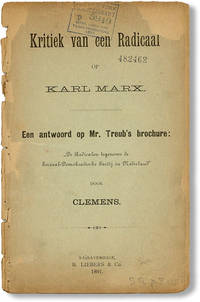
189143347's-Gravenhage: B. Liebers & Co 1891. First Edition. Octavo 20cm.; publisher's green wrappers; 53pp. Ex-NYPL with their usual markings wrappers and textblock exceedingly brittle and toned due to poor paper stock lacking rear cover. Good only. The Dutch syndicalist author's study of Marx published a year before his translation of The Communist Manifesto the first to appear in Dutch. Though this title is not institutionally uncommon in Europe OCLC locates no copies in North America as of January 2019. B. Liebers & Co unknown
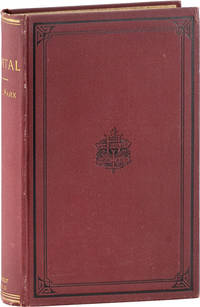
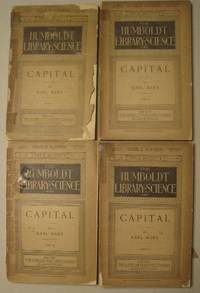
189059553New York: Humboldt Publishing Co N.d. 1890. First Humboldt Edition. First printing. Presumed later issue with ads undated but listing up to nos. 142-143 of the "Humboldt Library of Science" Wollstonecraft Vindication of the Rights of Woman issued in 1890. Octavo 24cm. Publisher's red cloth titled in gilt on spine with designs stamped in black on front cover in blind on rear cover; floral endpapers; xviii1-506pp;44pp ads. Bookplate to front pastedown of Jefferson D. Stewart Louisville Kentucky banker and financier whose pencil ownership signature dated 1895 also appears on the title page. An exceptional copy in the publisher's cloth binding minutely rubbed at joints and board corners; floral endpapers so prone to splitting at the hinges are fully intact and the text is fresh bright and unmarked. Very close to a fine copy and easily the best we have handled.<br /> <br /> The early publication history of this first volume of Marx's Capital in America is bibliographically complex at times stubbornly ambiguous and not seldom misrepresented. The earliest copies to appear for sale in America were imported sheets of the Swan Sonnenschein London edition of 1887 bound and distributed in America through two New York agents in one case identified on the pastedowns Julius Bordello in another Scribner & Welfored on a tipped-in slip see Philip Foner "Marx's 'Capital' in the United States" Science & Society Fall 1967. In 1889 Sonnenschein produced a stereotyped edition which was distributed in America through yet a third agent D. Appleton whose name appeared as co-publisher on the title page making this the first edition to carry any textual indication of an American publisher. Any of these three editions have some claim to being called the "First American Edition" notwithstanding the fact that none were printed in America. <br /> <br /> Beginning in January of 1890 Humboldt Publishing Co. a small New York radical publisher issued what it claimed to be "the only American edition - carefully Revised" of Capital. This was in fact an unauthorized reprinting of the Moore - Aveling translation issued without the permission of Marx's family the translators or the European publishers. To save on distribution costs Humboldt resorted to a standard 19th-century publishing ploy and issued the work as a four-part serial nos. 135-138 in its "Humboldt Library of Science" series at the time periodicals were subject to much lower postal rates than bound books. Around the same time - priority has never to our knowledge been established - Humboldt issued some of its printed sheets of Capital in the one-volume cloth edition we have here. This may be properly described as the first book edition of Capital to be printed in the United States. <br /> <br /> Unsurprisingly given the somewhat haphazard nature of 19th-century radical publishing some ambiguities remain. First it is clear from the dates of catalogued copies that Humboldt issued Capital at least twice in serial format - copies exist of issues 135-138 dated January to April 1890; other copies numbered identically exist dated October 1 to October 15 1890 see "Karl Marx Capital First American Editions" online resource . Second based on inspection of copies in our hands and other catalogued copies in commerce we note that the clothbound issue appeared with at least three different states of publisher's advertisements following the text - some with ads dated 1889 presumably the earliest issue; others as with our copy with undated ads but datable from contents to mid-to-late 1890; others with no ads at all. We suspect but cannot prove that the first two issues of the cloth edition correspond with the two known serial issues the first in January the second in October of 1890. Copies without ads were likely issued later to use up remaining sheets.<br /> <br /> Finally there is a question not previously commented upon in any of the scholarship we have consulted regarding Humboldt's claim that this "only American edition" was "carefully Revised." Some previous cataloguers have suggested that the Humboldt edition was a literal reprint of the Sonnenschein stereotype edition of 1889. But this makes little sense; Humboldt could not conceivably have had access to Sonnenschein's stereotype plates and besides the format and pagination of the two editions are entirely dissimilar. Was Moore & Aveling's translation in fact edited for American readers and if so to what degree This cataloguer has now spent sufficient time in a side-by-side comparison of the Humboldt and Sonnenschein via Hathi Trust editions to reach a preliminary conclusion that the only "revisions" consist in the alteration of British spellings to their American equivalents throughout the text e.g. "labor" for "labour"; "characterize" for "characterise" etc. No alterations to the substance of Moore and Aveling's translation appear to our eyes - though to be sure this is a lengthy work and we have performed only a random sampling of the text; an exhaustive comparison of the texts has never to our knowledge been carried out and this would seem to be a fruitful subject for research. <br /> <br /> 1. Foner Philip. "Marx's Capital in the United States." In Science & Society v. 31 no 4 Fall 1967 pp 461-66.<br /> 2. Amink Babak. "A Brief History of the Dissemination and Reception of Karl Marx's Capital in the United States and Britain." In World Review of Political Economy v.7 no. 3 Fall 2016 pp.334-349. <br /> 3. "Karl Marx Capital First American Editions" web article at Karl Marx Library Luxembourg <br /> <br /> NOTE: The second and third volumes had not yet been completed by Engels at this date and would not appear in the U.S. until the 1909 Kerr edition. Humboldt Publishing Co unknown
1863757Berlin: Verlag von Otto Janke 1863. Fair. <p data-path-to-node="10">Second Edition. 378 pp. 8vo. Half brown cloth over marbled boards. An ex-library copy with the associated stamps labels and checkout pocket of the Columbus Ohio Public Library. Spine is heavily frayed and chipped with significant loss to the cloth. The hinges are cracked and the text block is fragile. Internally complete though the pages are toned consistent with age.</p> <br /> <p data-path-to-node="11">Adolf Bernhard Marx was one of the most influential music theorists of the 19th century and this biography remains a cornerstone of Beethoven studies. Despite the heavy wear and library markings it remains a vital primary source for those studying the evolution of music theory and the early reception of Beethoven's œuvre.</p> . Verlag von Otto Janke unknown
18522007160020Robert Cocles and Company 1852. Hardcover. Good with shelf wear/no dust jacket. Vol. 1 only/ 1st English edition translated from the 4th German edition Robert Cocles and Company hardcover
18897705Paris: E. Dentu 1889. Fine. E. Dentu Paris 1889 12 x 19 cm broché First edition of which no deluxe copies were issued. About A. Thiers J. Richepin Sacher-Masoch A. Dumas C. Bernard L. Pasteur among others. Spine cracked with slight lacks at foot. E. Dentu unknown
190073265Nantes: Emile Grimaud et fils 1900. Fine. Emile Grimaud et fils Nantes 30 juillet 1900 19.50 x 27.50 cm relié First edition illustrated with fifty-nine engravings on copper and wood by Auguste Lepère one of 220 numbered copies on pure Arches laid paper with the Nantes watermark the only issue this one printed specially for M. Join-Lambert. Full tawny calf binding spine with five raised bands date at foot boards richly decorated with a broad design of compartments interlacing and shells inlaid with green mahogany and black calf in the Renaissance taste silk moiré doublures framed with seven gilt fillets endpapers of matching silk covers and spine preserved top edge gilt slipcase with rubbed and peeling headcaps Art Nouveau binding signed with the monogram DLR at foot of first board. Our copy is enhanced with one of the destroyed wood-engraved plates from the first series ""Rue des Barres - Rue Grenier sur l'eau - Sortie de l'exposition"" given to the Nantes museum. Rare and very handsome copy perfectly executed in an elegant binding with Art Nouveau decoration. Emile Grimaud et fils hardcover
1898136738New York: International Publishing Co 1898. 2nd edition. Very Good. octavo. hardback in original cloth xv 500pp. appendix Socialist Party Library label on front paste-down paper browning & front hinge tender o/w a very good reading / reference copy International Publishing Co hardcover
18794849628Breitkopf und Hartel 1879. Volume 3. This is an ex-library book and may have the usual library/used-book markings inside.This book has hardback covers. In good all round condition. Re-bound by library. 1871. Medium blue cloth 8vo with gilt border and lettering on backstrip. Lightly bumped corners. Interior is secure clean and clear. Marbled edges Please note the Image in this listing is a stock photo and may not match the covers of the actual item850grams ISBN: Breitkopf und Hartel hardcover
18734849629Breitkopf und Hartel 1873. Volume 2. This is an ex-library book and may have the usual library/used-book markings inside.This book has hardback covers. In good all round condition. Re-bound by library. 1871. Medium blue cloth 8vo with gilt border and lettering on backstrip. Lightly bumped corners. Interior is secure clean and clear. Marbled edges Please note the Image in this listing is a stock photo and may not match the covers of the actual item800grams ISBN: Breitkopf und Hartel hardcover
18754849626Breitkopf und Hartel 1875. Volume 1. This is an ex-library book and may have the usual library/used-book markings inside.This book has hardback covers. In good all round condition. Re-bound by library. 1871. Medium blue cloth 8vo with gilt border and lettering on backstrip. Lightly bumped corners. Interior is secure clean and clear. Marbled edges Please note the Image in this listing is a stock photo and may not match the covers of the actual item800grams ISBN: Breitkopf und Hartel hardcover
18754849625Breitkopf und Harterl 1875. Volume 1-2. This is an ex-library book and may have the usual library/used-book markings inside.This book has hardback covers. With owner's name inside cover. In poor condition suitable as a reading copy. Re-bound by library. Medium blue cloth 8vo with gilt lettering on sun faded backstrip. Bumped corners some fraying and several tears in backstrip seam. Hinges split. Interior is secure clean and clear save for some foxing. Trimmed. Please note the Image in this listing is a stock photo and may not match the covers of the actual item1500grams ISBN: Breitkopf und Harterl hardcover
18714849627Breitkopf und Hartel 1871. Volume 4. This is an ex-library book and may have the usual library/used-book markings inside.This book has hardback covers. In good all round condition. Re-bound by library. 1871. Medium blue cloth 8vo with gilt border and lettering on backstrip. Lightly bumped corners. Interior is secure clean and clear. Marbled edges Please note the Image in this listing is a stock photo and may not match the covers of the actual item850grams ISBN: Breitkopf und Hartel hardcover
189738951Paris: Floury 1897. A COMPLETE PROOF SET ON CHINESE PAPER before all letters of all of the relief prints executed for the July issue--the ninth of twelve published--of L'Image a groundbreaking artistic and literary journal. Numerous wood-engravings and woodcuts including A FINE PROOF ON CHINE OF LABOUREUR'S "AU LUXEMBOURG" Laboureur I 572 his first important print. Laboureur was 19 when this issue came out and its publication marked his being recognized as a consequential artist. This copy exceptionally includes A "FUME" early proof OF THE WOOD-ENGRAVING AFTER THOMAS LAWRENCE SIGNED IN PENCIL BY BELTRAND AND JUSTIFIED "Fumé nº 1". Folio. Printed wraps illustrated iwth art nouveau wood engravings after Berthon and De Feure. Stitching loose else FINE AND BRIGHT. Ray 321 and 321A. <br/><br/> Floury paperback
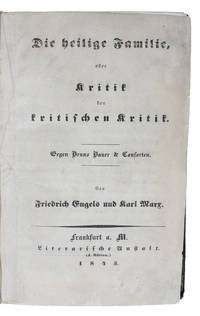
184558581Frankfurt a. M. 1845. 8vo. Contemporary black half calf. Professionally rebacked. Title-page somewhat dusty and re-hinged. VIII 335 1 pp. <br/><br/><em>Incredibly scarce first edition of one the most significant political publications of the 19th century the first joint work of Marx and Engels leading to a life-long association that would change the world. "The Holy Family" is one of the most fundamental works in the history of communism and contains the first formulations of a number of fundamental theses of dialectical and historical materialism. For instance it is here that the idea of mass/the people as the actual maker of the history of mankind is put forth for the first time and here that Marx shows that communism is the logical conclusion of materialistic philosophy.The work became incredibly influential and caused great uproar. Lenin claimed that it was this work that laid the foundations for scientific revolutionary materialist socialism.At the end of August 1844 Engels passed through Parison his way to Manchester. It was here that he met Marx then for the second time.Marx suggested that the two of them should write a critique of Young Hegelian trend of thought then very popular in academic circles. They decided to co-author the foreword and divided up the other sections between them. Engels had already finished his chapters before leaving Paris after 10 days. Marx had the larger share of work which he completed by the end of November 1844.The general title "The Holy Family" was added at the suggestion of the publisher Lowenthal being a sarcastic reference to the Bauer brothers and their supporters." "The Holy Family or Critique of Critical Critique. Against Bruno Bauer and Co." is the first joint work of Karl Marx and Frederick Engels. At the end of August 1844 Marx and Engels met in Paris and their meeting was the beginning of' their joint creative work in all fields of theoretical and practical revolutionary activity. By this time Marx and Engels had completed the transition from idealism to materialism and from revolutionary democratism to communism. The polemic The Holy Family was written in Paris in autumn 1844. It reflects the progress in the formation of Marx and Engels's revolutionary materialistic world outlook.In "The Holy Family" Marx and Engels give a devastating criticism of the subjectivist views of the Young Hegelians from the position of militant materialists. They also criticize Hegel's own idealistic philosophy: giving credit for the rational element in his dialectics they criticize the mystic side of it.The Holy Family formulates a number of fundamental theses of dialectical and historical materialism. In it Marx already approaches the basic idea of historical materialism - the decisive role of the mode of production in the development of society. Refuting the idealistic views of history which had dominated up to that time Marx and Engels prove that of themselves progressive ideas can lead society only beyond the ideas of the old system and that "in order to carry out ideas men are needed who dispose of a certain practical force." See p. 160 of the present edition. The proposition put forward in the book that the mass the people is the real maker of the history of mankind is of paramount importance. Marx and Engels show that the wider and the more profound a change taking place in society is the more numerous Me mass effecting that change will Re Lenin especially stressed the importance of this thought and described it as one of the most profound and most important theses of historical materialism.The Holy Family contains the almost mature view of the historic role of the proletariat as the class which by virtue of its position in capitalism "can and must free itself" and at the same time abolish all the inhuman conditions of life of bourgeois society for "not in vain does" the proletariat "go through the stern but steeling school of labour. The question is not what this or that proletarian or even the whole of the proletariat at the moment considers as its aim. The question is what the proletariat is and what consequent on that being it will be compelled to do." pp. 52-53.A section of great importance is "Critical Battle against French Materialism" in which Marx briefly outlining the development of materialism in West-European philosophy shows that communism is the logical conclusion of materialistic philosophy.The Holy Family was written largely under the influence of the materialistic views of Ludwig Feuerbach who was responsible to a great extent for Marx's and Engels's transition from idealism to materialism; the work also contains elements of the criticism of Feuerbach's metaphysical and contemplative materialism given by Marx in spring 1845 in his Theses on Feuerbach. Engels later defined the place of The Holy Family in the history of Marxism when he wrote: "The cult of abstract man which formed the kernel of Feuerbach's new religion had to be replaced by the science of real men and of their historical development. This further development of Feuerbach's standpoint beyond Feuerbach was inaugurated by Marx in 1845 in The Holy Family." F. Engels Ludwig Feuerbach and the End of Classical German Philosophy.The Holy Family formulates some of the basic principles of Marxist political economy. In contrast to the Utopian Socialists Marx bases the objective inevitability of the victory of communism on the fact that private property in its economic motion drives itself towards its downfall.The Holy Family dates from a period when the process of the formation of Marxism was not yet completed. This is reflected in the terminology used by Marx and Engels. Marxist scientific terminology was gradually elaborated and defined by Marx and Engels as the formation and development of their teaching progressed." Introduction to the work by Foreign Languages Publishers"The book made something of a splash in the newspapers. One paper noted that it expressed socialist views since it criticised the "inadequacy of any half-measures directed at eliminating the social ailments of our time." The conservative press immediately recognized the radical elements inherent in its many arguments. One paper wrote that in The Holy Family "every line preaches revolt. against the state the church the family legality religion and property." It also noted that "prominence is given to the most radical and the most open communism and this is all the more dangerous as Mr. Marx cannot be denied either extremely broad knowledge or the ability to make use of the polemical arsenal of Hegel's logic what is customarily called 'iron logic.'Lenin would later claim this work laid the foundations for what would develop into a scientific revolutionary materialist socialism." Marx Archive. </em> unknown
19001747226850ABSSwan Sonnenschein & Co. 1900. Hardcover. Acceptable. 1900. 6th Edition 1900. 816 pages. No dust jacket. Red cloth with gilt and black lettering. Translated by Samuel Moore and Edward Aveling. Edited by Frederick Engels. 2 volumes in 1. Pages are heavily tanned and foxed throughout. Occasional thumb marks to pages edges. Moderate dogearing to corners. Heavy cracking to gutters with a loose binding and pages. Boards have moderate shelf with bumping to corners. Spine ends are notably crushed with considerable tanning. Considerable water marks to boards and spine Slight forward lean to text block. Swan Sonnenschein & Co. hardcover
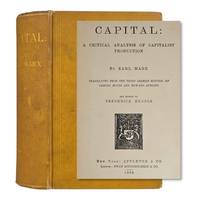
1889694 - 650 - 736<p><em>First American edition preceding the later Humboldt text in America by twenty months</em></p><p><strong>Publisher and Year</strong>: New York: Appleton & Co. 1889</p><p><strong>Edition</strong>: First American edition one of just 500 copies published in January 1889.1-4 Translated from the third German edition by Samuel Moore and Edward Aveling. The present work consists of the first and only volume to be fully written by Marx with the next two installments completed by Engels and published in English in 1907 and 1909.</p><p>Other than the title page the text of the 1889 Appleton edition is identical to the first British edition London: Swan Sonnenschein & Co. 1887 and was bound from sheets printed in the U.K. but was issued in one volume rather than two. For this edition the British firm printed and sold 500 sets of sheets to Appleton & Co. marking the first time that an American firm was listed as a publisher on the printed sheets. Note that in 1887 about half of the 500 copies of the first British edition were exported and bound in the United States but the sheets were not printed with credit to the two American distributors though both firms did make later alterations to advertise their involvement.1</p><p>The next appearance of the book in America came a full twenty months after the Appleton edition New York: The Humboldt Publishing Company 1890. Though the Humboldt edition was the earliest to be physically printed in the United States the text was an unauthorized piracy of the Moore-Aveling translation.1 The Humboldt edition was issued in serialized wrappers from September to October in 1890 and then in cloth by November of that year at the latest ~5000 copies were ultimately printed.15-8</p><p><strong>Condition and Description</strong>: Thick octavo publisher's ochre cloth stamped in gilt and blind pale-yellow endpapers 816 pp. Boards soiled with some rubbing and handling wear. Tips bumped and exposed. Gilt still legible. Some stains to the edges of the text block not intruding upon the text except for in one small instance on the upper part of the final blank. Hinges loose but holding with splits to the endpapers at the gutters but the webbing remains intact a common fault given the considerable weight and thickness of the text block. The text itself remains firmly bound with all pages attached. Tanning to the first two blanks from something that had been laid in. Previous owner's name in ink to the third blank page Louis Walldorf a member of the Socialist Labor Party in the 1890s. No other writing or underlining. A few scattered instances of light foxing and finger smudging. Without any restoration or repair. An 1899 card from The Labor Lyceum a socialist organization based in Rochester N.Y. is laid in. The card advertises an event "The 'People's Parliament'" consisting of a series of lectures and open debates concerning questions "vital.to the working people." The card in addition to ownership by a member of the Socialist Labor Party reflects the use of this copy in the American socialist movement in the late nineteenth century.</p><p><strong>Provenance: </strong>Louis Walldorf b. 1832 a German immigrant watchmaker and socialist political activist. In March of 1892 Walldorf was nominated by his ward to be an executive board member of The Socialist Labor SLP party in Rochester N.Y. where he resided. Later that year the SLP nominated their first candidates for president and vice president of the United States even though the official party platform was to abolish both offices. Walldorf remained a resident of Rochester throughout the 1890s and The Labor Lyceum card was plausibly his given where the advertised event was held.</p><p><strong>References:</strong></p><p>1. "Karl Marx Capital First American Editions." Article issued by the Karl Marx Library in Luxembourg.</p><p>2. The Publisher's Weekly 1888 Dec 29. Vol 34 Issue 26. Appleton's edition listed under "Will publish next week."</p><p>3. The Publisher's Weekly 1889 Jan 12. Vol 35 Issue 2. Appleton's edition listed under "Just published"</p><p>4. The Daily Inter Ocean 1889 Jan 12. Appleton's edition listed under "Books Received"</p><p>5. The Humboldt Library of Science issues of Marx's The Capital 135-138. Parts were dated Sep 1 Sep 15 Oct 1 and Oct 15 of 1890 on the front wrappers. Refer to the example sold by Swann Galleries on May 5th 2022.</p><p>6. Copies in wrappers were reprinted monthly from January 1891 to April 1891 with such copies bearing those dates on the front wrappers. Refer to the set listed by Antiquariat Inlibris.</p><p>7. The Nation 1890 November 6 Vol 51 Issue 1323. Humboldt edition advertised at $1.20 four parts in wrappers and $1.75 cloth</p><p>8. The Nation 1890 November 12 Vol 51 Issue 1324. Humboldt edition advertised at $1.20 four parts in wrappers and $1.75 cloth</p><p>-<br />Inventory ID: 694 - 650 - 736</p> Appleton & Co. hardcover
189046The Humboldt Publishing Co.: The Humboldt Publishing Co. 1890. First American edition. Wraps. Good. Wrappers. Translated from the third German edition & edited by Frederick Engels. Four issues in the Humboldt Library of Science Series. These issues are 135 136 137 and 138 and are dated September 1 1890 - October 15 1890. This is a pirated edition and is the first edition printed in America of the first volume of Capital. The first "official" American edition was published 1889 by Appleton & Co. NY as a re-issue of the 1887 London edition with sheets supplied by a London company with a new title page and was actually printed in Scotland. There was also a hardcover edition published around the same time precedence unknown. Spines and covers are taped and have chips missing. The third issue has three small holes through the cover and the first 21 pages of text which has done some damage to text. A rare set in any condition. The Humboldt Publishing Co., unknown
1890017498Hamburg: Otto Meissner 1890-94. Quattro libri in 3 volumi 14x22 cm. 1 Erster Band. Buch I: Der Produktionsprocess des Kapitals. Vierte durchgesehene Auflage. Quarta edizione 1890. 2: Zweiter Band. Buch II: der Cirkulationsprocess des Kapitals. Zweite Auflage. Seconda edizione 1893. 3: Dritter Band erster Theil. Buch III: Der Gesamtprocess der kapitalistischen Produktion. Kapitel I bis XXVIII. Zweiter Theil. Buch III: Der Gesamtprocess der kapitalistischen Produktion. Kapitel XXIX bis LII. Herausgegeben von Friedrich Engels. Le due parti in un volume in PRIMA EDIZIONE. 1894. Si tratta quindi della prima edizione completa del Capitale curato da Engels e pubblicato da Meissner. Al momento dell'uscita del terzo libro gli altri due erano rispettivamente alla quarta e alla seconda edizione. Legatura coeva in buona mezza pelle con titolo e fregio dorato al dorso piatti e risguardie con carta marmorizzata. Fenditura alla cerniera anteriore del vol 2 che ha anche un timbro di biblioteca alla pagina di titolo altrimenti ottime condizioni. Otto Meissner unknown
1895029919Berlin: Verlag der Expedition des Vorwärts 1895. Abdruck aus der ""Neuen Rheinischen Zeitung"" politisch-ökonomische Revue Hamburg 1850. Un volume 21 cm di 112 pagine. In lingua tedesca. Prima edizione separata in volume dello scritto di Marx apparso in precedenza nella rivista Neuen Rheinischen Zeitung e prima edizione assoluta della lunga introduzione di Engels. Brossura originale con titolo alla copertina; dorso muto rifatto con carta. Qualche fioritura alle copertine peraltro ottime condizioni. Verlag der Expedition des Vorwärts unknown
1872017495Paris: Lachatre 1872-75. Un volume 185x29 cm di 351-1 pagine. Senza la seconda delle due pagine di titolo; il volume si presenta dunque così: pagina di titolo con illustrazione raffigurante la Repubblica francese con nome e indirizzo dell'editore e le indicazioni 1ere livraison e Prix de la livraison: dix centimes; ritratto di Marx; facsimile della lettera di M. a Lachatre; risposta di Lachatre a Marx. A pag. 9 comincia la prefazione e a pag. 13 il testo del Capitale. Poche fioriture o ingialliture sparse. Legatura in mezza pelle coeva con usure; qualche usura anche ai piatti con carta marmorizzata angoli acciaccati. Sorprendente la provenienza del volume: sulla pagina di titolo infatti timbretto della Biblioteca del Grand Seminaire de Perigueux !. Prima tiratura della prima edizione della traduzione francese del Capitale apparsa in fascicoli tra l'agosto del 1872 e il novembre 1875. Famosa traduzione curata dallo stesso Marx che ne sottolineava il valore scientifico indipendente dall'originale consigliandola anche ai lettori familiari della lingua tedesca. Opera diventata rara a causa anche della pubblicazione in fascicoli in un arco di tempo assai lungo tre anni e degli ostacoli frapposti dall'autorità alla sua diffusione. Una seconda edizione che riprese la stessa traduzione e in gran parte gli stessi piombi venne pubblicata poi nel 1885 sotto l'indicazione "Librairie du Progres". La mancanza della seconda pagina di titolo con la raffigurazione del Pantheon di Roma si riscontra anche in altri esemplari e ciò ha fatto supporre che possa essere una caratteristica delle copie costituite dalla raccolta dei singoli fascicoli che si presentavano appunto con una copertina cartacea che i legatori poi eliminavano come quelle delle altre livraisons. Vicende dell'edizione: Dopo varie ricerche e contatti venne contattato Joseph Roy a Bordeaux traduttore di libri di Feuerbach. Ci lavorò dal febbraio 72 alla fine del 73. Marx si tenne in contatto ma non era molto contento la traduzione era troppo letterale si incontrarono una sola volta e Roy non piacque a Marx. Come editore fu contattato Maurice Lachatre 1814-1900 rifugiato in Spagna dopo la Comune che accettò stimando la spesa in 4000 franchi di cui metà dovevano venire da Marx li pagò Paul Lafargue e il 15 febbraio 1872 venne firmato il contratto. Frequenti contatti dell'editore con Marx al quale chiese di poter pubbicare uno scambio di lettere in facsimile e il ritratto. Nessuna pubblicità al libro per evitare la censura. La prima serie di 5 fascicoli 40pp uscì il 17 settembre 1873 e vendette in un mese 576 copie. Le serie 2 3 4 5 e 6 fascicoli da 6 a 30 uscirono nel 1873. Altre due serie 7 e 8 solo nel 1875. L'ultima serie la 9 era in preparazione quando Lachatre perse i diritti legali sulla sua casa editrice che furono passati a un certo Quest un reazionario che accettò di stamparla solo per evitare problemi legali coll'autore. Uscì alla fine di novembre del 1875. Quest aveva ridotto la tiratura degli ultimi fascicoli. Di quanto Non si sa. Poi Oriol che aveva preso di fatto il posto di Lachatre decise di ristampare il Capitale avendo a disposizione le copie invendute dei primi fascicoli: ne ristampò gli ultimi venne modificata la sequenza di inizio abolite le lettere e sostituito il nome dell'Editore con Librairie du Progrés. La ristampa ebbe circa 5000 copie di tiratura e fu messa in circolazione nel 1885. La struttura e il testo dell'edizione francese sono diversi da quelli delle edizioni tedesche ma Marx considerò avere quella francese un valore a se stante e la consigliò per i traduttori in altre lingue. Anna Uroeva La fortuna del Capitale. Lachatre unknown