Malthus, ThomasBiblio.com

80 résultats
1821048324Boston: Wells and Lilly 1821. First Edition. Hardcover Full Leather. Good Condition. Original full calf worn at edges and hinges slight bowing to covers. Internally with dampstains to upper corner heavy browning to half title and final pages and pervasive but mostly mild staining throughout not affecting legibility. Nearly very good overall. viii 472pp.<br /> <br /> Though largely overlooked at the time of publication it is in the principles that Keynes found "scientific explanation of unemployment" and that "the hundred-year domination of Ricardo over Malthus had been a disaster for the progress of economics" ODNB. Malthus's theory that spending on both public works and private luxuries could alleviate recessions and downturns by creating demand and prosperity were well ahead of his time. This is the first US edition. Size: Octavo 8vo. Quantity Available: 1. Shipped Weight: Under 1 kilo. Category: Economics; Americana. Inventory No: 048324. Wells and Lilly hardcover
1829147796London: J. Murray 1829. First appearance in print of these two papers by Malthus on the subject of value as contained in parts I pp. 171-180 and II pp. 74-81 of the first volume of the Transactions of the Royal Society of Literature here bound together. The papers were read before the society by Malthus in May 1825 and November 1827. In the first paper Malthus argues that "the natural and necessary conditions of the supply of all commodities not subject to a monopoly are represented and measured by the labour which they will ordinarily and on an average command and that no other object whatever can be substituted for labour or can represent and measure the natural and necessary conditions of the supply of commodities" p. 171. It was essentially a repetition of the arguments in Malthus's Measure of Value 1823. The second paper's aim was to show that when the term "value of a commodity" is used without referring to some other commodity in which it is to be estimated the term is "generally understood to refer and can only refer correctly to the conditions of its supply or the natural and necessary costs of its production" p. 74. The paper appears to have been intended as a development of the themes treated in his Definitions in Political Economy published earlier in 1827. 2 works bound in 1 vol. quarto 275 x 211 mm. With 21 plates of which 2 folding in first part; 7 plates of which 2 folding in second part. Twentieth-century blue quarter calf spine lettered gilt blue mottled sides marbled endpapers. With the book label to the front pastedown of the Ducs de Luynes at the Château de Dampierre. Residue from label removal at the foot of spine peripheral rubbing skilfully retouched contents clean and crisp. A very good copy. unknown
18211512140034Boston: Wells and Lilly 1821-01-01. First Edition. Hardcover. Very Good. First American edition. Bound in marbled boards spine rebacked in modern leather. Burgundy Moroccan leather spine label. Clean unmarked pages. Marginal browning to pages. Internally very good. <br> The first English edition was printed by John Murray in 1820 this is the 1st American edition printed in 1821 in Boston.J.M. Keynes "argued that Malthus's theory of effective demand provided a scientific explanation of unemployment and that the hundred-year domination of Ricardo over Malthus had been a disaster for the progress of economics. Keynes believed that if economics had followed Malthus . the world would be a much wiser and richer place" ODNB. The last chapter of the book was devoted to rebutting Say's law and argued that the economy could stagnate with a lack of "effectual demand". In other words wages if less than the total costs of production cannot purchase the total output of industry causing prices to fall; price falls decrease incentives to invest creating a downward spiral. Refs for 1st English ed: Goldsmiths 22767; Kress C577. <br><br>Early signature of E.W. Paige Schenectady NY and his book plate on front paste down. Eugene W. Paige 1852-1919 served in the New York legislature in the 19th century. Boston: Wells and Lilly hardcover
181722733London: John Murray 1817. First edition. 1 vols. 8vo. Rebound in later buckram. Title a little foxed contents generally clean. First edition. 1 vols. 8vo. Issued in conformity with but separately from the fifth edition - the penultimate edition before the sixth and final one in his lifetime. Kress B.6973; Goldsmith 21762 John Murray unknown
182056733London: John Murray Albemarle-Street. Printed by C. Roworth Bell-yard Temple-bar 1820. First Edition. Hardcover. Very Good. 601 pp. Octavo 22 cm; rebound in later brown calf over hand-painted brown cloth with gilt-stamped black morocco spine label raised spine bands new endpapers. Surface of cloth treated with a transparent shellac of some kind giving it a striated shine when viewed at an angle; some bubbling-up of front board cloth light dampstaining to rear board; a handful of light pencil underlines and one contemporary ink blot very light foxing else interior is remarkably clean. A nicely rebound first edition of this classic work. John Murray, Albemarle-Street. Printed by C. Roworth, Bell-yard, Temple-bar hardcover
1807AQ28409London: Printed for J. Johnson.by T. Bensley 1807. In two volumes. xvi 580; vii 484pp 60. With half-titles. Contemporary gilt-ruled half-calf marbled paper boards contrasting green and tan calf lettering-pieces marbled edges. Lightly rubbed corners exposed. Hinges exposed later inked ownership inscription of Arthur Johnson to recto of front blank fly-leaf of Vol. I very occasional light spotting. The fourth edition greatly extended from the anonymous first of 1798 of this cornerstone of early studies of demography and an influential work in the history of political economy. Contrary to the prevailing Whig theory of history English cleric and scholar Thomas Robert Malthus 1766-1834 argued that the agricultural output of modern Britain would not be able to support the rapid population growth witnessed in the eighteenth-century and thus that society would return to earlier subsistence levels following catastrophic outbreaks of disease and famine. The second edition of 1803 was substantially revised and extended to include observations made from European data and most notably the recognition that human agency and especially moral restraint could alleviate the plight of the poorest elements of society. The third edition of 1806 added an appendix in which Malthus replied to his many contemporary critics. This fourth edition incorporates all of the previous revisions and additions. Provenance: Arthur Henry Johnson 1845-1927 historian and chaplain of All Souls College Oxford; author of inter alia The history of the Worshipful Company of the Drapers of London Oxford 1914-22 and The disappearance of the small landowner Oxford 1909. . Fourth edition. 8vo. Printed for J. Johnson...by T. Bensley hardcover
1826149989London: John Murray 1826. The definitive text in original boards Sixth edition the final lifetime edition and the definitive text with Malthus's final revisions marking a significantly expanded and amended text from the first edition of 1798. The Essay is one of the most important and influential works in the history of economic thought and the foundation text of modern demography. 2 vols octavo. Original purple cloth-backed drab grey paper boards printed spine labels. Ownership signature dated 1882 to front free endpaper old price label to front cover of vol. II. Spines lightly sunned label of vol. II chipped with loss paper covering on front cover of vol. II peeling around front joint tips a little worn light foxing partly unopened. A very good copy. hardcover
1817231696London : John Murray 1817. 1st edition. Hardcover. Contemporary aniline calf over marble boards. Front hinge loose with wear to the spine bands and panel edges. A good copy. Physical description; iv 327 1 p. ; 22 cm. Includes bibliographical references.Subjects; Population.Malthusianism. Population control. Population growth.Referenced by: Kress Lib B.6973. London : John Murray hardcover
1809013706Washington City: Chew Weightman 1809. First american from the third London edition. Due volumi 13x22 cm di XVI-510-XXXIII pp e VI-542 pagine. Scritta di proprietà datata 5 march 1834 sulle pagine di titolo. Una gora alla metà inferiore del volume nelle prime ed ultime 30 pp del volume 1. Qualche altra brunitura sparsa. Legatura coeva in tutta pelle marmorizzata dorsi lisci con tassello di titolo; qualche usura e abrasioni ai piatti del volume 2 ma nel complesso bell'esemplare di questa prima edizione americana dell'opera di Malthus. Chew Weightman unknown
182123029Boston: Wells and Lilly 1821. First American edition of this landmark work in political economy. Octavo bound in three quarters leather over marbled boards black leather morocco spine label. In near fine condition. In his Principle of Political Economy Malthus was proposing investment in public works and private luxury as a means of increasing effective demand and hence as a palliative to economic distress. The nation he thought must balance the power to produce and the will to consume" DSB. Wells and Lilly hardcover
18265417London: John Murray 1826. Hardcover. Very Good. 2 volumes. 8vo. Pp. xviii 535; iv 528. Both volumes with one blank at the front and at the end. No half-title in volume 1. In the original boards with a patterned cloth spine strip the paper spine labels chipped spine cloth faded board corners worn ink name to the upper edge of the front boards with the previous owner's bookplate to paste-down and an ownership signature to the front endpaper of the first volume. Light foxing to the prelims and very light foxing throughout the text is very clean and the bindings are tight and square. A nice clean set. The sixth edition and the last edition to be published in his lifetime. Lowndes 1459. John Murray hardcover
1817720P18London: John Murray 1817. First edition. Hardback. Very Good. 9" by 5.5". None. The first edition of this additions volume to Thomas Robert Malthus' immensely influential essay on the issue of growing population. The first edition of this work.This work is Malthus' additions to his influential book 'An Essay on the Principle of Population' added to the fourth and earlier editions.'An Essay on the Principle of Population' is a treatise warning of the future difficulties with a growing population on Earth.The essay was not the first work to be published on population but it was incredibly influential as contributed to the passing of the 1800 Census Act.This addition volume highlights key issues in the original work and expands upon them giving the reader a wider understanding of the issue of population.Written by Thomas Robert Malthus a scholar who is best known for this work and for his influential economics.Bound without publisher's adverts. In the original publisher's marbled paper boards. Externally smart. A small amount of bumping to the head and tail of the spine and to the extremities. A little rubbing to the boards and spine resulting in fading of the marble pattern. Internally firmly bound. Pages are lightly age-toned and generally clean with some scattered spotting. Very Good John Murray hardcover
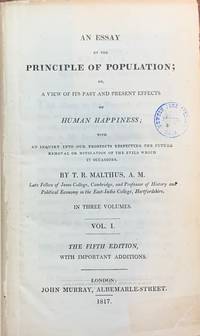
1817140901001London: John Murray 1817. Hardcover. Very Good. xvi 496 p; iv 507 p; 500 p. "The fifth edition with important additions." Complete and unrestored in three volumes. Original boards with orginal paper spines most of which are not surprisingly gone given their fragility. In protective mylar wraps. Very Good condition overall: bindings degraded over time but completely unrestored and text in very nice shape. Clean pages-- no marks-- generally bright for age. Some foxing throughout text and typical waviness. Bumped corners. Not ex-library! Old London bookseller's stamp on front paste downs. Secodn volume front cover creased missing small strip o paper. Third volume front board detached the other covers are intact; the mylar wraps keep them all in place. Nice condition overall. A greatly revised and expanded edition of Malthus' most famous work the second-to-last published during his lifetime. Contains revisions of his views on rent a deeper look at how the political organization of states was determined by population and what limits to population growth were already occurring in Europe and an appendix with replies to critics. An enormously influential and controversial work that inspired Charles Darwin and Alfred Russel Wallace. John Murray hardcover
180785583J. Johnson in St. Paul's Church Yard 1807. Hardcover. Very Good. 1807 2 volume set full leather bindings 4th edition London. Bookplates to front pastedowns both volumes. Volume one shows borer damage to margins not to text. Also shows contemporary ownership ink to title. Text is unmarked bindings are tight. Spines are sunfaded. oversized and overweight. Please email for photos. J. Johnson in St. Paul's Church Yard hardcover
1807314917London: Printed for J. Johnson in St. Paul's Church-Yard by T. Bensley 1807. Fourth edition. 2 vols. 8vo. Contemporary mottled calf marbled edges. Rebacked in gilt calf one hinge tender. Fourth edition. 2 vols. 8vo. Malthus is as controversial as he is influential. "The central idea of the essay . was a simple one. The population of a community . increases geometrically while food supplies increase only arithmetically. If the natural increase in population occurs the food supply becomes insufficient and the size of the population is hecked by 'misery'" PMM. PMM 251 first edition; Kress 5219 Printed for J. Johnson in St. Paul's Church-Yard, by T. Bensley unknown
18177080<p><em>An Essay on the Principle of Population or A View of its Past and Present Effects on Human Happiness; With An Inquiry into our Prospects Respecting the Future Removal or Mitigation of the Evils which it Occasions.</em><br /><br />8vo. Modern ½-brown calf leather binding over marbled boards gilt decorated spine with 5 raised bands two black and red gilt lettered morocco labels; new endpapers added. London: Printed for John Murray 1817. <strong>Fifth Edition with Important Additions.</strong> <strong>3 volumes. </strong><br /><br /><em>An Essay on the Principle of Population </em>was first published anonymously in 1798 through J. Johnson London. The author was soon identified as The Reverend Thomas Robert Malthus. In 1803 a second and much enlarged edition was published with the author acknowledged. Later editions were taken from the second edition and there are additional changes throughout the sixth edition. It has been acknowledged as one of the most influential economic works in history. Library stamps on the title pages; some numbers in pencil on the copyright pages; title page of volume 1 worn with a small tape repair; o/w Fine. Rare.</p> Printed for John Murray hardcover
1806ZB1325657London: J. Johnson 1806. Price HAS BEEN REDUCED by 10% until Monday June 29 SALE item 2 vols. xvi 505 58 index vii 559 pp. contemporary full leather bindings now dry and worn a few areas of the spine of the first volume now lacking the leather covering masonic library and private book plate to the front paste down of each volume scant foxing else internally clean and tight. - If you are reading this this item is actually physically in our stock and ready for shipment once ordered. We are not bookjackers. Buyer is responsible for any additional duties taxes or fees required by recipient's country. Photos available upon request. London: J. Johnson hardcover
1853133496London: Simpkin and Marshall 1853. Presentation copy to the editor of The Economist Second edition presentation copy of Malthus's Definitions edited and with a new preface notes and additional remarks by John Cazenove 1788-1879 an intimate friend and protégé of Malthus who described him as "a very clever man and good political economist." Cazenove's writings are "a worthwhile contribution to political economy in their own right and an important part of the anti-Ricardian tradition" New Palgrave. This copy is inscribed on the half-title: "To the Editor of The Economist with Mr Cazenove's Comps." The founder and first editor of The Economist was James Wilson 1805-1860 a businessman economist and Liberal politician who continued as editor until 1857. Octavo. Original green cloth printed paper label to front board yellow coated endpapers. Pencil annotation to one or two pages. Spine ends and corners rubbed joints with short splits to extremities occasional marginal finger marks: a very good copy. Sraffa 3702. hardcover
1836ELTinMAL26London: William Pickering 1836. 1836. 8vo. pp. liv 1 leaf 446. untrimmed & partly unopened in original cloth spine dull & frayed at ends label chipped. Second Enlarged Edition of Malthus's chief contribution to general economic theory in which he explains in particular his differences with Ricardo. ".Ricardo's work.started with the Wealth of Nations and recoined the latter's theoretical contents by a method that centered in the concept of value. Exactly the same thing is evidently true of the work of Malthus.Except for his theory of saving and investment which on the face of it seems to be Malthus's own all the elements that enter into the analytic apparatus of that work and even its terminological arrangements point to the First Book of the Wealth of Nations. Only whereas Richardo recoined the doctrine of the Wealth by means of the labor-quantity theory of value Malthus recoined it by the means of the theory of value that A.Smith actually used namely the theory of supply and demand.whereas Ricardo's analytic apparatus is geared to the problem of distribution.Malthus.geared his apparatus to the analysis of the whole economic process.Therefore Malthus should.stand in the history of analysis not only as the author of a valid alternative to Ricardo's theory but as the sponsor or rather as one of the sponsors of the victorious one." Schumpeter This edition enlarged with additions from Malthus's own manuscript was published two years after the author's death and includes William Otter's important Memoir pp. xiii-liv one of the chief original authorities for James Bonar's Malthus and His Work 1886. Einaudi 3681. Goldsmiths' 29340. Kress C.4188. McCulloch p. 18. NCBEL III 1294. Palgrave II p. 677. Schumpeter p. 482-83. Hardcover. London: William Pickering, 1836. Hardcover
180940999Washington City: Roger Chew Weightman 1809. 2 volumes 8vo. 8 1/4 x 5 inches. Vol. 1 xvi 510 xxxiv pp.; Vol. 2 vii 542 pp. Contemporary tree calf skilfully rebacked. Spines gilt ruled forming six compartments lettering pieces in the second compartmenrs<br/> <br/> Provenance: Possibly John Barclay 1749-1824 former Mayor of Philadelphia from 1791 to 1793<br/> <br/> First American edition of a fundamental text of Modern Economics.<br/> <br/> Thomas Robert Malthus was an English economist cleric and scholar influential in the fields of political economy and demography. Malthus came to prominence for his publication of the present work first published in 1798. Between 1798 and 1826 Malthus published six versions of the essay updating each edition to incorporate new material to address criticism and to convey changes in his own perspectives on the subject. Writing in response to Jean-Jacques Rousseau and William Godwin specifically their approaches to the improvement of society Malthus opposed the optimistic view in 18th-century Europe that saw society as improving and in principle as perfectible. Malthus saw population growth as inevitable whenever conditions improved thereby precluding real progress towards a utopian society: "The power of population is indefinitely greater than the power in the earth to produce subsistence for man." Malthus laid the "theoretical foundation of the conventional wisdom that has dominated the debate both scientifically and ideologically on global hunger and famines for almost two centuries" Daoud. He remains a much-debated writer.<br/> <br/> Shaw 17975; Daoud Ade "Robbins and Malthus on scarcity abundance and sufficiency: The missing sociocultural element" in American Journal of Economics and Sociology 69.4: 1206-1229; Harvey David "Population Resources and the Ideology of Science"in Economic Geography 503: 256277. Roger Chew Weightman unknown
180752022<p>HANDSOME COPY IN CONTEMPORARY BOLDLY SPECKLED CALF<br />2 vols. tall 8vo. iii-xvi 580; iii-viii 484 58 indexpp. contemporary boldly speckled calf smooth spines richly decorated in gilt in panels using two different designs black lettering and russet numbering labels gilt board edges gilt rolled spines a trifle chaffed at headbands some cracking at ends of some joints but overall a very nice copy.<br />Near contemporary pencilled shelf number "D198" of Lord Dunraven of Adare Manor Co. Limerick on endpaper.<br /><br />KRESS B5219<br />This is edition incorporates the substantial revisions and additions which Malthus had made for his third edition of 1806. They are listed and described in full in his preliminary 'Advertisement' to that edition also printed here. The most substantial of the changes made was that "The chapters which were the fourth and sixth of the second book are nearly rewritten on account of an error into which the author had fallen in an attempt to estimate the fruitfulness of marriages and the number born living to be married from the data in registers" 'Advertisement'. Furthermore he added as an appendix here vol.2 p.429-484 his important Reply to the Chief Objections to the second edition of 1803. This appendix he had also published separately in quarto "for the accomodation of the purchasers of the former edition" 'Advertisement'.Malthus recommends that "those who have not the leisure or inclination to read the entire work will find in the appendix such notice of its most prominent arguments as will give them a good general idea of the aim and bent of the whole". In it he writes "My object is to correct some of the misrepresentations which have gone abroad respecting two or three of the most important points of the Essay. . The first grand objection that has been made to my principles is that they contradict the original command of the Creator to increase and multiply and replenish the earth . The next grand objection which has been urged against me is my denial of the right of the poor to support. . and lastly and rather a matter of feeling than of argument. Many persons have accused him of excessive pessimism in throwing a darker shade over our views of human nature and tending particularly to narrow our prospects of future improvement". All of these objections he attempts to refute.<br />From the library of Edwin R. W. Wyndham-Quin Viscount Adare F.R.S. of Adare Manor Co. Limerick.</p> Printed for J. Johnson .. by T. Bensley hardcover
1806156997London: for J. Johnson by T. Bensley 1806. The foundation text of modern demography Third edition the first edition to be published in two octavo volumes the format which was to remain the standard in Malthus's lifetime. This third edition has important alterations and additions particularly the appendix in which Malthus replied to some of his many critics; it follows the first edition of 1798 in a single octavo volume and the expanded second edition in quarto in 1803. Malthus's treatise on population is one of the most important and influential works in the history of economic thought and the foundation text of modern demography. "For today's readers living in a post-Malthus era the world's population problems are well known and serious but no longer sensational. It is difficult therefore to appreciate the radical and controversial impact made by the Essay at the time of publication. It challenged the conventional notion that population growth is an unmixed blessing. It discussed prostitution contraception and other sexual matters. And it gave vivid descriptions of the horrendous consequences of overpopulation and of the brutal means by which populations are checked" ODNB. Despite its unpopularity with liberal critics Malthus's principle of population became accepted as a central tenet of classical political economy and Charles Darwin acknowledged Malthus's influence in the development of his theory of natural selection. 2 vols octavo 209 x 128 mm. Bound without half-titles. Recent half calf red morocco label marbled sides. A few contemporary annotations in vol. II. Repairs to closed tears at head of A7 and A8 into text without loss slight sporadic spotting light dampstaining at lower outer corner of vol. II towards rear. A very good copy. Einaudi 3689; Goldsmiths' 19210; Kress B5067. unknown
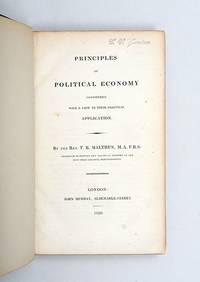
1820158341London: John Murray 1820. From the library of a neo-Malthusian First edition with the stamp on the title page of Carel Victor Gerritsen 1850-1905 the radical Dutch politican who founded the Nieuw-Malthusiaansche Bond Neo-Malthusian League in 1881; like Malthus Gerritsen deemed unchecked population growth the root of society's ills and proposed - unlike Malthus - the use of contraception to restrain it. Principles of Political Economy was conceived as a series of tracts rather than a comprehensive and systematic treatise. Malthus published it to establish his own position against that of Ricardo with whom he had been having an ongoing debate about the nature of labour demand and profit. Unlike Ricardo Malthus supported the active encouragement of demand and in so doing was seen by John Maynard Keynes as a forerunner of his own thought. "Malthus was proposing investment in public work and private luxury as a means of increasing effective demand and hence as a palliative to economic distress. The nation he thought must balance the power to produce and the will to consume" DSB. "The Principles had only a limited impact at the time and was severely criticized by J. R. McCulloch and Ricardo; the latter prepared extensive critical notes. But more recently it has received greater recognition largely as a result of the comments by J. M. Keynes in the 1930s. Keynes argued that Malthus's theory of effective demand provided a scientific explanation of unemployment and that the hundred-year domination of Ricardo over Malthus had been a disaster for the progress of economics. Keynes believed that if economics had followed Malthus instead of being constrained by Ricardo in an artificial groove the world would be a much wiser and richer place" ODNB. Octavo 215 x 132 mm. Recent brown morocco red morocco label marbled endpapers. Neat ink ownership signature to front free endpaper. Sporadic light foxing short closed tear not affecting text at head of L2. A very good copy. Goldsmiths' 22767; Kress C.577. unknown
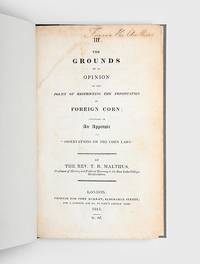
1815172737London: Printed for John Murray and J. Johnson and Co. 1815. Malthusian economics stress-tested First edition presentation copy inscribed in a secretarial hand "From the Author" at the head of the title page. The Grounds of an Opinion is a rare Malthusian argument in favour of economic interventionism supporting the restrictions imposed by the Corn Laws on foreign grain. In his wider work on population and poverty Malthus promoted an essentially laissez-faire approach to political economy. In the Essay on the Principles of Population 1798 for example he rejected poor relief and centralized intervention as fatally detrimental to the work ethic of the poor. The Grounds of an Opinion therefore shocked his circle of Whiggish friends but Malthus justified his deviation on grounds of national security: encouraging domestic production was the only way to ensure self-sufficiency in food within a fickle and changeable continent. Malthus's presentation may have been less effective than he hoped. A leaf of contemporary manuscript notes tipped in after p. 4 records considerable dissatisfaction with Malthus's "most extraordinary assertion". Octavo 208 x 128 mm pp. ii 48; lacking terminal advertisement leaf. Recent brown quarter calf grey paper-covered boards. Infrequent 20th-century pencil annotations to contents. Light foxing vertical tear to title page neatly repaired and upper inner corner replaced: a very good copy. Einaudi 3672; Goldsmiths' 2177; Kress B6535; Mattioli 2214; Sraffa 3690. hardcover
180775775hLondon: Printed for R. Johnson in St. Paul's Church-Yard by T. Bensley Bolt Court Fleet Street 1807. Book. Very Good. Hardcover. 8vo - over 7¾ - 9¾" tall. Two-volume set in full tree-calf with gilt spines. Professionally re-backed with original spines relaid. Moderate handling and bumping to covers. Edges and endpapers toned. Armorial bookplate of Sir Edward Strachey Baronet Sutton Court Somerset inside front covers; early owner's name in ink to free endpapers. Otherwise clean tight and unmarked -- no foxing or staining to text. Very neat -- a sound and handsome set. Half-titles present; extensive index. xvi580viii48460indexpp. Printed for R. Johnson in St. Paul's Church-Yard, by T. Bensley, Bolt Court, Fleet Street Hardcover