MALTHUS, TR T RBiblio.com
80 résultats
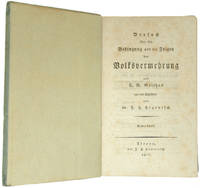
180731326Altona J.F. Hammerich 1807. 8vo. Bound in the two orig. blue cardboardbindings. The backs have been professionally restored preserving the orig. printed paper title-labels and cont. paper library-labels at lower backs. Occasional brownspotting due to the paper-quality but all in all a very nice and attractive copy. XVI 4 368; VIII 358 1 pp. Some of the first leaves of the "Erstes Buch" in the first volume have been misbound but are all present. <br/><br/><em>Rare first German edition of this political and economic classic which constitutes Malthus' first major publication and his main work because of which he is considered the father of demography and one of the main sources of inspiration for Darwin and Wallace. It is the first translation of the "Principle on Population" into any language and it influenced German politics tremendously.The first edition was printed anonymously in London in 1798 and in 1803 the second edition which also according to Malthus himself can be said to constitute a new work appeared; -the great quarto edition from 1803 is thoroughly revised and much enlarged the title has been changed and Malthus' name appears on the title-page for the first time it is on this edition that all the preceding editions are based and in consequence also the early translations. All the later editions were minor revisions of the second one. In 1806 the third edition appeared and as soon as 1807 the first German one which is translated from the revised third edition "Die gegenwärtige Uebersetzung ist nach der dritten Ausgabe Oktav London 1806. Die Quartausgabe ist minder vollständig" Vorwort p. V. New revisions of the text kept appearing till the sixth edition in 1826. The book then as now is considered highly controversial and it has influenced all demographers ever since as well as being of immense importance to the study of economic theory and genetic inheritance. "The "Essay" was highly influential in the progress of thought in the early nineteenth-century Europe. "Parson" Malthus as Cobbett dubbed him was for many a monster and his views were often grossly misinterpreted. But his influence on social policy whether for good or evil was considerable. The Malthusian theory of population came at the right time to harden the existing feeling against the Poor Laws and Malthus was a leading spirit behind the Poor Law Amendment Act of 1834." PMM 251.Thomas Robert Malthus 1766-1834 called the "enfant terrible" of the economists was an English demographer statistician and political economist who is best known for his groundbreaking views on population growth presented in his "Essays on the Principle of Population" which is based on his own prediction that population would outrun food supply causing poverty and starvation. Among other things this caused the legislation which lowered the population of the poor in England. Malthus actually turned political economic and social thought upside down with this work which has caused him to be considered one of the 100 most influential persons in history Hart The 100: A Ranking of the most Influential Persons in History 1978. Of course he was condemned by Marx and Engels and opposed by the socialists universally but the work was of immense impact on not only politics economics social sciences etc but also on natural sciences. "Later in the "Origin of Species" he Darwin wrote that the struggle for existence "is the doctrine of Malthus applied with manifold force to the whole animal and vegetable kingdoms; for in this case there can be no artificial increase of food and no prudential restraint from marriage" p. 63. Alfred Russel Wallace who arrived at a worked-out formulation of the theory of evolution at almost precisely the same time as Darwin acknowledged that "perhaps the most important book I read was Malthus's "Principles of Population" My Life p. 232. Although there were four decennial censuses before Malthus' death he did not himself analyze the data although he did influence Lambert Quetelet and Pierre Verhulst who made precise statistical studies on growth of populations in developed countries and showed how the early exponential growth changed to an S curve." DSB IX p. 69. As Malthus realized that his theories were not satisfactorily presented or sufficiently demonstrated in the first edition from 1798 he travelled for three years through Europe gleaning statistics and then published the second edition in 1803. Among other places he travelled through Northern Germany and his detailed diaries of these journeys provided him with some of the evidence necessary for the development of his theory on population growth. The observational information that he gathered on his travels in Europe were crucial to the development of his theories which also means that the work is of great interest for other European countries and not only Britain. "In 1819 the Royal Society elected Malthus to a fellowship. He was also a member of the French Institute and the Berlin Academy and a founding member of the Statistical Society 1834." DSB IX p. 67. Printing and the Mind of Man 251 first edition. </em> unknown
1803156812London: printed for J. Johnson by T. Bensley 1803. A classic of economic thought significantly expanded The Great Quarto edition notionally the second edition of the Essay on Population published in 1798 but so substantially enlarged rewritten and re-titled as to be a new book. "In 1803 Malthus published a greatly expanded second edition of the Essay incorporating details of the population checks that had been in operation in many different countries and periods. Although nominally a second edition it was regarded by Malthus as a substantially new work. He did not claim originality for the idea that population tends to outrun the food supply. In the preface to the second edition he stated that in writing the first edition he had deduced the principle of population from the writings of David Hume Robert Wallace Adam Smith and Richard Price but that in the intervening period he had become aware that much more had been published on the subject. He nevertheless believed that even more remained to be done especially in describing the means by which populations are checked and in drawing out the practical implications of the principle of population. In the second edition he made clear what was only implicit in the first that prudential restraint should if humanly possible be 'moral restraint' - that is delayed marriage accompanied by strictly moral pre-marital behaviour although he admitted that moral restraint would not be easy and that there would be occasional failures. Whereas in the first edition he had said that all the checks to population would involve either misery or vice in the second edition he attempted to lighten this 'melancholy hue' Essay on the Principle of Population 1st edition 1798 p. iv and 'to soften some of the harshest conclusions of the first essay' 2nd edition 1803 p. vii by arguing that moral restraint if supported by an education emphasizing the immorality of bringing children into the world without the means of supporting them would tend to increase rather than diminish individual happiness" ODNB. Quarto. Uncut in the original boards manuscript lettering to spine. Housed in a custom solander box with red label. Neat 20th-century ownership label to front pastedown. Joints and corners worn some expert reconsolidation to binding horizontal tear to head of title neatly repaired without loss and short vertical tear to lower margin of the same; a very good copy. Einaudi 3668; Goldsmiths' 18640; Kress B.4701. hardcover
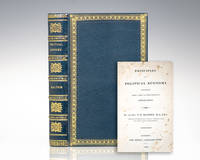
1820143844London: John Murray 1820. Rare first edition of Malthus' classic work. Octavo bound in full diced morocco raised bands gilt titles and tooling to the spine front and rear panels marbled endpapers. In near fine condition. An exceptional presentation. Thomas Malthus was an English economist known for his work in the fields of political economics and demography. His theory that prosperity and production lead not to utopia but to population growth and thereby back to social imbalance known as the "Malthusian trap" was expounded in his Essay on the Principle of Population 1789 one of his most notable and debated works. His Principles of Political Economy was written as a polemic against David Ricardo's On the Principles of Political Economy and Taxation and Say's Law arguing that demand did not grow simultaneously with supply but that they should be analyzed independent of each other expounding ideas which became influential on Keynsian economics. Both these works were divisive incurring backlash and support amongst notable economists. The bleak message of his Principle of Population rendered Malthus a notorious figure: Ebenezer Scrooge from A Christmas Carol for example justifies his refusal to give charity as a Malthusian attempt to control the population. John Murray hardcover
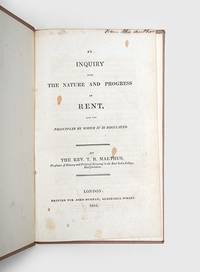
1815168217London: for John Murray; 1815. A major contribution to rent theory First edition first issue presentation copy inscribed in a secretarial hand "from the author" on the title page. The pamphlet is the first expression of Malthus's view for which he is credited as among the founders of the classical theory of rent. "Together with the population principle the theory of rent was one of the chief ideas contributed by Malthus to the re-evaluation of Smith's political economy which took place during the first decades of the nineteenth century" Winch p. 349. Malthus developed the idea from his lectures while professor of history and political economy at the East India College. Its publication grew out of a private debate between Malthus and Ricardo. In response Ricardo expounded on Malthus's ideas and their synthesis was the basis of English thought on rent for the rest of the century. The second issue names J. Johnson and Co. in the imprint. Provenance: with the bookplate of the Dutch economist Arnold Heertje 1934-2020. Octavo 207 x 127 mm pp. iv 62. Twentieth-century pink paper boards red morocco label to spine. Superficial split to front joint contents spotted. A good copy. Black 2877; Einaudi 3673; Goldsmiths' 21130; Hollander 2323; Kress B.6536; McCulloch p. 32. Donal Winch Riches and Poverty 1996. hardcover
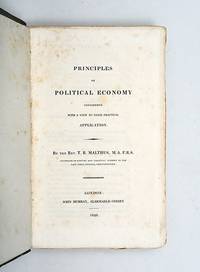
1820151433London: John Murray 1820. First edition. The book was conceived as a series of tracts rather than a comprehensive and systematic treatise though Malthus published it to establish his own position against that of Ricardo with whom he had been having an ongoing debate about the nature of labour demand and profit. "In his 'Principles of Political Economy' Malthus was proposing investment in public work and private luxury as a means of increasing effective demand and hence as a palliative to economic distress. The nation he thought must balance the power to produce and the will to consume" DSB. "The Principles had only a limited impact at the time and was severely criticized by J. R. McCulloch and Ricardo; the latter prepared extensive critical notes. But more recently it has received greater recognition largely as a result of the comments by J. M. Keynes in the 1930s. Keynes argued that Malthus's theory of effective demand provided a scientific explanation of unemployment and that the hundred-year domination of Ricardo over Malthus had been a disaster for the progress of economics. Keynes believed that if economics had followed Malthus instead of being constrained by Ricardo in an artificial groove the world would be a much wiser and richer place" ODNB. Octavo. Uncut and unopened in the original drab paper-backed blue boards printed paper spine label. Housed in a dark blue quarter morocco solander box by the Chelsea Bindery. Engraved book plate "Bibliothèque de Mr de Barante" to front pastedown paper library shelf label to foot of spine. Head of spine chipped front joint cracked rear joint cracked at head spine label a little chipped all still very strong; a very good copy. Goldsmiths' 22767; Kress C.577. hardcover