6 résultats
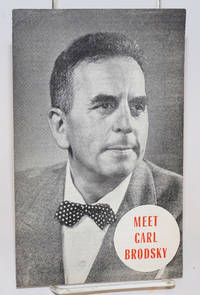
194362854New York: the Committee 1943. 4p brochure illus. 5.25x8.25 inches. Campaign calls "For support of our Commander-in-Chief in the direction of the war" and "For maximum and uninterrupted production" among other platform points. the Committee unknown books
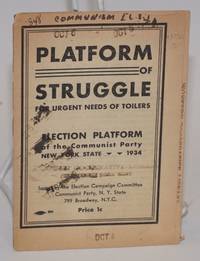
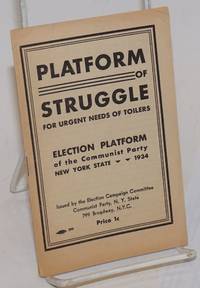
193437561New York: the Committee 1934. 23p. staplebound pamphlet rubberstamp and other marking from an old CP library; a reading copy only. the Committee unknown books
193410852New York: the Committee 1934. Pamphlet. 23p. staplebound pamphlet toned otherwise very good 4x6 inches. the Committee unknown books
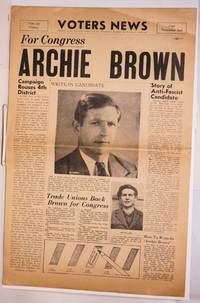
1942168162San Francisco: Communist Party 1942. Election campaign broadside single sheet folded designed to appear like the front page of a tabloid newspaper. Paper is evenly toned some closed edge tears minor chipping. Cover story is on write-in candidate Archie Brown candidate for congress and a veteran of the Abraham Lincoln Brigade. He is said to have received 31000 votes in a run for SF's Board of Supervisors. Communist Party unknown books
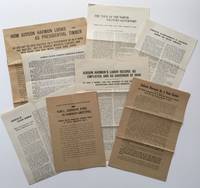
1912371Columbus Oh 1912. About very good. Eight pieces including one 12pp. pamphlet and seven broadsides and bifolia. Old folds light wear. Several items evenly tanned. An informative group of eight extremely scarce or unrecorded pieces promoting the presidential campaign of Ohio Governor and former U.S. Attorney General Judson Harmon in 1912. Harmon eventually lost out to Woodrow Wilson at the Democratic National Convention. The most substantial piece a twelve-page pamphlet concerning Harmon's "presidential timber" located only at the Ohio History Center lavishes praise upon his character and provides a lengthy discussion and defense of his legislative record as Governor. The remaining pieces are not recorded by OCLC and include an endorsement from the late mayor of Cleveland Tom L. Johnson a broadside comparing Harmon's record with Wilson's a four-page endorsement by Charles H. Wirmel leader of the Ohio Steam Engineers Union a broadside printing of endorsements from Progressive leaders in the Democratic Party and two printings of remarks made by Harmon before Democratic Party gatherings. Scarce and ephemeral material on the Democratic contest for the presidential nomination in 1912. unknown books
193624942<p>This sheet contains five rough sketches of graphics calling on the workers and voters of America to support Franklin D. Roosevelt's reelection in 1936. They did in record numbers.</p> <b>PRESIDENTIAL ELECTION OF 1936.</b>Typed Document Signed. Artwork by Franz Felix and Ideas and Copy by Richard Barron "Set of Rough Sketches Containing Some Suggested Promotion Ideas to be Used in the 1936 Democratic Presidential Campaign" July 2 1936. 1 p. 12 x 10½ in.<p><b><br /></b></p><p><b>Excerpts:</b></p><p>"<i>1. Sounding the call against 'economic royalists' in the spirit of 1776.</i>"</p><p>"<i>2. Appropriating the well-known symbol of violence</i> upraised fist<i> diverting it to peaceful democratic use. To include the farmer phrase the appeal: TOILERS OF AMERICA – UNITE FOR ROOSEVELT.</i>"</p><p>"<i>3. The statue of 'The Thinker' as a symbol of the man today who thinks the toiler with brawn and brain.everyman.</i>"</p><p>"<i>4. Direct appeal to radical labor and leftists in general.</i>"</p><p>"<i>5. Another way of appealing to the working class men and women.</i>"</p><p>"<i>This collaborative effort respectfully submitted for consideration to the Chairman of the Democratic National Committee Mr. James A. Farley.</i>"</p><p><b>Historical Background</b></p><p>After unseating incumbent Republican President Herbert Hoover in 1932 President Franklin D. Roosevelt ran for reelection in 1936. His Republican opponent was Governor Alf Landon of Kansas. Although the Great Depression had entered its eighth year Roosevelt's New Deal policies were broadly popular. He won the highest share of the popular and electoral vote since the uncontested 1820 election. Roosevelt attracted more than 60 percent of the popular vote and won the electoral votes of 46 states; Landon won the electoral votes of only Maine and Vermont.</p><p>Democratic Party chairman James Farley had predicted that Roosevelt would lose only Maine and Vermont. After the results of the 1936 election Farley quipped that the nation needed to revise the conventional political wisdom of "As Maine goes so goes the nation" to "As Maine goes so goes Vermont."</p><p>These ideas for campaign imagery employed or modified common images to support Roosevelt's campaign. One drew on the imagery of artist Archibald Willard's 1875 painting <i>The Spirit of '76</i> and employed three figures of workers to match the subjects of Willard's image. Another appropriated the upraised fist as a symbol of violence and repurposed it as a symbol of defiant unity against "<i>economic royalists</i>." A third used an image of <i>The Thinker</i>by French sculptor Auguste Rodin 1840-1917 to appeal to thinking voters. Another image appeals to the fears of radicals that the alternative to Roosevelt is "<i>Reaction</i>."</p><p>Richard Barron and artist Franz Felix submitted these ideas to Democratic National Committee chairman James A. Farley on July 2 1936 three weeks before the Democratic Party held its convention in Philadelphia. There is no evidence that these images were used in the campaign and it is possible that Farley rejected them. At the end of the campaign the Democratic National Committee had a campaign deficit of approximately $850000. To help offset those expenses the treasurer convinced President Roosevelt to sign 2500 brief Forewords which were bound into <i>The Democratic Book 1936</i> and sent to donors of $250. Purchases brought in more than $400000 for the party and led Republicans to charge corrupt practices for allowing corporations to contribute to the campaign by buying copies.</p><p><b>Franz Felix</b> 1892-1967 was born in Vienna Austria and developed an ability as a child to draw portraits in charcoal. He studied portraiture in Vienna and immigrated to the United States shortly after World War I. He settled in San Francisco where he established himself as a portrait artist and commercial illustrator. In the late 1920s he moved to New York and established a studio in the suburb of Spring Valley where he produced book and magazine illustrations. During World War II he painted a series of murals of wartime activities of Spring Valley residents.</p><p><b>James A. Farley</b> 1888-1976 was born in New York into an Irish Catholic family. After his father died he helped his mother with a small business to support the family. After graduating from Packard Business College in New York City where he studied bookkeeping and other business skills Farley got a job with the U.S. Gypsum Corporation. He served as a Democratic town clerk in Stony Point New York and became chairman of the county's Democratic Party in 1918. He organized upstate Democrats and helped elect Alfred E. Smith as Governor that year. He served in the New York State Assembly in 1923 but was defeated at the next election for supporting the repeal of Prohibition. As chair of the state Athletic Commission Farley fought for the civil rights of African American athletes. Farley founded he General Builders Corporation from smaller firms to become New York City's largest building supply company. Farley directed Franklin D. Roosevelt's narrowly successful New York gubernatorial campaign in 1928 and his reelection in 1930. Farley served as chairman of the New York State Democratic Committee from 1930 to 1944 and helped build the national New Deal coalition that elected Roosevelt to the Presidency four times. In 1932 Farley became the chairman of the Democratic National Committee and in 1933 U.S. Postmaster General. He held both positions until 1940. Farley and Roosevelt broke on the two-term tradition of the Presidency in 1940 and he later helped propose the 22nd Amendment to the U.S. Constitution limiting a person to two elections as president approved by Congress in 1947 and ratified in 1951. Farley became chairman of the board of the Coca-Cola Export Corporation in 1940 and held that position for more than thirty years.</p> books