38 résultats
19812091502135414764Not Available 1981. Soft Cover. Fine. Number of books: 2 Not Available paperback
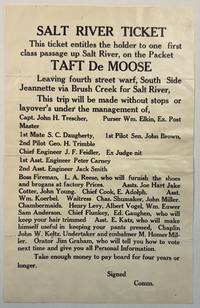
191240330Westmoreland County PA 1912. 4to broadside in bold type faces and fonts. A rather clumsy repair on blank verso to a horizontal fold split. Else Very Good.<br /> <br /> This broadside is a Who's Who of Jeanette Westmoreland County Pennsylvania citizenry. They apparently backed the losers in the three-way 1912 presidential election President Taft; former President Roosevelt who ran on the Bull Moose Ticket.<br /> John H. Trescher Proprietor and co-founder of Jeannette Dispatch. William Elkin postmaster. S. Clark Daugherty Drugs and Books. George H. Trimble Proprietor of Hotel Marian. Peter W. Carney occupation listed as "lab". John "Jack" Smith occupation listed as lab. Lowry A. Reese Shoes. Joseph M. Hart Bartender at Hotel Kramer. Jacob Cotter Bartender at the Miller House. John H. Young Bartender at the Hotel Jeannette. Elias Adolph Proprietor of New McKee. William C. Koerbel of Koerbel Brothers florists and sheet metal workers. Charles S. Shumaker of Shumaker Ringer & Foster. Henry Levy Levy Brothers Clothing and Men's Furnishings. Albert Vogel baker. William Euwer Furniture and Carpets. Edward M. Gaughen barber. Eleazer Katz clerk at Union Clothing Store. John W. Keltz cashier at First National Bank. H. Homer Miller Insurance and Real Estate Funeral Director and Embalmer. Taken from R.L. Polk & Co.'s Greensburg Derry Jeannette and Latrobe Directory for 1913 accessed at Ancestry website August 2024. <br /> Not located on OCLC as of August 2024. unknown
19362111902158501807Gifu Branch of Japan Seamen's Election 1936. Soft Cover. Fine. Number of pages: 82p. Size: 19cm Gifu Branch of Japan Seamen's Election paperback
197784349Washington DC: The Federal Election Commission 1977. Presumed First Edition First printing. Hardcover. Very good/No DJ present. Format is approximately 8.75 inches by 11.25 inches. v 1 1223 3 pages. Some edge soiling. Some cover soiling. Sticker residue on spine location code--no signs that this is a formal ex-library copy. Bottom corner of pages 1211-1212 trimmed. Subject Index to Legislative History. Index to Days of Congressional Debate. The contents include: S. 3044; Report to Accompany S. 3044; Senate Floor Debates on S. 3044; H. R. 16090; Report to Accompany H. R. 16090; House Floor Debates on H.R. 16090; Report of Committee of Conference; Senate Floor Debate on Conference Report; House Floor Debate on Conference Report; President Ford's Remarks at Bill Signing Ceremony; and Public Law 93-443. Oversized book that would require additional shipping charges if sent overseas. The Federal Election Commission FEC is the independent regulatory agency charged with administering and enforcing the federal campaign finance law. The FEC has jurisdiction over the financing of campaigns for the U.S. House Senate Presidency and the Vice Presidency. In 1971 Congress consolidated its earlier reform efforts in the Federal Election Campaign Act instituting more stringent disclosure requirements for federal candidates political parties and political action committees PACs. Still without a central administrative authority the campaign finance laws were difficult to enforce. Following reports of serious financial abuses in the 1972 presidential campaign Congress amended the Federal Election Campaign Act in 1974 to set limits on contributions by individuals political parties and PACs. The 1974 amendments also established an independent agency the FEC. The FEC opened its doors in 1975. Not until 1974 following the documentation of campaign abuses in the 1972 Presidential elections did a consensus emerge to create an independent body to ensure compliance with the campaign finance laws. Comprehensive amendments to the FECA P.L. No. 93-443 established the Federal Election Commission an independent agency to assume the administrative functions previously divided between Congressional officers and GAO. The Commission was given jurisdiction in civil enforcement matters authority to write regulations and responsibility for monitoring compliance with the FECA. Additionally the amendments transferred from GAO to the Commission the function of serving as a national clearinghouse for information on the administration of elections. Under the 1974 amendments the President the Speaker of the House and the President pro tempore of the Senate each appointed two of the six voting Commissioners. The Secretary of the Senate and the Clerk of the House were designated nonvoting ex-officio Commissioners. The first Commissioners were sworn in on April 14 1975. The 1974 amendments also completed the system currently used for the public financing of Presidential elections. The amendments provided for partial Federal funding in the form of matching funds for Presidential primary candidates and also extended public funding to political parties to finance their Presidential nominating conventions. Complementing these provisions Congress also enacted strict limits on both contributions and expenditures. These limits applied to all candidates for Federal office and to political committees influencing Federal elections. Another amendment relaxed a 1939 prohibition on contributions from Federal government contractors. The FECA as amended now permitted corporations and unions with Federal contracts to establish and operate PACs. The Federal Election Commission hardcover
197784350Washington DC: The Federal Election Commission 1977. Presumed First Edition First printing. Hardcover. Very good/No DJ present. Format is approximately 8.75 inches by 11.25 inches. v 1 1198 4 pages. Some edge soiling. Some cover soiling. Sticker residue on spine location code--no signs that this is a formal ex-library copy. Subject Index to Legislative History. Index to Days of Congressional Debate. The contents include: Federal Election Campaign Act Amendments of 1976 S. 3065; Report to Accompany S. 3065; Senate Floor Debates on S. 3065; H. R. 12406; Report to Accompany H. R. 12406; House Floor Debates on H.R. 12406; Report of Committee of Conference; House and Senate Floors Debate on Conference Report; President Ford's Remarks at Bill Signing Ceremony; and Public Law 93-283. Oversized book that would require additional shipping charges if sent overseas. The Federal Election Commission FEC is the independent regulatory agency charged with administering and enforcing the federal campaign finance law. The FEC has jurisdiction over the financing of campaigns for the U.S. House Senate Presidency and the Vice Presidency. In 1971 Congress consolidated its earlier reform efforts in the Federal Election Campaign Act FECA instituting more stringent disclosure requirements for federal candidates political parties and political action committees PACs. Still without a central administrative authority the campaign finance laws were difficult to enforce. FECA has been amended in 1976 after the Supreme Court struck down several provisions as unconstitutional in Buckley v. Valeo. Buckley v. Valeo 424 U.S. 1 1976 was a landmark decision of the US Supreme Court on campaign finance. A majority of justices held that as provided by section 608 of the Federal Election Campaign Act of 1971 limits on election expenditures are unconstitutional. In a per curiam by the Court opinion they ruled that expenditure limits contravene the First Amendment provision on freedom of speech because a restriction on spending for political communication necessarily reduces the quantity of expression. It limited disclosure provisions and limited the Federal Election Commission's power.<br /> By some measures Buckley is the longest opinion ever issued by the Supreme Court. The Federal Election Commission hardcover
19832090502128301600Takarazuka Family Land 1983. Soft Cover. Fine. The book is in fine condition. Takarazuka Family Land paperback
19752091502135710487Kosaisha 1975. Soft Cover. Fine. The book is in fine condition. Kosaisha paperback
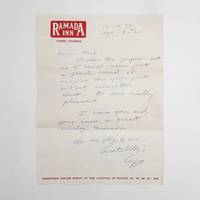
1979375947Casper Wyoming 1979. 8vo. One sheet Ramada Inn letterhead written in blue ink recto only. 8vo. "Dear Mace- Pardon the paper-but as I head home just a quick word of thanks for your part in that successful event-I was really pleased. I hope you and yours have a great Holiday Season. We underlined are going to win. Gratefully George. unknown
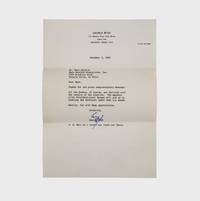
1980375940Washington D.C. 1980. 8vo. Single sheet his personal stationery signed in blue pen recto only. With a large franked envelope White House stationery. 8vo. "Dear Mace Thanks for the great congratulatory message. All the Bushes of course are thrilled with the results of the election. The mandate given President-elect Reagan will aid us in tackling the difficult tasks that lie ahead. Hastily but with deep appreciation. Sincerely George P. S. Well do I recall our lunch out there. unknown
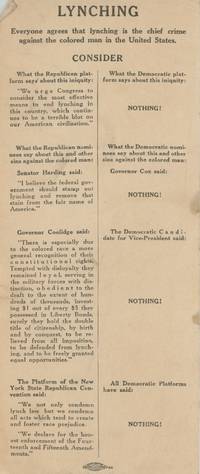
1920List2706Chicago or New York 1920. 6 x 9 inches single sided. Toning several small stains small fold at top left corner; near fine. An anonymous handbill decrying lynching in the United States and advertising the differences in anti-lynching policy between the Republican and Democratic parties. The header states that “Everyone agrees that lynching is the chief crime against the colored man in the United States†and the remainder illustrates the great disagreement over just what to do about it. The left column quotes the Republican platform and its then-nominees Warren G. Harding and Calvin Coolidge who would shortly be elected to office on their support for federal anti-lynching legislation. The right column points out that the Democratic platform and its nominees James M. Cox and Franklin D. Roosevelt all “said: NOTHING!†on this issue. Lynching would not be made a federal hate crime until 2022 nearly 100 years later. As of writing we find no other copies of this handbill in OCLC. unknown
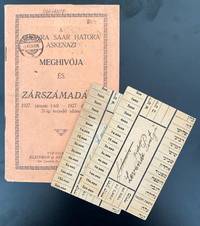
192843241Satu-Mare Szatmar/Satmar Romania: No Publisher The Chevra Sa’ar HaTorah Ashkenazi; printed by Tipográfia Kleinman si Heimlich 1928. 1st edition. Original orange printed paper wrappers 8vo 10 pages. Primarily in Hungarian with 2-page statement & closing speech also in Yiddish. <br> <br> WITH LAID IN: Two aliyah to the Torah Ark pledge cards one for Ephraim Lavii and one for Levende Pinty<br> <br> Title translates roughly as “The Saar Hatora Ashkenazi Society Financial Statement and Closing Speech. For The Period From January 1 1927 To December 31 1927.â€<br> <br> From the strife-ridden year of 1928 in Satu Mare see below a budget report including tables and lists for the Chevra Sa’ar HaTorah Ashkenazi with heartfelt call to action by the President Yosef Chaim Mayer asking the community to support its efforts to raise funds to build a new Beit HaMidrash. The plea is also undersigned by Eli Mandelbaum and by the two gabbais David Spiegel and Yona Weiss. <br> <br> A total of 11 names of leaders of the society are named. <br> <br> Society members are asked for their support in the upcoming election; presumably this is the controversial election of a new chief rabbi which famously split the community and resulted in the appointment of Hasidic Joel Teitelbaum and the creation of the Satmar Dynasty under him. <br> <br> In 1715 when Sathmar became a royal town the Jews were expelled but they began to resettle in the 1820s."In 1841 several Jews obtained the permission to settle permanently in Sathmar; the first Jewish community was formally established in 1849 and in 1857 a synagogue was built. After a great number of traditional Ashkenazic Jews had settled in the town the Jewish community split in 1898 when a supporter of the Hasidic movement was elected chief rabbi into an Orthodox and a Status Quo community led by a Zionist rabbi which erected a synagogue in 1904.<br> <br> In the 1920s there were several Zionist organizations in Satu Mare and the yeshiva one of the largest in the region was attended by 400 students. In 1930 the city had five large synagogues and about 20 shtiebels. In 1928 a conflict within the Orthodox community broke out over the election of a new chief rabbi lasting six years and ending in 1934 with the appointment of the Hasidic rabbi Joel Teitelbaum a traditionalist and anti-Zionist who later re-founded the Satmar Hasidic dynasty in Williamsburg New York. Another Hasidic rabbi Aharon Roth the founder of the Shomrei Emunim and Toldot Aharon communities in Jerusalem was also active in Satu Mare†Wikipedia.<br> <br> We could not locate another copy of this publication anywhere not in OCLC not in KVK not in the Hungarian National Library not in the Romanian National Library and not with a google search. Perhaps a unique surviving copy.<br> <br> Adressee’s name and “Satu Mare†penned on rear cover for mailing stamp clipped out of corner of blank rear wrapper no text loss. Postal cancellation stamp “Satu Mare 5. Feb 1928†on front cover as well as some other ink notations. Paper remains bright and strong about Very Good Condition. Exceedingly Rare with important connection to Satmar Hasidism. B Holo2-163-11-'LG. Satu-Mare [Szatmar/Satmar, Romania]: No Publisher [The Chevra Sa’ar HaTorah Ashkenazi; printed by Tipográfia Kleinman si Heim unknown
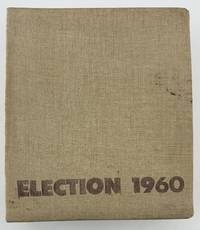
19604337Various locations in and around Chicago Il: likely early November 1960. Very good plus. Title leaf plus 25 leaves illustrated with forty-seven silver gelatin photographs pasted one per leaf or page all about 5.5 x 7.5 inches plus five loose images two duplicates and three other images not pasted in. Square quarto. Contemporary tan cloth custom photograph album metal-hinged spine front cover printed with title reading "ELECTION 1960." Minor wear and soiling to album. Light occasional thumb-soiling to album leaves ownership signature reading "G. Robert Hillman" on title leaf. Photographs in excellent condition. An utterly charming vernacular photograph album assembled during the seminal Presidential Election of 1960 one of the closest presidential elections in United States history which pitted Vice President Richard Nixon against the junior Senator from Massachusetts John F. Kennedy. The album features about fifty original photographs on the campaign trail in Illinois beginning with about a dozen-and-a-half images of Richard Nixon and his local supporters. The photographs capture various angles of Nixon during his stump speech a young boy waving an "I'm for Nixon" handmade sign another young boy with a Nixon button on his coat crowd scenes a large campaign sign for Nixon-Lodge outside a local store and more. One image featuring a mixed crowd of Nixon and Kennedy supporters transitions into the next section of photographs which concentrates on JFK's campaign. The first image in this section is a closeup of a "Kennedy for President" hat followed by four images of JFK's campaign manager Robert Kennedy making a speech three images of Eleanor Roosevelt stumping for Kennedy five images of Lyndon Johnson and his airplane numerous shots of Kennedy supporters and crowd shots outside Chicago Blackhawks stadium. The photographs then feature the inside of Chicago Auditorium where the first three images depict John F. Kennedy - the first shaking hands with Chicago's longtime Mayor Richard Daley and two during his speech likely his speech of November 4 1960 - just four days before Election Day. The final three images show supporters of both candidates.<br /> <br /> The 1960 United States Presidential Election was a watershed moment for the campaign politics of the country. Senator Kennedy won the election with a clear Electoral College margin of 303 to 219. However Vice President Nixon won three more states than Kennedy and lost the popular vote only by about 110000 votes out of more than 68 million votes cast. The election set the course for most of the remainder of the 1960s but left Nixon soured and suspicious that the election had been stolen from him - a feeling he never let go and one with ominous echoes today. As indicated in the present album the 1960 presidential election was passionate on both sides with each candidate drawing large enthusiastic crowds for their appearances.<br /> <br /> The signature on the title leaf of the present album likely identifies the compiler. G. Robert Hillman is a Senior Editor for Politico. Hillman was born in Peoria and grew up on a farm near Flanagan Illinois about a hundred miles from Chicago. He went to college at the University of Illinois at Urbana-Champaign and began his career at Chicago Today and the Chicago Sun-Times. Hillman would have been in middle school during the 1960 election campaign not too precocious for a young man obsessed with politics especially during one of the most heated and media-intensive campaigns of the 20th century. likely early November unknown
193624942<p>This sheet contains five rough sketches of graphics calling on the workers and voters of America to support Franklin D. Roosevelt's reelection in 1936. They did in record numbers.</p><p><strong>PRESIDENTIAL ELECTION OF 1936.</strong> Typed Document Signed. Artwork by Franz Felix and Ideas and Copy by Richard Barron "Set of Rough Sketches Containing Some Suggested Promotion Ideas to be Used in the 1936 Democratic Presidential Campaign" July 2 1936. 1 p. 12 x 10½ in.</p><p><strong>Excerpts:</strong></p><p>"<em>1. Sounding the call against 'economic royalists' in the spirit of 1776.</em>"</p><p>"<em>2. Appropriating the well-known symbol of violence</em> upraised fist<em> diverting it to peaceful democratic use. To include the farmer phrase the appeal: TOILERS OF AMERICA – UNITE FOR ROOSEVELT.</em>"</p><p>"<em>3. The statue of 'The Thinker' as a symbol of the man today who thinks the toiler with brawn and brain.everyman.</em>"</p><p>"<em>4. Direct appeal to radical labor and leftists in general.</em>"</p><p>"<em>5. Another way of appealing to the working class men and women.</em>"</p><p>"<em>This collaborative effort respectfully submitted for consideration to the Chairman of the Democratic National Committee Mr. James A. Farley.</em>"</p><p><strong>Historical Background</strong></p><p>After unseating incumbent Republican President Herbert Hoover in 1932 President Franklin D. Roosevelt ran for reelection in 1936. His Republican opponent was Governor Alf Landon of Kansas. Although the Great Depression had entered its eighth year Roosevelt's New Deal policies were broadly popular. He won the highest share of the popular and electoral vote since the uncontested 1820 election. Roosevelt attracted more than 60 percent of the popular vote and won the electoral votes of 46 states; Landon won the electoral votes of only Maine and Vermont.</p><p>Democratic Party chairman James Farley had predicted that Roosevelt would lose only Maine and Vermont. After the results of the 1936 election Farley quipped that the nation needed to revise the conventional political wisdom of "As Maine goes so goes the nation" to "As Maine goes so goes Vermont."</p><p>These ideas for campaign imagery employed or modified common images to support Roosevelt's campaign. One drew on the imagery of artist Archibald Willard's 1875 painting <em>The Spirit of '76</em> and employed three figures of workers to match the subjects of Willard's image. Another appropriated the upraised fist as a symbol of violence and repurposed it as a symbol of defiant unity against "<em>economic royalists</em>." A third used an image of <em>The Thinker</em> by French sculptor Auguste Rodin 1840-1917 to appeal to thinking voters. Another image appeals to the fears of radicals that the alternative to Roosevelt is "<em>Reaction</em>."</p><p>Richard Barron and artist Franz Felix submitted these ideas to Democratic National Committee chairman James A. Farley on July 2 1936 three weeks before the Democratic Party held its convention in Philadelphia. There is no evidence that these images were used in the campaign and it is possible that Farley rejected them. At the end of the campaign the Democratic National Committee had a campaign deficit of approximately $850000. To help offset those expenses the treasurer convinced President Roosevelt to sign 2500 brief Forewords which were bound into <em>The Democratic Book 1936</em> and sent to donors of $250. Purchases brought in more than $400000 for the party and led Republicans to charge corrupt practices for allowing corporations to contribute to the campaign by buying copies.</p><p><strong>Franz Felix</strong> 1892-1967 was born in Vienna Austria and developed an ability as a child to draw portraits in charcoal. He studied portraiture in Vienna and immigrated to the United States shortly after World War I. He settled in San Francisco where he established himself as a portrait artist and commercial illustrator. In the late 1920s he moved to New York and established a studio in the suburb of Spring Valley where he produced book and magazine illustrations. During World War II he painted a series of murals of wartime activities of Spring Valley residents.</p><p><strong>James A. Farley</strong> 1888-1976 was born in New York into an Irish Catholic family. After his father died he helped his mother with a small business to support the family. After graduating from Packard Business College in New York City where he studied bookkeeping and other business skills Farley got a job with the U.S. Gypsum Corporation. He served as a Democratic town clerk in Stony Point New York and became chairman of the county's Democratic Party in 1918. He organized upstate Democrats and helped elect Alfred E. Smith as Governor that year. He served in the New York State Assembly in 1923 but was defeated at the next election for supporting the repeal of Prohibition. As chair of the state Athletic Commission Farley fought for the civil rights of African American athletes. Farley founded he General Builders Corporation from smaller firms to become New York City's largest building supply company. Farley directed Franklin D. Roosevelt's narrowly successful New York gubernatorial campaign in 1928 and his reelection in 1930. Farley served as chairman of the New York State Democratic Committee from 1930 to 1944 and helped build the national New Deal coalition that elected Roosevelt to the Presidency four times. In 1932 Farley became the chairman of the Democratic National Committee and in 1933 U.S. Postmaster General. He held both positions until 1940. Farley and Roosevelt broke on the two-term tradition of the Presidency in 1940 and he later helped propose the 22nd Amendment to the U.S. Constitution limiting a person to two elections as president approved by Congress in 1947 and ratified in 1951. Farley became chairman of the board of the Coca-Cola Export Corporation in 1940 and held that position for more than thirty years.</p>