22 résultats
17675532Dublin: G Faulkner 1767. 220 x 143 mm. Very Good. pp 22 2 In very good condition with old staining to head of pages in modern blue card wrappers with title label to upper cover. Very Good 1767 G Faulkner unknown
1795358514Annual Register London 1795. Booklet - Unbound Pages. Very Good Condition. 29 pages. An authentic standalone article extracted from a larger volume. Not a reprint or reproduction but an original work in its own right. Preserved in a modern card cover prepared for practicality - an unassuming but serviceable presentation that favours function over finery. Size: 13 x 20 cms. Category: Annual Register; Printed before 1800; New Arrivals; This item may require more postage than the rates shown for delivery outside the UK. If extra postage is required we will contact you before processing your order and you will be given the details and option to decline the extra cost. Annual Register unknown
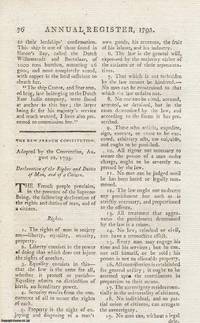
1787358416Annual Register London 1787. Booklet - Unbound Pages. Very Good Condition. 11 pages. An authentic standalone article extracted from a larger volume. Not a reprint or reproduction but an original work in its own right. Preserved in a modern card cover prepared for practicality - an unassuming but serviceable presentation that favours function over finery. Size: 13 x 20 cms. Category: Annual Register; Printed before 1800; New Arrivals; This item may require more postage than the rates shown for delivery outside the UK. If extra postage is required we will contact you before processing your order and you will be given the details and option to decline the extra cost. Annual Register unknown
171947102Sans lieu d'édition 1719. Bonded Leather. <b>Livre en français</b>. Couverture rigide. Seconde édition revue corrigée et augmentée où l'on répond à ce qu'il y a de plus spécieux dans les avertissements de Soissons. Reliure plein veau d'époque dos manquant. 279 pages. Mouillure à une dizaine de pages. Petite tache d'encre à la marge inférieure. <i>ref. 47102</i> Sans lieu d'édition hardcover
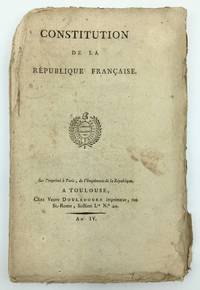
17951507Toulouse: Douladoure. An. IV. 1795. Octavo. Stitched without wrappers likely as issued. Page edges untrimmed. Woodcut device emblematic of the French Republic to the title page. 62pp. A good copy with nibbling/loss to the top left-hand corner not affecting the text and a few minor marks to the title page and rear blank verso. The contents remain clean and in very good order. A scarce provincial printing of the Constitution of the Year III Constitution de l'an III the constitution of the French First Republic which established the Directory regime following the fall of Robespierre.</p><p>Adopted by the convention on 5 Fructidor Year III 22nd August 1795 and approved by plebiscite on 6th September its preamble formed the Declaration of the Rights and Duties of Man and of the Citizen of 1789. Largely the work of political theorist Pierre Daunou it established a bicameral legislature made all taxpaying French males over 25 eligible to vote in primary elections enfranchising around one million more citizens than the 1791 Constitution and contained an explicit ban on slavery.</p><p>It remained in effect until the coup of 18 Brumaire 9th November 1799 which effectively ended the Revolutionary period and began the rise to power of Napoleon Bonaparte. </p><p>A pleasing unsophisticated copy remaining in the same form as it would have been when it reached the hands of ordinary Frenchmen in year that it was issued. Toulouse: Douladoure. unknown
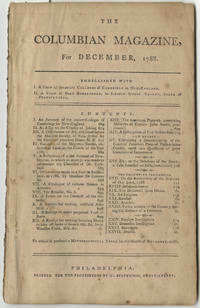
178830007.048Philadelphia PA 1788. Softcover. Fine. The Columbian Magazine. Magazine. The Columbian Magazine Philadelphia Pa. December 1788. 52 pp. 5 x 8 in. Lacking plates. This title has the honor of being the first successful American magazine having begun in September 1786 and lasting until December 1792. Although many titles existed earlier none enjoyed the success of lasting beyond a few issues or a couple of years.Opens with five pages on ""An Account of the Ancient Colleges at Cambridge in New England."" that being Harvard University. pp. 669-673.A recipe for making artificial Asses milk p. 698.With ""The American Plutarch - Memoirs of Captain John Smith"" pp. 699-703 continued for a previous issue and concluded in the next.A section on ""American Intelligence"" pp. 715-718 with the latest news reports including an item from Edenton North Carolina:""a new convention be recommended for the purpose of reconsidering the new constitution held out by the federal convention as a government for the United States."" p. 716.With a ""List of Senators of the United States Already Chosen"" by state pp. 717-718.Also mention of the officers for the Masonic Lodge at Philadelphia p. 716. paperback
178836781Boston: Benjamin Russell 1788. First Edition. Newspaper. Good. Newspaper. Single issue removed from larger gathering. Paper measures proximately 15" x 9.5". 4 pages. Stitched holes on the left margin. Scattered brown spots. Light toning to the paper.<br /> <br /> Contents include the latest "American Intelligence". Including the front page news article titled: "Augusta Georgia January 5. We have the pleasure to announce to the publick that on Wednesday last the Convention of this State unanimously ratified the Federal Constitution in the words following viz. <br /> <br /> State of Georgia. In Convention Wednesday January 2 1788. We the Delegates of the people of the State of Georgia in Convention met having taken into serious consideration the Federal Constitution agreed upon and proposed by the Deputies of the United States in General Convention held in the city of Philadelphia on the 17th day of September in the year of our Lord one thousand seven hundred and eighty seven Have assented to ratified and adopted and by these presents do in virtue of the powers and authority to us given by the people of the said State for the purpose for and in behalf of ourselves and our constituents fully and entirely assent to ratify and adopt the said Constitution which is hereunto annexed under the great seal of said State. Done in Convention at Augusta in the said State on the second day of January in the year of our Lord one thousand and seventy eight and of the Independence of the United States the twelfth." <br /> <br /> Other items from the paper includes news from Charleston S. C.; Wilmington Delaware; Philadelphia; New York; Massachusetts; and Europe. Much of the Massachusetts news concerns the newly adopted Constitution. [Benjamin Russell] unknown
173311867London: J. Peele. Very Good with no dust jacket. 1733. First Edition; First Printing. Softcover. Stapled inside heavy card covers. No lib marks on the pamplet itself. ; Ex-Library; 12mo 7" - 7½" tall; 61 pages . J. Peele paperback
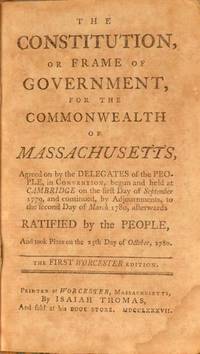
1787768991787. MASSACHUSETTS Constitution of. THE CONSTITUTION OR FRAME OF GOVERNMENT FOR THE COMMONWEALTH OF MASSACHUSETTS . RATIFIED BY THE PEOPLE AND TOOK PLACE ON THE 25TH DAY OF OCTOBER 1780. Worcester Massachusetts: Isaiah Thomas 1787. "The first Worcester edition" stated on the t.p. preceded by three Boston editions 1880-84. 18mo. 107 pp. Worn contemporary binding of leather-backed paper-covered scabbard boards. Approximately half of the lower board is missing. Text leaves are age-browned occasionaly foxed and dampstained in the margin at the bottom fore-corner. The final page has some loss just affecting the final letters in some lines. Sabin 45691. unknown
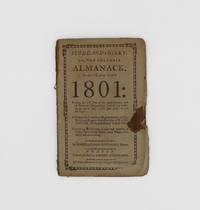
1800374113Hudson: Printed and sold by Ashbel Stoddard 1800. 36pp. Some interleaving with contemporary manuscript annotations recording weather deaths etc. 12mo. Stitched final leaf trimmed close with minor loss to final line on H2r staining and chipping at fore-edge other minor chips and tears. 36pp. Some interleaving with contemporary manuscript annotations recording weather deaths etc. 12mo. With a printing of the U.S. Constitution and the Bill of Rights on the final 12 pages. This almanac calculated by Beers Hutchins died in 1782. Evans 37670; ESTC W33544; Drake 6126 Printed and sold by Ashbel Stoddard unknown
1789100147<p>8vo later calf backed marbled boards 320 202 pp. Edges and covers rubbed occasional bit of foxing but overall very good. The most important feature of this collection is an early British printing of the United States Constitution p.289-300. Also contains a curious description of two Negro children with some unusual physical markings see p.53-55. Very interesting coverage of a few executions including a woman who was hanged for forgery is also provided.</p> J. Dodsley hardcover
1795NS0005Paris L'An 3 de la Republique Française une & indivisible. Hard Cover. 8vo; 56 pages a-c8 d4. Dated p. 56: 5 Fructidor l'an troisième i. e. 22 Aug. 1795. Signed p. 56 by Chenier président; Dersey Solignac Bernier Laurenceat Dentzel Quirot sécrétaires. The French Convention Nationale 1792-1795 had governed without a constitution. That of 1791 had been replaced by a more radical one of 1793 which was never activated. "The post-Robespierrist Convention continuing the reaction against popular revolutionism. elements of direct democracy that had characterized the earlier constitution were abandoned but the new one preserved the basic changes brought by the Revolution" see R.R. Palmer <i>Age of Democratic Revolution</i> 2: 214. This edition seems to be unrecorded. It is signed by the members of the committee that drafted it chaired by playwright Marie-Joseph Chenier 1764-1811. The edition seems to be an attempt to persuade people to accept its terms. This Constitution was rejected by even more reactionary elements and led to establishment of the Directorate in October 1795. Not in NUC; not in Martin & Walter cf. 4: 2: 4140. Very Good in contemporary boards leather spine. Stock#NS0005. L'An 3 de la République Française une & indivisible. hardcover
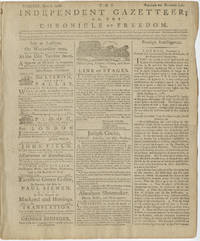
178830007.003Philadelphia PA 1788. No binding. Fine. Independent Gazetteer; or The Chronicle of Freedom. Newspaper. Independent Gazetteer; or The Chronicle of Freedom Philadelphia Pa. May 6 1788. 4 pp. 9 1/2 x 11 1/2 in. The Maryland ratifying convention suggests some amendments along with their approval of the Constitution. ExcerptsFrom page 3:""From the MARYLAND GAZETTE or April 29 1788. The CONVENTION of this state on Saturday last determined to ratify the proposed plan of Federal Government. -YEAS 63 NAYS 11-And then appointed a committee of thirteen members to consider and report amendments to be recommended to the people. -The following amendments were proposed by a member and referred to the committee who are now sitting-And it is hoped that the great and essential rights of the people will be declared and secured.- PROPOSED AMENDMENTS.Wherefore whenever the ends of Government are perverted and public liberty manifestedly endangered and all other means of redress are ineffectual the people may and of right ought to object to reform the old or establish a new Government-that the doctrine of nonresistance against arbitrary power and oppression is absurd slavish and destructive of the good and happiness of mankind. All imposts and duties laid by Congress shall be placed to the credit of the state in which the same be collected. That there shall be no national religion established by law; but that all persons be equally entitled to protection in their religious liberty. That the Supreme Federal Courts shall not admit to fictions to extend its jurisdiction; nor shall citizens of the same state having controversies with each other be suffered to make collusive assignments of their rights to the citizens of another state for the purpose of defeating the jurisdiction of the State Courts; nor shall any matter or question already determined in the State Courts be revived or agitated in the Federal Courts. That Congress have no power to lay a Poll-Tax. That the people have a right to freedom of speech of writing and publishing their sentiments and therefore that the freedom of the PRESS ought not to be restrained and the printing presses ought to be free to examine the proceedings of Government and the conduct of its officers.""From page 2: Protesting the Slave Trade by Boycotting West Indian Produce""A CAUTION.WHEREAS in the year 1787 some vessels were fitted out at the port of Philadelphia for the iniquitous purpose of stealing the inhabitants of Africa from all the endearments of domestic life; one of which vessels has succeeded in obtaining a number of poor blacks and has taken the to a port in the West Indies where they are under the iron hand of oppression. From this shameful traffic this horrid source the proprietors of the vessel have purchased some West India produce which after landing at Wilmington they have brought up to this city and offered for sale. It is a grateful circumstance to the supporters of the common rights of mankind that the virtuous inhabitants of the city reprobate the horrid idea.-A correspondent hopes that the citizens will further testify their disapprobation of the practice by turning with indignation from the purchase of any property thus basely procured by men so lost to the common feelings of humanity; notwithstanding the patriotic convention at which Washington presided have declared that this abominable traffic shall be continued for TWENTY years by the people of America.From page 1:An advertisement with engraving for a ""Line of Stages"" between Philadelphia and New York started by four partners who split off from an established stage line and promising better service. From page 4:An advertisement for another different ""New Line of Stages."" And a report on the creation of a Philadelphia committee for the relief of the nearly 100 Americans captured by Algerian corsairs and Barbary pirates. unknown
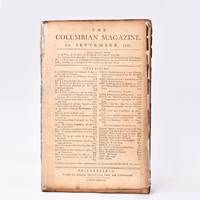
1787365066Philadelphia: Seddon Spotswood Cist and Trenchard 1787. 3 618-674. Without 2 plates. 8vo. Disbound fire damage at edges leaves detached. 3 618-674. Without 2 plates. 8vo. Along with a printing in the American Magazine among the earliest printings of the Constitution in a periodical. "One of the best of the eighteenth century magazines was the Columbian of Philadelphia. Considered from beginning to end the Columbian Magazine with its sequel the Universal Asylum affords an extremely valuable treasury of materials which reflect its own times and the war years immediately preceding. it was the handsomest American magazine of its century" Mott. Seddon, Spotswood, Cist and Trenchard unknown
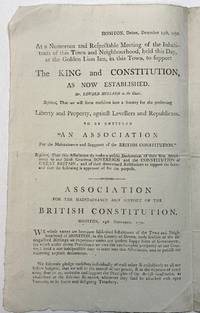
179241771Honiton England 1792. Folio leaf 16" x 13." Folded to 4 pp. Printed on verso of first leaf and recto of second leaf only. Light old folds spine with early reinforcement tape. Text clean and bright. Very Good. <br /> <br /> Public enthusiasm for the tenets of the French Revolution and Thomas Paine worried those who supported the established monarchy and British parliamentary government. <br /> In response Loyalists created local Societies like this one pledging "that we will to the utmost of our power & at the expence of every thing dear to us maintain and support the Principles of the British Constitution as established at the Glorious Revolution whenever they shall be attacked with open Violence or be secret and designing Treachery."<br /> The Association expresses its "deepest Abhorrence of the Authors and Publishers of those seditious Pamphlets which under the specious disguise of Liberty are calculated only to promote Licentiousness and Disorder to encourage Rebellion against the State and Treason against Society." More than thirty supporters sign in type. E. Holland and C. Gidley sign in type as Chairman and Secretary respectively.<br /> ESTC records this rare document only at the British Library. OCLC does not list it. <br /> ESTC T22340 1- British Library. Not on OCLC as of March 2026. unknown
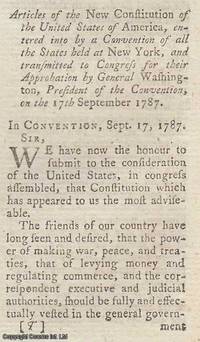
178767677London: Printed for D. Henry 1787. UNITED STATES CONSTITUTION; URBAN Sylvanus. One of The First Means by Which The British People Learned of The Enactment of The Constitution of The United States of America<br> <br> UNITED STATES CONSTITUTION subject. URBAN Sylvanus editor. The Gentleman's Magazine "New Constitution of the United States of America". Printed by John Nichols for D. Henry November December 1787.<br> <br> First edition of these November and December 1787 issues. Two small octavo volumes 8 1/2 x 5 1/8 inches; 215 x 130 mm. 941-1035 1; 1037-1131 1 pp. With woodcut text illustration on front wrapper of each volume. November issue with one fold-out plate and lacking plate I entitled "S.W. View of Aconbury Chapel 5 Miles from Here." The December issue with two plates plate II and Supp. but lacking plate I Illustrations of the Royal Charter School Near Dublin Clontarfe Castle Dublin and others. Text of American Constitution on pp. 1008-1011; 1110-1112.<br> <br> Self-wrappered. Newer stitching. Some very minor toning and light occasional spotting. Overall very good.<br> <br> This is the first English magazine printing of the U.S. Constitution. The November issue on pages 1008-1011 prints George Washington's Letter and the first Article. The December issue on pages 1110-1112 contains articles two through seven and the delegates names.<br> <br> "The following is the new Plan of the Constitution of the United States of America upon which the Convention of all the most distinguished men in the States have been deliberating for several months and by which if finally adopted the Constitution of the Union is totally changed." From the introduction<br> <br> Einaudi. Goldsmiths'. Howes. Howes. Kress. Streeter. Streeter.<br> <br> HBS 67677.<br> <br> $1500. Printed for D. Henry unknown
17892601011London: Annual Register 1789. early. hardcover. good. One of the earliest British printings of the US Constitution. Printed for J. Dodsley in Pall-Mall London 1789. Book good wear to covers gutters cracked front free end paper has two tears former owner's name stamp to 2nd front free end paper. Annual Register unknown
179276952Paris 1792. First French edition of the 1787 Federal Constitution in addition to the thirteen state constitutions the Declaration d'Independance Articles de Confederation; and several treaties. . old marbled wrappers with ms. paper labels on spines preserved in a utilitarian portfolio. . This was Kenneth Nebenzahl's copy with his book label inside the portfolio. An uncut copy in very attractive original condition. 8vo. Howes C-716. Translated and published at the suggestion of Benjamin Franklin who likely contributed footnotes. He wrote in late 1783: "The extravagant Misrepresentations of our Political State in foreign Countries made it appear necessary to give them better information which I though could not be more efectually and authentically done than by publishing a Translation into French." unknown
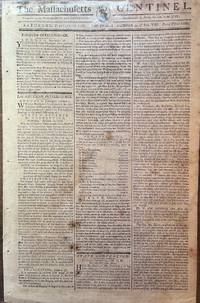
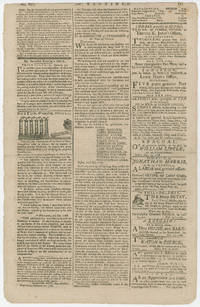
178824836Boston MA 1788. No binding. Condition: Fine. Massachusetts Centinel illustrator. Newspaper. Massachusetts Centinel February 13 1788 Volume VIII pp. 171-174. Boston: Benjamin Russell. 4 pp. 9 5/8 x 14 7/8 in. This newspaper is replete with Constitution-related content including minutes from the debates of Massachusetts' State Ratifying Convention - everything from discourse on standing armies to Fisher Ames' hearkening back to 1775 with "WE MUST UNITE OR DIE"; a poem to Washington on his birthday; a fictional dialogue The Federal Anti-Federalist Returned to His Neighbours; a rare example of one of Benjamin Russell's famed 'Pillars' illustration series; and a great deal of reporting on the popular reception of the news of ratification expressed in particular by an enormous parade and surrounding celebrations. The Massachusetts Centinel employed the Federal Pillars political imagery to announce the ratification of the Constitution by successive states. In this issue the Centinel announces the pending ratification by New Hampshire. "This day the Convention of the State of New Hampshire meet at Exeter for the purpose of erecting another PILLAR to support the great Federal Superstructure; by ratifying the proposed Constitution." On February 6 1788 Massachusetts ratified the United States Constitution by a vote of 187 to 168 the sixth and largest state to do so. Two days later the people of Boston engaged in a grand procession led by the "Mechanicks" and Tradesmen of Boston "to express their approbation of the conduct of the Gentlemen who represented this town in the late Convention" p3/c2. A sampling of the groups of marchers most of whom carried implements and tools of their professions festooned for the occasion as detailed here p4c1-2: 73 Blacksmiths; 43 Shipwrights; 75 Rope-makers with part of a rope-walk on a sled and martial music; 30 Mast-makers; 36 Sail-makers; 34 Ship-joiners; 30 Block-makers pulley makers; 6 Mathematical Instrument Makers makers of navigation equipment etc.; 53 Coopers; 20 Boat-builders; 6 Pewterers; 40 Bakers 50 Shoe-makers; 56 Taylors; 26 Hatters; 20 Ship-builders; 136 Carpenters; 70 Masons; 30 Wheelwrights; 15 Printers; as well as a dozen other tradegroups such Bookbinders; Goldsmiths and Jewelers Saddlers Tobacconists Tanners Curriers Leather-dressers Cabinetmakers Carvers Painters Tinsmiths Coppersmiths and 250 of the "principal merchants in the town." Toward the middle of this assemblage thirteen horses pulled the ship "FEDERAL CONSTITUTION" manned by a crew of thirteen. A subtext of much of this was an emphasis on domestic manufactures as well as a celebration of Boston's power and potential in maritime trade.At this event "WE THE PEOPLE" of Boston "in GRAND PROCESSION MOVING" passed an ordinance to rename Long Lane as Federal Street in commemoration of the site where the convention had sat. The ordinance concluded "GIVEN under our auspices.the FIRST YEAR of OUR real political federal existence.GOD SPEED THE CONSTITUTION!" p1/c1. That night a long boat called "the Old Confederation" which had been exhibited during the parade was drawn to the Common and condemned "as unfit for any further service." The boat was immediately burned "in presence of an applauding concourse of citizens" p3/c2. On February 12 the twelve delegates who represented Boston in the ratifying convention including John Hancock and Samuel Adams responded to the procession in a letter to "the Committee of Tradesmen of the Town of Boston." Excerpt: "We endeavoured that our conduct in the late Convention should be governed by the magnitude of our subject:-And after the most mature deliberation we severally decided according to the best light of our understandings and the dictates of our consciences." "We are happy to find that our decisions have so fully corresponded with the sentiments and wishes of our constituents."
1791262411Paris: Baudoin 1791. hardcover. near fine. 2 37 4 4 151 82 pages. 12mo handsomely bound in full contemporary mottled calf chipped at top of spine; gilt-stamped spine with leather spine labels; marbled end-papers. Paris: Baudouin Imprimeur de L'Assemblee Nationale 1791.<br/> <br/> First written constitution of France. Many different printings appeared within days of the original folio edition this is likely the first 12mo edition. Included in this volume with separate paginations are: Message du Roi a l'Assemblee 13 Set. 1791; Discours et Serment du Roi. 14 Sept 1791; La Declaration des Droits de L'Homme et du Citoyen Includes comparison of the laws of many peoples ancient and modern and particularly the declarations of different American states Paris l'an troisieme de la liberte. Also Bound-in is another copy of the Declaration des Droits de l"Homme Paris: Chez Baudoin 1790.<br/> <br/> Baudoin unknown
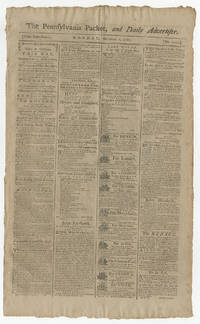
178724135<p><b>U.S. CONSTITUTION.</b>Newspaper. <i>The Pennsylvania Packet and Daily Advertiser</i>. October 1 1787 No. 2700 Philadelphia: John Dunlap and David C. Claypoole including the September 28 resolution of the Confederation Congress to send to the states for ratification the recently completed U. S. Constitution. 4 pp. 12 x 18¾ in. </p><br />"<i>The United States in Congress Assembled. Friday September 28 1787.</i><p><i>CONGRESS having received the Report of the CONVENTION lately assembled in Philadelphia</i></p><p><i>Resolved unanimously THAT the said report with the resolutions and letter accompanying the same be transmitted to the several legislatures in order to be submitted to a convention of delegates chose in each state by the people thereof in conformity to the resolves of the convention made and provided in that case. CHARLES THOMSON Secretary.</i>" p2/c3</p><p>The convention called to revise the Articles of Confederation met in the Pennsylvania's State House in Philadelphia starting on May 25 1787. After many delegates agreed that the Articles could not be sufficiently improved they started to draft an entirely new structure. Maintaining their pledge of secrecy after months of private deliberations over trade defense taxation representation separation of powers the election of a president the slave trade international relations and many other issues the proposed United States Constitution was signed by thirty-nine of the fifty-five delegates on September 17.</p><p>Two days later the Constitution was first published by the <i>Pennsylvania Packet</i>and four other Philadelphia newspapers. The cover letter sent by George Washington president of what came to be called the Constitutional Convention submitting the plan to Arthur St. Clair the President of the Congress of the Confederation in New York was also printed then.</p><p>Congress received and read the proposed Constitution on September 20th. As a sampling of their deliberations William Grayson of Virginia thought it was too weak while Richard Henry Lee of Virginia and Nathan Dane of Massachusetts thought it was too strong.</p><p>On September 27 Virginia's Richard Henry Lee proposed that the Constitution be sent to the executives of each of the states. A Delaware representative quickly added "in order to be by them submitted to conventions of delegates to be chosen agreeably to the said resolutions of the convention." Ten of the twelve states then represented in Congress voted in favor. Before Congress adjourned for the day the majority of Virginia's representatives and a minority of New York's representatives also indicated their support. On September 28 Federalists holding out for a unanimous vote found a way to compromise with anti-Federalists: Congress unanimously resolved to send the Constitution to the states but without any recommendation or approval.</p><p>Arider from New York City arrived in Philadelphia with the resolution that same day.</p><p>George Clymer presented his own resolution to the Pennsylvania Assembly noting that "<i>the late Federal Convention has digested a plan of government for the United States and recommended that it should be referred to the consideration of State Conventions…</i>" After a "<i>very long and animated debate</i>" Clymer's resolution passed by a vote of 43 to 19 and adjourned until 4:00 p.m. But only 44 members returned falling two shy of the necessary quorum. The Assembly's sergeant-at-arms was sent to show the resolution to absent members. Two who still refused to attend were seized by the public dragged through the streets and thrust into the assembly room. The involuntarily completed quorum voted that "<i>it is the sense of great numbers of the grand people of this state already signified in petitions & declarations to this house that the earliest steps should be taken to assemble a convention within the state for the purpose of deliberating and determining on the said constitution.</i>" They called for the election of deputies who would assemble for that purpose "<i>on the third Tuesday of November at the State-house in the city of Philadelphia…</i>" p2/c3-4</p><p>Other articles of interest in this issue include news from Europe and a brief piece against Indians "<i>from the western country</i> who <i>still continue their depredations on the whites…</i>" p2/c3</p><p><b><i>The Pennsylvania Packet or the General Advertiser</i></b>1771-1839 was founded by John Dunlap in late 1771 as a weekly newspaper in Philadelphia though it relocated to Lancaster during the British occupation of Philadelphia in 1777-1778. On May 30 1783 Benjamin Towne turned the <i>Pennsylvania Evening Post</i> into the first daily newspaper in the United States. However with Towne branded a traitor and forced to hawk his own papers on the street the newspaper collapsed the following year. John Dunlap and David Claypoole then made their <i>Pennsylvania Packet</i> the first successful daily on September 21 1784. It underwent numerous name changes in the 1790s until sold in 1800 and renamed <i>Poulson's American Daily Advertiser</i>.</p> John Dunlap and David C. Claypoole
178769121London: Sold by T. Wilkie 1787. UNITED STATES CONSTITUTION. The London Chronicle "The New Plan for the Constitution of the United States of America". Vo. LXII. No. 4834-4835. From Saturday October 27 to Tuesday October 30 1787 and From Tuesday October 30 to Thursday November 1 1787. Pages 409-424. London: Sold by T. Wilkie 1787.<br> <br> Likely the first public printing of the United States Constitution in England. This newspaper printing precedes the know first edition pamphlet published by Debrett as well as the first magazine printing in "The Gentleman's Magazine." It is broadly stated that news of the United States Constitution hit England early in November however the dates of the Chronicle precede this by a few days. This copy also contains the preliminary cover letter from George Washington to the president of Congress which is usually included with early printings of the Constitution and which states Washington's strong support of ratification. "The Plan" is printed in its entirety without comment or explanation from the publisher.<br> <br> Together two issues no. 4834 and 4834. Each issue self bound along left margin. 11 3/8 x 8 5/8 inches; 288 x 222 mm. Number 4834 is four leaves pages 409-416 and number 4835 is four leaves pages 417-424. The first part of the Constitution is printed on pages 413-414 of the first part with the end stating "To be concluded in our next" and the second part is printed on pages 420-421. Both issues very good with just some slight toning. Page 421-422 trimmed close at top margin just touching header. A small red stamp on verso of first leaf of each issue along bottom margin. Overall about fine. We could find no other copies of this or any earlier British newspaper containing the US Constitution on Rare Book Hub. We could not locate any copies on OCLC or ESTC. Housed in a custom quarter red morocco clamshell.<br> <br> At the time of the Constitutional Convention John Adams was living in England as a diplomat. In a letter to John Adams from Elbridge Gerry dated September 20th 1787 just one day after the first newspapers in America printed the Constitution he states "The proceedings of the Convention being this day published I embrace the Oppertunity of transmitting them by a Vessel which is to sail this morning for London." According to the National Archives "Gerry enclosed a copy of the new U.S. Constitution. Gerry likely sent this letter to John Adams via the Prince George Capt. Strong which departed New York City in late September and arrived in London on 3 Nov. New York Independent Journal 1 Sept. 1787 2 Feb. 1788." This shows that it would have been impossible for news of the Constitution to arrive in England much before this date of November 3rd. Lengthy searches turn up no indication that any other British publication has a copy of the US Constitution before this London Chronicle printing. The National Archives go on to state "The U.S. Constitution was adopted on 17 Sept. 1787 and British newspapers first published the text in late autumn. The London Chronicle printed the preamble and the first article in its 27-30 Oct. issue and the remaining articles and signatures in its 30 Oct. - 1 Nov. issue. "<br> <br> The London Chronicle was a thrice weekly newspaper also known for being " one of the first to break the news that the United States had declared independence from the British Empire reporting on the event in its 13 August 1776 edition. It was also one of the first to publish the declaration in its entirety in the 15-17 August 1776 edition but containing no explanation or comment as to what it was" Wikipedia. This holds true for their publication of the Constitution as well.<br> <br> United States Constitution now the longest continuing charter of a national government in the world and "the product of a revolution in political thought at least as important and far-reaching as the winning of American independence from Great Britain and the culmination of the intellectual ferment and political experimentation in the new republic" Richard B. Bernstein Are We to Be a Nation.<br> <br> HBS 69121.<br> <br> $20000. Sold by T. Wilkie unknown