WORLD WAR II PROPAGANDABiblio.com
87 résultats
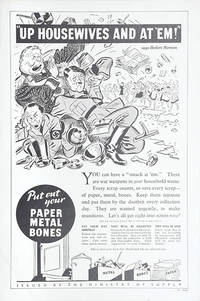
1940173612London: Issued by the Ministry of Supply 1940. A striking British wartime poster appealing for salvage showing Hitler Goebbels and Goering cowering under a barrage of newspapers pots and bones thrown by a mob of British housewives. The poster tells housewives that "you can have a 'smack at 'em'. There are war weapons in your household waste". It instructs them to separate out paper metal and bones from their house waste to be collected and used in munition manufacturing. The title is a quote from Herbert Morrison which was also used for a Pathé newsreel and a popular song. Offset lithograph 379 x 252 mm. Tiny chip at foot light crease at head. In very good condition. unknown
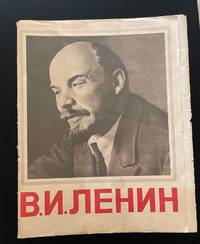
1969013792Moscow 1969. Soft cover. Very Good. Printed in the former USSR in 1969. Paper portfolio with cover photograph of Lenin measuring approx. 17.5 x 22" containing 31 pictures of various sizes on 18 sheets depicting all aspects of Lenin's life as student father one of the people and founder of the republic. Images presumably "suitable for framing" to be used in offices public buildings schools etc both as government issued "art" and history lessons. Some wear to paper portfolio along edges; sheets fine. unknown
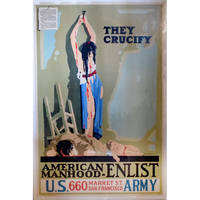
19172999<p>27 x 41 inch broadside backed with linen 29 x 43 inches. Color lithograph printed in green blue black and red. Three semicircles of loss to upper margin not affecting image; pinholes to corners of linen backing. Very Good.</p><p>A gruesome WWI recruitment poster depicting German wartime atrocities in Belgium specifically the crucifixion and possible rape of a woman and the killing of her husband and baby. Prominently displayed below this image is the address of San Francisco's Army recruitment office located at 660 Market St.</p><p>According to the explanation printed in the upper corner "'They Crucify' portrays an actual incident of the war witnessed by Sergeant Albert Goad formerly of the Seaforth Highlanders but since stationed with the British recruiting Mission in San Francisco. The atrocity was perpetrated in Blegium in a shell shattered cottage where Sergeant Goad found a murdered husband a mother nailed to the wall and a babe mutilated by bayonet. The Sergeant told of this experience to the artist M. Hoyle of San Francisco who in turn painted it for the San Francisco Army Recruiting District adhering conscientiously to the facts."</p><p>We note holdings at UC Berkeley the Imperial War Museum the Hoover and the Canadian War Museum.</p> Louis Roesch Co, Lith.
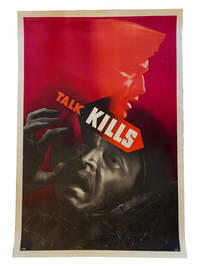
1943004937London 1943. Printed poster approximately 530mm x 775mm in size. Once folded now backed with linen one or two tiny amounts of colour loss to surface otherwise quite bright and clean. Designed by Abram Games 1914-1996 and printed by Henry Hildesley Limited. Games designed many British wartime propaganda and information posters over the course of his military service with the Royal Engineers. In 1942 he was appointed Official War Poster Artist. He produced two versions of this poster showing the possible consequences of disclosing sensitive information about the war - one coloured green that suggested a death at sea and another coloured red which suggested a death on land From the National Army Museum website. First Edition. Unbound. Good. Illus. by Games A.bram. Double Elephant. Poster. Paperback
1958055782Cairo: The USSR Embassy Press Office in the United Arab Republic UAR 1958. 1st Edition . Hardcover. Very Good. 8vo - over 7¾ - 9¾" tall. Contemporary full green cloth in Egyptian style contemporary white endpapers gilt lettering of title on front board and gilt decorations on spine. Original pictorial cover saved inside. Roy. 8vo. 24 x 17 cm. In Arabic. 88 p. 12 b/w ills. including drawings and reproduced photographic plates. Extremely rare unrecorded first issue of this Soviet propaganda organ published in Cairo the centre of the UAR by the USSR Propaganda Press Office with a striking cover design depicting the Sputniks in space celebrating the third anniversary of the Kosmicheskaya programma SSSR. The content begins with a comparison between the Soviet and American satellites. A full-paged photograph shows the Muscovites reading newspapers about the launch of the third Soviet satellite into space. In the periodical many details such as the construction processes and technical specifications of the satellites are explained as well as a striking history of the Soviet Space Program. Relations between Russia and Egypt have a long history dating back to before the 16th century. In the 1950s Gamal Abdel Nasser's independent and anti-imperialist policy earned him enthusiastic support from the Communist government of the USSR. In 1955 Egypt made a major arm deal with the Soviet Union and from then teams of Egyptian officers were trained in Eastern Bloc countries. Czechoslovak instructors also came in 1956 to train Egyptian personnel in the use of Soviet weapons. When France attacked Egypt during the Suez Crisis the USSR threatened to use destructive weapons i.e. nuclear weapons for the defence of Egypt. The degree of the Soviet approval of the Egyptian leader's policies culminated rather controversially in the award of the highest Soviet decoration the star of the Hero of the Soviet Union with the Order of Lenin to Nasser during Nikita Khrushchev's visit to the country in 1964. Kosmicheskaya programma SSSR i.e. The Soviet Space Program was the national space program of the Union of Soviet Socialist Republics USSR active from 1955 until the dissolution of the Soviet Union in 1991. After WWII the Soviet and US space programs both utilized German technology in their early efforts. Eventually the program was managed under Sergei Korolev who led the program based on unique ideas derived by Konstantin Tsiolkovsky sometimes known as the father of theoretical astronautics. Contrary to its American European and Chinese competitors who had their programs run under a single coordinating agency the Soviet space program was divided and split among several internally competing design bureaus led by Korolev Kerimov Keldysh Yangel Glushko Chelomey Makeyev Chertok and Reshetnev. The Soviet space program served as an important marker of Soviet claims to its global superpower status. Wikipedia. As of May 2024 not in OCLC and KVK. <br/> <br/> The USSR Embassy Press Office in the United Arab Republic (UAR) hardcover
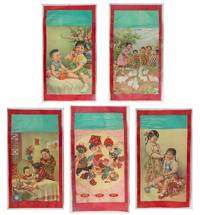
1960217261Circa1960s. Collection of five colour-printed Nianhua posters each of the central images onlaid within a stiff red paper border with a thin cream paper frame worn and discoloured and at the top of each a fine aqua paper border; the sheets a little creased two images with a visible tide-mark minor edge tears not affecting the images strengthened neatly on the verso with washi one with an early paper repair to the top margin all approx. 93 x 51.5cms sheet size in good condition. Five examples of "new" Nianhua posters dating from the Great Leap Forward all featuring babies and children symbolizing happiness prosperity and the promise of a thriving future. In one a sister braids her hair whilst minding her crawling toddler brother "Sweet Heart". On the wall a poster proclaiming the industrialisation of agriculture "Agriculture is the foundation of the national economy and grain is the foundation" caption; in another five toddlers dance in a circle their flags and lanterns captioned "The Great Leap Forward" and "Long Live Mao". Ephemeral examples of folk art and the use to which it was put for political purpose. . unknown
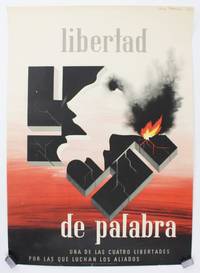
19424754Washington DC: El Coordinador de Asuntos Interamericanos 1942. Very good. Pictorial lithograph 20 x 14.25 inches printed in red gray yellow and black. Minor surface wear mild creasing light dust-soiling a few pinholes. A rare poster issued by the Office of the Coordinator of Inter-American Affairs CIAA during World War II attempting to sway public opinion in Latin America to the Allied side. The CIAA was established by executive order in July 1941 in order to distribute news advertising film reels and more to and from Latin America to counter Italian and German propaganda campaigns in the region. The text of the present poster translates from the Spanish as "Freedom of Speech. One of the four freedoms for which the Allies are fighting." The central image features an open-mouthed face breaking open a large swastika which is itself on fire. A mildly subtle message that free speech destroys fascism. The poster was designed by noted Russian-American graphic designer and photographer Alexey Brodovitch whose printed credit appears at top right; Brodovitch is most well-known for his art direction of Harper's Bazaar from 1934 to 1958. A powerful visual display with only one copy reported in OCLC at MOMA though we also find two other institutional holdings at the United States Holocaust Museum and the Hoover Institute. El Coordinador de Asuntos Interamericanos unknown
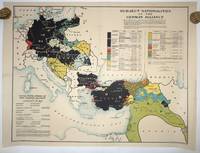
191728118London: Stanford's Geographical Establishment 1917. First printing. Map. Fine condition. A large format map illustrating the geopolitics of Europe after W.W.I. Intended to persuade viewers about the threat presented by the Central Powers of Germany Austro-Hungary Bulgaria and Turkey it color-codes them in black to emphasize the danger they might pose to the fledgling League of Nations. <br /> <br /> The solution is stated on the map which quotes from the Allies' war aims as articulated to President Wilson in 1916: "The civilized world knows that the aims of the Allies include-the reorganization of Europe guaranteed by a stable settlement based alike upon the principle of nationalities and on the right which all peoples whether small or great have to the enjoyment of full security and free economic development."<br /> <br /> The efforts to secure the peace in Europe dictated the division of nations cultures and tribes has continued to plague the world for over 100 years sellers' opinion. These groups include Greek pockets within Turkey Armenians in three pockets and Kurds Arabs which includes Jewish Colonies in Palestine. Also of note and marked on the map are the "Expropriations of the German Ansiedelungs Commission" an 1886 German proclamation that allowed Prussian settlers to appropriate Polish sovereign land. <br /> <br /> Printed at The Dangerfield Printing Co. Ltd. OCLC 9876563; Persuasive Maps: PJ Mode Collection #1188. Color lithograph 28" x 36 1/2". Backed on acid free linen supporting some tiny closed splits along the central & one other fold with one triangle of added margin not affecting the map. Very bright color and overall in very good condition. Stanford's Geographical Establishment unknown
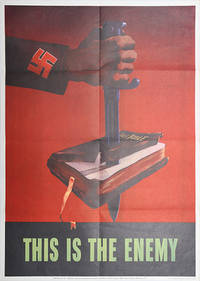
1943175357Washington DC: Office of War Information 1943. Deliver us from evil One of the most striking American wartime propaganda posters depicting a Nazi fist stabbing through the Bible against a vivid red background. "This is the Enemy" was the slogan of various American posters focusing on the evils of Nazi ideology and actions here presenting their attack on freedom of religion and their threat to Christian civilization. The artist Barbara Marks was a Californian art student. The Office of War Information solicited entries from the public for poster designs and received over 2000. Her original slogan was "deliver us from evil". Offset lithograph 710 x 560 mm. Light creases where formerly folded and a couple of tiny chips at intersections. A near-fine copy. unknown
19401715961940. SOVIET PROPAGANDA. L'novodstvo khlopkovodstvo i sakharnaya svekla: Tsvetnye tablitsy. Cultivation of Flax Cotton and Sugar Beet: Colorful Tables. 4 25 34 ills. Oblong folio 335 x 240 mm. in original cloth portfolio. N.p.: Izd. Narkomzema 1940. A handsome piece of unintentional book illustration. While the illustrations are largely botanical in nature the overall effect is more of an illustrated book than a tedious tome extolling Soviet agricultural prowess. Extremely rare with no listing on OCLC. hardcover
195553657Berlin: Verlag Junge Welt 1955. First edition. Loose leaf. Very good condition. Elephant Folio 18 x 25". 8pp 1 42 plates. Original marine blue faux leather portfolio with gilt lettering on cover. <br /> <br /> Complete set of this extraordinary publication on the history of the German workers youth movement from its founding in 1904 to October of 1954. Founded in Mannheim as the "Union of Young Workers" in 1904 the organization merged with other youth organizations over time changed its name several times e.g "Center for the Working Youth" at the SPD party convention in 1908 and triggered after the outbreak of W.W.I and with the help of Karl Liebknecht an opposition youth organization the Youth Education Association and became active internationally.<br /> <br /> This propaganda tool consists of forty-two numbered plates with modern graphic design in variant colors is illustrated with b/w photographs artwork and drawing four in color maps documents newspaper articles and charts produced to entice its use as a wall newspaper or exhibition. It was issued in East Germany during the reign of the Communist Government of East Germany. Not surprisingly the revolutionary elements and history of the organization is highlighted presenting an overview of the development of the revolutionary youth movement in Germany throughout the world wars the Weimar Republic Nazi Germany and the German Democratic Republic stressing an anti-capitalist and antifascist view.<br /> <br /> Enclosed eight-page "Methodical Instructions" for the forty-two plates of visual covering the design and preparations of an exhibition and one paragraph designated to preparations for the exhibition guides. Furthermore it highlights the main objectives of the project and proposes ways to use the material in public schools including details for the correct pedagogical use of the material. Four pages of the pamphlet are reserved for an exhaustive table on the history of the workers youth movement. One copy at Berlin Staatsbibliothek KVK. Text in German. Visual aid lightly browned. Scarce complete edition in very good condition. Verlag Junge Welt unknown
19281723681928. SOVIET PROPAGANDA DESIGN. Za oboronu SSSR For Defence of the USSR. 48 pp. illustrated with 32 full page plates printed in red and black. Small folio 275 x 200 mm. bound in publisher's wrappers illustrated by Czech artist P. Skala. Moscow: Izdatel'stvo AKHRR: Shkola FZU pri 1-i Obraztsovoi tipografii 1928. A remarkable collection of Soviet imagery intended as instruction for decorating workers' clubs reading huts and use during rallies. The illustrations include fully decorated interiors concepts for 'hands-on' attractions such as a 'rayok' or Russian peep show shooting galleries and quiz shows. Most of the imagery is in the constructivist style but also includes numerous caricatures of western fat cats fascists and even a Ku Klux Klan member which would have been inspiration for costume design. Rare OCLC finds just one copy at the Bibliotheque Nationale de France. The leaves with illustrations have an even toning from the printing process else a fine copy with the errata slip and unusually printed on fine thick paper. unknown