[Parliament, Great Britain]Biblio.com

130 résultats
17411394690London: Thomas Baskett 1741. First Edition. Loose folio. Quarto pp. 2 699-700 two leaves. In Good plus condition. In an incomplete modern binding comprised of uncovered boards bearing pencil annotations; mull and sewing visible at spine. Corners of boards lightly bumped. Text block lightly age toned. BB Consignment. 1394690. Special Collections - Downstairs. Thomas Baskett unknown
17531394689London: Thomas Baskett 1753. First Edition. Loose folio. Quarto 2 399-403 1 pages. In Good plus condition. Disbound with light age toning and light scattered foxing. Light creasing at gutter. BB Consignment. Shelved in Room A Oversized Ephemera. In 1714 the British Parliament made an act which established a £2000 reward for the individual who developed an accurate method of calculating longitude at sea. This 1753 act was one of several revisions or replacements of that original. 1394689. Special Collections. Thomas Baskett unknown
17131394685London: Printed by John Baskett 1713-1717. First Editions. Hardcover. Folio 61-174 2179-191 6 203-206 2 211-218 2 223-270 2 275-357 3 361-362 2 367-382 2 387-422 4. In Good minus condition. Bound in full contemporary calf with banded spine and tooling to boards. Boards show moderate wear to edges moderate plus wear and bumping to corners and several gouges to the front board. Cracking to leather along joint of front board. A clear lacquer appears to have been applied to the boards. Text block has light age toning to edges. Ex-Library institutional plate appears on front paste down. Ex libris of former owner appears on front pastedown. Several ink "doodles" in an 18th-century hand appear on the front paste down and front free end page. Square-inch tear to fore-edge of front free end page. Pages tightly trimmed by binder impacting some of the printed marginal annotations. BB Consignment. Shelved in Room A Oversized. Appears to contain two collections of public statutes passed in 1713 and 1714 but printed between 1713 and 1717 each with a closing contents page. The first collection contains Acts II - XVIII of 18 acts and the second contains Acts II - XXIII of 23 acts. The acts cover a range of topics including duties tariffs and taxes; the paying and management of military personnel and militias; and the management of churches. The most significant of the acts however is Act 15 of the second set of acts entitled "An Act for Providing a Publick Reward for such Person or Persons as shall Discover the Longitude at Sea". This formally established the Commissioners of the Longitude and the reward of £20000 for "the first Author or Authors Discoverer or Discoverers of any such method ." that to the satisfaction of the committee accurately determined a ship's longitude at sea accurate to within 20 geographical miles. This reward would not be claimed until 1765 when clockmaker John Harrison developed his "time-keeper" or marine chronometer. 1394685. Special Collections. Printed by John Baskett hardcover
1702mon0003110386London: Charles Bill 1702. Hardcover. Very Good. . Rebound in sturdy brown cloth with gilt decoration and lettering on the spine cover shows minor rubbing to the extremities. Pages are tanned with some minor foxing. Authentic 1702 publication not a reprint. London: Charles Bill hardcover
174635112London 1746. Folio printed in two columns per page. 2 150; 2 72; 2 195 1 blank pp. PLUS: large folding engraved illustrated plate 'The Situation of the English French and Spanish Fleets when They Began the Engagement in the Mediterranean on the Eleventh of Feby. 1743/4. Cape Sicie Bearing then N.N.E. & from the Center of the Fleet About ten Leagues.' Mild wear occasional light toning and mild foxing bound in modern institutional buckram with gilt-lettered spine title call numbers at base of spine. Title page with two rubberstamps. Very Good.<br /> <br /> These gentlemen were charged with permitting the combined French-Spanish fleet to escape after the British victory at Toulon during the War of Austrian Succession. It was feared that the fleets were heading for Gibraltar and a planned invasion of England.<br /> ESTC T114204. unknown
178420795London: J. Debrett 1784. 37 1 advt pp. Disbound a couple of spots else Very Good. <br /> <br /> First and only edition. "Considers the question whether the system of a strong responsible parliamentary administration should be restored" NUC. In England ministers are "responsible to parliament for their conduct and looking up to parliament for support; and not as in despotic governments the mere instruments of the will of an arbitrary master." This is "the great palladium of the Constitution." <br /> The author attacks "Lord B." Bute and the King for subverting this system during the events leading to the American Revolution and giving the executive arm of government over to "men ever unfriendly to liberty." <br /> FIRST EDITION. J. Debrett unknown
17771224London: Printed by Charles Eyre and William Strahan. 1777. First edition. Folio 32 x 20cm. Unbound. 2 1083-1095. Woodcut coat of arms to the title page decorative woodcut initial to the first text page text in black letter. A very good copy with some creasing to the foot of pp.1091-1092 due to an original paper flaw minor toning and a little wear to the left-hand margin where once bound within a larger volume. London: Printed by Charles Eyre and William Strahan. unknown
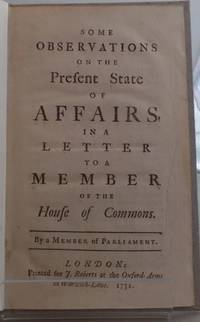
1731BS44TRACT14London: J. Roberts 1731. Hardback. First edition first issue 1731. No half-title. 34pp. Boards a little faded. A very pleasing copy. bs44. 1st Edition. Hard Cover. Very Good. J. Roberts Hardcover
175692353Thomas Baskett. London. 1756. First edition. 1756. 36 pages with title page not bound but held together with paper clips. Page edges very chipped last blank page lacks portions and is very torn and worn. Stain to top of title. Was originally folded in half so paper clip marks are visible to right margin of title. SCARCE. unknown
1798182503London: printed by George Eyre and Andrew Strahan 1798-99. First edition of this complete set of 114 statute laws. It opens with the act that granted Lord Nelson and his descendants a perpetual pension in reward for his victory at the Battle of the Nile. It also includes the Slave Trade Act 1799 notable for better regulating the conditions aboard slave ships sailing from Africa. Other laws of note include William Pitt's Income Tax Act; the Offences at Sea Act still in force today; and the Combination Act banning trade unions. Folio 294 x 183 mm pp. 887 36. Woodcut headpieces tables in text. Near-contemporary half calf flat spine gilt-lettered direct flat bands marbled boards. From the collection of Clive Richards although unmarked as such. Spine darkened and rubbed wormhole in fifth compartment corners worn front free endpaper stabilized pp. 321-33 with large loss at foot affecting text: a very good copy. hardcover
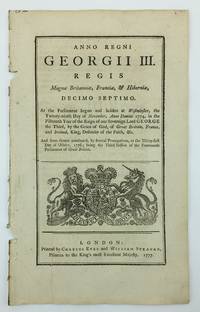
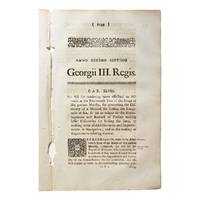
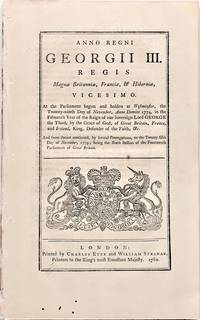
1777599<p>Anno Regni GEORGII III REGIS Magnae Britaniiae Franciae & Hiberniae DECIMO SEPTIMO. At the Parliament Begun and holden at Westminster the Twenty-ninth Day of November Anno Domini 1774 in the Fifteenth Year of our Sovereign Lord GEORGE the Third by the Grace of God of Great Britain France and Ireland King Defender of the Faith. </p><br /><p>FIRST EDITION 4 1039-1042 woodcut coat of arms on title woodcut floriated initial text in black letter unbound folio 320 x 200mm London Charles Eyre and William Strahan 1777</p><br /><p>This important act emphasised the Government's dedication to improving general science and navigation by offering rewards to those who could find an accurate method for determining longitude at sea. </p><br /><p>The first Longitude Act of 1714 was Parliament's response to the loss of 2000 lives in 1707 when four British navy ships ran aground after miscalculating the longitude. The Act offered prize money of £10000 reduced from £20000 for a reliable and accurate method of determining longitude at sea. Research and related experimentation were also encouraged and award money was made available for lesser discoveries and specific improvements. The competitions attracted the skill and imagination of the greatest scientific minds and mariners of the time.</p><p>The most prominent and successful competitor was John Harrison 1693-1776 who received disbursements of £22000 over a period of 35 years for his brilliant discoveries and invention of the marine chronometer. This was however not without a struggle for recognition. The marine chronometer was quicker but the preferred avenue of institutionalisation was the Lunar Distance Method. The Lunar Distance method was a method to determine longitude using certain astrological measurements and specific corrections marked in yearly almanacks. The Act of 1765 put caveats and conditions on the original act of 1714 and included stipulations that applied specifically to Harrison. It even named him in the opening language and described the current status of his contrariety with the board. Only with the relentless championing from his son and the personal intervention of King George III Harrison was awarded the monetary prize he was due. The Longitude Act 1777 reiterated specific goals of the program as revised by the 1774 Longitude Act and approved an additional £5000 for continued research work and experimentation and for awards to recognize lesser contributory discoveries as approved by the Commissioners of the Board of Longitude.</p><p>The Longitude at Sea program was successful in multiple ways and facilitated important advances in mathematics astronomy horology navigation and Arctic exploration. Over the life of the program a total of £53000 in prize money was awarded to more than sixty participants.</p><br /> Charles Eyre and William Strahan
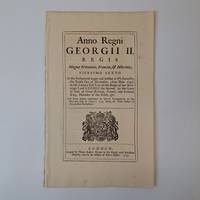
1745583<p>Anno Regni GEORGII II REGIS Magnae Britaniiae Franciae & Hiberniae DECIMO OCTAVO. At the Parliament Begun and holden at Westminster the First Day of December Anno Domini 1741 in the Fifteenth Year of our Sovereign Lord GEORGE the Second by the Grace of God of Great Britain France and Ireland King Defender of the Faith. </p><br /><p>FIRST EDITION 2 483-486 woodcut coat of arms on title woodcut floriated initial text in black letter folio 320 x 200mm London Thomas Baskett 1745</p><p>The third Act to be published on the Northwest Passage the act of 1745 offered the enormous sum of £20000 for the discovery of a north-west passage providing that they were a British subject. </p><p>The preamble to the Act stated the expected economic benefits of the discovery of the passage and that it would be "a great encouragement to adventurers" to offer a prize. The allocated sum was £20000 to be paid to the owners of the first ships to successfully make such a passage.</p><p>The Board of Longitude existed from 1714 until 1828 after the original Act of Parliament was passed in 1714. First added to in 1741 the act was subsequently amended or repealed and replaced on numerous occasions until the Board was dissolved by Act of Parliament in 1828. </p><p>This Act established a group of commissioners to determine the validity of any claims and restricted the scope of the Act to only apply to British subjects. It further required all British subjects to provide help and assistance to the explorers when necessary. In setting a hefty monetary reward and promoting the potential benefits to society this act of Parliament likely intensified the Northwest Passage fervour and motivated explorers to venture deep into the Arctic.</p><p>When the Act was extended in 1775 and the reward reiterated Cook took up the mantle leading to his third voyage. </p> Thomas Baskett
17671098111767. First Edition. CUSTOMS COMMISSIONERS ACT. Act to enable His Majesty to put the Customs and other Duties in the British Dominions in America and the Execution of the Laws relating to Trade there under the Management of Commissioners. London: Mark Baskett 1767. Folio 20th-century marbled stiff paper boards. $3200.Rare first printing of the 1767 Customs Commissioners Act one of the controversial Townshend Acts that united patriot opposition to British rule and provoked the Boston Massacre.Following the Stamp Act which had united colonial opinion against British authority ""as no issue before a new period of agitation began in 1767 with the passage of the Townshend Acts"" Morison Sources xv. Engineered by Charles Townshend Chancellor of the Exchequer these were intended to raise revenue from the American colonies by imposing duties on goods Americans were already forced to import only from England punish New York's opposition to the Quartering Act and establish a board of customs commissioners in America. This is the first printing of that Customs Commissioners Act. ""To guarantee that colonial duties raised as much money as he had promised to Parliament Townshend was tightening control over America's slack customs procedures"" by appointing commissioners in England and sending them to Boston ""with broad powers. Since colonial jurors rarely convicted a local merchant of smuggling Townshend's acts set up new admiralty courts that could try smugglers without a jury. And the acts made it easier for customs officials to obtain writs of assistance"" Langguth 93. In addition ""the moneys thus raised in the colonies were to be used to render the royal governors and judges independent of colonial assemblies"" Morison xv. To Samuel Adams ""these new commissioners of customs were 'the greatest political curses that could be sent amongst us From the time the acts took effect November 20 1767 many Bostonians had been boycotting luxury goods from Britain by signing a 'nonimportation agreement Stricter enforcement at the customs offices was drawing off hard currency from America and bad times were spreading across the colonies"" Langguth 94 102-103. With increased colonial opposition to the Customs Commissioners Act and other Townshend laws ""the customs administration to enforce them became especially in ports like Boston increasingly militarized"" provoking merchants such as John Hancock into ""calling one of his sloops Liberty and flaunting his intention of 'running Madeira ashore"" Schama History of Britain II:463. The day after the Liberty was seized by customs officials Sam Adams was overheard challenging the crowd ""If you are men behave like men. Let us take up arms immediately and be free and seize all the king's officers"" Langguth 98. With the Board of Commissioners of the Customs headquartered in Boston the city became the ""rowdiest of all the centers of protest"" and those who broke the boycott were often tarred and feathered. As tempers grew shorter and customs officers were accused of bribery and extortion matters often ""got completely out of control. On 23 February 1770 an eleven-year-old boy Christopher Seider joined by a noisy protest of schoolboys and apprentices outside the shop of an importer was shot dead by a customs officer"" and his funeral turned into a mass protest led by Sam Adams. Only one month later on March 5th amidst these already heightened tensions ""a wigmaker's apprentice ragged a soldier all the way to the Custom House for an allegedly unpaid bill. When a guard struck the pursuing youth a tocsin normally used as a fire alarm was sounded and mobilized a large and angry crowd"" Schama History of Britain II 463. In the melee that followed the redcoats opened fire killing fiveamong them Crispus Attucksand the day would be memorialized in history as the Boston Massacre. Printed in gothic type indicative of the first edition. This first printing excised from the Sessional Volumes of Parliament pages 563-66 precedes all American printings. Minor rubbing spine. Very nearly fine condition. hardcover
17741353592London: J. Almon 1774. First Edition. Hardcover. Octavo 2 63 pages 4. In Very Good minus condition. Pamphlet later bound in light blue boards. Boards show light plus age-toning to edges and spine with black lettering on spine. <br /> Text block shows moderate age-toning to edges light plus age-toning throughout interiorly and a 1-in. closed tear to title page along fore-edge. Four pages of publisher's ads appear at back. Lacking half-title page. RW Consignment. Shelved in Case 1. Authorship of this tract has been variously attributed to Arthur Lee William Pitt the Elder and Benjamin Franklin. While Benjamin Franklin submitted the text to J. Almon for publication it is generally accepted that Lee was the author. Arthur Lee was a pro-American Member of Parliament and writes here in defense of colonial rights and liberties. References: Sabin 39697; Adams 74-44a. 1353592. Shelved Dupont Bookstore. J. Almon hardcover
174121301London: John Baskett 1741. Very good condition. An Act for opening a Trade to and from Persia through Russia" granting the Russia Company the right to import Persian commodities in particular raw silk on the provision that British woollen goods be bartered in exchange. The Act prohibited the using or wearing of any "wrought silks" in Britain and states "this Act not to affect the East Indian Company". With the first page of the Act followed by pp675-679. Folio. John Baskett unknown
173521297London: John Baskett 1735. Very good condition. An Act for the better regulating the Nightly Watch and Bedels within the Parish of Saint Martin in the Fields within the Liberties of the City of Westminster". An early attempt to establish policing in the parish with much interesting content on the proposed policies including: meeting date set to determine number of watchmen needed; how to fill vacancies; times for watching; the duties of constables & watchmen; payment by half yearly assessment; the assessment on houses of ambassadors to be paid by landlords; and hired servants barred from serving as watchmen. It was not until 1774 when Sir Charles Whitworth pushed through the Westminster Night Watch Act that additional security measures were finally approved such as specifying the minimum number of watchmen and patrols punishments for infractions by watchmen and allowing watchmen from different parishes to assist in other parishes. With the first page of the Act followed by pp183 - 190. Folio. John Baskett unknown
1777100737Pamphlet format small folio disbound but expertly taped spine 711-780 pp. Some darkening around edges mostly title and last page very minor aging; overall in nice condition. This content focuses on a variety of local government issues during the reign of George III. Topics include the widening and lighting of streets altering or rebuilding some buildings appointment of local authorities and the regulation of carts and carriages in town. Charles Eyre and William Strahan unknown
1716100738Pamphlet format small foilio disbound 643-646 pp. Some darkening aging and minor foxing; otherwise very good. While only three pages this act focuses on the important subject of the regulation of tobacco production. It seems the primary goal was to prevent the mixing of other substances with tobacco in the product sold to the public and prevent any abuses in the making and mixing of snuff. John Baskett unknown
1764100735Pamphlet format small folio disbound. Five acts lacking separate titles but complete appears to be two extra tittle pages a few tears and corner folds one act with margin tear not affecting text minor some soiling; otherwise very good. This is an interesting collection of Parliamentary Acts relating to America during the reign of George III. While most of the acts are from the colonial period there is also some Revolutionary War material. There are several acts concerning the importation of rice from South Carolina and Georgia and others that relate to importation of wheat beaver skins and tea into the colonies. Others address the quartering of troops in the colonies as well as better pay for soldiers and dealing with mutiny and desertion. Additionally several acts refer to a continuation of the right of the king to secure and detain people charged with or suspected of "high treason" and for the exchange of American prisoners brought to Great Britain. Mark Baskett; Charles Eyre and William Strahan
1745100736Pamphlet format small folio disbound each act with its own title. One act with 2 pages separated some minor dampstaining; otherwise very good plus. The lengthiest act relating to the raising of money makes several specific references to colonial Georgia including the provisioning of the garrisons commissioning of troops of Highland Rangers with schooners and granting money to the trustees of Georgia for the improvement of the colony. Another act provides for a speedy trial for those who commit treason against the king. Also included is an act to indemnify those individuals who defended the king concerning the "Scottish Rebellion." Thomas Baskett unknown
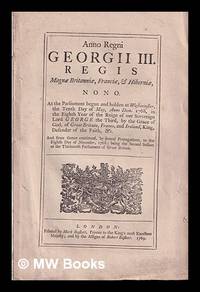
1769369465London: printed by Mark Baskett printer to the King's most Excellent Majesty; and by the Assigns of Robert Baskett 1769. First Edition. Softcover. Poor disbound copy. Some slight wear and tear as with age. Text remains well preserved overall; bright and clean. Physical description; 895-898 pp. Subjects; George III King of England. British Parliamentary Reports. London: printed by Mark Baskett, printer to the King's most Excellent Majesty; and by the Assigns of Robert Baskett paperback
1780W1890London: Charles Eyre and William Strahan 1780. Title page pp. 691-696. Folio. First edition. Printed on laid paper. Disbound from larger volume. "An Act to allow the exportation of provisions goods wares and merchandize from Great Britain to certain towns ports or places in North America which are or may be under the protection of His Majesty's arms; and from such towns ports or places to Great Britain and other parts of His Majesty's dominions." The effect of this act was to amend the American Prohibitory Act of 1776 to to allow the resumption of trade betwenn Britain and those parts of the American colonies that remained under British control. The Prohibitory Act had been the final straw that led to the American Revoltion but if Parliament thought the 1780 revisions would reverse British fortunes in the colonies they would be disappointed: The Restoration of Trade Act was too little and too late. The document is in very good condition: clean and bright with 4 tiny bookworm holes in bottom margins--well away from the text. First Edition. Paper. Very Good. Folio - over 12" - 15" tall. Manuscript. Charles Eyre and William Strahan Paperback
176248611S.l.: s.n. 1762 y Roma: L'Imprimerie de la Chambre Apostolique 1773 la Bula de Clemente XIV.- Las cinco partes con paginación independiente 199 p.; 16 p.; 148 p.; 19 p.; 26 p.; 8º menor 17 x 10 cm; Clara impresión sobre papel verjurado; Texto en francés; Enc. de la época en Holandesa Pergamino cortes pintados en color granate.- MUY RARO. La encuadernación algo rozada en los ángulos externos. En la portada una firma manuscrita de la época que no toca texto. Dicho esto la obra se encuentra muy buen estado. Libro de alta significación documental e histórica que constituye un testimonio material clave sobre la persecución judicial parlamentaria y finalmente eclesiástica contra los jesuitas. La bula del Papa Clemente XIV es Primera Edición. HISTORIA Y POLÃTICA DE LOS SIGLOS XVI-XXI E HISTORIAS GENERALES EXTRANJERAS Livre en français Sin Editorial hardcover
17591309160003England and Wales. Parliament. House of Commons 1759-01-01. Hardcover. Acceptable. Large heavy folio. 42 cm x 27 cm. Covers King William & Queen Mary's reign. 880 p. Hardcover. Contemporary boards. Boards detached. Unmarked pages. Issued as a Parliamentary paper. This is an oversized or heavy book which requires additional postage for international delivery outside the US. England and Wales. Parliament. House of Commons hardcover
178200TP08Paris France 1782. On June 13th 1782 'Docteur rege de la Faculte de Medecine en L'Universite de Paris ancien Proffesseur de les Ecoles.' Etienne Pourfour-de-Petit first hired by the University in 1732 writes the Faculty beseeching that the Faculty honor and uphold his 1760 retirement 'edict'. Superbly interesting document that highlights the struggles of the revolutionary period and transition of power. The Professor obviously a monarchist and of the 'ancien regime' is faced with a new board made up of the rebels. Easily read is a certain disdain to the new Faculty members his deep respect for the Monarch but also an embracing of the new revolutionary ideas. Biographical Notes: SIR THOMAS PHILLIPPS 1792-1872. Born in 1792 Sir Thomas Phillipps from childhood was obsessed with the idea of obtaining virtually anything written or printed on paper including cartloads of documents from wastepaper merchants and the entire inventories of booksellers. "I wish to have one copy of every book in the world" he declared to a friend. He very nearly succeeded. His collection ultimately grew to more than 100000 books and at least 60000 manuscripts. As a result of his extravagant purchases Sir Thomas was permanently on the verge of bankruptcy and was constantly pursued by creditors. So many books arrived at his house that it was impossible to unpack his acquisitions much less keep pace with them. Visiting scholars driven to distraction would spend days hunting for an elusive text in the dusty heaps that filled every room. Because Sir Thomas has a morbid dread of fire most of his collection was housed in coffinlike boxes that could be carted away quickly. Visitors to Middle Hill were struck too by the presence of numerous logs a ploy he used to lure beetles away from his books. As Sir Thomas relentlessly pursued his passion the house itself began to crumble and its floors started to sag under the cast weight of hundreds of tons of paper. His neglect of Middle Hill was partly deliberate however. Sir Thomas's chief enemy in life James Halliwell had married his daughter against his wishes. It appears that Halliwell was in Sir Thomas' eyes the worst kind of criminal a book thief who had stolen valuable works from university libraries and even from his father-in-law. Having no sons Sir Thomas was unable to prevent Halliwell from inheriting his estate. To ensure that his detested heir would never receive anything of value Sir Thomas's solution was to allow Middle Hill to fall unto complete disrepair. He even went so far as to chop down and sell for lumber the centuries-old oak trees that lined the majestic mile-long drive to his home. In 1863 Sir Thomas decided to move - in order to accommodate his books. With the aid of 160 men 103 wagonloads of books and papers drawn by 230 horses the books were lumbered from Middle Hill top their new estate in nearby Cheltenham. It is said that for years afterwards the countryside was littered with the remains of carts that had collapsed under the sheer weight of the Phillipps collection. Sir Thomas continues to add to his library until his death in 1872. After Sir Thomas's death his immediate family had no room for his collection. So vast was the library that although individual items and large sections were sold privately or through numerous auction sales the Phillipps collection is still being sold more than a century after the death of its owner. In the course of its sales many treasures have come to light. As late as 1964 part of the long-lost and unique medieval manuscript of the Roman poet Ovid's Metamorphoses appeared and was subsequently reunited with its other half at Magdalen College Oxford. Once destined for destruction as worthless wastepaper this and many other priceless works were saved by the single-minded obsession of the greatest bibliomaniac of all time. Autograph. Manuscript. Very Fine. Folio - over 12" - 15" tall. Paperback