[PARLIAMENT]Biblio.com
232 résultats
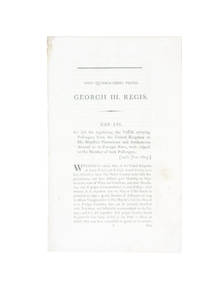
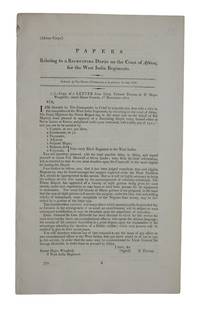
1812AQ27619London: s.n. 1812. 9pp 2. Docket title to verso of terminal leaf. Disbound. Later resewn. Early alternate pagination in manuscript to upper corners. The second located copy a series of dispatches relevant to the establishment of a British Army recruiting station at either Sierra Leone or Gorée. Under the authority of the Prince Regent Brevet Major Wingfield of the 8th West India Regiment was charged with determining the most suitable location for the depot with the assistance of inter alia one sergeant and two corporals 'from every Black Regiment in the West Indies' and that 'such eligible Negroes as may be found amongst the cargoes captured under the Slave Abolition Act should be appropriated to this service'. From the recently dispersed library without any indication of such of British scholar and senior civil servant William St Clair 1937-2021 and presumably used by him in his research for his acclaimed book The Grand Slave Emporium: Cape Coast Castle and the British Slave Trade 2006. OCLC records a single copy UWI; COPAC adds no further. . Folio. [s.n.] unknown
18035000976Edinburgh: printed by Sir D. Hunter Blair & J. Bruce 1803. Folio pp. 1-14 disbound. <p><p>One of the most important amendments to the laws of Transportation formalising the requirement for convict vessels to carry a Surgeon and thus directly responsible for a huge improvement in mortality rates. The Act is also interesting for noting some of the abuses rampant aboard convict transports and other passenger vessels travelling from Britain.</p> <p>The First Fleet had been provisioned by the Admiralty itself and the Surgeons on board led by John White had an excellent record. From the Second Fleet onwards the task was contracted to private companies infamously derelict on the Second Fleet itself and with wildly varying results over the ensuing decade. On several occasions officers colluded to deny the convicts their correct rations so that the surplus could be sold upon arrival at Port Jackson for a handsome profit. A plan to return convicts to naval vessels was scuppered by the ongoing conflict with France.</p> <p>This Act regulated the terms of carrying all passengers free or convict detailing acceptable provisioning and the role of the Surgeon and allowing for a bond of £50 per head to be paid by the owners of any vessel. Although abuses continued aboard the convict transports conditions did improve overall and the casualty rate for convicts sent to New South Wales fell from one in ten between 1795 and 1801 to one in forty-six for the period 1802-1812. One paradoxical result was that British conservatives started to criticise the transports as being too comfortable and therefore a poor deterrent to crime.</p> </p> . printed by Sir D. Hunter Blair & J. Bruce unknown
186156074London Eyre & Spottiswoode 1861. Folio. 2 contemp. hcalf. Spines gilt. Titlelabels with gilt lettering. 8LI228;24692 pp. 3 folded maps Index-map with colouring 2 diagrams 5 plates. Textdiagrams textillustrations in woodcut. Clean and fine. unknown
1809357240London.: Samuel Smith. 1809. Old half tan calf over gray boards raised band gilt spine title on red label. Lower panel of spine missing moderate wear and soiling to covers half-title page wrinkled otherwise very good. 23.5x29x1.8 cm. “An act for raising a certain sum of money by way of annuitles to be attended with the benefit of survivorship in classes.'"" These schemes were used by governments in the 17th 18th and 19th centuries to raise money for the public treasury. This is an accounting of the nominees of the last tontine sponsored by the British government. Rare. weight: 2.1 lb. Samuel Smith. hardcover
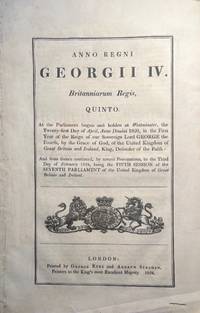
18246000004London: George Eyre and Andrew Strahan 1824. Folio pp ii added general title-page for the parliamentary year 737-756; unbound neat paper spine. <p><p>A crucial landmark in the creation of the Australian Agricultural Company and the first official use of the great company's name. Two months earlier the House of Commons had passed a bill incorporating "The Australian Company of London" which this overrides Ferguson 949.</p> <p>The Australian Agricultural Company or AACo played a huge role in shaping the early Australian economy. From its establishment in 1824 it was responsible for the development and expansion of the Hunter Valley and other regions. Surviving all the rural challenges - including droughts economic depressions and labour shortages - its long-term impact on early Australia was substantial in establishing agriculture as a primary industry and contributing to Australia's economy famously "riding on the sheep's back".</p> <p>AACo continues to be a significant player in today's agricultural sector today as Australia's largest integrated cattle and beef producer owning and operating approximately 7 million hectares of land in Queensland and the Northern Territory. This vast landholding represents roughly 1% of Australia's land mass highlighting the company's substantial presence in the country's agricultural landscape.</p> </p> . George Eyre and Andrew Strahan unknown
1831elala1146York: James Baxter Printer 1831. 1831. 8vo. pp. 5. text in double columns. modern cloth-backed bds. foxing to title. Rare. Concerning the establishment of a school fund from the sale of Crown lands set aside for the purpose. The committee was chaired by William Morris 1786-1858 who by the late 1820s "had become a recognized authority on the distressing state of schooling in Upper Canada. " DCB VIII p. 640 Fleming 583 Public Archives copy only. Casey I 1334. Not in TPL. Hardcover. York: James Baxter, Printer, 1831. Hardcover
1839elala1150Toronto: Printed At The Patriot Office 1839. 1839. 8vo. pp. 87. old half sheep binding worn spine damaged foxing to outer leaves margins closely trimmed. The first half of the report dated April 30 1839 is concerned with the American involvement in the Rebellion: the raids conducted by sympathizers in the northern states including extensive discussion of the seizure and burning of the steamer Sir Robert Peel. The second half constitutes a commentary on Lord Durhams report. The last four pages contain the draft of an address to the Queen requesting continued support and protection. Fleming 1373. TPL 2334. Casey I 1727. Lande S2250. Toronto: Printed At The Patriot Office, 1839. unknown
181824993London: John Baskett and others printers 1818. 12 works folio. 12 1/2 x 8 inches and smaller. Disbound or stitched<br/> <br/> A fascinating series spanning the whole of the period when whaling was carried out on a successful commercial basis in the waters off Greenland.<br/> <br/> After an abortive start by the South Sea Company between 1724 and 1732 the British whaling fleet operated off Greenland and the Davis Strait throughout the remainder of the 18th century with increasing success due to a large degree to the succession of bounties granted to ship owners by the British Government. The present selection of acts of parliament includes a number concerning the bounty: the first dated 16th January 1732 makes law "that a Bounty will be paid on the Return of every Ship of 200 tons and over imployed by His Majesty's Subjects in the Whale Fishery". For the bounty to be paid certain stringent criteria had to be met; these increased as the century progressed. By the time of the last Act in the present group March 1818 the Greenland whalers were reporting declining catches and were already beginning to turn their attention to other whaling grounds i.e. largely in the Pacific and Antarctic. This group offers and interesting series of snapshots of the industry during its most productive century. The acts comprise: 1. An Act for encouraging the Greenland Fishery. 1732. Stitched later wrappers. Exemption from duty extended for a nine year period. 2. An Act for the further Encouragment of the Whale Fishery carried on by His Majesty's British Subjects. 1733. Stitched later wrappers. The introduction of a bounty for ships over 200 tons. 3. An Act for continuing the several Laws therein mentioned . including granting a further Bounty for all Ships employed in the Whale Fishery during the present War; for exempting Harponers and others . from being impressed. No date but circa 1750. Spine reinforced. The bounty raised by a third other measures to help the trade. 4. An Act for granting a additional Bounty on Ships employed in the Greenland and Whale Fishery for a limited time. No adte but circa 1761. Disbound. The increased bounty confirmed for another five years. 5.An Act for further continuing several Acts . for the Encouragement of the Whale Fishery. 1768. Stitched. 6. An Act for the better Support and Establishment of the Greenland and Whale Fishery. 1771. Stitched. The rules about the amount of bounty to be paid has changed with additional laws concerning vessels of American origin exemption from duty extended to include the Gulf of St. Lawrence certain members of a whaler's crew to be exempt from being pressed into service in the Royal Navy etc. 7.An Act to explain and amend Two Acts made . with respect to the Limits of the Greenland Seas and Davis's Streights . and to enlarge the Time for the Return of the Vessels employed in the Whale Fisheries. 1780. Stitched. 8. An Act for granting an additional Bounty on Ships employed in the Greenland and Whale Fishery for a limited Time. 1782. Disbound. The bounty retained for a further five years. 9. An Act for allowing Vessels employed in the Greenland Whale Fishery to complete their full Number of Men at certain Ports for the Present Season. 1805. Spine strengthened. Whaling ships permitted to call in to ports in Scotland the Orkneys and the Shetland Islands to find men to complete their crews. 10. An Act for allowing until the Signature of Preliminary Articles of Peace Vessels . to complete their full Number of Men at certain ports. 1806. Spine strenghtened. An extension of the previous act. 11. An Act to revive and continue for five years several Laws. 1815. Strengthened spine. Several prvious acts re-confirmed. 12. An Act to amend an Act . so far as it relates to the Oaths thereby required. 1818. Unbound. Concerns the oaths required from owners/captains before the bounty due would be released to them. John Baskett [and others], printers unknown
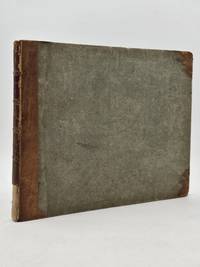
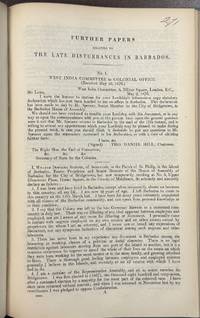
187640713London: Printed by George Edward Eyre and William Spottiswoode 1876. xii 247 1 pp.<br /> bound with FURTHER PAPERS RELATING TO THE LATE DISTURBANCES IN BARBADOS. PRESENTED TO BOTH HOUSES OF PARLIAMENT BY COMMAND OF HER MAJESTY JULY 1876. Printed by George Edward Eyre and William Spottiswoode. 1876. x 220 pp. The two titles bound together in modern two-toned cloth with paper title affixed to front cover. Near Fine.<br /> offered with FURTHER PAPERS RELATING TO THE LATE DISTURBANCES IN BARBADOS. PRESENTED TO BOTH HOUSES OF PARLIAMENT BY COMMAND OF HER MAJESTY FEBRUARY 1877. London: Printed by George Edward Eyre and William Spottiswoode. 1877. iv 66 pp.<br /> bound with FURTHER PAPERS RELATING TO THE LATE DISTURBANCES IN BARBADOS. PRESENTED TO BOTH HOUSES OF PARLIAMENT BY COMMAND OF HER MAJESTY MARCH 1877. London: Printed by George Edward Eyre and William Spottiswoode. 1877. v 1 blank 70 pp. The two titles bound together in modern two-toned cloth with paper title affixed to front cover. Near Fine.<br /> <br /> These books print observations and official dispatches beginning in 1871 that tell the story of the Barbados insurrection beginning in 1876. "Slavery in Barbados was abolished in 1834. . . Despite gaining their freedom in the sense of no longer being 'owned' officially life for plantation workers remained difficult for many years. Perhaps the same children whose parents avoided having them apprenticed became involved 40 years later in the Confederation Riots of 1876. The primary cause of these riots is often cited as the proposed confederation of Barbados and the Windward Islands. However it is very likely that this was one cause of many and the primary reason for unrest and unhappiness was down to pay working and living conditions. The 'despatches' of 1875 describe cases of death by starvation - one of a baby whose mother had had to return to work weeks after giving birth and could not feed her daughter often enough or worked so hard so soon that she could not produce enough milk. According to the rector of the Parish Church this was a common occurrence. . . Cases such as this were the primary causes of unrest in Barbados in the 1870s. These cases illustrate the difficulties faced by the descendants of enslaved African-Caribbeans and the long lasting legacy of the slave trade." online The National Archives essay 'When did plantation workers in Barbados truly become free'. Printed by George Edward Eyre and William Spottiswoode unknown
1838elala1149Toronto: R.Stanton 1838. 1838. 8vo. pp. 91 60. old half chagrin spine & extremities worn retaining original printed wrs. wrs. soiled. imprint date found on fr. wr. The report dated Feb. 13 1838 is largely concerned with the Rebellion: "It cannot but be felt that this traitorous insurrection of a portion of the inhabitants of Upper Canada is an event much to be regretted It has entailed upon the public a very formidable expense the sufferings occasioned by an enterprise of so criminal and desperate a nature to the guilty actors can hardly fail to excite compassion." p. 9 Appended are numerous related documents including proclamations and handbills from William Lyon Mackenzie and from R.J.Sutherland of the Patriot Army the Militia General Order of Dec. 4 1837 official acts resolutions despatches and petitions communications from the American government regarding the capture of the steam-boat Caroline &c. Fleming 1271. TPL 2231. Casey I 1656. Gagnon I 2994. Lande 869. [Toronto]: R.Stanton, 1838. unknown
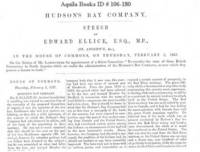
1857106180London: Great Britain. House of Commons 1857. Broadside. fine. 1 sheetpp. Sheet 25.2 x 32cm. with approximately 180 lines of text in 3 columns. fine Not in Peel. Edward Ellice 1781-1863 was an English merchant and politician who was active in bringing about the union of the NorthWest Company and the Hudson's Bay Company in 1821. An HBC Company executive for whom Fort Ellice was named states here that in his opinion the porposed Committee of Inquiry is necessary due to the uninformed opinions of other Members of Parliament. 1857 Great Britain. House of Commons unknown
1829elala1046Quebec: Re-Printed by Order of the House of Assembly of Lower Canada 1829. 1829. 8vo. pp. 2 p.l. 377. partly unopened in later cloth some foxing throughout. The report p. 1-10 is dated July 22 1828 and is followed by minutes of evidence May 8-July 15 1828 pp. 11-328 and an appendix of supporting documents pp. 329-77. Among the witnesses listed on p. iii are Samuel Gale Edward Ellice John Neilson Denis Benjamin Viger amd Austin Cuvillier. The British parliamentary Canada Committee was set up in 1828 to study the grievances of Upper and Lower Canada. "Its major recommendations were that a tax should be imposed on unimproved lands held by speculators; that the laws customs and religion of the French Canadians should be respected that the crown revenues should be surrendered to the colonial Houses of Assembly in exchange for a Civil List; that steps should be taken to sell the Clergy Reserves and to divide the proceeds fairly among all Protestant denominations; and that the revenue from the Jesuits Estates should be used for education." Story p. 145 TPL 1486. Dionne III 217. Lande 385. Sabin 10576. cfGagnon I 2989. Quebec: Re-Printed by Order of the House of Assembly of Lower Canada, 1829. hardcover
190095179London: HMSO 1900. Hardcover as now bound; all were originally issued as softcovers. Good. Modern red cloth. 34 cm. 1 5 p.; 2 iv 59p.; 3 2 folding maps iii 57p.; 4. 51p.; 5. 33p.; 6 9p.; 7 19p.; 8 5p.; 9 43p.; 10 6p.; 11 2 maps both titled Index Plan 147p. Condition of individual papers vary with some chipped edge-wear soiling etc. Some leaves browned and brittle with chipping in railroad report as if high acid paper was used for those leaves. We found various paginations for the final document but our contents seem consistent with most. Original wrappers if any not preserved. HMSO hardcover
1836elala1147<p>Toronto: R.Reynolds Printer 1836. 1836. 8vo. pp. 256 4. original cloth-backed bds. short split in upper front joint covers spotted some scattered light foxing. A scarce and important report. Charles Duncombe a prominent American-born physician and politician in Upper Canada was appointed in 1835 to visit and report upon the systems of education pursued in the United States and to offer recommendations for the educational institutions of Upper Canada. His report pp. 68 in which he stresses the need for practical education and adequate financial support for common schools and teacher education is followed by a lengthy appendix of supporting documentation pp. 69-256. Although Duncombe's proposals were not immediately implemented many would be introduced under the administration of Egerton Ryerson and would form the basis of Ontario educational policy until 1871 i.e. local assessment elective school boards female education the creation of normal schools non-sectarian religious instruction &c. Fleming 1059. Gagnon I 1201. Sabin 21268. TPL 2011. DCB IX pp. 228-32. Hardcover.</p> Toronto: R.Reynolds, Printer, 1836. hardcover
183119854London 1831. FIRST PRINTING. Drop title; with a number of contemporary annotations corrections on Schedules A and B pp. 26-27. Sewn as issued preserved in a folding case. First printing of the final revisions to the Great Reform Bill. This was the second bill put up for a Parliamentary vote. The initial version of the bill March 1831 was rejected by Parliament.<br /> <br /> The Great Reform Bill of 1831 also known as the Reform Act was a significant piece of legislation in the United Kingdom aimed at addressing the deficiencies in the electoral system. Before the bill representation in Parliament was heavily skewed with many industrial cities lacking adequate representation while rural areas held disproportionate power. The bill sought to expand the electorate improve representation and reduce the influence of "rotten boroughs" which were sparsely populated constituencies that had the same voting power as more populous areas.<br /> <br /> The bill proposed to extend the franchise to more men particularly those in the burgeoning middle class and aimed to redistribute parliamentary seats to reflect population changes especially due to the industrial revolution. Although it faced fierce opposition from the House of Lords public pressure and widespread protests highlighted the demand for reform. The rejection of the initial version of the bill led to a wave of public agitation and a second attempt which was again passed by the House of Commons and rejected by the House of Lords. Ultimately this third version passed after the government threatened to create new peers to secure its approval in the House of Lords. <br /> <br /> The Great Reform Bill marked a pivotal moment in British political history laying the groundwork for future electoral reforms and increasing public participation in the democratic process. unknown
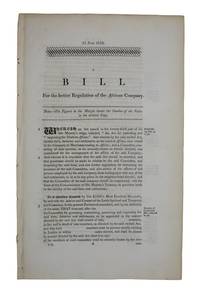
1819AQ27617London: s.n. 1819. 5pp 1. Docket title to verso of terminal leaf. Disbound. Three old horizontal folds. An apparently unrecorded parliamentary bill proposing amendments to the 1750 Act for extending and improving the Trade to Africa specifically reducing the number of committee members and restraining the trade opportunities of the African Company of Merchants. The bill was seemingly never enacted.; the Company was abolished in 1821 with all assets passing to the Crown. From the recently dispersed library without any indication of such of British scholar and senior civil servant William St Clair 1937-2021 and presumably used by him in his research for his acclaimed book The Grand Slave Emporium: Cape Coast Castle and the British Slave Trade 2006. . Folio. [s.n.] unknown
1804157362London: R. Wilks 1804. First edition. This Act published at the outset of the Napoleonic Wars and intended as a temporary measure permitting the enlistment of non-British officers and retrospectively formalized the commissions of any who had been serving until its passing. We have located only four institutional copies on WorldCat at the Gottfried Wilhelm Leibniz Bibliothek King's College London the British Library and ULB Darmstadt. The text of the act is followed by Rules and Articles for the Better Government of such of our Forces as Shall Consist of Natives of Foreign States who now are or may at any Future Period be Enlisted into our Service. This outlines the regulations all serving British officers and henceforth all foreigners in the army would be subject to. The act was repealed by the Statute Law Revision Act of 1872. Octavo pp. xxxvii iii 292 lacking pp. 112-21. Text in English and German. Original grey boards white paper backstrip printed paper labels on both boards. Nineteenth-century ink shelf mark on spine. Binding worn spine cords exposed inner hinges cracked front inner hinge stablized contents lightly toned rear endpaper stained: a good copy. hardcover
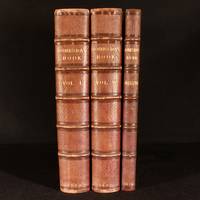
1875981F12London: George Edward Eyre and William Spottiswoode 1875-1876. First edition. Leather. Very Good. 15" by 11.5". None. Three volumes of highly informative first edition statistical returns detailing land ownership in late 19th century England Wales and Scotland. The first two volumes in this set are 'England and Wales Exclusive of the Metropolis. Return of Owners of Land 1873' complete in two volumes. Volume I: Bedford to Norfolk; Volume II: Northamton to Radnor.This is a statistical return listing for each county in England and Wales excluding London detailing: the names and holdings of all landowners with one acre or more showing acreage and annual rental value; the total number and combined acreage and rental value of owners with less than one acre; and the estimated area of commons and waste land.The third volume is the scarce 'Return of Owners Land of One Acre and Upwards in the Several Counties Counties of Cities and Counties of Towns in Ireland' offering the same information for Ireland. This is essentially a modern Domesday book of Ireland with long lists of the names of Landowners and the values of the land. The lists were returned to the Local Government Board by the end of 1875 arranged into counties alphabetized and finally published in 1876. Since the returns include the names of small landowners as well as large owners of a few acres as well as great estates they stand as a census of a large proportion of the population of Ireland in 1876.In handsome half morocco bindings with cloth covered boards.With a supplement to the start of volumes I and III.These volumes offer detailed statistical insight into land distribution in England Wales and Ireland in the late 19th century. In half morocco bindings with cloth covered boards. Light rubbing to back strip head and tail and raised band with board perimeters age toned with handling marks. Internally firmly bound. Pages clean and bright. Very Good George Edward Eyre and William Spottiswoode hardcover
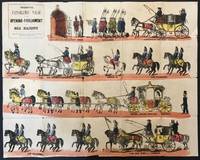
18603220414<i>Wood-engraved single sheet panorama in four strips 565 x 450 mm crudely coloured and folded with title at top left some splitting to joints; </i><i>in the original green publisher's wrapper titled in black lower wrapper lacking some chipping to edges and lightly dust-soiled but a remarkable survival nonetheless.</i><br /><i><br /></i>Rare panorama depicting the State Opening of Parliament likely sold on the day to crowds lining the procession route. The panorama itself presented as four strips one above the other on a single sheet has been printed from the same blocks as another we have seen by T. Goode but with new references set beneath the panorama image see below.<br /><i><br /></i>The procession advances from right to left with the Queen accompanied by Prince Albert and captioned where appropriate: 'Entrance to Parliament House'; 'Beefeaters'; 'Carriage of the Prime Minister'; 'Herald'; 'Her Majesty's Spokeman's Carriage'; 'Officer of the Life Guardsmen'; 'Queen's Carriage'; 'Life Guardsmen'; and 'Lord John Russell's Carriage.' The procession advances from r. to l. The Queen is accompanied by Prince Albert. Earlier the block for 'Beefeaters' had been used for T. Goode's 'Panorama of the Lord Mayor's Show'; as too had the block for 'Her Majesty's Spokesman's Carriage' previously uncaptioned and 'Lord John Russell's Carriage' previously 'The Recorder in his Carriage' explaining why Lord Russell seems to be holding a mace. It would be the Horse Guards who would have taken part in the procession; the beefeaters would have been awaiting the monarch in the House of Lords. <br /><i><br /></i>It is curious to note that the 'Entrance to Parliament House' bears no resemblance to the Royal Entrance in Victoria Tower and instead looks more like the Soane entrance but that was destroyed in the fire of 1838 so perhaps more evidence of earlier blocks being repurposed.<br /><i><br /></i>In the London directories William Sutton's name replaces Georgina Duggan's at 2 Bartlett's Passage in 1860. The Prime Minister at the time was Palmerston and Lord John Russell was Foreign Secretary. The panorama also represents one of the final depictions of Queen Victoria accompanied by Prince Albert who died in 1861.<br /><br />Not in OCLC. W. Sutton, (late G. Duggan,) 2, Bartlett’s Passage, Bartlett’s Buidlings, Holborn, W.C.
1829elala1084np: 1829. 1829. 8vo. pp. 1 p.l. 3index 4-255. modern calf covers bit discoloured. The majority of the grievances were directed at the authoritarian regime of Lord Dalhousie as governor of Lower Canada and Governor-in-Chief of British North America 1820-28 when he was recalled. Included are grievances relating to Dalhousies establishment of a new Quebec Gazette his censure of Sir Francis Burton for having sanctioned a Bill of Supply his dismissal of militia officers and exercise of intimidation during elections his dismissal of justices of the peace and the unfair manner of jury selection. "Among other things the Montreal petitioners complained that contrary to the laws of England juries both grand and petty and both King's Bench and Quarter Sessions were being drawn exclusively from the town of Montreal rather than from the district at large. The committee chaired by Denis-Benjamin Viger concluded that this practice of jurors being "selected or as it were packed - summoned exclusively from among the inhabitants of a particular place or from a particular class - cannot be more compatible with liberty than it is with the rules of impartial justice. It is repugnant to every principle of our government and can only tend to the overthrow of the constitution of the country .The executive's control over the process of selecting juries became for the Patriotes yet another symbol of despotism and of the attempted exclusion of canadiens from their democratic rights given that they predominated in the countryside; a number of highly political jury trials for libel and sedition did nothing to help matters. The controversy only began to die down from 1830 when James Kempt ordered that jurors be drawn from the body of the district; the denouement came in 1832 when the legislature adopted a law regulating the qualification and selection of jurors " Donald Fyson Grand Juries Political Power And Citizenship In Quebec And Lower Canada 1764-1830 a paper for the 77th annual meeting of the Canadian Historical Association Ottawa May 1998TPL 1549. Sabin 10568. cfCasey I 1279. Not in Dionne Gagnon or Lande. np: 1829. unknown
1900K3ME5C11OCGBLondon: Harrison and sons 1900. Bound as sewn. Folio. With a folding lithographed map with some coloured details. Diplomatic document presented to the Houses of Parliament on the trade of the Ethiopian cities Addis Ababa and Harar. It includes many letterpress tables showing imported and exported tradeware its quantities prices and origin occasionally with some other remarks. The maps shows various trade routes from the two cities to other cities towns and ports. In very good condition. Harrison and sons, unknown
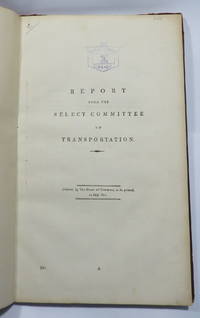
181225333London: The House of Commons. Good with No dust jacket as issued. 1812. First Edition. Hardcover. Binding poor. Front board detached. Spine leather worn with 75mm loss and 65mm piece of spine detached and loose. Text block very good. Ex-library General Assembly Library New Zealand. Gilt library stamps on spine and front board. Library bookplate on front endpaper with rubber stamp "Withdrawn from Parliamentary Library". Rubber stamp on title page "General Assembly Library APR 1899". ; 117 1 blank pages. Half morocco binding with front board detached and spine poor. Folio. Page dimensions: 333 x 202mm. Without original blue wrappers. Page edges sprinkled red. References: Wantrup 38 pp. 108-9 - "The first important document from the Macquarie era is a Parliamentary Paper of major significance in the early history of Australia. . . . In its 118 foolscap folio pages this report includes a transcript of the evidence given by many notable witnesses. Among them were ex-Governor Hunter ex-Governor Bligh his deposer the now plain Mr George Johnston the famous navigator Matthew Flinders the first fleet chaplain Reverend Richard Johnson and many other colonial officials."; Ferguson 543 . The House of Commons hardcover
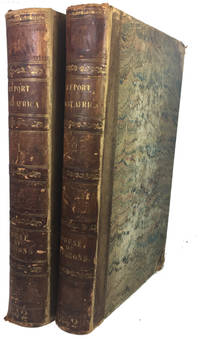
184291013London: Ordered by the House of Commons to be printed 1842. 1st ed. Hardcover. Good because of fragile repaired map. 2 vols. 4 folding maps 3 in Part I and one in Part II xxvi 744 637p. Contemporary 1/2 leather with marbled boards. Covers intact but rather heavily scuffed and rubbed. Bookplates removed on both front pastedowns. Contents generally sound and clean although the large folding map of the coast of West Africa in Part Volume II is fragile. That map had split apart along many of the original folds and elsewhere. While it had been carefully put back together it needs careful handling when folding or unfolding to keep nthe map intact. These volumes contain a wealth of material about British trade and administrative activities in Gambia Sierra Leone and Gold Coast the three areas of particular British interest and control in West Africa at that time -- Lagos and other pieces of what is now modern Nigeria were still outside British influence and control in 1842 and Benin hadn't yet been grabbed by Germany before passing to Great Britain after World War I. These volumes also contain quite a bit of information about British efforts to suppress and end the slave trade. Ordered, by the House of Commons, to be printed hardcover
1891675561891. Debates in Parliament 1892-1908 Great Britain. Parliament. The Parliamentary Debates Fourth Series. London: Reuter's Telegram Co. and Others 1892-1908. 136 of 199 volumes lacking Volumes 16-77 1893-1899 and 100 1901. Contemporary cloth blind frames to boards gilt titles to spine. Several volumes bound in three-quarter calf over paper-covered boards some with cloth-reinforced spines a few bound in recent buckram. Moderate to heavy shelfwear with chipping to spine ends most hinges cracked several boards loose or detached interiors clean. Ex-law school library. Location labels to spines bookplates and other markings to pastedowns and endleaves. $1995. Fourth Series. Authorized by Parliament this series was the successor to Hansard's Parliamentary Debates which succeeded the series commenced by William Cobbett in 1804. unknown
181528825London. Printed by R.G. Clarke. 1815 1815. Hardcover. thick8vo 21.2cm xii786xivpp. index rebound in full burgundy sheep raised bands crushed green morocco label gilt marbled endpapers fine thus very rare. cgc Worldcat cites only 1 copy at Harvard. British Museum Catalogue locates 1 copy. Not in Amicus. Not in T.P.L. Lande etc. No listings or price records located. An extensive collection of correspondence and treaties presented to the British Parliament under the titles; "Slave Trade" 46 Papers; "Genoa" 10 Papers October 1811 to March 1815; " Naples" 19 Papers January 1814 to March 1814; "Italy" 8 Papers October 1811; "War with America" 9 Papers June 1812 to November1 1813; The Person and Family of Napoleon Buonaparte" April 1814 to August 1814; and "Correspondence on Alliance against France"2 papers & Treaty copies April -May 1815. The War in America papers concern the War of 1812 and are primarily naval; with the Royal Navy on the Great Lakes and Lake Champlain. Of particular interest are extracts of the proceedings of the court martial of Captain Barclay and others resulting from the Battle of Lake Erie September 1813. The slavery papers from 1813 to 1814 containing extracts of treaties between Britain and European countries give an overview of the gradual abolishment of the slave trade. Correspondents include the Duke of Wellington Viscount Castlereagh Henry Wellesley and Earl Bathurst. The Genoa Naples and Italy papers relate to risings against the French in 1814 with much of the correspondence by Lord Bentinek. The material on the Napoleon Wars deals with the period between The Treaty of Paris in 1814 and the Hundred Days campaign of 1815. The last correspondence is between Viscount Castlereagh and Earl of Clancarty the month before the Battle of Waterloo in June 1815. An wealth of contemporary material on a critical period in British and European history. London. Printed by R.G. Clarke. [1815] hardcover