955 résultats
196025343E1960. Original Autograph Letter Signed by former U.S. President Harry S. Truman to Dean Acheson who served as his Secretary of State from 1949 to 1953 regarding the 1960 presidential election between John F. Kennedy and Richard M. Nixon. With an Autograph Letter from Dean Acheson to Harry S. Truman. Both letters are written and dated before the 1960 Democratic National Convention and concern how how to handle the press. The first is a 4 page letter from Dean Acheson to Truman handwritten on yellow legal paper 8 inches by 12 5/8 inches double-spaced single-side only dated June 28 1960. In the letter Acheson who was arguably Truman’s greatest admirer and devoted friend writes to clarify for Truman the positive benefit to the party and the nation in favoring Kennedy over the other likely contenders including California Governor Pat Brown former Illinois Governor Adlai Stevenson Senator Hubert Humphrey of Minnesota and Senator Lyndon B. Johnson of Texas. He begins: “Dear Boss As the Convention approaches we partisans are likely to become shall we say emphatic in our statements to the press. Could we make a treaty on what we shall not sayâ€. In his conclusion he writes “We have got to beat Nixon. We shall probably have to do it with Kennedy.†On July 2 1960 a week before Truman’s written reply he spoke at a dramatic televised press conference at the Truman library during which he lashed out at Kennedy citing his relative inexperience specifically doing exactly what Acheson had urged him never to do. After the press conference on a 2 page letter dated July 9 1960 written on his imprinted personal stationery Truman writes in part to Acheson: “Dear Dean:- You’ll never know how very much I appreciated your call and good letter. I tried my best to profit by both. Whether I did or not is up to you to decide. Anyway it looks as if things have to some extent slowed down and the band wagon isn’t running so fast. I’ve never been so wrought up and if you and the ‘Madam’ - the ‘Boss’ had not put the brakes on I’d have blown my top - maybe!†The letter closes with “Again thanks to a real friend and a real standby. My best to Alice Sincerely Harryâ€. In response to Truman’s criticism Kennedy responded noting that if fourteen years in major elective office was insufficient experience then that would have ruled out all but a handful of presidents including Wilson Roosevelt and Truman himself. In the end Truman opted to support Kennedy and his running mate Lyndon B. Johnson campaigning for them across nine states making thirteen speeches. These letters make a remarkable association referencing an historic moment in American presidential history. unknown
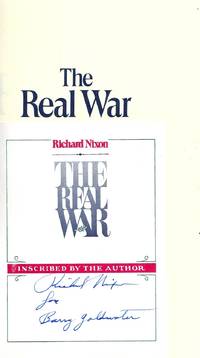
1980019025New York: Warner Books 1980. First Edition. Hardcover. Near Fine in a Very Good dustwrapper with a closed tear and crease at the rear. INSCRIBED and SIGNED by Nixon as usual for this book on a tipped-in publisher's bookplate. This copy however is INSCRIBED to Barry Goldwater. <br/><br/>Barry Goldwater a five-term United States Senator from Arizona 1953-1965 1969-1987 and the Republican Party's nominee for President in the 1964 election is the politician most often credited for sparking the resurgence of the American conservative political movement in the 1960s. His landslide defeat to Lyndon Johnson which also brought down many other Republican candidates opened the door for Johnson and a Congress dominated by Democrats to pass the Great Society programs. Goldwater returned to the Senate in 1969 but his role as a leader of the conservative movement had been transferred to Ronald Reagan. In 1974 Goldwater successfully urged President Richard Nixon whom he called "the most dishonest individual I have ever met in my life" to resign at the height of the Watergate scandal. Goldwater retired in 1987 and was succeeded in office by John McCain. Acquired from the Goldwater family. Warner Books hardcover
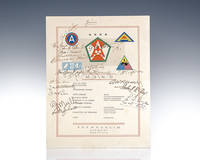
1945148763Germany: Bad Nauheim November 11 1945. Rare original dinner menu from George S. Patton's 60th birthday celebration at the Spa Hotel in Bad Nauheim Germany on November 11 1945. Octavo featuring colorful hand-decorated double ruled borders four-star rank and unit insignia designs. Boldly signed under the four-star rank insignia by Patton "G. S. Patton Jr." Additionally signed by eighteen attendees including: Robert B. Patterson recently elevated to Secretary of War; Hobart R. Gay Patton's Chief-of Staff; Paul D. Harkins deputy Chief-of-Staff and later Vietnam-era commander; Geoffrey Keyes; and Thomas H. Nixon. In near fine condition. General George S. Patton’s 60th birthday celebration was a day-long event that served both as a reunion with fellow veterans of the Third and Seventh Armies and as a farewell before his planned departure for the United States on December 10 1945. The occasion offered a brief moment of joy amid the turbulence of Patton’s final months. In September just weeks earlier he had been relieved of his positions as commander of the Third Army and military governor of Bavaria by General Eisenhower following controversial remarks in which he compared former Nazi Party members to Democrats and Republicans in the U.S. Reassigned to lead the Fifteenth Army a unit tasked with compiling the official history of the war Patton found little satisfaction in the new role. He disagreed with American denazification efforts and believed U.S. forces should remain strong in Europe to counter any future threat from the Soviet Union. With no reassignment to the Pacific forthcoming Patton hoped simply to return home—a journey he would never complete. On December 9 a truck collided with his jeep resulting in a broken neck and paralysis; he died in a hospital in Heidelberg on December 21 1945. Bad Nauheim unknown
1969713822/01/1969. <div class=""first""><p><strong><big>I</big>n February 1953 Henry Cabot Lodge was named U.S. Ambassador to the United Nations by President Eisenhower with his office elevated to Cabinet level rank. </strong>The position then was high profile and Lodge often engaged in debates with the UN representatives of the Soviet Union that were broadcast or covered on television. On the front lines in the Cold War in 1959 he escorted Soviet leader Nikita Khrushchev on a highly-publicized tour of the United States. Lodge left the ambassadorship during the election of 1960 to run for Vice President on the Republican ticket headed by Richard Nixon. Nixon selected Lodge because the latter had made a name for himself at the United Nations as a foreign-policy expert.</p><p>President Kennedy appointed Lodge to the position of Ambassador to South Vietnam which showed the import U.S. policymakers were coming to place on that nation. Lodge held the post from 1963 to 1964 and again from 1965 to 1967. As ambassador there Lodge supported President Johnson's decision to escalate American involvement in the Vietnam War believing that a Communist takeover in the South would be disastrous for U.S. foreign policy goals.</p><blockquote><p>The original appointment of <em>“Henry Cabot Lodge of Massachusettsâ€</em>_as <em>“Ambassador to head the United States Delegation at the Paris Meetings on Vietnam.â€</em></p></blockquote></div><p><!--break--></p><p>President Johnson and American military leaders had long insisted that the Vietnam War was going well and that they could see the light at the end of the tunnel. But in the aftermath of the Tet Offensive in February 1968 when the Communists were able to initiate coordinated attacks on all the regional capitals throughout Vietnam even in the American compound in Saigon itself Secretary of Defense Clark Clifford issued a report to the President in mid-March that the United States could not win the war. Johnson was stunned and he in turn stunned a nationwide audience on March 311968 announcing he would cease bombing north of the 20th parallel initiate peace talks to end the war and not seek renomination or reelection in 1968. The peace talks commenced in Paris on May 10 1968 with W. Averill Harriman leading the U.S. delegation.</p><p>From the outset the talks were fraught with difficulties. The U.S. insisted on mutual withdrawal of American and North Vietnamese forces which would leave the Saigon government in control. The North Vietnamese refused to negotiate anything until all bombing of North Vietnam was halted. When the U.S. finally agreed to that condition the Johnson administration was unable to persuade cajole or coerce South Vietnam and its leader President Thieu to participate unless it was recognized as a legitimate party by its foes. It was alleged at the time that both candidates in the 1968 election were using the talks as a political football with Hubert Humphrey seeking to appeal to pro-peace voters by insisting that the South Vietnamese participate and more germanely with Nixon leading the South Vietnamese to understand that his administration would give them a better deal if they would continue to delay. Formal negotiations would not begin until January 18 1969 two days before Nixon took office.</p><p>In the immediate aftermath of the 1968 election it seems that Lodge was Nixon’s foremost advisor on Vietnam. He urged Nixon to appoint a man of stature to negotiate in Paris and warned him away from a trip to Saigon for strategic reasons. Nixon adopted these suggestions. In fact on January 5 1969 fifteen days before his inauguration President-elect Nixon named Lodge himself to succeed Harriman as chief U.S. negotiator at the Paris talks. This signaled that Nixon was likely to take a hard line in the talks considering Lodge’s background as a proponent of American policy in Vietnam as promulgated by President Johnson and his chief military commander Gen. William Westmoreland.</p><p><strong>Document Signed</strong> as President Washington January 22 1969 just two days after his inauguration being the original appointment of <em>“Henry Cabot Lodge of Massachusettsâ€</em>_as <em>“Ambassador to head the United States Delegation at the Paris Meetings on Vietnam.â€</em> The wording here is highly politically indicative showing that Nixon avoided using the terms “peaceâ€_“talks†“negotiations†or “war.†These were simply “Meetings on Vietnam†nothing more to be implied. The document is countersigned by Secretary of State William P. Rogers.</p><p>On January 25 the first fully attended meeting of the formal Paris peace talks was held. Ambassador Lodge urged an immediate restoration of a genuine Demilitarized Zone as the first ""practical move toward peace."" He also suggested a mutual withdrawal of ""external"" military forces and an early release of prisoners of war. Tran Buu Kiem and Xuan Thuy heads of the National Liberation Front and North Vietnamese delegations respectively refused Lodge's proposals and condemned American ""aggression.""</p><p>Meanwhile Henry Kissinger Nixon’s National Security Advisor developed a two-track policy whereunder the Paris negotiators would discuss military matters while the real political decisions would be made privately out of the public eye by the leadership in Washington and Hanoi directly. This would avoid public pressure from all directions while also preventing the junior partners on either side South Vietnam and the National Liberation Front from exercising power to preclude a deal from happening. Nixon liked the idea and determined that political negotiations would emanate from the White House. So as Lodge continued treating with the North Vietnamese in Paris starting in early August Kissinger was secretly meeting with North Vietnam’s Le Duc Tho. As the summer turned to fall however Kissinger’s approaches to Hanoi failed to elicit an acceptable response and Nixon adopted a get tough policy to force an accommodation on his terms. In early October the President told Lodge to break off the talks by staging a walk-out at the October 23 plenary session. On the appointed day Lodge insisted that the talks be adjourned which they were immediately. Lodge himself had not favored this action and he suggested that the President use him as a personal intermediary to Hanoi’s leaders who were frequently in Paris. Nixon declined.</p><p>The only official public negotiations to end the Vietnam War were over never to resume. Nixon went directly to Camp David to work on a foreign policy address to the nation which he delivered on November 3. Dubbed the Silent Majority speech in it he asked the American people to support his decision to continue the war until the North Vietnamese would accept “honorable†peace terms. On November 20 1969 seeing no role remaining for a peace negotiator Lodge resigned. The war did not end until January 23 1973 four years and one day after Nixon had appointed Lodge to help end the conflict.</p> unknown
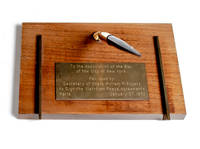
1973145329Paris January 27 1973. The original pen used by Secretary of State William P. Rogers to sign the Vietnam Peace Agreement ending the Vietnam War Paris 27 January 1973. Sheaffer fountain pen with 14 karat gold tip housed in an adjustable gold pen holder wooden base brass hardware including etched plaque. The plaque reads "To the Association of the Bar of the City of New York / Pen used by Secretary of State William P. Rogers to Sign the Viet-Nam Peace Agreements / Paris January 27 1973." During his tenure as Secretary of State under President Nixon William P. Rogers was involved in multiple matters of foreign policy including negotiations leading up to the signing of the Paris Peace Accords in 1973 after years of negotiations and secret talks. On 27 January 1973 representatives of the South Vietnamese communist forces North Vietnam South Vietnam and the United States gathered in Paris to sign the Paris Peace Accords and officially end the United States' involvement in the Vietnam War. The ceasefire took effect the next day on January 28 1973 and the last U.S. troops left Vietnam in March 1973. In very good condition. A unique piece of world history. In 1955 conflict between North and South Vietnam began. Fearing the spread of communism in Southeast Asia the United States entered the war in the early 1960s providing financial aid military advisors and eventually combat troops in support of South Vietnam. As the conflict escalated and anti-war sentiment grew talks about ending United States military intervention began in 1968 proceeding for years until an agreement in 1973. Fighting reignited almost immediately after US departure and continued for two more years before the Fall of Saigon and the end of the war. Eric Caren proprietor of the most significant private collection of historical documents in the United States notes that this item "represented the most tragic element of the 1960s inspiring the collective rebellion on university campuses and the combined rights for women and Blacks that led to the most positive changes in the most interesting decade. There is rare and there is unique this pen is obviously both." unknown