2 résultats
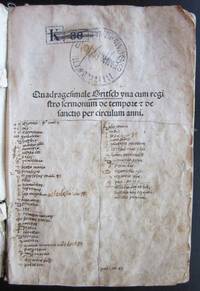
1495SAV133Venice: Lazarus de Suardis 1495. Paperback. Very Good . Venice: Lazarus de Suardis 21 March 1495. 8vo 173 x 116 mm. 284 leaves. Collation: 1-84 a-H in 34 gatherings of 4. Woodblock monogram printers device on colophon leaf. 48 lines double column Gothic type with printed guide letters. Stamp of the St. Charles Borromeo Seminary Library deaccessioned and two library shelfmarks pasted in Q83 and K30. Contemporary limp vellum; lightly soiled with some dampstains backstrip partly perished with partial ms. title and light edgewear; lower outer corner of l5 and D2 torn affecting a few words but in remarkable shape given its extensive use; cloth folding case. Title extensively inscribed in Latin with two columns of a subject index for sermons. The annotator was interested in indexing themes like heaven paradisus and hell infernus or Virgin Mary and Evangelists and easily being able to locate sermons for certain medieval virtues and vices or sins like luxury patience love anger and justice. Early biographical inscriptions on rear blank date to probably to the mid-sixteenth century and venetis gives this book a probable Venice home at one point. There are further scattered annotations notes and references to the index which reflect on sermons of interest. This book likely once belonged to preaching Franciscan monk from northern Italy. This monastic association is further evident with an ownership inscription in the lower margin of a1 Iste Liber est fratus dominici. Preaching was most closely associated with the Franciscans who also traveled extensively to reach audiences. The compact octavo format and lightweight wrappers of this volume would have made transportability much easier. Incunable edition of Johannes Gritschs register of medieval sermons called the Quadragesimale with an interesting period index of subjects probably added by a Franciscan scribe. Johannes Gritsch of Basel himself a Franciscan monk delivered his sermons in German and translated them in simple Latin ready for translation and adaptation to the vernacular. He used scriptural passages supporting texts from classics and fables and exemplary stories to prove moral grounds. Two main themes have been recognized to dominate the medieval sermon: the awareness of death and the need for contrition. Preachers would have relentlessly implored their audience to come to repentance. Brother Dominic the early modern friar who heavily used this book was no exception. He leaves evidence of his moral preaching interests throughout the book. The preliminary subject index is an invaluable glimpse into a composing preachers mindset at the dawn of the sixteenth century. This is the twenty-first edition of Gritschs Quadrigesimale which included fifty numbered sermons and additional sermons for specific church feasts; the first appeared in 1468 and a succession of printings appeared well into the sixteenth century. In fact a Lyons edition of the "Quadragesimale" was produced just one month later after this one in 1495 by Joannes Treschel. Printed sermon compilations were especially popular in monastic communities where volumes of model sermons would have enjoyed wide circulation. ISTC ig00506000. <br/><br/>Incunable edition of Johannes Gritschs register of medieval sermons called the Quadragesimale with an interesting period index of subjects probably added by a Franciscan scribe. Johannes Gritsch of Basel himself a Franciscan monk delivered his sermons in German and translated them in simple Latin ready for translation and adaptation to the vernacular. He used scriptural passages supporting texts from classics and fables and exemplary stories to prove moral grounds. Two main themes have been recognized to dominate the medieval sermon: the awareness of death and the need for contrition. Preachers would have relentlessly implored their audience to come to repentance. Brother Dominic the early modern friar who heavily used this book was no exception. He leaves evidence of his moral preaching interests throughout the book. The preliminary subject index is an invaluable glimpse into a composing preachers mindset at the dawn of the sixteenth century. This is the twenty-first edition of Gritschs Quadrigesimale which included fifty numbered sermons and additional sermons for specific church feasts; the first appeared in 1468 and a succession of printings appeared well into the sixteenth century. In fact a Lyons edition of the "Quadragesimale" was produced just one month later after this one in 1495 by Joannes Treschel. Printed sermon compilations were especially popular in monastic communities where volumes of model sermons would have enjoyed wide circulation. ISTC ig00506000. Lazarus de Suardis paperback books
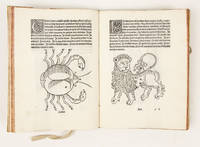
14823785Venice:: Erhard Ratdolt 14 October 1482. FIRST ILLUSTRATED EDITION of Hyginus' "Poeticon Astronomicon". Quarto:. 19 x 14 cm. Collation: a-f8 g10 a1 blank a2r dedication to M. Fabius Quintilianus a3r text g9r commendatory poem by Jacobus Sentinus g10r poem and verse colophon by Johannes Santritter g10v blank. 58 leaves. 31 lines. Types 3:91G text 7:92G heading on a2r 91 Gk a few words. Title on a2r printed in red 11- 7- 5- and 3-line white-on-black woodcut initials. 47 half-page woodcuts probably designed by Johannes Santritter of the constellation and planet figures. Illustrated with 47 half-page woodcuts of the constellations and the planets personified. The text of Hyginus was first published in an unillustrated edition in Ferrara in 1475. A very good copy in 18th c. stiff vellum. The initial blank is soiled and stained. Light stains to top of second leaf and leaves d1-2. Soiling to f1 and blank verso of final leaf with faded inscription. The "Poeticon Astronomicon" more correctly the "Astronomica" is an ancient Roman work on the constellations chiefly based on the work of the Greek scientist Eratosthenes 3rd c. B.C. The work was traditionally attributed to the first century writer C. Julius Hyginus the Director of the Palatine Library under the Emperor Augustus but the extant text is now believed based on stylistic analysis to be an abridgement of Hyginus' work made in the late second century. The fact that the order of the constellations in the poem follows precisely that of Ptolemy's "Almagest" further strengthens the case for a second century date. A remarkable aspect of Hyginus' text is his insistence on the use of astronomical models in particular a celestial globe as an aid to teaching or explaining astronomical principles and phenomena particularly for "discussions on the inter-relationships between the constellations and especially between the constellations and the celestial circles."Lippincott p.4Like Manilius' "Astronomicon" and Proclus' "Sphaera" a text that Hyginus sought to improve upon the "Poeticon Astronomicon" was of special interest to Renaissance astronomers who desired accurate editions of ancient texts from which they might derive a clear understanding of the astronomical knowledge of the Romans and Greeks thereby establishing a firm foundation upon which to undertake astronomy's "renewal".Hyginus' text which gives detailed accounts of the myths associated with each of the constellations served as source material for artists in the Middle Ages and Renaissance one of the most famous examples of the text's influence being the splendid ceiling painted around 1511 by Peruzzi for Agostino Chigi in the Sala di Galatea of the Villa Farnesina See Förster Farnesina-Studien 1880 p. 40.One of the chief interests in Ratdolt's editions of Hyginus 1482 and 1485 lies in the illustrations of the constellations the first such illustrations to appear in a printed book. These images derive from medieval manuscript and other artistic sources –though a specific source has not been identified. The figures appear in medieval European costume and in the words of Redgrave "There is a vigour and quaintness about these woodcuts which merit recognition." These images proved enormously influential serving as models for the representation of the constellations in stellar atlases and celestial maps for centuries to come."In many instances these medieval European often mythological constellation figures differed notably from those used by Ptolemy and his Islamic successors . Several stylistic conventions first published in Ratdolt's woodcuts endured for several centuries both in the numerous editions of Hyginus and in the various maps derived therefrom . Ratdolt's figures led directly to those of Jacob de Gheyn 1600 and through him to those of Johannes Bayer 1603." Warner The Sky ExploredThe Contents of Hyginus' "Poeticon Astronomicon"Hyginus tells us that he intends to give a better description of the celestial sphere than Aratus had done in his "De Sphaera". Book I gives a brief overview of the cosmography of the universe the celestial sphere the Earth and its zones and the Zodiac. Book II is a compendium of myths related to the constellations the five planets Mercury Venus Mars Saturn and Jupiter as well as the Sun Moon and Milky Way.Book III is Hyginus' star catalogue. It is in this book that Ratdolt's woodcuts appear. "Each constellation is described in the same order as in Book II in terms of its location relative to the surrounding constellations and the celestial circles with some indications being given as to the overall shape and disposition of the figure. In addition Hyginus provides a list of the positions of the stars relative to the figure itself describing the placements in terms of 'left' and 'right' and 'above' and 'below' in line with the tradition of descriptive star catalogues. Moreover he tends to list the stars from the top of a figure downwards or from the head to the feet regardless of the orientation of the figure within the sky. This is very different from the way the more mathematically-oriented astronomers such as Hipparchus or Ptolemy describe the constellations."Book IV returns to the subject of cosmology and to astronomical topics such as the position of the constellations on each celestial circle the unequal division of the night and day and the risings and settings of the constellations relative to the signs of the zodiac. He discusses the movements of the Sun and the Moon and the five planets and touches upon Pythagorian notions of the harmony of the spheres." Lippincott Kristen "The textual tradition of the De Astronomia of Hyginus" pp. 10-11 BMC V 286; BSB-Ink H-459; CIBN H-334; Essling 285; Goff H-560; HC 9062; Hind II p. 462; IGI 4959; Klebs 527.2; Pollard/Perrins 31; Redgrave 30; Sander 3472 Erhard Ratdolt, 14 October, books