Medieval Manuscript 15th CenturyBiblio.com
15 résultats
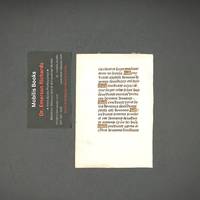
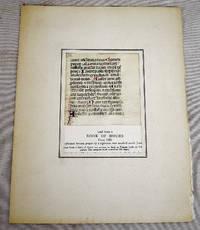
14502308180006Paris 1450. First Edition. Very Good. Vellum. Two sided with 15 lines on each with 13 blue and red uncials. Losely mounted on custom printed card stock. Includes a separately printed description by James J. Rudisill printer Lancaster PA 1949. Rudisill was a commercial printer in Lancaster who had an extensive illuminated manuscript collection and pages from the Gutenberg Bible. The description discusses the history of books of hours. [Paris?] hardcover
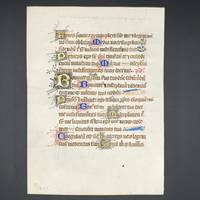
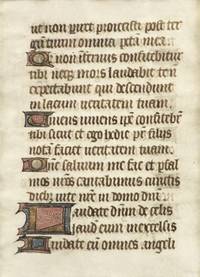
145013211450. Very Good. Leaf from Book of Hours late 14th or early 15th century likely FranceSingle leaf on parchment 140 x 90 mm; textblock 75 x 50 mm 16 lines in Latin of Gothic bâtarde script from Book of hours. 9 single-line intials in purple with white decorations on gilt background colored with dark rose gesso outlined in black. Abbreviations for antiphoner and psalm in rubricated letters. 20th century penciled numbers in bottom margin of recto 48486 and number 2 in top margin. Overall VERY GOOD condition. unknown
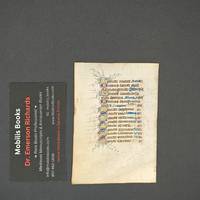
145027036Paris Circa 1450. 15 lines of brown/black inked text with 10 blue and red highlighted gold uncials and with stylized registers and other decoration in blue red and gilt ruled in red. Single sheet 160 by 118mm double-sided on very thin fine vellum. The leaf is in fine condition well preserved and very attractive. hardcover
145013221450. Near Fine. Single leaf of Book of Hours 15th century likely Low Countries. Leaf on parchment 110 x 75 mm; textblock 60 x 40 mm. 16 lines of Latin in Gothic textura libraria. Single line intials in alternating blue and gilt with ornate penwork decorations in alternating red and blue. Pen decorations appear to have been trimmed by being tucked in gutter. Line fillers in gilt and blue terminating with ora pro nobis abbreviations. Standard list of saints with no significant local/regional deviations. Overall VERY GOOD condition. unknown
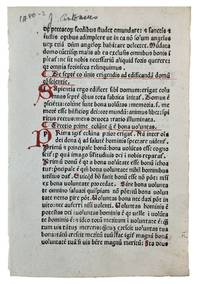
145034789Probably Milan Circa 1450. Written in Latin 19 lines in a fine hand the calligraphy in black and red augmented with a multi-line "B" in blue and decorative accents in red. Single sheet 20 x 13.8 cm double-sided on vellum and tipped into a cream and black mounting. 2 pp. A fine specimen visually very attractive. A FINE VELLUM MANUSCRIPT LEAF. The breviary of Rites in the Catholic Church is a liturgical book it contains public or canonical prayers hymns the Psalms readings and notations for everyday use especially by bishops priests and deacons in the Divine Office.<br> The canonical hours of the Breviary owe their remote origin to the Old Covenant when God commanded the Aaronic priests to offer morning and evening sacrifices. Other inspiration may have come from David's words in the Psalms "Seven times a day I praise you" Ps. 119:164 as well as "the just man meditates on the law day and night" Ps. 1:2. <br> In the early days of Christian worship the Sacred Scriptures furnished all that was thought necessary containing as it did the books from which the lessons were read and the psalms that were recited. hardcover
145034790Probably Milan Circa 1450. Written in Latin citing one of the Psalms. 19 lines in a fine hand the calligraphy in black and red and gold augmented with a multi-line "B" in blue and decorative accents in red and gold. Single sheet 19.8 x 13.5 cm double-sided on vellum and tipped into a cream and black mounting. 2 pp. A fine specimen visually very attractive. A FINE VELLUM MANUSCRIPT LEAF. The breviary of Rites in the Catholic Church is a liturgical book it contains public or canonical prayers hymns the Psalms readings and notations for everyday use especially by bishops priests and deacons in the Divine Office.<br> The canonical hours of the Breviary owe their remote origin to the Old Covenant when God commanded the Aaronic priests to offer morning and evening sacrifices. Other inspiration may have come from David's words in the Psalms "Seven times a day I praise you" Ps. 119:164 as well as "the just man meditates on the law day and night" Ps. 1:2. <br> In the early days of Christian worship the Sacred Scriptures furnished all that was thought necessary containing as it did the books from which the lessons were read and the psalms that were recited. hardcover
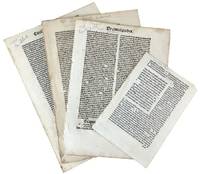
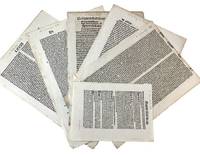
1483169411N: N 1483. 1 1483 Ulrich Gering Paris. A leaf from Nicolaus de Lyra. Postilla super psalterium. 39 lines of commentary round text roman letter. 19.7 cm. x 13.5 cm. 2 1489 Printer of the 1483 Jordanus de Quedlineburg Georg Husner Strasbourg. A leaf from Vincentius Ferrerius. Sermones de tempore et de sanctis. 53 lines and headline double column gothic letter. 29.2 cm. x 20.6 cm. 3 1494 Martin Flach the Elder Strasbourg. A leaf from Jean Gerson. Opera. 53 lines and headline double column gothic letter. 29.5 cm. x 20.7cm. 4 1496 Printer of the 1483 Jordanus de Quedlinburg George Husner Strasbourg. A leaf from Helias Regnier. Casus longi Sexti et Clementinarum. 52 lines and headline double column. 27.5 cm. x 20.4 cm. 1483-1496. Together:. N unknown
145013201450. Very Good. Leaf from Psalter likely Low Countries early 15th century. Single leaf on parchment 210 x 150 mm; text block 130 x 100mm 16 lines in Latin of Gothic textualis in somewhat browned ink. Employs decorative hairlines crossed tironian et bifurcations on ascenders Two 2-line initials in blue with red penwork decoration and gold with dark blue penwork decoration. Twenty single-line initials in alternating shell gold with blue penwork decoration and dark blue with red penwork decoration. Six line fillers in blue and shell gold. Rubricated psalm-section beginnings. Multiple corrections from a second still- contemporary campaign in darker black ink including signe-de-renvoi palimsests/strikethrough and interlinear insertion. The scribe of this mansucript produced a very technically proficient product-- the letters have decorative hairlines thorns bifurcations and feet. Each line begins with an illuminated initial richly decorated by ornate penstrokes. Every indication that this manuscript was a high-end production. However another hand in a darker ink with a less formal script has had to come through and make multiple significant corrections. On the third line of the recto we see the use of a signe-de-renvoi similar to our modern footnotes-- a symbol next to the line corresponds with a in the top margin adding in an entire line of text that the original scribe skipped. Throughout we see the use of 'carrot' symbols inserting a word or two that our scribe omitted between the lines-- this correcting hand has gone into the margins on the verso to add possessive pronouns. We also see three examples of palimsets the scraping off of words to create blank parchment on the verso two of which the corrector has emphatically struck through to ensure the correction is registered. It's impossible to know if this single leaf happens to be where an otherwise competent scribe lost focus or if it represents an illiterate scribe essentially blind-copying to the best of their ability without comprehension. Either way it's a remarkable moment of human error demonstrating the difficulty of producing a handwritten work of several hundred pages and the indvidual labouring behind the scenes. unknown
1483184819N: N 1483. 1 1483 J. Koelhoff the Elder Cologne. A leaf from Jean Gerson. Opera. 36-39 lines double column gothic letter. 28.7 cm. x 21.3 cm. 2 1485 J. Otmar Reutlingen. A leaf from Jacobus de Voragine. Legenda Aurea. 45 lines and headline double column gothic letter. 28.5 cm. x 20.2 cm. 3 1491 A. Koberger Nuremberg. A leaf from Bonaventura. Quaestiones super IV libros Sententiarum Petri Lombardi. 64 lines of commentary round text and headline double column gothic letter. 30 cm. x 21.2 cm. 4 1494 A. Koberger Nuremberg. A leaf from Johannes Herolt. Sermones de Tempore et de Sanctis. 62 lines and headline double column gothic letter. 30.2 cm. x 21.4 cm. 5 1496 H. Quentell Cologne. A leaf from Geradus de Harderwyck. Epitomata seu reparationes totius philosophiae naturalis Aristotelis. 46 lines and headline gothic letter. 19.1 cm. x 13.3 cm. 6 1496 A. Koberger Nuremberg. A leaf from Alexander Carpentarius. Destructorium Vitiorum. 62 lines and headline double column gothic letter. 27.2 cm. cropped x 19.7 cm. 1483-1496. Together:. N unknown
145029503Most probably Paris Circa 1450. A leaf of two pages with 15 lines per page written in brown ink with opening initials of ten lines and other decorations in red and blue and beautifully burnished with bright gilt one two line initial also heavily burnished in gilt. 125 x 90 mm approximate now handsomely presented in a very large and attractive museum quality frame the mounting designed so that both sides of the leaf may be viewed. The decoratively carved frame is of gilded red wood with ebony trim glazed with archival quality glass in all measuring 60 by 42 cm. A very beautiful example in fine condition the vellum clean the lettering dark and strong the painted and gilt initials bright and finely done. hardcover
1476184820N: N 1476. 1 1476 H. Liechtenstein Levilapis Vicenza. A leaf from Virgil. L`Eneida in prosa volgare ridotta. 23 lines roman letter. 18.1 cm. x 13.5 cm. 2 1477 H. Lichtenstein Treviso for M. Manzolus. A leaf from Tortellius. Commentariorum Grammaticorum de Orthographia. 44 lines roman letter. 27.9 cm. x 20.5 cm. 3 1479-1480 Don Ippolito Florence for Giovanni di Nato. A leaf from Antoninus Confessionale. 23 lines roman letter. 20.5 cm x 14 cm. 4 1480 L. Pachel and U. Scinzenzeler Milan. A leaf from Antoninus. Confessionale. 28 lines roman letter. 20.9 cm. x 12.5 cm. 5 1480-1482 J. Antonius and B. de Honate Milan. A leaf from Meditationes etc. S. Bernardi edited by M. Venia. 30 lines gothic letter initials in red. 16.8 cm. x 11.2 cm. 6 1480 B. Celerius Treviso. A leaf from Dionysius. Antiquitates Romanae translated by Lapus Biragus. 37 lines roman letter. 27.3 cm. x 20 cm. 7 1481 A. de Mazalibus and P. Odoardus Reggio Emilia. A leaf from Tibullus Catullus and Propertius. Elegiae Carmina Elegiae. 42 lines roman letter. 27.6 cm. x 18.5 cm. 8 1486 J. Suigus de Suico Chivasso. A leaf from Angelus de Clavasio. Summa de Casibus Conscientiae. 55 lines double column gothic letter. 20.7 cm.cropped x 14.7 cm. 9 1492 Bonetus Locatellus Venice for Octavianus Scotus. A leaf from Silius Italicus. Punica cum commentariis Petri Marsi. 61 lines commentary surrounding the text. 31 cm. x 20.5 cm. 10 1493 Benedictus Hectoris Bologna. A leaf from Suetonius. Vitae Caesarum with the commentary of P. Beroaldus. 56 lines of commentary round text and headline roman letter. 30.5 cm. x 20.5 cm. 1476-1493. Together:. N unknown
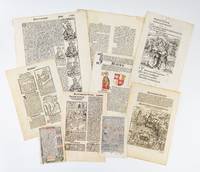
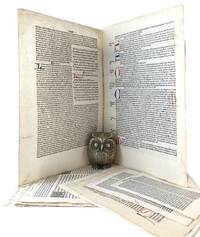
1480ST12778-08481480-1537. Largest leaf measures 428 x 307 mm. 16 3/4 x 12 1/8". <br/> 13 OF THE 15 LEAVES WITH WOODCUT OR METALCUT ILLUSTRATIONS several being a half-page or larger and one with contemporary coloring most leaves also with woodcut or metalcut initials. A couple leaves with some light dampstaining a few others with light toning thumbing and/or the occasional stain repair or other minor issue but in general excellent specimens in pleasing condition.<br/> <br/> These early printing packets present an excellent opportunity for libraries teachers and students as well as private collectors to develop or expand their teaching or personal collections and at a modest cost. Each packet includes four incunabular leaves six post-incunable leaves and five 16th century leaves printed after 1520--all hand-picked to demonstrate a variety of genres formats and countries of origin. Most of the leaves here feature woodcut or metalcut illustrations two of which can be attributed to the prominent engravers Urs Graf and Albrecht Dürer. The illustrations depict a wide variety of scenes including battles biblical episodes saints royalty and natural history. The packets are comprised of leaves from the following works listed in chronological order.<br /> <br /> 1 BIBLE IN LATIN. Ulm: Johann Zainer 1480. From the press of the first printer in Ulm the first Bible to have notices by Menardus Monachus at the beginning of each chapter briefly summarizing the contents. 2 CHRONICLE. Chronecken der Sassen. Mainz: Peter Schoeffer 6 March 1492. 3 SCHEDEL HARTMANN. Liber Chronicarum. Nuremberg: Anton Koberger 1493. 4 HORTUS SANITATIS. Strassburg: Johann Prüss OR Cologne: Heinrich Quentell 1499 or possibly 1507. 5 A BOOK OF HOURS IN LATIN PRINTED ON VELLUM. Paris: Thielman Kerver 1507. With initials finished by hand. 6 GUILELMUS PARISIENSIS. Postilla Guillermi Super Epistolas et Evangelia. Basel: Michael Furter 1513. With woodcuts attributed to Urs Graf. 7 CHRONICLES: FRANCE. Le Premier -Quatrième Vollume de la Mer des Hystoires & Croniques de France. Paris: Gaillot Du Pré; Michel le Noir 1517-18. 8 MAXIMILIAN I. Die Geuerlicheiten und Eins Teils der Geschichten des . . . Helds und Ritters Tewrdannckhs. Augsburg: Johann Schönsperger 1519. 9 SHIP OF FOOLS - COMMENTARY. Des Hochwirdigen Doctor Keiserspergs Narenschiff. Strassburg: Johanne Grieninger 1520. Using the original woodcut blocks from the First Edition of Sebastian Brant's "Das Narrenschiff'" 1494 many of which are attributed to Dürer. 10 BIBLE IN LATIN. Biblia cum Concordantijs. Lyon : Jacob Sacon for Anton Koberger ca. 1520. From one of many similar editions printed from 1512 to the early 1520s. 11 JACOBUS DE VORAGINE. Golden Legend. Westminster: Wynkyn de Worde 1527. 12 A BOOK OF HOURS IN LATIN PRINTED ON PAPER. Venice: Luca-Antonia Giunta 1532. 13 LIVIUS TITUS. Römische Historien. Mainz Juonem Johann Schoeffer 1533. 14 CHRONICLE. FORESTI GIACOMO FILIPPO. Supplementum Supplementi Delle Chroniche del Venerando Padre Frate Jacobo Philippo. Venice : Bernardino Bindoni 1535. 15 BIBLE IN CZECH. Biblij Czeska. Prague: Pawel Severýn z Kapí Hory 1537. <br /> <br /> Provenance note: These specimens were acquired by us as part of a very large group of leaves assembled by a collector who purchased widely and frequently over the course of 25 years; he did not take apart books to harvest individual leaves. unknown
1476179736N: N 1476. kerning21 1476 J. de Colonia & J. Mathen. Antoninus. Summa Confessionum. Printed in double columns with red initial letters. 21 cm. x 15.3 cm. 2 1478 J. de Colonia & J. Manthen. Lactantius. Opera Roman letter. 29.3 cm. x 20 cm. 3 1481 Michael Manzolus. Horatius Flaccus. Opera. Roman letter. Commentary round the text. 30 cm. x 21 cm. 4 1489 B. de Zanis. Pliny. Historia Naturalis. Roman letter double columns. 31 cm. x 25 cm. 5 1489-1491 Peregrinus de Pasqualibus. Mesue. Opera. Double columns with coloured initial letters. 30 cm. x 21.3 cm. 6 1491 D. Bertochus. Augustinus. Opuscula Plurima. Printed in double columns. 22.3 cm. x 16.5 cm. 7 1491 Guilelmus Anima Mia Tridinensis. Valerius Maximi Factorum ac Dictorum. 64 lines of commentary surrounding the text. Fine capital letters. 29.7 cm. x 20.5 cm. 8 1491 Peregrinus de Pasqualibus Bononiensis. Augustinus. De Academicis. Printed in double columns. 22.3 cm. x 16.5 cm. 9 1492 B. de Choris. de Cremona. Seneca. Opera Philosophica. Roman letter. 30.3 cm. x 21 cm. 10 1493 J. Tacuinus Tridinensis. Silius Italicus. Punica. Double columns initial letters in red. 29.3 cm. x 20.7 cm. 11 1493 Damianus de Mediolano. Suetonius. Vitae Caesarum. Roman letter with commentary round the text. 28.2 cm. x 19.3 cm. 12 1493 Simon Bevilaqua. Tibullus. Elegiae. Roman letter commentary round text coloured initial letters. 32 cm. x 21.4 cm. 13 1493 J. Rubeus Vercellensis. Justinus. Epitome. Roman letters coloured initials. 31.2 cm. x 21.5 cm. 14 1493/1494 Simon Bevilaqua. Lucanus. Pharsalia. Roman letter with commentary round text. 30.2 cm. x 21.4 cm. 15 1495 Simon Bevilaqua. Opuscula. Printed in double columns. 14.7 cm. x 10.3 cm. 16 1496 G. Arrivabenus for B. Rusina & B. Fontana. Caracciolus. Sermones. Double columns gothic letter. 18.4 cm. x 12.5 cm. 17 1497 J. & G. de Gregoriis de Forlivio. Hieronymus. Commentaria in Bibliam. Roman and gothic letter. 32.3 cm. x 21.7 cm. 1476-1487. Together. N unknown
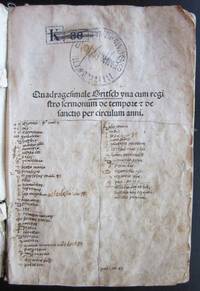
1495SAV133Venice: Lazarus de Suardis 1495. Paperback. Very Good . Venice: Lazarus de Suardis 21 March 1495. 8vo 173 x 116 mm. 284 leaves. Collation: 1-84 a-H in 34 gatherings of 4. Woodblock monogram printers device on colophon leaf. 48 lines double column Gothic type with printed guide letters. Stamp of the St. Charles Borromeo Seminary Library deaccessioned and two library shelfmarks pasted in Q83 and K30. Contemporary limp vellum; lightly soiled with some dampstains backstrip partly perished with partial ms. title and light edgewear; lower outer corner of l5 and D2 torn affecting a few words but in remarkable shape given its extensive use; cloth folding case. Title extensively inscribed in Latin with two columns of a subject index for sermons. The annotator was interested in indexing themes like heaven paradisus and hell infernus or Virgin Mary and Evangelists and easily being able to locate sermons for certain medieval virtues and vices or sins like luxury patience love anger and justice. Early biographical inscriptions on rear blank date to probably to the mid-sixteenth century and venetis gives this book a probable Venice home at one point. There are further scattered annotations notes and references to the index which reflect on sermons of interest. This book likely once belonged to preaching Franciscan monk from northern Italy. This monastic association is further evident with an ownership inscription in the lower margin of a1 Iste Liber est fratus dominici. Preaching was most closely associated with the Franciscans who also traveled extensively to reach audiences. The compact octavo format and lightweight wrappers of this volume would have made transportability much easier. Incunable edition of Johannes Gritschs register of medieval sermons called the Quadragesimale with an interesting period index of subjects probably added by a Franciscan scribe. Johannes Gritsch of Basel himself a Franciscan monk delivered his sermons in German and translated them in simple Latin ready for translation and adaptation to the vernacular. He used scriptural passages supporting texts from classics and fables and exemplary stories to prove moral grounds. Two main themes have been recognized to dominate the medieval sermon: the awareness of death and the need for contrition. Preachers would have relentlessly implored their audience to come to repentance. Brother Dominic the early modern friar who heavily used this book was no exception. He leaves evidence of his moral preaching interests throughout the book. The preliminary subject index is an invaluable glimpse into a composing preachers mindset at the dawn of the sixteenth century. This is the twenty-first edition of Gritschs Quadrigesimale which included fifty numbered sermons and additional sermons for specific church feasts; the first appeared in 1468 and a succession of printings appeared well into the sixteenth century. In fact a Lyons edition of the "Quadragesimale" was produced just one month later after this one in 1495 by Joannes Treschel. Printed sermon compilations were especially popular in monastic communities where volumes of model sermons would have enjoyed wide circulation. ISTC ig00506000. <br/><br/>Incunable edition of Johannes Gritschs register of medieval sermons called the Quadragesimale with an interesting period index of subjects probably added by a Franciscan scribe. Johannes Gritsch of Basel himself a Franciscan monk delivered his sermons in German and translated them in simple Latin ready for translation and adaptation to the vernacular. He used scriptural passages supporting texts from classics and fables and exemplary stories to prove moral grounds. Two main themes have been recognized to dominate the medieval sermon: the awareness of death and the need for contrition. Preachers would have relentlessly implored their audience to come to repentance. Brother Dominic the early modern friar who heavily used this book was no exception. He leaves evidence of his moral preaching interests throughout the book. The preliminary subject index is an invaluable glimpse into a composing preachers mindset at the dawn of the sixteenth century. This is the twenty-first edition of Gritschs Quadrigesimale which included fifty numbered sermons and additional sermons for specific church feasts; the first appeared in 1468 and a succession of printings appeared well into the sixteenth century. In fact a Lyons edition of the "Quadragesimale" was produced just one month later after this one in 1495 by Joannes Treschel. Printed sermon compilations were especially popular in monastic communities where volumes of model sermons would have enjoyed wide circulation. ISTC ig00506000. Lazarus de Suardis paperback
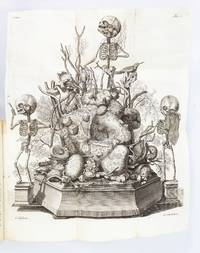
1417ST20185Amsterdam: Joannes Wolters then Jansson-Waesberg 1701-14; 1715-16. FIRST EDITIONS. 224 x 168 mm. 8 3/4 x 6 1/2". 4 p.l. 62 pp. 1 leaf errata; 2 p.l. 98 pp.; 2 p.l. 70 pp.; 1 p.l. 55 pp.; 1 p.l. 54 pp. 2 p.l. 30 pp. 1 leaf 92 pp. 2 leaves 44 pp. 4 leaves 68 pp. 8 leaves 72 pp. 1 leaf errata 12 leaves 78 pp. 10 parts in one volume. <br/> Contemporary stiff vellum smooth spine with ink titling yapp edges. WITH 42 ENGRAVED PLATES as called for by Norman six of these folding. Text in Latin and Dutch. Blake 395; Garrison-Morton 389; Heirs of Hippocrates 627; Jeremy Norman's HistoryofMedicine.com 623; Norman 1875. Vellum lightly soiled front pastedown slightly defective but the original unsophisticated binding in perfect order. Final plate with small hole due to adhesion to facing page minor damage done to image a few other trivial imperfections a couple of negligible marginal tears a faint ink stain across the top inch of text a tiny burn hole but AN UNUSUALLY BRIGHT CLEAN COPY INTERNALLY with all the important plates in exceptionally fine condition.<br/> <br/> Scarce when seen bound from its original 10 parts as here this work describes the memorable "Anatomical Treasure" of Dutch physician and anatomist Frederick Ruysch being illustrated by surrealistic charmingly macabre engravings depicting "fantastic dream-like concoctions constructed of human anatomical parts." History of Medicine Described by Norman as "probably the most original artist in the history of anatomical preparations" Ruysch 1638-1731 "enjoyed making up elaborate three-dimensional emblems of mortality from his specimens" which included fetal skeletons and preserved organs. Heirs to Hippocrates says that "the engraved illustrations deserve special mention for their whimsical almost surrealistic quality: quaintly posed skeletons surrounded by stuffed monsters strange reptiles dried plants and sea creatures." According to Norman "Ruysch's methods allowed him to prepare organs such as the liver and kidneys and keep entire corpses for years. He used a mixture of talc white wax and cinnabar for injecting vessels and an embalming fluid of alcohol made from wine or corn with black pepper added. Using his injection methods Ruysch was the first to demonstrate the occurrence of blood vessels in almost all tissues of the human body thereby destroying the Galenic belief that certain areas of the body had no vascular supply. He was also the first to show that blood vessels display diverse organ-specific patterns." Ruysch's dioramas were displayed in his home museum in Amsterdam which was open to the public; visitors included Tsar Peter the Great of Russia who purchased the collection in 1717 for the foundation of Russia's first public museum the St. Petersburg Kunstkammer. Unfortunately the Russian climate was not kind to the fragile constructions and all deteriorated over time; the dramatic plates here are the best record we have of this unique collection. Joannes Wolters, then Jansson-Waesberg unknown