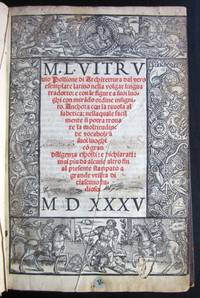
M. L. Vitrvuio Pollione Di architettura dal vero esemplare latino nella volgar lingua tradotto: e con le figure a suoi luoghi con mirãdo ordine insignito. Anchora con la tauola alfabetica: nellaquale facilmente si potra trouare la moltitudine de vocaboli a suoi luoghi cõ gran diligenza esposti : e dichiarati: mai piu da alcuno altro fin al presente stampato a grande vtilita di ciascuno studioso
1535SAV123Venice: Nicolo de Aristotele detto Zoppino 1535. Hardcover. Very Good. Folio 295 x 190mm. 12 I-CX 110ff. Signatures: AA6-BB6; A8-N8; O6. Title printed in red and black with woodcut block border depicting strewn armor and dueling knights with wreathed portrait of Cicero at top and plaques with monogram initials of Roman Emperors Fabius Maximus Julius Caesar and Alexander Magnus. 136 woodcut in-text illustrations depicting lives of primitive humans the famous Vitruvian Man on p. XXII constellations rules for perspective and other mathematical figures and diagrams of architecture. Woodcut historiated chapter initials throughout of repeating portraits. Translated by Benedetto Giovio 1471-1545. Edited by Francesco Lutio Durantino. 19th-century calf with decorative stamps spine stamped in gilt TRAT DE ARCH endpapers renewed; loose in binding some margins trimmed close some light worming at least six early cancelled inscriptions on title leaf CX with significant excision otherwise an crisp and clean text block with wonderful woodcut impressions. 19th-century inscription on fly-leaf Famoza Archi-tectura. Another 19th-century inscription on front flyleaf Presented to the Mercantile Library Association of New York by Philip A Reach .Consul/ Lisbon Jan. 7 1848. Sold in 1958 on removal of Architecture Books from the Library pencil note. Rare illustrated Durantino edition of Vitruvius printed in Venice by Zoppino in 1535. This Vitruvius work was first printed in 1521 for Como. As it gained notoriety another edition in the vernacular Italian was prepared by Giovanni Antonio and Pietro de Nicolino da Sabbio in 1524. It incorporated woodcuts from a 1511 Latin edition produced by Giovanni Giocondo in Venice Tacuino. This Zoppino printing had a newly redesigned title-leaf with an elaborate woodcut border of chivalric battle scenes between Augustus Caesar Julius Caesar and Alexander the Great. The 136 in-text woodcuts are an all too interesting miscellany of late-medieval life nature and architecture and are characteristic of Vitruvian ideals in regards to proportion ornament language space place and beauty. The famous figure of Symmetria Vitruvian Man is present on p. XXII. Both the 1524 and 1535 editions were widely read by an Italian public. Vitruvian principles deeply influenced early Renaissance artists thinkers and architects who believed they were rediscovering an ancient discipline which would be the foundation of their culture. <br/><br/>Rare illustrated Durantino edition of Vitruvius printed in Venice by Zoppino in 1535. This Vitruvius work was first printed in 1521 for Como. As it gained notoriety another edition in the vernacular Italian was prepared by Giovanni Antonio and Pietro de Nicolino da Sabbio in 1524. It incorporated woodcuts from a 1511 Latin edition produced by Giovanni Giocondo in Venice Tacuino. This Zoppino printing had a newly redesigned title-leaf with an elaborate woodcut border of chivalric battle scenes between Augustus Caesar Julius Caesar and Alexander the Great. The 136 in-text woodcuts are an all too interesting miscellany of late-medieval life nature and architecture and are characteristic of Vitruvian ideals in regards to proportion ornament language space place and beauty. The famous figure of Symmetria Vitruvian Man is present on p. XXII. Both the 1524 and 1535 editions were widely read by an Italian public. Vitruvian principles deeply influenced early Renaissance artists thinkers and architects who believed they were rediscovering an ancient discipline which would be the foundation of their culture. Nicolo de Aristotele detto Zoppino hardcover books
Sanctuary Books · États-Unis6 000,00 $US≈ 5 076,60 €
