135 résultats
1744D4448France 1744. Hardcover. Very Good. Manuscript book on paper in French. c.1744. 8vo 166 x 106mm. 8 355pp. written in brown ink in a clear humanist script with some calligraphic aspects between framed pages in a single column of approximately 28 lines headings in Roman majuscules. With 89 full-page diagrams and technical illustrations of sundial construction and usage and other supporting images three are on plates and two of which are folding at rear. Contemporary mottled calf spine gilt in compartments labeled Gnomonique on gilt red morocco lettering piece marbled endpapers & edges; edges uniformly toned occasional stains; expertly rebacked preserving the original spine somewhat worn. Full contents listed on first 6 pages for this expertly executed and comprehensive compendium on the sundial. The objective of this manual is to enable the 18th century audience to understand the operating principle of sundials by describing the construction and manipulation of different forms of sundials including the planet-sundial moon-clock celestial houses-clock polar-clock ancient Babylonian and Jewish clocks as well as the construction of quadrants and astronomical tables. The suns position in the sky has always been an obvious means to keep track of time. The use of shadows of sticks cast by the sun were a natural means of indicating the time of day by the direction of the shadow and the time of year by its length. Although town squares began constructing clocks beginning somewhere in the 14th century sundials remained in the picture well into the 18th century. Mechanical clocks were expensive and could be found only in the most noble of homes. They were also more of a curiosity at first; most people still used their sundials or just estimated the time of day by the height of the sun in the sky. In 1777 when the French General Lafayette wanted to express his admiration for his ally and friend General George Washington during the American Revolution he chose a silver Explorer sundial as his gift. But by the close of the 18th century clocks and watches began to supersede sundials. They had one huge advantage- they worked all day long and were not dependent on weather. However they were also notoriously unreliable- telling time only approximately within an hour and needing to be reset frequently of course with the help of a sundial. Although the work of this study is anonymous an ownership entry at the foot of the title helps to date the work: Hic est Thorridon Rectoris Laurentii Moussault 1744. This wide-ranging study of the sundial appears at a time when the mechanical clock was on its way into popular fashion. A unique scholarly work that may well be one of the last close studies of such an ancient and important time-telling tool. <br/><br/> hardcover
1710ST19567-052Cantabrigiae Cambridge: Cornelius Crownfield 1710. THE DEDICATION COPY ONE OF 150 ON LARGE PAPER per Mackenzie. 248 x 192 mm. 9 3/4 x 7 1/2". 4 p.l. xxiv 532 2 318 283-304 pp. 84 leaves.Edited by Rev. Joseph Wasse. <br/> FINE CONTEMPORARY RED MOROCCO GILT covers panelled with gilt fillets accented with fleuron acorn and scallop tools raised bands spine compartments densely gilt with similar tools red morocco label marbled endpapers all edges gilt probably with some very facile repairs to top and bottom of joints and spine. Front pastedown with the armorial bookplate of the dedicatee Henry Grey Duke of Kent dated 1713 and with the armorial ex-libris of Robert Offley Ashburton Crewe-Milnes Marquess of Crewe; front free endpaper with engraved armorial bookplate of Thomas Philip Earl de Grey see below for all. Dibdin II 385; Mackenzie "The Cambridge University Press 1696-1712" I 273-76. ◆Front joint with thin crack at head and tail covers with darkish splotches obvious but somehow not overly offending with antique morocco like this other very minor signs of use but the binding still extremely pleasing as a grand specimen for an important dedicatee. A MOST ATTRACTIVE COPY INTERNALLY especially clean and fresh with only negligible imperfections.<br/> <br/> This is the stately dedication copy of Wasse's monumental edition of Sallust in its original handsome unrestored binding. Described by Dibdin as "an excellent edition . . . the merits of which have long been acknowledged by the literary world" our version was prepared by Wasse after consulting nearly 80 manuscripts including "some very ancient editions." A huge undertaking it spent five years in the press. Oxford Antiquary Thomas Hearne mentioned it in his "Remarks" amazed that "Mr. Wasse . . . has so swell'd his Salust sic . . . with Notes" that "his Index will be upwards of 20 sheets"; in fact the Index consumes 84 leaves 21 quires. The text of the present volume contains the only two extant historical works of Sallust 86-34 B.C. which are his history of the conspiracy of Catiline against the senate in the year Cicero was consul and his history of the Roman war against the Numidian Algerian chieftain Jugurtha brought to its conclusion by the great soldier and populist politician Marius. As a stylist Sallust has enjoyed great fame for his artistic and epigrammatic speeches with their vividly delineated characters. A fellow of Queen's College Cambridge Joseph Wasse 1672-1738 served as chaplain to the Marquess later Duke of Kent Henry Grey 1671-1740 to whom he dedicated this work. The handsome binding is of very high quality and is decorated in the Cambridge style by an unknown binder of that city. Grey was a courtier who held a number of prominent positions: under Queen Anne he served as Lord Chamberlain of the Household and Knight of the Garter and as one of the Lords Justices Regents of the Realm upon her death; under George I he was Lord of the Bedchamber Lord Steward of the Household and Lord Keeper of the Privy Seal. Our volume was passed down in his family through the line of his granddaughter Jemima Campbell Marchioness Grey to Thomas Philip de Grey 2nd Earl de Grey 1781-1859 an amateur architect who rebuilt the family seat Wrest Park in Bedfordshire. He became the first president of the Royal Institute of British Architects. It was later in the 24000-volume library of the politician Robert Crewe-Milnes 1858-1945 Marquess of Crewe. Cornelius Crownfield unknown
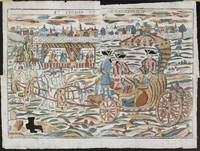
178009496Orléans: P.-F. Perdoux 1780. Beneath the title band lies the walled city of Soissons fronted by a broad field. In the center left shoemakers and cobblers serve customers and make and repair shoes in the shelter of a temporary stall. An elaborate outsized carriage dominates the scene. On the left an angel leads the team of six white horses toward the town gate. In the carriage a well dressed coachmen drives the beasts which are caparisoned with the tools of the shoemaker's and cobbler's trades. With a Cross of the Holy Spirit pinned to each of their chests Saints Crispin and Crispinian richly garbed sit behind unruffled in their journey. The carriage door is emblazoned with shoemakers' and cobblers' tools. In the lower left of the scene more tools overflow a wooden box and just to the right a pair of high boots and a half-dozen lasts lie scattered on the ground. Famous throughout northern Europe in the Middle Ages Crispin and Crispinian are known today from the king's great speech before the Battle of Agincourt in Shakespeare's Henry the Fifth act IV scene 3. Probably produced for their feast day - 25 October - to be hung in merchants' stalls and shops and fixed to tavern walls this wonderfully exuberant monumental print celebrates THE PATRON SAINTS OF SHOEMAKERS AND COBBLERS and of Soissons where they made shoes at night having preached all day. These sheets were sold to the tradesmen across France who were protected by the saints and broadly to the inhabitants of Soissons. Orléans was the most important center for the production and distribution of popular imagery in 18th-century France and Perdoux a dominant force not only in cheap prints but in decorated papers many used for book wrappers. It is unlikely that another example of this four-sheet print survives and certainly not in such superb condition four neat blank marginal repairs on the verso one just into the image. [P.-F.] Perdoux unknown
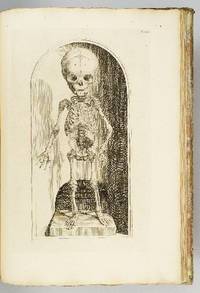
1739ST12883Leyden: Johann Arnold Langerak 1739. First Edition in Latin. 540 x 380 mm. 21 1/4 x 15". 70 leaves of text.Translated by William Dundass. <br/> Original red quarter vellum over marbled boards raised bands UNTRIMMED EDGES. Engraved printer's device on title large decorative initials and tailpieces EXTRA ENGRAVED TITLE AND 114 STRIKING PLATES OF ANATOMICAL FIGURES three folding. Wellcome II 401; Heirs of Hippocrates 468; Choulant-Frank pp. 252-3; Russell 213. ◆Vellum on spine rather worn with three one-and-one-half-inch pieces broken away revealing structure underneath paper boards quite chafed other minor problems externally but an entirely solid unrestored binding. A couple of plates with short closed marginal tears one folding plate with one-inch closed tear into image no loss untrimmed edges a little browned and brittle with isolated small chips occasional minor foxing or insignificant stains three plates lightly browned but still AN UNUSUALLY ATTRACTIVE COPY INTERNALLY with the broadest of margins with especially clean and fresh leaves and with rich impressions of the plates.<br/> <br/> With plates of notable visual impressiveness this was the finest anatomy book in England during the first half of the 18th century; it also was largely a plagiarism borrowing most of its engraved content from a work by the Dutch physician Govert Bidloo published in 1685. Bidloo's work was the first large-scale anatomical atlas to appear after Vesalius' epoch-making "De Humani Corporis Fabrica" and the plates which are highly praised by Norman and Garrison-Morton are characterized by startlingly detailed life-size depictions of the human body both adult and infant with figures flayed to reveal muscles opened to show organs and unfleshed to exhibit bones. According to Choulant-Frank Bidloo's publishers sold 300 impressions of these plates to Cowper probably to recoup some of their money after disappointing sales. Cowper took Bidloo's original 105 plates added nine of his own and produced an English translation of the original Latin text to accompany them. Discussing the original plates produced by Gerard de Lairesse 1641-1711 Norman says that the figures are displayed "in an emotional almost tender manner contrasting the raw dissected parts with the full soft surfaces of uncut flesh placing flayed bound figures in ordinary nightclothes or bedding setting ordinary household objects such as books jars or cabinets in the same scene as cut-up torsos or limbs. His illustrations brought the qualities of Dutch still-life painting into anatomical illustration and gave a new darker spiritual expression to the significance of the act of dissection." When Cowper's version of the atlas first appeared as "The Anatomy of Humane Bodies" in London in 1698 there was also a 1737 Leyden printing in English before our more scholarly Latin edition Bidloo complained to the Royal Society and accused Cowper of plagiarism and fraud resulting in much acrimony and heated pamphleteering between the two physicians. Notwithstanding this scandal Cowper's achievements and discoveries--including the pair of glands that bear his name--were considerable and his text improved significantly upon the original work. Unfortunately as the DNB notes "the notoriety of this case has served to obscure a true appreciation of Cowper and of his many original contributions to anatomical illustration." The atlases of Bidloo and Cowper appear on the market regularly but at 540 x 380 mm. the present copy is distinguished by its size which is significantly larger than what is typically seen with this edition--we have not been able to trace a copy larger than ours from marketplace or institutional records. Johann Arnold Langerak unknown
1780ST17950Caprées i.e. Nancy: Chez Sabellus 1780 1784. FIRST EDITIONS FIRST PRINTINGS 11 lines on title page and long "s" in text with these Illustrations. 256 x 190 mm. 10 x 7 1/2". Two volumes. <br/> BEAUTIFUL 19TH CENTURY RED MOROCCO GILT IN THE ROCOCO STYLE BY CUZIN stamp-signed in gilt on front turn-ins covers with a gilt-ruled border featuring rocaille motifs at the sides and a floral spray at each corner elaborate inner frame of strapwork interwoven with scrolling acanthus drawer-handle tools flower garlands and several special tools including satyrs mountain goats insects and large vases of flowers raised bands compartments with gilt lettering or a central floral sprig surrounded by a frame of leaves and flowers turn-ins with intricate gilt lace roll-tooling all edges gilt. WITH A TOTAL OF 102 EROTIC PLATES by Denon each volume with a frontispiece and 50 plates plus an engraved title in volume II. Front pastedowns with ex-libris of Léon Gambetta. Cohen-de Ricci 474-75. ◆Light offsetting from illustrations paper in both volumes perhaps lightly pressed but not washed FIRST VOLUME with the faint stain from a ribbon marker now gone one plate slightly toned and with two very small repairs to margin otherwise IN FINE CONDITION; paper in volume II slightly toned and with occasional small spots and light stains but still excellent. None of this significant because THE GLORIOUS BINDINGS LUSTROUS AND UNWORN.<br/> <br/> Despite their scholarly titles which promise scenes from the private lives of the 12 Caesars and secrets from an ancient Roman cult these are among the most famous erotic books of the 18th century. In the first volume the 12 Roman emperors from Julius Caesar to Domitian are depicted engaged in a panoply of intimate acts beginning with Julius Caesar's liaison with King Nicomedes IV of Bithynia which led his enemies to dub him "Queen of Bithynia." We see what Caesar's heir Augustus was willing to do in order to succeed his great-uncle and his later sexual excesses as emperor including incest. Antony and Cleopatra are relatively demure compared to the orgies of Caligula Nero and Claudius' wife Messalina. The "Secret Cult of Roman Women" examined in the companion work is devoted to the fertility god Priapus and his phallic symbols with guest appearances by assorted satyrs nymphs and Bacchantes. The images are white-on-black to resemble sculptured wall medallions and claim to be based on ancient carvings; however Cohen-de Ricci informs us that while the text is evidence of d'Hancarville's erudition the illustrations are entirely the result of his libertine imagination. Art historian Pierre-François Hugues Baron d'Hancarville 1719-1805 established himself in the world of antiquarians when he helped William Hamilton acquire the impressive Porcinari collection of Etruscan Greek and Roman antiquities that would subsequently be purchased by the British Museum. He then supervised the production of four sumptuous volumes of engravings documenting the collection. He seems to have undertaken the present work for his own amusement. A later issue of the second title facetiously attributed publication to the Imprimerie de Vatican the Church had of course put it on the Index of Prohibited Books. According to Cohen-de Ricci this is the first and most desirable printing identifiable by 11 rather than 10 lines of text on the title page of the first work and by the use of the f-like "long s" in both volumes. The especially splendid bindings by Francisque Cuzin 1836-90 nod to the Rococo bindings of the 18th century and to the risqué subject matter with satyrs cavorting about the elegant frame. Cuzin opened his Paris workshop in 1855 and soon made his name among bibliophiles of that city with his exquisite bindings establishing what was called the "Cuzin style." Devauchelle says that this style was copied by Cuzin's colleagues but was never equalled. Cuzin was not a gilder but employed some of the best in the trade to execute his graceful designs among them Marius Michel père Wampflug Maillard and Cuzin's eventual successor Émile Mercier. Our copy was once in the library of the distinguished French statesman Léon Gambetta 1838-82 one of the founders of the Third Republic who served as president of the Chamber of Deputies. Chez Sabellus unknown
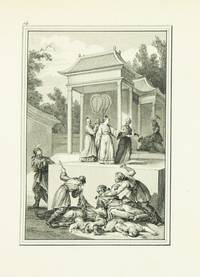
1788ST20889Paris: Chez l'Auteur 1788 1788. FIRST EDITION. 565 x 400 mm. 22 1/4 x 15 3/4". 50 leaves. Two separately published works bound in one. <br/> Modern retrospective calf-backed tan paste paper boards smooth spine profusely gilt with a repeating pattern of grape vines red morocco label lettered in gilt vellum tips. ENGRAVED THROUGHOUT WITH A TOTAL OF 48 FULL-PAGE ILLUSTRATED PLATES each accompanied by either one or two plates of engraved text. SHEETS UNCUT AND UNFOLDED the first work printed only on the recto; the second with three sheets printed on both sides. Reed and Dematté China on Paper 20 21; Cohen-de Ricci 479. Edges and lower corners slightly worn but the binding with only just minor signs of use; free endpaper in front and back with vertical crease one sheet with an early marginal repair isolated inconsequential faint spotting but still AN EXTREMELY FINE COPY the wide-margined sheets exceptionally fresh and bright and with strong impressions of the engravings.<br/> <br/> This pair of lavishly illustrated fully engraved works produced by a talented French engraver after earlier Chinese artworks are here presented in an enormous volume made up of uncut and unfolded sheets. According to Benzit Parisian engraver and print seller Isidore Stanislas Henri Helman 1743 - ca. 1809 "stands out among the engravers of the end of the 18th century" and his skill is evident in the two works bound together here. The first is a pictorial history of the Chinese emperors from the earliest mythical rulers to the Northern Song dynasty 960-1126. It is based on the Dijian Tushuo composed in 1573 to educate the Ming-dynasty Wanli Emperor 1563-1620 who had ascended to the throne at the age of nine. In accordance with its didactic aims it presents the very best and worst of imperial behavior and the original handwritten album was published as a block-printed book to great popularity. Two centuries later the Qing-dynasty Qianlong Emperor 1711-99 commissioned a Western-style edition of the famous work which was executed by two French artists the Jesuit painter Jean-Denis Attiret and the engraver Charles-Nicolas Cochin II. The enterprising Helman was able to see the Attiret-Cochin book in the collection of French statesman Henri Léonard Jean Baptiste Bertin 1720-92 and having had great success with a previous reproduction of a Chinese work Conquêtes de l'Empereur de la Chine ca. 1783 he created the present reproduction. The second work the life of Confucius was also reproduced from plates in Bertin's collection. The source material in this case was the biography of Confucius assembled by the Jesuit Joseph-Marie Amiot 1718-93 as part of his informational series on China meant to educate missionaries. Amiot was a correspondent of Bertin and had sent him the biography and accompanying album of drawings which were based on the Shenji tu Illustrated Traces of the Sage a popular Confucian work throughout the Ming and Qing dynasties. Helman selected 24 scenes from each creating books that balance serene scenes of mountainous landscapes and temples with dramatic fight scenes and dragons. The quality of the engravings is excellent with delicate linework creating faint wisps of smoke and subtle shadows. These two works apparently both published in 1788 were released in several formats. The format here with the engravings laid out on the recto of large uncut sheets appears at auction very infrequently: we have been able to trace only two copies of both works in this format since 2004 and neither in such fine condition as the present example. Chez l'Auteur unknown
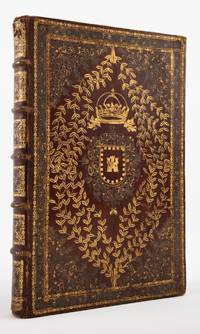
1714ST20995Naples: Bernardo-Michele Raillard 1714. 343 x 223 mm. 13 1/2 x 8 3/4". 6 p.l. CCLXIX 15 pp. <br/> IMPOSING CONTEMPORARY BROWN MOROCCO EXUBERANTLY GILT covers with painted and gilt frames of floral rolls central panel with elaborate volute cornerpieces large central lozenge formed by myriad leafy gilt vines enclosing a coat of arms containing a three-turreted castle topped by a crown held up by two putti raised bands spine compartments framed by floral roll painted and gilt daisy centerpiece tulip cornerpieces all edges gilt. The Academy's engraved device on title page and 75 ENGRAVED PLATES of scientific instruments and experiments. DSB 9:3; Dibner Herald of Science 82 first edition. Joints with modern wear one short crack at top of rear joint head of spine a bit wormed corners and extremities somewhat rubbed gilt a bit rubbed in spots difficult to tell if some of the decoration is dark because painted or is now missing gilt a couple of leaves slightly browned in the text bed occasional minor foxing more pronounced on a couple of quires other trivial imperfections but an excellent copy--quite clean and fresh internally--in a solid binding still bright with gilt.<br/> <br/> Given its binding and provenance this is a uniquely desirable copy of a significant scientific work: our stately Neapolitan edition of the "Essays on Natural Experiments" is offered here in very animated morocco bearing the arms of the man who paid for its printing and to whom the book is dedicated. That remarkable patron Caesare Michelangelo d'Avalos Marquis of Pescara and Vasto prince of Isernia and Francavilla 1667-1729 was a true Renaissance man who took Machiavelli's "The Prince" as inspiration. He was both a wily political conspirator and a generous patron of the arts and sciences. His palace at Vasto was renowned for the beauty of its furnishings for its splendid art gallery and for its impressive library overseen by the humanist scholar Alessandro Berti. The present volume was a worthy addition to that library with its glowing dedication and its regal binding extravagantly gilt but so tastefully composed that it never crosses the line into ostentatious. <br /> First printed in 1666 "Essays" was produced by the Accademia del Cimento the most significant expression of post-Galilean scientific progress in Italy. Founded in 1657 as the first organization formed for the sole purpose of making scientific experiments the Accademia occupies a singular position in the history of the development of science. Prince Leopold of Tuscany the last exceptional member of the Medici family and his brother Ferdinand who followed the Medici family tradition of patronizing the arts and sciences provided the support free-thinking direction and financial patronage for the Academy. A well-equipped laboratory and an apparently inexhaustible supply of apparatus and materials helped to make the work of the 10 scientists associated with the Academy more sustained and broader in scope than anything that had come before it. W. E. K. Middleton "The Experimenters" According to Thorndike among many other subjects the experiments described here "were concerned with air pressure and freezing; or they aimed to prove that water was incapable of compression and that there was no such thing as lightness or positive levity. Some experiments were magnetic and others electric the latter being chiefly performed with amber. Other subjects investigated were the change of colors in fluids the motion of sound and projectiles." Although no author is given by name the title page of the 1666 first edition indicated that this account was written by the secretary to the academy Lorenzo Magalotti 1637-1712. A pupil of Viviani and a friend of Boyle Magalotti was celebrated for his highly finished colorful almost dramatic descriptions of experiments. DSB notes "He has the distinction . . . of having written the best scientific prose in Italian after that of Galileo.". Bernardo-Michele Raillard unknown
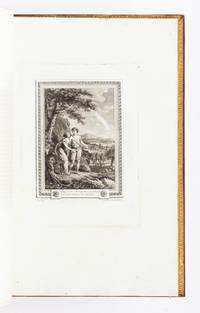
1786ST19671Paris: Chez l'Auteur Veuve Hérissant et Barrois l'aîne 1786-93. First Edition with these Illustrations. 485 x 340 mm. 19 x 13 1/2". Three volumes. <br/> ELEGANT RED STRAIGHT-GRAIN MOROCCO BY BOZERIAN signed in gilt on front free endpaper covers framed by gilt fillets double raised bands separated by a strip of black morocco tooled with gilt chain spine gilt in compartments with a rose or a musical instrument at center turn-ins with gilt arches roll Culot 18 green endpapers all edges gilt. 147 FINE ILLUSTRATIONS AFTER DESIGNS BY JEAN-JACQUES-FRANÇOIS LE BARBIER: three engraved title pages four vignettes 66 tailpieces and 74 leaves of plates including frontispiece portrait of Gessner engraved by Alix Baquoy Dambrun de Longueil et al. ALL IN FIRST STATE those in volumes I and III with original tissue guards. A Large Paper Copy. Cohen-de Ricci 433; Ray 39. For the binding: Culot "Jean Claude Bozerian" roulette #18. ◆Just a hint of rubbing to upper joint of first volume small indent to front cover of volume II occasional mostly marginal mild foxing more frequent in volume II but QUITE A FINE SET clean and fresh internally with beautiful impressions of the engravings and enormous margins in lustrous bindings with few signs of wear.<br/> <br/> This is a sumptuous set approaching 20 inches tall that epitomizes the best in 18th century French book arts: a Large Paper Copy of a book that in Ray's opinion "represents one of the happiest of all collaborations between artist and writer"--all of this in a graceful binding by the preeminent Paris atelier of the day. Gessner 1730-88 was a painter and poet from Zurich who hoped to renew the ancient genre of the eclogue. In his imagined neoclassical world all the shepherdesses are beautiful virtuous and sensitive and the shepherds are always honest and respectful. This struck a chord with illustrator Jean-Jacques-François Le Barbier 1738-1826 who wrote in the dedication "the charm of Gessner's poems filled my imagination and transported it to the happy centuries of the world's innocence." It also inspired him to collaborate with Gessner on this present work. Le Barbier 1738-1826 was one of the first great French neoclassical illustrators and this work is both an important early success in that style and in Ray's words the "most sustained and accomplished series of illustrations" by the artist. Most of Le Barbier's designs for this work are set in the classical world--the exception being "Le Mort d'Abel" based on the story of Cain and Abel in the Bible. There are nymphs fauns and other fantastical creatures mingling with humans in bucolic settings. While Le Barbier illustrates many love scenes they are romantic and wistful rather than passionate; he was a master of nudes but those depicted here seem innocent rather than erotic. As Ray says "Le Barbier's emphasis is on simplicity and naturalness. We are in a different world from the witty gallantry and sophisticated sentiment of the rococo pastoral illustrations." The engravings are characterized by the clarifying use of softly radiant light and by a restrained animation and the book as a whole is "a work of harmonious distinction which admirably realizes the ideals of its author and illustrator." Ray The elegant binding by Bozerian is notable for its refinement and it continues the motif of noble simplicity set by author and illustrator. Jean-Claude Bozerian 1762-1840 was the elder of the Bozerian brothers François is referred to as "le jeune" and was active in Paris from 1795 to about 1810. He began his career in Lyon as an apprentice bookseller printer and bookbinder eventually deciding to focus on the latter craft. Marriage to the widow of binder Pierre Boulier allowed him to establish a binding workshop in Paris where he was joined by his brother. His bindings were soon much in demand by French bibliophiles who appreciated their superior materials tasteful design and flawless execution. A rich man by age 50 he decided to retire and enjoy his leisure turning his business over to his nephew Lefebvre. Gessner's "Oeuvres" typically appears in quarto; Large Paper Copies like this one are very rare especially with all of the plates in first state which according to Cohen-de Ricci is recognizable by the lack of numbering to the plates and their appearance on bluish paper. It would seem next to impossible to imagine a book with margins as wide as are seen here. Chez l'Auteur, V[eu]ve Hérissant et Barrois, l'aîne unknown
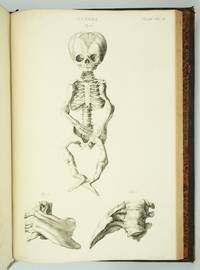
1793ST20586Lugduni Batavorum Leyden: S. & J. Luchtmans 1793 1827 1835. FIRST EDITION A COMPLETE SET. 525 x 350 mm. 20 3/4 x 14". Four volumes. <br/> First two volumes in contemporary cat's paw calf volumes III and IV in contemporary flamed calf raised bands spines gilt in compartments with central fleuron one red and one black morocco label. WITH 206 ENGRAVED ANATOMICAL PLATES all with guards. Front pastedowns with bookplate of Harvard Medical School Library; library shelf markings in white at bottom of spines; bookseller's ticket of Schönhof & Mueller Foreign Books Boston. Bibliotheca Walleriana 8549; Choulant pp. 312-13; Larousse XIX vol. 14 p. 171. Lucas L. Boer Peter L. J. Boek Andries J. van Dam and Roelof-Jan Oostra "History and highlights of the teratological collection in the Museum Anatomicum of Leiden University The Netherlands " American Journal of Medical Genetics Part A Volume 176 no. 3 2018 pp. 618-37.<br /> Shallow chips across the tail of first two volumes covers variably abraded one noticeably so corners somewhat worn partially with boards showing through vague additional signs of wear but the bindings solid and retaining much of their original appeal; plates in first two volumes with faint overall browning either because of paper stock or because of contact with guards a handful of trivial tears but all in all an extremely pleasing set the plates in volume IV very clean and bright and the plates elsewhere and the wide-margined text clean and fresh throughout.<br/> <br/> This is an extremely scarce complete set of a very substantially proportioned anatomical work with more than 200 striking giant folio engravings that emphasize birth defects and that range from clinically cheerless to heartbreaking. A physician and professor of anatomy at Leyden Eduard Sandifort 1742-1814 was commissioned by the University and the city council to publish this account of the school's anatomical collections with a focus on pathological anatomy including especially congenital abnormalities. After the publication of the first two volumes in 1793 the third and fourth were issued following Sandifort's death by his son Gerard 1779-1848 who followed in his father's professorial footsteps in Leyden. The first second and fourth volume are illustrated with copperplate engravings which Larousse tell us make this book "one of the most beautiful works of this genre" though "beautiful" needs to be understood here to mean "convincing" or "compelling" rather than aesthetically appealing. The first volume concludes with nine full-size depictions of skulls; the illustrations in the second and fourth are of a more affecting nature consisting of malformed bodies and body parts damaged or destroyed by disease and birth defects. The engravings of the conjoined twins in these volumes are especially powerful--consisting of poignant even haunting images showing undeserving victims of pronounced congenital defects though some are softened with a touch of the fanciful in their presentation. The thoroughness and accuracy of the work is so great that it remains of scholarly value even today. A recent study by Dutch curators and anatomical scholars Lucas L. Boer Peter L. J. Boek Andries J. van Dam and Roelof-Jan Oostra used "Museum Anatomicum" as a guide to identify and re-diagnose the University's historic teratological collections noting that "many historically made diagnoses could not be improved upon after re-diagnosing the specimens with contemporary dysmorphological knowledge actually confirming that these old collectors were perhaps the first dysmorphologists and can be seen as true pioneers in the field of teratology." Although single volumes and incomplete sets of this work come on the market with some regularity we have been able to trace only five complete sets at auction since 1872. And ours especially fresh and wide-margined in pleasing contemporary calf is a particularly attractive specimen. S. & J. Luchtmans unknown
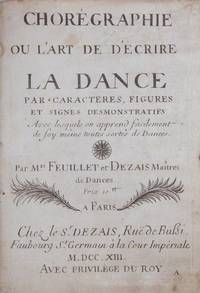
170940499Paris 1709. FEUILLET and DEZAIS<br /> Chorégraphie ou l'art de décrire la dance par caractères figures et signes démonstrifs avec lesquels on apprend facilement de soy-même toutes sortes de dances. ouvrage très utile aux maîtres à dancer et à toutes les personnes qui s'appliquent à la dance. Par Mrs. Feuillet et Dezais Maîtres de Dances. Prix: . <br /> <br /> Paris: Chez le Sr. Dezais Ruë de Bussi Faubourg St. Germain à la Cour Impériale . Avec Privilége du Roy 1713.<br /> <br /> 1f. recto title verso blank i dedication "A Monsieur Pécour Pensionnaire des Menus Plaisirs du Roy et Compositeur des Balets de l'Académie Royale de Musique de Paris" ii Préface i "Extrait du Privilege du Roi" 95 i blank pp. Engraved throughout. <br /> <br /> The revised fourth edition of this seminal work first published in 1700. RISM Écrits Imprimés p. 314 2 copies only of all editions in the U.S.: one of the first 1700 edition at the NYPL and one of the present edition at the Library of Congress. Beaumont p. 72. De Moroda 938. Schwartz and Schlundt 21. This edition not in Cortot Hirsch or Malkin.<br /> <br /> "A rather less known choreographer is Jacques Dezais. He lived in the first half of 18th century and regarded himself as a follower of R. A. Feuillet. In 1726 he published a collection of dances named Premier Livre de Contre-Dances à Quatre à six & à Huit. Unfortunately the publication was lost when the famous Anna-Amalie Library in Weimar burned in 2004." earlydance/news/8138-les-cotillons-de-jacques-dezais<br /> <br /> Bound with:<br /> FEUILLET<br /> Recueil de Dances Composées par Mr. Feuillet Maître de Dance. <br /> <br /> Paris: Chez l'Auteur rue de Bussi Faubourg St. Germain à la Cour Imperiale Avec Privilége du Roy 1709. <br /> <br /> 1f. recto title verso blank 84 pp. Engraved throughout.<br /> <br /> Contains 18 dances in Feuillet notation with melody for each at head as follows:<br /> <br /> - Le Rigaudon de la Paix pp. 1-2<br /> - 2e Rigaudons pp. 3-7<br /> - Gigue à deux Gigue de Roland pp. 8-11<br /> - Entrée a deux Rigaudon pp. 12-16<br /> - Autre Entrée a deux Rigaudon pp. 17-20<br /> - Sarabande pour femme Sarabande pp. 21-24<br /> - Sarabande pour homme Sarabande pp. 25-28<br /> - Sarabande Espagnole pour homme Sarabande Espagnole pp. 29-32<br /> - Folie d'Espagne pour femme Folie d'espagne pp. 33-38<br /> - Canary à deux Canary pp. 39-40<br /> - Gigue pour homme Gigue pp. 41-44<br /> - Entrée pour homme pp. 45-48<br /> - Autre entrée pour homme entree pp. 49-52<br /> - Entrée grave pour homme pp. 53-59<br /> - Entrée d'Apolon Entrée Apolon pp. 60-66<br /> - Balet de neuf Danseurs entre graue pp. 67-72<br /> - Canary pp. 73-74<br /> - second canary p. 75-84 with pp. 77-84 folding<br /> <br /> First published in 1700. Little and Marsh 1709-Feu p. 103 for a list of editions and issues see 1700-Feu. De Moroda 938. This edition not in Malkin Niles & Leslie Schwartz & Schlundt or RISM<br /> <br /> "All but one of the dances in Feuillet's collection are solos or duets ranging from easy to difficult; the single exception is a piece for eight dancers and a soloist - the only known example in Feuillet notation of a French ballet entry for more than two persons." Little and Marsh p. 91.<br /> <br /> Bound with: <br /> FEUILLET<br /> Recueil de Dances Composées par M. Pecour Pensionnaire des menus Plaisirs du Roy et Compositeur des Balets de l'Academie Royale de Musique de Paris et mise sur le Papier par M. Feuillet. Maître de Dance. <br /> <br /> Paris: Chez l'Auteur rue de Bussi Faubourg St. Germain à la Cour Impériale Avec Privilege du Roy 1709. 1f. recto title verso blank 72 pp. Engraved throughout.<br /> <br /> Contains 15 dances in Feuillet notation with melody for each at head as follows:<br /> <br /> - la Bourée d'Achille Bourée pp. 1-3<br /> - menuet pp. 4-11<br /> - La Mariée la Mariée pp. 12-21<br /> - le Passepied passepied pp. 22-23<br /> - 2e. Passepied pp. 24-31<br /> - la Contredance Gigue pp. 32-36<br /> - le Rigaudon des Vaisseaux Rigaudon pp. 37-39<br /> - 2e. Rigaudon pp. 40-42<br /> - la Bourgogne Courant pp. 43-44<br /> - Bourée pp. 45-46<br /> - Sarabande pp. 47-48<br /> - PassePied pp. 49-53<br /> - la Savoye Bourée pp. 54-61<br /> - la Forlana la Forlana pp. 62-67<br /> - la Conty Venitienne pp. 68-72 <br /> <br /> First published in 1700. Little and Marsh 1700-Péc p. 93. De Moroda 1341. This edition not in Malkin Niles & Leslie Schwartz & Schlundt or RISM.<br /> <br /> "Pecour's Recueil was bound and sold with Feuillet's Chorégraphie and Feuillet's Recueil . for a survey of editions and issues see comments under 1700-Feu. This collection contains a variety of pieces for ball dancing in vogue in 1700; many of them are quite difficult. According to the preface to Feuillet's Chorégraphie Pécour himself went over the proofs to eliminate errors in notation." Little and Marsh p. 93.<br /> <br /> Louis Guillaume Pécour 1651-1729 was an important French dancing-master and choreographer. He worked closely with celebrated royal choreographer Pierre Beauchamp 1631-1705 Louis XIV's personal dancing master.<br /> <br /> Octavo. Full dark brown mottled calf with raised bands on spine in decorative compartments gilt dark brown title label gilt. <br /> <br /> Binding worn rubbed and bumped with some abrasions; head of spine joints and edges chipped with minor loss; endpapers slightly worn soiled and foxed. Occasional minor signs of wear soiling and foxing; several titles very slightly cropped. <br /> <br /> Very good copies overall of all three works. Feuillet was a highly important French choreographer dancing-master and author. "He worked at the court of Louis XIV. His fame rests on his Chorégraphie a book describing a system of dance notation that was used in Europe throughout the 18th century. He probably did not invent the system himself although he said he had but derived it from the original work of Pierre Beauchamps Louis XIV's personal dancing-master. Unlike previous methods which describe movement verbally and use letters to refer to the sequence of steps Feuillet's system is a track notation. It represents symbolically not only the steps of the dancer with his turns leaps and slides but also the floor pattern in which he is to travel. The dance music is printed at the top of the page and the steps are marked off in a manner corresponding to the structure of the music. .<br /> <br /> The publication of the Beauchamp-Feuillet notation meant that specific dances could easily be distributed throughout Europe. It also added to France's pre-eminence in the world of dance. Today the system makes it possible for scholars to study some of the dances in use in the late 17th and early 18th centuries an important period for the development of the classical French ballet style and technique." Meredith Ellis Little in Grove Music Online<br /> <br /> "With the invention of his dance notation system in the eighteenth century Raoul-Auger Feuillet revolutionized the dance world. Published in 1700 his Chorégraphie . was conceived as a self-teaching device not a way of preserving dance. Yet owing to its immense popularity throughout Europe even today a large body of theatrical and ballroom dances from that period in both printed and manuscript forms can still be found in most archives. . Chorégraphie was reprinted three times in thirteen years translated into English by John Weaver in 1706 and appeared in various "improved" versions in France Germany Spain and Portugal. Voltaire 1751 ranked the invention among the "achievements of his day" and Denis Diderot 1763 devoted ten pages to the subject in his Encyclopédie." International Encyclopedia of Dance Vol. 2 p. 588.<br /> <br /> An extraordinary presentation of three of the most important early choreographic works all major factors in confirming France's preeminence in the world of 18th century ballet. unknown