31 résultats
179138981791. 13 x 9 inches. Dark brown body colour on prepared paper. Inscribed "N.2.Stück" and "am 9ten Aprill 1791--nach der Natur gezeichnet von JEW" ink collector's stamp "Linel-Smlg. No." followed by pencilled number "1046" all on verso. Provenance: Linel ink collector's stamp on verso.<br/> <br/>A high quality image that clearly is drawn from life as the inscription claims. The artist's use of a dark prepared ground recalls the work of Barbara Regina Dietsch and her family. A search of Nissen's index of artists reveals one possible name: the Swiss artist Johann Emmanuel Wyss 1782-1837. However the maturity and assurance shown in the present drawing would seem to rule him out: he could have been no older than nine in April 1791. unknown books
1795312011Philadelphia: by and for Colerick & Hunter 1795. First American Edition. a2 B-Z6 Aa-Kk6 Ll4. 399pp. 12mo 6 1/2 x 3 3/4 inches. original sheep both boards detached ex libris George Vaux with his signature on pastedown and first leaf of preface. First American Edition. a2 B-Z6 Aa-Kk6 Ll4. 399pp. 12mo 6 1/2 x 3 3/4 inches. by and for Colerick & Hunter unknown books
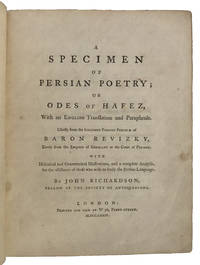
1774ME1081London:: Printed and Sold at No. 76 Fleet-Street 1774. 1774. 4to. iv xv 1 68 pp. Original full calf gilt spine; neatly rebacked to style preserving original endsheets. Inscribed by an early owner "This Book belonging to Monsieur Pierre Monneron." Extremely rare. This is the first edition in English of the ghazals of Hafez translated by one of the leading Persian orientalists of his day John Richardson FAS of Wadham College Oxford and famous for his seminal work written in conjunction with Sir William Jones the work being A Dictionary Persian Arabic and English 1777. / Hafez was previously unknown to the western world until Count Karl Emerich Reviczky von Revisnye 1737-1793 the Hungarian Orientalist and bibliophile 'discovered' him and brought his poetic classic to Europe with this Vienna printing. The work features an extensive text on Hafez and a translation of selected ghazals . Reviczky von Revisnye also issued in 1784 1794 a catalogue of his Greek and Latin library using the pseudonym of "Periergus Deltophilus". In the prefatory essay for that volume he shows an interest in the printing of Nicolas Jenson Aldus Manutius and the Estiennes. / Hafez was born in Shiraz Persia and lived approximately from 1325/26–1389/1390. He is considered a mystic and poet. His life and poems are the subject of much analysis commentary and interpretation influencing post-fourteenth century Persian writing more than any other author. FULL TITLE: A Specimen of Persian Poetry; or Odes of Hafez With an English Translation and Paraphrase. Chiefly from the Specimen Poeseos Persicae of Baron Revizky Envoy from the Emperor of Germany to the Court of Poland. With Historical and Grammatical Illustrations and a complete Analysis for the assistance of those who wish to study the Persian language. Printed and Sold at No. 76, Fleet-Street, 1774. unknown books
1744D4448France 1744. Hardcover. Very Good. Manuscript book on paper in French. c.1744. 8vo 166 x 106mm. 8 355pp. written in brown ink in a clear humanist script with some calligraphic aspects between framed pages in a single column of approximately 28 lines headings in Roman majuscules. With 89 full-page diagrams and technical illustrations of sundial construction and usage and other supporting images three are on plates and two of which are folding at rear. Contemporary mottled calf spine gilt in compartments labeled Gnomonique on gilt red morocco lettering piece marbled endpapers & edges; edges uniformly toned occasional stains; expertly rebacked preserving the original spine somewhat worn. Full contents listed on first 6 pages for this expertly executed and comprehensive compendium on the sundial. The objective of this manual is to enable the 18th century audience to understand the operating principle of sundials by describing the construction and manipulation of different forms of sundials including the planet-sundial moon-clock celestial houses-clock polar-clock ancient Babylonian and Jewish clocks as well as the construction of quadrants and astronomical tables. The suns position in the sky has always been an obvious means to keep track of time. The use of shadows of sticks cast by the sun were a natural means of indicating the time of day by the direction of the shadow and the time of year by its length. Although town squares began constructing clocks beginning somewhere in the 14th century sundials remained in the picture well into the 18th century. Mechanical clocks were expensive and could be found only in the most noble of homes. They were also more of a curiosity at first; most people still used their sundials or just estimated the time of day by the height of the sun in the sky. In 1777 when the French General Lafayette wanted to express his admiration for his ally and friend General George Washington during the American Revolution he chose a silver Explorer sundial as his gift. But by the close of the 18th century clocks and watches began to supersede sundials. They had one huge advantage- they worked all day long and were not dependent on weather. However they were also notoriously unreliable- telling time only approximately within an hour and needing to be reset frequently of course with the help of a sundial. Although the work of this study is anonymous an ownership entry at the foot of the title helps to date the work: Hic est Thorridon Rectoris Laurentii Moussault 1744. This wide-ranging study of the sundial appears at a time when the mechanical clock was on its way into popular fashion. A unique scholarly work that may well be one of the last close studies of such an ancient and important time-telling tool. <br/><br/> hardcover books
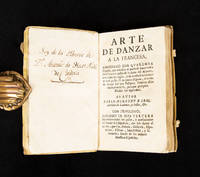
175834566Madrid: The Author 1758. 16mo. ca. 150 x 103 cm. Full contemporary vellum with manuscript titling to spine leather ties. 1f. recto title verso blank 1f. "Al Lector i privileges dated July 2 9 and 10 1737 iii "Advertencia" 72 pp. text 20 engraved plates of choreographic notation of dances including those by Feuillet and Pecour with music with alternate rectos and versos blank as issued. With one folding plate of engraved music between pp. 35 and 37.<br/><br/>With charming woodcut depictions of both male and female dancers one with an accompanying musician illustrating positions of the arms and feet and dance etiquette including bowing and managing one's hat. Diagrams and choreographic notation within text. <br/><br/>The final textual section "Explicacion del Danzar a la Española" offers detailed definitions of 46 steps used in Spanish dance followed by descriptions of "Danzas a la Española ." including the pabana the gallarda the españoleta the villano the impossibles and the hermosa. <br/><br/>Plates include:<br/>- Explicn. de la Chorographia<br/>- Movimentos de los Brazos Codos etc.<br/>- Demonstracion de la Bretaña<br/>- Rigodon ô Allegro de la Bretaña<br/>- El Amable con otra Chorographia<br/>- La Pastoril demonstda. redonda y larga<br/>- La Diligenta delinda. â lo largo ô larga<br/>- La Cortesana Cont. quadrada ô en quadro<br/><br/>Free front endpaper with elaborate contemporary paraph verso with contemporary inscription: "Soy de la Libreria de Dn. AntonÃo de Hozes Ferñz de Cordova."<br/><br/>Binding slightly worn; ties partially lacking; endpapers slightly worn; free front endpaper slightly stained. Minor internal wear and soiling; some leaves browned; occasional foxing; several small virtually invisible professional archival repairs. Rare third edition of the work demonstrating the foundations of dancing in the French style considered of greater elegance than the Spanish first published in 1737. Derra de Moroda 1856 edition of 1758. Malkin 79 edition of 1737. Niles & Leslie pp. 360-361 edition of 1758. Waterloo p. 144 RISM Écrits p. 587 editions of 1758 and 1768. All with variant titles no recorded copies with this title. <br/><br/>Minguet's manual incorporates material from two other important early 18th century dance treatises Feuillet's Chorégraphie Paris 1700 and Rameau's Le Maître de danser Paris 1726.<br/><br/>"A compilation of Feuillet Rameau and De la Cuisse. His engravings however are superior to the originals of the fore-mentioned and make his Arte de Danzar perhaps the most important treatise in 18th century Dance literature in Spanish." Niles & Leslie<br/><br/>"Spain was one of the first countries to record its social dances in a system of dance notation and notation was to be an important element in dance manuals of the eighteenth century. The first Spanish book devoted entirely to dance was Discursos sobre el arte de danzado 1642 by Juan de Esquivel Navarro dancing master to Philip IV. The next dance book by Bartolemé Ferriol y Boxeraus did not appear until a century later in 1745. Pablo Minguet e Irol a famous engraver as well as an author and translator published works on a wide range of subjects; his dance books included several important works which incorporated the French dance notation of Raoul-Auger Feuillet." International Encyclopedia of Dance 5 p. 670. <br/><br/>"A particularly lovely set of illuminations can be found in Pablo Minguet e Yrol's Arte de danzar à l a francesca." op. cit. 6 p. 124. <br/><br/>Antonio de Hoces Fernández de Córdoba 1722-1782 was a "Master of Seville" and served as mayor of Cordoba. [The Author] unknown books
179728174Birmingham England 1797. Oblong quarto. 7 1/2 x 11 inches. 143 engraved plates 13 folding on laid paper priced throughout in manuscript. Period calf-backed marbled paper covered boards<br/> <br/>Provenance: W. G. & Co. inscription on front endpaper<br/> <br/>A rarely encountered pattern book or trade catalogue of 18th century English furniture hardware including drawer pulls keyholes hinges locks castors bolts watch stands and more.<br/> <br/>By 1770 over thirty different brass foundries operated in Birmingham England making it the epicenter of furniture hardware design in the last quarter of the 18th century. At roughly the same period trade catalogues like the present began to be issued by both furniture and hardware makers alike. Although most of the brass foundry trade catalogues of this early period have no indication of the foundry the present pattern book is inscribed W. G. & Co. on the front pastedown. In all nearly 1000 designs are shown on the 143 plates from rather simple hinges and hooks to incredibly ornate pulls knockers watchstands etc. Although no engravers's names are identified it has been suggested that the foundries themselves produced such plates utilizing the talents of their own craftsmen who by their very occupation would have been highly skilled at etching on metal. Such pattern books "illustrate the beginning of what was then a new movement in the conditions of the crafts namely the growth of the organised factory as a means of production and distribution as compared with the earlier limitation of these functions to the efforts of individuals" Young.<br/> <br/>Cf. Hummel Charles F. "Samuel Rowland Fishers Catalogue of English Hardware." Winterthur Portfolio Vol 1 1964: 188-197; cf. Symonds R. W. "An Eighteenth-Century English Brassfounders Catalogue." Magazine Antiques Feb. 1931: 102-105; Young W. A. comp. Old English pattern books of the metal trades: a descriptive catalogue of the collection in the V&A Museum. London: HMSO 1913. unknown books