135 résultats
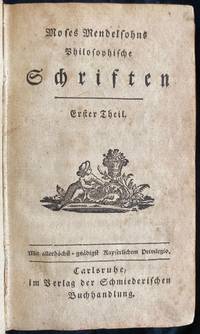
178043258Carlsruhe: im Verlag der Schmiederischen Buchhandlung 1780. No Date 1780s. Period laquered boards with leather spine label. 12mo. XXIV 278; 283 pages. In German. Title translates as “Writings.†Includes 2 different title vignettes 1 on each title page.<br> <br> Goedeke IV 1 488 6. Meyer 108; Dorn 105-107; Holzmann/Bohatta Deutsches Anomymen-Lexikon IV no. 1559. <br> <br> Early printing of Mendelssohn’s second work in which he "began his formulation of a new psychological theory that stressed the autonomy of aesthetics logic and ethics relative to each other." Merriam-Webster's Encyclopedia of World Religions p. 710. <br> <br> Contents:<br> <br> Vol. 1. Vorrede. <br> I. Ueber die Empfindungen.<br> II. Gespräche; <br> <br> Vol. 2. I. Rhapsodie oder Zusätze zu den Briefen über die Empfindungen. <br> II. Ueber die Hauptgrundsätze der schönen Künste und Wissenschaften. <br> III. Ueber das Erhabene und Naive in den schönen Wissenschaften. <br> IV. Ueber die Wahrscheinlichkeit. <br> <br> Also includes bibliographical references.<br> <br> Included within these is a series of writings on aesthetics which influenced Lessing and Schiller with Lessing noting“We have to thank him Mendelssohn for the true theory of mixed sensations.â€<br> <br> Moses Mendelssohn Moses of Dessau; 1729–1786 was a philosopher of the German Enlightenment in the pre-Kantian period early Maskil and a renowned Jewish figure in the 18th century. Mendelssohn was fluent in German and Hebrew and learned Latin Greek English French and Italian. His early teachers were young broadly educated Jews and he met the writer and dramatist G.E. Lessing 1754 and a deep and lifelong friendship developed between them. Throughout his life he worked as a merchant while carrying out his literary activities and widespread correspondence in his free time. In 1754 Mendelssohn began to publish – at first with the assistance of Lessing – philosophical writings and later also literary reviews. <br> He also started a few literary projects for example the short-lived periodical Kohelet Musar in order to enrich and change Jewish culture and took part in the early Haskalah. In 1763 he was awarded the first prize of the Prussian Royal Academy of Sciences for his work Abhandlung über die Evidenz in metaphysischen Wissenschaften "Treatise on Evidence in Metaphysical Knowledge". However when the academy elected him as a member in 1771 King Frederick II refused to ratify its decision. <br> <br> In 1769 he became embroiled in a dispute on the Jewish religion and from then on he confined most of his literary activity to the sphere of Judaism. His most notable and enduring works in this area included the translation into German and commentary on the Pentateuch Sefer Netivot ha-Shalom "Book of the Paths of Peace" 1780–83 and his Jerusalem: oder Ueber religiöse Macht und Judenthum "Jerusalem or On Religious Power and Judaism" 1783 this work the first polemical defense of Judaism in the German language and one of the pioneering works of modern Jewish philosophy. <br> <br> An active intermediary on behalf of his own people in difficult times and a participant in their struggle for equal rights he was at the same time a forceful defender of the Enlightenment against the opposition to it which gained strength toward the end of his life. In the midst of a literary battle against one of the leading figures of the counter-Enlightenment he died in 1786 EJ. <br> <br> SUBJECTS: Philosophy -- Early works to 1800. Philosophie -- Ouvrages avant 1800. Philosophy. OCLC: 1352546328. <br> <br> Light wear to original boards more so at spine but solid and attractive light spotting as expected About Very Good- Condition an attractive 18th Century copy. B KH-10-31. Carlsruhe: im Verlag der Schmiederischen Buchhandlung unknown
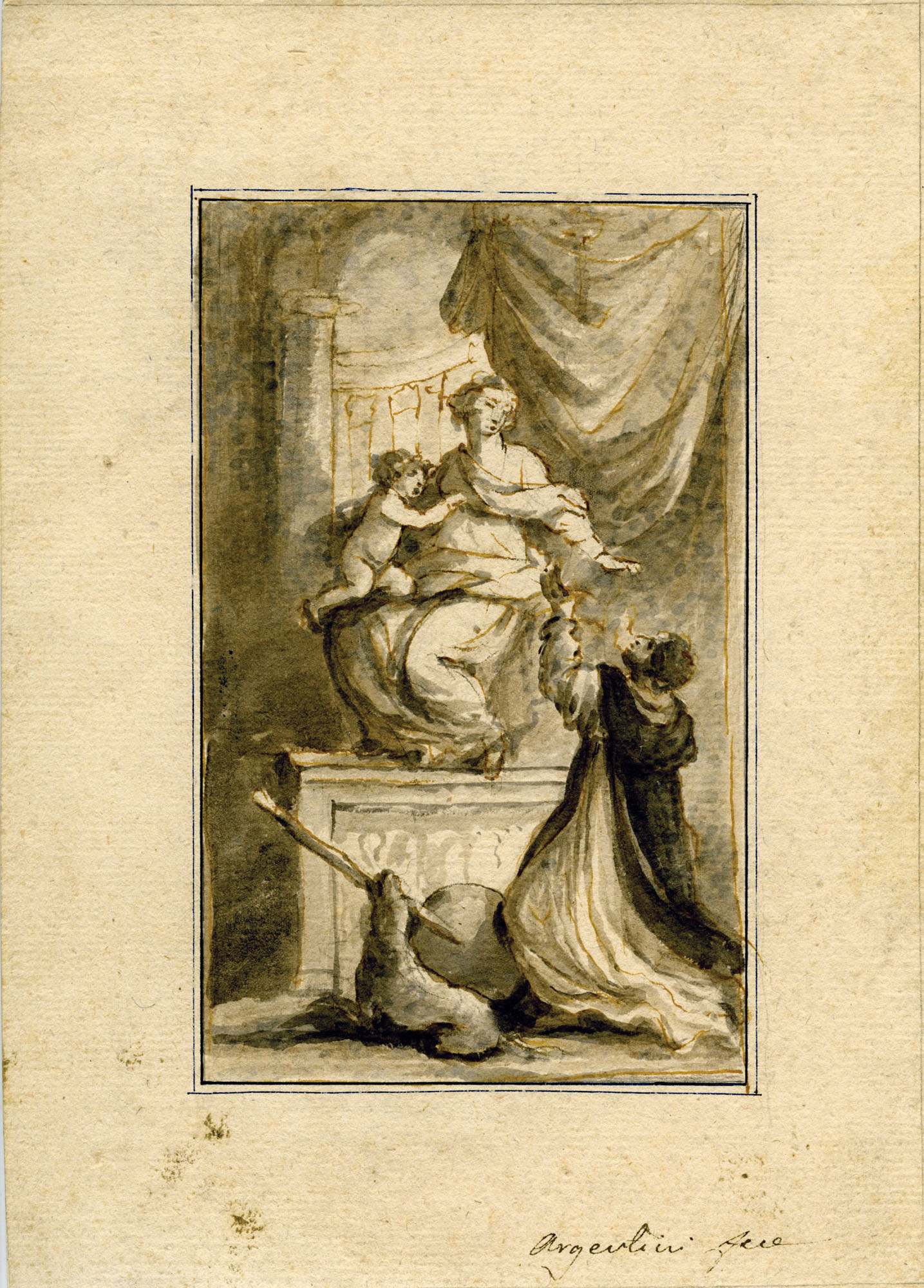
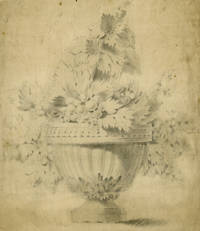
17508801750. Ink wash in gray and black with heightening in brown pen and ink on cream laid paper laid down to an archival matrix 9 3/4 x 7 inches 247 x 178 mm. In good condition with some minor surface soiling and slight attenuation especially visible in the areas with brown ink. Adhesive residue on the verso at the top corners and bottom center margin does not effect the recto. The name "Argentini." appears in ink on the recto in the lower right margin. unknown
1755D200Madrid: En la Imprenta del Mercurio 1755. First Edition. Hardcover. Very Good. 4to 318 x 496mm. 23 331pp. Contemporary limp vellum; text block loose from vellum front-free endpaper inscribed with date 1788 and creased spine damaged hinges loose. First Edition. Trincados important history of the popes kings and emperors of Rome Constantinople Germany France England and of many Spanish regions including Aragon Castile León Navarra and Castile. The Compendio historic also includes a significant description of the famous conquistador Cortès 1485-1547. The text is dedicated to entrepreneur Juan Fernandez de Isla y Alvear 1709-1788 and the dedication lists the works of Don Juan. The introduction in the Compendio provides valuable information on the contemporary economic history of the region of Cantabria Included are mention of the foundation of the shipyard Guarnizo and the opening of roads in the province to bring wood to build ships and establish factories in china soap paper flour and brandy. This is the first of seven editions that came out in the second half of the 18th century. <br/><br/> En la Imprenta del Mercurio hardcover
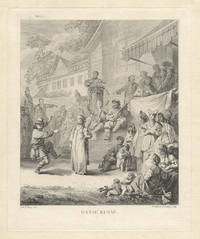
176837106Paris 1768. 243 x 200 mm. A very good impression on laid paper with good margins.<br /> <br /> The scene depicts a Russian couple dancing outside surrounded by adults and children in traditional dress; a group of musicians playing on the violin colascione a gamba-like instrument and a long-necked lute; with a group of elegantly-dressed people watching from a balcony. Bocher: Catalogue de l'oeuvre de A. de Saint-Aubin 550 third state including letters. unknown
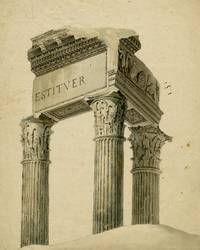
180010251800. Ink and wash in black ink with pen in black ink on watermarked C & I Honig cream laid paper 14 7/8 x 12 1/4 inches 378 x 311 mm the full sheet. In very good condition with some minor areas of light brown spotting in the right-center sheet margin. An excellent drawing with fine detail. The ruins of the Temple of Vespasian and Titus are located in the Roman Forum in Rome. The temple is a marble ruin that honors the deified emperors Vespasian and Titus. Located near the Temple of Saturn all that remain standing are three Corinthian columns that formed part of the colonnade. The temple was also dedicated to the son of Vespasiano Titus. Construction started on this temple in 79 AD. unknown
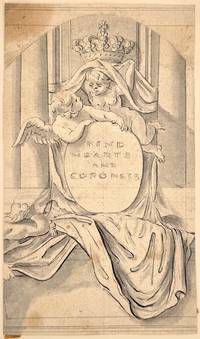
175025101750. Graphite ink and wash on cream laid paper with an extensive yet partial and illegible series of alphabetic watermarks. 7 1/4 x 4 1/2 185 x 115 mm the full sheet. With an contemporary support adhered to the top sheet edge. 19th century text in graphite added to the shield held by the putti. The image has been cropped to exclude the top portion of a recumbent figure whose legs are covered by a shroud and whose left hand remains visible in the left-center image area propped upon an pillow holding a heart. While this drawing appears to have been completed in the mid-18th century given the Neoclassical style media and paper the text "Kind Hearts and Coronets" comes from the poem Lady Clara Vere de Vere by Alfred Lord Tennyson. The poem was pubished in 1842 indicating that the pencil inscription in the image was added later. unknown
179429828London: Anthy. Milteno 1794. St. Caecilia is seated at an organ with an open music book above the keyboard; two cherubs sing from a music book to her right. <br /> <br /> The model for the painting was the singer/actress Mrs. Richard Brinsley Sheridan née Elizabeth Ann Linley 1754-1792 daughter of the composer and conductor Thomas Linley 1733-1795. <br /> <br /> 370 x 280 mm. Printed on wove paper.<br /> <br /> Some wear; minor chips tears and soiling to edges with remnants of former mount to upper right edge; some creasing; old paper repairs to verso; trimmed to just within plate impression. Anthy. Milteno unknown
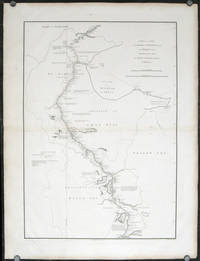
1796207049London.: George Nicol. 1796. Double-sheet engraved copperplate map 63.2 x 44.8 cm; 75 x 57 cms sheet including platemark central fold the sheet toned at the edges and central fold a couple of minor spots and edge wear but in very good condition. An exquisitely engraved map with fine detail of the route taken by George Macartney on the first official British embassy to China 1792-1794 undertaken with the aim of gaining trade concessions from the Chinese Emperor and published in George Staunton's officall account. <br> <br>While the official purpose was not successful much was learned about China and the Chinese as is evident from this map with its explanatory texts. To the west of Pekin just below the starting point at Zhe-hol Jehol which is situated at the top of this map the commentary reads: "A great part of the country around Pekin is employed in the production of culinary vegetables and a variety of fruits." At the lower edge of the map just north of the ending point of Hangzhou is the lake Tai Hoo: "The western side of the Tai-hoo is bounded by a very romantic and fertile country whose mountains are clutivated to their very tops. A great part of the province of Tche-tchiang appears to be cultivated with Mulberry trees for the food of the Silk worms." Cities of the 1st 2nd and 3rd orders "considerable towns" and villages are marked along with "Halting places" etc. Fascinating Western documentation of the area around the Imperial Canal of the late Eighteenth Century. . George Nicol. unknown
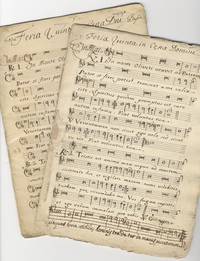
178040349Italy 1780. Folio 226 x 312 mm. Sewn. Notated on 10-stave rastrum-ruled paper with lowermost stave of first page of the Tenore part hand-drawn with music and text added in another hand. Watermark letters within a circle above a star. <br /> <br /> Music for Holy Thursday Good Friday and Holy Saturday of Holy Week in the Christian calendar: <br /> <br /> - "Feria Quinta in Cena Domini." Tenore. 4 pp. Bound with "Feria Sexta in Parasceve" Basso 6 pp. and an additional bass part headed "Sabbato Sancto" 6 pp. <br /> <br /> - "Feria Quinta in Cena Domini." Basso 6 pp. Bound with "Feria Sexta in Parasceve" 6 pp. "Sabbato Sancto" 6 pp. 1f. blank. <br /> <br /> With short semi-chanted homophonic liturgical pieces:<br /> "In Monte Oliveti" "Tristis est anima mea" "Ecce appropinquat" "Ecce vidimus" "Vere languores" "Amicus meus" "Flius quidem hominis" "Unus ex vobis" "Eram quasi agnus innocens" "Seniores populi" "Revelabunt celi iniquitatem" "Omnes amici" "Velum Templi" "Vinca mea" "Tamquam ad latronem" "Tenebre facte sunt" "Barabbas latro dimittitur" "Tradiderunt me" "Jesum tradidit" "Sicut ovis" "Sepultro Domino" "Jerusalem Iuge" "Plange quasi virgo" "Recessit Pastor" "O Vos omnes" "Caligaverunt oculi mei" "Ecce quomodo" "Æstimatus sum" "Agnus Dei" and "Lustris sex qui."<br /> <br /> Occasional moderate soiling and small stains; first leaf of Tenore part partially detached. unknown
1709JC14459Amsterdam: Ex officina Wetsteniana 1709. Hardcover. Very Good. Small 4to 200 x 155mm. 32 index 728pp. Signatures: 1star-4star4 A-Z4 Aa-Zz4 Aaa-Zzz4 Aaaa-Yyyy4. Full-page engraved half-title of scene of busy hospital room with patients reclining in beds in background and ailing patient treated by group of physicians with herbs and bottled medicines. Title printed in red and black. Preface by Swiss editor and physician Johann Conrad Amman 1669-1724. Period half vellum blind stamped with arabesque to covers backed in calf of gilt-stamped spine with red morocco lettering label: AURELIANI DE MORBIS; binding slightly rubbed with few spots internally clean and complete. <br/><br/>Though Caelius Aurelius was a Latin translator of ancient Greek medical manuscripts philologists often discuss his work as if he was the original author. He was born in Sicca Numidia now in Algeria with a dubious start but almost certainly flourished as a Greco-Roman physician in the mid-fifth century. Caelius Aurelius is known by his Latin medical writings especially this translation of a now lost Greek medical textbook on diseases written by Soran of Ephesos and titled De Morbis Acutis & Chronicis or On Acute and Chronic Diseases. Both authors are considered to be the primary representatives of the secta methodici or Methodist school a Greek school of medicine whose texts gave access to and crucially reconstructed the rich medical teachings of the ancient world. The work De Morbis Acutis & Chronicis consists of two parts. The first part deals with fourteen acute diseases in three books and the second consists of five books and covers forty-four chronic diseases. This is widely regarded as the best edition of the Caelius Aureliuss work edited by Johann Conrad Amman and published in Amsterdam by Jacob de Wetstein in 1709; it was reprinted in 1722 1755 and 1759. This edition contains valuable annotations and a Lexicon Caelianum by the Dutch physician Theodorus Janssonius van Almeloveen 1657-1712. Aldus first published it in 1547 in a collection titled Medici Antiqui Omnes. This text is one of the most valuable in the field of pathology not only for describing a grant range of diseases including sections on psychiatry and neurology and their treatments famously prescribing sun-baths for chronic affections but that it also contains the foundation of contemporary Latin medical terminology rooted in the Greek language. Rare first edition far more common is the Amsterdam edition of 1722. Ex officina Wetsteniana hardcover
179014061790. Pencil on cream laid paper 10 x 8 3/4 inches 254 x 222 mm. Uniform age tone scattered surface soiling and handling wear. One pea-sized area of skinning in the top-center sheet area. Repaired 3-inch horizontal edge tear at the right sheet edge mended on the verso with 19th century paper tape. Light horizontal fold across the sheet center and paper tape remnants on the verso. unknown
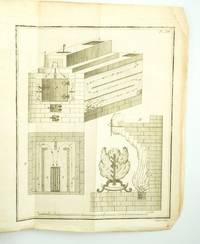
1792ST20535-05Paris: L'imprimerie de Valade fils aîné 1792. 210 x 130 mm. 8 1/4 x 5 1/4". xviii 3 22- 152 pp. Translated by J. Goy. <br/> Publisher's blue paper wrapper flat spine with paper label hand-lettered in ink edges untrimmed three quires UNOPENED. With 14 folding engraved plates. First section with an attractive woodcut headpiece of a pastoral landscape; floral woodcut tailpieces throughout. VD18 11592109 first edition. Front joint cracked joints and spine with apparent chipping first quire thinking about detaching but the volume still intact and retaining much of its fragile antique appeal. The text clean and fresh with the plates being crisp and well preserved.<br/> <br/> In its original paper wrappers this is an exceptionally well-preserved copy of a scarce work on stoves heating and saving wood first printed in Quedlinburg in 1790. Our author Johann Heinrich Sachtleben writes in the introduction that he composed this book on efficient and economical heating in response to increasing wood prices throughout Europe. The 14 engraved plates done in imitation of those in the German edition are particularly appealing. The technical depictions of chimneys and cooking apparatuses are joined by illustrations of stylish heating stoves with artistic decorative elements. This is quite a rare book: OCLC finds no copies in American institutions. And we have been unable to trace any copies of this French edition at auction and only two copies of the German edition. Our copy is distinguished by the state of preservation of its original wrappers assembled by the publisher as a temporary binding using unmatching endleaves repurposed from other volumes never intended to have lasted as the book's binding for well over two centuries. L'imprimerie de Valade, fils aîné unknown
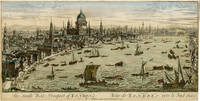
17601226London 1760. Copper plate engraving with hand coloring in watercolor on cream laid paper with a large circular watermark bearing a heart and arrow along with several Roman numerals and letters including II and S 8 1/4 x 16 3/ 8 x inches 208 x 423 mmimage area margins trimmed. Color slightly attenuated with some age tone mat tone and light scattered discoloration. Paper tape repair with in-painting at top right extreme corner paper tape support along the top sheet edge. Condition issues are consistent with age. This optic view of London and the Thames shows the north bank of the river from where Somerset House now stands in the east down to London Bridge and the Tower in the west. Also visible is the dome of St. Paul's Cathedral. Published in London circa 1760 this engraving is one of a series of images that were called optical views or perspectives. They originated in the early eighteenth century as part of the thriving topographical print market in cities such as Paris and London. As monied tourists traveled Europe these views became increasingly popular as souvenirs. After a trip abroad it was common practice among the wealthy denizens of London and Paris to produce "perspectives" after a dinner party. The views were enjoyed with the aid of a device known as a zograscope while the hosts regaled their company with travel tales. unknown
17801481780. Graphite and ink on handmade watermarked C & I Honig laid paper 8 15/16 x 6 3/4 inches 226 x 170 mm. Signed illegibly in ink lower margin. Scattered light creasing and surface soiling minor areas of rubbing all consistent with age. unknown
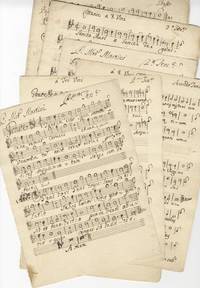
175040348Italy 1750. 5 parts. Quarto and two bifolia. Notated on 10-stave rastrum-ruled paper. Watermark letters within a circle.<br /> <br /> Contains:<br /> <br /> 1 P.rimo Ten.ore: 1 p. Text commencing "Tantum ergo sacramentum" and Genitori Genitoque" "P Mro Martini" to head.<br /> 2 P.rimo Ten.ore music different from above: 1 p. Text commencing "Tantum ergo sacramentum" and Genitori Genitoque."<br /> 3 Basso: 1 p. Text commenting "Tantum ergo sacramentum" and "Genitori Genitoque" with "Tantum &c. a 3 Voci Ripieno" to head.<br /> 4 Secondo Tenore: 2 pp. Text commencing "Pange lingua" "Nobis datus" "Verbum caro" and "Genitori Genitoque." With "à 3. Voci TT. e B." to head of first page.<br /> 5 2o. Ten.ore: 1 p. Text commencing "Tantum ergo" and "Genitori Genitoque." With "P Mro Martini" to head.<br /> 6 2o. Ten.ore: 3 i blank pp. Text commencing "Sancta Maria" "Sedes sapienti" "Regina Martyrum" and "Agnus Dei." With "Littanie a 3. Voci" to head. <br /> 7 Basso: 3 i blank pp. Text commencing "Kyrie" "Virgo potens" "Regina Angelorum" and "Agnus Dei." With "Littanie a 3. Voci" to head.<br /> <br /> A few small stains. unknown
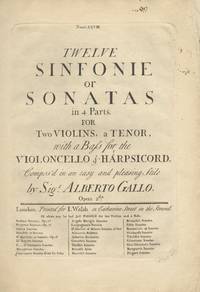
175440749London: Printed for I. Walsh in Catharine Street in the Strand 1754. Folio. Contemporary light blue wrappers. Engraved throughout. Uncut.<br /> <br /> Violino primo: 1f. recto title verso blank 12 pp.<br /> Violino secondo: 1f. recto title i blank 2-11 i blank pp. <br /> Alto viola: 1f. recto title i blank 2-9 i blank pp. <br /> Cembalo e violoncello: 1f. recto title verso blank i blank 2-10 pp.<br /> <br /> "Numb. XXVIII." printed at head of titles.<br /> <br /> With brief publisher's catalogue to foot of titles listing works "Just Publish'd for two Violins and a Bass" by Nussen Porpora Solniz Handel St. Martini Boyce St. Germain Humphries Geminiani Morigi Lampugnani Albinoni Alberti Ceruetto Torelli Purcell Mascitti Brioschi Fritz Bononcini Schickard Tibaldi Valentine Valentini Bomporti and Finger.<br /> <br /> Wrappers somewhat worn and creased with small stains spines and edges frayed and chipped with minor loss. Occasional minor soiling and small stains mainly to blank lower margins; some creasing to blank margins; lower wrapper of cembalo part detached. First Edition. Smith & Humphries 666 p. 149. BUC p. 359. RISM G260 no copies in the U.S. <br /> <br /> Little seems to be known about Alberto Gallo other than that he was a Venetian composer active in the mid-18th century. Printed for I. Walsh in Catharine Street in the Strand unknown
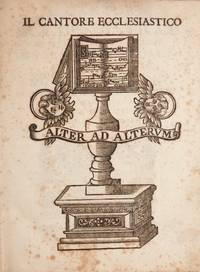
171339799Padova: Stamperia del Seminario . Appresso Giovanni Manfrè 1713. Small quarto. Modern half faux vellum with marbled boards. 1f. recto fine full-page woodcut verso blank 1f. recto title with fine large woodcut device verso blank 5-164 vii Index i blank pp. With numerous woodcut musical examples.<br /> <br /> With a striking full-page woodcut to preliminary leaf depicting a book of plainchant on a cantor's lectern and a large woodcut illustration of a Guidonian hand on folding plate between pp. 34-35.<br /> <br /> Binding very slightly worn. Light uniform browning; slightly cockled; occasional foxing to margins. A very good crisp copy overall. Second edition of the work first published in 1698. Cortot p. 79 1698 edition. Gregory-Bartlett p. 97 1698 edition. Hirsch I p. 66 1698 edition. RISM Écrits p. 330 one copy only in the U.S. <br /> <br /> An important treatise on ecclesiastical chant. Stamperia del Seminario ... Appresso Giovanni Manfrè unknown
174939377London: Printed By Thoas Baskett. Good with no dust jacket. 1749. . Behalf of Themselves and Their United Brethren Was Referred: Together with some Extracts of the Most Material Vouchers and Papers contained in the Appendix. "Deals in large part with the Moravian emigration to America. No American record of sale. Collation: half title Acta Fratrum Unitatis in Anglia 1749 verso blank; Syllabus verso blank; title verso blank; p. Iii Extract from the Votes of the House of Commons verso blank; inserted 4 pp. Anno Regni Georgii II. . An Act etc. ; second title Report of the Committee verso blank; pp. 3--27 verso blank; Appendix pp. 1--58; Unitatis Fratrum Fidei Liturgiae et Praxeos Expositio pp. 59a 59b 59c---120; 2 leaves Added since in an Octavo Edition; with respect to Page 121 the following Preface; pp. 121---156. P. Iii as above contains an Order addressed to Lieut. -Gen. Oglethorpe and Mr. Velters Cornwall for the ecouragement of the Moravians to settle in America. The following 4 pp. which seem to have been inserted contain An Act for encouraging this settlement and defining the Moravian attitude toward taking oath and bearing arms. The colophon of this Act dates it London 1749. Among the Vouchers and Papers are leters to and from Count Zinzendorf and General Oglethorpe. The Report deals with the numbers character and American colonization of the Moravians and their missions in the West Indies and other parts of the world. Beginning at p. 59 are the Augsburg Confession gospel of the Synod of Bern litany etc. Small folio mottled calf"RBH SDabin Folio B. M. 69731.Original binding mottled claf. Wear to extremities some edgewear to first few leaves prior to title page. . Printed By Thoas Baskett unknown
1721215234Hamburgi : Impensis Viduae Liebezeitiæ & Theodori Christoph Felgineri 1721. First Edition. Hardback. Very good copy bound in later 19th c. leather over the original boards. Raised bands. Some light dust-dulling to the spine ends. Panel edges somewhat worn and rubbed as with age particulaly at corners. Pages dust-toned with tanning and shadow staining to margins and scattered foxing. Text is legible throughout. Remains quite well-preserved overall. Further scans images etc. and additional bibliographical material available on request. Physical description: 317 17p ; 21.5 x 17cm. Subjects: Karaites -- Tanakh -- Judaism -- Jewish studies -- 18th century -- Early works to 1800. Notes: Title page in red and black. Includes bibliographical references and index. Errata listed on final leaf. Text in Latin and Hebrew. Other names: Liebezeitiæ vidua de printer. Trigland Jacobus 1652-1705. Felginer Theodor Christoph printer. Hamburgi : Impensis Viduae Liebezeitiæ & Theodori Christoph, Felgineri hardcover
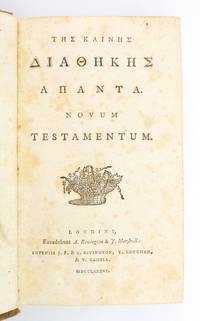
1786ST20133London: Excudebant A. Rivington & J. Marshall: Impensis J. F. & C. Rivington T. Longman & T. Cadell 1786. 175 x 105 mm. 7 x 4 1/4". 368 pp. 1 leaf ads. <br/> Contemporary brown "school cloth" rough linen raised bands. Front flyleaf with owner inscription of John Cutler dated Sept 21 1789 four lines of Latin doggerel threatening anyone who steals the book with hanging and two large copperplate trials of Cutler's signature. ESTC N63834. Not in Darlow & Moule. A little fraying at top and bottom of joints light foxing and toning throughout due to paper quality a couple of small ink stains but a surprisingly appealing copy the text extremely clean and the unsophisticated makeshift binding--remarkably--with no significant wear.<br/> <br/> This is an almost startling survival: an 18th century New Testament in Greek in its original utilitarian binding preserved in condition far better than what could be anticipated given the audience of generally uncareful pupils for which it was intended. Considering the usual depredations of school children the rough school cloth should have been worn to shreds long ago but against the odds it has fortuitously escaped hard use and now gives us a glimpse of an important element of the English schoolroom very close to its original condition. One particularly delightful aspect of our copy is the flamboyant declaration of ownership by a pupil called John Cutter who inked his name no fewer than four times in different styles and with calligraphic flourishes across the flyleaf. Cutter's neatly penned book curse threating any would-be thieves with hanging may have helped to preserve the book as it now exists. In fact there are few signs of use by any owner rightful or unlawful. The leaves are free from any markings and the insubstantial binding appears to have rarely left the shelf. Excudebant A. Rivington & J. Marshall: Impensis J. F. & C. Rivington, T. Longman, & T. Cadell unknown
175550315Altenburg Richterischen Buchhandlung 1755. 4to. Contemp. boards. Handwritten titlelabel on spine. Engraved titlevignette. 205315 pp. and 22 folded engraved plates. A few scattered brownspots but in general clean. <br/><br/><em>Scarce first German edition of this hugely influential textbook in optics."Smith wrote on optics and harmonics. In 1738 he published A Compleat System of Optics in Four Books viz. A Popular at Mathematical a Mechanical and a Philosophical Treatise. Both comprehensive and reliable the work became probably the most influential optical textbook of the eighteenth century. It was also published in Dutch in 1753 in German in 1755 and in two different French translations in 1767 In 1778 an abridged version was published in English. In turn its popularity helped to establish the eighteenth-century conviction that light is particulate." DSB. </em> hardcover
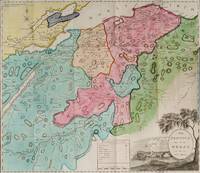
179829839AB1798. First Edition. Aberdeen Printed for Isaac Forsyth Bookseller Elgin 1798. Octavo 14 cm x 215 cm. Folded hand-coloured Frontispiece-Map by William Millar Frotispiece-Engraving of the "Elgin Cathedral" VIII 353 pages. Original Hardcover / Original 18th or early 19th century leather with original spinelabel. The large hand-coloured Map with a minor tear only. Corners slightly bumped. Spine slightly starting but overall in excellent condition with some minor signs of wear only. Interesting Provenance and signed manuscript dedication by the Cartographer and Mapmaker William Millar: From the library of Aberdeen Highlander Major Hugh Houstoun with a dedication: "April 27th 1798 - To Major Hugh Houstoun - from his Much obliged and Humble Servant William Millar". The fantastic Map in this publication was produced by William Millar who is identified inside the publication in the text of an Advertisement placed verso the titlepage and in which the Publisher Isaac Forsyth of Aberdeen gives thanks: ".For the very handsome manner in which the two first chapters were furnished by the Revd. Mr.Grant of Elgin and the other two by the Revd. Mr.Leslie of Darkland he offers this testimony of his grateful remembrance. Nor can he omit expressing his sense of obligation to Mr.William Millar Engineer of the Sutherland Coal Work for the Most accurate Map of the Province of Moray ever offered to public notice." The publication includes for example stories about the "First Inhabitants Celts Picts Scots Surnames in Moray Thanes Earls of Moray Family of Gordon Family of Grant Family of Shewglie Family of Innes Family of Brodie Family of Calder Family of Kilravock Family of Dunbars Family of Grangehill and Durn Family of Comyn of Altre Family of Fraser of Lovat Family of Mackintosh Family of Macpherson Family of Macdonalds of Glengary Family of Duff Earl of Fife Family of Gordonstown Family of Lethin Family of Findrassie Family of Murreffs of Duffus Population of Moray Antiquities of the Province with Roman Progress in Moray Vitrified Forts etc. etc. hardcover
178344413Neuchatel Samuel Fauche 1783. 4to. Bound in fine contemp. full sprinckled calf raised bands and richly gilt spine. Wear to head of spine. Without the 2 free endpapers. Halftitle present and with stamps. XXIV367 pp. 2 engraved plates 1 folded. The folded plate depicts his two types of Hair-Hygrometers a. 1 engraved vignette. A fine clean and wide-margined copy. <br/><br/><em>First edition of a fundamental work in Meteorology in which Saussure describes how to construct a hygrometer from human hair that can measure the relative humidity and discussing the principles behind it. Cuvier regarded this book as one of the greatest contributions to science of the eighteenth century."A milestone work in chemistry physics and meteorology which established hygrometry as an exact science. Primarely a geologist who explored and published on the Alps Saussure 1740-1788 was the first to prove that air expands and becomes less dense the more humidity it contains. In these Essais the work offered he describes his experiments with the hair hygrometer of his invention and his theory of the evaporation and hygrometry with their applications to meteorology. he also enunciates his theory of the evaporation of water in hydrogen carbon dioxide and other gases."Neville II p. 427 a."In his essay on the theoretical principles of hygrometry which he conceives as "the art of measuring the absolute quantity of water suspended in the air" De Saussure distinguishes three classes of methods of determining humidity which respectively utilize i observations of changes in the weight dimensions or shape of a hygroscopic body; ii observations of the capacity of the air for taking up water; and iii observations of the quantity of water condensing from the air under given conditions on a cold surface or of the degree of cold necessary to start such an condensation."Wolf "A History of Science Technology & Philosophy in the 18th Century" I p. 326 ff.Partington III 763. - Partington "Breakthroughs" 1783 M - Poggendorff II 755-56. </em> hardcover
1797ST15599London: Printed for T. Longman B. Law F. & C. Rivington R. Baldwin G. & T. Wilkie and J. Walker 1797. 21st Edition. 150 x 93 mm. 5 7/8 x 3 5/8". viii 123 1 ads pp. <br/> Contemporary brown burlap flat spine. With allegorical vignette on title page and 25 half-page woodcuts illustrating items from the vocabulary lists. Pastedowns with traces of book label removal. ◆Spine slightly cocked short split to cloth on rear joint a little fraying at ends of spine but the insubstantial binding surprisingly solid. Two small stains to each pastedown where labels removed title page lightly browned leaves a shade less than bright due to paper quality other minor imperfections but an excellent copy internally clean and fresh with comfortable margins. All in all remarkably well preserved.<br/> <br/> First issued around 1711 this is the best-selling work of James Greenwood 1683-1737 an influential grammarian and a proponent of women's education. Arranged into 33 chapters the book divides vocabulary lists by topic beginning with "things" and proceeding through minerals plants animals humans and diseases to everyday items affairs of church and state the law the military and finally to the various parts of speech from verbs to conjunctions. Widely used the work was revised and reprinted until at least 1828. At about the time this work was originally issued Greenwood had founded a school in Essex where he accepted girls as well as boys as pupils; he was later recruited to serve as assistant headmaster at St. Paul's School in London. This volume is of particular interest because of its rarely seen utilitarian period binding. We would have expected it to have been worn to shreds long ago but against the odds it has withstood hard use by young pupils remarkably well and it gives us a glimpse of an important element of the English schoolroom at the turn of the 19th century. Printed for T. Longman, B. Law, F. & C. Rivington, R. Baldwin, G. & T. Wilkie, and J. Walker unknown
1781ST13831Venice: Giovanni Gatti 1781. 214 x 147 mm. 8 1/2 x 5 3/4". Four volumes. <br/> Attractive contemporary limp paper boards patterned with yellow red and black inks paper manuscript labels on spines deckle edges. With four folding engraved plates at the end of volume IV. Pastedown of volume I with a small square of paper with some inscrutable pencil notations glued down. Bolton p. 646; Cole 893; Partington III pp. 80-90. ◆Edges just a touch bumped a few pages with some very light foxing one page with a small hole affecting a word or two of text plates a little browned along the fold and one plate partially torn along the fold but still A SUPERB COPY exceptionally fresh and clean inside and out.<br/> <br/> Offered here in very pleasing contemporary paper boards this is the first combined edition in Italian of two of Macquer's most popular works: "Élémens de chymie-théorique" 1749 and "Élémens de chymie-pratique" 1751. Coherently written in a straightforward manner primarily with the classroom in mind Macquer himself was a highly respected teacher these works became instantly successful as university-level textbooks. Partington tells us that they replaced Lemery's rather outdated "Cours de Chymie" as the favored text for teaching and they were eventually translated into English German Russian and Italian. Macquer 1718-84 made a few modest chemical discoveries but his chief contributions to the science were his applications of chemistry in particular to the porcelain industry and most importantly his writing. In addition to the present work he also penned "the first dictionary of chemistry in the modern sense" according to Partington. Given that Macquer's works were often destined for the hands of students our copy is a fortunate survival indeed not to mention enormously charming with its original deckle edges clean contents and vibrant pattern. This edition also appears to be quite rare. OCLC locates only 10 copies worldwide with just one in the US Huntington and one in the UK Wellcome. Giovanni Gatti unknown