10 résultats
179018573Paris: De l'Imprimerie de L. Potier de Lille 1790. 8vo. Disbound. 19 pages. 8vo. Following Robespierre's election in 1789 a strong campagne to discredit and denigrate Robespierre in the eyes of the populace that had elected him took place. It was quite effective and Robespierre was even warned not to return to his area for fear of physical attack. This campagne was credited a great deal to Brios de Beaumetz the elder in the Council of Artois and his son also Brios de Beaumetz a member of the Assembly with Robespierre. Robespierre decided that these attacks should not go unanswered and the present pamphlet is part of the response. He was strongly attacked for a comment saying that most of the people of Artois did not pay enough taxes. This was picked up by Beaumetz and widely circulated causing great discord and greater loss of popularity. What this related to was the decision of the Assembly in October 1789 to adopt conditions for being a candidate for election or an elector and basing it upon the amount of direct tax paid by the individual. Robespierre had pointed out that only the rich in Artois paid direct taxes and the most of the population there paid duty or indirect taxes and would therefore be excluded from the electoral process. This is explained in this pamphlet which includes a letter of good conduct by other Artois delegates to the Assembly Fleury Du Buisson Boucher Payen de Croix Brassart and Charles de Lameth. M & W IV 29526-18 De l'Imprimerie de L. Potier de Lille unknown
179423050Paris: De L'Imprimerie Nationale 1794. First edition. 4 pages. 1 vols. 8vo. Disbound else a very good copy. First edition. 4 pages. 1 vols. 8vo. Recommending honors for bravery and dying for the nation on Fabre de l'Hérault. The Convention Nationale gave Fabre the honors of the Pantheon. M &W IV 29526-46 De L'Imprimerie Nationale unknown
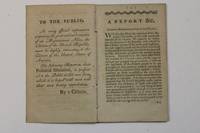
179439879Boston: Reprinted by T. Fleet jun. for William T. Clap. . . 1794. 12mo. 36pp. Disbound else Very Good.<br /> <br /> Prefatory remarks "To the Public By a Citizen" explain that "every official information respecting the great national concerns of our Magnanimous Allies the Citizens of the French Republic must be highly interesting to Citizens of the United States of America." Thus the reason for this highly favorable report on the progress of the French Revolution. The Report is signed in type at the end by "Robespierre In Behalf of the Committee of Public Safety."<br /> Evans 27003. ESTC W26438. Reprinted by T. Fleet, jun. for William T. Clap. . . unknown
179218576Paris: De L'Imprimeris Nationale 1792. 8vo. Disbound. 15 pages. 8vo. Responding to the public need for bread and grains he challenges the judgements of the lawmakers and those choosing to tax and control grains as they do indigo and similar imports without consideration of the needs of the people for provisions. M & W IV 29526-32 De L'Imprimeris Nationale unknown
179418583Paris: de l'Imprimerie Nationale 1794. 8vo. Disbound. 6 pages. 8vo. In an effort to combat atheism Robespierre and others of the National Convention scheduled a Fête de l'Être Suprême on 8 June 1794 the culmination of which was to be the symbolic destruction of the statue of Atheism by fire and the emergence of Wisdom from the remains. Unfortunately the figure of Wisdom was so badly smeared in soot that the audience laughed. This was his speech to inspire the people and to assure them of the Supreme Being and of his support of their notable cause. M & W IV 29526-40 de l'Imprimerie Nationale unknown
179218578Paris: De l'Imprimerie de Mayer et Compagnie 1792. 8vo. Disbound. 16 pages. 8vo. The Brissotins were continuing to battle against the power and conduct of Robespierre. He had been elected public prosecutor of the criminal tribunal of Paris and resigned prior to taking his seat. He had spoken in March of the peaceful intentions of the Emperor Francois II attributing Emperor Leopold's demise as an act of Providence drawing severe criticism from the atheists and specific criticism from the Girondin deputy Guadet. On the 20th of April Louis XVI had proposed a declaration of war against the King of Bohemia and Hungary and the vote was carried unanimously. Robespierre was against it. Guadet attacked him denouncing him with an accusation of tyranny and Robespierre responded with his explanation of his behavior how he had done everything that he had done for the country to guarantee freedoms and establish equality how when his goals were reached he would retire into private life but how could he abandon the nation that needed him in its time of crisis. He also as usual strikes out at Lafayette. M & W IV 29526-61 De l'Imprimerie de Mayer et Compagnie unknown
179418581Nismes: De l'Imprimerie Nationale de J. Gaude Imprimeur du Departement du Gard 1794. Reprinted by the Departement du Gard for distribution. 8vo. Stitched. 16 pp. Reprinted by the Departement du Gard for distribution. 8vo. His defence and explanation of the laws and actions of the revolution "La revoltion est la guerre de la liberte contre ses ennemis: la constitution est le régime de la liberté victorieuse & paisible". M & W IV 29526-45 variant De l'Imprimerie Nationale de J. Gaude, Imprimeur du Departement du Gard unknown
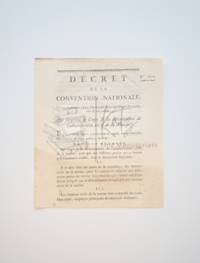
17930010134France. Very Good. 1793. Ephemera. On offer is offer is a superb copy of the order that purged the French Navy of its officer corps in the days of the Reign of Terror in the French Revolution. This document is the order given to suppress the Navy. An excerpt of the document follows: Qui supprime le Corps et la denomination de l'administration civile de le Marine Le corps et la denomination de l'administration civile de la marine ainsi que des differens grades qui y etoient precedemment etablis font ey demeurent supprimes. Translation: iWhich abolishes the Body and the designation of the civil administration of the Navy The body and the designation of the civil administration of the navy as well as the different ranks which were previously established there are and remain suppressed. . Les dispositions ci-dessus sont communes aux ingenieurs constucteurs. : ils cesseront egalement de saire corps. Ils auront le meme uniforme que les employes aux bureaux civile de la marine avec la seule difference que les paremens de l'habit seront en velours noir mais il ne seront sous les ordres d'aucun des employes. Translation: .The above provisions are common to the construction engineers: they will also cease to be a body. They will have the same uniform as the employees of the civil offices of the navy with the only difference that the clothing will be in black velvet but they will not be under the orders of any of the employees The document was inspected by a man named Blaux and also bears a printed signature of Robespierre. The order also bears the printed signatures of Dabarade and Gohier. Dalbarade was Jean Dalbarade the Minister of the Navy and Colonies Gohier was Louis-Jerome Gohier the Minister of Justice and of course Robespierre was Maximilian Robespierre who became the embodiment of the Reign of Terror which saw an orgy of public executions numbering between 15 and 20 thousand citizens. Information on the history that informed the document is as follows. The French navy has always been affectionately known as La Royale The Royal in part because of its close relationship with the monarchy. Under Louis XVI the French Navy was rebuilt into a powerful fighting force capable of fighting and defeating the British Royal Navy. The French Navy played a decisive role in the American Revolution defeating the Royal Navy in the Battle of Chesapeake Bay. However the French Revolution was to be a disaster for the French Navy. In 1793 sailors in the Brest Squadron mutinied in a series of mutinies that became known as the Quiberon Mutinies. This occurred at the height of the Reign of Terror. Regardless of the underlying causes this gave the hardline revolutionaries the justification needed to purge the officer corps of the Navy. The French Navys officer corp was comprised of many members of the old aristocracy and was viewed with deep suspicion. The purge resulted in dozens of ships captains being driven out of the navy along with some admirals. Many were imprisoned and some sent to the guillotine. The Naval Gunnery School was also disbanded with catastrophic consequences when they had to face the Royal Navy. Since 1745 the Royal Navy required all ships to run gunnery drills daily and in action a Royal Navy ship could fire a broadside every 90 seconds which was unmatched by any other navy. For a historian this is a superb document that speaks to the heart not only of the Reign of Terror but also to the debilitating purges of the French navy at a time when they were so needed. This 4-page printed manuscript measures 8.25 inches by 7.0 inches The document is 100% complete. The paper is in very good condition. There is some slight staining on the inside right page but it does not in any way interfere with the legibility of the contents. The document is signed and countersigned with printed signature and also bears a handwritten signature confirming it is a certified copy of the original legislation. ; 8vo 8" - 9" tall; 4 pages; Signed by All Authors . unknown
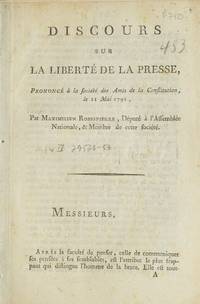
179118587Paris: De L'Imprimerie Nationale 1791. 8vo. Disbound. Some spotting at front and back. 23 pages. 8vo. Robespierre on freedom of the writer and the press and on slander: "la liberté de la presse ne peut être distinguée de la liberté de la parole; l'une & l'autre est sacrée comme la nature; elle est nécessaire comme la société même. Par quelle fatalité les lois se sont-elles donc presque partout appliqués à la violer C'est que le lois étoient l'ouvrage des despotes & que la liberté de la presse est le plus redoutable fléau du despotisme". M & W IV 29526-53 De L'Imprimerie Nationale unknown
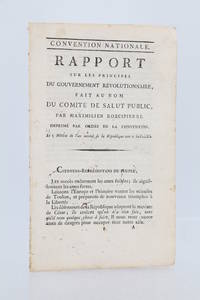
179383855Paris: Convention Nationale 1793. Fine. Convention Nationale Paris 5 Nivôse An II 25 Décembre 1793 12 x 19.50 cm broché First edition of this famous speech by Robespierre justifying the principle of revolutionary government and laying the foundations for the establishment of the Terror. Small black ink stains sometimes faded and some foxing. In autumn 1793 the threats weighing on the Republic had intensified both at the borders and in the heart of the country: Hébert the extremist ""enragé"" calling for a popular uprising the royalist threat still present the Indulgents demanding an end to the policy of Terror. On 5 Nivôse Year II December 25 1793 Robespierre went to the Committee of Public Safety to present the principles of revolutionary government. He warns from the very first words of his speech: recent victories Vendée defeats of December 12 and 23 recapture of Toulon on December 19 thanks to the notable action of Captain Bonaparte must not lull patriots into complacency. Counter-revolution remains very active within the country the Committee of Public Safety must confound the intrigues of the enemies of liberty and make revolutionary principles triumph. In his words: ""Le gouvernement révolutionnaire doit aux bons citoyens toute la protection nationale ; il ne doit aux ennemis du peuple que la mort."" ""Revolutionary government owes good citizens all national protection; it owes the enemies of the people nothing but death."" To carry out its action successfully the latter must find its way between two extremes: the moderatism preached by the ""indulgents"" and the excess aspired to by the ""enragés."" For Robespierre the dictatorship of the Committees like the Terror is justified because they alone will make it possible to end civil and foreign war. As long as the country is in conflict citizens will not be able to fully enjoy the Constitution. Counter-revolution must be annihilated. To this end Robespierre demands reform of the Revolutionary Tribunal. Reform that would find its culmination in the law of 22 Prairial Year II June 10 1794: suppression of defense hearing of witnesses when material evidence is lacking acquittal or death being the only possible verdicts. Thus the machinery of Terror is set in motion replacing with arbitrariness the principles and laws enacted by the Declaration of the Rights of Man and by the Constitution. cf Delphine DUBOIS and Régis LAPASIN on the site Nouvel éclairage sur l'histoire - L'histoire par l'image. Very rare copy of this founding speech of the policy of Terror which would ultimately lead its principal instigator Maximilien Robespierre to the scaffold. Convention Nationale unknown