MARAT, Jean-Paul (1743-1793).Biblio.com
4 résultats
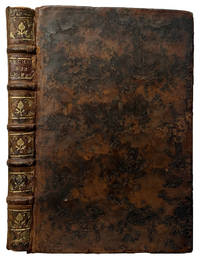
1780S14167Paris :: Cl. Ant. Jombert 1780. 1780. 8vo. 4 202 2 pp. Half-title engraved frontispiece portrait tipped-in title vignette 7 folding engraved plates by Madame Ponce; some waterstaining. Contemporary full mottled calf raised bands spine tooled spine compartments maroon leather label; spine ends worn front joint starting rubbed. Very good. 290 First edition. Marat "practiced in Paris well-known for his activities in the French Revolution; Benjamin Franklin was interested in his electrical experiments but his works especially on fire and heat were discredited." – Cole. / There is apparently one known copy with a portrait plate perhaps spurious or added to the work and yet most every copy does not mention a portrait. Cole notes two copies without a portrait and one at Oklahoma University he saw only in microprint where a portrait was present – Cole says "appears to have a portrait." Of several copies found for sale none had a correct portrait. I inquired about the Oklahoma copy and they verified that it does not in fact have a portrait see above. Net result: the book was not issued to the public with a portrait. Copies mentioning a portrait will thus be referencing a tipped-in plate from another source presumably an unknown source. / "In this book Marat attempts to give a mechanical explanation of the phenomena of heat by the use of his theoretical 'fluide igne.' Some 166 experiments are described in support of his views." – Cole. / NOTE: "Jean-Paul Marat was a leader of the French Revolution along with others like Danton and Robespierre. In 1793 he was assassinated while soaking in a bath—one of the most famous murders in French history. While there is no question about who killed him the reason he was in the bath has confounded historians for centuries. And this mystery may have just been solved." "Marat bled profusely when he was stabbed and his blood soaked the papers he was working on. These were kept by his sister and eventually found their way to the National Library of France. / French forensic scientist Philippe Charlier working with a team of specialists was recently able to extract DNA from these centuries-old papers. As well as finding DNA that confirmed Marat's ancestry French and Italian the team found a number of non-human DNA fragments. / These fragments ruled out many of the popular theories—no syphilis no scabies no leprosy or tuberculosis. But there was strong evidence of an advanced fungal infection of Malassezia restricta. This would explain his pain and sores and would probably have damaged his immune system as well leaving him open to other infections. / While the answer can't be known for sure modern technology seems to have validated the belief of Marat—ever the scientist—that the sewers of Paris were his undoing." – Keith van Sickle The Good Life. REFERENCES: Bolton 1899 284; Cajori History of physics 1929 p. 122; Chevremont p. 14; Cole 909 without portrait; Duveen 388 without portrait; Ferchl 337; Partington III p. 607; Poggendorff II 39; Waller 11396. See: C. Connor Jean Paul Marat: Scientist and Revolutionary. Atlantic Highlands NJ: Humanities Press International 1997. Cl. Ant. Jombert, 1780. hardcover
1792334974Paris: De L'Imprimerie de Marat 1792. First edition; see Martin & Walter III No. 22896; Hayden. 'French Revolutionary Pamphlets' No. 2425. 32pp. Small 8vo. Pamphlet has been rebound with early leather spine stamped in gilt and early marbled endpapers present lacking boards; text is lightly foxed otherwise fresh and clean a very good copy. First edition; see Martin & Walter III No. 22896; Hayden. 'French Revolutionary Pamphlets' No. 2425. 32pp. Small 8vo. Jean-Paul Marat 1743-1793 Swiss-born French scientist and physician was the editor of 'L'Ami du Peuple' and an advocate of the September 1792 massacre of jailed "enemies of the Revolution" launching the Reign of Terror.<br /> <br /> Scarce; OCLC locates only a few holdings. Martin & Walter III No. 22896; Hayden. 'French Revolutionary Pamphlets' No. 2425 De L'Imprimerie de Marat unknown
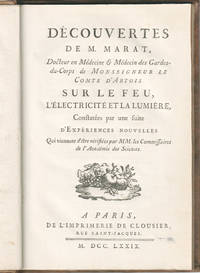
177912883Paris: Clousier 1779. 207x136mm. 8¼x5¼". Paris Clousier 1779. En 4º 207 x 136mm. 6 38 pp. Encuadernación de mediados del siglo veinte en piel. Primera edición del primer trabajo publicado de Marat sobre el fuego la electricidad y la luz presentado a la Academia de las Ciencias y a cuyos experimentos acudieron varios académicos entre ellos Benjamin Franklin. Jean-Paul Marat 1743-1793 fue un cientÃfico y médico francés que realizó gran parte de su carrera en Inglaterra; sobresalió como polÃtico durante la Revolución francesa: identificado con el ala izquierdista de la Revolución los jacobinos su apasionada defensa del Terror le llevó a ser asesinado por Charlotte Corday una joven girondina. Marat presentó esta <em>Memoria</em> para su ingreso en la Academia aunque no consiguió ser aceptado como miembro pues los académicos estaban horrorizados por su osadÃa al disentir de Isaac Newton. Sus experimentos interesaron sobremanera a Benjamin Franklin quien solÃa visitarle y Goethe siempre consideró el rechazo de la academia como una clara muestra de despotismo cientÃfico. Clousier unknown
179347018Paris: De l'Imprimerie de Marat 1793. Very Good. Paris: De l'Imprimerie de Marat l'Ami du peuple rue des Cordeliers No. 30 n.d. ca. 1793. First Edition. Four volumes bound in one; quarto 26cm; full contemporary mottled calf elaborate floral gilt spine with tan gilt-lettered spine label marbled endpapers. Leather dried and starting to peel along margins scattered foxing to early leaves else Very Good and sound.<br /> <br /> Volume of four contemporary works relating to a leading figure of the French Revolution Louis Heron 1746-1796 who paired with the radical Jacobin politician Marat 1743-1793 participated in the Insurrection of 10 August 1792 and the September Massacres the following month. <br /> <br /> Contents include: "Complot d'une Banqueroute Generale"; "Memoire a Consulter pour Louis Heron Citoyen François"; "Mémoire pour le Sieur Héron Citoyen Breton"; and no. 209 of the periodical "Le Publiciste de la République Française" edited and published by Marat. De l'Imprimerie de Marat unknown