96 résultats
1783180319007Rome actually Neuchatel Switzerland: De l'Imprimerie du Vatican Francois Mallet 1783. First Edition. Hardcover. Very Good. First edition. iv 192 pp. Original red boards spine lettered in gilt. Very Good with light wear to boards and foxing. British publisher novelist book collector and bibliographer Michael Sadleir's copy with his small bookplate on paste down. <p>A rare work of erotica written in prison in Paris while the author was sentenced to die for "abduction and seduction." Erika Delbecque Special Collections Librarian at University of Reading writes of this book: <p>Organised by different sexual practices and perversions into eleven chapters including topics such as bestiality ‘Béhéma’ female homosexuality ‘L’Anandryne’ and nymphomania ‘La Linguanmanie’ it purports to offer a history of human sexual behaviour. Mirabeau draws on quotes from the Bible and ancient sources to provide historical examples of each sexual practice and attacks the corruption of the clergy and the aristocracy in the process. De l'Imprimerie du Vatican (Francois Mallet) hardcover
1785751L23London: W Faden 1785. First edition. Leather. Very Good. 9" by 5.5". Not Stated. A very scarce English language edition of this political writing regarding the free navigation of the Scheld. Written by one of the leaders of the early stages of the French revolution Honore Gabriel Riqueti. ESTC reference no: T83504. A very scarce work This translation is of Mirabeau's 'Doutes sur la liberte de l'Escaut reclamee par l'empereur'. Engraved vignette to the title page. With the folding map which has been rebacked with linen. Bookplate of the City of Westminster to the front pastedown. The Scheldt river flows through northern France Western Belgium and southwestern part of the Netherlands with its mouth at the North Sea. Access to this river was the subject of the brief Kettle War of 1784 and during the French Revolution. This book looks at this issue of access to the river. In a half morocco binding. Externally generally smart. Patches of rubbing to the spine and extremities. Small loss to the head and tail of spine. Bookplate to the front pastedown. Internally firmly bound. Pages are bright. A few chips to the title page and to a2 and A1. Pages are clean. Very Good W Faden hardcover
17588067Paris 1758. Second Edition of parts I-III first Edition of part IV. 8 192; 2 266 4; 6 264; 8 278 81pp. 2 vols. 4to. Contemporary mottled calf with gilt spines red morocco labels; covers a bit rubbed spine extremities and corners worn with slight chipping otherwise a very good copy internally crisp and clean. Frontispiece lacking as is often the case. Bookplates of A. de Seville. Second Edition of parts I-III first Edition of part IV. 8 192; 2 266 4; 6 264; 8 278 81pp. 2 vols. 4to. A work of fundamental importance whose appearance created a sensation throughout Europe was widely translated and reprinted and earned its author an international reputation "greater than that of any other economist before or after not excluding Adam Smith or Karl Marx." Schumpeter p. 175n Mirabeau argues that wealth is the product of population -- in particular agriculture -- and that a large populartion is desirable that religious toleration free enterprise a more equitable system of taxation and distribution of wealth were necessary components of a vital economy. The first three parts appeared in 1756; by 1758 Mirabeau had fallen under the influence of Quesnay and issued the fourth part in which the latter's influence is very much felt. The two between them it may be said founded the school of the physiocrats. A fifth and sixth part were added in 1760. Kress 5735; Higgs 1631; Goldsmith 9317 unknown
1788263089Londres 1788. hardcover. very good. 3 titles bound together. 183 72 142. 8vo 3/4 vellum backed green boards covers worn. Londres: 1788. Very good . Scarce.<br/> <br/> unknown
1798D7144Paris 1798. Hardcover. Very Good. Contemporary tan calf boards ornately gilt-ruled gilt-stamped detail in spine compartments gilt-stamped lettering in black leather spine label a.e.g.; 3 volumes large 8vo 148 x 234 mm; with half-titles and 15 engraved plates each in 2 states uncolored and color-printed. Latin text with French translation and notes by Victor de Riquetti Marquis de Mirabeau. Lovely bindings in excellent condition just a few small scuff marks here and there. And equally lovely plates -- some light dampwrinkling along top edge of some leaves in Volume 2; a few leaves toned in Volume 3. A handsome set. Cohen-de Ricci 993. <br/><br/> hardcover
1776015882Londres Paris: se 17761788. Tre opere riunite in un volume 12x20 cm legatura coeva in piena pelle dorso liscio ornato e dorato; risguardie con carta marmorizzata tagli marmorizzati. 1- ESSAI sur le despotisme. Londres 1776. Di 214pp. Ristampa della prima edizione. 2- OBSERVATIONS d'un voyageur anglais sur la maison de force appelé Bicetre; suivies des réflexions sur les effets de la sévérité des peines et sur la la législation criminelle de la Grande-Bretagne. Avec une lettre de M. Benjamin Franklin. Sl ma Paris 1788. Di 2-VIII-128pp. Prima edizione. Einaudi 393- 3- SUR LA LIBERTÉ de presse. Imité de l'anglois de Milton. Londres. 1788. Di 66 pagine. Ma gli ultimi 8 fogli sono interessati da una vecchia erosione circolare che sebbene restaurata comporta la PERDITA di varie parole del testo. se unknown
1760018551Avignon Hambourg: Se Herold 1760. Otto parti in sette volumi in 12° piena pelle del tempo dorso a nervi ornato e dorato. Paginazioni: Vol.1: Avignon 1760; pp.290. Vol.2: Avignon 1760; pp.389. Vol.3: Avignon 1760; pp.378. Vol.4: Avignon 1760; pp.208336. Vol.5: Memoire sur lAgriculture Hambourg Herold 1760; VI281pp. Vol.6: Reponse a lEssai sur les Ponts et Chaussées Hambourg Herold 1760; 205pp. Vol.7: Tableau économique avec ses explications Hambourg Herlod 1760; 192pp con 6 tavole ripiegate Huitième partie Lettres pour servir de suite a lAmi des Hommes Hambourg Herold 1760; 184pp. Lultima parte con le Lettres pour servir. è in edizione originale. Gli ultimi tre volumi sono dello stesso anno delledizione originale. Bell' insieme in ottime condizioni di questa opera capitale per la storia dell'economia politica testo fondatore della scuola fisiocratica. Se, Herold unknown
1788GRALMIRA19London: 1788. 1788. 7 Volumes of text in 8 in 8vo. plus folio atlas. with half-titles. engraved frontis. portrait & 1 other engraving in text volumes. atlas containing 10 double-page engraved maps 93 engraved plates some folding & 60 tables some folding. text volumes bound in 19th century quarter sheep spines defective one cover detached several joints cracked internally very good except for some faint embrowning. the atlas uncut in original bds. spine wanting covers worn some dampstaining to plates & tables. First Octavo Edition of the text also published in quarto format. An exhaustive work published following Mirabeau's secret mission to the court of Prussia at Berlin in 1786 dealing with geography population agriculture natural resources manufactures commerce revenues and expenses military affairs religion &c. Mirabeau was assisted in its compilation by Jakob Mauvillon and J.Thibault de Laveau. The numerous statistical tables are separately bound in the atlas volume together with ninety-three engraved military diagrams and ten double-page engraved maps by Edme Mentelle. An extensive bibliography of eighty-nine works is given in Volume I. Kress B1448-49. Cioranescu 45224. 1st Edition. Hardcover. Fair. London: 1788. Hardcover
1758EIRAm[MI39<p>Parts I-III: Avignon: 1756 & Part IV: np: 1758. 1758. 4 Parts in 5 Volumes. 12mo. pp. 431 1; 578 1 leaf; 577 1; 4 p.l. 285; 1 p.l. 313 1 150 1 leaf. engraved frontis. in Vol. I. woodcut initials. An attractive set bound in 19th century tree sheep slight worming to lower front joint of Vol. I & lower front cover of Vol. III. First Duodecimo Edition; originally published in quarto format the same year. Fourth present here fifth and sixth parts containing material by other writers including Quesnay were published in 1758 and 1760. Mirabeau's treatise created a sensation throughout Europe and was widely reprinted and translated earning for its author "though only for a few years a.fame much greater than that of any other economist before or after not excluding Adam Smith or Karl Marx.". Schumpeter p. 175n In it Mirabeau intended to show that agriculture is the great source of subsistence and must be encouraged that a large population is desirable and that religious toleration free trade a more equal distribution of wealth and lower and equitable taxation are needed for the economic improvement of the country. The work attracted the attention of Quesnay and the meeting of the two men led to the formation of the physiocratic school. Quesnay contributed to the continuations including a portion of the fourth part and the Tableau Économique in part six. Goldsmiths' 9093 Vols. I-III. Higgs 1143 & 2160. Kress 5545. Quérard VI 154. Stourm p. 100n. Tchemerzine VIII 750 Vols. I-III. Coquelin & Guillaumin II pp. 190-91. cfEinaudi 3941.</p> [Parts I-III:] Avignon: 1756 & [Part IV:] np: 1758.
1788010138A Londres; et se trouve A Paris: Chez Le Jay & Maradan 1788. Book. Very Good Plus. Vellum. First Edition. 4to - over 9¾" - 12" tall. Four volumes bound in contemporary full vellum red morocco labels back with gilt lettering and devices marbled end papers. Provenance; with the bookplates of Francesco Rizzo Patarol 1749-1807 front paste downs of Vols. I III and IV whose noble family built the Rizzo Patarol palace in Venice which was at one time the seat of the Savoy embassy then the French embassy. A Very Good Plus set light soiling to vellum uniform browning. Vol. I: xliv 522 pp. 8 tables 7 of them fold-out. Vol. II: 2 566 4 pp. 34 tables 25 fold-out. Vol. III 710 pp. 2 fold-outs at p. 34 plus engraved Metropolis of Scotland Colledge fold-out plate tipped in at p. 449. Vol. IV: 4 560 1 pp. 14 fold-outs. An oversize and heavy set extra postage will be requested for priority mail or international orders. Chez Le Jay & Maradan Hardcover
1769126597Amsterdam et se trouve à Paris: Lacombe 1769. Scarce complete thus attractively bound First duodecimo edition of Mirabeau's Les économiques also printed in a single quarto volume format the same year. A further volume was published in 1771 also in both quarto and 2-volume duodecimo formats. Complete sets are very scarce. Mirabeau who seems to have taken the title of this work from the Économiques of Xenophon here gives various methods of economic instruction for the various levels of society; he also suggests the method of approach in the instruction of heads of government. 2 vols duodecimo 162 x 95 mm. Engraved head- and tailpieces. Near-contemporary half calf twin morocco labels spine elaborately tooled in gilt red morocco onlay roundels with vol. numbers to foot of spine marbled paper boards. Ownership signature to title pages of both vols of one H. Wrangel possibly a descendant of the Swedish Governor General Hermann Wrangel 1584-1653 whose crest incorporates a turret as stamped at the head of each spine. Extremities lightly rubbed two neat paper repairs to title leaf of volume 1 else a very good set attractively bound. Einaudi 3943; Higgs 4568; INED 3196; Mattioli 2432 hardcover
1791015877Paris: Lejay e poi Devaux 1791-92. .Precedée de tous les Discours et Ouvrages du meme Auteur prononcés ou publiés en Provence pendant le cours des élections. Par M. Etienne Méjan. - 5 volumi 125x21 cm in mezza pelle coeva dorso liscio ornato e dorato con tassello di titolo rosso fenditura alla cerniera del vol 1 e in coda la dizione Bibliothèque de Michel Chevalier. Ex libris di Chevalier anche all'interno di ognuno dei 5 volumi. Piatti con carta marmorizzata usure tagli gialli -Paginazioni: Vol 1: 4-396-IV pagine; ritratto di Mirabeau in antiporta. Una tavola ripiegata di tabelle fuori testo che si riferisce però al tomo 5. Vol 2: 4-514-IV pagine. Vol 3: 4-436-VII pagine. Vol 4: 4-362-II pagine. Vol 5: 538 pagine. Ricercata raccolta -sconosciuta allEinaudi e al Kress- degli interventi di Mirabeau allAssemblea Nazionale dal 1789 al 1791 pubblicata subito dopo la sua morte. Contiene numerosi pezzi di soggetto economico e finanziario per esempio: "Sur la proposition faite par M. Necker douvrir un emprunt de 30 millions"; "Sur le nouveau imprunt de 80 million proposé par M. Necker"; Discours sur la caisse descompte in polemica con Necker; Sur le papier monnoie; Motion pour létablissement dune caisse nationale; Discours sur le projet de banque nationale présenté par M. Necker; Discours sur le retour des Indes; numerosi interventi soprattutto nel IV vol. sulla emissione di assignats. Ma i discorsi potevano toccare naturalmente altri argomenti come "Sur les droits à donner aux Juifs et aux comediens" sic; "Discours sur le droit de paix et de guerre"; Eloge funebre de Franklin". Il 5° volume contiene per la prima volta in edizione completa uno dei più importanti lavori economici di M. le Observations préliminaires sur le premier rapport du comité des monnoies presentate il 12 dicembre 1790. Pp.11-224. Un errore del rilegatore ha spostato le pagg. 209-224 quaderno O dopo pag. 368. Inoltre la tabella fuori testo sui saggi delloro è stata per errore inserita allinizio del tomo 1. Proprio il saggio di Mirabeau venne poi ripreso e ripubblicato da Michel Chevalier nel suo "De la baisse probable de lor." Paris Capelle 1859 Einaudi 1050. Esemplare quindi di straordinaria provenienza. Mirabeau avait à cette date 41 ans. Il avait en finances des connaissances etendues mai sourtout dexcellents conseillers qui lui preparaient ses papiers. Ses idées en matière monétaire mériteraient une étude trés attentive: on sait che sa volumineuse Constitution monetarire a passé longtemps pour un classique de la littérature monetaire et Michel Chevalier la publiait encore en 1859: Guy Thuillier Les idées monetaires au debut de la Révolution: Mirabeau et la réforme monetaire de 1785 Roma Accademia dei Lincei 1979 pp.7. Lejay e poi Devaux unknown
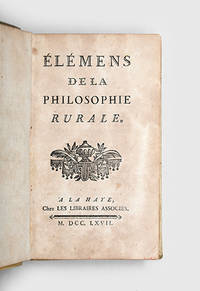
1767164209The Hague: chez les Libraires associés 1767. Handbook of Physiocracy including the Tableau économique First edition of Mirabeau's own abridgement of his and Quesnay's Philosophie rurale 1763 the first textbook of the physiocratic school. The Philosophie rurale presented "perhaps the most complete and magisterial account of the views of the Physiocratic school" Higgs p. 57. The Eléméns condenses the work into a more manageable textbook format aiming at a broader dissemination and understanding of the system. Importantly the Eléméns contains as a folding plate the Tableau économique first published in 1758 in a minute number of copies and reproduced in Mirabeau's L'Ami des hommes in 1760 and in the Philosophie rurale. The Tableau économique is cited as the earliest attempt to visualize a comprehensive model of the economic system illustrating the flow of goods and money and the interdependence of the agricultural manufacturing and commercial sectors. It is credited as "the most important and famous work of Physiocracy and has often been regarded as a summary of the entire corpus of Physiocratic economics" New Palgrave IV p. 23. Provenance: 19th-century bookplate of Isaac Iselin to the front pastedown; 20th-century note of authorship to front free endpaper; half-title with 20th-century library stamps of the Basel section of Schweiz Vereinigung für Sozialpolitik noted as bequeathed by the Austrian labour economist Stephan Bauer 1865-1934 and of the political science seminar of the University of Basel. Duodecimo 162 x 89 mm. Engraved folding Tableau économique at rear. Contemporary vellum spine lettered in gilt red sprinkled edges. Slight browning half-title loosening a little short closed tear to inner margin of table. A very good copy. Einaudi 3948; Goldsmiths' 10275; Higgs 3977; INED 3197; Kress 6477. Henry Higgs The Physiocrats 1963. hardcover
1760322182Paris 1760. First complete edition. Frontispiece. 192; 266 4; 6 263 1; 6 1-278; 80; viii 1-167 1; 279 5pp. Six parts in three volumes. 3 vols. 4to. Contemporary mottled french calf gilt spines red edges. Some wear at edges and joints. First complete edition. Frontispiece. 192; 266 4; 6 263 1; 6 1-278; 80; viii 1-167 1; 279 5pp. Six parts in three volumes. 3 vols. 4to. The first three parts constituting L'Ami des Hommes were first published by Mirabeau in 1756 before his meeting with Quesnay and his conversion to the physiocratic theses. In 1758 the work was reissued as a new edition with a fourth part added and in 1760 the fifth and sixth parts. Thus the present edition is the first complete one.<br /> <br /> Notably the final volume of the work includes Quesnay's Tableau Economique the first work attempting to describe the workings of the economy in an analytical way. Portions of Quesnay's work had been privately printed in a few copies only at the palace at Versailles in 1758 and 1759 but is here more widely and fully published.<br /> <br /> An important work on economic thought and political theory. Higgs 1628; Goldsmiths 9317; Kress 5735 unknown
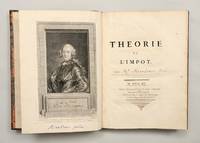
176083935No place: no printer 1760. First edition of a spirited and able attack upon the financial administration of France and especially upon the "fermiers généraux" whom Mirabeau regarded as parasites preying upon the vitals of the nation. The work highlights the problems and injustices of the French system of taxation and added fuel to the fire of the coming revolution. The king disapproved of the work; Mirabeau was imprisoned on 16 December 1760 but through the efforts of Madame de Pompadour and others was released on Christmas Eve under orders to leave Paris for his estate at Bignon. The work proposes a reorganization of financial administrative machinery the abolition of the "Fermes" a reduction in the taxation upon salt with the object of increasing the total yield and a special tax upon tobacco farms. The domaine the post and the mint were to be further sources of revenue. The author ranks as one of the earliest important writers on taxation. Higgs notes that the book is "of real importance in the history of financial theory" The Physiocrats p. 57. Quarto 257 x 192 mm. Additional engraved frontispiece portrait of the author. Contemporary sprinkled calf spine ruled and decorated gilt in compartments red morocco label sprinkled edges. Spine ends and corners skilfully repaired. Manuscript note to title-page "par Mr Mirabeau père" with a short verse "helas dans le Siècle ou nous sommes / pour avoir dit la vérité / Mirabeau cet ami des hommes vient de perdre la liberté" in a neat calligraphic hand. Occasional light foxing. A very good copy. Goldsmiths' 9836; Higgs 2881; INED 3204; Kress 6120. unknown
1756131625Avignon: n.p. 1756-60. The first public appearance of Quesnay's Tableau économique First edition of all six parts containing the first public appearance of Quesnay's Tableau économique. The first to follow Quesnay in the foundation of the Physiocratic circle Mirabeau was familiar with and influenced by Cantillon's theories. As well as fully articulating the principles that were to mark the school of physiocrats and expounding their implications regarding population agriculture and commerce the Ami des Hommes contained a reproduction of Quesnay's Tableau économique vol. VI previously published separately in very small numbers in 1758 and 1759. Mirabeau's reproduction made the essay obtainable thus bringing the founding document of the school of physiocrats to the attention of a wide public. "This remarkable treatise created the greatest sensation throughout the whole of Europe. It is said to have gone through forty editions and was translated into several languages. Its anonymous author soon discovered became the idol of the day and was generally referred to by the soubriquet which he had chosen for the title of his book" Palgrave II p. 775. Following the publication of the first three parts Mirabeau made the acquaintance of Quesnay who had been greatly impressed by his book. "Mirabeau now became the fervent admirer of Quesnay and between them they founded the school of the Physiocrats" ibid. In 1758 a fourth part was published in which Quesnay's influence is clearly visible. The remaining two parts were published in 1760. The final part is of particular importance as it contains the first obtainable appearance of Quesnay's Tableau économique which was previously published separately in tiny numbers in 1758 and 1759. An English translation was first published in 1766. 6 parts in 2 vols quarto 246 x 188 mm. Contemporary French mottled calf spines ruled and decorated gilt in compartments all edges red. Joints and extremities expertly restored scattered foxing to contents; a handsome copy. Einaudi 3941; Goldsmiths' 9092; Higgs 1143 1631 & 2160; INED 3194; Kress 5543 & 5736; Mattioli 2426 2428 & 2429. unknown
176084111No place: no printer 1760 & 1761. OF REAL IMPORTANCE IN THE HISTORY OF FINANCIAL THEORY" - a BEAUTIFUL COPY First edition of both works pairing Mirabeau's Théorie de l'Impôt his spirited and able attack upon the financial administration of France especially the "fermiers généraux" whom Mirabeau regarded as parasites preying upon the vitals of the nation with Pesselier's counterattack notable for its terse affirmation of the characteristically Physiocratic doctrine that agriculture holds a privileged place in the economic system. Mirabeau's work highlights the problems and injustices of the French system of taxation and added fuel to the coming fire of the revolution. The king disapproved of the work; Mirabeau was imprisoned on 16 December 1760 but was released on Christmas Eve through the efforts of Madame de Pompadour and others under orders to leave Paris for his estate at Bignon. The work proposes a reorganization of financial administrative machinery the abolition of the "fermes" a reduction in the taxation upon salt with the object of increasing the total yield and a special tax upon tobacco farms. The domaine the post and the mint were to be further sources of revenue. Mirabeau ranks as one of the earliest important writers on taxation. Higgs notes that the book is "of real importance in the history of financial theory" The Physiocrats p. 57. Pesselier was one of the most forceful critics of the physiocrats. Of the products of the soil Pesselier here writes "Elles procurent un profit net et durable puisqu'elles sont à l'abri de l'imitation" "They provide a net and lasting profit since they are safe from imitation". Two works bound in a single vol. quarto 255 x 193 mm. Contemporary French mottled calf spine decorated gilt in compartments red morocco label marbled endpapers. Housed in a brown morocco-backed book-form case. Engraved armorial bookplate to front pastedown. Lower edge a little rubbed with corners worn very occasional spotting; very good copies. Mirabeau: Einaudi 3946; Goldsmiths' 9602; Higgs 2297; INED 3209; Kress 5883. Pesselier: Brunet I 1118; Einaudi 4409; Goldsmiths' 9695; Higgs 2534; INED 3524; Kress 5964. unknown
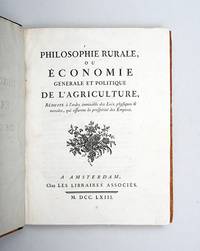
1763153616Amsterdam: Chez les Libraires Associés 1763. The new science of economics Rare first edition presenting "perhaps the most complete and magisterial account of the views of the Physiocratic school" Higgs. "Quesnay collaborated very substantially in preparing this last major work contributing the final chapter with further explanations and manipulations of his Tableau Économique analysis" The New Palgrave. Schumpeter calls the work "the first of the four textbooks of physiocrat orthodoxy" p. 225. It contains for the first time Quesnay's masterful explanation of his Tableau Économique "one of those works in the history of economics which have often been regarded as an anticipation of modern theories" Schumpeter p. 242. Originally printed as a pamphlet of 16 pages in 1758 in a minute number of copies Quesnay's Tableau Économique was first revealed to the public as the final part of Mirabeau's L'Ami des Hommes in 1760. In the Philosophie rurale Quesnay for the first time gives a full explanation of his system. The Tableau économique is credited as the "first precise formulation" of interdependent systems in economics and the origin of the theory of the multiplier in economics. An analogous table is used in the theory of money creation under fractional-reserve banking by relending of deposits leading to the money multiplier. In a letter to Mirabeau written late in 1758 Quesnay remarks "J'ai taché de faire un tableau fondamental de l'ordre économique pour y représenter les dépenses et les produits sous un aspect facile à saisir et pour juger clairment des arrangemens et des dérangemens que le gouvernement peut y causer" translated: "I have tried to make a fundamental table of the economic order in order to represent the expenses and the products in an aspect easy to grasp and to judge clearly of the arrangements and disturbances that the government can cause there". "A most remarkable analysis of the economic condition of his country" Palgrave the Tableau économique "is the most important and famous work of Physiocracy and has often been regarded as a summary of the entire corpus of Physiocratic economics. The Tableau has also been regarded as the analytical synthesis of the logical structure of Quesnay's economics or at least as its most relevant aspect. The Tableau économique is one of those works in the history of economics which have often been regarded as an anticipation of modern theories. The Tableau has been considered a first rough presentation of Keynes's multiplier and as a sort of general equilibrium system of a Walrasian type. For others the Tableau is an input-output table. Because of the Tableau Quesnay has been regarded as an early econometrician. The Tableau has also been interpreted as the first classical system of price determination thus anticipating Marx's reproduction schemes and Sraffa's price system" Giovanni Vaggi in The New Palgrave. Quarto 260 x 192 mm. With 3 engraved plates including the Tableau économique. Contemporary quarter marbled sheep orange paste paper sides light blue endpapers. Housed in a black cloth flat-back box by the Chelsea Bindery. Neatly restored at extremities insect abrasion to spine slight cockling to paste paper sides contents clean and fresh. A very good copy. Goldsmiths' 9836; Higgs 2881; INED 3204; Kress 6120; Mattioli 2435. hardcover
1758153197Avignon: no publisher 1758-60. The first public appearance of Quesnay's Tableau Économique First complete edition of all six parts containing the first public appearance of Quesnay's Tableau Économique; a superb copy in contemporary French red morocco very uncommon thus. The first to follow Quesnay in the foundation of the Physiocratic circle Mirabeau was familiar with and influenced by Cantillon's theories. As well as fully articulating the principles that were to mark the school of physiocrats and expounding their implications regarding population agriculture and commerce the Ami de l'Homme contained a reproduction of Quesnay's Tableau Économique vol. 6 previously published separately in very small numbers in 1758 and 1759. Mirabeau's reproduction made the essay obtainable thus bringing the founding document of the school of physiocrats to the attention of a wide public. "This remarkable treatise created the greatest sensation throughout the whole of Europe. It is said to have gone through forty editions and was translated into several languages. Its anonymous author soon discovered became the idol of the day and was generally referred to by the soubriquet which he had chosen for the title of his book" Palgrave II p. 775. Following the publication of the first three parts Mirabeau made the acquaintance of Quesnay who had been greatly impressed by his book. "Mirabeau now became the fervent admirer of Quesnay and between them they founded the school of the Physiocrats" ibid. With this new edition of the first three parts a fourth part was published in 1758 in which Quesnay's influence is clearly visible. The remaining two parts were published in 1760. The final part is of particular importance as it contains the first obtainable appearance of Quesnay's Tableau Économique which was previously published separately in tiny numbers in 1758 and 1759. An English translation was first published in 1766. 6 parts in 3 vols quarto 252 x 195 mm. Engraved frontispiece in part I engraved head- and tailpieces initials. Contemporary French red morocco spines elaborately decorated gilt in compartments twin green morocco labels raised bands triple gilt rule border to sides gilt inner dentelles marbled endpapers gilt edges green silk ribbon bookmarkers. Authorship attribution to first title in ink in an early hand. Bar a few trivial marks to sides the binding in beautiful condition corners a touch rubbed; vast majority of contents bright crisp and clean with very occasional spotting third volume with some light browning and foxing; loss to lower corners of leaves vol. 1 Hh2 and vol. 3 Aa3 not affecting text; patch of dampstain to last two leaves and final blank of vol. 2. A near-fine set. Einaudi 3941; Goldsmiths' 9317; Higgs 1628 1631; INED 3194; Kress 5735 & 5736; Mattioli 2427 2428 2429 & 2430. hardcover
178957115Paris Chez Baudouin Imprimeur de l'Assamblée Nationale 1789. 8vo. Bound in an exquisite later red half morocco with gilt spine. Top edge gilt. 1 f. title-page 8 pp. "Déclaration des droits de l'Homme en société" 6 pp. "Articles de Constitution" 1 f. "Réponse du Roi" 1 f. blank. Woodcut head-pieces. Title-page slightly bowned otherwise in excellent condition. A truly excellent copy. <br/><br/><em>The exceedingly scarce true first printing in an incredibly rare form of off-print/separate printing of one of the most important and influential documents in the history of mankind namely the French Human Rights Declaration containing also the articles for the first French Constitution. This groundbreaking publication constitutes a monumental change in the structure of the human world providing all citizens with individual rights that we now take for granted. This monument of humanist thought appeared in the "Procès verbal de l'Assemblée Nationale" copies of which are also very difficult to obtain. There however the two parts appeared without a title-page and without the final blank which together constitute a form of wrappers for this off-print/separate printing of which only five or six other copies are known and which is present in merely one or two libraries world-wide. As far as we now only one other copy has been on the private market and that did not have the blank back wrapper. This exceedingly rare separate printing of the Human Rights Declaration with the Constitution was intended for the inner circle of those participating in its creation and was limited to a very restricted number of copies - all of which will have been owned by the creators of the Declaration. This epochal document is just as important today as it was when it was formulated during the French Revolution in 1789 and since 2003 the Declaration has been listed in the UNESCO Memory of World Register - "This fundamental legacy of the French Revolution formed the basis of the United Nations Declaration of 1948 and is of universal value". Few other documents in the history of mankind has done as much to determine the way we live and think the way Western societies are structured and governed and few other documents have had such a direct impact upon our constitutional rights and the way we view ourselves and others in society. It is here that we find the formulation of liberty and equality upon which so much of Western political and moral thought is based - that all "men are born and remain free and equal in rights" Article 1 which were specified as the rights of liberty private property the inviolability of the person and resistance to oppression Article 2; that all citizens were equal before the law and were to have the right to participate in legislation directly or indirectly Article 6; no one was to be arrested without a judicial order Article 7; Freedom of religion Article 10 and freedom of speech Article 11 were safeguarded within the bounds of public "order" and "law" etc. etc.The content of the document that were to change the Western world for good emerged largely from the ideals of the Enlightenment. "The sources of the Declaration included the major thinkers of the French Enlightenment such as Montesquieu who had urged the separation of powers and Jean-Jacques Rousseau who wrote of general will-the concept that the state represents the general will of the citizens. The idea that the individual must be safeguarded against arbitrary police or judicial action was anticipated by the 18th-century parlements as well as by writers such as Voltaire. French jurists and economists such as the physiocrats had insisted on the inviolability of private property." Encycl. Britt.The key drafts were prepared by Lafayette working at times with Thomas Jefferson. In August 1789 Honoré Mirabeau played a central role in conceptualizing and drafting the Declaration. On August 26 1789 in the midst of The French Revolution the last article of the Declaration was adopted by the National Constituent Assembly as the first step towards a constitution for France. "In 1789 the people of France brought about the abolishment of the absolute monarchy and set the stage for the establishment of the first French Republic. Just six weeks after the storming of the Bastille and barely three weeks after the abolition of feudalism the Declaration of the Rights of Man and of the Citizen French: La Déclaration des Droits de l'Homme et du Citoyen was adopted by the National Constituent Assembly as the first step toward writing a constitution for the Republic of France.The Declaration proclaims that all citizens are to be guaranteed the rights of "liberty property security and resistance to oppression." It argues that the need for law derives from the fact that ".the exercise of the natural rights of each man has only those borders which assure other members of the society the enjoyment of these same rights." Thus the Declaration sees law as an "expression of the general will" intended to promote this equality of rights and to forbid "only actions harmful to the society." www.humanrights.com. This sensational document became the crowning achievement of the French Revolution; it came to accelerate the overthrow of the "Ancien Régime" and sowed the seed of an extremely radical re-ordering of society. The Declaration interchanged the pre-revolutionary division of society -in the clergy the aristocracy and the common people- with a general equality - "All the citizens being equal in the eyes of the law are equally admissible to all public dignities places and employments according to their capacity and without distinction other than that of their virtues and of their talents" From Article VI upon which today's society is still based. It is hard to imagine a work that is more important to the foundation of the society that we live in today. </em> unknown