205 résultats
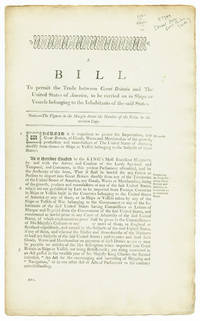
1809WRCAM47399London 1809. 1pp. on a folded folio sheet with printed docketing on the fourth page. Folio. Lightly tanned around the edges. Near fine. Rare printing of a British Parliamentary "slip bill" seeking to reestablish trade between Great Britain and the United States a few years before the outbreak of the War of 1812 and in the midst of great tension between the two nations. This bill was considered by Parliament in the spring of 1809 in the wake of President Jefferson's rescinding the Embargo Act and following the negotiations between U.S. Secretary of State Robert Smith and British envoy David Erskine which created a glimmer of hope that Anglo- American relations might be repaired after a period of great stress and turmoil. In March 1809 Jefferson signed the Non- Intercourse Act which rescinded the Embargo of 1807 and held out the promise of resuming trade with England and France if either of those nations ended its commercial restrictions toward the United States. The Erskine-Smith negotiations of April held out the promise of improved relations and in May the Parliament considered the present bill which permitted trade between Great Britain and the United States to be carried on in American ships. Unfortunately Prime Minister Canning disavowed the Erskine-Smith Agreement in late May and Anglo-American relations continued to deteriorate culminating in outright warfare in 1812. <br> <br> Slip bills are printed during the legislative process in small numbers for the use of legislators and staff. They are ephemeral items and their survival is rare. A printed note before the text of the bill reads "the figures in the margin denote the Number of the Folios in the written copy" which indicates just how early in the legislative process these bills were printed. OCLC locates only a single copy at the University of Massachusetts. OCLC 49887290. unknown books
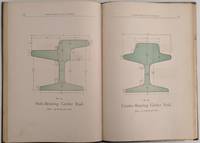
1890502San Francsico California: Pacific Rolling Mill Company 1890. 8vo. 250 x 170 mm. 10 x 7 inches. 100 pp. plus 4 leaves of ruled paper 2 with measurements in manuscript. Illustrated throughout with simple drawings of parts many stenciled with green wash; one plate folding. Bound in limp cloth covered boards title in gilt on front cover; a cloth binding shows some wear to gilt title two pencil drawings on front endpaper; other a very good sound copy. Straight forward price list of iron bar steel rail rolled and forged metal axles nuts bolts washers and dozens of other metal products. There is no introduction about the history of the firm just images of parts prices and a few lines of text describing specifications for some of the more complicated manufacture items. What distinguishes this rare trade catalogue is the design sense of many of the images and the application of stenciled color to highlight the object. The printed form of the parts are in outline and as one pages through the catalogue the images take on an abstract quality. Metal parts become contoured shapes with form being determined only by the light green wash applied to the physical part of the design. Although unintentional I am sure this late 19th century publication replete with many of the characteristics of period book design exhibits a very modernist feel one that is most unusual in publications of this nature. Although called the 7th edition this is only one of three issues of the PRMC's product guide and price list that is known. Organized in 1867 PRMC grew continuously and by 1892 was producing more than 40 thousand tons of iron and steel. "This giant enterprise is so closely identified with the manufacturing interests of the Pacific Coast that there is scarcely a manufacturing firm or corporation on the Coast that does not depend upon its output. The mills are located at Potrero Point in South San Francisco and cover an immense area" Master Hands. Romaine Guide to American Trade Catalogues p. 200 this edition and one from 1886 both known in only one copy each at California Historical Society. OCLC cites an edition from 1885 in one copy at San Francisco Public Library and this edition 1890 also in only one copy at California H. S. See: Master Hands in the Affairs of the Pacific Coast Historical Biographical and Descriptive. A Resumé of the Builders of Our Material Progress. San Francisco: Western Historical Publishing Company 1892 pp. 260. Pacific Rolling Mill Company unknown books
184336988London: Printed by T.R. Harrison 1843. Folio. 19 1 blank pp. New stitching light rubberstamp in upper blank portion of title page else Very Good.<br/><br/> England used her mighty naval power in a massive effort to stamp out the International Slave Trade. The major roadblock to a Treaty with the United States was English board-and-search tactics reminiscent of the objectionable practice that had helped to bring on the War of 1812. England claimed the right to board and search any vessel suspected of carrying on the Trade. The Earl of Aberdeen reports to Lord Ashburton on the "clamour about the right of search liberty of the seas &c." which "has already created so much excitement in the United States." Secretary of State Daniel Webster and his British counterpart settled the dispute in the Webster-Ashburton Treaty which also resolved the question of Maine's boundary with Canada.<br/> This publication treats exclusively the issues involved in the Slave Trade. The Correspondence describes "the nature of the stations or baracoons in which Slaves are collected on shore to be sold to the traders"; the areas of West Africa where the trade occurs; and the tactics of the ships which convey the slaves.<br/>OCLC 1007185044 2- Lib. Canada York U as of August 2020 and many facsimiles. Printed by T.R. Harrison unknown books
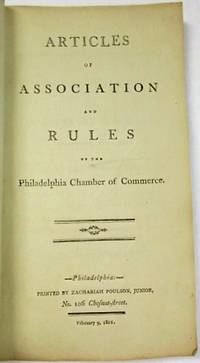
180135810Philadelphia: Printed by Zachariah Poulson Junior 1801. 8 18 blanks pp. Stitched into contemporary marbled wrappers. Fine.<br/> offered with Manuscript document headed "Chamber of Commerce 2nd March 1801." Folio leaf folded to 1 3 blanks pp addressed on last page "For Mr. T. W. Francis". The manuscript prints Resolutions to be considered for revision of certain Rules at the next meeting.<br/><br/> The Rules set forth in XVI numbered paragraphs were adopted at a meeting on January 5 1801. AAS's copy has our imprint; other copies list only the year not the month or day. The Chamber's web site states "Since 1801 the Chamber has brought area businesses and civic leaders together to promote growth and create opportunity in our region." This mission comports with that printed in its Articles of Association: "For the purpose of aiding the Trade of the City of Philadelphia by carrying into effect such Rules and Regulations as may from time to time be established with respect to our Commerce and the adjustment of Mercantile differences between each other." <br/> Thomas Whilling Francis 1767-1815 born in Philadelphia graduated from the University of Pennsylvania in 1784. He then entered the family mercantile firm of Willing and Francis. In 1786 he became a private in the Fourth Company Second Philadelphia Battalion of the City Cavalry and years later was promoted to Captain. An original member of the Chamber of Commerce he served on its Committee for the first month of its existence and in 1815 was its vice-president. He was also a director of various Philadelphia mercantile educational governmental and benevolent establishments. "The Second Troop Philadelphia City Cavalry" THE PENNSYLVANIA MAGAZINE OF HISTORY AND BIOGRAPHY VOLUME 49 1925 pp.83-85. <br/>AI 1148 1- PHi and Sabin 61974 neither noting the month in the imprint. Not in Rink or Eberstadt. OCLC 191262677 1- AAS as of April 2019. Printed by Zachariah Poulson, Junior unknown books
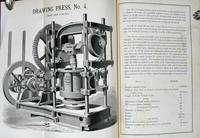
188134419Brooklyn 1881. 1st edition thus and 5th edition overall. Not in Romaine. Period pebbled brown cloth with title lettering gilt stamped to front board. Spine sunned. Modest binding wear. A VG copy. 135 1 blank pp. Frontis of the Bliss & Williams plant. Most presses illustrated with a cut many full-page in size & some folding. Royal 8vo. 10-5/8" x 6-5/8" <br/><br/> hardcover books
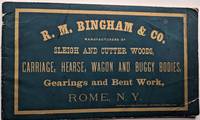
1875497Rome New York 1875. Oblong 8vo. 145 x 250 mm. 5 ¾ x 9 ¾ inches.30 pp. Illustrated with 30 color lithographs by Punderson & Crisand Lithographers and Printers of New Haven Conn. Bound in original green coated paper wrappers printed in gold ink; a crease at the lower corner of the front wrappers a few chips and nicks but otherwise an excellent survival in very good condition. Unrecorded trade catalogue beautifully illustrated to highlight the simplicity of design and the quality of the wood used in the construction of all types of sleighs and carriages. Very little is know of R. M. Bingham & Co. and the only recorded reference is to an advertisement for the company in an undated catalogue for Palm & Fletcher of New York City who sold carriage ornaments and artistic supplies. The lithographer was Punderson & Crisand a New Haven printer who did most of his work between 1870 and 1879. The company is known for its views of New Haven images of the harbor the Yale College year book of 1870 and a series of maps of New Haven and the surrounding counties. unknown books
1883236859Kansas City Missouri: Press of Ramsey Millett & Hudson 1883. Illustrated with 2 full-page Engravings. 76 pp. 1 vols. 8vo. Original wrappers printed in red and black. Vertical crease to front wrap and a few corners previously turned down a few prices realized in pencil. Very good. Illustrated with 2 full-page Engravings. 76 pp. 1 vols. 8vo. Over sixty-five Galloway bulls and heifers on the block giving detailed pedigree. With an introduction by Matthews explaining the his interest in the breed. Not in OCLC Press of Ramsey, Millett & Hudson unknown books
1816WRCAM39129London: Ordered by the House of Commons to be Printed 1816. 2pp. plus docket title printed on verso of second leaf. Folio. Early horizontal folds. Near fine untrimmed. Official Parliamentary draft printing of a commercial agreement between the United Kingdom and the United States passed just over a year after the signing of the Treaty of Ghent. The convention of commerce establishes that the same import and export duties be applied to goods carried by American and British ships in direct British- American commerce. Duties on and bounties for prize ships and goods are also put on the same terms. This version of the bill would have been printed while the question was being considered by Parliament. Not in Kress or TPL and not listed on OCLC. Ordered, by the House of Commons, to be Printed unknown books
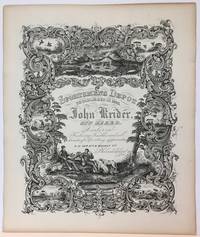
185061392Philadelphia PA: The company 1850. Engraved broadside 14 x 12 inches text executed in several sizes and styles of lettering. Krider was a long-time Philadelphia sporting goods dealer and sportsman and the author of Krider's Sporting Anecdotes 1853. Henderson p. 158 dating the broadside "ca. 1850". OCLC locates four copies Clements American Antiquarian Society Hagley Museum Library of Congress. Margins a little browned several short tears into margins but a very good example of a handsome sporting exhibition broadside. #8465. <br/><br/> The company unknown books
185051153Philadelphia: The company 1850. Printed broadside 14 x 12 inches employing several sizes and styles of type including several nice display types. Krider was a long-time sporting goods dealer and sportsman and the author of Krider's Sporting Anecdotes 1853. Henderson p. 158 dating the broadside "ca. 1850". OCLC locates a single copy Hagley Museum. A little browning in the margins but a very good example. <br/><br/> The company unknown books
1801WRCAM44263Dieppe France 1801. 1p. printed circular letter on a folded folio sheet the blank fourth page addressed in manuscript and postmarked at Boston Oct. 23 1801 and with a "Ship" cancel. Docketed on the fourth page as well. Old folds some edge wear small tears at edges of fold fourth page torn from wax seal. Very good overall. An interesting and rare artifact of the attempt to rebuild French-American trading relations in the wake of the so-called "Quasi- War" between the two nations. The Quasi-War was an undeclared conflict between the United States and France during John Adams' administration in the late 1790s manifested mostly in naval engagements between the two nations. The war wreaked havoc on American commerce with France which only began to be rebuilt with the Convention of 1800. The present printed circular was created by "Le Baron fils" the former American consular agent in Dieppe and was apparently sent to a variety of American merchants encouraging them to once again send shipments of American goods to that French port. <br> <br> Not much is known of Le Baron fils though he did correspond with Benjamin Franklin and he served as the American consular agent at Dieppe for several years. This copy of Le Baron fils' circular was sent to prominent New York merchant and politician Nicholas Low and is dated in manuscript July "24." It is addressed to Low in manuscript on the fourth page and his name is also written in the upper left corner of the circular. In the printed text Le Baron fils states: "you may see by the inclosed Price Current of our Colonial & American goods not present here that our prices are more advantageous than in Bordeaux as we are more in the center of the Republick nearer to Paris Rouen Amiens and all the Chiefest manufacturing towns of France." Low is encouraged to "consign me some goods the sale of which shall be attended to with the greatest care and the proceeds of which will be sent to you either in goods from this country or in Bills on Paris London or Hamburgh at your choice." The printed text concludes by giving the names of the American consuls at Paris and Hamburg as well as two English trading houses as references to Le Baron fils' character. Le Baron fils adds in manuscript: "Mr. J. Clason & Mr. C. Codwise of yr place can give you an account upon my house in case you want quick information." unknown books
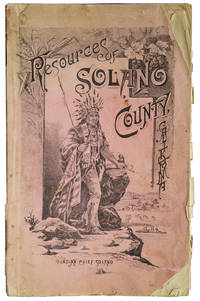
1887248583Oakland CA: Enquirer Print 1887. Numerous full-page plates plus one double-page plate and a folding frontispiece map. 84pp. In a half morocco and cloth folding box spine gilt. Original pictorial wrappers. Wrappers soiled and quite chipped especially at the edges and along the spine. Map edgeworn and with a closed tear in the center. Final four leaves chipped in upper outer corner else clean internally. A good copy overall. Numerous full-page plates plus one double-page plate and a folding frontispiece map. 84pp. A scarce promotional for Solano County California in the northeastern part of the Bay Area. The text gives a general description of the county with an emphasis on its agricultural potential and also includes in-depth looks at Vallejo Vacaville Suisun Benicia and other towns. The illustrations show prominent buildings homes ranches and the variety of agricultural crops cultivated locally. The map shows several of the townships of the county at a scale of six miles to an inch. Rocq 14643. Eberstadt 132:164 Enquirer Print unknown books
1887WRCAM42822Oakland: Enquirer Print 1887. 84pp. including numerous full-page plates plus one double-page plate and folding frontispiece map. Original pictorial wrappers. Wrappers soiled and quite chipped especially at edges and along spine. Map edgeworn and with a closed tear at center. Final four leaves chipped in upper outer corner else clean internally. A good copy overall. In a half morocco and cloth folding box spine gilt. A scarce promotional for Solano County California in the northeastern part of the Bay Area. The text gives a general description of the county with an emphasis on its agricultural potential and includes in-depth looks at Vallejo Vacaville Suisun Benicia and other towns. The illustrations show prominent buildings homes ranches and the variety of agricultural crops cultivated locally. The map shows several of the townships of the county at a scale of six miles to an inch. ROCQ 14643. EBERSTADT 132:164. Enquirer Print hardcover books
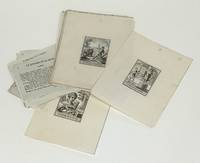
18256446A Paris: chez E. Jourdan quai des Augustins n. 17 1825. Sixteen numbered poems printed on trimmed laid paper the largest measuring 8 x 8.5 cm. accompanied by sixteen corresponding engraved plates sheet sizes circa 12.75 x 9.75 cm. and images 5 x 3.75 cm. The imprint is provided at the bottom edge of plates no. 6 and 14. Bonbon box trade cards to be collected by children the texts including fables and poems four apiece by La Fontaine Abbé Aubert Pierre- Louis Ginguené and Antoine Le Bailly. Near fine. Bibliographie de la France 1825 no. 825 records the following publication page 871: Dont la publication et la vente sont autorisées conformément à la loi du 25 mars 1822 art. XII et à l'ordonnance du roi du 1o mai 1822. 865. Douze Planches divers petits sujets pour bonbons. A Paris chez Jourdan quai des Augustins n. 17. chez E. Jourdan, quai des Augustins, n. 17 unknown books
1870315110New York: George Blackie & Co 1870. Woodcut illustrations throughout. 12mo. Publishers pink pictorial wrappers. Woodcut illustrations throughout. 12mo. Includes marked playing cards gambling and magic books magic tricks novelties and all sorts of curiosities and miscellany such as "False Moustaches that cannot be detected when worn" offered by New York wholesale agents George Blackie & Co. George Blackie & Co unknown books
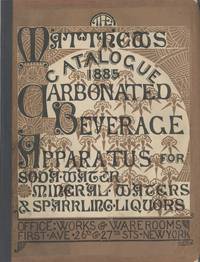
18857887New York: John Matthews Apparatus Co 1885. Quarto 104 pages. Fully illustrated. A lovely trade catalogue for this important manufacturer of bottling equipment soda fountains and carbonation apparatus. The fountains get progressively larger and more elaborate. Also includes siphon boxes for home delivery of soda water. Edges of wrappers and one or two pages with repair corners bumped. Some soiling throughout. In elaborately decorated printed wrappers. Good. Rare. OCLC locates just one copy in this series; Noling page 283. John Matthews Apparatus Co unknown books
18854833New York: John Matthews Apparatus Co 1885. Quarto 104 pages. Fully illustrated. A lovely trade catalogue for this important manufacturer of bottling equipment soda fountains and carbonation apparatus. The fountains get progressively larger and more elaborate. Also includes siphon boxes for home delivery of soda water. Edges of wrappers and one or two pages with repair corners bumped. Some soiling throughout. In elaborately decorated printed wrappers. Good. Rare. OCLC locates just one copy in this series; Noling page 283. John Matthews Apparatus Co unknown books
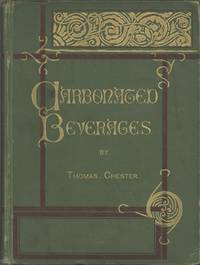
18826662New York: P.H. Reilly Wood-Cut and Color Printer 25 Rose Street 1882. Quarto 27 x 20.5 cm. 108 4 166 2 pages. Profusely illustrated. Text in two columns. Table of contents at rear. FIRST EDITION. An early - perhaps the first - history of carbonated beverages. Issued together with a trade catalogue for the soda water supply firm of John Matthews of New York an important manufacturer of bottling equipment soda fountains and carbonation apparatus. The fountains get progressively larger and more elaborate and with wonderful names: "The Citadel" "The Horicon" "The Adriatic" "The Fire-Eater" "The Nepenthe" and "The Snow Queen". There I also an outdoor soda fountain "The Street Spa". Also included are the auxiliary equipment of the carbonated water industry like siphon boxes for home delivery of soda water. The historical work and the trade catalogue were issued in celebration of the firm's 50th Anniversary. Some pencil scribbles to a few pages. Text block shaken; free front endpaper lacking. In publisher's brown and gilt-decorated green cloth corners rubbed and extremities a bit worn. Better than good. With the ownership signature of "Leopold F. Schmidt Deer Lodge Montana" and a more recent "Olympia Brewing Company". Very scarce. OCLC records two copies with this pagination Loma Linda Univ. & Hagley Museum and four copies with just 108 pages presumably just the history; Noling Beverage Literature page 104 for the 108 page version. P.H. Reilly, Wood-Cut and Color Printer, 25 Rose Street hardcover books
1873002874Washington DC: Published by Order of the Secretary of War 1873. First Edition. Good. Six maps for: Monday February 17 1873 - 11 P. M.; Tuesday February 18 1873 - 7:35 A. M.; Tuesday February 18 1873 - 4:35 P. M.; Wednesday February 19 1873 - 7:35 A. M.; Wednesday February 19 1873 - 4:35 P. M.; Wednesday February 19 1873 - 11 P. M.; 8 3/4 x 11 1/2; relief shown by hachures and gradient tints; small reference table in the lower half of the image; edges brittle with small chips and cuts; overall in good to very good condition. A scarce collection of maps their publication began in January of 1871 with no less than 3 maps being published every day. Samuel Morse's invention of the telegraph had made it possible to easily observe gather and transmit data from different points over the entire country. A small note at the head read: "All observations made at the same moment of actual not local time." Released by the US Army's Signal Service the maps were intented to be primarily used by farmers and merchants. They were published in at least three different sizes and formats the current being one of the smaller ones. These particular maps showed precipitation and wind velocity at various elevation points. Published by Order of the Secretary of War unknown books
189621325New York and elsewhere 1896. Folio. 14 1/2 x 12 inches. Approximately 350 larger ephemeral items and about 200 small scraps mounted on both pastedowns and recto and verso of 22 leaves. All leaves browned 3 leaves split vertically others with margins chipped some loosely inserted. Original rose-coloured glazed paper-covered boards lower cover blocked in blind and lettered 'Pat. March 76' in blind the upper cover blocked in gilt with three shaped raised panels with gilt borders enclosing chromolithographic images backstrip blocked in gilt corners rounded some fading to upper cover and backstrip inner hinges broken<br/> <br/>A spectacular album with an unusually rich assortment of advertising and trade cards including a selection chromolithographed designs of birds after Audubon.<br/> <br/>Internal evidence suggests that the album was probably assembled by a New York State resident living just south of Rochester - possibly from near Bath Cohocton or Canandaigua the patent date of the album gives a 'now earlier than' date whilst there are a number of dated items amongst the scraps the latest being 1896. Included are a large number of cards issued by local businesses as well as more national concerns like a fine series of six advertising cards for 'Wright's Indian Vegetable Pills" featuring toddlers playing baseball "Tum on ets' p'ay ball"; "See me tech it!"; "Aint dot out!"; "I'se bo'en home"; "I'se dot it!". There are also 33 'Arm & Hammer' bird cards after designs by John James Audubon 13 from the Arm & Hammer Brand / Church & Co. "Beautiful Birds of America" Collectors' Card 1st Series from 1894; the others probably from the second series. unknown books
187754690Indianapolis IN: Indianapolis Journal Co 1877. Trade catalogue. 8vo. 32 pp. 4-page inserted price list dated March 1877. Profusely illustrated with seven black and white wood-engraved plates four large black and white illustrations in text and five striking folding chromolithograph plates. Original printed green wrappers foxed. Very good. <br/>A scarce catalogue of heavy agricultural machinery with five brilliantly colored folding plates chromolithographed by Chandler Indianapolis depicting the "double canvass separator Hasselman separator oscillator thresher agricultural engine and the Eagle horse power." Romaine records nothing from this firm. OCLC locates several items from this firm but nothing before 1883. 1219. <br/><br/> Indianapolis Journal Co unknown books
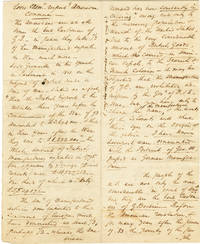
1807WRCAM56123Great Britain 1807. Manuscript written in eight columns on rectos and versos of two quarto sheets. Old folds two smalls spots of light soiling. Accompanied by four leaf typed transcription. Very good. An interesting but unattributed and apparently unpublished manuscript essay with a caption title reading "Loose Memo. Respectg. American Commerce." The gist of the memo is set forth in the first sentence: "The Americans are at all times the best customers of G.B. - in peace they take 1/3 of her manufactured exports - in War much more." In addition to the eager American market for British goods the author notes that British goods are often trans-shipped via America to other markets where Great Britain would not normally have access thanks to America's neutral status: ".you have only to change the name of the manufacturer & the wants of the Colonists will shut their eyes on the origin of the fabric. I have known Liverpool ware ornamented with the Portrait of Geo. III passed as German manufactures." <br> <br> The author notes that while the understandable economic downturn during the Revolution and for several years after the "peace of '83" resulted in some problematic credit relations between the U.S. and the British market much has changed. "The industry & the enterprise of our countrymen aided no doubt by the enjoyment of a neutral position has enabled them to throw off their dependence on the British merchant or manufacturer. They now have a sufficient capital of their own and a very important proportion of their imports are now paid for in ready money or in bills at short sight." The author explains that American merchants are able to export their surpluses of their own production and surplus British goods to the Continental market and transfer that money directly to creditors in Great Britain with an added perk: "The result of this species of trade must be ruinous to France. She is drained of her wealth to enrich & invigorate her enemy." <br> <br> Finally the author provides a specific example of this favored trading relationship with regard cotton. At this time the author estimates that Great Britain imports three- fifths of all cotton from the United States - some 150000 bags of cotton annually weighing 250lbs. each. The U.S. buys back nearly one-third of all cotton goods manufactured in Great Britain yielding a net profit of over £2.5 million to Great Britain. The author adds that this ratio holds for almost all raw materials produced in the United States. <br> <br> This essay was almost certainly written during the earlier part of the Napoleonic Wars; the author cites an 1801 speech by Lord Grenville which helps narrow the date range and it seems unlikely the Embargo Act of 1807 had been passed yet. Regardless the essay promotes Anglo-American trade and cooperation at least insofar as it enriches Britain and cripples France at a time when other forces were driving the two countries toward war. unknown books
1900263502Lyon France: J. Bouvard & Cie 20 Rue Lafont 1900. 14 thick card sheets with samples centrally mounted vertically to recto and verso some sheets quite thick to accommodate larger epaulets each with manuscript notations of name size etc. 11-3/4 x 6-3/4 inches. Black cloth album with the printed label of "J. Bouvard et Cie Fabrique de Dorures Soireries Ornaments d'Eglise" to front paste-down. Some wear commensurate with age and use spotting and thumbsoiling apparently complete with all samples backing possibly restored at an early date. 14 thick card sheets with samples centrally mounted vertically to recto and verso some sheets quite thick to accommodate larger epaulets each with manuscript notations of name size etc. 11-3/4 x 6-3/4 inches. This very unusual French sample book contains a large range of epaulets and sequin samples with a few lettering and star samples. J. Bouvard & Cie 20, Rue Lafont unknown books
18721427091872. TRADE CATALOGUE -- NURSERYMAN'S GUIDE. DEWEY D.M. Nurseryman's Specimen Book of American Horticulture and Floriculture Fruits and Flowers Ornamental Trees Shrubs Roses &c. D.M. Dewey's American fruit & flower plates colored from nature 2300 varieties. With a chromolithographic title page and 56 stencillled plates of fruits flowers and 9 chromolithographic plates plates of fruits flowers and trees. 8vo. 220 x 140 mm bound in contemporary morocco rebacked. Rochester N.Y.: D.M. Dewey n.d. ca. 1872. An early American trade catalogue of Fruit Flowers Trees and Nursery stock issued according to the Smithsonian Library "ca. 1872" by the firm of D.M. Dewey Rochester N.Y. Many of the plates have captions giving name of variety of plant and brief information on main characteristics and growing season. The Smithsonian copy contains only 24 plates compared to the 40 in the above copy. "Nurserymen's plates were an American innovation. They were made by various methods the most distinctive being painted in watercolors. In design and coloring these plates were more akin to folk painting than to the commercial art of their time" Charles von Ravenswaay "Drawn and Colored from Nature" in Antiques Magazine March 1983 pp. 594-599. Some minor wear overall in excellent condition. See Raphael. An Oak Spring Pomona Nos 63 to 66. unknown books
1870WRCAM55334Osage Mission Ks 1870. Hand-drawn and hand-painted watercolor sign on a 14 x 18 3/4-inch sheet of cardstock. Pencil sketch for the same sign on the verso. Small chips at lower corners some light soiling. Very good. A remarkable and very attractive handmade sign for D.B. Gregory's livery stable in Osage Mission Kansas. Undated the style of the sign suggests a date of the 1870s. The center of the sign shows a lovely illustration in profile of a horse pulling a single-rider four-wheeled carriage along a dirt road. The text above the illustration reads "D.B. Gregory & Co." and below: "Livery & Sale Stables / Best Stock / Horse & Buggies / Main Bet. County & Neosho Strs. / Osage Mission Kan." The lettering is in black with blue and purple shadowing and "Osage Mission Kan." is drawn in a very ornate style. The entire sign is decorated with purple watercolor ornamentation. On the verso is a pencil sketch of the horse and the lower half of the carriage likely a preliminary sketch for the finished illustration. <br> <br> David B. Gregory born in 1846 in Iowa established his livery business with his brother in Osage Mission now St. Paul Neosho County Kansas by the early 1870s. An advertisement in the March 23 1873 issue of the OSAGE MISSION TRANSCRIPT describes Gregory's livery as having a "fine and well selected stock of horses and carriages.the best matched teams for style and speed in the city. Saddle horses for ladies and gents a specialty that defy competition." Settlers came to the region around Osage Mission in the 1840s following the founding of nearby Fort Scott in 1842. Osage Mission itself was founded in 1847 by Father John Schoenmakers as a mission to local Indian tribes and then grew into a town in its own right serving as a trading post and gateway for commerce and westward exploration. By the late 1860s it had grown to nearly 900 people with a hotel boarding house saloon stables general store hardware store and blacksmith. <br> <br> A rare significant and informative survival from the American frontier. unknown books