205 résultats
18052612Leipzig: E. Z. Steinacker 1805. 3 parts small oblong 4to 178 x 219 mm. 20; 18; "19" recte 20 pp. Each part with half-title only titles supplied on the wrappers. 12 plates of oval hand-colored tinted aquatints by Geissler. Occasional light foxing to text. Publisher's original pale green printed wrappers some wear and creasing sewing loose in part 1.Only Edition a high spot of nineteenth-century German book illustration a fine copy in the rare original wrappers. In impressionistic prose an anonymous author delivers a dozen diverting vignettes of salesmen and their customers at the annual Leipzig trade fair weaving stories around Geissler's masterly hand-colored aquatints. This delightful suite was issued in parts published to coincide with the two 1804 Leipzig fairs at Easter and Michaelmas and the 1805 Easter fair. Together Geissler's aquatints and the text portray fortunetellers a peep show and its barker performing jugglers and musicians Russian dancers Transylvanian and Greek merchants in their native dress shoemakers Jewish clothing vendors processions of horses for sale horse traders and peddlers and fraudsters of every ilk. One of the oldest trade fairs in Europe by the eighteenth century the Leipzig fair had become the main venue for trade with Eastern Europe a perfect artistic subject for Geissler who had spent most of his twenties traveling through Russia and the Ukraine.Geissler's first subject part 1 Scene 1 is a second-hand bookseller. Surrounded by trunks of dusty books and pictures this poorly dressed oddball is a master of patter. His efforts to sell two popular 17th-century prayerbooks Arndt's Paradies-Gärtlein and Michael Cubach's Gebetbuch to a couple of wary customers is rendered verbatim. Other than the fact that the books are recommended for their usefulness the tactics of persuasion have not changed in two centuries. Meanwhile in the background two street urchins "two sons of the Vorstadt poorer outlying areas of town from the Order of the Barefoot" steal a defective copy of a red-bound issue of the Taschenbuch "wishing to return it to precisely the place mentioned in the title" i.e. their pockets. A poor book collector arrives; he is granted credit. This inimitable scene is completed by two more characters a French emigré hoping to find a "La Fontainesque novel" for a few pennies and a poet for hire shown from the back in the aquatint whose tragi-comic portraits are gleaned from their clothing hairstyles and gestures as rendered by Geissler.Equally astute and moving are the portraits of Russians and Eastern Europeans who appear in five scenes. In the final chapter in part 2 the anonymous author - an "unnamed Leipzig man of letters a friend of Geissler's who worked for a Modemagazin fashion magazine probably Baumgartner's" Wustmann p. 23 - quotes Geissler's own description of the wild Russian dancing and singing of the last night of the fair in a moving paean to Slavic soulfullness sharply contrasted with Germanic stiffness.The son of a Leipzig goldsmith and mineral dealer Geissler had trained at the Art Academy there but his major influence was the illustrator Johann Salomo Richter from whom he learned the taste for hand-colored aquatint portraits of the common people and genre scenes of everyday life. Geissler spent 1790 to 1798 in Russia serving as the expedition artist with the German scientist Peter Simon Pallas on his travels in the Caucasus and southern Russia. On his return to Leipzig Geissler published the Pallas works as well as his own illustrated accounts of Russian customs and costumes. Creatively gifted Geissler was also skilled at marketing his works. He established close relations with Leipzig publishers for whom he produced numerous children's books. The present "Scenes from the Leipzig Fair" was his most important publication during the period between his return from Russia and the Napoleonic wars. He later produced illustrated reportages of the Battle of the Nations Völkerschlacht in Leipzig and individual war images for newspapers almanacs and even peep shows. In the US OCLC locates copies at Brown Rice University and University of Wisconsin. Lipperheide 828 DfG 5; G. Wustmann C. G. H. Geissler der Zeichner der Völkerschlacht Leipzig 1912 pp. 23-24 and 115 note 24;; Rümann Die illustrierten deutschen Bücher des 19. Jahrhunderts 1926 504; Thieme Becker 13:351-2. E. Z. Steinacker unknown books
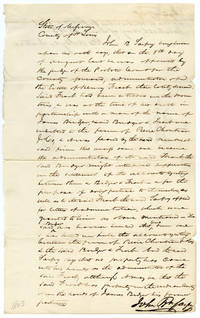
1843WRCAM42012St. Louis 1843. 1p. docketed on verso. Folio. Old fold lines; some separation at folds a few repaired with older archival tape. Quite clean and bright. Good. A remarkable window into the business dealings of famed mountain man Jim Bridger this signed manuscript affidavit of John P. Sarpy testifies to his actions on behalf of the estate of fellow fur trader Henry Fraeb who was killed by Indians in the Rocky Mountains. Sarpy who was a partner in the major firm of Pierre Chouteau & Co. had worked closely with Fraeb and knew him well. In his affidavit he writes about the Chouteau Company's concerns about Jim Bridger Fraeb's partner at the time of his demise and the difficulty of getting Bridger to pay his debts. Dated at St. Louis Sarpy's affidavit states: <br> <br> ".on the 8th day of August last he was appointed.administrator of the estate of Henry Fraeb then lately deceased. Said Fraeb had been a trader in the mountains & was at the time of his death in partnership with a man of the name of James Bridger & said Bridger & Fraeb were indebted to the firm of Pierre Chouteau Jr. & Co. & it was feared by the members of said firm that unless some one became the administrator of the said Fraeb the said Bridger might interpose difficulties in the settlement of the accounts existing between them & Bridger & Fraeb. & for the purpose of doing justice to themselves as well as to the said Fraeb the said Sarpy applied for letters of administration which were granted to him as above mentioned. The said Bridger has however since this time been here & has settled in full the accounts existing between the firm of Pierre Chouteau Jr. & Co. & the said Bridger & Fraeb. And the said Sarpy says that no property has come into his hands as the administrator of the said Fraeb although it may be that the said Fraeb has property in the mountain country or in the hands of James Bridger his former partner." <br> <br> Though he may have been one of the greatest and most beloved mountain men of all time Jim Bridger was not the best debt in the world nor did Pierre Chouteau & Co. forget business. unknown books
184324188St. Louis 1843. 1pp. docketed on verso. Folio. Old fold lines; some separation at folds a few repaired with older archival tape. Quite clean and bright. Good. Jim Bridger's bad debts.<br/> <br/>A remarkable window into the business dealings of famed mountain man Jim Bridger this signed manuscript affidavit of John P. Sarpy testifies to his actions on behalf of the estate of fellow fur trader Henry Fraeb who was killed by Indians in the Rocky Mountains. Sarpy who was a partner in the major firm Pierre Chouteau &. Co. had worked closely with Fraeb and knew him well. In his affidavit he writes about the Chouteau Company's concerns about Jim Bridger Fraeb's partner at the time of his demise and the difficulty of getting Bridger to pay his debts. Dated at St. Louis Sarpy's affidavit says that "on the 8th day of August last he was appointed.administrator of the estate of Henry Fraeb then lately deceased. Said Fraeb had been a trader in the mountains & was at the time of his death in partnership with a man of the name of James Bridger & said Bridger & Fraeb were indebted to the firm of Pierre Chouteau Jr. & Co. & it was feared by the members of said firm that unless some one became the administrator of the said Fraeb the said Bridger might interpose difficulties in the settlement of the accounts existing between them & Bridger & Fraeb. & for the purpose of doing justice to themselves as well as to the said Fraeb the said Sarpy applied for letters of administration which were granted to him as above mentioned. The said Bridger has however since this time been here & has settled in full the accounts existing between the firm of Pierre Chouteau Jr. & Co. & the said Bridger & Fraeb. And the said Sarpy says that no property has come into his hands as the administrator of the said Fraeb although it may be that the said Fraeb has property in the mountain country or in the hands of James Bridger his former partner." Though he may have been one of the greatest and most beloved mountain men of all time Jim Bridger was not the best debt in the world nor did Pierre Chouteau & Co. forget business. unknown books
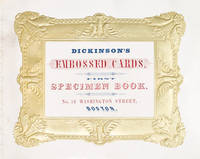
1842232013Boston: Samuel N. Dickinson 1842. Printed title in blue and red within an embossed gilt ornamental frame one printed "Notice" from the publisher dated June 1842 49 specimens of embossed cards many tinted some printed all mounted to stiff card stock; and 7 sheets of "Embossed Specimens of Printed Billets" sewn to a stiff printed card. Oblong 4to. Bound in an album of contemporary half calf and marbled paper boards with red leather label on upper cover stamped in gilt "Dickinson's Embossed Cards" calf shows much deterioration and corrosion although the sewing is still intact 28 specimen cards have been removed and are no longer present some minor soiling and foxing but generally vey clean and sound internally custom morocco backed folding box. Printed title in blue and red within an embossed gilt ornamental frame one printed "Notice" from the publisher dated June 1842 49 specimens of embossed cards many tinted some printed all mounted to stiff card stock; and 7 sheets of "Embossed Specimens of Printed Billets" sewn to a stiff printed card. Oblong 4to. Christian Gobrecht's Copy. With a very interesting presentation note from a previous Philadelphia owner Alfred Darrach dated 1928 affixed to the front pastedown identifying the original owner his grandfather as Christian Gobrecht 1785-1844 artist engraver embosser inventor engraver to the U.S. Mint and from 1840-1844 the 4th United States Engraver of the Mint where he was responsible for the creation of several new models and designs including the famous Seated Liberty design which appeared on a variety of American coins from 1836 through 1890. <br/>Gobrecht designed many notable medals coins and dies during his career but he also "invented a speaking doll and later a camera lucida. He also produced engravings for calico printers and dies for bookbinders. He engraved the brass dies for embossing the Morocco covers of the Boston Token from 1831 - 1836 as well as the eagle cover of the Philadelphia Token. Among the medals he engraved were the Charles Willson Peale medal the Franklin Institute medal etc ." - DAB.<br/>A remarkable specimen album in and of itself all the more so for having belonged to one of America's most important engravers. We cannot say for sure but it is entirely likely that if Gobrecht himself did not design many of the dies for this embosser he may have used the album for his own work and possibly removed the cards which are no longer present. Samuel N. Dickinson unknown books
1838List601Most Latin America 1838. Mostly Latin America 1809 - 1838. Over 150 pieces comprising over 280 pages .5 linear feet. The Massachusetts merchant Captain Eliphalet Smith Jr. 1780-1838 was a merchant trading primarily in Latin America during the Revolutionary Period. Described by the Chilean historian Diego Barros Arana as "an unscrupulous adventurer who saw in the countries struggling for independence nothing more than a field for his speculations" Smith bore witness to many seminal events in the continent's political history. These letters offer first-hand accounts of such events as the Sieges of Cadiz and Montevideo Admiral William Brown's victories in the Argentinian Independence War the Peruvian silver trade Simon Bolivar's arrival in Guayaquil and the battles of Real Felipe Fortress. <br /> <br /> Smith's business correspondence from the period sheds light on the pro-Regency networks active in the Americas during the period as his loyalties - like most merchants - were based on the Spanish Armada's control of trade. The tensions between Smith and the nascent Chilean government came to a head when goods from Smith's ship the Brig Macedonian were seized by Lord Cochrane Vice Admiral of the Chilean Squadron in two separate incidents in 1818 and 1821. The ensuing legal disputes would cast a long shadow over relations between the United States and Chile until the cases were resolved by international tribunal. The collection includes several original documents relating to the episodes including Smith's recollections of the events and several letters to investors describing the confiscated goods. <br /> <br /> Smith's efforts and their tacit support by the U.S. government make him a key figure in early relations between the United States and the new Latin American regimes. In 1822 an agent of the United States State Department acknowledged that "the Brigs Canton and Macedonian were for more than three years constantly violating blockades neutral and belligerent rights and supplying the royalists and flew the Spanish flag." Likewise historian Patricia Marks writes that Smith had business connections with Spanish merchants in Peru and refers to a quote from Viceroy to Peru JoaquÃn de la Pezuela: "Smith and the Macedonian became anathemas to the patriots. San MartÃn is reputed to have said that he did more damage to the cause of liberty than any other man." Historian Joseph Byrne Lockey points out that Smith's actions had greater implications regarding the perception of the United States in revolutionary-era Latin America: "The conduct of Captain Smith supported in so far as it was legal by the government at Washington contributed together with other incidents of a similar sort not a little to the dimming of the earlier impression of the Patriots that the United States would be in the struggle their friend and ally." <br /> <br /> The collection here consists of 153 documents from Smith's estate including letters received by Smith mercantile inventories and holograph copies of letters sent by Smith during the period. Correspondents include Smith's contacts in Latin America and his creditors in the United States. As a collection the documents relay scarce firsthand accounts of several seminal political events and map an extensive network of mercantile contacts and inventories. They are worthy of further research by scholars of the political history of Latin America and Spain and of early United States / Latin American relations as well as scholars of trade between China and Latin America. <br /> <br /> Overall the collection presents an uncommon opportunity to acquire primary source material from Latin America's Revolutionary Period. We find records from the Macedonian and Smith in the Forbes family collection at Harvard as well as some later documents relating to Smith's claims at the University of Virginia Special Collections. We find no publicly held examples of Smith's personal correspondence or papers prior to 1820. A full write-up and inventory is available in our PDF catalog. unknown books