48 résultats
175141756London: n.p. 1751. Modern marbled paper-covered boards. Minor wear to extremities browning to title page edge wear to last leaf still a near fine copy. 1 57 1 pp. Folio. "Very rare and valuable. It contains an Appendix of Premiums paid by the Irish Linen Board" Higgs Bibliography of Economics p.8. An important source document. There is also a 28 page edition. OCLC locates only four complete copies of this separate issue: Yale Amer. Textile Museum Univ. Mass. Univ. Minn. and nine of the 28 page extract. Kress 5155. Higgs 54. Goldsmiths'-Kress 08612.1. n.p. hardcover
176428707Paris: Aux dépens de la Compagnie 1764. 1 vols. 12mo. 19th century marbled boards paper manuscript label. Blanks at front and back removed marginal repair to title some soiling at front and back else very good with the signature of La marquise des Armoises d'espineaux with the 1765 date throughout. 1 vols. 12mo. Not in Kress Aux dépens de la Compagnie unknown
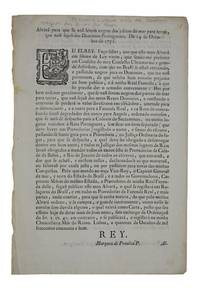
1751AQ31219Lisbon: s.n. 1751. Single sheet printed on both sides. A trifle creased. A rare survival of a mid-eighteenth century edict issued by King José I of Portugal forbidding traders to transport slaves from Portuguese seaports to colonial territories held by other nations. The Portuguese slave trade experienced continual growth throughout the latter half of the eighteenth century in particular from West African colony of Luanda from which between the issue of this edict in 1751 to 1760 an average of 10 940 enslaved Africans were trafficked annually. OCLC records copies at just three locations BL NYPL and UoL; COPAC adds one further Senate House. . Dimensions 200 x 300 mm. [s.n.] unknown
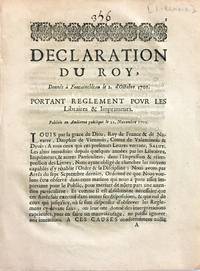
1701100900<p>Grenoble Alexandre Giroud 1701. 4to. 8pp. <br /><br />Reminder of the rules and regulations relevant to the printing trade given in VIII articles.</p>
1794354283Philadelphia: Printed by Francis Childs and John Swaine 1794. 8pp. Dbd. Contemporary ownership signature on titlepage and manuscript notes on final leaf. Very good. 8pp. Dbd. This copy bears the ownership signature of noted New York jurist and legal scholar James Kent who ran for Congress from New York in 1793 but was defeated by his brother-in-law Theodorus Bailey. He would go on to a distinguished career as a judge on the Chancery court and as an author of legal commentaries. At the conclusion of the text is a manuscript note:<br /> "Mr. Wadsworth stated in the House of Representatives the 19th May 1794 that within the last six months American vessels & property had been captured by the British Privateer in the W. Indies to the extent of one million of dollars - & that other nations had seized American property to ½ mil. dol. & that the total loss to our commerce was 1½ mil. dol."<br /> In this report to President Washington the new Secretary of State Edmund Randolph details the depredations against American shipping caused by the powers involved in the French Revolutionary Wars. He quotes from a study by the "committee of Philadelphia" on the interference with American trade by the British French Spanish and Dutch and summarizes the methods used by those countries. The British impress American sailors into service the French are embargoing American goods etc. He makes no recommendations as to an appropriate response.<br /> OCLC locates four copies. Scarce. EVANS 27917. OCLC 8090321 Printed by Francis Childs and John Swaine unknown
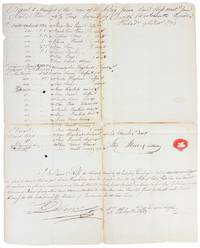
179231794Philadelphia: s.i. 1792. Very Good. Philadelphia: 1792-93. Single folded sheet 41.5 x 33.5cm; report in manuscript verso filled nearly to completion recto a quarter filled. Signed by Captain David Ross and two other parties; docket dated 1793 signed by Inspector Jeremiah Simmons. Stock exceedingly brittle with shallow chipping long closed tears along folds with old archival mending age-toning and light soiling as well as contemporary wax seal remnants. Overall a Very Good and legible survival. <br /> <br /> Cargo report executed in manuscript and dated November 9th 1792 listing materials shipped from Port-de-Paix Saint-Domingue modern day Haiti to Philadelphia for the firm Dutilh & Wachsmuth. The date places this report in the early days of the Haitian Revolution following the August 1791 enslaved peoples' revolt. The island was a vital source of commercial interests to Philadelphia and the burgeoning revolution was at the forefront of everyone's mind making this voyage and the survival of associated documents all the more significant. Dun cites one contemporary account "'No business is going on here' one letter told 'as every one is taken up with meetings committees and arming themselves.'" Dun p. 484. <br /> <br /> Goods delivered include wine sugar and coffee and were delivered to Dutilh and a handful of others including Captain Ross himself who received a hogshead of molasses. Ross eventually rose to the rank of Continental Navy Lieutenant during the Quasi-War with France and is remembered for commanding the privateer Belvedere guiding her back to Dover after an engagement with a French brig "leaving Belvedere with 50 round shot in her hull and her sails and rigging further shredded." <br /> <br /> References: James Alexander Dun "What Avenues of Commerce Will You Americans Not Explore! Commercial Philadelphia's Vantage onto the Early Haitian Revolution." The William and Mary Quarterly July 2005 Third Series Vol. 62 No. 3 pp. 473-504<br /> <br /> See also the Destroyer History Foundation website. [s.i.] unknown
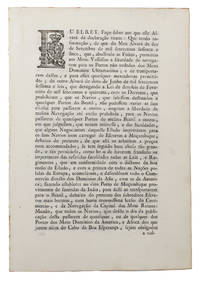
1772ABC_48853Lisbon 1772. Folio ca. 29 x 20 cm. Na Regia Officina Typografica Disbound and subsequently mounted in a modern black stiff paper folder with a printed label mounted on the front wrapper. With a large decorated woodcut initial E incorporating the Portuguese royal coat of arms. 3 1 blank pp. Very rare first issue of two of a late 18th-century decree by the Portuguese King José I 1714-1777 dealing with difficulties in the transportation of enslaved people from Mozambique to Brazil. This text dated 12 December 1772 and signed Rey King at the end is also signed by the notorious Portuguese nobleman and diplomat Marquez de Pombal. Sebastião José de Carvalho e Melo 1st Marquis of Pombal 1699-1782 who was the Secretary of State of the Kingdom during the reign of Dom José I in the period of 1750-1777. It is concluded with a formal text dated 18 December 1772 and signed by João Baptista de Araújo a senior officer of the Secretariat of State.In 1761 Marquez de Pombal prohibited the importation of enslaved people in Portugal and Portuguese India not for humanitarian reasons but because they were needed for labour in Brazil. He stimulated the trade of mostly African enslaved people for that colony and with his support two companies for slave trade were founded the Companhia Geral de Comércio do Grão-Pará e Maranhão and the Companhia Geral de Comércio de Pernambuco e Paraíba. Both companies were privileged and had a monopolistic character. Their lists of shareholders included many Portuguese noblemen and clergy. Between 1757 and 1777 more than 25000 enslaved people were imported to Pará and Maranhão from West African ports.The two issues can be identified by their catchwords on p. 1: issue one shows the catchword as a vol- that catchword was changed in the second issue to a.The inner margin shows some signs of the previous binding. Otherwise in very good condition.l Gauz Portuguese and Brazilian books in the JCB 772/1; WorldCat 1045359449 3 copies; cf. Porbase 2301650 and no copies. unknown
1766museumrusticumLondon: R Davis; J Newbury; L Davis and C Reymers 1766. Third Edition Corrected. Hardcover. Pages are clean with text block . Museum Rusticum et Commerciale: Or Select Papers on Agriculture Commerce Arts and Manufactures. Drawn From Experience and Communicated by Gentlemen Engaged in These Pursuits full 6 volume set Third Edition Corrected. Revised b the members of Society for the Encourage of Arts Manufactures and Commerce in 1766. Numerous plates including foldout tables and woodcut illustration.Pages are clean with text block solidly bound hinges weak / separating with prior poor repair original leather boards show heavy rub wear and bumping spines show cracking to leather and title bands no longer present. R Davis; J Newbury; L Davis and C Reymers hardcover
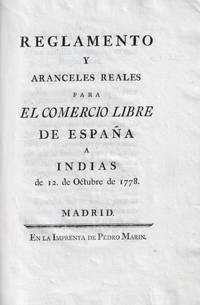
17789984Madrid: Pedro Marín 1778. First Edition Primera edición. Hardcover Tapa dura. 284x197mm. 11¼x7¾". Madrid Pedro Marín 1778. En folio 284 x 197mm. Frontispicio con el escudo real de España grabado al cobre 2 19 262 pp. Encuadernación en piel de época sin el tejuelo de la lomera. Primera edición del Decreto de Carlo III por el que se establece el comercio libre con América y Filipinas y se finaliza con el monopolio del comercio a las Indias que venían ejerciendo Cádiz y Sevilla permitiendo a otras ciudades que lo soliciten comerciar con el nuevo continente. Este Reglamento articulado en 55 puntos fue promulgado por Carlos III como parte de las reformas borbónicas con el fin de incrementar el intercambio comerical entre España y América; se habilitaron 13 puertos españoles y 24 puertos americanos: San Juan de Puerto Rico Santo Domingo Monte-Christi Santiago de Cuba Batabanó La Habana Isla de Margarita Trinidad Campeche Golfo de Santo Tomás de Castilla Omoa Cartagena de Indias Santa Marta Río de la Hacha Portobelo Chagres Tierra Firme Montevideo Buenos Aires Valparaíso La Concepción Arica Callao y Guayaquil. Se excluyó a Venezuela hasta 1788 para proteger los intereses de la Real Compañía Guipuzcoana de Caracas que se disolvió en 1785 y a México por el temor de que la prosperidad de este territorio provocara la despreocupación hacia otras zonas menos activas lo que iba contra la idea rectora del proyecto. Cuatro años más tarde en 1789 se amplió el comercio libre a México y en 1797 a otros países de Europa. Ejemplar en gran papel de amplios márgenes. Pedro Marín hardcover
177810011Madrid: Pedro Marín 1778. First Edition Primera edición. Hardcover Tapa dura. 265x195mm. 10½x7¾". Madrid Pedro Marín 1778. En folio 265 x 195mm. Frontispicio con el escudo real de España grabado al cobre 2 19 262 pp. Encuadernación en piel de época sin el tejuelo de la lomera. Primera edición del Decreto de Carlos III por el que se establece el comercio libre con América y Filipinas y se finaliza con el monopolio del comercio a las Indias que venían ejerciendo Cádiz y Sevilla permitiendo a otras ciudades que lo soliciten comerciar con el nuevo continente. Este Reglamento articulado en 55 puntos fue promulgado por Carlos III como parte de las reformas borbónicas con el fin de incrementar el intercambio comerical entre España y América; se habilitaron 13 puertos españoles y 24 puertos americanos: San Juan de Puerto Rico Santo Domingo Monte-Christi Santiago de Cuba Batabanó La Habana Isla de Margarita Trinidad Campeche Golfo de Santo Tomás de Castilla Omoa Cartagena de Indias Santa Marta Río de la Hacha Portobelo Chagres Tierra Firme Montevideo Buenos Aires Valparaíso La Concepción Arica Callao y Guayaquil. Se excluyó a Venezuela hasta 1788 para proteger los intereses de la Real Compañía Guipuzcoana de Caracas que se disolvió en 1785 y a México por el temor de que la prosperidad de este territorio provocara la despreocupación hacia otras zonas menos activas lo que iba contra la idea rectora del proyecto. Cuatro años más tarde en 1789 se amplió el comercio libre a México y en 1797 a otros países de Europa. Ejemplar en gran papel de amplios márgenes. Pedro Marín hardcover
1737EANmoFRA36London: Sold by J. and P.Knapton E.Symon and J.Stagg 1737. 1737. 8vo. pp. 1 p.l. viii ie. xvi 120 ie. 240 1. French & English text on opposite pages with duplicate pagination. woodcut title vignette ornaments & initials. contemporary calf bit rubbed occasional light foxing short tear to outer margin of B7 - no loss. armorial bookplate of Sir Richard Neave. First Edition. The first memorial pp. 1-20 concerns the Guinea Company the commerce of the French colonies in America the state of the French West Indian islands Martinique Sainte Croix Saint Domingue &c. and the means of preserving and extending trade there. Included are remarks on restricting some branches of commerce to certain ports exclusive companies and farms of certain commodities particularly tobacco and sugar. Goldsmiths' 7461. Kress 4346. Sabin 47744 title from a bookseller's catalogue. F. London: Sold by J. and P.Knapton, E.Symon, and J.Stagg, 1737. unknown
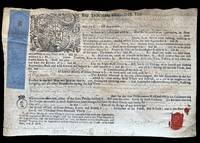
17363222Lichfield England 1736. Oblong document on vellum upper edge scallopped 143 x 214 mm. recto with letterpress form accomplished in manuscript in brown ink slightly faded but legible one passage erased large woodcut armorial initial and 2 pence duty mark strip of three blue sixpence stamps red wax seal paper stamp on verso. Slight soiling to corners and part of top edge.<br /> <br /> A bookseller joins the toy trade: Robert Shaw son of the Lichfield bookseller of the same name agrees to an apprenticeship of seven years during which he promises to serve his master keep his secrets to not waste or lend his Goods; and “Taverns Inns or Ale-houses he shall not haunt At Cards Dice Tables or any other unlawful Game he shall not playâ€. For this the toymaker Richard Robinson agrees to pay 5 pounds into the public charity pledges to feed and lodge his new Apprentice and added in manuscript promises his father Robert Shaw Sr. “to fund and provide for his said Son wearing apparell of all sorts as well Linens as Woolens during the said term.â€<br /> <br /> Lichfield Staffordshire was the childhood home of Samuel Johnson 1709-1784 whose father Michael Johnson was also a bookseller; as a boy Johnson sometmes bound books for his father to help earn money. Contemplation of the latter’s debt-ridden career may throw light on the motives of his colleague Shaw Sr. in sending his son out to learn another profession. <br /> <br /> A bookseller Robert Shaw is known from archival sources including a payment to him in 1737 by Lichfield Cathedral for lettering books in the library cf. Peter Hanks The Bookbinder and Historical Invisibility: Bookbinding and the Staffordshire book trade 1750-1850 thesis University of Wolverhampton 2024. Booksellers in this period were more involved in actual book production and their duties included supplying bookbindings. <br /> <br /> A colleague who previously owned this document remarked: “I have not been able to determine how Robert Shaw the Younger fared in the toy trade or if he was able to follow the indenture’s commandment `Taverns Inns or Ale-houses he shall not haunt’ which he never could have done if he’d followed his father into bookselling.†unknown
17622191Cadiz: Don Manuel Esoinosa de los Monteros 1762. Hardcover. Very Good. 4to - over 9¾ - 12" tall. 4to. 20.5 x 14 cm 158 pp. 1 f. index. With woodcut head- and tail-pieces blazon of Charles III and two Spanish galleons. Bound in mottled calf over boards spine gilt in six decorative compartments. Somewhat worn at extremities. Generally very good. First enlarged edition of an illustrated merchant's guide to the duties and tariffs levied by the Spanish crown on exports from the Americas chiefly gold and silver but also concerning timber textiles furs coffee spices and foodstuffs.After first offering a general overview of Spanish colonial commerce with Western Europe Garcia de Prado provides a wide range of practical instructions for traders negotiating the hazardous waters of colonial finance giving sample calculations for the volume of shipping containers converting currency and-crucially-providing a comprehensive alphabetical list of the royal tariffs on exports from America and the West Indies printed as a table for quick reference in terms of maravedis de plata silver coins of account and quintales approx. 46 kg. The second half of the work is concerned with trade in gold and silver explaining the six classes of government tariffs and their application to quintales of the metals in their various states acuñada labrada grana fina etc. Printed at the Royal Navy Office in Cadiz where Spanish shipping vessels would have arrived from the Americas the present work anticipates later efforts by the Spanish Bourbons-particularly Charles III and the Marquis de Esquilache-to reform the fiscal administration of its colonial properties. Garcia de Prado remarks in his introduction that a much smaller work un Quaderno with the same title was printed in 1745 and that the present work aims to augment and update the information contained therein. JCB.III.1320; Medina 3999; Palau 58415; Sabin 15037 Don Manuel Esoinosa de los Monteros hardcover
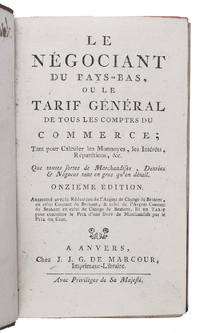
178095L94ST53226Antwerp 1780. 12mo. Johannes Judocus Gerardus de Marcour Contemporary mottled tanned sheepskin gold-tooled spine with olive title-label red edges. XXIII 1 543 1 pp. Corrected and augmented eleventh edition of a handbook for merchants and traders in the Southern Netherlands here in a French edition but also available in Dutch Den Nederlandschen negociant . All editions appear to be very rare. It consists of numerous tables giving information for the conversion of monetary units weights and measures.The privilege p. XXIV is issued in the name of Maria Theresa who died in 1780 and De Marcour was active from 1764 to 1797. The many unnumbered editions no doubt confused publishers who probably numbered their editions to follow the highest number they had seen: the University of Kansas has a ninth edition Liege 1784 the Hendrik Conscience library a ninth Antwerp De Marcour 1792; ; and there is a tenth Antwerp Grangé 1798.With some early 19th-century annotations on endpapers. Spine slightly rubbed one leaf party detached but otherwise in very good condition.l Groote Vijftig jaar boekdrukkunst te Antwerpen p. 31; Anet 3 copies; STCV 1 of the same copies; WorldCat 2 of the same copies. unknown
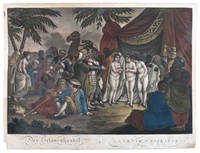
1800I7DD3T6LJ6QQNo place 1800. 27 x 40 cm. Aquatint in contemporary hand colour engraved by "J. L. T." after "J. R. P." Three partly exposed women before a large tent being advertised and inspected by several men dressed in fine oriental garb. On the left is another woman whose price is under discussion while the background shows date palms and two dromedaries.Rather severe water stains and a few small holes in the blank margin; some scuff marks in the image; trimmed closely with loss to lower left corner. A very appealing print. Rare. unknown
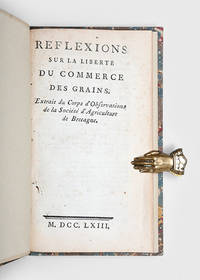
17631730471763. Grain policy in the ancien régime First edition of this exceptionally scarce economic tract on the grain trade. We trace only two institutional copies worldwide: at the University of Chicago and the BnF. The recent spine label attributes this work to Louis Paul Abeille 1719-1807 an early convert to physiocracy and a friend of Quesnay and Mirabeau. Abeille served as secretary of commerce under Louis XV & XVI from 1769-83. A series of subsistence crises brought concerns over public access to grain to the forefront of French economic debate in the mid-18th century. In the absence of public granaries government policy was to regulate more strictly the distribution of grain by private commercial interests but periodic subsistence crises revealed the inadequacy of this policy. Over the next decade the physiocrats continued to promote deregulation of the grain trade which contributed to spiralling prices and the Flour War of 1775. The attribution to Abeille is presumably based on his publication in 1760 of the Corps d'observations de la Société d'agriculture de commerce et des arts établie par les États de Bretagne années 1757 & 1758 which brought him to the attention of Quesnay and Mirabeau in Paris. Abeille was the secretary of the Agricultural Society of Brittany a learned society for agricultural improvement. Duodecimo 159 x 92 mm. Recent marbled paper boards gilt label to spine edges sprinkled red. Minor foxing and browning: a very good copy. Not in Black Goldsmiths' or Kress. hardcover
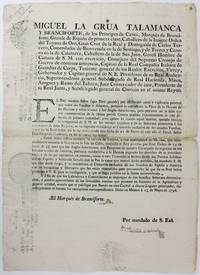
17965074Mexico City: May 13 1796. About very good. Broadside 17 x 12.25 inches. Old fold lines. Slight separation and loss at center fold slightly affecting a few letters. Minor wear else. Proclamation made by the Viceroy of New Spain authorizing trade between Cuba and the United States. The Caribbean was in tumult in the 1790s with Toussaint L'Ouverture overthrowing the French colonial government and outlawing slavery. Likewise in Cuba there was a similar revolt against slavery demanding abolition and equality -- both revolutions were of substantial concern to slaveholders in the American South. Specifically the present decree mentions flour and other vital foodstuffs as a measure against shortages in Cuba intended to prevent further trouble. "Para precaver la escasez de viveres y con especialidad de harinas que verosimilmente causaria la guerra concedio El Rey Permiso por Real Orden de 25 Junio de 93. para que los Anglo-Americanos.pudiesen conducirlos a la Havana pagando los derechos los puertos habilitados de España." The Viceroy at the time was Don Miguel de la Grua Talamanca de Carini y Branciforte First Marques de Branciforte. The Marques was notoriously corrupt even for colonial Spain having gained position through marriage to the Prime Minister's sister. He made sure to make some profit on everything that passed through his hands including taking advantage of the War in Cuba to remove the French from their lands and sell them to his benefit. A rare and interesting decree. We locate a single copy in OCLC at the University of Minnesota. May 13 unknown
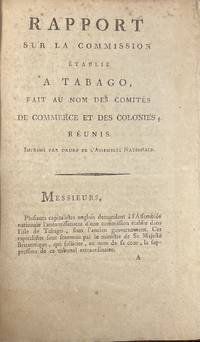
17913649Paris: Imprimerie Nationale 1791. First edition. Bound in later hardpaper boards covered with pastepaper spine with red gilt leather title vignette. Untrimmed. Paper tanned. Otherwise in very good condition. First edition. Bound in later hardpaper boards covered with pastepaper spine with red gilt leather title vignette. 18 2 blank p. <p><br /> Official report on the 1786 “Commission de Tabago†an extraordinary tribunal established to examine debts between British creditors and settlers after the French conquest of the island.<br /> <p><p><br /> First edition of the National Assembly’s official report on the controversial “Commission de Tabago†an extraordinary tribunal established in 1786 under the ancien régime to review debts between British capitalists and settlers after the French conquest of Tobago.<br /> <p><p><br /> The report reconstructs the background of the island’s transfer: originally ceded to Britain in 1763 Tobago had been largely settled and financed by British investors who lent capital for the development of sugar estates secured by mortgages. Following the French conquest 1781 and definitive cession Treaty of Paris 1783 the treaty guaranteed the inhabitants’ property rights under English law. Nevertheless in 1786 the Conseil du Roi created a special commission at Tobago to investigate alleged usury and excessive interest rates in these mortgage contracts. The commission—presided by the governor and ordonnateur—confiscated titles annulled or reduced debts and declared most English claims void provoking losses estimated at over 13 million livres.<br /> <p><p><br /> This Rapport examines the legality of the tribunal under both French and English law concluding that it was arbitrary unconstitutional and in violation of the 1783 peace treaty. The committees show that English statutes were misquoted that the island’s existing courts Common Pleas and Chancery already had proper jurisdiction and that no disputes existed before the commission was imposed. The report also denounces the suppression of trial by jury and the disregard of due process. It recommends—and the Assembly accepted—that the entire commission and its judgments be annulled thereby restoring lawful jurisdiction in the colony. The episode marked one of the last acts of French administration on Tobago which was recaptured by Britain in April 1793 returned to France in 1802 under the Treaty of Amiens and formally surrendered under the Treaty of Paris in 1814.<br /> <p><p><br /> An important Revolutionary document reflecting early attempts to reconcile French constitutional principles with colonial administration and international treaty obligations.<br /> <p><p><br /> Not in Sabin. No records on RBH. WorldCat locates 6 copies.<br /> <p>. [Imprimerie Nationale] unknown
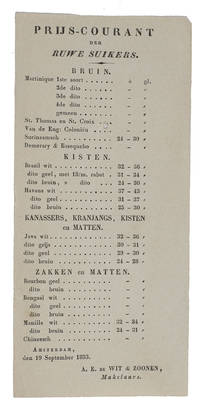
1721LC4D1MQ3QGJ6Amsterdam 1721. 1 leaf 21 x 8 cm; 1 leaf 20.5 x 8 cm; 1 leaf 17.5 x 8 cm. Jacobus van Egmond Ad 1: Text printed on both sides each in a border built up from typographic ornaments. Ad 2: Text printed on one side. Ad 3: Text printed on one side. 3 documents. Ad. 1: Rare VOC ships manifest for cargo shipped from the East Indies - Batavia and Ceylon Sri Lanka - on 22 East-Indiamen sailing on 1 December 1720 from Batavia and on 15 November from Ceylon. The list includes more than 100 different colonial wares and gives the weights in pounds or the lengths in feet: from pepper more than 6.5 million pounds cloves 694000 pounds cinnamon 604000 pounds and coffee more than 1.77 million pounds to 962 pounds of Javanese cardamom some jewels and rariora and many feet of silk and linen cloth. Small wormhole affecting two characters otherwise in good condition.Ad. 2: Rare list of the results of the auctions of colonial wares organized in 1781 by the Chambers of the VOC Amsterdam 30 April 1781; Zeeland 7 May; Delft 15 May; Rotterdam 17 May; Hoorn 22 May; Enkhuizen 23 May including pepper cinnamon nutmeg etc. with the prices fetched. With a small tear not affecting the text. Still in good condition.Ad. 3: Price list of the various varieties of raw sugar: brown sugar from Martinique Surinam etc.; sugar packed in chests from Brazil Havana; in bales from Bengal Manilla etc.Small hole not affecting the text.l Ad. 1: cf. Landwehr VOC 1123-1134 other manifests. hardcover
1787162443London: Printed by Charles Eyre and Andrew Strahan 1787 i.e. 1788. Among the earliest Parliamentary responses to the British slave trade First edition of the first British law to regulate slave shipping preserved in its original volume of yearly parliamentary acts. The law bound 54th in this volume pioneered techniques of popular abolitionist appeal. The Slave Trade Act 1788 limited the number of enslaved persons that could be transported on British ships. It also required that all ships carried a doctor to monitor the conditions of the enslaved persons. The Act was supported through Parliament by Sir William Dolben 1727-1814 and Charles Stanhope 1753-1816. LoGerfo notes of their campaign that "the machinery used to appeal to the literate public would also be used in the future" p. 450. This volume collects 57 acts passed by the 16th Parliament of Great Britain which met from November 1787 to July 1788 and was led by Pitt the Younger. Like all Parliamentary statutes of this period the Slave Trade Act was separately printed with a general title page for inclusion in the yearly volumes of acts. Most of these statutes were printed with their own title pages included in the signatures and pagination - here all such pages have been removed. These laws were printed in limited numbers usually estimated at around 1100 copies only. The volume includes laws against chimney sweeps and child labour and measures to compensate dispossessed American loyalists in the years after the Revolution. Folio 304 x 191 mm pp. 1012 = 900 title pages of individual acts removed. Woodcut device to title page woodcut head- tailpieces and initials to contents. Contemporary quarter sheep spine lettered and with black morocco label in gilt marbled paper sides. Bumping and wear minor loss to spine ends joints cracked but holding firm slight browning and foxing to endpapers and contents slight marking to edges: a good copy. ESTC N58828; N58797 Slave Trade Act. James W. LoGerfo "Sir William Dolben and "The Cause of Humanity": The Passage of the Slave Trade Regulation Act of 1788" Eighteenth-Century Studies Vol. 6 No. 4 Jun. 1973. unknown
177097Birmingham or Sheffield 1770. <p>Oblong folio. 390 x 220 mm. 15 1/4 x 8 3/4 inches. Vellum spine over decorative blue paper wrappers paper label with title in Italian on upper board and ink title in Italian on spine. Paper stock toned with age a few leaves with staining in the margin otherwise in good condition.</p> <br /> <p>Silversmith model book containing 80 full-page engravings of candles sticks and holders candelabra pitchers plates salt and pepper shakers serving utensils silverware and other household pieces. Each image is beautifully and careful engraved with rich detail and ornamentation. Each includes a printed product number as well as one in ink with a different item number and a price.</p> <br /> <p>Although there is no title-page or signatures of engravers this large sales catalogue appears to be English as some of the engravings have English words of explanation engraved in the text. The binding is definitely Italian and the paper label is in an Italian hand. The watermark is a "fleur de lis" pattern suggesting an international company manufacturing the silver. There were only a few English companies with the capacity to export at this time including silver works in Sheffield and Birmingham both of which by 1770's had established networks of dealers selling their wares across the continent. This catalogue with specific Italian connections is very unusual and suggests the scope of the business had reached export capacity by the third quarter of the century. The most important Italian silver makers at this time were Giardini of Rome and Venuti of Naples.</p> . unknown
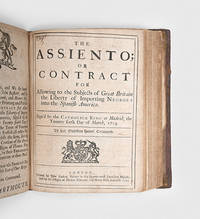
1713186652London: Printed for John Baskett Printer to the Queens most Excellent Majesty And by the Assigns of Thomas Newcomb and Henry Hills deceas'd 1713. A foundational document in the transatlantic slave trade First edition of a major development of the transatlantic slave trade which greatly expanded the market for British slave traders in the Americas and helped establish Britain as the predominant slave trading power. After the War of the Spanish Succession Spain ceded to Britain the exclusive right to import African slaves into Spanish America. This monopoly the Assiento was delegated to the newly formed South Sea Company and held until 1750. The supposed value of the Assiento was the basis of the South Sea Bubble. In fact the restrictive terms - slave numbers were capped and all shipments were heavily taxed by the Spanish Crown - resulted in the South Sea Company never making substantial profit from the agreement. Nonetheless the Assiento played a major role in boosting and consolidating Britain's role in the Atlantic slave trade. The front free endpaper contains a detailed contemporary owner's note naming the binder of the volume - John Worrall - the price paid how it was constructed and how the book should be used: a very unusual survival. The notes state "This book Intituled State Pamphlets was bound by John Worrall for 2s. 2d. and containes 425 leaves". Little is recorded of John Worrall. He was apprenticed from 1674 to 1682 and was working at Warwick Court in 1709 and at Fleet Ditch in 1722. He died in 1726 all from Howe p. 103. The notes continue that the contents are consecutively numbered in manuscript and to use that numbering not the pagination of the original pamphlets. It specifies that "Remarks" are to be "entred in the proper cleane leaves as the observation thereof sees best" - blanks are bound between the tracts. It then notes that the manuscript table should be placed as the second leaf as is found. It refers the reader to another volume with more detailed instructions - it is evident the volume was held in a library which anticipated wide use. The nine other works bound in the volume - an inventory is available on request - date from 1688 to 1714 and are tracts on religion law and politics alongside the Treaty of Utrecht. It includes Jonathan Swift's first political work A Discourse of the Contests and Dissensions between the Nobles and Commons in Athens and Rome 1701 - this copy is the second issue with most of the first edition type corrected and reset. 10 works bound in 1 vol. quarto 206 x 156 mm. Contemporary calf red morocco label to style covers ruled in blind edges sprinkled red. 19th-century ownership signature "S. Louise Langdon" to verso of manuscript contents leaf. Joints and extremities restored slight staining to endpapers a little browned occasional trimming to pagination. Overall very good. ESTC T4476 another issue only has Baskett in the imprint; Kress 5020; Sabin 2227. Ellic Howe A List of London Bookbinders 1648-1815 1950. unknown
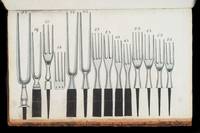
179212195Düsseldorf: s.n. 1792. Contemporary mottled calf rebacked restored marbled endleaves. <p>      ILLUSTRATED PATTERN AND PRICE BOOK OF STEEL KNIVES AND FORKS MANUFACTURED AT SOLINGEN with the strict governmental guidelines for craftsmen and their commercial partners.<br />       The “City of Blades†Solingen was the largest sword knife and scissor manufacturer in the West. It employed over four thousand workers and exported globally. Through their rigid guild system est. 1571 the knife makers protected their trade secrets. Legal standards and strictures ensured the Solingen bladesmiths dominated the market and were the sole suppliers to elite merchants who commissioned bulk orders and custom products. Ordinary tradesmen — like the owner of this book — could only purchase ready-made items and had to pay cash.<br />       KNIVES FOR COBBLERS WOOD- AND LEATHERWORKERS BUTCHERS HUNTERS FARMERS TAILORS GARDENERS WEAVERS AND COOKS form the largest section in the volume. Each blade has a schematic manuscript illustration with separate costs for the work of smiths and for grinders. Many models adopt Dutch English French Flemish and Portuguese designs for the local chic and for export. Only the leatherwork knives are illustrated in watercolor 95 pieces marking a specialty of the owner of this sample book.<br />       THE SECTION ON FORKS HAS ONE HUNDRED THIRTY-EIGHT WATERCOLOR ILLUSTRATIONS and price lists of large carving tools to dainty ones for desserts 65 models. This other house specialty addressed the increasing adoption of forks by upper- and middle-class families in later 18th-century Europe.<br />       ANOTHER SECTION SHOWS HANDLES. These were exclusively manufactured by artisans called Reyder. Each of the two hundred three models listed was available in a range of specified styles and materials. The cost of each type of custom work like turning polishing and coloring is itemized. THE MOST PRIZED EXAMPLES ARE OF FINELY DECORATED BONE EBONY ANTLER GOAT HORN GUAIAC OR PALM WOOD. Look-alikes of “false deer horn†“false guaiac wood†etc. fit other budgets with imitation luxury finishes and less expensive materials. The illustrated examples of knives showcase eighteen different handle decoration options including black red white yellow or green dye black marbling and fine lacquer painting in abstract or foliate patterns. Seven handles are inscribed with German verse. In good condition some light staining hand soiled throughout.<br /> ¶Daniels Vollständige Beschreibung der Schwert-Messer- und übrigen Stahl-Fabriken zu Solingen 30-62.</p> s.n. unknown