30 résultats
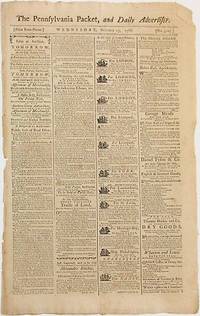
178834190Philadelphia: John Dunlap and David C. Claypoole 1788. 4pp folio caption title as issued folded. Printed in four columns per page. Uniformly toned some edge and spine wear. About Very Good.<br/><br/> More than three columns on page two print Parliament's Act regulating the African Slave Trade. The Act forbade any British ship "from any port of this kingdom" to transport African slaves except in accordance with registration requirements and detailed health and safety regulations. Many advertisements are also printed some of which reflect the busy West Indian trade; as well as news of arriving and departing vessels. John Dunlap and David C. Claypoole] unknown books
1731WRCAM46722London 1731. 31pp. Folio. Vertical fold reinforced with tissue. Very light foxing and wear. Very good. A protest against a bill to restrain the northern colonies from trading with the French and Dutch sugar islands. One of two editions published. Only four copies located by ESTC: British Library Bibliothèque National John Carter Brown Library and University of Minnesota. ESTC T20672. HANSON 4222. EUROPEAN AMERICANA 731/39. unknown books
1731WRCAM46721London 1731. 31pp. Folio. Vertical fold reinforced with tissue. Minor soiling. Very good. A protest against a Bill to restrain the northern colonies from trading with the French and Dutch sugar islands. One of five editions published all rather scarce. Only four copies of this edition noted by ESTC - at the National Archives New-York Historical Society University of Michigan and the University of Minnesota. European Americana also notes Yale and JCB. ESTC N15514. EUROPEAN AMERICANA 731/37. unknown books
1774WRCAM51552Paris 1774. Broadside 20 1/4 x 16 1/4 inches. Folded with three small holes along fold lines otherwise very good. A French chart detailing export and import figures for British trade with its American island colonies from 1697 to 1773 using amounts in both pounds sterling and livres tournois gathered from parliamentary reports and calculations by Charles Whitworth financial statistician and Member of Parliament for constituencies in Cornwall and Somerset from 1747 to 1778. Extremely scarce with only one copy recorded in OCLC. unknown books
1797WRCAM3973Philadelphia 1797. 7pp. Dbd. Printed self-wrappers. Very good. This report raises the issue of the arming of merchant vessels. The harassment of American commerce by European powers was a chronic problem in the Adams Jefferson and Madison administrations. EVANS 33039. unknown books
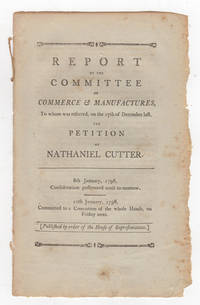
179843744Philadelphia 1798. First edition. Removed. A very good copy lightly soiled and edge worn. 4 pp. 8vo. Nathaniel Cutter wanted relief from being re-taxed on goods that left Massachusetts where he had paid tax and then returned to the same port with the same goods because he was harrassed by the British and French and turned away in the Dominican Republic. The committee wisely wrote: "Your Committee however cannot find any good reason for relieving him against consequences of a risque which every exporter ought to calculate for himself." Cutter would continue to take risks suppling the French in Saint-Domingue and a claim was allowed him in 1803 by the American Commission in Paris for unpaid costs by the French See Greg H. Williams: The French Assault on American Shipping 1793-1813: A History p. 154. Evans 34754. ESTCW25464. unknown books
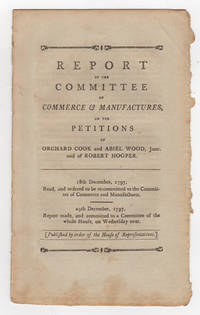
179743741Philadelphia: Printed by William Ross 1797. First edition. Removed. Very good mostly unopened uncut untrimmed copy minor browning at lower edge. 3 226-232 2 pp. 8vo. Evans dated it both 1797 and 1798. two petitions both concerning a waving of taxes on spirits the Orchard Cook and Abiel Wood case claiming the ship was wrecked on an island and the cost of recovering the cargo exceeded the cost of the mechandise and that their insurance had lapsed. In the second case Hooper claimed he was lax in filing papers for re-shipping a cargo overseas. Wisely both were declined as the committee felt the government is not in the business of insuring that a business is successful and well run. Ah to return to those days. Orchard Cook 1763-1819 and Abiel Wood 1772-1834 had a better idea. They both became U.S. Representatives from Massachusetts. OCLC locates eight copies. Evans 33015. Evans 34753. ESTCW15017. [Printed by William Ross] unknown books
175141756London: n.p. 1751. Modern marbled paper-covered boards. Minor wear to extremities browning to title page edge wear to last leaf still a near fine copy. 1 57 1 pp. Folio. "Very rare and valuable. It contains an Appendix of Premiums paid by the Irish Linen Board" Higgs Bibliography of Economics p.8. An important source document. There is also a 28 page edition. OCLC locates only four complete copies of this separate issue: Yale Amer. Textile Museum Univ. Mass. Univ. Minn. and nine of the 28 page extract. Kress 5155. Higgs 54. Goldsmiths'-Kress 08612.1. n.p. hardcover books
1778WRCAM37240Madrid: Pedro Marin 1778. 219262pp. plus engraved leaf with royal coat of arms. Quarto. Contemporary mottled calf gilt spine gilt extra. Edges of covers slightly worn corners heavily worn. Modern bookplate on front pastedown old book dealers' descriptions on front pastedown. Contemporary ownership inscription "Castillo" on titlepage. Occasional minor soiling and dampstaining in upper margins of a few leaves remainder of text fresh and clean with wide margins printed on heavy paper. Very good plus. Detailed rules and regulations governing Spain's late 18th-century commercial policy in Latin America with a preliminary section of nineteen pages providing a summary of the articles and tariffs documented in the main portion of the text. With this REGLAMENTO. the Crown terminated Cadiz and Seville's monopoly of trade with Spanish America allowing other cities of the realm to participate. In addition to much information on commerce and numerous tariffs on a large variety of Spanish and American goods several sections discuss shipping ports and other maritime activities directly related to commercial activity. The work also includes the text of concessions granted to Louisiana. PALAU 255843. SABIN 68890. MEDINA BHA 4845. Pedro Marin unknown books
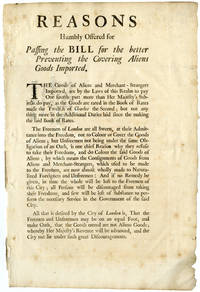
1714WRCAM39833London 1714. Small folio broadsheet. 1p. plus printed docket title on verso. Dbd. Early folds and early stab holes in left margin. Mild foxing. Very good. An early British petitionary leaflet calling for greater enforcement of customs laws for imported goods. The author charges that most consignments of foreign goods are now being made to "Naturalized Foreigners and Unfreemen" who are not under the same obligations as Freemen who state in their oath "not to Colour of Cover the Goods of Aliens." If "no Remedey be given" it is argued "all Persons will be discouraged from taking their Freedoms and few will be left of Substance to perform the necessary Service in the Government of London." The document is among the earliest examples of lobbying literature which first began proliferating during the major changes in British government in the mid-1710s. ESTC records four copies at the British Library Oxford National Library of Wales and California State Library. HANSON 1980. unknown books
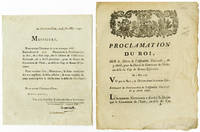
1790WRCAM51521Rouen: L. Oursel 1790. 3pp. with: PRINTED FORM LETTER COMPLETED IN MANUSCRIPT CONCERNING THE PROCLAMATION. N.p. 1790. 1p. Quarto on a folded folio sheet. Light wear and soiling. Very good. Proclamation by the Revolutionary government of France abolishing the monopoly of the French East India Company on trade beyond the Cape of Good Hope and declaring it open to all Frenchmen. The Compagnie des Indes Orientales was established in 1664 to compete with the British and Dutch East India companies. It had considerable difficulty maintaining itself financially through its long history and it was finally liquidated in 1769. In 1785 it was reconstituted and granted a seven-year monopoly on trade beyond the Cape of Good Hope but the French Revolution and the democratic zeal that accompanied it put an end to that with the present decree. The brief proclamation is accompanied by a transmittal form from the Bureau Intermediane du Departement de Montivilliers indicating that one copy of the proclamation was sent to the recipient. L. Oursel unknown books
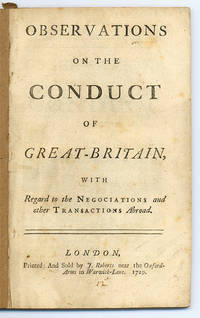
1729658131729. London: printed and sold by J. Roberts 1729. London: printed and sold by J. Roberts 1729. English Trade in the West Indies Trade. Great Britain. Amhurst Nicholas 1697-1742 Attributed. Observations on the Conduct of Great-Britain With Regard to the Negociations and Other Transactions Abroad. London: Printed: And Sold by J. Roberts 1729. 61 1 pp. Octavo 7-3/4" x 4-1/2". Stab-stitched pamphlet in later plain wrappers. Light rubbing minor wear to spine ends and corners light soiling to title page and verso of final leaf. Light toning to text light foxing to a few leaves. A nice copy. $100. First edition. Attributed in some sources to Nicholas Amhurst this pamphlet defends Sir Robert Walpole then chancellor of the exchequer against accusations of neglecting England's West Indian commerce to the advantage of Spain. It describes English expeditions to counter Spanish influence and in the interest of fairness lists English ships taken by Spain since the Treaty of Hanover 1725. English Short-Title Catalogue T41776. unknown books
180044270Paris: Ve. Panckoucke An IX 1800. First Edition. Octavo 20cm.; recent salmon paper-covered boards red gilt morocco spine label; 4xvi118pp.; folding map bound in rear "Carte de la Côte Occidentale D'Afrique entre le Cap Blanc et le Cap Tagrin." New endpapers though half title and rear free endpaper retained. A Fine exceedingly fresh copy. Pelletan served as the director of the Compagnie de Sénégal the administrative company for the colony in 1787 and 1788 though the present work was composed from memory while Pelletan was imprisoned in 1793 at the height of La Terreur. The "Mémoire" provides geographical descriptions of the western coast of the African continent as well as an account of imports and exports the latter chiefly rubber and slaves Pelletan mentions 1000 to 1200 perhaps for the years under his administration prior to the suppression of the slave trade. The second half of the work deals primarily in describing the ravages of the slave trade on the country and it people: "It is without a doubt that the abolition of the slave trade will completely change the face of the region devastated for centuries by ceaseless warfare crippled by the enslavement of portions of its peoples and depopulated by this horrific commerce conducted by degraded persons and greedy European merchants who can only satisfy their avarice at the price of the blood and freedom of these miserable Africans" our translation; pp. 48-9. Pelletan also dedicates brief sections to the moral and physical attributes of the Senegalese inhabitants as well as a description of their homes and pottery before proposing a detailed outline for a newm post-slave trade colonial government for the region. See George E. Brooks "Western Africa and Cabo Verde 1790s-1830s" 2010 p. 13; and Paul Masson "Marseille et la Colonisation Française" 1906 pp. 231-2. Ve. Panckoucke unknown books
177097Birmingham or Sheffield 1770. Oblong folio. 390 x 220 mm. 15 1/4 x 8 3/4 inches. Vellum spine over decorative blue paper wrappers paper label with title in Italian on upper board and ink title in Italian on spine. Paper stock toned with age a few leaves with staining in the margin otherwise in good condition. Silversmith model book containing 80 full-page engravings of candles sticks and holders candelabra pitchers plates salt and pepper shakers serving utensils silverware and other household pieces. Each image is beautifully and careful engraved with rich detail and ornamentation. Each includes a printed product number as well as one in ink with a different item number and a price. Although there is no title-page or signatures of engravers this large sales catalogue appears to be English as some of the engravings have English words of explanation engraved in the text. The binding is definitely Italian and the paper label is in an Italian hand. The watermark is a "fleur de lis" pattern suggesting an international company manufacturing the silver. There were only a few English companies with the capacity to export at this time including silver works in Sheffield and Birmingham both of which by 1770's had established networks of dealers selling their wares across the continent. This catalogue with specific Italian connections is very unusual and suggests the scope of the business had reached export capacity by the third quarter of the century. The most important Italian silver makers at this time were Giardini of Rome and Venuti of Naples. unknown books
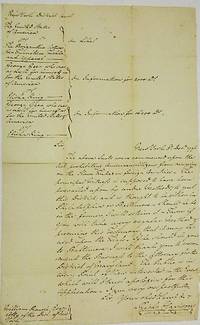
179635853New York 1796. Single page 9-1/2" x 15-3/4" entirely in manuscript. Headed with names of three cases pending in the New York District Court followed by Harison's letter to Rawle. Old folds with a pinhole at a fold intersection no text loss. Short fold split expertly repaired. Very Good.<br/><br/> Harison 1747-1829 was President Washington's appointee in 1789 as the first United States Attorney for the District of New York. He served until 1801 when Edward Livingston succeeded him. His correspondent William Rawle was Washington's appointee as U.S. Attorney for Pennsylvania. Rawle was founder and first president of the Historical Society of Pennsylvania president of the Pennsylvania Abolition Society and a highly respected writer on governmental matters.<br/> The Slave Trade Act of 1794 passed by the Third Congress and signed by President Washington was the first American regulation of the international slave trade. It prohibited Americans from trading in slaves to any foreign country. Harison had brought several cases under the Act as noted in this Letter: The United States vs. The Brigantine Active; and two by George Geer for himself and the USA vs. Elisha King. Harison explains "The above Suits were commenced upon the Act prohibiting American Citizens from carrying on the Slave Trade in foreign Countries." <br/> Harison's problem: "The principal witness is supposed to have been prevailed upon by undue Methods to quit this District is thought to be either in Philadelphia or Baltimore." If he's in Philadelphia "I will esteem it a Favor if you will take every regular Method of procuring his Testimony." If he's in Baltimore please "recommend the Business to the Attorney for the District of Maryland. The Public is in every Point of View interested in the Event." Diligent research has uncovered no additional information on these cases. unknown books
176428707Paris: Aux dépens de la Compagnie 1764. 1 vols. 12mo. 19th century marbled boards paper manuscript label. Blanks at front and back removed marginal repair to title some soiling at front and back else very good with the signature of La marquise des Armoises d'espineaux with the 1765 date throughout. 1 vols. 12mo. For the Commercial Traveller. Not in Kress Aux dépens de la Compagnie unknown books
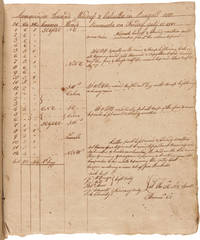
1796WRCAM54712Mostly at sea from New York with stops in Calcutta Saint Helena Ascension Island and Cornwall England 1796. 246pp. Square folio. Original crude burlap covers stab-sewn with thick string. A bit toned and foxed occasional ink or tobacco burns. Very good. A remarkable artifact of early American naval commerce containing the sailing directions and shipboard activities of the "Ship Washington of Philadelphia" which sailed from New York to Calcutta rounding the southern tip of Africa and visiting Saint Helena and Ascension Island before crashing on the rocks at Cornwall England on the way to Hamburg Germany. The log contains a navigational ledger with locations headings wind and weather remarks along with occasional sick lists names of men "unfit for duty" those put on light duty temperatures and other information. The remarks are quite detailed and specific regarding shipboard work and activity. <br> <br> The captain of this final voyage of the ship WASHINGTON was Samuel Hubbart but the identity of the sailor who kept this log is unknown. The ship departed New York on July 4 1795 and reached Calcutta on August 31. Without the need for recording navigational data while in port the log's author switches from the ledger-style format and writes longer more-detailed daily entries describing the crew's activities. The crewmen mentioned include pilots boatswains carpenters coopers caulkers sailmakers and others. Most of the entries pertain to the maintenance of the ship while anchored in the bay. Numerous mentions are made of crew on board fixing various equipment including types and amounts of supplies. A few entries note the employment of Indian "Cooleys" on board the ship making various repairs. An interesting incident of September 17 bears relating: <br> <br> "Hearing a noise upon the main Deck Mr. Naylor went to see what was the matter - upon engaging found Abraham Moor had struck Thomas Williams the Cook as Moor said for wanting to trouble a girl which Moor had on board - Mr. Naylor told him he should not ill use that man for he had every reason to believe it to be false what he alledged against the Cook. Moor said he did not come here to be jawd by a black Man.S." <br> <br> After swearing he would "never go home" on the WASHINGTON Moor literally jumped ship just after this confrontation and hid on another ship before being found and brought back to the WASHINGTON "in irons." <br> <br> In early November a few entries mention the ship receiving a supply of sugar taking on "Three Burr Load of Sugar" on November 7 and two more "Burr Load" two days later. Subsequent entries detail the loading of several "Burr Load of Bales" and "one hundred bags of ginger." <br> <br> Over the course of the ship's time at Calcutta the author mentions encounters with at least four other American ships: the GANGES the HAMILTON the MAJOR PINKNEY of Charleston and the "American Ship Camilla of New York arriv'd here from London." <br> <br> By early February the WASHINGTON left Calcutta for the voyage to Hamburg spelled variously here as "Hamborough" and "Hamburgh" though the ship would never make it to Germany. On March 15 and again on April 6 the recordist notes an inventory of the ship's water supply. By March 23 the ship reaches a point "prependicular on Cape Lagulas Bank" the southernmost point of Africa. About a week later the punishment of a drunken sailor is reported: <br> <br> "Joseph Gonrabbysp who has for some time past been addicted to Drunkeness and no person on board having given him any liquor he was discovered this morning to have taken from the Ships stores about half a Gallon of rum and from his being frequently very drunk there is no doubt of his having been Guilty of the same offence before for which Capt. Hubbart is necessitated to order his Boatswain to flog him. Accordingly mustered all hands aft and give him one and a half dozen lashes." <br> <br> On April 16 the WASHINGTON arrived at the remote island of Saint Helena in the South Atlantic Ocean sending "the Boat on shore with an Officer to the Governor for permission to Anchor." Here the WASHINGTON restocked supplies including water potatoes & other vegetables rice and bread before embarking for Ascension Island which they reached on April 25. The author remarks on the "number of remarkable rocks like pyramids" and "a low point of black Rocks with a fine white sandy beach back of it" witnessed at Ascension Island. The WASHINGTON spent one night at Ascension where a group of men went ashore in order to "spend the Night in Catching Turtle in the different Bays." The crewmen caught twelve turtles and brought them aboard ship before continuing their journey. <br> <br> While heading north to Europe the WASHINGTON was boarded on May 17 by the "Quebec British Frigate Cap J Cook in Company with the Carnatic 74 Rear Admr Powel with a convoy of 21 sail of Transports & Gun boats with 10000 Troops on board bound for Martinico Martinique." On June 7 they again encounter another ship "a Spaniard from some port in South America bound for Cadiz out 3 months & 10 days - we cannot understand rightly what port she was from." <br> <br> Then on June 18 disaster struck the WASHINGTON as it ran aground at the Lizard Rocks off Cornwall England. The log book records the ship's demise: <br> <br> "The weather still very thick and hazy. At 9PM hearing the Surf break on shore took in all the studding sails Braced the Yards sharp and hauled to the Southward finding ourselves in amongst the Rocks off the Lizard have all aback and endeavored to get her out from among them but the Flood tide making very strong drove the Ship so hard upon the Rocks that with every endeavour we found it impracticable to get her off she having settled on them & the strength of the tide Thumping her very hard upon the Rocks sounded the Pump and found she made water very fast. Fired several Guns as a signal of Distress which brought several boats off from the Shore to our assistance." <br> <br> For the next couple of weeks the crew of the WASHINGTON participated in "discharging the cargo" from the ship so that it is not "plundered by the natives" sending everything to Falmouth "where the Goods are deposited under the protection of a Custom house Yaught." The log book mentions one crewman of the WASHINGTON "threatening revenge on Captain Hubbart." Another crewman is put "under a Guard of Soldiers" after selling off some of the muslin stored in the bales rescued from the wreck. Here the ship's log ends along with the career of the Ship WASHINGTON. <br> <br> A unique record of the last voyage of an early American trading vessel with insight into late 18th-century navigational methods and the commercial interests of Federal-era America. unknown books
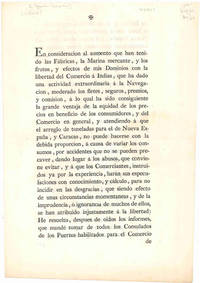
1789WRCAM47977Madrid 1789. 3pp. Folded folio sheet. Two worm holes very minor soiling else fine. This royal decree liberalized the tightly controlled trade between Spain New Spain and the Captaincy of Caracas. The Crown hoped to spur navigation and commerce and lessen the incentive for smuggling. Export duties on goods traveling to the Indies were to be slashed by ten percent but penalties against contraband would still be enforced. unknown books
17944016Leeds 1794. Large 4to 308 x 240 mm. 12 leaves text comprising 3 printed titles each with a 6-page description of the items in the catalogue in German French and English and 45 engraved plates of which one folding containing 186 designs numbered 1-152 with an additional 34 numbered and lettered designs for "tea-ware" tea- and coffee-ware in the French and English descriptions. Paper watermarked with a fleur-de-lys and shield with capital letters L V G below Lubertus van Gerrevink. Some light scattered foxing and offsetting plate 20 with closed tear to top margin just entering plate area without loss folding plate 26 torn across and repaired. Modern retrospective calf gilt edges red-stained extremities very lightly rubbed. Provenance: contemporary notes in Portuguese on the blank verso of the last plate; Duncan Grant Warrand loosely inserted ex-libris; Martin Woolf Orskey bookseller 1925-2018 signature at end with purchase date 1972. A multi-lingual catalogue of pottery produced by Hartley Greens and Co. for the use of traveling salesmen. Founded circa 1756 at Hunslet south of Leeds the company gained a reputation for its elegant cream-colored earthenware in the classical style known as creamware a type of earthenware made from white Cornish clay combined with a translucent glaze to produce a characteristic pale cream color. Hartley Greens and Co. so dominated the market that their products came to be referred to as Leedsware or Leeds pottery. Although some of the pieces in this catalogue are for display or special use Leeds pottery was generally a more everyday pottery than that of Wedgewood their principal rival and hence its survival rate is low. The earlier pieces before around 1775 were furthermore unmarked making attribution uncertain thus rendering the firm's printed catalogues all the more important. The present catalogue was "one of the earliest pattern books published in England by pottery manufacturers for the use of their travellers with illustrations of all the articles produced by the firm" Solon. It shows the creamware as issued from the studios before jobbers and importers added colored glazes. Shown are terrines sauce boats salts jugs egg cups covered terrines and bowls cake plates cruet stands candlesticks urns tea services and a remarkable tulip vase among other useful objects of the table many with ornaments some in the characteristic openwork or perforated style. All 186 designs are numbered and identified in the accompanying plate lists. The variety is impressive. Copies of the Leeds catalogues were often cut up by jobbers who relied on the illustrations to transmit orders accurately rather than trusting to written descriptions of the forms. Their consequent rarity makes the publishing history of the catalogues difficult to unravel. The earliest catalogue appeared in 1783 with the text in English only and 41 plates. The Danish National Library has a copy with the text in English and French and the English title dated 1786. Another copy of the present 1794 edition is held by the V&A but it has only 41 plates. Meanwhile there are also copies of a 1794 edition at Yale and RISD with the English text only but with 71 plates. The plates were reissued in 1795 and 1814 or 1815 these undated issues are identified by the watermarked dates of the paper they are printed on. Most of the variously dated copies seem to be reissues of the same plates. Most of the variously dated copies seem to be reissues of the same plates. A comparison of this copy to the Winterthur copy from 1814 which is digitized shows that the same plates were used with the addition of an engraved oval label " Leeds Pottery" on each plate up to and including plate 38 a compotier from which emerges a large cross after which the designs diverge. The editions or issues after 1795 do not have the very useful text with gives the name function and size of each piece: "As the price lists and the general title had been printed independently from the plates and not in sufficient quality to accompany the sets of engravings these late copies are generally found without the title and the printed description of the objects. These price lists now very rare were printed in English French German and Spanish. As the prices were subject to constant revision prices are added with pen and ink" Solon. Our copy is unpriced. Altogether OCLC locates fewer than a dozen copies some incomplete of various issues or editions of the Leeds pottery catalogue. Cf. M.-L. Solon Ceramic Literature 1910 p. 196. unknown books
1775WRCAM14145Versailles 1775. 8pp. Quarto. Printed self-wrappers. Fine. An important treaty between France and Spain with significant ramifications for their colonial holdings in America. Herein Vergennes and the Conde d'Aranda further define commercial arrangements between the two countries in an attempt to control contraband. This had special impact for the Caribbean basin where the colonies of both powers were required to ship goods through European ports. Dissatisfaction over this prohibition was a key factor in the Louisiana Rebellion of 1768. This convention was agreed to at Versailles on Dec. 27 1774. Not in Wroth. DAVENPORT 155. unknown books
17622191Cadiz: Don Manuel Esoinosa de los Monteros 1762. Hardcover. Very Good. 4to - over 9¾ - 12" tall. 4to. 20.5 x 14 cm 158 pp. 1 f. index. With woodcut head- and tail-pieces blazon of Charles III and two Spanish galleons. Bound in mottled calf over boards spine gilt in six decorative compartments. Somewhat worn at extremities. Generally very good. First enlarged edition of an illustrated merchant's guide to the duties and tariffs levied by the Spanish crown on exports from the Americas chiefly gold and silver but also concerning timber textiles furs coffee spices and foodstuffs.After first offering a general overview of Spanish colonial commerce with Western Europe Garcia de Prado provides a wide range of practical instructions for traders negotiating the hazardous waters of colonial finance giving sample calculations for the volume of shipping containers converting currency and-crucially-providing a comprehensive alphabetical list of the royal tariffs on exports from America and the West Indies printed as a table for quick reference in terms of maravedis de plata silver coins of account and quintales approx. 46 kg. The second half of the work is concerned with trade in gold and silver explaining the six classes of government tariffs and their application to quintales of the metals in their various states acuñada labrada grana fina etc. Printed at the Royal Navy Office in Cadiz where Spanish shipping vessels would have arrived from the Americas the present work anticipates later efforts by the Spanish Bourbons-particularly Charles III and the Marquis de Esquilache-to reform the fiscal administration of its colonial properties. Garcia de Prado remarks in his introduction that a much smaller work un Quaderno with the same title was printed in 1745 and that the present work aims to augment and update the information contained therein. JCB.III.1320; Medina 3999; Palau 58415; Sabin 15037 Don Manuel Esoinosa de los Monteros hardcover books
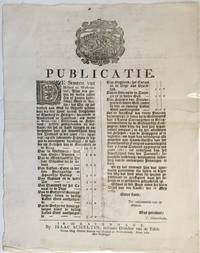
17852954The Hague: Isaac Scheltus 1785. Very Good. Broadside. Text in two columns. Large woodcut of coat of arms of the Dutch Republic along with the arms of all member states woodcut initial also with modified Dutch Republic arms. Crease down the vertical and horizontal middle other small creases in the lower half ink offsetting from folding on lower half small tears and chips along edges small dark stain just above top woodcut. The origins of the Dutch Naval College. <br/><br/>Fascinating broadside detailing tax duties on ships trading in the East and West Indies America the Cape of Good Hope and elsewhere levied for - and applied towards - the newly founded Dutch Royal Naval College "Kweekschool voor de Zeevaart" or Seminary for Navigation which produced officers for the Dutch Sea Service. Notably these officers were not trained at sea but in the classroom -- and in the courtyard where the navy erected large model training ship for the ultimate experiential learning. The vessel was large enough for young students to climb the rigging. It is with good reason that graduates were described as "paper sailors." <br/><br/>According to this broadside the Dutch Republic approved and consented to the establishment and maintenance of the Kweekschool in the year 1781 for which the bespoke taxes were collected. The academy was officially opened in 1785 the same year that this "Publicatie" was printed. Taxes were only levied on ships of the East Indies Oostindien and the Cape of Good Hope Kaap.<br/><br/>It was with some urgency that the Kweekschool was developed: at this time there was a radical shift in the balance of maritime power: the power of the Dutch East India Company was in gradual decline in deference to the rising British East India Company which came to dominate global trade. In particular 1785 marks the first full year following the end of the Fourth Anglo-Dutch War which broke out over British and Dutch disagreements on the legality and conduct of Dutch trade with Britain's enemies during the War of American Independence. <br/><br/>The broadside is signed in print by Caspar Clotterbooke 1711-1791 who was Secretary of the States of Holland at the time.<br/><br/>OCLC shows no copy in any institution outside of the Netherlands. Our copy appears to be the only one on the market; it is probable that this is the only one in private hands.<br/><br/>Literature: See especially Margaret E. Schotte Sailing Schools: Navigating Science and Skill 1550-1800 JHU Press 2019 passim. Isaac Scheltus unknown books
17745521Marseille 1774. No Binding. Very Good. Folio - over 12 - 15" tall. Two folio bifolia 43.1 x 27.7 cm each with letterpress text woodcuts and manuscript text on the first leaf. Retaining deckle edge on all sides folded and annotated as typical of such documents one of the documents a bit weak at the folds otherwise very well preserved. Two rare folio-size maritime insurance policies from 1770s Marseille relating to mercantile voyages to France's American colonies in the Caribbean and valuable witnesses to the more practical bureaucratic aspects of maritime trade in late 18th-century France. Each document is illustrated with the three large woodcut seals of the city and carries in letterpress the standard legal formulas particular to Marseille as well as extensive manuscript notes and signatures completing the policy. The earlier of the two policies signed in May of 1774 relates to the vessel La Gentille likely the frigate later recorded as having taken part in the 1780 Battle of Martinique a stalemate between the French and British navies during the American War of Independence. The second policy signed on 3 November 1777 concerns the Bon Pasteur a ship under the command of captain Pierre Antoine Massier. Historical records show that this policy was nearly redeemed: Returning from Martinique in late December the Bon Pasteur was fired upon by the British frigate Westmoreland off the coast of Cabo de Gata in Spain boarded by six men each armed with a brace of pistols and a saber and Captain Massier roughly handled. The English suspected that the Bon Pasteur was not carrying goods from Martinique but from New England tobacco rice which would have been in violation of the protectionist economic policies common in both the French and British colonies in the Americas. After several sailors aboard the Bon Pasteur were thoroughly questioned the ship was sent on its way and its insurers in Marseille breathed a sigh of relief. OCLC does not locate any institutional copies of Marseille policies of this sort. B.-M. Emerigon and P. S. Boulay-Paty Traité des assurances et de contrats à la grosse vol. 1 pp. 54-5; Bulletin de la Socété archéologique historique et artistique vol. 3 pp. 277-8; Observations sur le Mémoire justificatif de la cour de Londres 1780 pp. 12-3. books
1789WRCAM37445Paris: de l'Imprimerie Royale 1789. 3pp. Quarto. Folded sheet. Large woodcut vignette at head of first page. Moderate agetoning particularly at edges leaves slightly separated at fold. A very good copy. A very rare decree concerning the trade in wheat and grain between France and the United States. Echeverria and Wilkie records a single copy in a private library OCLC cites a copy at Yale Franklin Collection with a variant imprint. ECHEVERRIA & WILKIE 789/44A. OCLC 45249572 different printer. de l'Imprimerie Royale unknown books
1773WRCAM14144Paris 1773. 4pp. Quarto bifolium. Light stain else good. Relates to various problems and disturbances in the port of Marseilles including fraud in the tobacco tax and trade. Not in Wroth. unknown books