Joseph Breck & Sons (Trade Catalog)Biblio.com
239 résultats
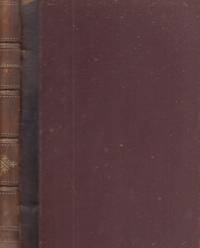
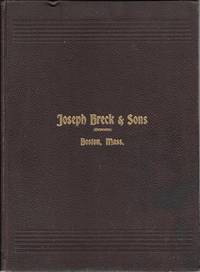
1897401494Boston MA: Joseph Breck & Sons 1897. 1st. Hardcover. Very Good/None. 288 pages illustrated throughout with detailed b&w engravings. A trade catalog featuring everything from coal forks and cider mills to hay rakes and manure spreaders. Textured maroon cloth with gilt lettering. The book itself is warped but the pages are crisp and clean. An excellent visual resource. Record # 401494 Joseph Breck & Sons hardcover
189486157Imprenta Navegación y Comercio 1894. hardcover. Bueno. Madrid 1894. Imprenta de Navegación y Comercio. Tela lomo piel. Ilustrado con numerosas láminas una desplegable fuera de texto. Sello anterior propietario. Contiene publicidad de la época. 23x16. 326 pp. Imprenta Navegación y Comercio hardcover
183334458v.p. including Antwerp London Havana Pensacola New York 1833. Folio. 12 3/4 x 8 inches. 21 leaves plus two additional manuscript leaves laid in. Contemporary half calf and marbled boards manuscript label on front board. Bookseller's label on front pastedown.<br/> <br/> Account book of Atlantic trading voyages.<br/> <br/> An interesting manuscript ship's log containing financial accounts for the brigs Nimrod and Jasper for an eight year period from 1826 to 1833 while they were under the command of a Captain John Hill. The two ships made numerous voyages between the United States Europe and the Caribbean. The present log book contains line accounts of expenditures for journeys from London and Marseilles to New York and Norfolk in 1827; from Antwerp to London in 1828; from Philadelphia to the West Indies in 1829; from Madeira to the Turks Islands in 1831; from the West Indies to Pensacola to Havana in 1832; from the Indies to New York in 1833; and other similar voyages. The log also contains two copies of an 1832 letter written in Havana by Hill to merchants there inquiring about the price of molasses and a list of port charges at several major way points. A fascinating artifact of trans-Atlantic trade in the 1820s and 1830s. unknown
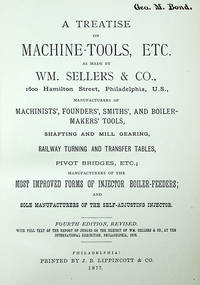
187754162Philadelphia: J.B. Lippincott 1877. Fourth edition revised. Small octavo 19cm. Publisher's green cloth titled in gilt and decoratively stamped in black on spine and front cover; 275pp; illus; one folding chart; lithographed frontispiece in colors. An exceedingly fresh and clean copy in the original publisher's cloth very near to Fine. Stenciled ink ex-libris of a Geo. M. Bond likely the engineer and inventor George Meade Bond ca 1853-1932 long-time chief engineer for Pratt & Whitney to front pastedown and head of title page. <br /> <br /> A nicely produced treatise-cum-trade catalog for this major producer of industrial machinery illustrated throughout with line engravings. An exceptionally pretty copy appearing almost unread. ROMAINE p.203 for the 3rd edition 1876 "one of the best illustrated catalog-books in the field. J.B. Lippincott unknown
189621325New York and elsewhere 1896. Folio. 14 1/2 x 12 inches. Approximately 350 larger ephemeral items and about 200 small scraps mounted on both pastedowns and recto and verso of 22 leaves. All leaves browned 3 leaves split vertically others with margins chipped some loosely inserted. Original rose-coloured glazed paper-covered boards lower cover blocked in blind and lettered 'Pat. March 76' in blind the upper cover blocked in gilt with three shaped raised panels with gilt borders enclosing chromolithographic images backstrip blocked in gilt corners rounded some fading to upper cover and backstrip inner hinges broken<br/> <br/> A spectacular album with an unusually rich assortment of advertising and trade cards including a selection chromolithographed designs of birds after Audubon.<br/> <br/> Internal evidence suggests that the album was probably assembled by a New York State resident living just south of Rochester - possibly from near Bath Cohocton or Canandaigua the patent date of the album gives a 'now earlier than' date whilst there are a number of dated items amongst the scraps the latest being 1896. Included are a large number of cards issued by local businesses as well as more national concerns like a fine series of six advertising cards for 'Wright's Indian Vegetable Pills' featuring toddlers playing baseball "Tum on ets' p'ay ball"; "See me tech it!"; "Aint dot out!"; "I'se bo'en home"; "I'se dot it!". There are also 33 'Arm & Hammer' bird cards after designs by John James Audubon 13 from the Arm & Hammer Brand / Church & Co. "Beautiful Birds of America" Collectors' Card 1st Series from 1894; the others probably from the second series. unknown
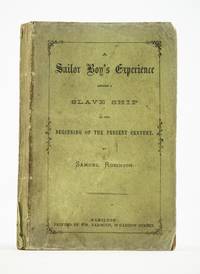
1867ST20572Hamilton Scotland: W. Naismith 1867. FIRST EDITION. 168 x 106 mm. 6 1/2 x 4 1/4". vii 183 pp. <br/> In the very rare original green paper wrappers. Spine cocked wrappers somewhat soiled spine with paper beginning to lift along the bottom inch of the rear joint other minor exterior defects but the volume solid and internally in excellent condition. QUITE A GOOD COPY of a fragile inexpensively produced volume one would expect to find in shambles.<br/> <br/> Told in the form of letters drawn from the author's actual correspondence as well as his contemporary journals this first-hand account by a young sailor of the transatlantic slave trade in the years 1800-04 brings those horrific voyages vividly to life. At the same time the author writing in direct unvarnished prose makes it clear he is at least as much an observer of difficult sea life in general as he is concerned with the abolition of a great evil. In the preface Robinson 1786-1875 explains his reasons for publishing this record of his time aboard a slave ship: "I have heard so many gross misstatements respecting West Indian slavery and the horrors of the 'Middle Passage' that I formed the resolution should time be allowed me to give the result of my own experience . . . in order to disabuse the minds of many well-meaning people." He is rightly aware that some readers may be offended by unconvincing apology in an account encumbered with naïveté : "It is doubtless the opinion of many that I put myself into a wrong position and incurred blame and obloquy by entering into this obnoxious trade at all. It may be so; I will not dispute the matter. I certainly did not feel myself comfortable or at home in the service. But let it be remembered in my favour that the trade was then a lawful one; whilst at the same time I was induced to enter it by what is called an accidental circumstance . . . and an irresistible desire for a seafaring life so completely carried me away that it became a matter of perfect indifference to me where the ship went if not to the bottom provided I was aboard of her--or in what trade engaged if not a pirate." As indicated the letters originating in various ports in England West Africa and the West Indies depict a harsh life at sea for all involved but most especially for the wretches who made up the ship's cargo. An accident on board nearly cost Robinson his foot and ended his career at sea just a year before in his words "the united voice of a generous and philanthropic people" passed the Emancipation Bill into law ending British participation in the slave trade. The phrasing here makes it clear our narrator had his heart mostly in the right place. This is a very rare book which is not surprising for a pocket-sized work from a provincial press near Glasgow issued in insubstantial paper wrappers. OCLC records just two copies in libraries both in the UK while RBH and ABSA seem to list no copies at auction except the present one. W. Naismith unknown
188731477New York Jan. 8 1887. 1887. Very good. - Over 75 words penned on both sides of an 8 inch high by 5 inch wide sheet of A.A. Low's personal 31 Burling Slip buff white stationery with attached blank leaf. In his letter addressed to Mr. Davenport at the Garfield Building which was also one of the buildings which A.A. Low developed in Brooklyn Low mentions the possibility of naming the building located at 186 Remsen Street which would house the Franklin Trust Company after that institution: "I have asked Mr. ____ if it would suit him or it will not to have the edifice called 'The Franklin Building'". Signed "Respectfully yours A.A. Low". Folded for mailing with some minor creases to the left edge. Remnants of paper adhere to the edge of the verso of the blank leaf. Very good. <p>The American entrepreneur businessman and philanthropist Abiel Abbot Low 1811-1893 made his fortune from the China trade. His company A.A. Low & Brothers imported teas porcelain and silks from China and Japan. His firm was originally housed on Fletcher Street in New York City. It moved to new quarters the A.A. Low building which he erected on John street in 1849-50. Once established in New York Low went on to invest in numerous other ventures including the first Atlantic cable and the Nickel Plate Railroad.<p>Among A.A. Low's speculative investments were the Garfield Building as well as financial institutions such as the Dime Savings Bank and the Title Guarantee & Trust Company. Another of his projects the Franklin Building is a seven and a half story Romanesque Revival Building. While most were later replaced by taller skyscrapers The Franklin Building which was completed in 1887 by the architectural firm of the Parfitt Brothers survives as one of the oldest buildings in the district. New York, Jan. 8, 1887. unknown
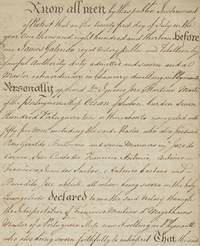
1813List1947Plymouth 1813. Plymouth Devon England: 21st July 1813. Folio 7 pages 13 1/8 x 8 ¼ inches duty blindstamp small ink stamp to upper inner margin of the first page two seals to the last page signed twice by Galindo. Toned some small repaired tears using reversible archival ph-neutral paper-repair tape very good to near fine. Very Good. An interesting document of privateering in the Peninsular war this ‘Public Instrument of Protest‘ documents a Portuguese captain and crew complaint in detail to an English notary. After sailing from Calcutta to Brazil and then from Rio to just outside of Lisbon their ship the 700-ton ‘Oceano’ was seized and comprehensively ransacked by a French privateer the ‘Lion’ out of Lorient. Most of the crew and passengers were offloaded onto a passing American vessel the ‘Leda’ bound for Lisbon. Meanwhile the ‘Lyon’ escorted her prize towards the nearest French port but before a friendly haven was reached they were both set upon by the brigantine HMS ‘Achates’. The ‘Lyon’ escaped but the ‘Ocean’ was captured by Commander Morrison and the ‘Achetes’. The ’Ocean’ was taken to Plymouth and moored in the Hamoaze. The remaining Portuguese crew who had been forced to remain aboard the ‘Ocean’ by the French got a message to the ‘Ocean’s Master Dn. Ignacio Joze Martins and he and the boatswain made their way to Plymouth as quickly as possible. The sworn statement presented here is in English thanks to the translation given by Francisco Martins d' Magalhaens master of a Portuguese ship “now dwelling in Plymouthâ€<br /> <br /> The ’Oceano’ sailed from Calcutta to Brazil arriving 10th February 1813. She left Rio on 4th April all was plain sailing until the afternoon of the 7th June off the Rock of Lisbon when the ‘Lion’ showed up first under false British colors then French. The fighting was fierce the privateer was driven off once but eventually the ‘Oceano’ was taken. The night of the 7th June was spent by the French ‘conveying everything Moveable and Valuable from the Ocean to the Privateer’. The ‘Leda’ the US vessel landed the majority of the ‘Ocean’s crew including the Master in Lisbon on the evening of the 9th June.Monday 14th June the ‘Lyon’ engaged in a running battle with HMS ‘Achates’ and escaped but the ‘Achates’ did capture the ‘Ocean’. Wednesday 16th June the ‘Ocean’ arrived in Plymouth under the watchful eye of the ‘Achates’. Receiving the crew’s message the Captain of the ‘Ocean’ left Lisbon for Falmouth and then Plymouth arriving on the 20th July. The document was dated 21st July 1813.<br /> <br /> Full transcription available. unknown
1818127276London: J. M. Richardson 1818. One of the outstanding exponents of the theory of international trade in the nineteenth century First separate edition of this anonymous tract originally published in The Pamphleteer Volume XII number 23. Arnold Plant declared that "the anonymous author of this tract should take his place with Ricardo J. S. Mill Longfield Mangoldt and Edgeworth as one of the outstanding exponents of the theory of international trade in the nineteenth century. His use of algebraic symbols in setting out the ratios between the quantities of commodities his method of ascertaining from these ratios which of a number of commodities can be most advantageously exported and imported his demonstration that the ratios used may be either those of quantities of different commodities within the same countries or of the same commodities in different countries will bear comparison with for instance Professor Viner's own lucid exposition well over a century later" Plant introduction to 1933 reprinting pp. 40-41. Although the tract was reprinted in the Pamphleteer in the same year it has otherwise left little trace. Octavo 197 x 120 mm. Recent quarter cloth paper label to spine marbled paper sides. Light marking to cloth some very faint scattered foxing else an excellent copy. See Goldsmiths' 22070 for The Pamphleteer. hardcover
183924051S. l. Santander: Imp. de Martinez 1839.- 8 h.; 8º mayor 21 cm.; fuerte y clara impresión; Cubiertas en papel de aguas de la época.- Perfecto estado MUY RARO. POLÃTICA ESPAÑOLA DESDE 1833 A 1936 Libro en español Imp. de Martinez paperback
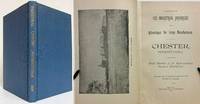
188917253Chester Pennsylvania: Board of Trade. Very Good. 1889. First Edition. Hardcover. Clean blue cloth with gilt title on spine. Pictorial frontispiece. Engraved illustrations of locations and portraits. Two small mended bottom edge tears that do not interfere with text. Text Is tight clean and intact. Located on the west bank of the Delaware River. 99 pages including 31pages of advertisements. Pennsylvania ; 8vo 8" - 9" ; 99 pages . Board of Trade hardcover
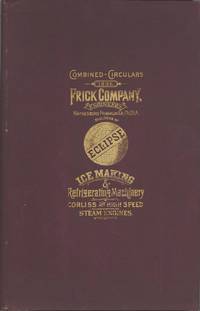
18956891Waynesboro Franklin Co. Pennsylvania: Frick Company Engineers 1895. Octavo 24 x 15 cm. 201 15 pages. Index. Profusely illustrated with engravings and diagrams. FIRST EDITION thus of this trade catalogue for the Frick Company of Franklin County Pa. focused on their line of heavy machinery in refrigeration applications. Text black generally clean and bright. Head of spine bumped a bit. In publisher’s gilt-stamped burgundy cloth with some rubbing. Generally very good or better. Scarce. OCLC locates no copies; Romaine records two other Frick Co. catalogues. Frick Company, Engineers hardcover
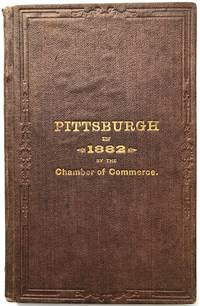
1882H7835Pittsburgh: Wm. G. Johnston 1882. Hardcover. Very Good. 8vo mauve cloth with gilt titles on front cover 164 pp with fine Otto Krebs lithograph 40.5 x 9 inches: Bird's Eye View of Pittsburgh and Allegheny dated 1871. RARE: few original copies in OCLC. Lithograph has one tiny repair to a 2-inch split at one of the folds p. 10 has small stain and abrasion else a very nice clean copy. Wm. G. Johnston hardcover
1879106415<p>Pamphlet 8vo cloth covers gilt title on top cover illustrated 80 pp. Some cover and edge wear center margin tears throughout not affecting text or illustrations by pre drilled hole in pamphlet normal aging and browning; otherwise very good. Somewhat scarce brush catalogue from the 1870s. Whiting started making brushes in the 1850s and by 1868 he had a stand-alone brush business that included other family members. The company expanded a great deal and was considered one of the best brush makers by the 1890s. By the time of John Whiting's death in 1892 it was probably the largest manufacturer in the United States. This attractive little catalogue includes an engraving of the Whiting factory and images of the brushes they made. A complete price list is included. </p>